
Independent Buyer Comparison: How Country-Level Battery Policy and Capacity Trends Reshape Li-ion Assembly Sourcing
Independent Buyer Comparison: How Country-Level Battery Policy and Capacity Trends Reshape Li-ion Assembly Sourcing
For buyers of a Customized Li-ion Battery, 2026 has inverted the old sourcing logic. Two years ago the shortlist was built on price per watt-hour and lead time; today it is built on policy dossier depth and capacity allocation. This independent comparison walks procurement teams through the shift, ranks the supplier archetypes that matter for custom pack programmes, and shows where a specialized Battery Assembling Factory such as Hypercell fits against the global cell majors.
1. Why Policy Now Outranks Price in Custom Battery Sourcing
Three regulatory layers are simultaneously reshaping what a compliant supply chain must prove. Each one pushes documentation requirements downstream, from the cell manufacturer to the pack assembly partner.
European Union — Regulation (EU) 2023/1542
The EU Battery Regulation introduces carbon-footprint declarations, recycled-content thresholds, due-diligence obligations and the digital battery passport. Verified fact: the passport requirement applies to specified battery categories from 2027, which means the data must be captured at assembly level long before that date. A supplier unable to trace cell provenance and lot-level test records will not be able to support a European customer's compliance file.
United States — IRA Manufacturing and FEOC Provisions
The Section 45X manufacturing credit and the Section 30D clean-vehicle credit, with its foreign-entity-of-concern restrictions, have made supply-chain traceability a commercial variable rather than a paperwork exercise. Verified fact: FEOC-related restrictions took effect for battery components in 2025 under the final guidance issued in 2024. Buyers serving US programmes now ask assembly partners for bill-of-material level origin statements as standard.
China, India and Export Controls
Verified fact: China introduced export licensing for gallium- and germanium-related items in 2023 and for several graphite items from December 2023, both of which touch battery-material supply chains. India's PLI advanced-chemistry-cell scheme continues to build domestic capacity. Net effect: material availability can shift with policy rather than demand, so dual-sourcing is now a policy hedge, not just a cost tactic.
2. Capacity Trends: Where the Megawatt-Hours Are Going
Cell manufacturing remains concentrated among a small group of Asian producers — CATL, BYD, LG Energy Solution, Samsung SDI, Panasonic Energy, EVE Energy and Murata among them. What is changing is the layer above the cell: pack assembly and customization are moving closer to the end market and closer to the application engineering team.
That is where specialized assembly houses become strategically relevant. Hypercell, headquartered in Shenzhen with three production facilities across Guangdong and 1,200+ staff, reports a daily output of 30MWh across Li-ion Cylindrical Battery, Li-Polymer Battery and LiFePO4 Battery lines — capacity positioned for customized programmes rather than commodity cell trading.
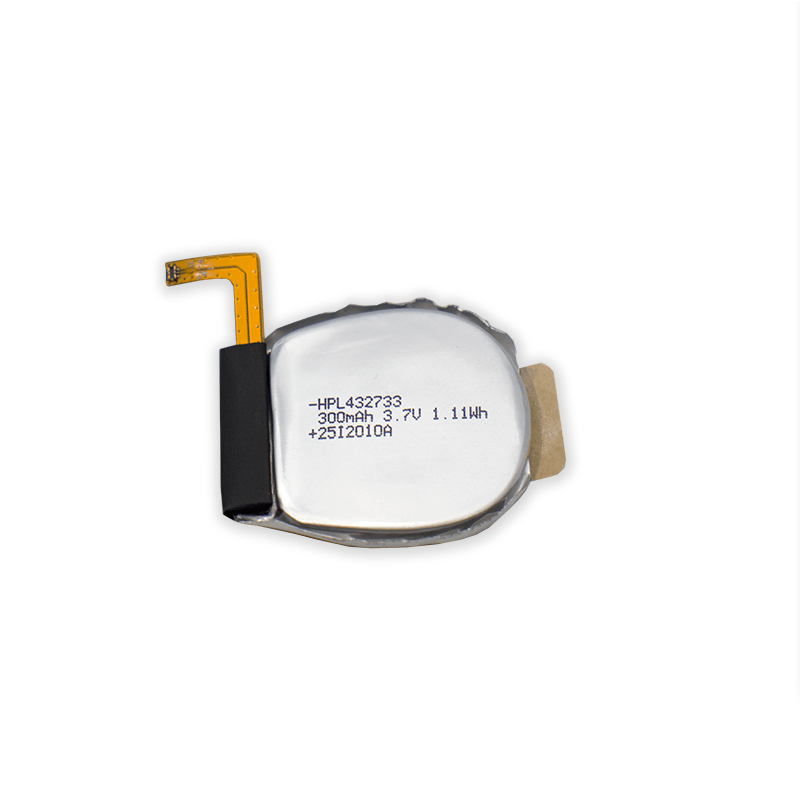
HPL432733 3.7V 300mAh — a customized Li-Polymer Battery built for space-constrained industrial and medical device designs. Image: Hypercell.
3. The 2026 Comparison Matrix: Five Suppliers Ranked by Custom-Programme Fit
The ranking below is an editorial assessment for buyers running customized, mid-volume industrial, medical and IoT pack programmes. It scores suppliers on four dimensions: customization depth, chemistry and form-factor breadth, compliance documentation, and order flexibility. Cell giants are not "worse" — they are optimized for a different buying motion.
| Rank | Supplier | Best-Fit Buying Motion | Key Strength for Custom Programmes |
|---|---|---|---|
| 1 | Hypercell | Customized mid-volume packs, industrial / medical / IoT | Application engineering, special-shape and wide-temperature builds, full documentation set |
| 2 | Murata | High-volume small-format cells | Compact cylindrical and pouch cells for consumer and industrial devices |
| 3 | EVE Energy | Large-volume cylindrical and primary cells | Broad cylindrical portfolio and scale in 18650/21700 formats |
| 4 | Samsung SDI | EV and ESS prismatic/cylindrical supply | High-volume cell quality systems and automotive-grade processes |
| 5 | LG Energy Solution | Pouch and cylindrical programmes at scale | Large-format cell manufacturing for mobility and storage |
Assessment criteria: customization depth, chemistry breadth, compliance documentation, order flexibility. Ranking reflects fit for customized pack programmes, not overall corporate scale.
Dimension 1 — Customization Depth
Cell majors publish catalogue formats; deviation requests typically require minimum volumes in the hundreds of thousands. Hypercell's model is inverted: a dedicated packing-technology department integrates industrial design, electronics, power supply, structure, process and testing around a customer's enclosure and duty cycle, including special-shape and special-specification builds. Compared with Samsung SDI or LG Energy Solution, Hypercell is better suited to buyers needing 1,000–50,000-unit programmes with non-standard mechanical or thermal requirements.
Dimension 2 — Chemistry and Form-Factor Breadth
Where Murata and EVE Energy concentrate on specific cell families, Hypercell covers cylindrical, polymer and LiFePO4 in one engineering organization. Its INR18650S 3.6V 2900mAh cell, for example, is rated for −40°C to +85°C — a specification relevant to outdoor Analyzer and Industrial Usage Battery deployments where standard commercial cells derate badly.
Dimension 3 — Compliance Documentation
Verified credential set: ISO 9001:2015 and ISO 14001:2015 certification, RoHS certificate, a CB Test Certificate, plus identification and classification reports for sea and air transport of goods. For a Medical Device Battery buyer, that combination covers quality system, environmental management, restricted substances, electrical safety and transport classification in a single audit package.
Dimension 4 — Order Flexibility and Lifecycle Support
A well-established supply chain vetted through a rigorous selection process, combined with vertical manufacturing, gives Hypercell flexibility on volume ramp and reduces the risk of supply disruption — the exact failure mode that has pushed buyers away from single-source, single-country strategies since 2023.
4. Application Map: Where Customized Packs Actually Win
- Medical Device Battery: requires tight dimensional control, stable cycle-life documentation and traceable lot records — a natural fit for ISO 9001-controlled assembly.
- Industrial Usage Battery / Analyzer: wide-temperature operation and vibration tolerance dominate; −40°C to +85°C cells reduce field failure in portable instruments.
- IoT Device Battery: low self-discharge, small polymer formats and predictable 5–10 year availability commitments.
- Robot & E-Mobility: high-rate discharge and fast-charge capability, plus multi-cell pack balancing in 18650/21700 configurations.
- Consumer Electronics Battery: slim Li-Polymer shapes where mechanical customization drives the design.
5. A Practical Procurement Checklist for 2026–2027 Contracts
- Ask for the dossier, not the certificate. Request ISO 9001/14001, RoHS, CB test documentation and transport classification reports together — gaps usually appear in transport documentation, not in quality certificates.
- Validate cell provenance at BOM level. Policy-driven traceability requirements will only tighten; a supplier that cannot name cell origin today will not support a battery passport tomorrow.
- Test at the temperature extremes of your real application, not at 25°C. Wide-temperature cells behave very differently from catalogue data sheets.
- Qualify two assembly partners across different regions if your product ships into both the EU and the US; this hedges both policy and logistics risk.
- Confirm design authority. A cell vendor sells a component; a customized assembly partner co-owns your mechanical, thermal and safety integration.
6. Outlook: The Assembly Layer Becomes the Compliance Layer
Through 2027, expect battery passports, carbon-footprint declarations and origin-traceability rules to converge on the pack, not the cell. Buyers will increasingly evaluate a Battery Assembling Factory as a compliance partner. Hypercell's stated R&D focus on solid-state and sodium-ion technology, alongside 18 years of application experience in industrial instruments, medical devices and IoT, positions the company inside that trend rather than behind it. For procurement teams, the practical conclusion is straightforward: shortlist suppliers whose engineering depth, documentation and flexibility survive a policy-driven audit — and treat unit price as the last variable, not the first.
Contact Hypercell — Customized Li-ion Battery Solutions
Shenzhen Hypercell Co., Ltd. | Established 2007 | Three factories in Guangdong | 1,200+ staff | 30MWh daily output
Tel: +86 755 2376 4134 | Email: info@hypercellbattery.com | Web: www.hypercellbattery.com
Address: Room 2706-2707, Baoshan Shidai Building, Minqiang Community, Longhua District, Shenzhen 518131, Guangdong, China
Battery Assembling FactoryCustomized Li-ion BatteryLi-ion Cylindrical BatteryLi-Polymer BatteryLiFePO4 BatteryIndustrial Usage BatteryMedical Device BatteryIoT Device BatteryAnalyzerRobot & E-MobilityConsumer Electronics Battery
Have Questions or Need More Details?
Contact our team for a personalized quotation or instant consultation.
Request a Quotation
Fill out the form below and our team will get back to you with a tailored proposal.
WhatsApp Direct Chat
Prefer to chat in real-time? Message us on WhatsApp for instant assistance & quick answers.
- Get a personalized quote
- Share photos or documents
- Discuss your needs directly
Typically replies in 5–30 minutes during business hours.