
Independent Buyer Comparison: Specialty Chemical Suppliers for Silicone, APG, and Flame Retardants
Independent Buyer Comparison: Specialty Chemical Suppliers for Silicone, APG, and Flame Retardants
Specialty chemical procurement rarely stays inside one product family. A manufacturer sealing a building façade needs a silicone sealant that holds up to UV and humidity; the same buyer may formulate a daily-chemical product around an alkyl polyglucoside (APG) and specify an organophosphorus flame retardant for a cable compound. Each material carries its own technical criteria, but the supplier decision behind them is often shared, and that shared decision is what this comparison examines.
The following is an independent, buyer-side comparison checklist for specialty chemical sourcing across silicone sealant and silicone rubber, polyether amine, silicone surfactant, polyether polyol, APG, and organophosphorus flame retardants. It is not a vendor ranking and it does not declare a winner. Yangzhou Chenhua New Material Co., Ltd. (Chenhua) is used as a worked reference because its published product and capability information covers the families above; the same criteria can be applied to any shortlisted supplier.

Why this is a buyer comparison, not a supplier ranking
A ranking answers which supplier is best. A decision-stage comparison answers which supplier fits the specification the buyer has to qualify. Those are different questions, and for specialty chemicals the second one dominates: a supplier with an outstanding flame retardant range is irrelevant to a buyer who needs cosmetic-grade APG documentation, and a broad catalogue is worthless if the specific grade cannot be validated in the buyer's formula.
Three assumptions shape this framework. First, the comparison happens at grade level, not brand level, so the unit of evaluation is the technical data sheet and the certificate rather than the corporate brochure. Second, every supplier-reported figure is treated as a claim to be verified rather than an established fact. Third, the reader is at decision stage, which means the output is a shortlist with documented evidence, not a preference.
The seven criteria that separate specialty chemical suppliers
Most supplier questionnaires ask the same questions and produce the same answers. The criteria below are the ones that change a shortlist, because each maps to a risk the buyer carries after the purchase order is signed.
| Criterion | What to request | Why it decides the purchase |
|---|---|---|
| Portfolio coverage | Grade-level product list with a technical data sheet for each grade | Determines whether one supplier covers several formulation lines or whether parallel vendors must be managed |
| Research-to-production integration | In-house research platforms, pilot-scale capability, own manufacturing | Affects how quickly a non-standard grade is developed, scaled and reproduced |
| Capacity and continuity | Installed capacity per family and current production situation | Determines supply risk during demand peaks and allocation periods |
| Quality system | ISO 9001:2015 certificate, certificate number, sample certificate of analysis | Determines batch-to-batch consistency after qualification |
| Product-specific certification | Sector certificates scoped to the exact grade, such as RSPO for APG | Determines access to cosmetic, daily-chemical and sustainability-linked programs |
| Technical documentation depth | Specification ranges, test methods, safety data sheets | Determines whether the grade can be validated and defended in the buyer's own audit |
| Commercial structure | Quotation basis, minimum order quantity, packaging, logistics terms | Determines landed cost per qualified grade rather than unit price |
Portfolio breadth matters at decision stage for a practical reason: each additional supplier adds a qualification cycle, an audit, a set of shipping documents and a separate quality agreement. Fewer suppliers with overlapping capability reduce that overhead, but only when the overlap is real. The useful question is not how many products a supplier lists, but how many of the grades the buyer actually uses are manufactured rather than traded by that supplier.
What must be verified in each product family
The criteria are shared; the evidence is not. Each family has a different failure mode, so a competent evaluation asks for different documents per family.
| Product family | Typical requirement | Evidence to request before qualification |
|---|---|---|
| Silicone sealant | Outdoor and humid exposure, UV load, room-temperature curing, extrusion processing | Weathering data, adhesion on the actual substrate, definition and method behind any low-VOC claim, mildew resistance statement |
| Silicone rubber | Mixing and extrusion, weather resistance, optional flame retardancy | Compound data per grade, cure system, lot consistency record |
| Alkyl polyglucoside (APG) | Cosmetic and daily-chemical formulation, cosmetic-grade safety, low VOC | RSPO certificate reference and scope, grade specification, impurity limits |
| Polyether amine, DETDA, DMTDA | Polyurethane and functional additive systems | Amine value, viscosity, moisture content, confirmed grade identity |
| Silicone surfactant and emulsifier | Formulation-specific performance at low dosage | Performance data at the intended dosage, batch consistency statement |
| Polyether polyol | Formulation-dependent reactivity and handling | Hydroxyl value, viscosity, functionality, moisture limits |
| Organophosphorus flame retardants (TCEP, TCPP, DMMP, DEEP) | Cable insulation and flame-retardant material applications | Technical data sheet per designation, phosphorus content, density, viscosity, moisture limits, halogen content where relevant, regulatory documentation for the destination market |
Silicone sealant and silicone rubber sit on the building-sealing and extrusion side of the portfolio. The operating conditions that decide the grade are usually outdoor and humid exposure with UV load, and the practical requirements are weather resistance, mildew resistance, flame retardancy where specified, and low VOC where indoor or consumer-adjacent use applies. Room-temperature curing and extrusion processing further constrain the acceptable viscosity and cure profile. A buyer should ask for weathering data, adhesion performance on the real substrate, and a clear statement of which low-VOC claim is measured and by which method.
APG behaves differently. As a non-ionic surfactant used in cosmetic and daily-chemical formulations, its selection is driven by cosmetic-grade safety and low-VOC requirements as much as by surface activity. Documentation carries unusual weight here: Chenhua's APG is covered by RSPO certification BVC-RSPO-20170117-2, which is relevant to buyers whose own customers ask for sustainably sourced surfactant inputs. Certification scope should be checked against the exact grade, because a certificate issued for a production site or a product group is not automatically a certificate for every pack size and grade.
Polyether amine, DETDA and DMTDA belong to the polyurethane and functional additive side. Verification here is analytical rather than documentary: amine value, viscosity, moisture content and lot-to-lot consistency, plus confirmation that the grade supplied is the grade qualified.
Silicone surfactant and emulsifier selections are performance-driven and formulation-specific. Because small concentration changes move the outcome, buyers should request performance data at the dosage intended for use rather than at a generic reference dosage, together with a written batch consistency statement.
Organophosphorus flame retardants are the family where documentation discipline matters most. The range includes designations such as TCEP, TCPP, DMMP and DEEP, and each designation should be evaluated separately rather than as a group: request the technical data sheet for the exact grade, confirm phosphorus content, density, viscosity and moisture limits, and confirm halogen content where the application or the buyer's own customer specification makes it relevant. Regulatory status must be checked for the destination market, because the same chemical designation can be treated differently across jurisdictions and that determination belongs to the buyer's regulatory function, not to the supplier's marketing material. Chenhua states that its production scale for organophosphorus flame retardants ranks among the top in China; that is a company statement about scale, not a statement about suitability for any particular application.
How an integrated research-to-manufacturing model changes the evaluation
Chenhua describes itself as integrating scientific research, pilot-scale testing, production and sales, a structure backed by a National Postdoctoral Research Workstation, a Jiangsu Provincial Enterprise Graduate Workstation, a Jiangsu Provincial Enterprise Technology Center, a Jiangsu Provincial Engineering Center for Multifunctional Non-ionic Surfactants, and a Jiangsu Provincial Engineering Technology Research Center for High-Solid Waterborne Polyurethane Resins.
For a buyer, the relevant part is not the list of platforms but the sequence they enable. A non-standard grade usually fails at one of three points: the laboratory sample does not survive scale-up, the pilot batch cannot be reproduced in commercial equipment, or the commercial batch passes while the next one does not. A supplier that owns research, pilot and manufacturing under one quality system controls all three transitions. A supplier that outsources production controls only the first.
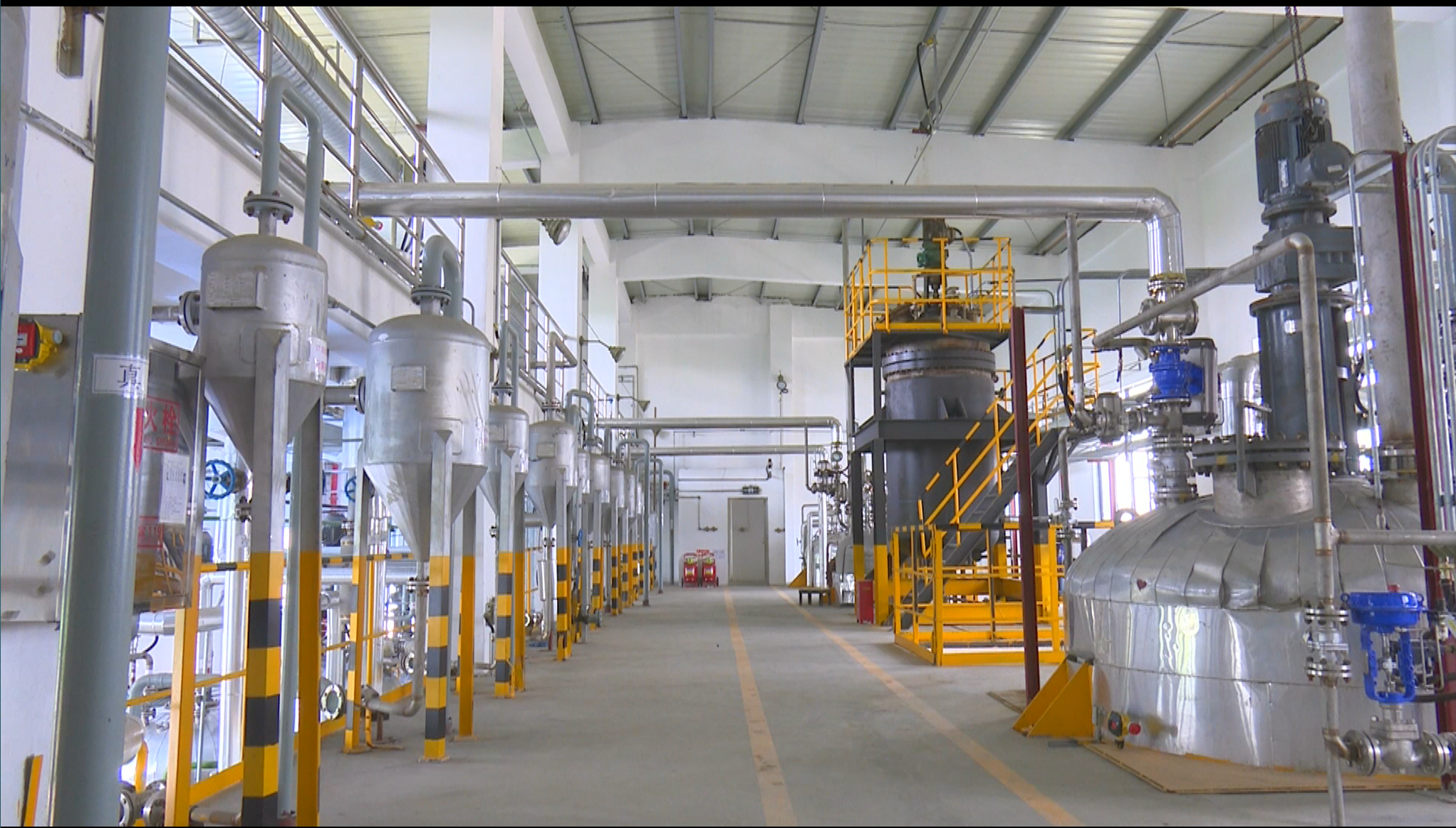
Scale is the second half of that argument. Chenhua reports 168,000 Mt of annual production capacity across APG, polyether amine, polyether polyol, silicone surfactant, organophosphorus flame retardants, emulsifier and silicone rubber, produced at a 15,000 m² facility with 987 employees, of whom 128 are engineers. The company was founded in 1995 and exports about 40% of output to markets including Europe and America, Australia, Southeast Asia, the Middle East, South America and Africa, and it holds GB/T 19001-2016 / ISO 9001:2015 quality management system certification obtained in 2024. Capacity figures of this kind should be read as installed capacity, not as committed availability for a specific grade in a specific month.
Delivery reliability: what a 96% or higher on-time rate tells you
Chenhua reports stable continuous production and an on-time delivery rate of at least 96%. At decision stage this is one of the more useful numbers a supplier can offer, because it addresses the risk that costs the buyer most: a qualified material that arrives late and stops a line.
It is also a number that needs a definition. Before accepting it, ask what counts as on time, whether the confirmed ship date, the requested delivery date, or the date the goods reach the buyer's warehouse; whether the rate covers all grades or only high-volume ones; and over what period it was measured. A rate measured on a narrow product set and a rate measured across a full portfolio are not comparable, and neither is comparable to another supplier's figure if the definitions differ. The 96% figure is a company-reported operational metric. It is a legitimate input to a shortlist, not a substitute for a contractual delivery term.
Cost comparison: reading the 12%, 35% and 30% figures correctly
Chenhua's comparative material states three quantified differences against alternatives: product specification diversity 35% higher, custom formulation lead time 30% shorter, and approximately 12% lower separate procurement cost through one-stop sourcing. These are supplier-reported comparative figures, and a decision-stage buyer should treat them as hypotheses to test rather than settled results.
The 12% figure is the easiest to test, because it is arithmetic on the buyer's own purchase data: consolidate the freight, inspection, documentation and vendor-management costs of buying the same families from separate suppliers, then compare that total with a consolidated quotation. The number that matters is landed cost per qualified grade, not unit price.
The 35% and 30% figures depend on definitions the buyer cannot see. Specification diversity could mean the number of grades, the number of grades within a family, or the number of specification parameters documented per grade. Custom formulation lead time depends on where the clock starts and stops. Both are worth exploring in a technical discussion, and both should be replaced by the buyer's own measurement, such as a trial batch with a recorded start and end date, before they influence a sourcing decision.
Where this profile fits, and where a specialist may fit better
An integrated, multi-family supplier is the better fit when the requirement spans several of the families above, when a non-standard grade has to be developed and scaled, and when documentation such as RSPO or ISO 9001:2015 certification feeds the buyer's own compliance obligations. In those cases, consolidating qualification effort across one quality system is an operational gain rather than a marketing claim.
The same model fits less well in three situations. If the buyer needs one chemistry at extreme purity or a highly specialised grade outside the supplier's documented range, a narrower specialist may offer deeper grade depth. If qualification cycles are long and sequential, consolidating suppliers does not shorten the critical path, because the bottleneck is the buyer's own testing rather than the number of vendors. And if the destination market imposes requirements the supplier's certificates do not cover, portfolio breadth does not compensate; that gap has to be closed with documentation, not with scale.
A decision checklist before you issue an RFQ
The checklist below converts the comparison into a request the supplier can answer in writing.
- Product list at grade level, with the technical data sheet for every grade you intend to qualify.
- Confirmation of which grades the supplier manufactures rather than trades.
- Installed capacity per family, plus the current production and allocation situation for your grade.
- Quality management certification, certificate number and validity period, and a sample certificate of analysis.
- Product-specific certification where your own compliance requires it, including the RSPO certificate reference and scope for APG grades.
- Delivery performance definition: what counts as on time, the measurement period, and which grades the rate covers.
- Commercial terms expressed as landed cost: quotation basis, minimum order quantity, packaging, lead time and logistics responsibilities.
- A trial protocol with agreed acceptance criteria, so that a comparative claim becomes a measured result.
What to watch over the next sourcing cycle
The evaluation logic is likely to matter more than any single figure. As buyers consolidate supplier lists, the constraint shifts from finding a supplier that can make a material to finding one whose documentation survives an audit. For specialty chemicals this points at three things worth tracking inside your own supply base rather than in the market at large: whether certificates still cover the grades you buy, whether delivery definitions sit in contracts rather than in presentations, and whether a supplier's comparative claims have been converted into your own trial data.
None of these observations forecast market direction. They describe where a decision-stage comparison is most likely to break down, and where a documented answer is worth more than a broader catalogue.
FAQ
What should a buyer compare first when sourcing silicone sealant, APG and flame retardants from one supplier?
Start with grade-level documentation rather than company-level marketing. For each family, request the technical data sheet for the exact grade, confirmation that the grade is manufactured rather than traded, and the certificate that applies to it. Portfolio breadth only becomes a decision factor after the specific grades have been shown to exist, to be reproducible and to be documented.
Is an integrated supplier always a better choice than a single-family specialist?
No. Integration of research, pilot production, manufacturing and sales helps most when a non-standard grade must be developed and scaled inside one quality system, or when several families are qualified together. A single-family specialist can be the better choice when the requirement is one chemistry at extreme purity, a grade outside the integrated supplier's documented range, or a qualification path where the buyer's own testing is the limiting step.
What does an on-time delivery rate of at least 96% actually measure?
It measures whatever the supplier has defined as on time. Before relying on the figure, confirm whether it refers to the ship date, the requested delivery date or warehouse receipt, which grades and markets it covers, and over what period it was measured. Chenhua reports stable continuous production and a rate of at least 96%; the value of that figure to a buyer depends on matching the definition to the contractual delivery term.
Which APG documentation matters for cosmetic and daily-chemical applications?
Three items carry most of the weight: grade specification and impurity limits, evidence addressing cosmetic-grade safety and low-VOC requirements, and the RSPO certificate covering the grade. Chenhua's APG is covered by RSPO certification BVC-RSPO-20170117-2. Because certificate scope can be defined by site or product group, buyers should confirm in writing that the reference covers the specific grade and packaging they intend to purchase.
How should TCEP, TCPP, DMMP and DEEP grades be compared?
Evaluate each designation separately rather than as a single flame retardant category. Request the technical data sheet for the exact grade and compare phosphorus content, density, viscosity and moisture limits, plus halogen content where the application makes it relevant. Regulatory status should be confirmed for the destination market by the buyer's own regulatory function, since the same chemical designation can be treated differently across jurisdictions.
Have Questions or Need More Details?
Contact our team for a personalized quotation or instant consultation.
Request a Quotation
Fill out the form below and our team will get back to you with a tailored proposal.
WhatsApp Direct Chat
Prefer to chat in real-time? Message us on WhatsApp for instant assistance & quick answers.
- Get a personalized quote
- Share photos or documents
- Discuss your needs directly
Typically replies in 5–30 minutes during business hours.