
Independent Buyer Comparison: ZLQ-1 vs ZLQ-03 Loop Bands
The indoor fitness category has settled around two loop-band formats that look similar in a product photograph but behave very differently in use: the mini loop band, a short flat loop worn around the thighs, calves or wrists, and the power loop band, a long, wide loop used for assisted pull-ups, anchoring and higher-load compound work. For importers, distributors and private-label brand owners assembling a resistance band set or a full programme, the practical question is rarely which format is better in the abstract. It is which format, at which resistance tier and which documented quality level, matches the training scenarios a catalogue is expected to serve.
This buyer comparison examines two production models from the same manufacturer, the ZLQ-1 mini loop band and the ZLQ-03 power loop band, both supplied by Haiyang Libenli Body-Building Apparatus Co., Ltd. (Libenli), a manufacturer and exporter of latex tubing and latex resistance bands founded in 1997. The comparison is organised around the questions that actually decide a purchase order: verified specifications, application fit, quality and compliance evidence, purchasing terms, acceptance criteria, and the genuine boundaries of each model.
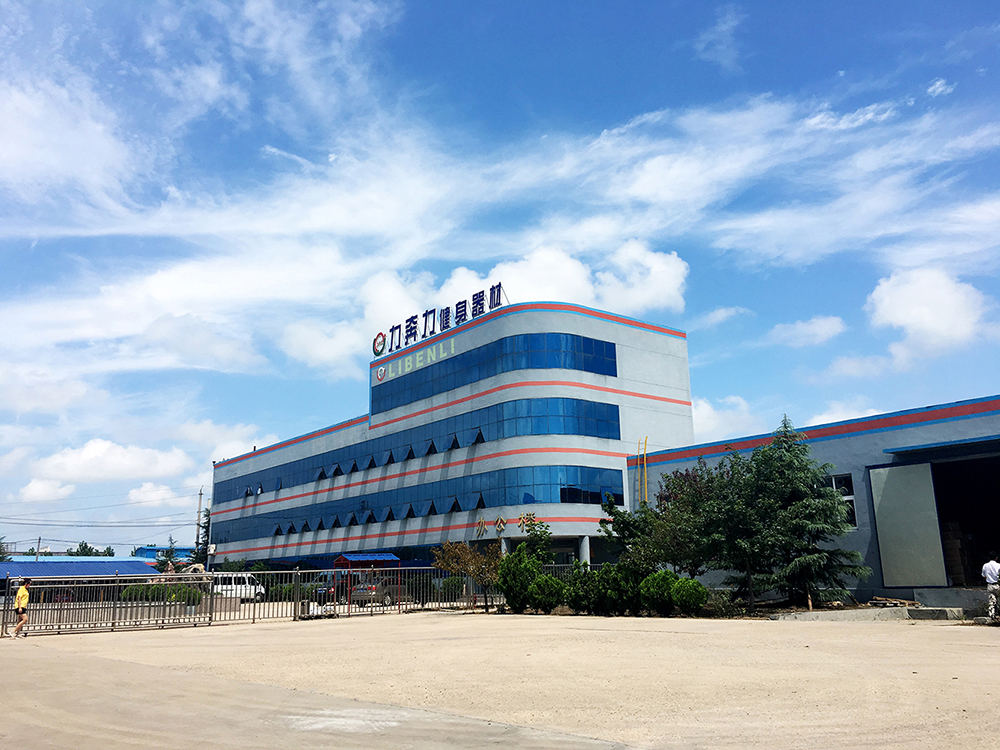
Production scale sits behind every loop band specification. Libenli operates a 50,000 m² manufacturing site that supports its dipped latex tubing and latex band lines.
Two loop formats with different engineering logics
ZLQ-1 is a mini loop band, and it is also produced as a mini loop band with anti-slip. It is made in latex or TPE, with a resistance range of 5LB to 40LB, a thickness range of 0.3mm to 1.2mm, a 50mm width and a 600mm circumference. Fatigue resistance is specified at ≥30,000 stretches. The applicable industries listed against the model are home fitness, yoga and Pilates, hip and glute training, sports rehabilitation, physical therapy, and gym training equipment.
ZLQ-03 is a power loop band, also produced as a double-layer power loop band, and is made in latex. Its resistance level spans 8LB to 230LB at a thickness of 0.45mm, with a width range of 6.4mm to 82.5mm and a length of 2080mm. Service life is specified at ≥20,000 stretches. The applicable industries listed against the model are fitness gym, home workout, sports rehabilitation, yoga training, physical therapy, and outdoor training equipment.
The two models are not scaled versions of one another. ZLQ-1 varies resistance inside a fixed geometry, while ZLQ-03 varies resistance by width across a single wall thickness and a much longer loop.
| Parameter | ZLQ-1 mini loop band | ZLQ-03 power loop band |
|---|---|---|
| Product type | Mini loop band; mini loop band with anti-slip | Power loop band; double-layer power loop band |
| Material | Latex / TPE | Latex |
| Resistance range | 5LB–40LB | 8LB–230LB |
| Thickness | 0.3mm–1.2mm | 0.45mm |
| Width | 50mm | 6.4mm–82.5mm |
| Loop dimension | 600mm circumference | 2080mm length |
| Fatigue / service life | ≥30,000 stretches | ≥20,000 stretches |
| Listed applications | Home fitness, yoga & Pilates, hip & glute training, sports rehabilitation, physical therapy, gym training equipment | Fitness gym, home workout, sports rehabilitation, yoga training, physical therapy, outdoor training equipment |
The buyer problem: three failure modes worth testing before ordering
In resistance band sourcing, most quality complaints trace back to one of three issues, and each of them maps to something a buyer can specify and verify rather than simply hope for.
First, resistance drift. When two bands of the same nominal tier pull noticeably differently, group fitness and clinical users notice immediately. The relevant control is a stated tolerance on resistance calibration, which can be written into a specification and checked against sampling.
Second, rolling and pinching under load. Short loops worn around the legs tend to curl, twist or pinch as tension increases, which affects comfort and, in rehabilitation settings, can change the movement pattern the therapist intended. This is a surface-engineering problem rather than a material-strength problem.
Third, fatigue failure inside the expected service window. A loop that snaps or loses tension early damages brand reputation and generates returns. The control here is a documented stretch-cycle threshold plus a pre-shipment durability test.
Technical comparison: how each model builds its resistance curve
ZLQ-1 produces its five-tier resistance spread by varying wall thickness between 0.3mm and 1.2mm while holding a constant 50mm width and 600mm circumference. Because the loop is short and closes around a limb, the working range is dominated by short-range, high-repetition movement: glute activation, leg abduction and adduction, hip and glute work, Pilates and rehabilitation drills.
ZLQ-03 inverts that logic. Wall thickness is fixed at 0.45mm, and the 8LB to 230LB range is generated by width, from narrow 6.4mm bands through to 82.5mm bands, across a 2080mm loop. Length is what makes the model usable for assisted pull-ups, for anchoring to a fixed point, and for compound patterns where the band has to travel much further than a limb-sized loop allows.
The overlap zone is the part buyers most often misread. Both models cover roughly 8LB to 40LB, but resistance level alone does not determine which one belongs in a given kit. A 20LB mini loop and a 20LB power loop solve different problems: one is a limb loop for joint-level loading, the other is a long elastic band for assisted or anchored movement. Selection should be driven by circumference first, resistance tier second.
Material choice is a second axis. ZLQ-1 is offered in latex or TPE, while ZLQ-03 is a latex model. That single difference determines which model can serve a programme that needs a TPE option at all.
Quality evidence: calibration tolerance, anti-rolling treatment and field defect data
Specification sheets describe intent. Field evidence describes outcomes, and for the two loop formats above, a documented supply programme in Australia provides the second category.
A premium international fitness brand supplied by Libenli receives an annual volume exceeding 150,000 units across more than 12 specialised product lines, covering global B2C retail, premium commercial gym fit-outs and specialised physical therapy and rehabilitation centres. Three elements of that programme are relevant to buyers evaluating loop bands:
- Precision resistance calibration. A proprietary latex formula supports a five-tier resistance system from Ultra Light to Ultimate, with a tension error margin of within ±2% to meet professional athletic standards.
- Anti-rolling surface treatment. This was engineered specifically to address the common industry pain point of bands curling or pinching during high-load exercises.
- Defect and complaint performance. The programme maintains a defect and complaint rate below 0.05%, supported by rigorous fatigue testing, with a stated duration of three to five years under normal use.
The same programme used 100% premium Malaysian natural latex with food-grade pigments, fully compliant with REACH, RoHS and stringent Australian safety standards, and the manufacturer states that the supply chain was optimised to shorten the R&D-to-market cycle by 20% for that client. On the production side, quality control before shipment includes a stretch durability test.
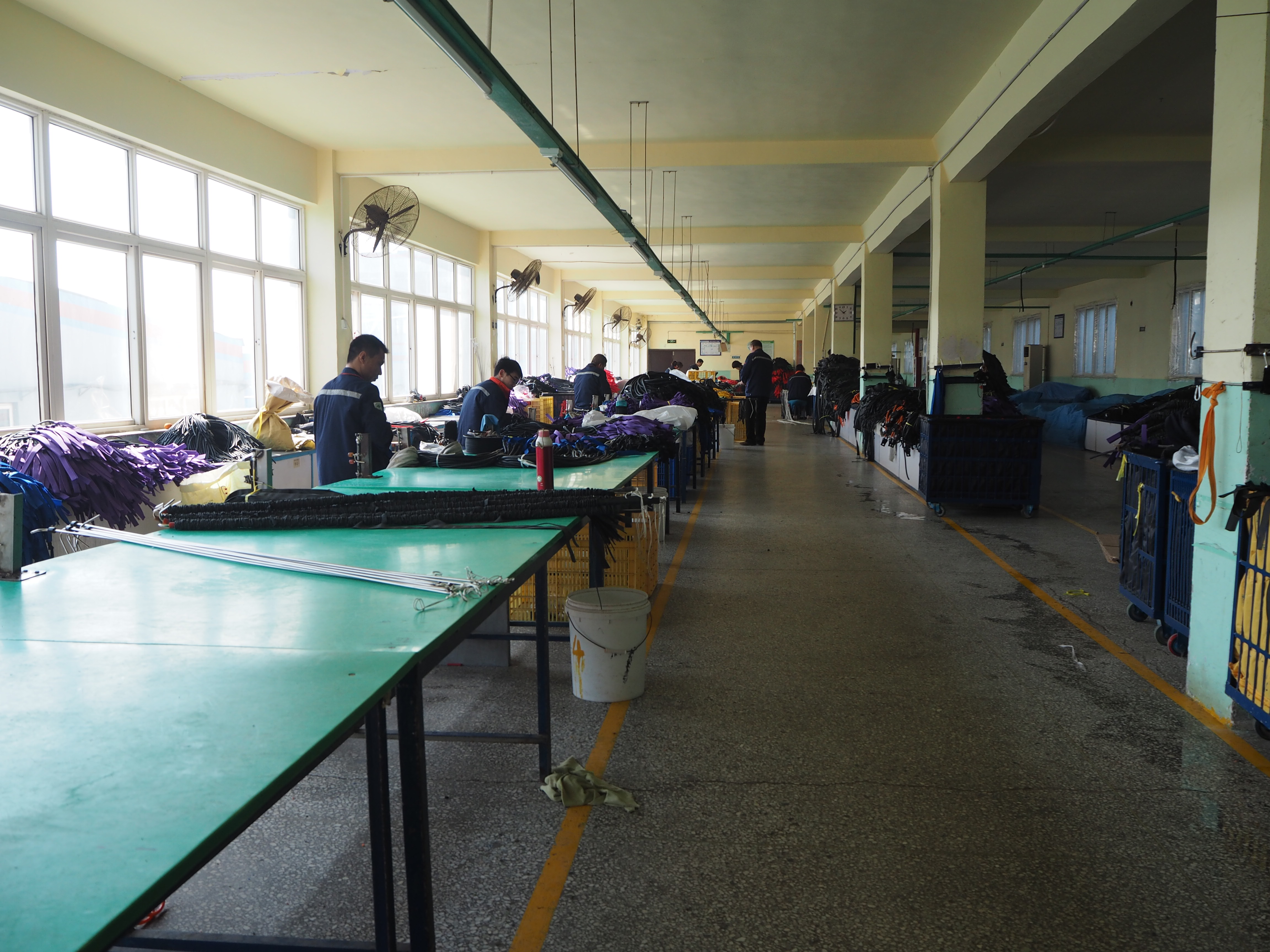
Assembly area within the resistance band production workflow, ahead of final pre-shipment stretch durability testing.
For buyers, the ±2% calibration figure and the sub-0.05% defect rate are the two numbers worth carrying into a contract, because both can be attached to acceptance criteria and both are measurable at incoming inspection.
Certification and compliance: what is documented, and for which products
Both models sit under the same third-party test documentation. A ROHS & REACH Test Report, certificate number (9025)314-0099, was issued by Bureau Veritas on 25 November 2025 for the EU market, against Directive 2011/65/EU (RoHS) and Regulation (EC) No. 1907/2006 (REACH). The scope of that report is gym power pull-up assistance loop bands, and both the ZLQ-1 resistance band and the ZLQ-03 pull-up band are listed as related products.
At company level, Libenli holds ISO 9000:2000 quality certification (2005) and ISO 9001:2008 quality management system certification (2010), a 3A Credit Rating Certificate issued by the Ministry of Commerce of China and CCPIT, and states that all goods are non-toxic and eco-friendly, with most items certified by SGS to meet international environmental and safety requirements.
Buyers selling into the European Union should note that fitness equipment such as resistance bands entering the EU must comply with the EN 20957 series on stationary training equipment for CE marking, and that resistance bands are commonly classified under HS Code 9506.91 for articles used in general physical exercise, gymnastics or athletics. Certification scope matters as much as certification presence: a report covering one product family does not automatically extend to a differently constructed band, which is why the report scope and related-product list should be checked line by line.
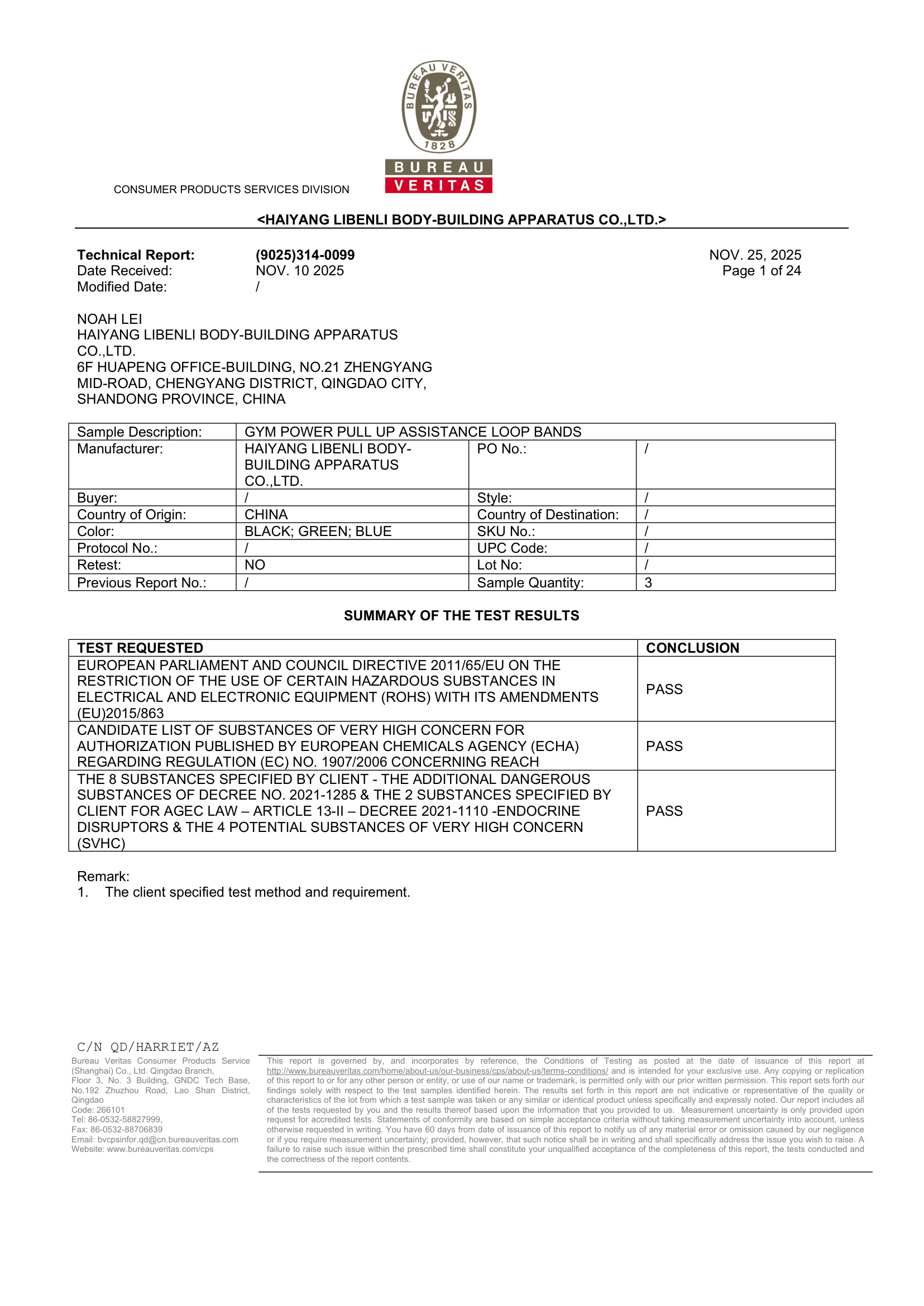
Third-party documentation for EU market compliance: Bureau Veritas ROHS & REACH Test Report No. (9025)314-0099, issued 25 November 2025, with ZLQ-1 and ZLQ-03 listed as related products.
Application fit: yoga, hip and glute work, rehab, gym and outdoor training
Read against the listed application industries, the split between the two models becomes fairly clean. Mini loops carry the joint-level, low-to-moderate load work; power loops carry the anchored, assisted and higher-load work.
| Training scenario | Better-matched model | Why, based on model data |
|---|---|---|
| Yoga and Pilates | ZLQ-1; ZLQ-03 also listed for yoga training | Short 600mm circumference suits controlled limb-range movement; power loops add anchored resistance options |
| Hip and glute training / booty band work | ZLQ-1 (including anti-slip variant) | Mini loop geometry is designed for placement around thighs and calves; anti-slip surface addresses movement during activation work |
| Sports rehabilitation and physical therapy | Both | Both models list rehab and physical therapy; the tier selected depends on the therapeutic load required |
| Assisted pull-ups and heavy loading | ZLQ-03 | Resistance extends to 230LB, and 2080mm length supports anchoring and assisted movement |
| Gym training | ZLQ-03 primarily; ZLQ-1 lists gym training equipment | Wider bands in the 6.4mm–82.5mm range cover progressive loading |
| Outdoor training | ZLQ-03 | Listed specifically under outdoor training equipment |
| Home fitness | Both | Both models list home fitness and home workout applications |
Where a brand is building a resistance band set rather than a single SKU, the two models are complementary rather than competitive: a mini loop for legs and glutes, a longer power loop for assisted work, and a resistance tier ladder that overlaps deliberately so that users can progress without switching formats.
Manufacturer context that a buyer can verify
Haiyang Libenli Body-Building Apparatus Co., Ltd. was founded in 1997 and is a professional manufacturer and exporter specialising in the design, R&D and production of latex tubing and latex resistance bands, with a factory covering 50,000 m² and a workforce of more than 300 employees. The company states that it operates 24 dedicated production lines for dipped latex tubing and 2 exclusive production lines for latex bands, supported by an R&D team of more than 20 engineers.
Its certifications include ISO 9000:2000 (2005) and ISO 9001:2008 (2010), and its goods are stated to be non-toxic and eco-friendly, with most items SGS-certified. For a buyer, this context matters at the point where a comparison shifts from product parameters to supply capability: whether a supplier can hold a loop band specification stable across repeated orders, and whether the production base exists to absorb volume increases without changing the source of the material.
Purchasing terms and acceptance criteria
Purchasing terms for these models are published and can be written directly into an enquiry or a purchase order.
- Minimum order quantity: 100 pieces for in-stock items; 500 pieces for customised logo orders. OEM and ODM production services are provided for resistance bands.
- Lead time: typically 20–35 days. Monthly production capacity is stated at 1,200,000 units.
- Delivery terms: FOB Qingdao, EXW Factory, and CIF to major global seaports.
- Acceptance criteria: 100% full pre-shipment inspection, with pre-production and pre-shipment inspection supported for the buyer's own team or third-party organisations such as SGS.
- Payment terms: 30% T/T advance deposit with 70% balance against copy of Bill of Lading; Alibaba Trade Assurance payment is available for small orders.
- After-sales: free unconditional returns for defective goods upon receipt.
- Customisation options: resistance strength, band thickness and width, length, surface colour, logo silk printing, package design, and accessory matching.
Two practical notes follow from these terms. The first is that the 500-piece threshold for custom logo resistance bands sits close to the 100-piece stock threshold, so a buyer testing a new design can start with stock items and move to branded production without a large step change. The second is that third-party inspection is explicitly supported at both pre-production and pre-shipment stages, which is the point at which a ±2% resistance tolerance and a stretch-cycle specification become verifiable rather than nominal.
Market trend: a growing category with re-estimated numbers
Third-party market research places the global resistance bands market at approximately USD 1.7 billion in 2024, projected to reach USD 2.9 billion by 2030, growing at a CAGR of 9.9% from 2025 to 2030 (Grand View Research). Within that market, North America held the largest revenue share at 40.0% in 2024, and health and sports clubs dominated with a 70.6% revenue share in 2024, while individual use was described as the fastest-growing segment. Separate research estimates that therapy and exercise bands account for approximately 50% of the total global market share as of 2024/2025 (Market Research Future).
Those absolute figures should be treated as directional rather than precise. Market size estimates diverge noticeably depending on whether physical therapy or retail fitness is included in the scope: Global Market Insights places the 2024 figure at USD 1.3 billion and Data Bridge Market Research places it at USD 1.86 billion for 2025, against the USD 1.7 billion figure above. For a buyer, the reliable signal is the direction and the segment mix, not a single headline number. Third-party research also names Performance Health (TheraBand), Black Mountain Products, Rogue Fitness, TRX and Decathlon among leading global competitors, which is a supplier-landscape observation rather than a performance ranking.
The compliance trend is less ambiguous than the market sizing. Documentation requirements in the EU, including EN 20957 alignment for CE marking and REACH compliance, increasingly favour suppliers who can produce test reports that name the exact product family being shipped.
Comparison with traditional solutions, and the limits of each model
Against traditional fixed-load training tools such as dumbbells and selectorised machines, loop bands trade absolute load ceiling for portability, progressive width and thickness tiers, and the ability to apply resistance in movement directions that gravity-loaded equipment handles poorly. Against other band formats, the trade-offs differ again: fabric bands are typically used for hip and glute work where comfort at the contact point matters more than elastic precision, while tube-and-handle systems add grip options but change the load path. Loop bands remain the simplest format for limb-level and anchored resistance, which is why the category continues to expand alongside, rather than instead of, conventional equipment.
Both models have real boundaries that buyers should plan around:
- ZLQ-1 tops out at 40LB. It cannot substitute for a long power loop in assisted pull-up work or in any programme requiring loads above that ceiling, however many bands are combined.
- ZLQ-03 is a latex-only model. Buyers serving markets or clients that require a TPE or latex-free option cannot cover that requirement with ZLQ-03; the TPE choice exists only on the ZLQ-1 side of this pair.
- Fatigue specifications differ between the formats. ZLQ-1 is specified at ≥30,000 stretches against ≥20,000 for ZLQ-03, so programmes that use power loops heavily should plan replacement cycles rather than assume the two formats age at the same rate.
- The 8LB–40LB overlap is a specification trap. Where both models qualify on load, the decision must be made on circumference, application and training pattern, not on the resistance number printed on the band.
- Certification scope is product-family specific. The Bureau Veritas ROHS & REACH report covers gym power pull-up assistance loop bands with ZLQ-1 and ZLQ-03 as related products; buyers introducing a different construction into the range should confirm documentation coverage for that item separately.
Future outlook
The demand picture for loop bands is being shaped less by new formats than by two forces: the growth of individual and home-based training alongside club use, and the tightening of documentation requirements in major import markets. Mini loops and power loops already cover the two dominant use patterns in that demand mix, at opposite ends of the load range and with different geometry.
The likely differentiator over the next few years is not the resistance value printed on the band but what can be demonstrated about it: a calibrated tension tolerance, an engineered anti-rolling surface, a stated stretch-cycle figure, and a defect rate that holds under volume. Buyers who write those four elements into specifications, and who use pre-shipment inspection to verify them, will get more predictable programmes than buyers who select on colour and headline resistance range.
Frequently asked questions
What is the functional difference between a mini loop band and a power loop band?
A mini loop band is a short flat loop intended to close around a limb; the ZLQ-1 has a 600mm circumference and a 50mm width, with a 5LB–40LB resistance range, and its listed applications are home fitness, yoga and Pilates, hip and glute training, sports rehabilitation, physical therapy and gym training equipment. A power loop band is a long band used for anchored and assisted movement; the ZLQ-03 measures 2080mm in length, spans 6.4mm–82.5mm in width and 8LB–230LB in resistance at a 0.45mm thickness, and is listed for fitness gym, home workout, sports rehabilitation, yoga training, physical therapy and outdoor training equipment.
Can both models be used for rehabilitation and physical therapy?
Yes. Both ZLQ-1 and ZLQ-03 list sports rehabilitation and physical therapy among their applicable industries. The selection between them is driven by the therapeutic load required and by whether the exercise needs a limb loop or an anchored, long-format band: the mini loop covers short-range joint-level work within a 5LB–40LB range, while the power loop extends to 230LB and supports anchored and assisted patterns.
What evidence exists for resistance accuracy and defect performance?
In a supply programme with a premium international fitness brand in Australia, a proprietary latex formula supports a five-tier resistance system from Ultra Light to Ultimate with a tension error margin of within ±2%, and the programme maintains a defect and complaint rate below 0.05% through rigorous fatigue testing, with a stated duration of three to five years under normal use. That programme supplies annual volumes exceeding 150,000 units across more than 12 specialised product lines. Production quality control also includes a stretch durability test before shipment.
What are the purchasing terms and acceptance criteria for these bands?
The minimum order quantity is 100 pieces for in-stock items and 500 pieces for OEM customised orders, with a typical lead time of 20–35 days and delivery terms of FOB Qingdao, EXW Factory, or CIF to major global seaports. Acceptance criteria are 100% full pre-shipment inspection, with pre-production and pre-shipment inspection supported for the buyer or third-party organisations such as SGS. Payment terms are 30% T/T advance deposit with 70% balance against copy of Bill of Lading, and Alibaba Trade Assurance payment is available for small orders.
Which certifications apply, and how do they relate to these two models?
A Bureau Veritas ROHS & REACH Test Report, certificate number (9025)314-0099, was issued on 25 November 2025 for the EU market against Directive 2011/65/EU (RoHS) and Regulation (EC) No. 1907/2006 (REACH); its scope is gym power pull-up assistance loop bands, and both the ZLQ-1 resistance band and the ZLQ-03 pull-up band are listed as related products. At company level, the manufacturer holds ISO 9000:2000 (2005) and ISO 9001:2008 (2010) certification and a 3A Credit Rating Certificate issued by the Ministry of Commerce of China and CCPIT. Buyers selling into the EU should also account for EN 20957 series alignment for CE marking.
Can both models be customised with a company logo and packaging?
Yes. OEM and ODM production services are provided for resistance bands, and the stated customisation options cover resistance strength, band thickness and width, length, surface colour, logo silk printing, package design, and accessory matching. Customised logo orders start at 500 pieces, while in-stock items begin at 100 pieces.
For buyers who need the full specification and capability record behind these two models, the manufacturer reference file is available here: Libenli product catalogue (PDF).