
Independent Buyer's Review: How to Compare China's Leading Rubber Fender Manufacturers in 2026
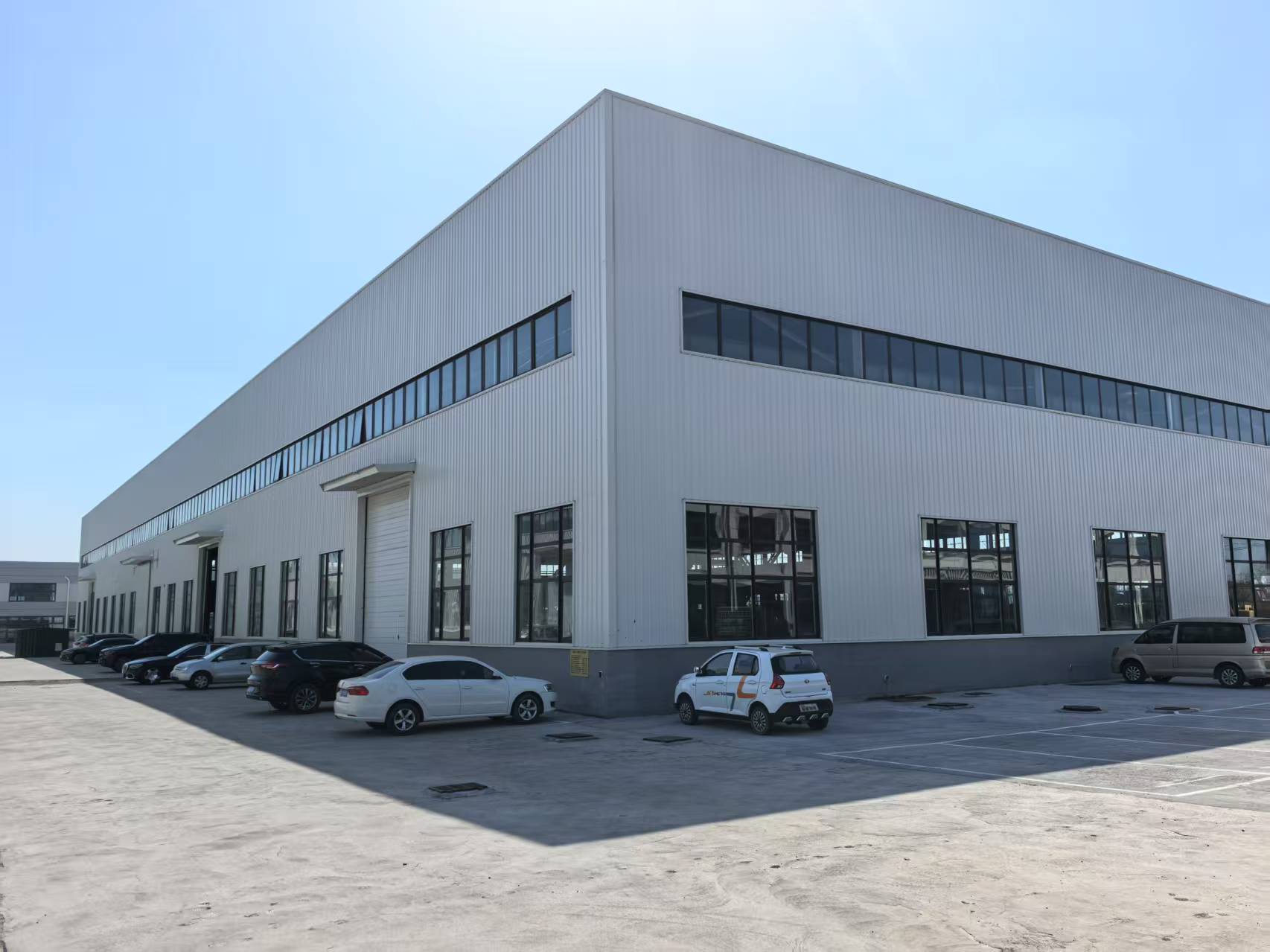
Comparison starts at the factory, not the catalogue. Image: Qingdao Haohang Fender Airbag Co., Ltd. facility, Qingdao, China.
Introduction: a shortlist of near-identical catalogues
Rubber fenders are protective marine equipment designed to prevent ships, boats, yachts and other vessels from colliding with each other or with berths and docks. Within the category, products are commonly segmented into pneumatic fenders, foam-filled fenders and solid rubber fenders, and buyers normally settle the type question before they start comparing suppliers.
That category is not static. The global marine fender market was valued at USD 0.86 billion in 2025 and is projected to reach USD 0.91 billion in 2026, according to Fortune Business Insights. Vertex Market Research estimates that Asia-Pacific accounted for approximately 40% of all maritime fender installations as of 2024. China sits inside that demand centre, which is why so many procurement shortlists today consist almost entirely of Chinese manufacturers.
The practical difficulty is that these shortlists look the same. Vendors publish comparable pressure classes, comparable dimensions and the same standard numbers. What actually differs is the supplier behind the document: how long the company has operated, whether it controls its own rubber compounding, how reliably it schedules production, and what support exists after installation.
This review sets out a buyer-side comparison framework for Chinese rubber fender manufacturers in 2026. It uses Qingdao Haohang Fender Airbag Co., Ltd. (Haohang) as a worked reference case because the company discloses an unusually complete set of first-party facts: founding year, plant area, headcount, annual output, engineering team, export ratio, certification numbers and lead times. The framework, not the company, is the subject of the article.
Why comparing Chinese rubber fender manufacturers is harder than it looks
Three structural reasons explain why shortlists stay unresolved for weeks.
Self-reported data dominates. Capacity figures, material claims, certification status and performance percentages usually arrive as supplier statements in a brochure or quotation. They may be entirely accurate, but they are not interchangeable with independently verified data. A comparison framework has to separate the two.
The standard exists, but disclosure varies. ISO 17357-1:2014 defines high-pressure floating pneumatic rubber fenders, including Type I net-type and Type II sling-type configurations and initial pressures of 50 kPa or 80 kPa. It also describes body construction — an outer rubber layer, a synthetic-tyre-cord reinforcement layer and an inner rubber layer — requires a safety valve for fenders of 2,500 mm diameter and above, and sets performance in terms of guaranteed energy absorption (GEA), reaction force at GEA deflection and hull pressure at GEA deflection. ISO 17357-2:2014 covers low-pressure fenders used for berthing and mooring of a ship to another ship or to a berthing structure, and specifies minimum test and inspection procedures. What the standards give a buyer is a shared vocabulary, not a ranking.
The cost of getting it wrong is long-tailed. Pneumatic rubber fenders have an estimated lifespan of 5 to 7 years under consistent tidal cycles, according to Vertex Market Research. A unit-price decision is therefore really a decade-long supply decision, which is why long-term supplier evaluation sits closer to the centre of procurement than it used to.
A buyer's comparison framework: eight dimensions that survive a real project
The table below is the working version of the framework. It is ordered the way a due-diligence file is normally built: entity first, delivery second, technical proof third, commercial terms last.
| Dimension | Question the buyer should ask | Evidence to request |
|---|---|---|
| Company history and legal entity | When was the manufacturer established, and who is the contracting entity? | Business licence, founding year, registered address, ownership structure |
| Production capacity and lead-time discipline | What is monthly output, and what lead time applies to this exact size? | Stated monthly capacity, stated lead-time range, production schedule for the quoted item |
| Engineering and R&D depth | Is design work done in-house, and how many engineers support it? | Engineer headcount, drawing review process, custom design workflow |
| Certification and compliance | Which certificates, issued by whom, valid until when? | Certificate copies, issuing body, scope of certification, validity dates |
| Material and construction | Natural rubber or recycled rubber? Which cord fabric grade? | Compound specification, layer construction, sample test report |
| Customisation and OEM flexibility | Can sizes outside the catalogue be produced, and at what MOQ? | Drawing-based quotation, MOQ for custom sizes, tooling lead time |
| Export footprint and market fit | Where do shipments actually go, and in what share? | Export ratio, main destination markets, export documentation patterns |
| Commercial terms and after-sales | What are the inspection, payment, spare-part and repair arrangements? | Delivery terms, acceptance criteria, payment schedule, maintenance provisions |
Table 1. Eight-dimension comparison framework for rubber fender suppliers, ordered by due-diligence sequence.
1. Company history and legal entity
Founding year is the fastest way to calibrate how much track record a supplier can offer. A manufacturer established in 2020 presents a different risk profile from one operating for three decades. Haohang was founded in 2020 and is located in Qingdao City, China, with a stated general investment of RMB 20,000,000. Buyers should match their track-record requirement to project criticality rather than applying a single age threshold across every order.
2. Production capacity and lead-time discipline
Ask for two numbers that must agree: monthly capacity and the lead time for the specific item quoted. Haohang states a monthly production capacity of 150 units with typical lead times ranging from 7 to 45 days, alongside a stated annual output of 2,000 units. The width of that range is itself information — it indicates scheduled production rather than stock, and it means the buyer must pin the quoted size to a point inside the range.
3. Engineering and R&D depth
Engineering headcount is a proxy for whether custom work is genuinely designed or simply copied from a catalogue. Haohang states a 15-engineer R&D team within a 60-person workforce, with the company describing in-house focus on product development and design as well as quality control and inspection.
4. Certification and compliance
Certification is where supplier claims and buyer verification most often diverge. Haohang references China Classification Society (CCS) certification under certificate numbers 2026CJSD00023 and QD22P4062, and states that its factory has passed ISO 9001:2009 quality management system certification. In the available public record these remain company-reported rather than independently confirmed, so the practical step is to request certificate copies and confirm scope and validity with the issuing body before treating certification as a scoring criterion.
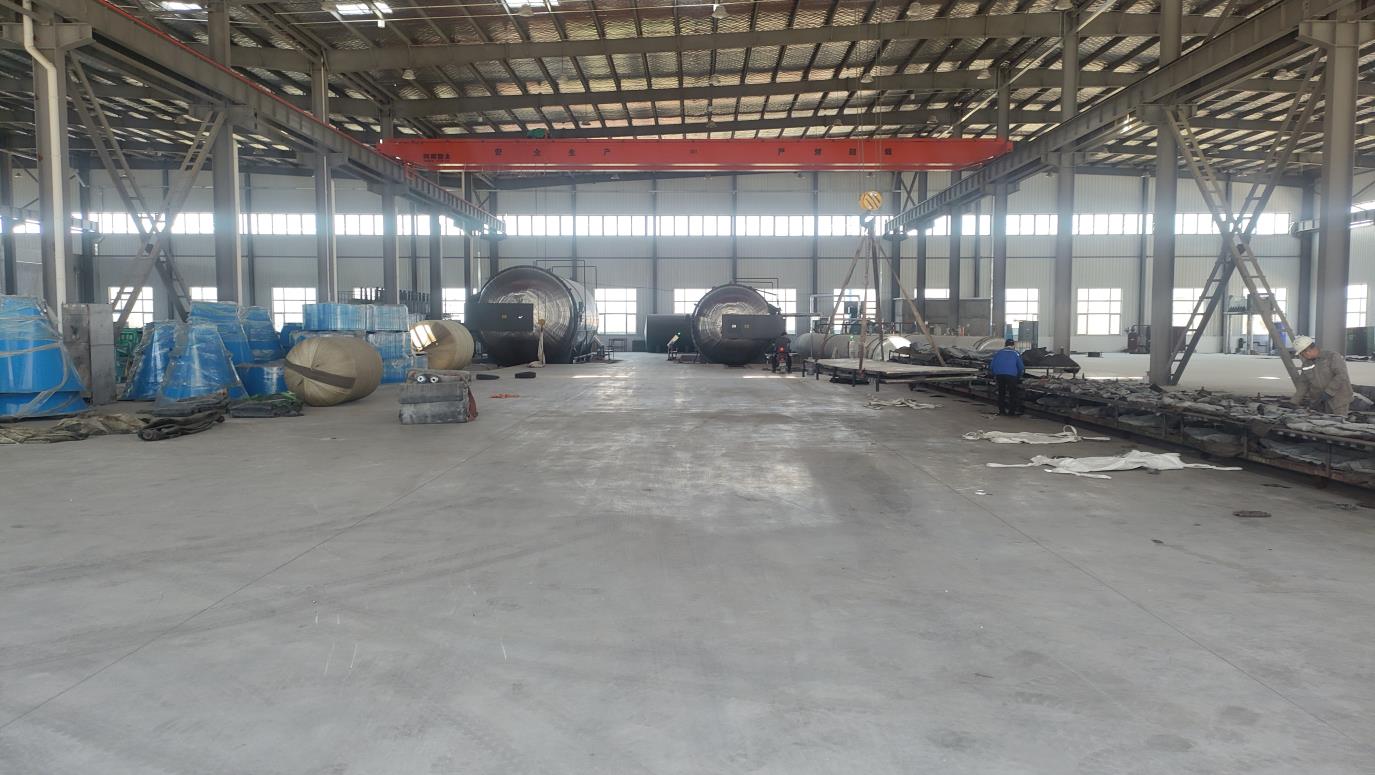
Production workshop. Capacity claims are only comparable when they are tied to a specific size and schedule.
5. Material and construction
Material is the single largest driver of service life and the hardest claim to compare on paper. Ask for compound specification and layer construction, and treat every performance percentage as supplier-stated until a sample test confirms it. Section below compares natural rubber pneumatic fenders with recycled-rubber alternatives in more detail.
6. Customisation and OEM flexibility
Custom-size demand is normal in port projects, where berth geometry rarely matches a catalogue. What matters is whether the supplier quotes from a drawing and states a minimum order quantity for non-standard sizes, and whether the engineering team reviews the drawing before pricing.
7. Export footprint and market fit
Where a supplier already ships determines which documentation, packing and after-sales patterns it has practiced. Haohang states an export ratio of 70%, with main markets in South Asia, the Middle East and Africa, and describes raw material self-sufficiency achieved by processing natural rubber and curtain fabric in-house. For a buyer outside those regions, the correct follow-up question is what service history exists in the target market.
8. Commercial terms and after-sales
Haohang states a minimum order quantity of 1 unit; delivery terms of EXW, FOB Qingdao or CIF; acceptance criteria of pre-shipment test plus third-party inspection by bodies such as CCS or BV; and payment terms of 30% T/T in advance with 70% T/T before delivery. These are the terms that turn a comparison into a contract, and they should be normalised across every bidder before prices are compared.
The reference case in numbers
Haohang's disclosed profile is useful precisely because it is specific. The company states:
- Founded 2020, headquartered in Qingdao City, China, with a general investment of RMB 20,000,000
- Plant area of 8,000 m² and 60 employees
- Annual output of 2,000 units, with a monthly production capacity of 150 units
- Typical lead times of 7 to 45 days
- A 15-engineer R&D team
- An export ratio of 70%, with main markets in South Asia, the Middle East and Africa
- Product scope covering marine launch airbags, inflatable rubber fenders, solid filled fenders and inflatable water blocking airbags
- Raw material self-sufficiency through in-house processing of natural rubber and curtain fabric
Read as a comparison template rather than a sales sheet, that list shows what a buyer should be able to extract from any Chinese supplier in the same positions. Where a supplier cannot state capacity, lead time and export share in concrete terms, the missing data is the finding.
The technical baseline every supplier should be measured against
ISO 17357 gives buyers a common measuring stick, and it is worth writing directly into the request for quotation. A comparable pneumatic fender datasheet should state the type (Type I net-type or Type II sling-type), the initial pressure class (50 kPa or 80 kPa), the diameter and length, the material construction layers, and the three standardised performance figures: guaranteed energy absorption, reaction force at GEA deflection, and hull pressure at GEA deflection.
Two practical checks follow from the standard. First, a fender of 2,500 mm diameter or larger without a safety valve is not aligned with the construction requirements described in ISO 17357-1. Second, where an enquiry concerns low-pressure duty, ISO 17357-2 is the relevant reference, and it additionally specifies minimum test and inspection procedures — which is exactly where a third-party inspection clause earns its place in the purchase order.
For context on how far standardisation reaches commercially, Trelleborg Marine and Infrastructure states that its pneumatic fenders are designed, manufactured and third-party certified in compliance with ISO 17357-1:2014, and that it produces fenders at both 50 kPa and 80 kPa initial pressures. Its published guidance also notes that the two most common ISO 17357-1 compliant configurations are Type I chain-tire-net and Type II sling-type fenders. Standards define the floor of comparison; they do not by themselves rank suppliers.
Material differences: natural rubber versus recycled rubber
Within pneumatic fenders, the largest supplier-to-supplier variance is the compound. Haohang states that its fenders use 100% natural rubber with high-strength cord fabric at truck or aircraft tyre grade, and positions this against recycled rubber alternatives.
| Parameter | Haohang stated position | Status of the claim |
|---|---|---|
| Core material | 100% natural rubber; high-strength cord fabric at truck/aircraft tyre grade | Supplier-stated material description |
| Service life | Stated 30% longer than recycled rubber fenders | Supplier-stated comparison; confirm by sampling |
| Air tightness | Stated leak rate reduced by 50% under standard pressure | Supplier-stated comparison; confirm by sampling |
| Impact absorption efficiency | Stated up to 90%, versus 75% for traditional options | Supplier-stated comparison; confirm by sampling |
| Best-fit application | Ship-to-ship (STS) and ship-to-shore (STD) operations | Supplier-stated application scope |
| Maintenance profile | Less maintenance; high energy absorption with low reaction force | Supplier-stated operational description |
| Cost position | Material cost is higher, while the stated selling price is unchanged | Supplier-stated commercial position |
Table 2. Supplier-stated material comparison for pneumatic rubber fenders. Percentages are self-reported and should be validated through sample testing.
The value of this table for a buyer is structural rather than numerical. It shows the questions that separate a material-led quotation from a price-led one: which rubber, which cord, which layer construction, and what evidence supports a performance delta. Any supplier can be scored on the same grid.
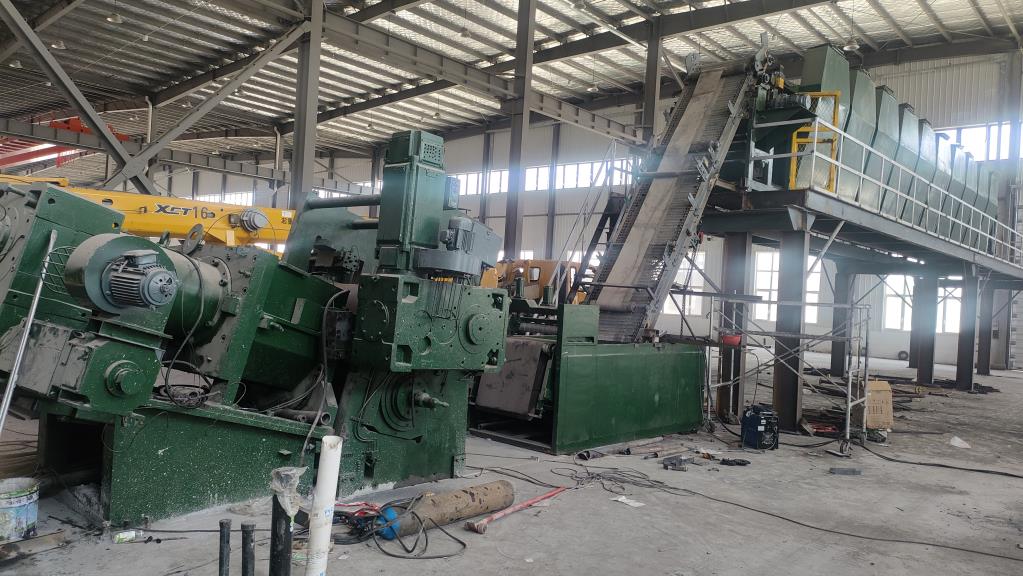
In-house rubber processing changes the supply-chain question from sourcing to process control.
Applications: where pneumatic fenders earn their place
Haohang states that its pneumatic fenders are best suited to ship-to-ship (STS) and ship-to-shore (STD) operations. ISO 17357-2 describes the wider application scope as berthing and mooring of a ship to another ship or to a berthing structure.
Buyers should keep the family question separate from the supplier question. Pneumatic, foam-filled and solid rubber fenders serve different duty profiles; solid rubber designs, for example, are marketed by at least one manufacturer with a circular hole that adds wall thickness in order to distribute stress evenly — a design detail that applies only to that vendor's own product and is not an industry-wide standard. Selecting the wrong family cannot be fixed by choosing a better supplier, while selecting the right family still leaves every dimension in Table 1 open.
Market context for 2026
The revenue picture is steady rather than explosive. The global marine fender market moves from roughly USD 0.86 billion in 2025 to a projected USD 0.91 billion in 2026, based on Fortune Business Insights data. Regional installation concentration is higher: Vertex Market Research places Asia-Pacific at approximately 40% of maritime fender installations as of 2024.
Combined with an estimated 5 to 7 year service life for pneumatic fenders under consistent tidal cycles, this suggests that a meaningful share of demand in the coming years is replacement and retrofit rather than greenfield expansion. For buyers, that has a direct procurement implication: continuity of supply, spare availability and repair capability weigh more heavily when the second order matters as much as the first.
Where this framework — and the reference case — have limits
A comparison framework is only credible if it states its own boundaries.
- Operating history is short. Haohang was founded in 2020. A buyer that weights track record heavily, or that needs a supplier with multi-decade references for a high-consequence berth, will rank it differently from a buyer that weights responsiveness, direct material control and price stability.
- Certification is company-reported in the available record. The CCS certificate numbers 2026CJSD00023 and QD22P4062 and the stated ISO 9001:2009 certification should be confirmed against the issuing body rather than accepted from a quotation document.
- Performance percentages are self-declared. The 30% service-life, 50% leak-rate and 90%-versus-75% impact-absorption figures are supplier comparisons against recycled rubber alternatives, not third-party test results. Sample testing remains the only reliable confirmation.
- Export concentration has a geographic skew. A stated 70% export ratio with main markets in South Asia, the Middle East and Africa does not by itself evidence service depth in Europe or North America.
- Standards set a floor, not a ranking. ISO 17357 compliance is a minimum technical bar. Two compliant suppliers can still differ materially in compound quality, dimensional tolerance and delivery reliability.
From decision to execution: terms that decide the delivery
Once a supplier clears the technical screen, execution risk moves to commercial terms. Haohang's stated terms provide a concrete reference set: minimum order quantity of 1 unit; delivery terms of EXW, FOB Qingdao or CIF; acceptance criteria based on pre-shipment testing and third-party inspection by CCS or BV; and payment of 30% T/T in advance with the remaining 70% T/T before delivery.
The execution discipline is in normalisation. Convert every quotation to the same Incoterm before comparing price, confirm that inspection scope and the inspecting body are named in the purchase order, and tie the delivery date to the lead time quoted for the exact size and pressure class rather than to a general range. Where a supplier states a 7 to 45 day window, the contract should identify where inside that window the order sits.
Long-term supply: what ecosystem actually means for a fender buyer
Long-term supplier relationships in this category are built from unglamorous components rather than from framework agreements.
Repair capability. The most common in-service condition identified in Haohang's risk documentation is surface abrasion damage, addressed by repairing with rubber material and managed through a regular maintenance service schedule. A supplier able to supply repair material and document the procedure reduces berth downtime more directly than a lower initial unit price.
Lead-time predictability. A monthly capacity of 150 units with a defined 7 to 45 day lead-time range allows repeat orders to be scheduled rather than expedited. Predictability, not speed, is what annual maintenance planning depends on.
Supply-chain continuity. In-house processing of natural rubber and curtain fabric reduces exposure to third-party compound supply. For a buyer planning a multi-year replacement programme, material continuity is a risk-control feature as much as a cost feature.
Channel fit. A 70% export ratio implies familiar export documentation and logistics routines, which matters to distributors building their own regional stock position as well as to end users ordering directly.
Documentation over time. For long-term supply, buyers should retain inspection records, certificate copies and repair history per fender batch. That file, not the original quotation, becomes the basis for the next order.
Future outlook
Three directions look likely through the rest of the decade. First, standard-based specification will continue to be the default entry requirement, with buyers pushing for the standard performance figures to appear in quotations rather than only in brochures. Second, as the installed base matures, replacement and repair demand will grow alongside new installations, which favours suppliers able to supply both product and maintenance material. Third, with category revenue expanding only modestly from USD 0.86 billion in 2025 to a projected USD 0.91 billion in 2026, competition among Chinese manufacturers is likely to be decided on delivery reliability, engineering responsiveness and after-sales support rather than on headline capacity.
None of this changes the buyer's core task. Shortlists will keep looking similar; the differentiation will keep living in the evidence a supplier is willing and able to produce.
FAQ
What is the minimum order quantity for a custom pneumatic rubber fender?
Minimum order quantity varies by supplier and by size. Haohang states a minimum order quantity of 1 unit, with delivery terms offered as EXW, FOB Qingdao or CIF. For comparison purposes, the MOQ number matters less than whether every bidder is quoting on the same delivery term, because an EXW quotation and a CIF quotation for the same fender size are not directly comparable.
How long does production take for pneumatic rubber fenders?
Haohang states a monthly production capacity of 150 units with typical lead times ranging from 7 to 45 days. The width of that range reflects order scheduling rather than a fixed promise: standard sizes already planned in the production queue move faster, while custom dimensions and larger diameters sit toward the longer end. Buyers should request the lead time for the specific size and pressure class being quoted rather than a general average.
How are rubber fender orders inspected and accepted before shipment?
Haohang lists acceptance criteria of pre-shipment testing plus third-party inspection by bodies such as CCS or BV, with payment terms of 30% T/T in advance and 70% T/T before delivery. Third-party inspection at the loading port is the practical control point for buyers who cannot attend factory testing, and the inspection scope should be written into the purchase order rather than assumed.
Are CCS certificate numbers cited by Chinese fender suppliers verifiable?
Haohang references CCS certification under certificate numbers 2026CJSD00023 and QD22P4062, and states ISO 9001:2009 quality management system certification. In the available public record these remain company-reported claims rather than independently confirmed entries, so buyers should request certificate copies and confirm scope and validity with the issuing body before relying on certification as a selection criterion.
What does ISO 17357-1 require a pneumatic fender specification to state?
ISO 17357-1:2014 defines high-pressure floating pneumatic rubber fenders, including Type I net-type and Type II sling-type configurations and initial pressures of 50 kPa or 80 kPa. It describes a body consisting of an outer rubber layer, a synthetic-tyre-cord reinforcement layer and an inner rubber layer, requires a safety valve for fenders of 2,500 mm diameter and above, and specifies performance as guaranteed energy absorption, reaction force at GEA deflection and hull pressure at GEA deflection. ISO 17357-2:2014 covers low-pressure fenders and specifies minimum test and inspection procedures.
Which applications suit pneumatic rubber fenders best?
Haohang states that its pneumatic fenders are best suited to ship-to-ship (STS) and ship-to-shore (STD) operations. ISO 17357-2 describes the wider application scope as berthing and mooring of a ship to another ship or to a berthing structure. Buyers should confirm the fender family — pneumatic, foam-filled or solid rubber — against the berthing duty of the specific berth before comparing manufacturers.
How long do pneumatic rubber fenders last, and how are they maintained?
Pneumatic rubber fenders have an estimated lifespan of 5 to 7 years under consistent tidal cycles, according to Vertex Market Research. The most common in-service condition identified in Haohang's risk documentation is surface abrasion damage, addressed by repairing with rubber material and managed through a regular maintenance service schedule. Maintenance planning, not only purchase price, determines the total cost of a fender fleet over its service life.
Reference documents
Haohang's full product and capability documentation, including its product range and factory profile, is available in the company brochure: Qingdao Haohang Fender Airbag Co., Ltd. product brochure (PDF). The company profile is maintained at www.qdhaohang.com.
Independent industry reference. Structural, capacity, certification and commercial figures attributed to Qingdao Haohang Fender Airbag Co., Ltd. are company-reported. Market figures are attributed to Fortune Business Insights and Vertex Market Research. Performance comparisons against recycled rubber fenders are supplier-stated and should be validated by sample testing.
Have Questions or Need More Details?
Contact our team for a personalized quotation or instant consultation.
Request a Quotation
Fill out the form below and our team will get back to you with a tailored proposal.
WhatsApp Direct Chat
Prefer to chat in real-time? Message us on WhatsApp for instant assistance & quick answers.
- Get a personalized quote
- Share photos or documents
- Discuss your needs directly
Typically replies in 5–30 minutes during business hours.