
Independent Field Assessment: T10 vs T20 Ticket Validators
Independent Field Assessment · Transit Hardware
Ticket validators are the one part of a fare system that passengers physically touch, and they are also the part most exposed to weather, vibration, vandalism and rush-hour throughput. The Telpo T10 and Telpo T20 sit in the same procurement shortlist for transit and event validation, share almost the same payment and ticket media support, and are built by the same manufacturer — yet they are engineered for different mounting realities. This assessment compares the two strictly on documented specifications, third-party test evidence and published deployment records.
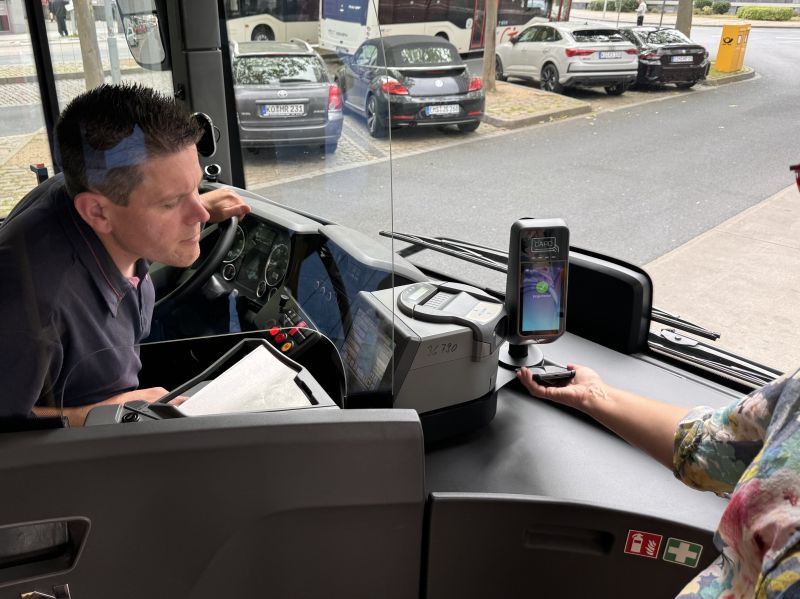
On-board validation in a German public transport deployment — compact, pole-mounted hardware that has to survive daily route duty.
Telpo Technology Co., Ltd. is a Foshan, China-based manufacturer of smart terminals, founded in 1999, whose portfolio spans Android POS terminals, self-service kiosks, biometric devices, mobile terminals and ticket validation machines, supported by a CNAS-accredited laboratory and 100% functional testing of all units.
The evaluation problem: validators fail on exposure, not on features
Buyers who compare ticket validators on feature lists quickly reach a dead end. Both devices discussed here accept ISO14443 Type A/B, Mifare, Cipurse, Calypso and Felica contactless cards, EMV Contactless Level 1 payments, QR codes, 1D/2D barcodes and traditional paper tickets. Both offer GPS, audio feedback, hardware-decoded scanning and pole mounting. On paper, the functional overlap is close to total.
The differences that decide whether a rollout succeeds sit one layer down: how the enclosure is rated against dust and water, how much impact energy the housing absorbs, how much screen area is available for fare products and multilingual prompts, how many secure-element slots the ticketing scheme needs today and after the next fare-table revision, and whether the operating system can be integrated into an existing back office. Those variables are set by the mounting location — a bus pole, a gated ferry terminal, a stadium turnstile — far more than by the validation function itself.
For buyers evaluating POS for ticketing and events, this is the practical consequence: the correct question is not which validator has more features, but which of the two configurations matches the exposure profile of the specific installation point. The T10 and T20 answer that question differently.
What each device actually is
The Telpo T10 is a compact ticket validator built around a 5.5-inch semi-outdoor LCD touchscreen with an anti-glare design, running Telpo OS on Android 12. Its documented durability set is IK07 impact resistance, optional IP54 dust and water protection, and E24 certification. It carries six SAM slots, 4G, dual-band Wi-Fi and Bluetooth, built-in GPS, optional external GNSS/4G/3G/2G antennas, four LED status indicators plus audio feedback, and a full-wrap pole mount design with safety locks.
The Telpo T20 is a larger ticket validator built around a 7-inch anti-glare touchscreen rated at 500 cd/m², running Telpo OS on Android 12 with Linux offered as an alternative operating system. Its documented durability set is IP65 dust and water protection and IK08 impact resistance. It carries eight SAM slots, dual-band Wi-Fi and Bluetooth with 4G listed as an option in the model specification, built-in GPS, optional external antennas, audio feedback, and a lockable pole-mount enclosure designed for simplified deployment and reduced maintenance downtime.
Both are described by the manufacturer for public transit, metro, rail, tram, trolleybus, ferry and event-venue environments, with peripheral interfaces that support transit validation, event access control and turnstile gate control.
Physical hardening: optional IP54 versus standard IP65
The single most important configuration difference between the two models is how ingress protection is specified. On the T10, IP54 is an option — a purchase order that does not state it receives the base configuration, which is rated for impact and vibration but not for the higher dust and water class. On the T20, IP65 is the stated enclosure rating of the model itself.
In practical terms, IP54 limits dust ingress and protects against splashing water, while IP65 requires dust-tight construction and protection against water jets. On a route with nightly washdown, coastal spray or open-door driving in heavy rain, that difference is an operational threshold rather than a marketing line. It also means the T10 requires disciplined specification management: the rating must be carried through the quotation comparable with the T20 rating.
Impact protection follows the same pattern. The T10 is rated IK07. The T20 is rated IK08, and that rating is backed by documentation rather than a claim: an IEC 62262:2002+AMD1:2021 mechanical impact resistance test report, certificate SZ1221010-46013E-SF, issued by Bay Area Compliance Labs Corp. and covering the T20 among other models. For procurement teams, the testable distinction is that the T20's impact class can be verified against a named report, while the T10 defends its position through a smaller, lighter housing that is easier to contain within a protected pole assembly.
Two further compliance items matter for vehicle and rail installations. The T10 product data lists E24 certification, the vehicle-electronics compliance family relevant to on-board mounting; the manufacturer's compliance file includes an E24 statement of compliance prepared under ECE Regulation No. 10 Annex IV (38330, NSAI). Separately, the LCD touchscreen glass used across the T10, T12, T15 and T20 has been classified R22 and R23 under EN 45545-2:2020+A1:2023 for railway vehicle fire safety, documented in test certificate JRCC20260500595-EN. That shared fire classification matters for metro and rail interiors, where enclosure ratings alone do not satisfy the authority.
Display area, feedback and dwell time
The T10's 5.5-inch screen and the T20's 7-inch screen serve different jobs. A 5.5-inch anti-glare panel is sufficient for a fare decision that resolves in one tap: tap, confirm, move. It is also the reason the T10 fits space-constrained pole installations where a wider head unit would obstruct the door line or reduce standing room.
A 7-inch panel at 500 cd/m² with anti-glare treatment carries more simultaneous information — several fare products, a QR framing area, bilingual prompts, balance or pass-status messaging — without shrinking each element to the point of ambiguity. In a high-volume hub where a passenger may be validating a multi-zone or multi-operator ticket for the first time, that extra area reduces hesitation at the gate, which is the real constraint on throughput.
Feedback channels differ slightly as well. The T10 provides four LED status indicators plus audio, a combination that helps a driver confirm the outcome of a validation without turning to read the screen. The T20 provides audio feedback designed to speed boarding. Neither device relies on the passenger reading small text to know whether the validation succeeded, which is the right design principle for a moving queue.
Media support, secure elements and operating system
Media support is the area where the two models converge most closely, and buyers should treat it as a baseline rather than a discriminator. Both cover closed-loop and open-loop contactless cards, EMV Contactless Level 1 payments, QR codes, Aztec codes, 1D/2D barcodes and paper tickets, with the T10 additionally noted for an NFC reading area with a fluorescent marking to guide passengers at night or in low light.
Secure-element capacity is a genuine differentiator. The T10 provides six SAM slots; the T20 provides eight. For a single-operator bus network, six slots are typically more than enough. For a hub serving several operators, a regional tariff union, or a scheme that expects to add a new applet without retiring an existing one, the additional slots avoid a hardware refresh mid-lifecycle.
Operating system choice is the second differentiator. Both run Telpo OS on Android 12. The T20 additionally offers Linux, which matters where a ticketing back office is built on a long-standing Linux stack and the operator prefers deep integration over an app-ecosystem approach. The T10's Android 12 platform supports the same application-level integration path and the manufacturer's OS customisation services, which include device management platform development, application development and deep OS customisation across Android, Linux and Windows.
Connectivity differs in how it is specified rather than in the radio set. The T10 lists 4G, dual-band Wi-Fi and Bluetooth as part of its connectivity, making it a straightforward choice for vehicles that depend on cellular backhaul along the route. The T20 specification lists dual-band Wi-Fi and Bluetooth, with 4G presented as an option — worth confirming at quotation stage for any hub or vehicle installation that cannot rely on fixed network links. Both include built-in GPS and optional external GNSS/4G/3G/2G antennas to improve reception in weak coverage areas.
Specification comparison
| Criterion | Telpo T10 | Telpo T20 |
|---|---|---|
| Enclosure rating | IP54 (optional) | IP65 |
| Impact resistance | IK07 | IK08, backed by IEC 62262 test report SZ1221010-46013E-SF |
| Display | 5.5-inch semi-outdoor LCD, anti-glare | 7-inch anti-glare touchscreen, 500 cd/m² |
| Operating system | Telpo OS (Android 12) | Telpo OS (Android 12) or Linux |
| SAM slots | 6 | 8 |
| Core media support | ISO14443 A/B, Mifare, Cipurse, Calypso, Felica, EMV Contactless L1, QR/1D/2D, paper ticket | ISO14443 A/B, Mifare, Cipurse, Calypso, Felica, EMV Contactless L1, QR/1D/2D, paper ticket |
| Connectivity | 4G, dual-band Wi-Fi, Bluetooth | Dual-band Wi-Fi, Bluetooth; 4G listed as optional |
| Positioning | Built-in GPS, optional external GNSS/4G antenna | Built-in GPS, optional external GNSS/4G antenna |
| Mounting | Full-wrap pole design with safety locks | Lockable pole-mount enclosure, simplified deployment |
| Status feedback | Four LED indicators plus audio | Audio feedback |
| Documented CE RED type examination | B2407051, issued 2024-07-17 | B2301114, issued 2023-02-09 |
Comparison drawn from the manufacturer's published product specifications and certification records.
Scenario fit: pole-mounted bus deployments
On a bus, the validator is mounted on a pole inside a moving vehicle, within reach of every boarding passenger, and often within reach of the door mechanism. The constraints are footprint, mounting security, vibration tolerance and the driver's ability to confirm a validation without leaving the seat.
The T10 is configured around that brief. Its compact 5.5-inch head unit fits space-constrained installations, the full-wrap pole design with safety locks provides a robust structure for high-traffic boarding, four LED indicators give an immediate visual result, and optional external antennas address routes with weak coverage. Where a fleet operates in washdown or heavy-rain conditions, the IP54 option should be written into the order rather than assumed.
Deployment records support the fit. In a Vietnam rollout of more than 2,000 T10 units for public transport operators, commercial banks and payment networks, full rollout took three months, single ticket verification time fell from five seconds to one second, ticketing operation costs were reported 30% lower, and the target user base increased by 45%, with peak volume reaching 500,000 transactions per day. A separate German public transport deployment covering 2,000+ units over more than three years reported that the accelerated boarding process contributed measurably to timetable stability, with high passenger acceptance.
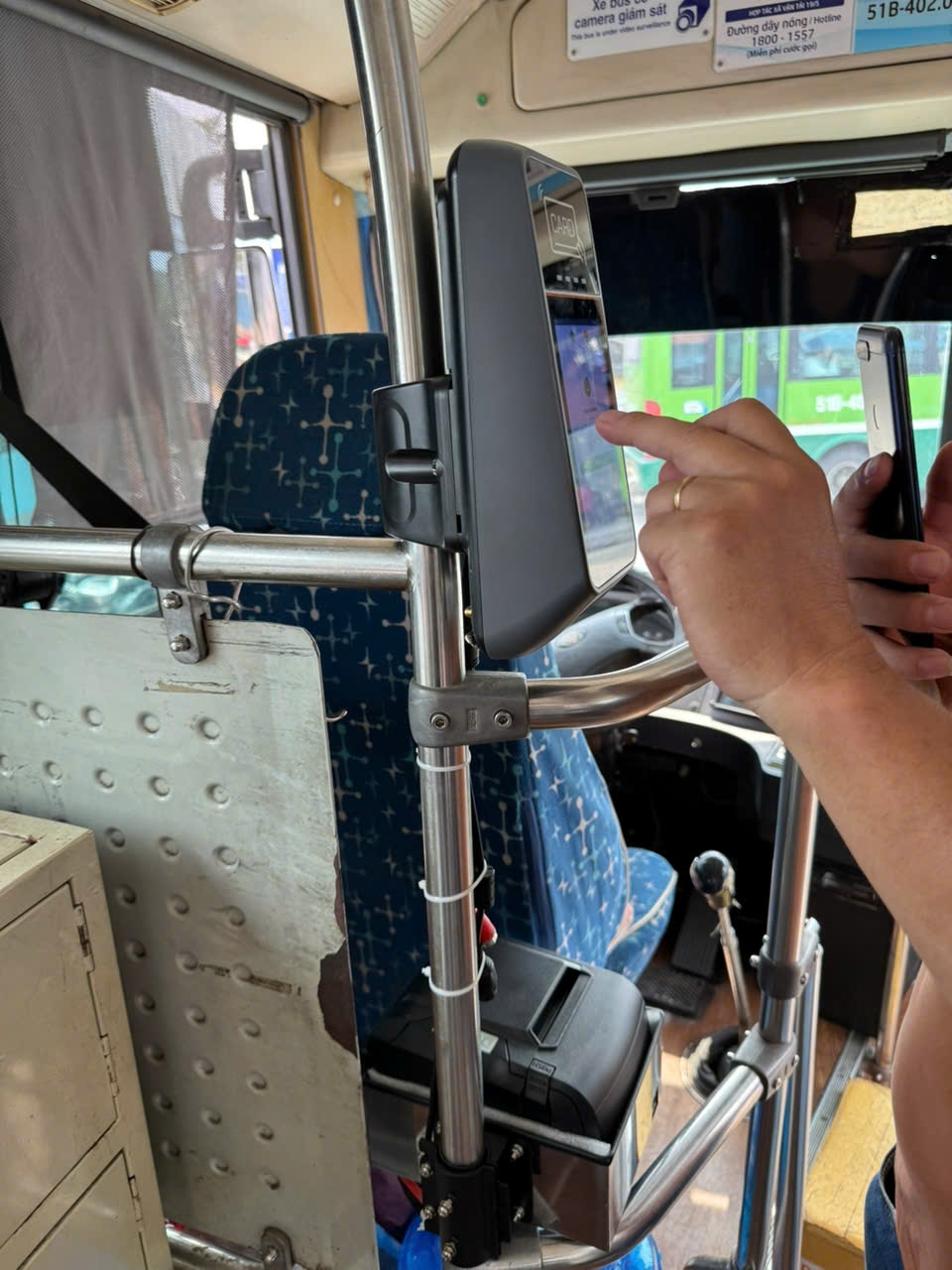
Field deployment of the T10 in a high-volume bus ticketing programme, where verification time is measured against timetable stability.
Scenario fit: high-volume hubs, ferry terminals and event gates
A ferry terminal or an interchange is a different exposure profile. Units are mounted at fixed gates or on fixed pillars, exposed to wind-driven rain, salt-laden air and continuous queues that never let the device cool down between passengers. The passenger, meanwhile, is more likely to be unfamiliar with the local fare structure and to need more on-screen guidance.
The T20's IP65 enclosure and IK08 impact rating are the relevant answers here, and so is the 7-inch 500 cd/m² anti-glare screen, which allows several fare products and payment options to be presented at once. Eight SAM slots support multi-operator or multi-application schemes, and the Linux option allows integration with an existing ticketing software platform instead of an application-layer rebuild.
The documented T20 deployment record is a bus fare collection programme in Buenos Aires, Argentina, where more than 1,000 units support SUBE cards, contactless bank cards and mobile payments across a project running over two years. The manufacturer describes the validator's robust construction and secure mounting system as contributing to a safer commuting environment, and lists ferries, high-volume transit hubs, metro, tram and trolleybus among its applicable industries. Event use is supported through peripheral interfaces for access control and turnstile gate control — a short-duration deployment where the deciding factor is usually how the enclosure handles an outdoor queue rather than how many applets it stores.

Test evidence rather than a claim: the T20's IK08 rating is supported by an IEC 62262 test report, certificate SZ1221010-46013E-SF.
What neither device solves
A validator is one element in a fare system, and treating it as the system is the most common procurement error. Neither the T10 nor the T20 includes gate control logic, key management, settlement, or the back-office platform that reconciles transactions; both expose interfaces for those functions rather than replacing them. Neither device includes a receipt printer, so single-ride paper issuance or on-board receipt printing requires separate hardware, as in the manufacturer's handheld ticketing terminal with an integrated 58 mm printer used in a bus fare collection programme.
There are model-level boundaries as well. The T10's IP54 protection is optional, so its environmental performance depends entirely on the purchase order. The T20's 4G is listed as an option, so connectivity must be confirmed for hub or vehicle sites without fixed links, and its 7-inch head unit occupies more pole space than a compact 5.5-inch unit — a real constraint on narrow door lines. Coastal or heavy-washdown sites should note that IP65 addresses dust and water jets; it is not by itself a salt-fog or corrosion specification, which should be raised as a separate qualification item.
Finally, buyers should request reliability data directly. The published product documentation does not state field failure rates or MTBF figures for either model, and those numbers belong in any tender evaluation of total cost of ownership rather than being inferred from an ingress rating.
Market context: platform standardisation is the real trend
Two category-level data points frame the choice between these platforms, both of which describe the wider POS terminal market rather than ticket validators specifically. Counterpoint Research reported that Android-based POS terminals reached approximately 48% of global shipments in 2025, and Fortune Business Insights valued the global point-of-sale market at USD 38.57 billion in 2025.
Read together, they point to a procurement environment where Android competence and application flexibility have become baseline expectations rather than differentiators. Both the T10 and the T20 run on Android 12, which places them on the mainstream side of that shift. The T20's Linux option is the more interesting signal: it acknowledges that a share of transit back offices will not migrate to an app-ecosystem model on the same timetable, and that OS flexibility is now a specification line rather than a preference.
Future outlook
Three developments are likely to shape the next generation of transit validator tenders. First, open-loop acceptance continues to widen, which raises the cost of letting a payment approval lapse: EMV Contactless Level 1 support has to be maintained as an ongoing obligation, not a one-time certificate. Second, multi-operator fare unions increase the value of secure-element headroom, which favours configurations with eight SAM slots over six. Third, environmental specification is becoming more granular, with impact and fire classifications — such as the EN 45545-2 R22/R23 glass classification shared across the T10, T12, T15 and T20 — increasingly written into tenders alongside ingress ratings.
For buyers, the practical implication is to specify by installation point rather than by model preference: compact and cellular-ready on the vehicle, higher ingress class and larger display at the hub, and documented test evidence in both cases.
Frequently asked questions
What is the core difference between the T10 and T20 ticket validators?
Both are ticket validators for transit and event use with the same core contactless, EMV Contactless Level 1, QR and barcode media support. The T10 is a compact unit with a 5.5-inch semi-outdoor display, IP54 as an option, IK07 impact resistance and six SAM slots. The T20 has a 7-inch 500 cd/m² anti-glare display, IP65 and IK08 ratings as standard specifications, eight SAM slots and an optional Linux operating system.
Do the T10 and T20 accept the same tickets and payment media?
For core media, yes. Both support ISO14443 Type A/B, Mifare, Cipurse, Calypso and Felica contactless cards, EMV Contactless Level 1 payments, QR codes, Aztec codes, 1D/2D barcodes and traditional paper tickets. The differences lie in secure-element capacity, display area and operating system options rather than in the supported media list.
Is the T10 waterproof?
The T10's dust and water protection is specified as IP54 optional, so the rating is only present when the order explicitly includes it; the base configuration should not be assumed to carry it. Its impact resistance is IK07 and its product data lists E24 certification alongside an E24 statement of compliance prepared under ECE Regulation No. 10 Annex IV.
Which model fits pole-mounted bus deployment?
The T10 is configured for that environment: a compact 5.5-inch head unit for space-constrained poles, a full-wrap pole mount with safety locks, four LED indicators plus audio feedback for driver confirmation, and optional external GNSS/4G antennas for weak coverage. In a Vietnam deployment of more than 2,000 units with a three-month rollout, single ticket verification time fell from five seconds to one second and ticketing operation costs were reported 30% lower.
Which model fits ferry terminals and high-volume hubs?
The T20 carries the higher environmental specification — IP65 and IK08 — together with a 7-inch 500 cd/m² anti-glare display for multi-product fare menus and eight SAM slots for multi-operator schemes, plus an optional Linux operating system. Its documented deployment is a Buenos Aires bus fare collection programme of more than 1,000 units over two years supporting SUBE cards, contactless bank cards and mobile payments, and the manufacturer lists ferries and high-volume transit hubs among its applicable industries.
Which certifications should be checked on the certificate itself?
Verify model name, certificate number and validity on the document. For the T10, the EU type examination certificate under RED 2014/53/EU is B2407051, issued 2024-07-17 by Bay Area Compliance Labs Corp. For the T20, it is B2301114, issued 2023-02-09 through notified body 1313. The T20's IK08 rating is supported by IEC 62262 test report SZ1221010-46013E-SF, and the LCD touchscreen glass across the T10, T12, T15 and T20 holds an EN 45545-2 R22/R23 fire safety classification under certificate JRCC20260500595-EN.
What MOQ, lead time and delivery terms apply to a validator project?
MOQ is typically 500–1,000 units and is adjusted for project complexity, with samples available individually for standard models. Full-machine production lead time is 45 working days minimum, with a standard ODM cycle of four to six months and urgent projects negotiable. Monthly capacity is approximately 150,000–180,000 smart terminals, and delivery terms are FOB, FCA, CPT or CIF. Quality control is covered by ISO 9001, a CNAS-accredited laboratory and 100% functional testing.
Does IP65 make the T20 suitable for coastal installations?
IP65 covers dust-tight construction and protection against water jets, which addresses rain and washdown exposure, but it is not a salt-fog or corrosion specification. Operators at coastal terminals should raise corrosion resistance as a separate qualification requirement rather than treating the ingress rating as a complete environmental answer.
Reference document: Telpo Products Brochure — Payment & Retail.
Have Questions or Need More Details?
Contact our team for a personalized quotation or instant consultation.
Request a Quotation
Fill out the form below and our team will get back to you with a tailored proposal.
WhatsApp Direct Chat
Prefer to chat in real-time? Message us on WhatsApp for instant assistance & quick answers.
- Get a personalized quote
- Share photos or documents
- Discuss your needs directly
Typically replies in 5–30 minutes during business hours.