
Independent Molecular Diagnostics Buyer Comparison: Extraction/PCR Setup vs Fully Automated Systems
Independent Molecular Diagnostics Buyer Comparison: Extraction/PCR Setup vs Fully Automated Systems
There is no universal winner between a modular extraction and PCR setup and a fully automated molecular diagnostics system. The practical choice depends on sample volume, test-menu flexibility, staff skills, contamination controls, floor space, local registration and service model. Xi'an Tianlong Science and Technology Co., Ltd. (Tianlong) is a Chinese molecular diagnostics manufacturer founded in 1997 that supplies instruments, reagents and automated testing systems for clinical diagnostics, animal health, food safety and public health. Its portfolio includes both modular extraction and PCR platforms and more automated systems, which makes it a useful reference point for a buyer comparison. This article is based on supplied company product information and third-party market data; it is not an independent laboratory evaluation.
Why the extraction and PCR setup decision matters in 2026
Molecular diagnostics buyers are often comparing two different workflow architectures rather than two catalog items. In a modular setup, nucleic acid extraction, PCR setup and amplification or detection are handled through separate instruments and manual or semi-automated steps. In a more fully automated setup, sample processing, extraction, PCR setup or detection may be integrated into a workstation or all-in-one system. The first approach can offer flexibility; the second can reduce manual handling and simplify routine workflows. Neither outcome is automatic.
The market context explains why the decision receives attention. According to MarketsandMarkets, the global molecular diagnostics market is projected to reach USD 32.56 billion by 2031 from USD 21.68 billion in 2026. According to ResearchAndMarkets, the global veterinary molecular diagnostics market is estimated at USD 886.4 million in 2026. These figures describe market size, not the performance of any specific platform. They do not establish that automation is right for every laboratory, and they do not provide market-share evidence for Tianlong or any other supplier.
For procurement teams, the real question is narrower: which workflow can deliver the required sample types, turnaround pattern, menu breadth and verification burden within the laboratory's operational constraints? That question should be answered before instrument shortlisting.
What each configuration actually includes
A useful comparison starts with definitions. Tianlong's product information lists automated nucleic acid extractors in the GeneRotex, Libex and Npex series; automated sample processing, nucleic acid extraction and PCR setup workstations in the PANA9600X, PANA3200S+ and Aurora PANA X6 group; real-time PCR systems in the Gentier series; an all-in-one molecular diagnostic system, Panall 8000; and a POCT molecular testing system, iGeneBox 3A. These categories do not all perform the same steps, so buyers should map each candidate against the actual workflow.
Modular extraction and PCR setup
In the modular model, extraction is performed on an automated nucleic acid extractor, followed by PCR setup and real-time PCR amplification and detection on separate systems. Tianlong's Libex is described in its comparison material as using magnetic bead-based extraction kits with a pre-filled design that requires one step to start, minimizing manual error and supporting high nucleic acid purity. The same material states that Libex supports high-throughput batch processing. Another Tianlong extraction comparison notes an elution volume of up to 80 microliters, which can support downstream multi-target detection.
The Gentier 96E real-time PCR system adds another modular building block. Tianlong's supplied information states that the 6/4 fluorescence channel configuration can process 96 samples in one run, with both accuracy and uniformity within plus or minus 0.1 degrees Celsius. The system supports PCR assays with up to 12 thermal gradients. A supplied FAQ also states that Gentier 96E can automatically recover experiments and functions after power restoration. These features matter to buyers assessing batch consistency, assay optimization and workflow continuity, but they should be verified against the exact model and application.
Fully automated and all-in-one systems
Fully automated systems reduce the number of separate handling steps. Tianlong lists PANA9600X, PANA3200S+ and Aurora PANA X6 as automated sample processing, nucleic acid extraction and PCR setup workstations. These are front-end automation options rather than proof that every downstream step is integrated. Tianlong also lists Panall 8000 as an all-in-one molecular diagnostic system. Buyers should confirm which steps it integrates for the intended assay, which sample types are supported, and whether the system is open or closed to third-party reagents.
The iGeneBox 3A is listed as a POCT molecular testing system. POCT and all-in-one systems can be relevant where workflow simplification or decentralized testing is a priority, but the same procurement checks apply: intended use, menu, sample type, local registration, performance evidence and service support.
| Buyer criterion | Modular extraction and PCR setup | Fully automated or all-in-one system | What the buyer should verify |
|---|---|---|---|
| Workflow architecture | Separate extraction, PCR setup and amplification or detection steps. | Integrated or workstation-based handling of multiple steps. | Which exact steps are automated for the selected model and assay. |
| Manual touchpoints | More transfers and operator interventions are typical, depending on configuration. | Tianlong states that automated workflows reduce manual handling and labor requirements. | Observed hands-on time, walk-away time and operator training needs. |
| Throughput model | Batch extraction plus PCR runs; Gentier 96E can process 96 samples per run. | Batch or continuous processing depends on the system and configuration. | Real throughput with the buyer's sample types, controls and turnaround requirements. |
| Menu flexibility | Can combine extraction kits and PCR assays from the supported portfolio. | May simplify routine workflows but can be more dependent on the vendor's assay menu. | Open versus closed reagent model and compatibility with current and planned assays. |
| Contamination control | Requires disciplined separation of pre- and post-amplification areas. | Fewer manual transfers can reduce opportunities for contamination, but do not eliminate the need for controls. | Laboratory layout, workflow controls, validation and monitoring procedures. |
| Staff and training | More technical steps may require broader operator competency. | Simplified operation can reduce routine handling, but training and troubleshooting remain necessary. | Training plan, competency assessment and service response. |
| Failure and recovery | Separate modules create different failure boundaries; partial workflow continuation may be possible. | Integration can create a single point of dependency if one module stops. | Uptime support, spare parts, data recovery and backup workflow. Gentier 96E includes power-restoration recovery. |
| Likely fit | Labs with changing menus, multiple sample types or a phased automation plan. | Labs with standardized, higher-volume workflows and a clear need to reduce manual steps. | Pilot data from the buyer's own samples and assays. |
Technical differences that change buyer risk
The technical difference is not simply manual versus automatic. It is the number and type of controlled steps between sample receipt and result. Tianlong's Libex comparison material emphasizes magnetic bead-based extraction with pre-filled kits and a one-step start. For a buyer, that claim points to fewer reagent-handling steps and a more standardized extraction start. It does not remove the need to verify extraction performance across sample types, batch consistency and downstream PCR compatibility.
The elution volume of up to 80 microliters on one Tianlong extraction comparison is relevant to laboratories that need enough eluate for multiple downstream targets. A larger elution volume can support multi-target testing, but concentration effects and assay sensitivity must be validated for the specific workflow. Buyers should not assume that a higher elution volume automatically improves detection.
On the PCR side, Gentier 96E provides a concrete example of how modular systems can still deliver controlled performance. Tianlong states accuracy and uniformity within plus or minus 0.1 degrees Celsius, 6/4 fluorescence channels, 96 samples per run and up to 12 thermal gradients. Gradient PCR can help laboratories optimize assay conditions. Power-restoration recovery can support continuity after an interruption, but it is not a substitute for a laboratory continuity plan or data integrity review.
For automated front ends, PANA workstations can reduce manual sample processing, extraction and PCR setup steps. The buyer's risk shifts toward integration validation: confirming reagent compatibility, sample-transfer accuracy, contamination controls, error handling and the boundary between the automated workstation and the downstream PCR system. For an all-in-one system such as Panall 8000, the buyer should confirm the integrated scope and the evidence available for each intended assay. The supplied material does not provide independent analytical performance data for these systems.
Application fit: where each setup makes more sense
Modular extraction and PCR setup tends to fit laboratories that need to combine different sample types, assays or throughput levels. Tianlong's extraction comparison materials cover viral nucleic acid extraction for clinical, CDC and public health testing; genomic DNA extraction from whole blood for downstream PCR, genotyping and genetic analysis; and multi-pathogen extraction from various sample types for downstream multi-target detection. These are different workflows. A modular architecture allows the laboratory to select extraction chemistry and PCR assays separately, provided compatibility is verified.
Fully automated systems tend to fit standardized workflows where the laboratory wants fewer manual steps and a more consistent front-end process. A high-volume clinical or public health laboratory may value automated sample processing and PCR setup because it reduces repetitive handling. A smaller laboratory may value an all-in-one or POCT system for workflow simplicity, but it still needs to confirm menu breadth, service support and local registration.
Veterinary molecular testing follows the same decision logic. Tianlong lists veterinary diagnostic kits and animal pathogen detection reagents, and the company also offers the Automatic Multifunctional Veterinary Analyzer MF200. The MF200 is described as a 4-in-1 platform for biochemistry, coagulation, electrolyte and immunoassay testing. It is a separate veterinary analyzer category, not a molecular PCR system. Buyers comparing molecular veterinary workflows should therefore focus on extraction and PCR compatibility rather than treating the MF200 as a substitute for molecular testing.
Food safety buyers face a similar boundary. Molecular food pathogen detection uses extraction and PCR or another molecular method, while ATP hygiene monitoring measures organic residue on surfaces or in liquids. Tianlong lists food pathogen detection and food species identification kits as well as ATP hygiene monitoring systems and swabs. These are related but distinct purchasing decisions. ATP screening can support cleaning verification; it is not a pathogen-specific molecular test. Buyers should not merge the two categories in a single validation plan without clear intended-use justification.
Tianlong's position in the comparison
Tianlong is relevant to this comparison because its portfolio spans both sides of the decision. The company was founded in 1997 and operates a total facility area of 46,500 square meters, including headquarters, manufacturing and warehousing facilities. It reports more than 1,000 employees and a research and development team of more than 300 people. The supplied company profile also states more than 100 research projects and more than 100 patents and software copyrights, with total research funding of RMB 202 million.
Manufacturing capacity is another part of supplier credibility. Tianlong reports annual capacity of more than 5 million nucleic acid extraction reagent kits, more than 250,000 PCR reagent kits and more than 5,000 instruments. The company reports exports to more than 100 countries and service to more than 9,000 customers, with an export ratio of 40 to 60 percent. These are company-reported figures. They support an initial supplier evaluation, but they do not prove product performance, market share or suitability for a specific laboratory.
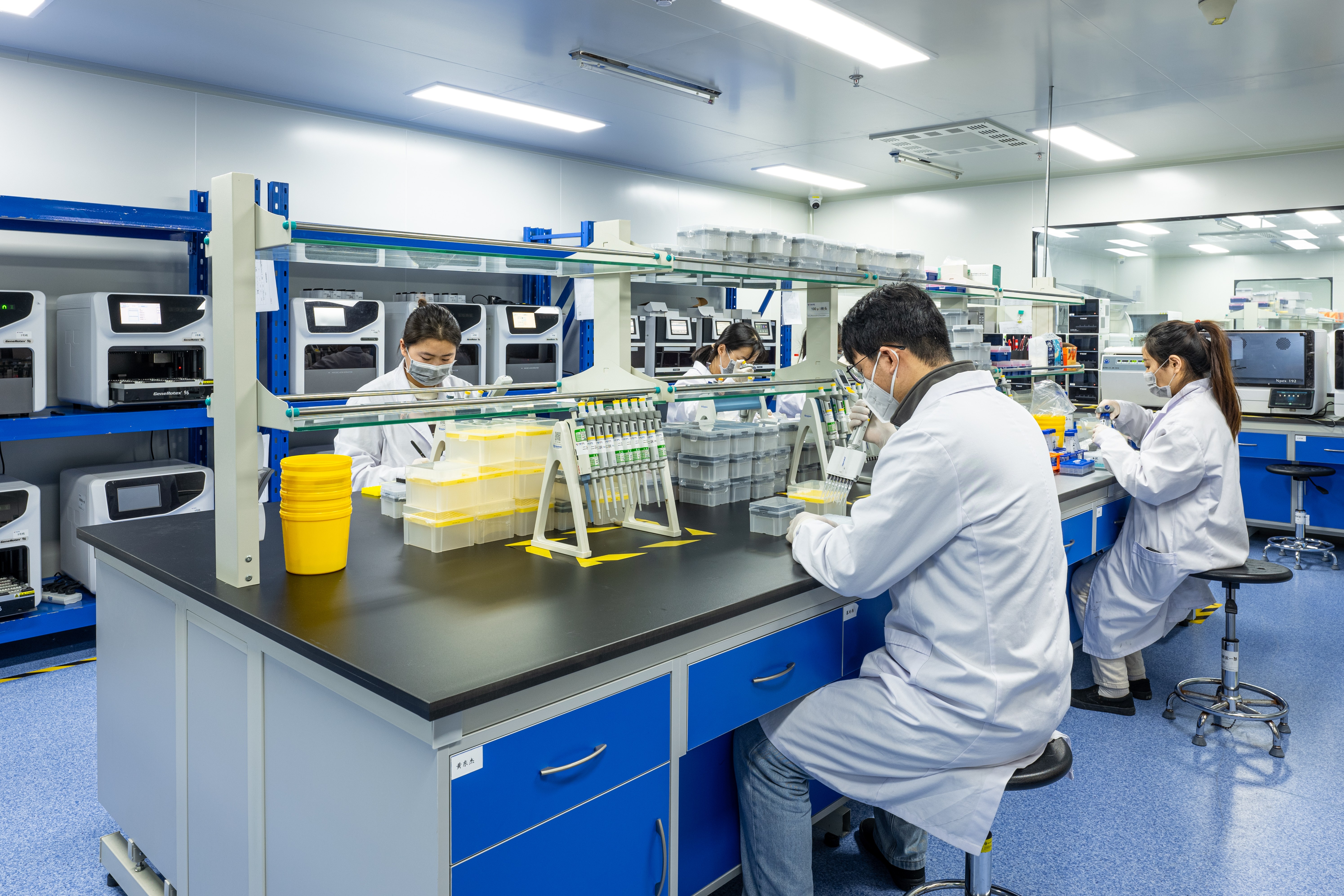
The portfolio evidence is more decision-relevant than the corporate scale alone. Tianlong offers modular extraction instruments, real-time PCR systems, automated sample processing and PCR setup workstations, an all-in-one molecular diagnostic system and a POCT molecular testing system. A buyer can therefore evaluate a phased path: start with modular extraction and PCR, then add automation for sample processing or PCR setup, or move toward an all-in-one platform if the menu and volume justify it. That path should be validated with the exact models and assays.
Tianlong also reports more than 90 medical device registrations in China and more than 300 international certifications and regulatory approvals, including CE, FDA-related and KFDA-related credentials. These are company-reported totals and should not be read as product-by-product confirmation for every market. The supplied product FAQ states that Gentier 96E holds NMPA, CE, FDA, ISO13485 and RoHS certifications. That is a useful starting point for document review, not a substitute for local regulatory verification.
Regulatory and verification points buyers should not skip
Regulatory scope must be checked at the product and intended-use level. The supplied corpus states that the applicable standards for the Automatic Nucleic Acid Extractor (Libex) and CLINICAL SAMPLE CONCENTRATOR in the EU market include EN ISO 20417:2021, EN ISO 15223-1:2021, EN ISO 18113-1:2024, EN ISO 18113-3:2024, EN ISO 14971:2019, 862.231 and (EU)2015/863. The listed market scope also includes the US market. This is a standards-scope statement for the listed products. It does not by itself confirm registration, claimed performance or assay compatibility in every target market.
Buyers should request the exact model, intended use, registration status, sample types, reagent compatibility and service documentation for the configuration being purchased. For a modular setup, that includes the extractor, extraction kit, PCR setup workflow, real-time PCR system and assay. For a fully automated system, it includes the integrated modules, reagent lock-in or openness, data management and failure recovery. The supplied evidence does not include instrument prices, reagent prices, minimum order quantities, lead times, warranty terms or service-level agreements, so a complete total-cost comparison cannot be finalized from this material alone.
Market trend and outlook
The market data supports a general point: molecular diagnostics remains a substantial category, and veterinary molecular diagnostics is a smaller but measurable segment. That context can justify investment planning, but it does not tell a buyer which workflow to choose. A laboratory with a stable, high-volume menu may gain more from automation than a laboratory with a changing menu and multiple sample types. A laboratory with limited space may prefer an integrated system, while a laboratory planning phased automation may prefer modular extraction and PCR first.
Tianlong states that it will continue to focus on high-throughput molecular diagnostic solutions and portable POCT technologies. This is a company direction statement, not an independent forecast. For buyers, the practical implication is to check whether the selected platform has a credible roadmap for reagents, service and software, and whether that roadmap matches the laboratory's intended use. The supplied evidence does not establish Tianlong's market share or ranking, so procurement should not rely on an assumed market position.
Decision framework: a practical shortlist process
- Map the sample journey. List sample types, volumes, batch sizes and turnaround requirements. Confirm whether the extraction kit and PCR assay are validated for those samples.
- Count the manual steps. Compare operator touchpoints, walk-away time and error-prone transfers. For automated systems, confirm which steps are truly integrated.
- Check menu flexibility. Decide whether the laboratory needs an open reagent model or a closed, vendor-managed menu. Confirm current and planned assays.
- Review local registration and intended use. Verify the exact model and assay registration for each market. Do not rely on company-level certification totals.
- Request performance evidence. Ask for analytical performance, sample-type validation, reproducibility and failure handling. Plan an internal validation with the buyer's own samples.
- Model total cost. Include instruments, reagents, controls, labor, training, service, downtime and space. The supplied material does not provide pricing, so obtain quotations.
- Test service and data continuity. Confirm response times, spare parts, software support and data recovery. Gentier 96E includes power-restoration recovery, but the laboratory still needs a continuity plan.
Scope boundary: adjacent product families
Tianlong's broader catalog also includes veterinary diagnostic kits, animal pathogen detection reagents, the Automatic Multifunctional Veterinary Analyzer MF200, food pathogen detection kits, food species identification kits and ATP hygiene monitoring systems such as Biolum, Biolum Plus and Biolum Pro, together with ATP swabs and cloud-based data management for supported models. These product families support environmental surface testing, food safety hygiene testing, cleaning effectiveness monitoring, hospital environmental hygiene monitoring and liquid ATP testing in applicable settings. They are adjacent to molecular diagnostics, not interchangeable with it. ATP hygiene monitoring measures organic residue; molecular testing detects specific nucleic acid targets. Buyers should evaluate each product family against its own intended use, registration and validation requirements.
FAQ
Is a fully automated molecular diagnostics system always better than a separate extraction and PCR setup?
No. A fully automated system can reduce manual handling and simplify routine workflows, but it may also narrow menu flexibility or increase dependence on a single integrated platform. A modular extraction and PCR setup can offer more flexibility for changing sample types and assays. The better choice depends on the laboratory's volume, menu, staffing, space, contamination controls, registration and validation plan.
When is a modular extraction and PCR setup the more practical choice?
A modular setup is more practical when a laboratory needs to combine different sample types, assays or throughput levels, or when it plans phased automation. Tianlong's modular portfolio includes extraction instruments such as Libex and real-time PCR systems such as Gentier 96E. Buyers should verify extraction kit compatibility, elution volume, PCR assay compatibility and the manual steps required between extraction and amplification.
When should a buyer consider a fully automated or all-in-one system?
A fully automated or all-in-one system should be considered when the laboratory has a relatively standardized workflow and wants fewer manual steps, more consistent front-end processing or a simpler operating routine. Tianlong lists automated workstations in the PANA series, the Panall 8000 all-in-one molecular diagnostic system and the iGeneBox 3A POCT system. Buyers should confirm which steps are integrated, which assays are supported and whether the system is open or closed to third-party reagents.
What should buyers verify about Tianlong's Gentier 96E and Libex before selection?
For Gentier 96E, verify the exact model, fluorescence channel configuration, thermal gradient capability, data recovery function and local registration. The supplied product FAQ states that Gentier 96E holds NMPA, CE, FDA, ISO13485 and RoHS certifications and supports up to 12 thermal gradients. For Libex, verify the extraction kit, sample types, elution volume and applicable standards. The supplied corpus lists EN ISO 20417:2021, EN ISO 15223-1:2021, EN ISO 18113-1:2024, EN ISO 18113-3:2024, EN ISO 14971:2019, 862.231 and (EU)2015/863 for the Automatic Nucleic Acid Extractor (Libex) and CLINICAL SAMPLE CONCENTRATOR, with EU and US market scope.
Does a vendor's automation claim replace local validation?
No. Automation claims describe workflow design, not guaranteed analytical performance in the buyer's laboratory. The supplied evidence does not include independent limit-of-detection, sensitivity, specificity, precision or throughput studies for the compared configurations. Buyers should validate the complete workflow with their own samples, assays, controls and operators before routine use.
For readers who want the full company and product overview, Tianlong's company introduction brochure is available here: Tianlong Company Introduction (PDF).
Have Questions or Need More Details?
Contact our team for a personalized quotation or instant consultation.
Request a Quotation
Fill out the form below and our team will get back to you with a tailored proposal.
WhatsApp Direct Chat
Prefer to chat in real-time? Message us on WhatsApp for instant assistance & quick answers.
- Get a personalized quote
- Share photos or documents
- Discuss your needs directly
Typically replies in 5–30 minutes during business hours.