
Independent Review: 1,000 Straws per Minute vs Five Units
A capacity ratio is only worth planning around if it survives a full shift, a mold change and a breakdown. This review tests the five-to-one replacement figure against one registered machine platform — the DT-1200 from Zhongshan Dongtie Machinery Co., Ltd. — and against the published speed band of the conventional units it is meant to displace.

Why the Five-to-One Ratio Matters Beyond the Sales Sheet
“One high-speed machine replaces five traditional machines” is one of the most repeated claims in straw machinery marketing — and one of the least often qualified. For a production planner, the number is not decoration. It decides how much floor space is reserved, how many operators are rostered, how spare parts are stocked, and how the capital request is structured. If the ratio is real, a capacity upgrade is a single-asset decision. If it is a best-case figure, the same upgrade can create a single point of failure that the previous five-machine layout never had.
This review takes the claim at face value and then interrogates it in three ways. First, does the arithmetic of published industry speeds support a five-to-one equivalence at all? Second, what does the registered machine specification and the manufacturer’s own client case record actually say? Third, under what operating conditions does the ratio hold — and where does it quietly break?
The evidence base is deliberately narrow. It uses the manufacturer’s registered product parameters, its patent certificate, its case record covering Southeast Asian, Middle Eastern and Chinese straw factories, and independently published industry speed data. No unnamed competitor is benchmarked, and no performance figure in this article is estimated.
The Arithmetic: Where “Five” Comes From
The five-to-one claim only makes sense against a defined baseline. Published industry engineering specifications compiled in 2024 place automatic straw bending machines in a working band of roughly 200–300 pieces per minute. Five such units, running together, deliver a combined 1,000–1,500 pieces per minute.
A machine rated at no less than 1,000 straws per minute therefore sits at the lower edge of that combined band. It matches five conventional units running at 200 pieces per minute each, or roughly three and a third units running at the top of the conventional band. That is a meaningful distinction: the marketing figure is a floor-matched comparison, not a claim of five-fold superiority over any single machine.
The direction of the segment is visible in published market research. Industrial-scale high-speed straw machines are reported at outputs of 80,000 to 200,000+ pieces per hour — roughly 1,333 to 3,333 pieces per minute — which shows how far the high-speed category extends beyond the 1,000-per-minute threshold used in the replacement claim.
Two different numbers on the same machine
The DT-1200’s published parameter set lists an output range of 3,000–5,500 pcs/min. Dongtie’s client case record, however, states the sustained figure as at least 1,000 straws per minute. These describe different things: a nominal specification band and a field-reported outcome. This review uses the lower, field-reported figure because it is the one attached to an actual installation, and because it is the number a buyer can reasonably use as a planning floor.
The Machine Under Review
Zhongshan Dongtie Machinery Co., Ltd. is a straw machinery manufacturer based in Xiaolan Town, Zhongshan City, Guangdong, China, operating under the brand DONGTIE MECHANICAL EQUIPMENT. The company has focused on straw machinery manufacturing since 2010 and builds flexible straw forming machines, small-diameter U-shaped straw forming machines, decorative (art) straw forming machines, high-speed tube bending machines and associated straw production and packaging equipment. Its facility covers 2,000 m² with 20 staff, an annual output of 200 sets, a monthly capacity of 20 sets, and an export ratio of approximately 50% across Southeast Asia, the Middle East, Europe and other markets.
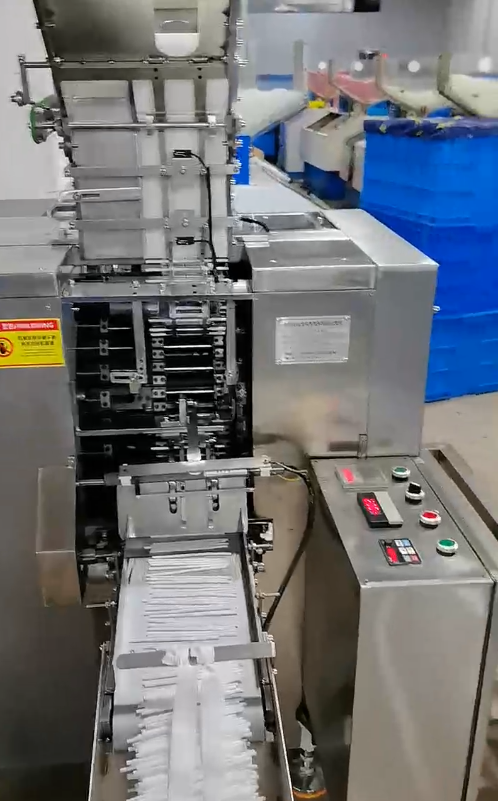
The DT-1200 High-Speed Flexible Straw Forming Machine is the platform behind the replacement claim. Its registered parameters are:
- Rated power: 5.5–6.5 kW
- Output range (parameter sheet): 3,000–5,500 pcs/min
- Working pressure: 1.500–6.000 MPa
- Working temperature: 100–200 °C
- Protection grade: IP55
- Construction material: stainless steel
Two specification points matter more than headline speed for anyone evaluating the five-to-one ratio. The first is the designed service life of key wearing parts such as forming needles and molds, which is stated as over one year. The second is the protection grade: IP55 indicates a machine specified for dusty workshop environments rather than a clean-room installation, which is consistent with the normal-temperature workshop conditions described for straw production.
Speed Is a Stability Problem, Not a Speed Problem
Every high-speed straw claim eventually meets the same physical constraint: the forming needle. At conventional speeds, a broken needle is an inconvenience. At sustained high speed, needle breakage becomes the variable that determines whether the machine actually holds its rated output across a shift — and therefore whether five-to-one is a real capacity ratio or a brochure number.
Dongtie’s engineering response is centred on the core forming components, which incorporate patented technology under patent number ZL202020756632.1. The company describes the arrangement as solving the chronic high-speed needle-breakage problem in the industry, and supports that with a reinforced materials and craftsmanship specification for forming needles and molds.
Several supporting design choices reinforce stability rather than raw speed:
- Independent embossing and forming modules. Separating these functions is stated to raise output while relaxing the tolerance demands placed on tube blanks, with standard straw diameter tolerance controlled at ±0.05 mm.
- Precision feeding unit. Feeding stability is the precondition for long-run consistency; a drifting feed shows up as diameter variation long before it shows up as a stoppage.
- Separately adjustable modules. Because embossing and forming can be adjusted independently, maintenance and re-tuning are described as substantially easier — a practical point, since a machine that needs a specialist for every adjustment loses more hours than one that does not.
- PLC control with fault visibility. The control system displays real-time operating status, stops the machine automatically on malfunction with a fault code shown on screen, and counts output automatically.
- Built-in inspection. Multiple on-line detectors monitor material shortage, defective forming and length deviation, and reject non-conforming product during the run rather than after it.
Taken together, these features matter to the replacement question because they shift the failure mode from “the machine cannot run fast” to “the machine runs fast and tells you when something is wrong.” That is the difference between a speed specification and a productivity claim.
What the Case Record Shows — and What It Does Not
Dongtie’s case record is the primary evidence for the five-to-one claim. It aggregates 60 sets installed over a three-year period across three client groups: Southeast Asian straw factories, Middle Eastern straw factories, and domestic Chinese straw manufacturers. The recorded application is mass production of flexible straws, replacing manual or semi-automatic processes to raise automation levels.
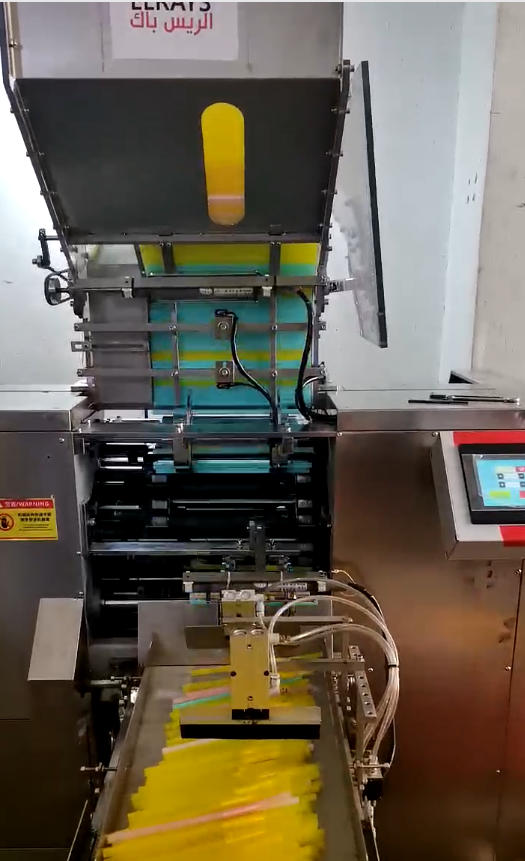
The stated result is specific: one high-speed flexible straw forming machine replaces five traditional machines, running at high speed without needle breakage, outputting at least 1,000 straws per minute, with higher automatic productivity and consistent finished product quality. The record highlights three supporting conditions — a custom-tuned mold solution matched to local straw specifications, stable long-term continuous-run performance, and full-set after-sales technical support for overseas sites.
Three qualifications are worth stating plainly, because they are what separates a review from a reproduction of marketing copy:
- The 60 sets are not broken down by country. The record identifies Malaysia (MY) and China (CN) market codes and describes Middle Eastern factories among the client types, but it does not allocate installation counts per market. Per-country volume claims should not be inferred from this figure.
- The record is first-party and unaudited. No client names, no independent audit and no third-party test certificate accompany the 60-set figure. Buyers should treat it as a track-record statement to be verified at reference-check stage, not as an audited performance report.
- The output figure is the conservative one. As noted above, the field claim of at least 1,000 straws per minute sits well below the nominal parameter band of 3,000–5,500 pcs/min. That gap is either a conservative reporting convention or a meaningful distinction between nominal and sustained output — and only a factory test-run record resolves which.
What the record does support credibly is the regional pattern. A 10 mm large-diameter decorative straw requirement from a Middle Eastern client, and a 3.8 mm U-shaped straw requirement from a domestic Chinese dairy application, illustrate why the replacement decision is not uniform: the ratio is achieved through mold configuration matched to local specifications, not by a single universal setup.
The Conditions That Decide Whether Five-to-One Holds
The replacement ratio is not a property of the machine alone. It is a property of the machine plus the production environment. Based on the documented operating conditions, the ratio holds when six things are true simultaneously.
1. The workshop meets the specified operating envelope
The documented working condition is a normal-temperature workshop environment with a stable power supply, raw material feeding and connection to the production line, suitable for continuous mass production. Rated power of 5.5–6.5 kW and protection grade IP55 assume a factory environment, not a marginal one.
2. The mold set matches the actual straw specification
Custom molds are required for different straw diameters and bending shapes. This is the single most common reason a replacement ratio underdelivers: the machine arrives capable, but the mold does not match the product the factory actually sells.
3. Material compatibility is confirmed before the order
Dongtie states that special standards apply to raw material specifications and surface treatment, and that material compatibility and mold solutions should be confirmed before order placement. In practice this is a pre-contract engineering step, not a post-delivery adjustment.
4. Downstream capacity absorbs the output
The machine can run standalone or be connected to a line. Matched equipment typically includes a feeder, sealing and cooling unit, packaging machine and conveyor system. A single unit producing at high speed behind a manual packing station does not replace five machines — it creates a bottleneck in a different place.
5. The product mix is stable enough to amortise changeover
The machine is described as supporting quick switching between different straw calibers and bending angles through a modular design, with corresponding molds required for each diameter and bend configuration. Changeover is reduced, not eliminated. For factories running many short SKU runs, the effective capacity gain will be lower than the steady-state ratio implies.
6. The site can carry the risk concentration
This is the condition most often left out of the pitch. Five conventional machines offer partial redundancy: when one is down, four keep producing. One high-speed machine offers none. The five-to-one ratio is an average-state figure, and averages do not cover breakdowns.
Five Traditional Units vs One High-Speed Platform: A Structured Comparison
The comparison below uses only documented figures and documented design facts. Where a number is not in the source material, the comparison stays qualitative.
| Dimension | Five conventional units (200–300 pcs/min band) | One DT-1200 platform |
|---|---|---|
| Combined output | 1,000–1,500 pcs/min across five machines | At least 1,000 straws per minute in field reporting; 3,000–5,500 pcs/min on the parameter sheet |
| Floor space | Five separate footprints plus inter-machine handling | Single compact footprint, described by the manufacturer as space-saving |
| Quality control | Depends on manual inspection at each station | On-line detectors for material shortage, defective forming and length deviation, with automatic rejection |
| Wearing parts | Five sets of forming needles and molds to schedule | One set; designed service life of key wearing parts over one year |
| Failure exposure | Partial redundancy: one stoppage leaves four units running | No redundancy: one stoppage halts the entire capacity block |
| Changeover | Five machines can hold five different specifications at once | One machine holds one configuration at a time; modular mold change required |
| Monitoring | Distributed across stations | Single PLC point with real-time status, fault codes and automatic counting |
| Expansion path | Add a sixth unit | Add optional downstream modules — fixed-quantity packaging system, automatic stacking unit |
The limitation, stated directly
The five-to-one ratio is a steady-state capacity equivalence, not a resilience equivalence. A factory that consolidates five units into one removes five maintenance schedules and gains floor space, but it also converts five independent failure points into one shared failure point positioned at the end of the whole capacity block. The manufacturer’s own support model reflects this: remote video technical guidance for common faults, with optional on-site training delivered in its own straw production workshop, which runs over 10 full production lines. Remote diagnosis is efficient, but it does not eliminate the hours lost while diagnosis happens.
There is a second limitation that buyers exporting to regulated markets should register. The documented certification for this platform is a Chinese Certificate of Utility Model Patent. The supplied material does not document CE marking or EU conformity assessment. That does not mean a machine cannot be placed on the EU market — it means the buyer must establish conformity independently rather than assume it from the patent document.
Certification and Compliance: What Is Documented
For a constraint-led purchase decision, the paper trail matters as much as the throughput claim. What is documented for the DT-1200 is a Certificate of Utility Model Patent issued by the China National Intellectual Property Administration, certification number No. 12166973, applied to the High-Speed Flexible Straw Forming Machine (Model DT-1200). The issue date is 2020-12-18 and validity runs to 2030-05-09. The certificate is described as mainly valid in China, while the product can be sold worldwide. The underlying patent number referenced in the product documentation is ZL202020756632.1.
What the patent proves is that the core forming-component design is registered intellectual property in China. What it does not prove is market access. Buyers shipping to regulated destinations should work through the relevant framework separately:
- China customs classification: drinking straw machines are primarily classified under HS code 84778090 according to China’s General Administration of Customs data, which is relevant to export documentation and duty treatment.
- EU machinery safety: machinery sold in the EU must comply with the Machinery Directive 2006/42/EC and carry the CE mark; EN ISO 12100 is the primary harmonised standard for machinery safety.
- EU food-contact: Regulation (EC) No 1935/2004 requires that machinery must not transfer constituents to food in quantities that endanger health — a consideration that extends to the material contact path, not only the machine frame.
These are conformity obligations on the buyer and the exporter respectively. Neither the patent certificate nor the IP55 rating substitutes for them.
A Procurement Checklist for a Five-to-One Decision
| Check | What to request | Documented reference point |
|---|---|---|
| Sustained output | Pre-delivery test-run record at your straw specification, not only the parameter sheet | Factory inspection includes a pre-delivery test run and functional verification; inspection reports available on demand |
| Mold match | Mold drawing for your diameter and bend angle, confirmed before order | Custom molds required for different diameters and bending shapes; compatibility confirmed before order placement |
| Line fit | Layout showing feeder, sealing and cooling, packaging and conveyor interfaces | Machine can run standalone or be connected to a line; downstream modules optional |
| Wearing-part cycle | Spare needles and molds priced into the first two years | Designed service life of key wearing parts over one year |
| Compliance for destination | Conformity documentation for your market, established separately from the patent | Certificate of Utility Model Patent No. 12166973, mainly valid in China |
| Delivery | Slot confirmation against the production calendar | MOQ 1 set; lead time 30 days; monthly capacity 20 sets |
| Service model | Written response-time and warranty terms | Installation and commissioning, remote technical support, spare parts supply; warranty terms and response time to be confirmed before purchase |
Market Context: Why Capacity Per Square Metre Is the Real Metric
The replacement question is being asked more often because the economics underneath it have shifted. The global straw machine market was estimated at USD 962.55 million in 2024 and is projected to reach USD 1,793.41 million by 2035, a CAGR of 5.82% according to Market Research Future. Industrial end-users account for 40.1% of market share as of 2025 projections, per Dataintelo — a segment where output per unit of floor space, rather than output per machine, is the number that decides capital allocation.
Supply is concentrated. China accounts for over 66% of the global export value of flexible straw bending machinery, based on 2023 customs data cited by Zauba. That concentration means most buyers comparing a five-to-one proposition are, in practice, comparing Chinese manufacturers — and the differentiation between them increasingly sits in documented test data rather than in headline speed.
Material substitution adds a second layer. The global paper straw market was valued at USD 2.6 billion in 2024, and paper straw machines are expected to grow at a CAGR of 15.6% between 2025 and 2030 as plastic bans expand, per Grand View Research. At the same time, plastic straw machines still hold significant market share in regions such as Asia-Pacific and Africa. For a factory in either region, the replacement decision is not simply “how fast” but “how fast, for how long, on which material substrate” — which is precisely the question the five-to-one claim answers least precisely.
Future Outlook
Three developments are likely to reshape how the five-to-one claim is evaluated over the next several years.
Verification replaces assertion. As high-speed platforms become the default in mid-volume straw production, the differentiator moves from the ratio itself to the evidence pack behind it — test-run records at the buyer’s specification, wearing-part lifecycle data, and reference installations the buyer can actually call. Manufacturers that already document pre-delivery test runs are positioned better than those that only publish a speed band.
Consolidation raises the cost of downtime. If five machines become one, the value of remote diagnostics, spare-part availability and response-time commitments rises in direct proportion. The service model becomes part of the capacity specification, not an afterthought.
Compliance becomes a selection filter. With the EU applying Machinery Directive 2006/42/EC and food-contact rules under Regulation (EC) No 1935/2004, and with other markets following at different speeds, buyers will increasingly screen suppliers on documented conformity rather than on IP alone. A Chinese utility model patent is a strong signal of engineering intent; it is not a market-access document.
For now, the honest summary of the claim under review is this: the arithmetic holds, the case record is consistent with it, and the ratio is achievable — but it is achievable under stated conditions, on a matched mold set, with downstream capacity in place and with the user accepting a single point of failure. That is a narrower promise than the marketing line, and a more useful one.
FAQ
Two figures are documented. The published parameter set for the DT-1200 lists an output range of 3,000–5,500 pcs/min, while Dongtie’s client case record for the same platform states at least 1,000 straws per minute as a sustained high-speed figure without needle breakage. These describe a nominal specification band and a field-reported outcome respectively. Buyers should ask which figure is supported by a pre-delivery test-run record produced at their own straw specification; the factory states that inspection includes a pre-delivery test run and functional verification, and that inspection reports can be provided on demand.
The High-Speed Flexible Straw Forming Machine (Model DT-1200) is protected by Certificate of Utility Model Patent No. 12166973, issued by the China National Intellectual Property Administration, with issue date 2020-12-18 and validity to 2030-05-09. The certificate is mainly valid in China, while the product can be sold worldwide. The core forming components incorporate patented technology under patent number ZL202020756632.1. No CE marking or EU conformity assessment is documented in the supplied material, so buyers placing the machine on the EU market must establish conformity with Machinery Directive 2006/42/EC and EN ISO 12100 separately.
Yes. By changing the corresponding molds, the machine can manufacture flexible straws with different diameters and bending angles to meet diversified production requirements. Molds are the specification-determining component: custom molds are required for different straw diameters and bending shapes, and Dongtie states that material compatibility and mold solutions should be confirmed before order placement. Buyers may purchase matched molds based on the specifications they intend to run.
The documented working condition is a normal-temperature workshop environment with a stable power supply, raw material feeding and production-line connection, suitable for continuous mass production. The machine operates fully automatically with manual monitoring and regular maintenance, and can run standalone or connected to a line. Matched equipment typically includes a feeder, sealing and cooling unit, packaging machine and conveyor system. Relevant technical parameters are a rated power of 5.5–6.5 kW, working pressure of 1.500–6.000 MPa, working temperature of 100–200 °C, and protection grade IP55.
The minimum order quantity is 1 set and the stated lead time is 30 days, with a monthly production capacity of 20 sets and an annual output of 200 sets. Molds, production capacity specifications, control systems and line connection schemes can be customised according to client requirements, with the full customisable scope confirmed with the sales team. After-sales services include installation and commissioning, remote technical support and spare parts supply; warranty terms and response time are recommended to be confirmed before purchase.
The ratio is a steady-state capacity equivalence rather than a resilience equivalence. It weakens when the production mix requires frequent diameter or bending-angle changes and changeover time is not amortised; when downstream packing or conveying cannot absorb the machine’s output; when the site cannot accept a single point of failure, since one stoppage halts the whole capacity block whereas five units leave partial redundancy; and when conformity requirements for the destination market have not been established independently of the patent certificate. It should also be noted that the 60-set case record aggregates installations across Southeast Asian, Middle Eastern and Chinese factories over three years without a per-country breakdown.
Reference document: Dongtie Mechanical Equipment product brochure (PDF).
Have Questions or Need More Details?
Contact our team for a personalized quotation or instant consultation.
Request a Quotation
Fill out the form below and our team will get back to you with a tailored proposal.
WhatsApp Direct Chat
Prefer to chat in real-time? Message us on WhatsApp for instant assistance & quick answers.
- Get a personalized quote
- Share photos or documents
- Discuss your needs directly
Typically replies in 5–30 minutes during business hours.