
Independent Review: GA01-016 vs Standard Engineered Planks
What a compliance file changes, and what it does not, when a multi-layer engineered flooring unit is compared against a typical catalogue-level market construction.
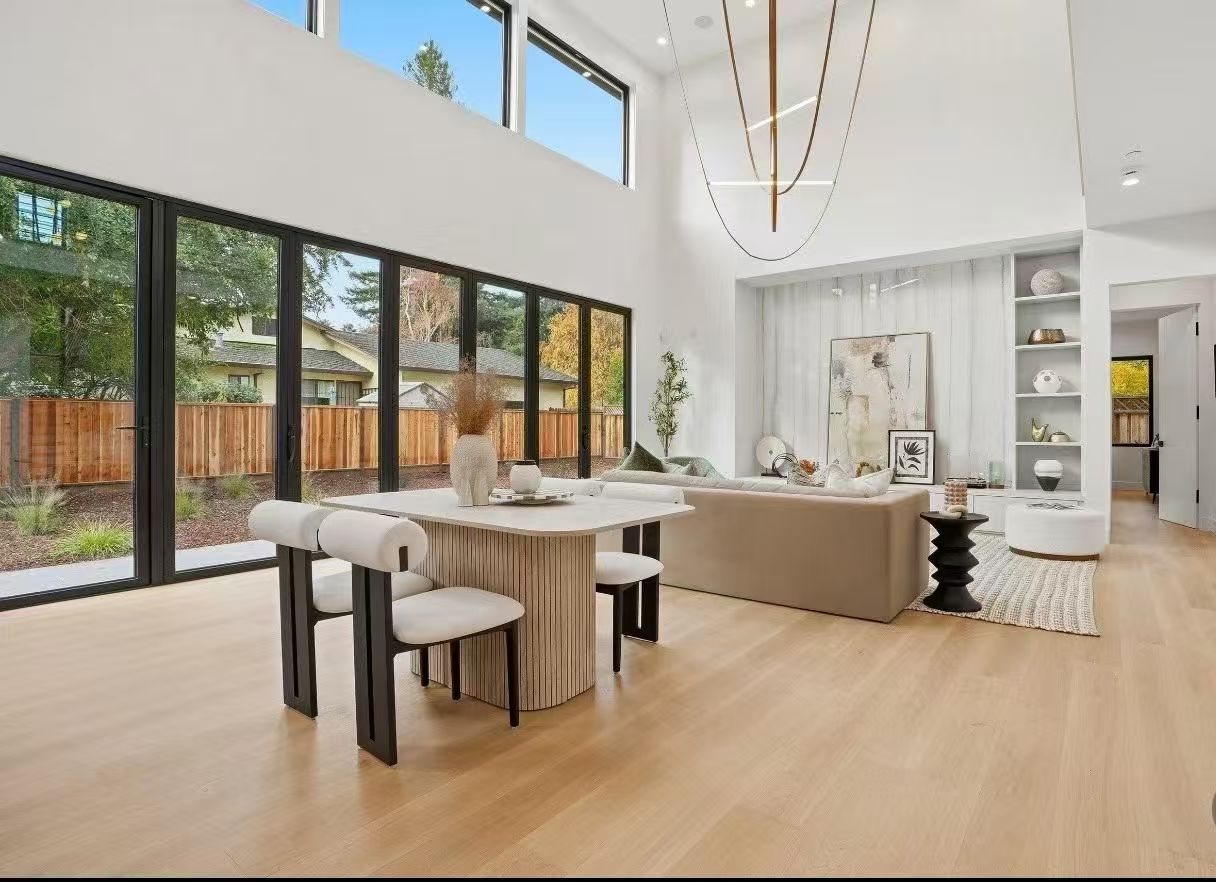
An installed engineered wood flooring floor in a United States residential project, the end point every specification decision is measured against. Image: Dongda Wood.
The Category Is Settled. The Specification Is Not.
Engineered wood flooring is no longer the challenger format. As of 2024, engineered wood flooring accounted for approximately 55% of total wood flooring consumption volume, with solid wood accounting for the remaining 45%, according to segmentation published by Mordor Intelligence. A separate 2026 research cycle projects the global engineered wooden flooring market growing from about USD 9.35 billion in 2026 to USD 14.4 billion by 2035 (Business Research Insights).
Volume at that scale flattens the visible differences. Two multi-layer planks can share the same oak face, the same 1900 mm length and the same factory-applied finish while diverging on the three points that decide whether a container clears an import file and whether a floor still performs in year eight of a hotel contract: how the core is bonded, how thick the wear layer actually is, and whether the emissions documentation exists in a form the destination market accepts.
This review focuses on the third question. It compares a compliance-documented unit, GA01-016 from Dongda Wood, against what a typical market-engineered plank discloses at catalogue level. The purpose is not brand preference. It is to separate the differences a buyer can see before purchase from the ones that only appear afterwards.
The Unit Under Review: GA01-016
Suzhou Dongda Wood Co., Ltd is a China-based manufacturer founded in 1995 in Suzhou, Anhui Province, producing engineered wood flooring and plywood. The company operates a 190,000 m2 facility with more than 500 employees and a 20-engineer R&D team, reports a 100% export orientation, and lists the United States, Canada, Australia, the EU, the United Kingdom, Brazil, Chile and South Africa among its main markets.
GA01-016 sits inside Dongda Wood's engineered hardwood flooring line (listed alongside the CC01-09 reference) and is offered across nine dimension formats that span both thin-veneer and thick-veneer construction:
| Format (Length x Width x Total / Top Layer) | Construction Reading |
|---|---|
| 1200 x 127 x 12 / 1.2 mm | Thin veneer, 12 mm total |
| 1900 x 190 x 12 / 1.2 mm | Thin veneer, 12 mm total |
| 1900 x 190 x 18 / 0.6 mm | Thin veneer, thick board |
| 1900 x 190 x 14 / 3 mm | Thick veneer, 14 mm total |
| 1900 x 190 x 15 / 4 mm | Thick veneer, 15 mm total |
| 2200 x 220 / 240 / 260 / 300 x 15 / 4 mm | Wide plank, thick veneer |
| 3000 x 300 x 19 / 4 mm | Long wide plank, thick veneer |
| 900 x 150 x 15 / 3 mm | Thick veneer, shorter plank |
| 750 x 150 x 15 / 3 mm | Thick veneer, shorter plank |
| 600 x 125 x 14 / 3 mm | Thick veneer, compact plank |
Beyond the plank itself, the programme terms are documented rather than negotiated from zero: OEM/ODM customization covering product dimensions, grade, packaging design and logo; a monthly capacity of 150,000 m2; a 45-day production lead time; a minimum order quantity of 400 m2 per colour; 100% product testing; and a stated warranty of 25 years for residential use and 3 years for commercial use.
That combination, a defined dimension matrix plus stated order terms plus a compliance orientation, is what makes the unit reviewable at all. Most catalogue-level market planks disclose only the first item.
Construction: How to Read 12 / 1.2 mm
Engineered wood flooring is a solid wood veneer bonded to a multi-ply or cross-laminated core. The layered construction is what allows the product to be installed in conditions where solid hardwood boards are not normally recommended, and it is also what makes the specification notation unreadable to anyone outside the trade.
In the format list above, 1900 x 190 x 15 / 4 mm means a 1900 mm plank, 190 mm wide, 15 mm total thickness, carrying a 4 mm solid wood top layer. A 1200 x 127 x 12 / 1.2 mm format follows the same logic at the opposite end: 12 mm total thickness, 1.2 mm veneer. The number after the slash matters more than the length number.
European standard EN 13489:2023, which specifies characteristics, requirements and test methods for multi-layer parquet elements intended for internal flooring, defines the category around a solid wood top layer of at least 2.5 mm. Constructions below that threshold are still engineered wood flooring, but they fall outside that particular definition and are normally specified against different criteria: surface wear performance and finish durability rather than refinishing depth.
For a 15 / 4 mm or 19 / 4 mm plank, the top layer is a working layer that can be sanded and refinished as the surface ages. For a 12 / 1.2 mm or 18 / 0.6 mm plank, the visible surface is effectively the finished face; sanding depth is limited and renovation becomes a surface-treatment decision rather than a resurfacing one. The GA01-016 matrix therefore contains two genuinely different products under one model reference, and the buyer's first task is to decide which one the project actually needs.
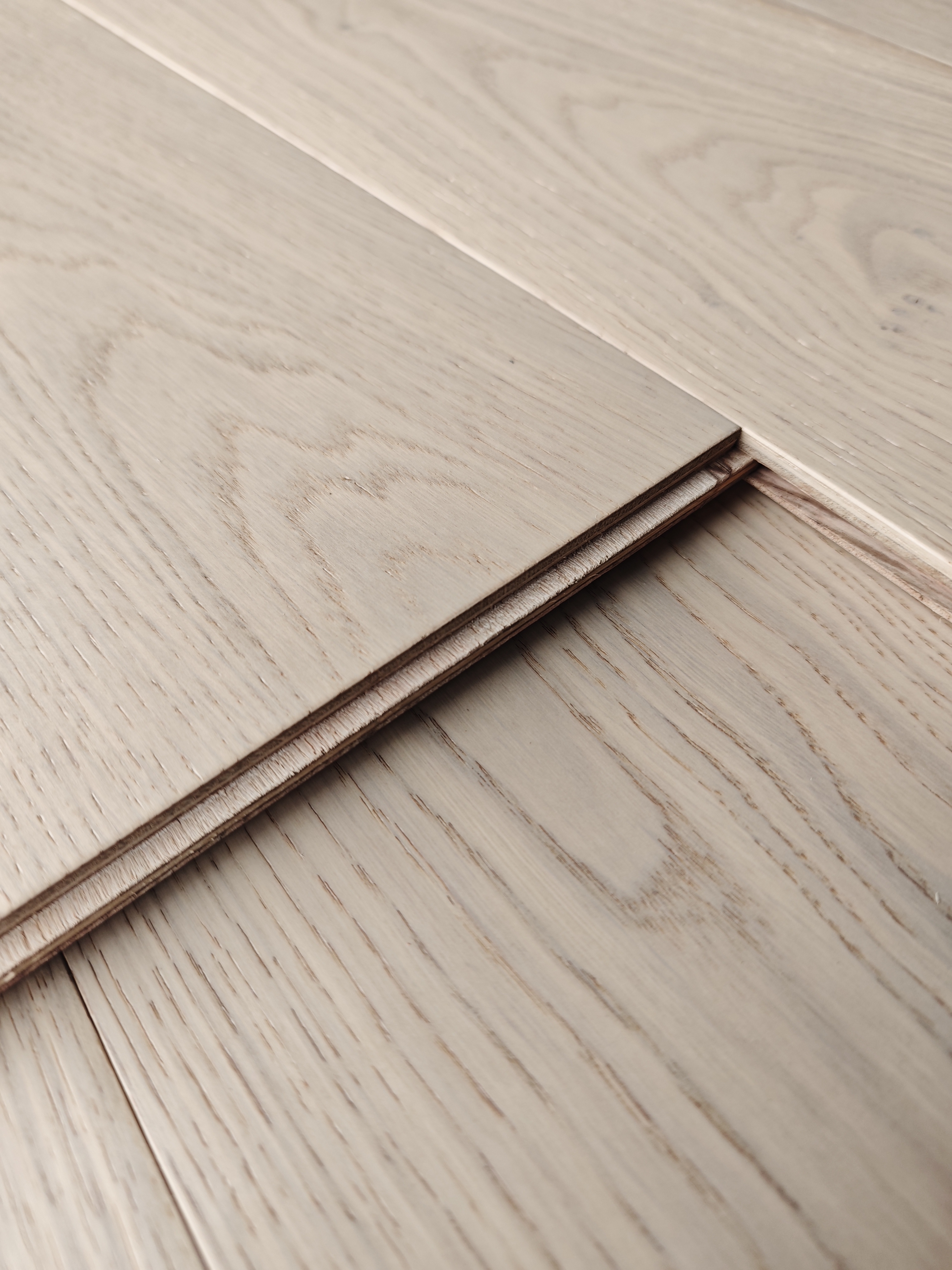
Plank detail from the engineered hardwood range: veneer thickness, core build and edge profile are the specification points that decide renovation depth. Image: Dongda Wood.
One further technical anchor is worth naming. ASTM D1037 is the standard test method commonly used to evaluate properties of wood-base panel materials, including the modified Janka ball hardness test and dimensional change measurement applied to engineered flooring. Both are measures a buyer can request as test values rather than as adjectives on a sales sheet.
Emissions, CARB, EPA TSCA Title VI and What Should Travel With the Container
Formaldehyde emission control is the compliance gate that most often delays a North American engineered flooring shipment, and it is the least visible from a sample.
Two frameworks apply to composite wood products used in flooring in the United States. The California Air Resources Board (CARB) administers the state airborne toxic control measure for composite wood products sold in California. At federal level, the U.S. Environmental Protection Agency administers TSCA Title VI, which sets the national framework for the same product category. Both rules reach the composite core and the resin system that bonds it, not the visible hardwood face.
This is where a real wood veneer can mislead a buyer. A sales sheet that emphasises a solid hardwood surface answers a material question, not an emissions question. On a multi-layer plank, the regulated components are the plywood core, the adhesive system and any added backing layer.
For this application, the stated requirements are low formaldehyde emission, wear resistance and CE certification, a combination that points at both the North American and the European gate. Dongda Wood's production disclosures also reference imported Germany Jianfo paint and Finland Taier phenolic glue in the manufacturing process, which is the part of the supply chain the emissions rules actually address.
The practical difference between a compliance-documented unit and a catalogue-level plank is usually not the board. It is the file. A buyer evaluating a claim of CARB or TSCA Title VI coverage should be able to confirm, without a second request:
- Whether the emissions test report names the specific construction, not only the company name.
- Whether core material and glue type are identified in the technical datasheet.
- Whether the referenced standard edition is the current one.
- Whether the certificate scope covers the factory that will actually run the order.
Certified should be treated as a document claim to be checked, not a marketing adjective to be accepted.
Side by Side: Documentation Coverage
The table below compares what a buyer typically learns from a catalogue-level market plank against what is disclosed for the GA01-016 programme. It is a category-level comparison of disclosure, not a brand-versus-brand verdict: market constructions vary widely, and any shortlist decision should still be made against the specific supplier datasheet.
| Review Dimension | Typical Catalogue-Level Market Plank | GA01-016 (Dongda Wood) |
|---|---|---|
| Top-layer options | Usually one thickness within a narrow band, tied to price tier | 0.6 mm, 1.2 mm, 3 mm and 4 mm builds across a nine-format matrix |
| Core and adhesive disclosure | Frequently omitted from catalogue material | Germany Jianfo paint and Finland Taier phenolic glue referenced in production disclosures |
| Emissions documentation | Often requested late in the buying cycle, if at all | Low formaldehyde emission stated as an application requirement; positioned for North American and EU markets under CARB and EPA TSCA Title VI frameworks plus CE requirements |
| Standard reference | Rarely stated | Range includes a build meeting the EN 13489:2023 definition (top layer of at least 2.5 mm) alongside thin-veneer builds outside it |
| Order terms | Negotiated case by case | 400 m2 per colour MOQ, 45-day lead time, 150,000 m2 monthly capacity |
| Quality control | Sampling-based inspection is common practice | 100% product testing stated |
| Warranty | Often still unwritten at quotation stage | 25 years residential, 3 years commercial |
| Customization scope | Usually limited to stock dimensions | OEM/ODM dimensions, grade, packaging design and logo |
Where the Documented Build Is Not Automatically Better
An independent review has to state the boundaries as clearly as the advantages.
Thin-veneer formats sit outside the EN 13489:2023 category definition. The GA01-016 range includes 1.2 mm and 0.6 mm top-layer constructions. These are valid products for value-driven projects, but they cannot be presented as multi-layer parquet under the 2.5 mm definition, and buyers comparing them against a 4 mm unit are really comparing two different project requirements.
Refinishing depth is proportional to veneer thickness. A 0.6 mm or 1.2 mm face limits how many times a floor can be sanded and refinished. For a single-life-cycle residential renovation this is often acceptable; for a commercial corridor with an expected refurbishment cycle, a 3 mm or 4 mm top layer is the more conservative specification.
Compliance documents are unit- and factory-specific. A certificate covering one construction does not automatically transfer to another thickness, another species, another core build or another production site. Specification changes made mid-order can require re-confirmation.
Standards move. EN 13489:2023 supersedes the 2017 edition of the same standard. Test reports and declarations that reference the older edition should be checked for currency before they are placed in a tender file.
Application conditions are defined, not universal. The product is specified for indoor residential dry-environment conditions and for residential and commercial interior decoration. It operates in click and glue dual installation modes and requires skirting boards and floor trims as supporting components.
Compliance does not prove scratch behaviour or dimensional stability. Those are separate tests. A low formaldehyde emission statement answers the emissions question and nothing else.
Project Fit: Renovation, Hotel and Office
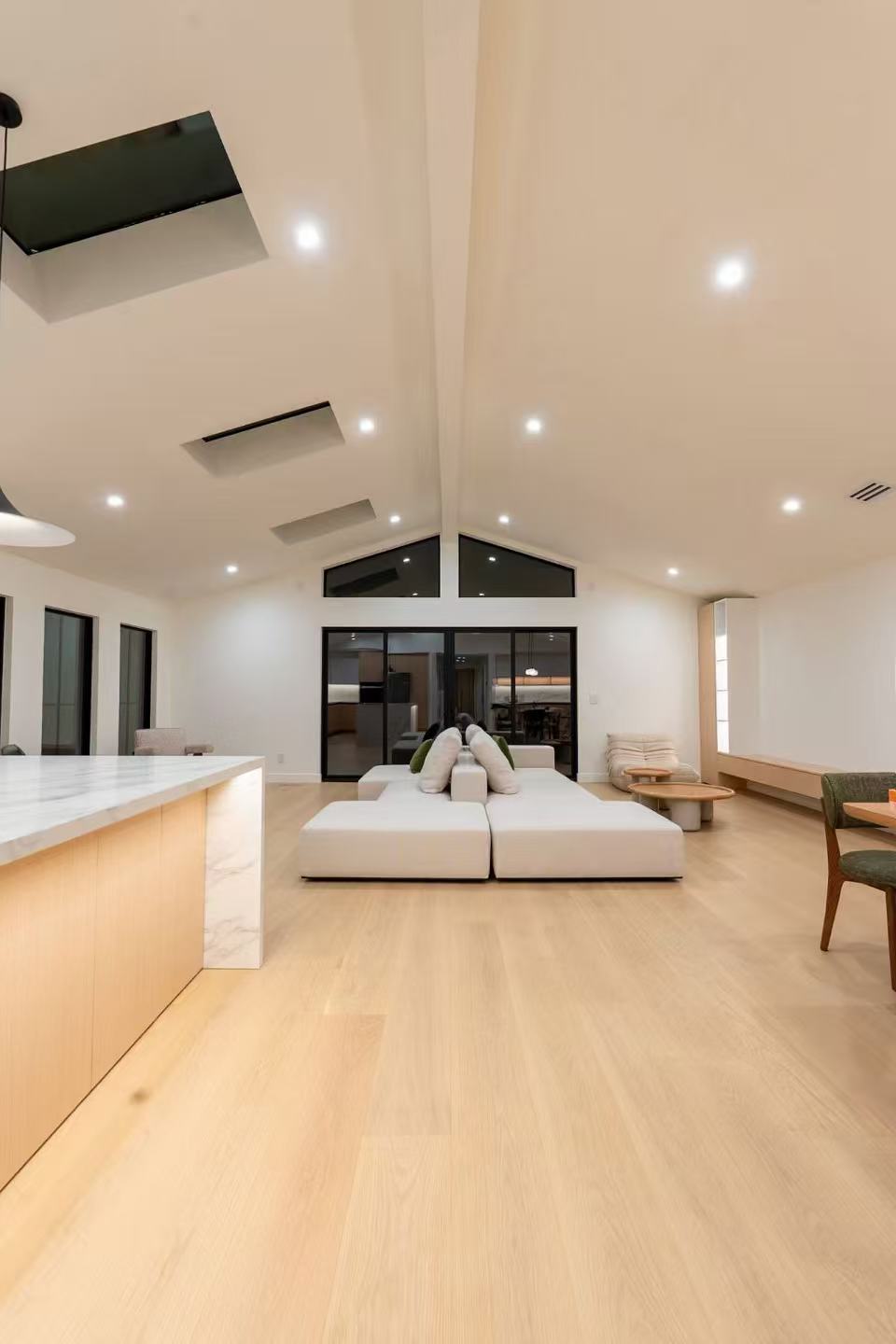
A second completed installation in the United States, showing the finish and plank proportion at room scale. Image: Dongda Wood.
The application record for this construction type covers residential house renovation and commercial hotel and office interior decoration, with the scenario documented across Australia, Brazil, Canada, Chile, France, Guatemala, Ireland, Italy, Japan, Kuwait, Monaco, Madagascar, Mexico, New Zealand, Peru, the Philippines, Portugal, Qatar, Saudi Arabia, Sweden, Singapore, Thailand, Turkey, the United Kingdom, the United States and South Africa.
Canada provides the clearest evidence base. Dongda Wood's Canadian programme covers residential house renovation together with commercial hotel and office interior decoration at a scale of 300,000 m2 per year over more than ten years, with brand owners, wholesalers, contractors and distributors as the client types. Reported outcomes are high durability, stable surface performance and long service life in indoor decoration projects. The stated highlights for that market are low formaldehyde emission, high scratch resistance, underfloor heating compatibility, and customizable wood grain and sizes.
The useful reading of that case is not the volume figure in isolation. It is that the same construction has been supplied into both a low-traffic residential segment and a high-traffic commercial segment inside a North American market with an active emissions enforcement regime. It is also notable that the two attributes attached to the case record, scratch resistance and grain customization, are precisely the ones that most often decide whether a specification survives value engineering.
Market Signals Behind the Compliance Question
Three signals explain why compliance coverage has moved from a purchasing footnote to a shortlisting filter.
Scale. Engineered wood flooring now accounts for the majority of wood flooring consumption volume, which means the buyer population has shifted from specialists who knew the construction differences to general importers and project specifiers who need those differences documented.
Trade classification. Multi-layer assembled wood flooring panels of wood other than bamboo fall under HS code 4418.75. That places the product in a well-defined customs lane and, by extension, under well-defined documentation expectations at import.
Standard revision. The 2023 edition of EN 13489 replaced the 2017 edition, resetting the reference point for what a multi-layer parquet element is and how it should be tested. Whenever a core standard moves, supplier declarations built on the older edition become a visible differentiator during exactly the period when buyers are comparing suppliers.
Taken together, these signals point in one direction: the compliance file is becoming part of the product.
Outlook
The next phase of competition in engineered wood flooring is unlikely to be fought over species or finish. Oak is available to everyone, and surface technology converges quickly between suppliers. The differentiators that hold are structural and documentary: veneer thickness matched to the project renovation cycle, order terms that fit the buyer inventory model, and an emissions and conformity file that can be transferred into a tender without rework.
For a buyer running a 2027 project cycle, the practical implication is to add one column to the supplier scorecard. Not does the supplier offer certification, but which construction, which factory, which certificate and which standard edition. GA01-016 is one unit that answers that column with a defined dimension matrix, stated order terms and a North American compliance orientation. The comparison in this review is not a verdict on the market; it is a reminder that the same-looking plank is frequently two different procurement decisions.
FAQ
What is the difference between the GA01-016 unit and a typical market engineered plank?
GA01-016 is offered across nine formats with top layers of 0.6 mm, 1.2 mm, 3 mm and 4 mm, under stated order terms of 400 m2 per colour MOQ, 45 days lead time, 150,000 m2 monthly capacity and 100% product testing, with a warranty of 25 years residential and 3 years commercial. A catalogue-level market plank usually discloses dimensions and finish only; core glue type, veneer thickness in millimetres and emissions documentation generally have to be requested separately.
Which markets and installation conditions is this construction specified for?
It is specified for indoor residential dry-environment conditions and for residential and commercial interior decoration projects. It operates in click and glue dual installation modes and requires skirting boards and floor trims as supporting components. The installation scenario is documented across Australia, Brazil, Canada, Chile, France, Guatemala, Ireland, Italy, Japan, Kuwait, Monaco, Madagascar, Mexico, New Zealand, Peru, the Philippines, Portugal, Qatar, Saudi Arabia, Sweden, Singapore, Thailand, Turkey, the United Kingdom, the United States and South Africa.
What should a buyer request before approving GA01-016 for a hotel or residential project?
A technical datasheet naming the exact construction, total thickness, top-layer thickness, species and core build; an emissions test report that references that construction and the producing factory; conformity documentation valid for the destination market; confirmation that the referenced EN 13489 edition is the current 2023 edition; ASTM D1037 based hardness and dimensional change test values where the project requires them; a physical sample in the specified grade and finish; and the warranty terms in writing.
Is the product suitable for underfloor heating?
Underfloor heating compatibility is listed among the stated product highlights for the Canadian market record. Compatibility should still be confirmed for the specific thickness and installation mode in the order, because click and glue assemblies manage movement differently.
How do the thin-veneer and thick-veneer versions differ for a project?
The 1.2 mm and 0.6 mm builds limit how far the surface can be sanded and refinished, and they sit outside the EN 13489:2023 definition, which is built around a solid wood top layer of at least 2.5 mm. The 3 mm and 4 mm builds function as a working layer that can be refinished as the surface wears. The choice should follow the expected refurbishment cycle of the building, not the purchase price alone.
What are the commercial terms for ordering?
The programme is quoted with a minimum order quantity of 400 m2 per colour, a 45-day production lead time and a stated monthly capacity of 150,000 m2. OEM and ODM customization is available for product dimensions, grade, packaging design and logo.
Reference document: the Dongda Wood engineered wood flooring brochure is available for download at Dongda Wood engineered wood flooring brochure (PDF).
Have Questions or Need More Details?
Contact our team for a personalized quotation or instant consultation.
Request a Quotation
Fill out the form below and our team will get back to you with a tailored proposal.
WhatsApp Direct Chat
Prefer to chat in real-time? Message us on WhatsApp for instant assistance & quick answers.
- Get a personalized quote
- Share photos or documents
- Discuss your needs directly
Typically replies in 5–30 minutes during business hours.