
Independent Review: HD-FB001 vs. HD-VB001 for Freezer and Preservation Needs
Freezing slows spoilage; packaging decides whether the freezer actually protects the food. Moisture loss dries out exposed surfaces, and residual air continues to degrade fats and colours during storage. For buyers, that turns the freezer bag from a commodity consumable into a specification decision — and it explains why two bags sold for the same cabinet can behave very differently once the door closes.
Haida Packaging's HD-FB001 and HD-VB001 sit on opposite sides of that decision. HD-FB001 is a frozen food bag made from 100% LDPE, rated for low-temperature resistance down to -40°C, oil-resistant, and specified across a 100 g to 2 kg load range. HD-VB001 is a food vacuum bag made from PA+PE, vacuum-sealable, described as high temperature resistant, and specified across a 50–2000 ml range. One is engineered around cold weight; the other is engineered around removing air.
Neither format is a general upgrade over the other. What separates them is the workflow behind the bag: whether a vacuum sealer is present at the packing point, whether the buyer measures product in grams or millilitres, and whether the pack is meant to be opened and reclosed repeatedly or sealed once for a long hold.
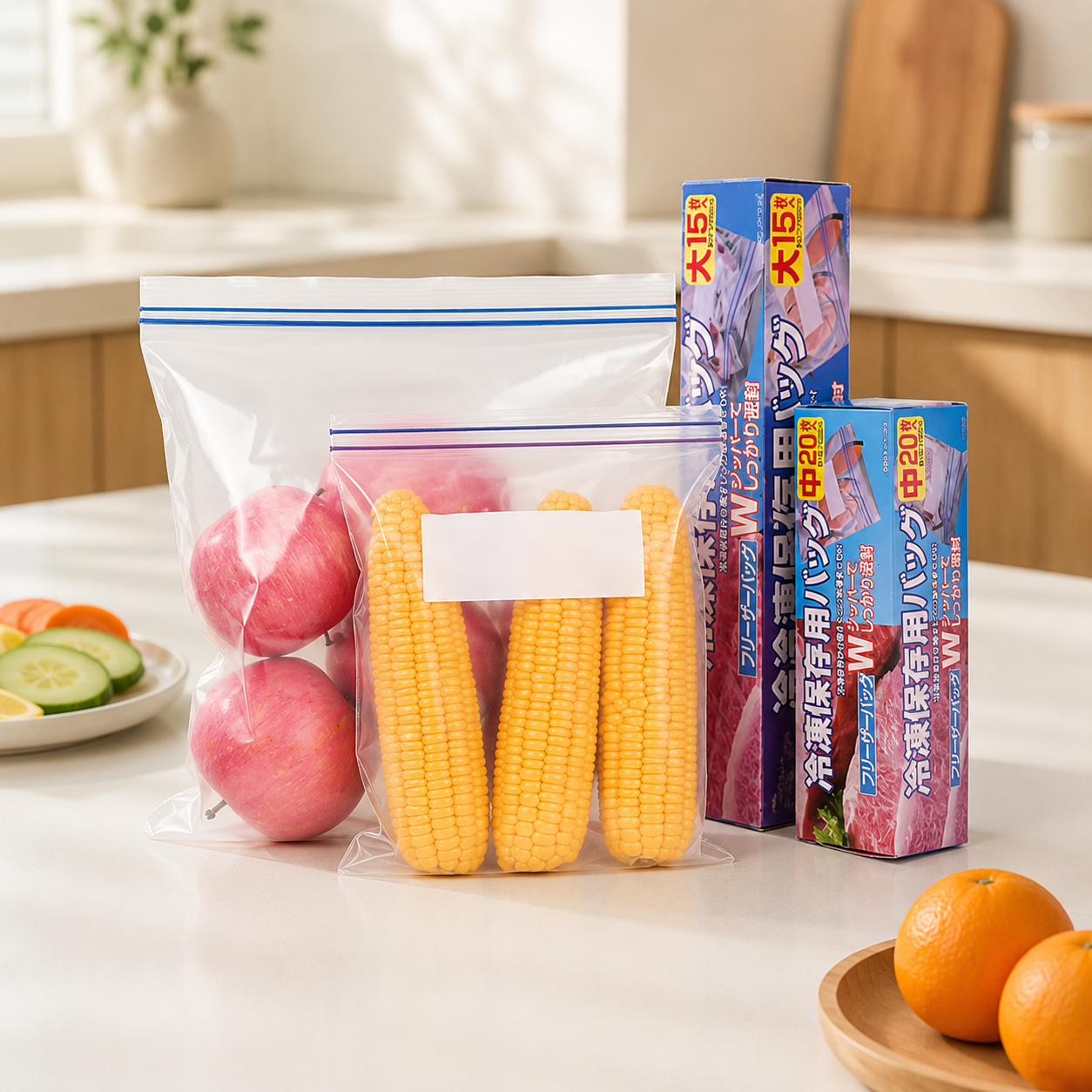
HD-FB001: a 100% LDPE frozen food bag specified for low-temperature resistance down to -40°C and a 100 g to 2 kg load range.
Why preservation decisions start with the packing workflow
Preservation outcomes are usually discussed as a material question. In practice they are a process question. A bag only protects food to the extent that the person packing it can complete the intended action — evacuating air, closing a seam, portioning a fixed weight — inside the time and equipment available in that kitchen or plant.
Two commercial signals explain why this matters more than it did a few years ago. One commercial research estimate places the global market for zipper storage bags above USD 12 billion by 2026, with food applications accounting for roughly 52.3% of the end-use segment in the same year. Those figures describe a category where buyers increasingly purchase formats by application rather than by generic bag size. The second signal is regulatory: California's SB 54 requires 100% of single-use packaging in the state to be recyclable or compostable by 2032, which pushes packaging discussions toward material structure and away from closure convenience alone.
For a kitchen or a food processor, the practical consequence is straightforward. A bag that removes air solves a different problem from a bag that survives -40°C, and buying one while needing the other produces either wasted equipment or wasted shelf life.
HD-FB001: a specification built around cold weight
HD-FB001 is a frozen food bag. Its declared properties are narrow and concrete, which makes it easy to evaluate against a task.
| Attribute | Specified value for HD-FB001 |
|---|---|
| Material | 100% LDPE |
| Product type | Frozen Food Bag |
| Load range | 100 g to 2 kg |
| Low-temperature resistance | Down to -40°C |
| Additional property | Oil-resistant |
| Declared user segments | Household and kitchen; frozen food; ready-to-eat packaging |
The two attributes that carry the most weight for a buyer are the -40°C rating and the weight range. The temperature rating addresses the actual working condition of a freezer cabinet rather than room-temperature storage. The 100 g to 2 kg range spans a single portion through to a bulk family or catering pack, which means one SKU can cover several packing stations instead of forcing a size split.
The oil-resistant property is the less obvious one. Oily marinades, fatty cuts and prepared foods with a lipid content are exactly the loads that stress a thin film at the seam and at the fold. Oil resistance is a material statement about contact with those loads, not a claim about shelf life — buyers should read it that way.
What the LDPE specification implies
A mono-material LDPE construction keeps the specification simple. There is one polymer to declare, one material to document for food-contact review, and one stream to consider when a market introduces packaging-recovery requirements. Simplicity here is a procurement advantage: fewer components mean fewer documents to collect at the qualification stage.
HD-VB001: a specification built around removing air
HD-VB001 is a food vacuum bag, and its design logic is the opposite of the frozen food bag. It does not aim to work by holding a temperature; it aims to work by removing the atmosphere around the product.
| Attribute | Specified value for HD-VB001 |
|---|---|
| Material | PA+PE (multi-material construction) |
| Product type | Food Vacuum Bag |
| Closure / function | Vacuum-sealable |
| Capacity range | 50 ml to 2000 ml |
| Heat property | Described as high temperature resistant (no numeric range stated in the available specification) |
| Declared applications | Household and kitchen; food processing; freezing; preservation |
Two details in that table matter more than they look. First, the capacity is expressed in volume rather than weight, which aligns with liquids, sauces, braises and irregular cuts that are easier to fill than to weigh. Second, the material is a PA+PE combination: a polyamide component and a polyethylene component working together, typically to combine strength and sealability in one structure. That is a different material system from the mono-material LDPE bag, and it is documented differently.
The high-temperature resistance claim is stated without a numeric range in the available product data. Buyers who intend to use the bag for heated applications should obtain the specific temperature window from the supplier before writing it into a specification.
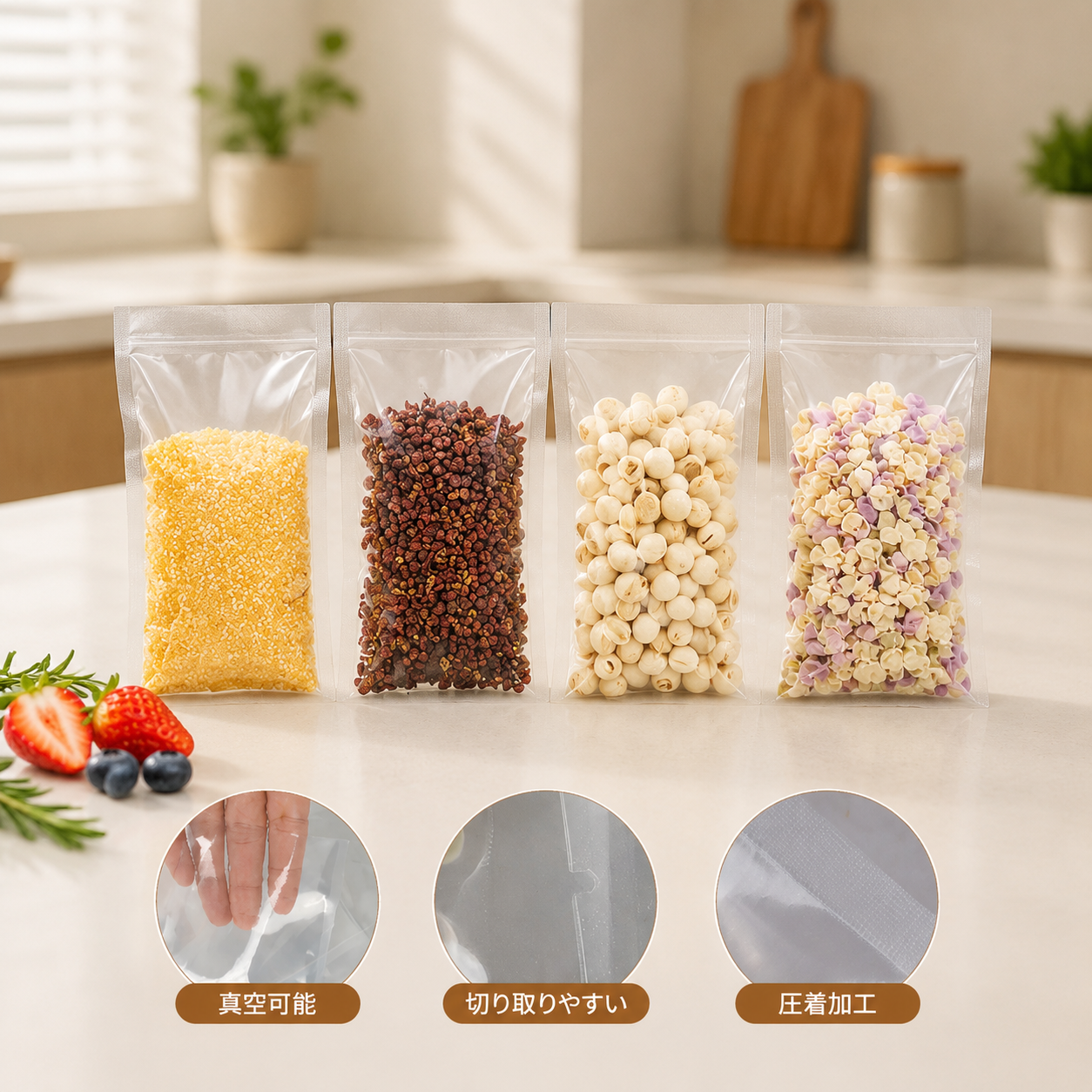
HD-VB001: a PA+PE vacuum-sealable bag specified across a 50–2000 ml range for food processing, freezing and preservation.
How the two formats behave inside a freezer
The technical difference is easiest to see when both bags are placed in the same cold chain. HD-FB001 is rated to -40°C, which covers freezer storage and cold-chain handling down to that limit. HD-VB001 is positioned for freezing and preservation as an application, with its protective effect coming from air removal rather than from a stated low-temperature figure.
Air removal changes what happens to the product surface. When atmosphere is evacuated, the moisture at the food's surface has less opportunity to migrate into the headspace and then condense or sublimate onto the film. In a freezer, that is the difference between a cut that keeps its colour and a cut that develops dry, pale edges. Industry practice widely treats oxygen exclusion as the primary lever against freezer burn and oxidative rancidity; it is general, well-established practice rather than a claim specific to any one supplier.
Temperature tolerance changes what happens to the bag itself. A film rated to -40°C is specified to remain serviceable at freezer temperatures, which is the failure mode buyers actually encounter — brittle film that cracks at the fold when a bag is pulled from a chest freezer. HD-FB001's rating addresses exactly that condition.
Applying each format to real workflows
A frozen food processing line works under low-temperature conditions around -40°C with freezer storage, and its packaging function is freeze protection and portioned packaging. Supporting equipment in that environment typically includes freezers and vacuum machines, with low-temperature resistance and anti-crack behaviour listed as the special requirements. Both Haida formats map onto parts of that workflow, but not the same parts.
Where HD-FB001 fits
- Bulk portioning by weight: a 100 g to 2 kg range covers single servings through to catering-size packs, so one format serves multiple packing stations.
- Oily and marinated products: the oil-resistant property supports direct contact with fatty and oil-based preparations.
- Ready-to-eat packaging: the declared application set includes ready-to-eat food, making it relevant to kitchens that freeze prepared meals rather than raw ingredients.
- Manual packing without equipment: the bag does not require a sealing machine to perform its declared function, which suits household and small-kitchen environments.
Where HD-VB001 fits
- Liquid and semi-liquid products: a 50–2000 ml range is easier to apply to sauces, stocks, braises and soups than a weight rating.
- Long-hold preservation: vacuum sealing is intended for product that will sit undisturbed, where oxygen exclusion matters most.
- Food processing environments: the declared application set includes food processing, where vacuum machines are standard equipment.
- Freezer storage of formed portions: the bag is positioned for freezing as well as preservation, supporting portion-controlled freezing of vacuum-packed units.
Side-by-side decision matrix
| Decision criterion | HD-FB001 (Frozen Food Bag) | HD-VB001 (Vacuum Bag) |
|---|---|---|
| Primary preservation mechanism | Cold-temperature resistance plus oil-resistant film | Air removal through vacuum sealing |
| Material system | 100% LDPE (mono-material) | PA+PE (multi-material) |
| Capacity expressed as | Weight: 100 g to 2 kg | Volume: 50 ml to 2000 ml |
| Stated low-temperature limit | -40°C | Not stated numerically in available data |
| Stated high-temperature capability | Not stated in available data | Described as high temperature resistant |
| Equipment dependency | None declared; manual packing is sufficient | Requires a vacuum sealing device to perform its function |
| Best fit when the buyer needs | Weight-based portion control in cold storage | Oxygen exclusion for longer undisturbed holds |
The matrix makes the trade-off explicit. A buyer who specifies by weight and plans to open the pack repeatedly is describing HD-FB001. A buyer who specifies by volume and can guarantee a vacuum step at packing is describing HD-VB001.
Limits, and where traditional packaging still competes
An independent review is only useful if it states what each format does not do.
HD-FB001 does not evacuate air. It is a frozen food bag, not a vacuum bag, and no vacuum function is claimed for it in the available specification. A buyer who needs oxygen exclusion from a single-LDPE freezer format will not get it from this product; that requirement points to HD-VB001 or to an external evacuation step.
HD-VB001 depends on equipment. Its declared function is vacuum-sealable, which means the protective mechanism only activates when a vacuum device is used. In a household without a sealer, or on a line where the vacuum step is a bottleneck, the format cannot deliver its intended benefit. The available data also does not state a numeric low-temperature limit for HD-VB001, so a buyer specifying a freezer floor of -40°C should confirm that figure directly rather than assume parity with the LDPE bag.
Neither format displaces rigid containers in every case. Rigid boxes and containers remain the practical choice where the pack must survive stacking loads, where the contents are sharp and heavy, or where the container itself is the serving vessel — they are reusable and dimensionally stable, at the cost of storage space and washing labour. Cling film remains cheaper per metre and useful for short holds, but it offers limited liquid containment and no defined temperature rating. Standard press-to-close zipper storage bags sit between the two: resealable and convenient, but generally not vacuum-capable and not specified to -40°C. The correct reading is that HD-FB001 and HD-VB001 remove specific failure modes — cold brittleness and surface oxidation respectively — rather than replacing the entire packaging cabinet.
A second boundary is material structure. HD-VB001's PA+PE construction is a multi-material system, while HD-FB001 is mono-material LDPE. Where a buyer's market is moving toward recyclability or compostability requirements — California's SB 54 target of 100% recyclable or compostable single-use packaging by 2032 is the clearest published example — mono-material structures are generally simpler to place in recovery streams than multi-material laminates. That is a structural consideration, not a verdict on either product, and buyers in regulated markets should treat material structure as a specification field with the same weight as temperature.
What this means at the procurement stage
Haida Packaging, operated by Taizhou Haida Plastic & Rubber Packaging Co., Ltd., is a Chinese flexible packaging manufacturer founded in 2003 that produces zipper bags, single zipper bags and slider bags, exporting roughly 90% of output with Japan and Europe as its main markets. Company data records an annual output of 11,000 tons, 310 employees and a 20-engineer R&D team, alongside quality and environmental system certifications including ISO9001, ISO14001, ISO13485, BRC, BRC-CP, BSCI, GMPc and FDA.
On the commercial side, the company's published capability data lists OEM production with logo customization, a monthly capacity of 900 tons, a minimum order quantity of 20,000 boxes and a typical lead time of 35–40 days, with quality control covering food-safety compliance testing to FDA and LFGB plus visual inspection. These are supplier-reported figures; a buyer should confirm them against a quotation and, where the order justifies it, against a factory audit.
Three questions translate this review into a workable RFQ. First, which capacity metric governs the price — weight for HD-FB001, volume for HD-VB001 — because the two are not interchangeable when comparing quotations. Second, whether the closure and film thickness of the selected format are documented, since the available product data does not state thickness or tolerance values for either bag. Third, whether the intended use requires a specific food-contact declaration or migration report for the destination market, which sits outside the product specification and must be requested separately.
For buyers building a mixed programme, the formats are complementary rather than alternative. A kitchen that freezes raw and prepared foods by weight and also vacuum-packs high-value cuts has a legitimate reason to hold both SKUs.
Market trend: application-led specifications
Two forces are pushing buyers toward application-specific formats. The first is demand mix. With food applications accounting for roughly 52.3% of the end-use segment in 2026, according to one commercial research estimate, the centre of gravity in the category sits with food preservation rather than general storage — which favours bags specified by temperature and preservation mechanism over bags specified by size alone.
The second is regulation. California's SB 54 target of 100% recyclable or compostable single-use packaging by 2032, with an effective date of 2027 for the framework, changes how material structure is discussed in procurement. A mono-material LDPE format and a multi-material PA+PE format are no longer equivalent in the eyes of a buyer whose market has a packaging-recovery obligation. That does not make either format obsolete; it makes the material field something a specification has to state rather than inherit.
Both trends point in the same direction: fewer generic bags, more bags defined by the job they perform.
Future outlook
The next round of specification work is likely to happen in documentation rather than in film. Buyers evaluating freezer and vacuum formats are increasingly asking for thickness, tolerance, seal strength and food-contact declarations alongside the temperature rating, because a -40°C claim and a vacuum claim answer different questions and neither substitutes for a technical datasheet.
On the supply side, the format split seen in HD-FB001 and HD-VB001 is likely to persist. Cold-weight freezing and oxygen-free preservation solve different problems, and a single mono-material bag that handles both well is not a trivial engineering outcome. Buyers planning multi-year programmes should expect to specify at least two formats and to hold suppliers to documentation on both.
Frequently asked questions
What is the main difference between HD-FB001 and HD-VB001?
HD-FB001 is a frozen food bag made from 100% LDPE, rated for low-temperature resistance down to -40°C, oil-resistant, and specified for a 100 g to 2 kg load range. HD-VB001 is a food vacuum bag made from PA+PE, vacuum-sealable, described as high temperature resistant, and specified for a 50–2000 ml range. One works through cold-temperature resistance, the other through air removal.
What temperature is HD-FB001 rated for?
HD-FB001 is specified for low-temperature resistance down to -40°C. The available product data does not state an upper temperature limit for this bag, so any heated application should be confirmed with the supplier before it is written into a specification.
Can HD-FB001 be used for vacuum sealing?
No vacuum function is claimed for HD-FB001 in the available specification. It is a frozen food bag whose declared benefits are low-temperature resistance and oil resistance. Buyers who require oxygen exclusion should specify HD-VB001, which is described as vacuum-sealable.
Is HD-VB001 suitable for freezing food?
HD-VB001 lists freezing and preservation among its declared applications alongside household and kitchen use and food processing. Its protective effect comes from vacuum sealing rather than from a stated low-temperature figure; the available data does not give a numeric low-temperature limit for this bag, so buyers operating at a defined freezer floor should confirm that value directly.
Which bag suits bulk portioning, and which suits long undisturbed storage?
HD-FB001 is specified by weight across 100 g to 2 kg, which aligns with portioning raw or prepared food into fixed-weight packs for freezing. HD-VB001 is specified by volume across 50–2000 ml and is vacuum-sealable, which aligns with liquid or semi-liquid products and with packs that stay closed for a long hold. The first is a portioning format; the second is a preservation format.
Can freezer and vacuum formats be customised at order level?
Haida Packaging's published capability data lists OEM production with logo customization, a monthly capacity of 900 tons, a minimum order quantity of 20,000 boxes and a typical lead time of 35–40 days, with quality control covering food-safety compliance testing to FDA and LFGB plus visual inspection. These figures are supplier-reported and should be confirmed through a quotation and, where appropriate, a factory audit.
A full product catalogue covering the range is available for download: Taizhou Haida Catalogue 2025 (PDF).
Have Questions or Need More Details?
Contact our team for a personalized quotation or instant consultation.
Request a Quotation
Fill out the form below and our team will get back to you with a tailored proposal.
WhatsApp Direct Chat
Prefer to chat in real-time? Message us on WhatsApp for instant assistance & quick answers.
- Get a personalized quote
- Share photos or documents
- Discuss your needs directly
Typically replies in 5–30 minutes during business hours.