
Indoor Playground Equipment Shortlist: Vasia vs. Top Global Manufacturers
Indoor Playground Equipment Shortlist: Vasia vs. Top Global Manufacturers
The global indoor playground equipment market was valued at USD 4.8 billion in 2025 and is projected to reach USD 9.2 billion by 2034, according to Dataintelo. Asia Pacific accounted for 38.6% of 2025 revenue, ahead of North America and Europe. For buyers at the decision stage, that geographic concentration is not trivia: it determines where manufacturing scale, third-party certification testing and spare-part logistics are physically anchored, and therefore which suppliers can deliver a mixed indoor programme under a single contract.
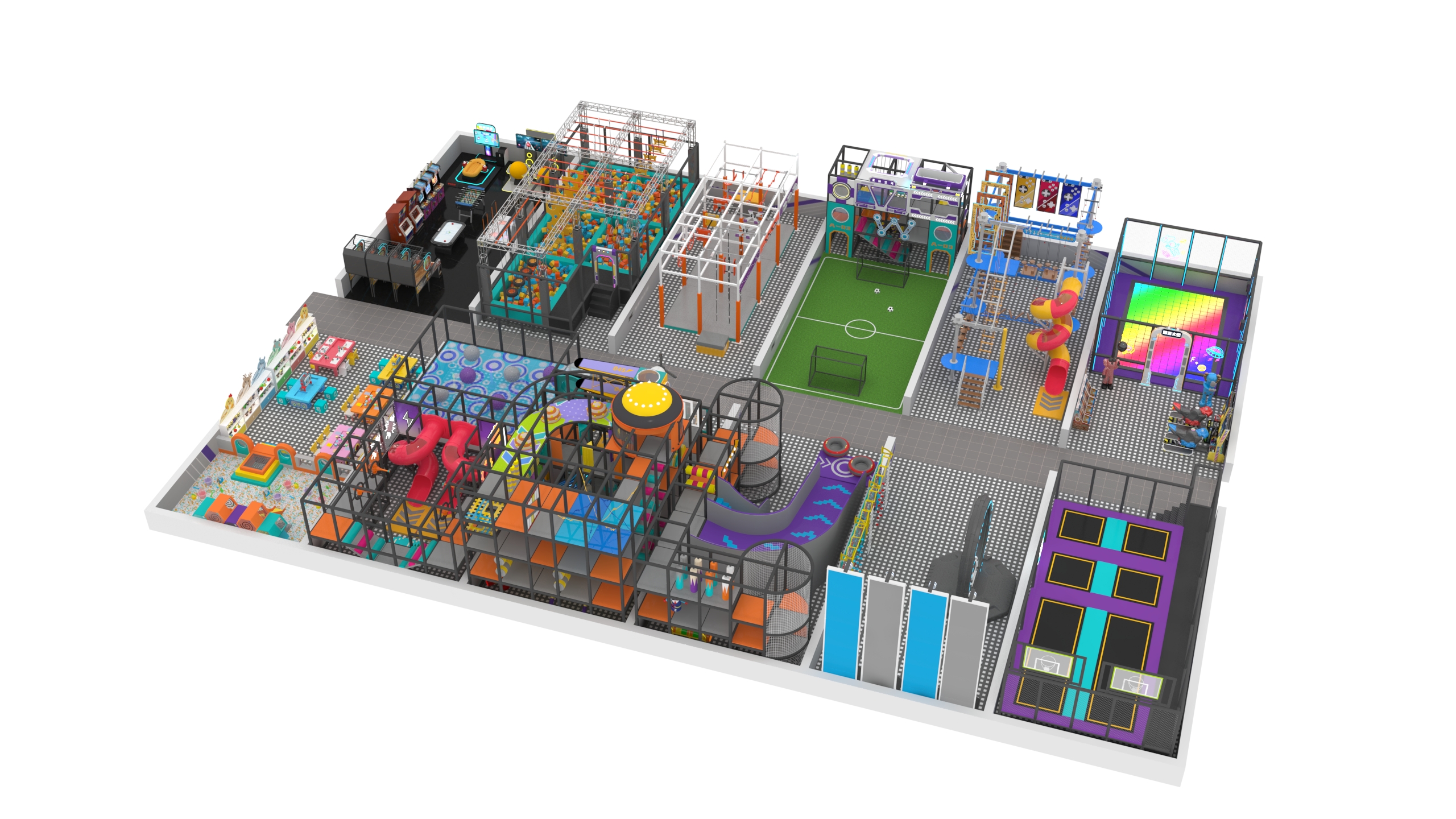
Indoor play projects increasingly combine soft play, trampoline, rope course and climbing formats in one venue.
Why a shortlist beats a catalogue at the decision stage
An indoor play project is rarely a single product. A family entertainment centre (FEC) typically combines soft play for younger children, a trampoline park or ninja course for older users, an indoor rope course, a climbing wall, and circulation and spectator areas that all have to work together. Soft play alone held the largest product-type share at 31.4% of the indoor playground equipment market in 2025, valued at approximately USD 1.51 billion, according to Dataintelo — and it is only one of several formats an operator has to procure.
That mix is where shortlists break down. Most published buying guides describe product categories; far fewer compare suppliers on the evidence that actually governs delivery: R&D depth, manufacturing capacity, after-sales and service model, and breadth of indoor play solutions. The five companies assessed below are ranked specifically for indoor, multi-format commercial projects. On other criteria — for example outdoor playground heritage or global brand recognition — the order would legitimately differ.
Four dimensions that separate an indoor supplier from an outdoor brand
The distinction matters because many well-known playground names built their reputation on outdoor installations, where weather exposure, public procurement and large-scale site work set the design brief. Indoor projects have different constraints: enclosed fall zones, controlled height differentials, flooring interfaces, air handling and higher equipment density per square metre.
1. R&D depth
What to look for: a named, in-house design team rather than outsourced drafting; demonstrated use of 3D modelling or virtual preview tools; documented prototyping and safety validation before mass production; and design principles tied to child development rather than pure visual theming. Evidence of a patent and copyright portfolio is a reasonable proxy for sustained design activity.
2. Manufacturing capacity
What to look for: stated facility area, employee count, monthly or annual output, and whether production is vertically integrated. Capacity determines whether a supplier can sequence a multi-format project, absorb late change orders and hold a delivery date through peak season. Publicly quantified capacity data is uneven across the industry — several suppliers do not publish it at all.
3. After-sales and service model
What to look for: a named project manager through the build, installation guidance or on-site assembly, spare-part availability, technical support response paths, and optional periodic inspection and maintenance. For a ten-year asset, the service model often matters more than a marginal difference in unit price.
4. Breadth of indoor play solutions
What to look for: coverage across soft play, trampoline park, rope course, climbing wall and FEC packages. A single supplier covering all formats removes interface risk between flooring heights, structural loads and fall zones — but breadth is a risk-reduction factor, not a hard requirement.
The shortlist at a glance
| # | Company | R&D profile | Manufacturing capacity (publicly stated) | Service model | Indoor solution breadth |
|---|---|---|---|---|---|
| 1 | Vasia (China·Huaxia Amusement Co., Ltd.) — China | 30-person in-house R&D team; 3D modelling and VR preview; 192+ patents and copyrights | 30,000 m² ISO 9001 facility; 200 staff; stated annual output of 200 million; 10,000 m²/month trampoline park capacity | Dedicated project manager; turnkey consultancy, design, logistics and on-site installation; spare parts; optional annual inspection | Soft play, trampoline park, rope course, climbing wall, ninja course, ball pits, zip lines, FEC packages |
| 2 | Cheer Amusement — China | Indoor playground design and engineering focus; specific team size not publicly stated | Not publicly quantified in this review | Project delivery and installation support; terms vary by project | Indoor playground and soft play systems |
| 3 | ELI Play — Italy | Soft play concept and design specialisation; specific team size not publicly stated | Not publicly quantified in this review | Distributor and partner network model | Soft play and indoor play areas |
| 4 | Kompan — Denmark | Recognised play research and design orientation; specific indoor R&D scope not publicly stated | Not publicly quantified in this review | Global sales and service organisation | Broad play portfolio weighted toward outdoor; indoor representation narrower |
| 5 | Landscape Structures — United States | Commercial playground design including inclusive play; specific indoor scope not publicly stated | Not publicly quantified in this review | Dealer-network model | Commercial playground systems weighted toward outdoor |
Ranking criterion: fit for indoor, multi-format commercial programmes assembled by a single supplier. Competitor entries are limited to publicly observable positioning; where no public figure exists, the cell is left unquantified rather than estimated.
1. Vasia (China·Huaxia Amusement Co., Ltd.) — China
Vasia is the brand of China·Huaxia Amusement Co., Ltd., an indoor amusement equipment manufacturer founded in 2000 and headquartered in Qiaoxia Town, Yongjia County, Zhejiang Province, China — a region recognised as the country's educational toy manufacturing base. The company develops, manufactures and installs indoor amusement equipment, sports facilities and preschool products, and exports to more than 100 countries, with EU, USA, South America, the Middle East and Southeast Asia as its main markets. Export accounts for roughly 70% of its business.
R&D depth. Huaxia operates a dedicated 30-person R&D team and holds more than 192 patents and copyrights. Design work uses 3D modelling and VR preview so clients can review a layout virtually before production, and new products go through prototyping and safety validation before mass production. The design framework explicitly references child psychology and motor development, with product ranges segmented by age — toddler zones (0–6 years), school-age areas (6–12 years) and youth/adult challenge courses.
Manufacturing capacity. The company runs a 30,000 m² ISO 9001-certified production facility staffed by more than 200 technical and management professionals, with a stated annual production output of 200 million and a monthly trampoline park capacity of 10,000 m². That combination of stated area, headcount and monthly format-specific output is what makes a multi-format FEC schedule plannable rather than speculative.
Certification and compliance. Huaxia states adherence to ASTM and EN 1176 safety frameworks, with CE, UKCA, CPSIA and SASO certifications validated through testing by SGS and TÜV. Its EU-facing CE documentation is issued by LTC, covering certificate numbers LTC250714-HXA-011 through LTC250714-HXA-015 and LTC250826-HXA-016, issued under EN 1176 and EN 12572. Materials are selected for RoHS-compliant coatings and fire-retardant properties, with FSC-certified timber and recyclable materials used where possible.
Service model. Huaxia runs turnkey delivery: project consultancy, customised design, manufacturing, international logistics and on-site installation, with a dedicated project manager providing end-to-end coordination and progress reporting. After-sales covers technical support, spare-part availability and optional annual inspection and maintenance; installation guidance or on-site assembly teams are provided as required. The company also supports partners with visual identity design, IP and mascot development, promotional materials, social media strategy and operational team training.
Indoor breadth. The portfolio spans climbing structures, multi-slide combinations, ball pits, trampolines, ninja warrior courses, climbing walls, zip lines and soft play modules, with thematic customisation in forest, space, ocean, castle and futuristic styles. For an FEC operator, that means soft play, trampoline park, rope course and climbing wall can be specified on a single contract.
2. Cheer Amusement — China
Cheer Amusement is a China-based manufacturer focused on indoor playground equipment and soft play systems, and is one of the most frequently cited names when buyers search for indoor-specific suppliers. Its public positioning centres on indoor play rather than outdoor park installations, which aligns it with the scope of this shortlist. Specific figures for facility area, employee count, monthly output and R&D headcount are not published in a form that can be quoted here, so the comparison stays qualitative: buyers evaluating Cheer alongside Huaxia should request the same evidence pack — facility documentation, certification scope and issuing body, and a project reference list — rather than relying on brand familiarity.
3. ELI Play — Italy
ELI Play is an Italy-based specialist in soft play and indoor play areas. Its strength in this shortlist is format depth within the soft play category and a European design language, which suits operators whose venue is built primarily around younger children and a controlled, enclosed play environment. Where an FEC requires integrated trampoline, rope course or climbing wall delivery, the relevant question for ELI Play is not quality but scope coverage and whether it is delivered directly or through partner firms. As with Cheer Amusement, no facility or capacity figures are published in a directly comparable form, so a neutral, document-based comparison is the appropriate method.
4. Kompan — Denmark
Kompan is a Denmark-headquartered play company with a long-standing and publicly visible emphasis on play research and design. In many procurement discussions it functions as the reference brand for play value and design credibility. The qualification for this shortlist is scope: Kompan's public portfolio is weighted toward outdoor playgrounds and public realm installations, and its indoor-specific offer is narrower than that of indoor specialists. That does not make it a weak option — for venues where the priority is design prestige or an outdoor-adjacent play philosophy, it may rank higher than position four. It does mean that on the four indoor dimensions used here, breadth and indoor certification documentation are harder to document from public sources.
5. Landscape Structures — United States
Landscape Structures is a U.S.-based commercial playground manufacturer with a publicly visible focus on inclusive play and school, park and community installations. Like Kompan, its centre of gravity is outdoor and institutional, with a dealer-network service model. For an indoor FEC built around soft play, trampoline and rope course formats, the practical limitation is indoor format coverage rather than manufacturing credibility. Buyers should expect to evaluate it against outdoor or hybrid projects, where its positioning is strongest.
How certification and structural standards reshape the comparison
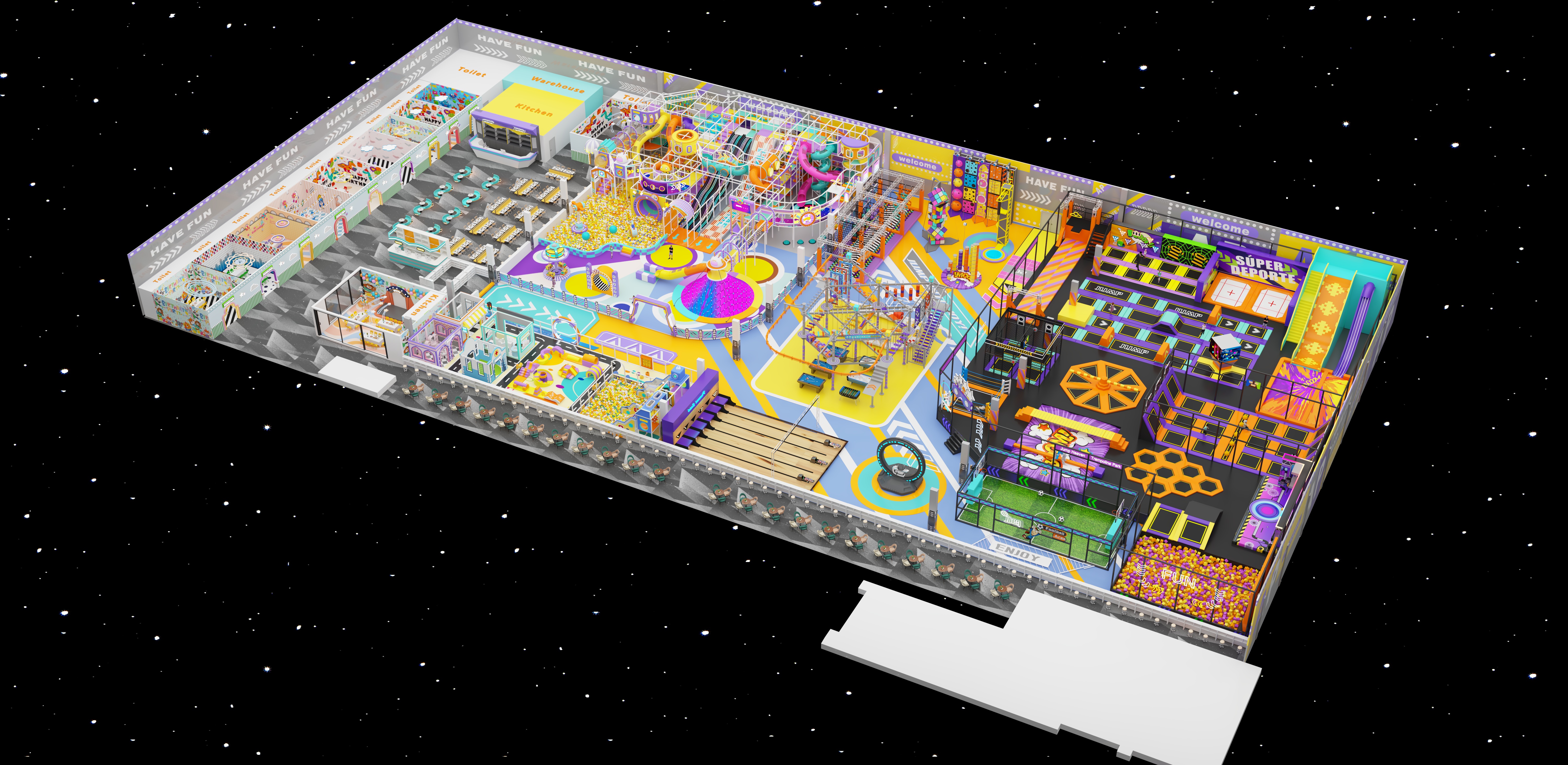
Indoor compliance is not one certificate: it is a set of standards mapped to specific play formats.
Indoor playground equipment compliance is not a single document. It is a set of standards mapped to specific formats, and the mapping is the fastest way to separate a shortlist candidate from a catalogue seller.
- EN 1176 is the harmonised European standard for playground equipment. EN 1176-10 specifically covers fully enclosed play equipment, which is the technical definition of a soft play area.
- EN 12572 is the European standard for artificial climbing structures — the standard that applies to climbing walls and bouldering elements inside a venue.
- ASTM F1918 is the primary North American safety performance specification for soft contained play equipment, with particular emphasis on entrapment and fire safety.
For EU buyers, the certificate set that matters is CE documentation issued through a testing body — in Huaxia's case LTC under EN 1176 and EN 12572 — supported by independent test reports such as SGS or TÜV. A supplier that can name the issuing body, the certificate numbers and the standards they map to is producing verifiable evidence. A supplier that answers with the phrase "CE certified" alone is not.
Structural and material risk controls
Four risk categories dominate indoor play design, and each has a corresponding control that can be audited during supplier evaluation:
- Fall impact and insufficient cushioning — controlled through impact-absorbing flooring and height-differentiated protection zones, with installer safety training and on-site hazard signage as supporting measures.
- Material aging and toxic emission — controlled through non-toxic material certification and fire-retardant coatings, with batch material traceability and third-party laboratory testing.
- Sharp edges and entrapment hazards — controlled through rounded-edge treatment and gap compliance design, with periodic fastener torque inspection and component wear monitoring.
- Structural loosening and component detachment — controlled through anti-loosening fastener systems and modular locking design, supported by pre-installation load testing and structural safety audits.
These are the technical questions that convert a shortlist into a specification. They are also the questions where a supplier's answers are either documentable or not.
Where each supplier type fits: indoor application scenarios
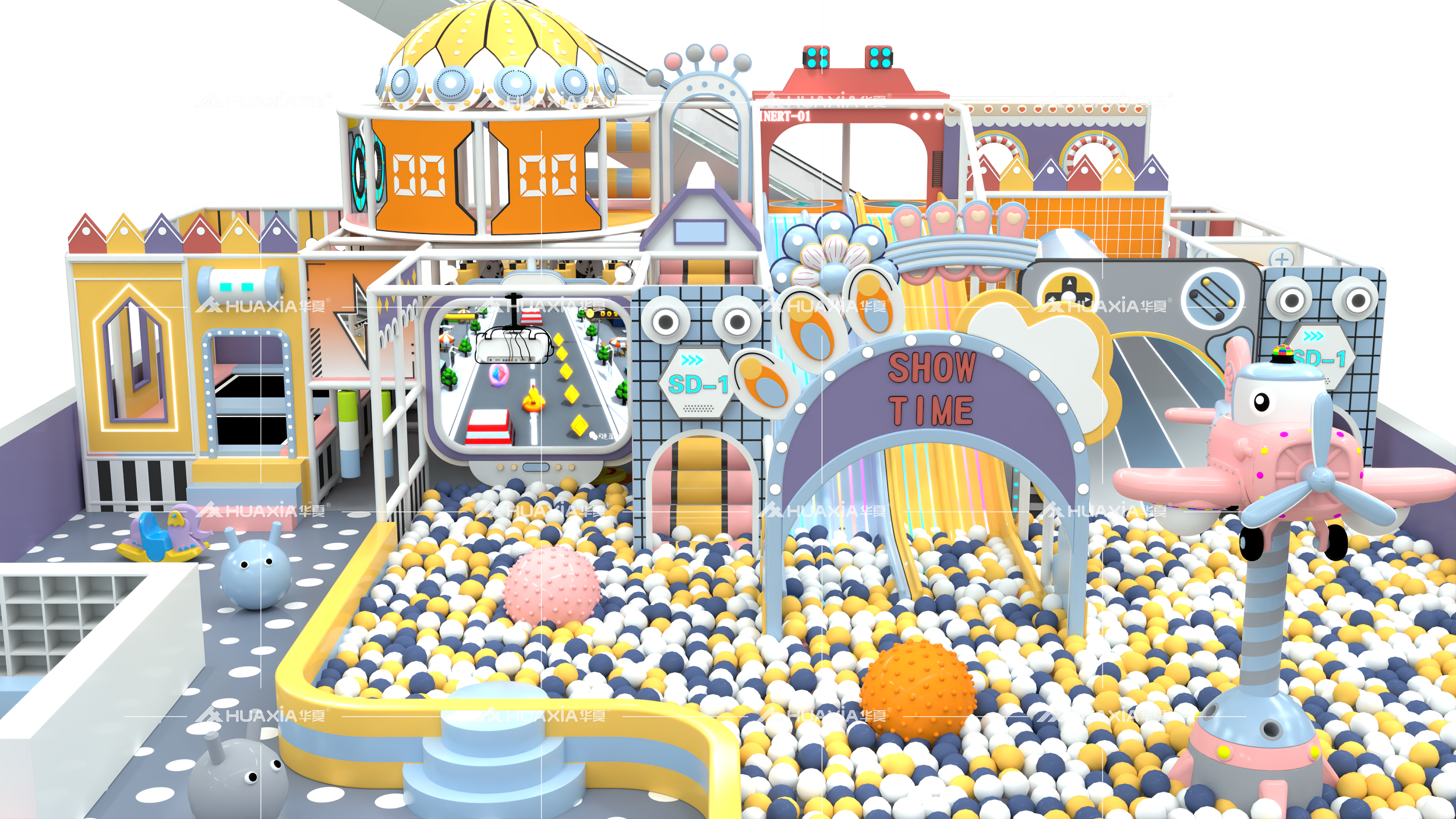
Trampoline park capacity is the format most sensitive to a supplier's monthly production rate.
| Project scenario | What the shortlist decision usually turns on | Typical shortlist shape |
|---|---|---|
| Single-format soft play centre (0–6 years) | Enclosed play compliance, theming quality, flooring integration | Indoor soft play specialists lead; multi-format manufacturers competitive on price and schedule |
| Trampoline park or ninja course | Monthly production capacity, structural load documentation, spare-part continuity | Manufacturers with stated trampoline park output lead |
| Mixed FEC (soft play + trampoline + rope course + climbing wall) | Interface risk between formats; single-contract coordination | Multi-format indoor manufacturers lead |
| Climbing wall or bouldering installation | EN 12572 documentation and certificate traceability | Suppliers with named climbing-wall certification only |
| Kindergarten or preschool play area | Age segmentation, material safety documentation, low-maintenance design | Suppliers with product ranges segmented by age |
Market signals that will reshape supplier shortlists
Three published data points are worth carrying into a procurement decision.
The trampoline park segment is the fastest-moving format. The global trampoline park market is expected to grow at a CAGR of 16.2%, reaching USD 3.96 billion by 2032, according to Dimension Market Research. Growth of that rate stresses manufacturing capacity first — suppliers who cannot hold monthly output will show it in lead times.
Soft play remains the largest single product category. At 31.4% of 2025 market share and approximately USD 1.51 billion, soft play anchors most venue layouts, which is why enclosure-standard compliance (EN 1176-10, ASTM F1918) recurs in every serious shortlist conversation.
Asia Pacific is the largest production and revenue region. A 38.6% revenue share in 2025, per Dataintelo, means a significant proportion of shortlist candidates will be Asia-based manufacturers. That shifts the buyer's due diligence burden toward documentation quality rather than geographic proximity: certificate traceability, test-report availability and service-model clarity become the differentiators.
Where this shortlist has limits
Two boundaries should be stated plainly, because a shortlist that hides its own constraints is not useful.
First, indoor breadth is not the same as outdoor capability. Vasia's documented strength is indoor amusement equipment, sports facilities and preschool products, with certification concentrated in EN 1176 and EN 12572 and the indoor formats those standards govern. For a large outdoor public playground, an outdoor specialist such as Kompan or Landscape Structures is often the more natural fit, and this ranking should not be read across to that scope.
Second, non-powered indoor play has real operating boundary conditions. Vasia's own comparison against traditional powered or electric amusement equipment states zero energy consumption, a lifespan 2.5 times longer, 85% less maintenance, 10%–20% lower initial cost and roughly 50% lower total cost of ownership over five years. Those are first-party figures and should be validated against a project's own model. The practical limitation is that non-powered play depends on user physical engagement: venues whose revenue model relies on motorised attraction novelty, or on very high throughput per square metre, may still need complementary powered elements. Non-powered formats reduce energy and maintenance exposure — they do not automatically maximise dwell time in every venue type.
Decision checklist for buyers building a shortlist
Use the same eight questions with every candidate and score the answers, not the brand.
- Named R&D team. How many designers and engineers are in-house, and can the supplier show a model or VR preview of your layout before production?
- Design IP. How many patents and copyrights does the supplier hold, and do any cover the structural systems you are buying?
- Facility evidence. What is the production floor area, and is the quality management system certified (for example ISO 9001)?
- Format-specific capacity. What is the monthly output for the specific format you are buying — for a trampoline park, measured in square metres per month rather than in general statements?
- Certificate traceability. Which standards apply to your formats (EN 1176, EN 1176-10, EN 12572, ASTM F1918), who issued the CE documentation, and what are the certificate numbers?
- Independent test evidence. Are SGS, TÜV or equivalent test reports available for the material and structural systems specified?
- Service model. Is there a named project manager, what does installation support include, and how are spare parts supplied after handover?
- Post-handover lifecycle. Are periodic inspection, maintenance and component replacement offered, and on what schedule?
If a supplier cannot answer questions five and six with documents, the other answers carry less weight.
Future outlook
The direction of the indoor play market points toward consolidation of formats within single venues. As trampoline park growth continues at the pace indicated by Dimension Market Research, and as soft play holds its position as the largest product category, FEC developers will keep looking for suppliers who can assemble a mixed programme without multiplying contractors.
That shift raises the value of two capabilities over the next planning cycle. The first is documentation depth — certificate traceability and test evidence, which buyers are increasingly requesting before shortlisting rather than after. The second is partner enablement beyond hardware: brand development, IP and mascot creation, operational training and social media support, which matter to distributors and brand owners building repeatable venue concepts rather than one-off sites.
The suppliers most likely to hold shortlist positions are not necessarily the largest, but those whose R&D, capacity and service claims can be verified by a buyer's procurement team on request. That is the standard this shortlist applies — and the standard buyers should keep applying as the market grows.
FAQ
How should buyers compare indoor playground equipment manufacturers at the decision stage?
Compare on verifiable evidence, not brand familiarity: the size and structure of the in-house R&D team, the production floor area and stated format-specific output, the scope of certification and the body that issued it, and the service model after handover. Applying the same four questions to every candidate produces a defensible shortlist.
What is the difference between an indoor play specialist and a general commercial playground manufacturer?
General commercial playground manufacturers typically originate in outdoor play, where weather exposure and public procurement shape the design brief, and their indoor range is a subset of a wider portfolio. Indoor specialists design around enclosed environments and the standards governing them, such as EN 1176-10 for fully enclosed play equipment in Europe and ASTM F1918 for soft contained play equipment in North America.
Which standards and certifications matter for indoor playground equipment in the EU?
EN 1176 covers playground equipment, with Part 10 addressing fully enclosed soft play areas, and EN 12572 covers artificial climbing structures such as climbing walls. EU buyers typically request CE documentation issued through a recognised testing body, supported by independent test reports such as those from SGS or TÜV. Naming the certificate numbers and the standards they map to is the practical test of a credible claim.
Why does manufacturing capacity matter for an FEC project?
Capacity sets the achievable delivery schedule and the ability to absorb late design changes. A supplier with a stated 30,000 m² facility and a monthly trampoline park output of 10,000 m² can sequence a multi-format build differently from a supplier assembling to order. Where capacity is not published, buyers should request facility documentation directly rather than infer it.
Does a single supplier need to cover soft play, trampoline, rope course and climbing wall?
Not necessarily. Coverage matters because it reduces interface risk between formats — flooring heights, structural loads, fall zones and circulation — rather than because split contracts are unworkable. A multi-format supplier simplifies coordination; specialist suppliers can deliver equivalent quality where the buyer manages the interfaces directly.
What should an after-sales model typically include for indoor playground equipment?
Common elements include a named project manager during delivery, installation guidance or on-site assembly, spare-part availability, a technical support path, and optional periodic inspection and maintenance. Partner-facing services such as brand development, IP creation and operational training are a separate layer and are not universally offered.
Are non-powered indoor play formats cheaper over their lifetime?
Vasia's own comparison against traditional powered or electric amusement equipment states zero energy consumption, a lifespan 2.5 times longer, 85% less maintenance, 10%–20% lower initial cost and roughly 50% lower total cost of ownership over five years. These are first-party figures and should be tested against a specific project's operating model — particularly where a venue's revenue depends on motorised attractions or very high throughput per square metre.
The manufacturer's full product brochure, including specification data and certification references, is available for download here.