
Induction Heater Shortlist: Matching JONSON Models to Smart Manufacturing Loads
Load matching, not rated power, is the constraint that decides which industrial induction heater a smart manufacturing plant should specify. Two facilities can run the same 380V supply, target the same process temperature, and still need different machines — because coil geometry, thermal mass, duty cycle and acceptable ramp time define the real heat demand. The shortlist below organizes JONSON induction heater models, from the wall-mounted 5kW/8kW JS1300-005/008 up to the 100kW JS1000-100, by power, voltage window and the process loads each is built to serve, and states where each model stops being the right choice.
JONSON is the brand of Guangdong Jiangxin Electronic Technology Co., Ltd., a Foshan-based manufacturer founded in 2011 that builds induction heaters, induction heating coils, induction steam generators and induction hot air generators for plastics and rubber, food processing, chemical reaction, crude oil pipeline heating, textile printing and dyeing, aquaculture heating, metal heat treatment, building heating and medicinal herb drying. Published company figures include a 3,000㎡ production site, 60+ employees, 30+ engineers, an annual output of 120,000 units and a 40% export ratio, with OEM and ODM production offered at a minimum order quantity of one unit.
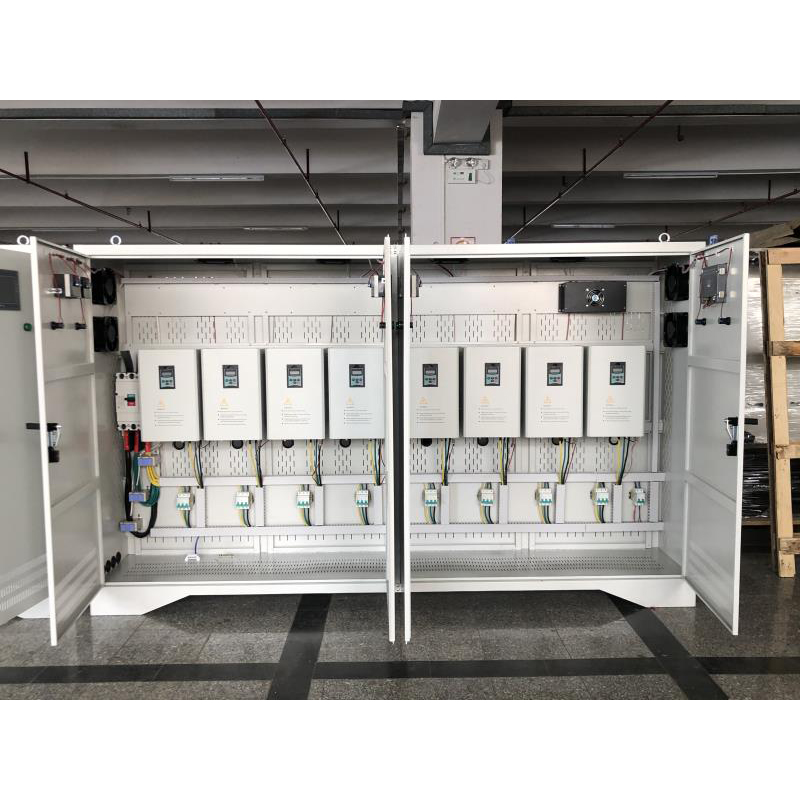 Induction heating equipment in an industrial setting: the machine rating matters less than how the coil couples to the actual load.
Why load matching comes before model selection
Industrial induction heating works on a physical principle that changes what a buyer should compare. A 50Hz mains supply is converted by an IGBT inverter module into a 5–40kHz high-frequency current, which drives an electromagnetic coil to produce an alternating magnetic field; eddy currents then form inside the metal itself, so the workpiece heats without contact and without a flame. The heater is therefore only half the system. The coil, the standoff distance to the metal, and the insulation around the heated zone determine how much of the nameplate rating actually reaches the process.
Three questions narrow the choice faster than a specification sheet does:
- What is the receiver? If the load is a steel barrel, a reactor jacket, a pipe or a bearing, direct induction applies. If the load is water, air or a non-conductive medium, an induction boiler, steam generator or hot air generator sits in between.
- What ramp and turndown does the process need? JONSON units regulate between 20% and 100% of rated power. That floor is a design boundary: a load that idles below one-fifth of the rating will cycle rather than modulate.
- What can the electrical supply deliver? Voltage adaptation windows differ by model, and the largest frame draws a substantial three-phase current that must exist at the panel before the machine arrives.
The shortlist at a glance
| Model | Rated power | Voltage / adaptation | Structure & cooling | Documented certification | Typical load role |
|---|---|---|---|---|---|
| JS1300-005/008 | 5kW / 8kW | 380V; adaptation 380V ±20% | Wall-mounted; −20 to 40°C ambient | CE, ISO | Small platens, barrels, pilot lines, single-zone heating |
| JS1300-10/15 | 10kW / 15kW | 380V; adaptation 300–400V | Wall-mounted; 7.3kg net | CE, ISO, RoHS | Mid-size extruder barrels, drying drums, small thermal-oil circuits |
| JS1000-20 | 20kW | 380V; adaptation 300–400V | Wall-mounted; air- or water-cooled | CE, ISO | Larger barrels, tanks, single reactor jackets |
| JS1000-30 | 30kW | 380V rated (no published adaptation window) | Wall-mounted; air- or water-cooled | CE, ISO | Multi-zone manifolds, reactor heating, medium process heat |
| JS1000-100 | 100kW three-phase | AC 380V / 50–60Hz; constant power output at 300–400V | Wall-mounted; air- or water-cooled; 35kg | CE, ISO | Plant-scale reactors, boilers, pipeline and high-throughput lines |
| Induction heating coil | 1kW–100kW | 220V / 380V; ±20% adaptation | Copper; custom-wound | ISO 9001:2015 | The coupling element for any frame above |
| JS-1600 steam generator | 30kW / 40kW / 50kW | 380V / 50–60Hz; adaptation 380V ±20% | Vertical; 304 stainless steel liner | Confirm scope per order | Steam supply for process and sterilization |
| JS-1600-8/12/15 hot air generator | 8kW / 12kW / 15kW | 380V; adaptation 300–400V | Vertical; outlet 80–130°C | CE, ISO, RoHS | Hot air drying, curing, tunnel ovens |
Reading the models by load
JS1300-005/008 — 5kW and 8kW at 380V
The smallest frame in the industrial shortlist is rated 5kW/8kW at 380V, with a voltage adaptation range of 380V ±20%, power adjustment from 20% to 100%, and a wall-mounted enclosure measuring 295mm × 169mm × 145mm. Ambient tolerance is −20 to 40°C at up to 95% humidity. This is the model for a single heated zone where the metal mass is modest and the barrel or platen geometry is fixed — a small extruder, a laboratory or pilot line, or one zone of a machine being converted from resistance bands. It carries CE and ISO documentation.
JS1300-10/15 — 10kW and 15kW with a 300–400V window
The 10kW/15kW unit is the one that carries the wider 300–400V adaptation window, and it is also the frame in this range documented with CE, ISO and RoHS together. Net weight is 7.3kg and dimensions are 356mm × 178mm × 178mm, so it mounts on a machine frame rather than occupying floor space. The wider window matters in plants where the supply sags under load from other equipment: the heater holds output across a broader input band than a ±20% window on a lower nominal voltage would allow. Typical use is a mid-size extruder barrel, a drying drum, or a small thermal-oil circuit where the heat demand is steady rather than batch-driven.
JS1000-20 — 20kW with a choice of cooling
At 20kW the thermal load is large enough that cooling becomes a specification decision rather than a detail. The JS1000-20 is offered in both air-cooled and water-cooled configurations, is rated 20kW at 380V with a 300–400V adaptation range, and measures 250mm × 390mm × 240mm with a −20 to 50°C ambient rating at ≤95% humidity. It is CE and ISO documented. Where cabinet space is enclosed or ambient temperatures climb in summer, the water-cooled variant is the more conservative choice; where a plant will not maintain a water circuit, air cooling avoids a dependency the maintenance team cannot service.
JS1000-30 — 30kW for multi-zone work
The 30kW frame measures 450mm × 245mm × 261mm and is again available air- or water-cooled, rated 380V with a −20 to 50°C ambient window. One point deserves attention during evaluation: the published data for this model does not state a voltage adaptation range, unlike the 20kW and 100kW frames that publish 300–400V. A buyer specifying the JS1000-30 for a site with known supply fluctuation should confirm the acceptable input window in writing rather than assume it matches the neighbouring models. Its natural role is a multi-zone manifold, a reactor jacket, or a process line where 20kW leaves too little headroom for heat-up but 100kW would be heavily throttled.
JS1000-100 — 100kW three-phase for plant-scale loads
The largest frame in the JONSON range is a three-phase 100kW unit rated at AC 380V / 50–60Hz with constant power output maintained across 300–400V. Its published electrical figures are specific enough to plan around: rated input current 140–150A, rated output current 200–220A, stepless power adjustment between 20kW and 100kW, heat conversion efficiency ≥95%, effective power ≥98%, and a working frequency of 5–40kHz. The main circuit is a full-bridge series resonance design driven by a DSP-based high-speed automatic phase-locking tracking control system, with a start time under one second, instantaneous overcurrent protection at ≤2μS, and 130% instantaneous overload protection. Control integration is supported through PID adjustment from a 0–5V input or RS-485, and load temperature detection spans 0–1000°C at ±1°C accuracy. Physical specification is 635mm × 445mm × 315mm at 35kg, with an adaptive coil recommendation of 95 square line, 40m length and 80–100uH inductance.
That last detail is the practical gate on this model. A 140–150A three-phase draw is not a retrofit afterthought, and a 40m coil run implies a physically large heated structure. The JS1000-100 belongs in greenfield plant design or in a planned capacity expansion, not in a cabinet swap.
The coil decides whether the nameplate rating is usable
JONSON's custom induction heating coil is rated 1kW–100kW at 220V or 380V / 50–60Hz, with ±20% voltage adaptation, 20%–100% power regulation, heat conversion efficiency ≥98% and an operating frequency of 5–40kHz. The coil is copper, and it is covered by ISO 9001:2015 certification, number 02826Q00032R001, issued by Beijing Zhong An Zhi Huan Certification Center Co., Ltd. (Zhong An Certification) to the standard GB/T 19001—2016 / ISO 9001:2015, valid from 6 January 2026 to 7 January 2029 for the worldwide market.
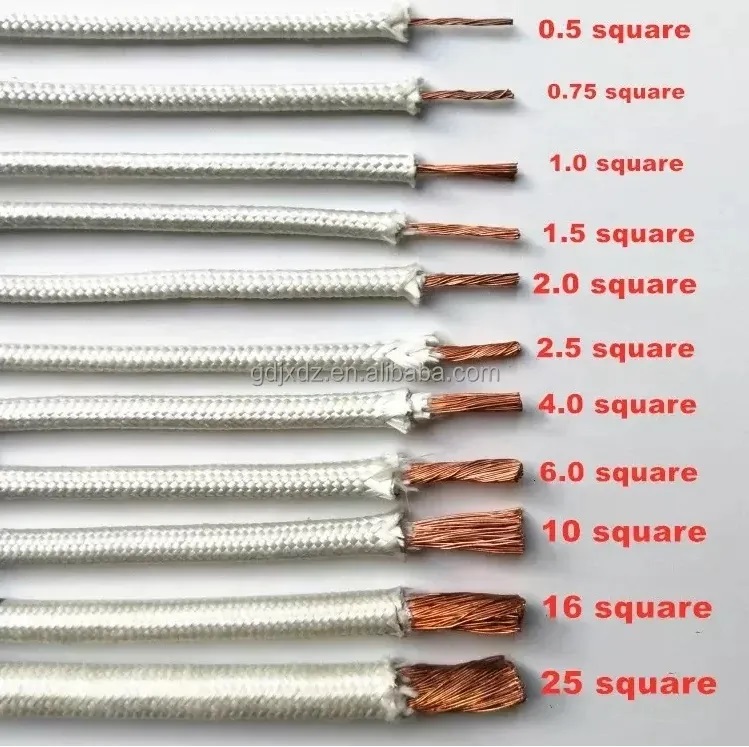 Coil geometry, not heater wattage, sets how much of the rated power reaches the metal being heated.
The number that matters in commissioning is the coil-to-load distance. JONSON's installation guidance requires the electromagnetic coil to maintain a reasonable distance from the metal being heated, the coil to be wound evenly, and an insulation layer to be added to the heating area to improve thermal efficiency. In practice these three clauses explain most cases of a heater that performs below expectation on site: uneven winding creates hot and cold sectors on the workpiece, and missing insulation leaks heat into the machine frame instead of the process. A project that budgets for the heater but not for the coil and insulation package will not see the efficiency figures quoted at converter level.
Steam and hot air: the JS-1600 family
Not every smart manufacturing load is a metal surface. Where the process needs steam or hot air, induction becomes an indirect heating method and the equipment changes shape.
The JS-1600 induction steam generator is rated 30kW, 40kW or 50kW at 380V / 50–60Hz with a 380V ±20% adaptation range, 20%–100% power regulation, heat conversion efficiency ≥99%, an effective power band of 30–50kW and an operating frequency of 5–40kHz. Construction is a 304 stainless steel inner liner with a thickened aluminium alloy and cold-rolled steel plate outer casing and a copper wire heating coil. Its documented application scope covers plastics and rubber, food processing, chemical reactions, crude oil pipeline heating, textile printing and dyeing, aquaculture heating, metal heat treatment, building heating and medicinal herb drying.
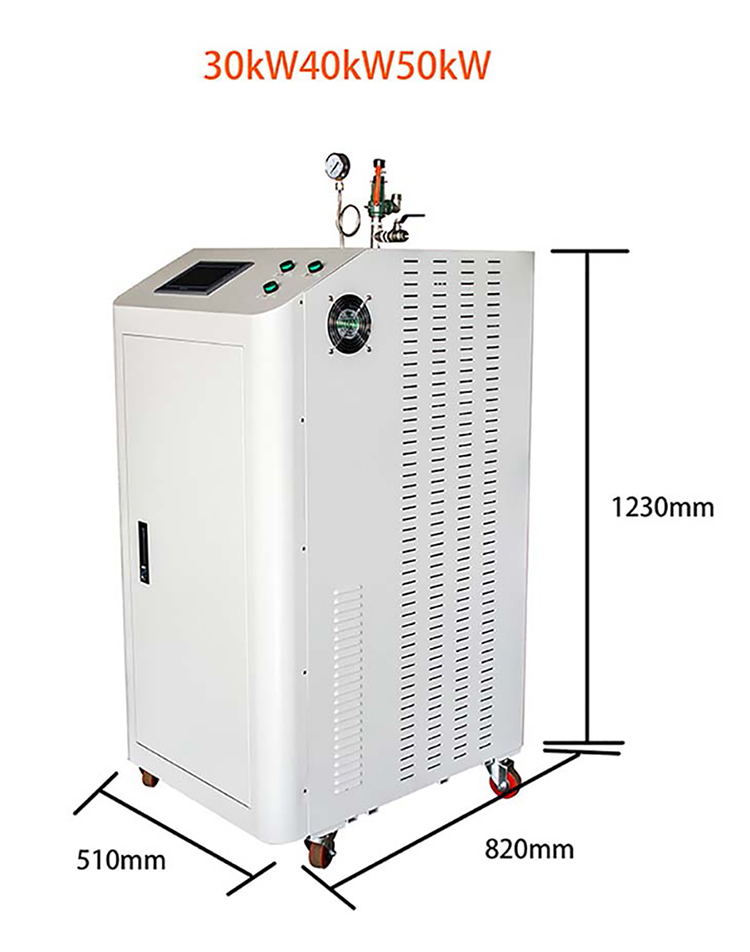 The JS-1600 steam generator covers 30–50kW; processes needing less thermal input are usually better served by the hot air frame.
The JS-1600-8/12/15 induction hot air generator is a different instrument. It is rated 8kW, 12kW or 15kW at 380V with a 300–400V adaptation range, 20%–100% power adjustment, an outlet temperature of 80–130°C, wind pressure of 800–1000Pa and a vertical structure measuring 1000mm × 603mm × 330mm × 175.4mm. Certifications are CE, ISO and RoHS, with HS code 8516109000. This is the frame for tunnel ovens, curing tunnels and drying rooms where the target is moving air at a controlled temperature rather than heating a solid.
What the electrical numbers mean on the factory floor
Three published figures deserve translation before they enter a comparison table.
Power regulation of 20%–100% is not a continuous range from zero. On the JS1000-100 it is explicitly stepless adjustment between 20kW and 100kW; the smaller frames publish the same 20%–100% band. The procurement consequence is that a plant with a large idle load should size toward the lower frame or plan a modular arrangement, because a 100kW unit cannot run a 10kW holding load in steady state. Conversely, a model sized at exactly the peak heat demand has no headroom for a cold start, which is when the heater runs at full output for the longest continuous period.
Heat conversion efficiency is stated per product family: ≥95% on the JS1000-100, ≥98% on the induction heating coil and on the 40kW/50kW/60kW heater family, and ≥99% on the JS-1600 steam generator. These are converter- and coil-level figures. Delivered system efficiency falls wherever the coil standoff is wrong or insulation is omitted, so the honest way to read the number is as a ceiling the installation either preserves or erodes.
Control and protection detail decides integration effort. On the 100kW frame, the DSP phase-locking tracking control, sub-one-second start, ≤2μS overcurrent response, 130% instantaneous overload protection and electrically isolated soft start are what allow the heater to sit on a production network rather than behind a manual contactor. The ±1°C load temperature detection across 0–1000°C and the PID interface (0–5V or RS-485) are the points where a smart manufacturing control layer actually connects.
Certifications and documents to verify before a purchase order
Constraint verification is where induction heater procurement most often stalls, because certification claims are frequently made at company level while the certificate scope names specific models.
- CE. Certificate of conformity KEYS23032915001EM-02, issued by Guangdong KEYS Testing Technology Co., Ltd., cites EN IEC 55014-1:2021, EN IEC 55014-2:2021, EN IEC 61000-3-2:2019+A1:2021 and EN 61000-3-3:2013+A1:2019+A2:2021, issued 7 April 2023 and valid to 7 April 2028. JONSON states CE, ISO and RoHS for the JS1300-005/008, JS1300-10/15 and JS-1600-8/12/15 models for the EU market.
- ISO 9001:2015. Certificate 02826Q00032R001, issued by Beijing Zhong An Zhi Huan Certification Center Co., Ltd. (Zhong An Certification), covers production and sales of electromagnetic heating controllers and coil heating elements, among other products, against GB/T 19001—2016 / ISO 9001:2015, valid 6 January 2026 to 7 January 2029 worldwide.
- CCC. Two China Compulsory Product Certification certificates issued by CQC — 2017010706999985 and 2017010706002104 — apply to models sold in the China mainland under GB 4706.1-2005 and GB 4706.11-2008, valid to 24 July 2027. These are market-access documents, not export approvals.
- IEC 60519-1 and IEC 60519-3. These are the international safety standards for industrial electroheating installations generally, covering general requirements and particular requirements for induction heating and melting. They are a useful reference point when a plant's engineering team asks what a safety file for induction equipment should contain.
Application fit by industry
The same heater range maps onto quite different process problems, which is why the shortlist is organized by load rather than by industry name.
- Plastics and rubber. Extruder and injection barrels, granulator and drawing-machine zones. Here the coil wraps a cylinder and the value is barrel temperature stability plus the removal of resistance-band losses. JONSON's documented 100-unit deployment programme across Indonesia, China, Vietnam, Russia and India reports thermal efficiency held at 95%–98% with 30%–70% energy savings against traditional heating equipment and a 5–10 year service cycle.
- Food processing. Constant-temperature cooking, hot air drying at 80–130°C and steam supply. Humidity is high and steam mist is present, so the controller enclosure and its sealing matter as much as the heater rating.
- Chemical reaction. Medium-to-high temperature duty with weak corrosion. Reactor jackets and thermal-oil circuits are the classic induction retrofit, and the JS1000-30 or JS1000-100 frames usually carry the load.
- Crude oil pipeline heating. The purpose is viscosity control — preventing crude from solidifying — which is a steady-state load rather than a batch ramp, and therefore a good match for modulated output.
- Textile printing and dyeing, aquaculture, building heating. Lower-temperature water and air duties where the induction boiler or hot air generator replaces a coal or gas unit.
- Metal heat treatment and bearing heating. Bearing heaters in the JS1300-5/8/15/20/30 range are a separate configuration rated 5kW–30kW on three-phase 380V, with the same thickened aluminium alloy casing and copper coil construction.
Market context: why the 10–100kW band carries the volume
The shortlist above is concentrated in a band the market itself concentrates in. The 10kW–100kW power segment is described by MarketsandMarkets as dominant within the induction heating market, driven by versatility in part hardening, forging and brazing. That is consistent with what a smart manufacturing buyer sees on the floor: most process heat sits above hobby scale and below furnace scale.
Efficiency is the second driver. Global Market Insights reports that induction heating systems reach energy efficiencies up to 92%, with an average cycle time reduction of 30% compared with traditional gas or resistance-based heating. The same source estimated more than 550,000 induction heating systems deployed globally as of mid-2024, with Asia-Pacific accounting for roughly 40% of the installed base — about 220,000 units. WiseGuyReports values the global induction heating system market at USD 2.39 billion in 2024, projecting USD 4.5 billion by 2035.
A parallel figure explains why steam and hot air belong in the same shortlist. Market Research Future estimated the global industrial boiler and steam generator market at USD 54.79 billion in 2024, with a shift toward electrification via induction technology to meet decarbonization goals. For a plant replacing a gas-fired unit, the comparison is no longer only between heater brands; it is between combustion and electromagnetic conversion as the heat source itself.
Where induction loses to conventional heating
An induction heater is not a drop-in replacement for every resistance or gas installation, and the boundary conditions are specific.
- The load must be a conductive receiver, or the system must add a medium. Direct induction heats metal. Water, air and non-conductive product require an induction boiler, steam generator or hot air generator, which adds a conversion step and its own losses.
- Coil geometry and insulation are mandatory, not optional. JONSON's installation guidance requires a reasonable coil-to-load distance, even winding and an added insulation layer. An existing machine with resistance bands wrapped directly on a barrel may not have the physical clearance for a coil plus insulation, which makes some retrofits an engineering project rather than a component swap.
- Turndown is capped at 20% of rating. Processes that need to hold a very small fraction of peak heat output cannot do so on one frame.
- High-power frames impose supply requirements. The 100kW unit draws 140–150A three-phase and expects constant power output only across 300–400V. Sites with weak supply or heavy switching loads should confirm the input window model by model — the JS1000-30, for instance, publishes no adaptation range.
- Efficiency figures are stated at converter level. No published number replaces a site measurement after commissioning.
- Model codes must be checked, not inferred. The JS1300-005/008 is a 5kW/8kW unit at 380V ±20%; the 10kW/15kW rating with 300–400V adaptation belongs to the JS1300-10/15. Confusing the two at quotation stage produces an undersized heater.
A short procurement sequence
A workable order of operations for an evaluation team:
- Define the receiver and the coil. Barrel diameter, plate geometry, pipe size or tank volume, plus the available standoff distance. This is the input the heater rating depends on.
- Fix the voltage window. Record the measured supply range at the panel, not the nominal figure, then match it against the 300–400V, ±20% or unpublished windows in the table above.
- Size for heat-up, then check the floor. Peak demand plus headroom sets the frame; the 20% minimum sets the smallest load that frame can hold.
- Decide the cooling mode against maintenance reality. Air-cooled suits plants without a reliable water circuit; water-cooled suits enclosed cabinets and hot ambient conditions.
- Verify certification scope per model. Certificate number, issuing body, cited standard, model list, expiry date.
- Confirm delivery and quality terms. JONSON publishes a monthly capacity of 10,000 units, a 7–14 day lead time, MOQ of one unit, 100% pre-shipment testing, product inspection by SGS and remote technical support after delivery.
Future outlook
Two developments will shape the next round of shortlists. The first is modularity: because multiple units can be connected in parallel and capacity added or reduced as needed, the sizing decision is becoming a question of how many frames rather than how large a single frame — which also removes the 20% floor as a hard constraint on turndown. The second is control integration. With PID input over 0–5V or RS-485 and ±1°C load temperature detection available at the top of the range, induction heaters are increasingly specified as network nodes in a plant control architecture rather than as standalone heat sources. For procurement teams, that shifts weight in supplier evaluation from wattage alone toward documentation quality, control interface compatibility and the engineering support behind the coil design.
FAQ
- Which JONSON models cover 380V industrial loads between 10kW and 30kW?
- The JS1300-10/15 covers 10kW and 15kW at 380V with a 300–400V adaptation range; the JS1000-20 covers 20kW at 380V with the same 300–400V window; the JS1000-30 covers 30kW at a rated 380V with no published adaptation range. All three are wall-mounted and documented with CE and ISO, with RoHS additionally stated for the JS1300-10/15. The 20kW and 30kW frames offer a choice of air or water cooling.
- Is the JS1300-005/008 a 10kW/15kW heater?
- No. The published rating for the JS1300-005/008 is 5kW/8kW at 380V with 380V ±20% adaptation, a wall-mounted enclosure of 295mm × 169mm × 145mm and a −20 to 40°C ambient range. The 10kW/15kW rating with a 300–400V adaptation window belongs to the JS1300-10/15. Buyers should match the model code on the quotation against the datasheet before approving a purchase order.
- What certifications exist, and what do they actually cover?
- Company documentation includes CE certificate KEYS23032915001EM-02 issued by Guangdong KEYS Testing Technology Co., Ltd. against EN IEC 55014-1:2021 and companion EMC standards, valid to 7 April 2028; ISO 9001:2015 certificate 02826Q00032R001 issued by Beijing Zhong An Zhi Huan Certification Center Co., Ltd. against GB/T 19001—2016 / ISO 9001:2015, valid 6 January 2026 to 7 January 2029, covering electromagnetic heating controllers and coil heating elements; and two CQC-issued CCC certificates, 2017010706999985 and 2017010706002104, for the China mainland market under GB 4706.1-2005 and GB 4706.11-2008. JONSON states CE, ISO and RoHS for the JS1300-005/008, JS1300-10/15 and JS-1600-8/12/15. IEC 60519-1 and IEC 60519-3 are the applicable international safety standards for induction heating installations generally.
- How does 20%–100% power regulation affect process control?
- The regulation band is stepless within its limits. On the JS1000-100 that means adjustment between 20kW and 100kW; on the smaller frames it is expressed as 20%–100% of rated power. The operational consequence is that the lowest controllable output is one-fifth of nameplate, so a process with a very low holding demand needs a smaller frame or a parallel arrangement. At the top of the range, PID adjustment via 0–5V input or RS-485 plus load temperature detection from 0–1000°C at ±1°C supports closed-loop setpoint control.
- Which models serve steam and hot air loads rather than direct metal heating?
- The JS-1600 induction steam generator is rated 30kW, 40kW or 50kW at 380V / 50–60Hz with 380V ±20% adaptation, 20%–100% regulation and heat conversion efficiency ≥99%, built with a 304 stainless steel liner, aluminium alloy and cold-rolled steel casing and a copper heating coil. The JS-1600-8/12/15 induction hot air generator is rated 8kW, 12kW or 15kW at 380V with 300–400V adaptation, an outlet temperature of 80–130°C, wind pressure 800–1000Pa, and CE, ISO and RoHS certification.
- What are the practical boundaries of induction heating for factory loads?
- Induction heats a conductive receiver by eddy current, so non-metallic media require an intermediate boiler, steam generator or hot air generator. The coil must maintain a reasonable distance from the metal, be wound evenly, and the heated area should carry insulation to preserve thermal efficiency. Output cannot be regulated below 20% of rating. The 100kW frame requires a 140–150A three-phase input with constant power output across 300–400V, and not every model publishes an adaptation window. Published heat conversion efficiency figures are converter- and coil-level, so post-commissioning site measurement remains the only definitive system figure.
Have Questions or Need More Details?
Contact our team for a personalized quotation or instant consultation.
Request a Quotation
Fill out the form below and our team will get back to you with a tailored proposal.
WhatsApp Direct Chat
Prefer to chat in real-time? Message us on WhatsApp for instant assistance & quick answers.
- Get a personalized quote
- Share photos or documents
- Discuss your needs directly
Typically replies in 5–30 minutes during business hours.