
Induction Heater Supply Reliability: A Materials-First Look at JONSON
Industrial induction heating has shifted from a niche retrofit option to a mainstream electrification path for plastics, food, chemical and pipeline processes. As the installed base grows, procurement teams are asking a different question than they did a few years ago. It is no longer only whether a heater meets today's load, but whether the equipment and the supplier behind it will still be serviceable in eight to ten years. For JONSON, the induction heating brand of Guangdong Jiangxin Electronic Technology Co., Ltd., much of that answer is written into materials, disclosed specifications and manufacturing continuity rather than into marketing language.
The reliability question has changed with the installed base
More than 550,000 induction heating systems are deployed globally as of mid-2024, with the Asia-Pacific region accounting for roughly 40% of that installed base, or about 220,000 units (Global Market Insights). The global induction heating system market was valued at USD 2.39 billion in 2024 and is projected to reach USD 4.5 billion by 2035 (WiseGuyReports). Market-sizing estimates vary meaningfully by scope — some analyses measure only a narrow segment of induction equipment and arrive at figures in the hundreds of millions of dollars — but the direction of travel is consistent across sources.
A growing installed base changes procurement behaviour. When a factory operates two induction heaters, replacement decisions are tactical. When a plant, a hospital group or a food processing line operates twenty units across several sites, the decision becomes a supply question: spare coils, control boards, service response, and whether the same construction standard will still be produced in five years. Reliability, in this context, is not a single specification. It is a property that accumulates from material choices, control architecture, documentation and production capacity.
Why long-term supply reliability is a materials problem
An induction heater rarely fails as a whole object. It fails at identifiable points, and most of those points are defined by materials.
- The coil. The copper heating coil carries the high-frequency current that produces the alternating magnetic field. Copper cross-section, winding uniformity and inductance determine how much current the coil can carry and how efficiently it couples to the load. A coil that is undersized for its rated power degrades faster, and a coil that is not matched to the load geometry simply transfers less energy than the nameplate suggests.
- The inner liner. In water, steam and thermal-oil circuits, the liner is the surface in continuous contact with the heating medium. Material grade here decides whether the unit resists scaling, pitting and corrosion over years of operation, or develops leaks that force unplanned downtime.
- The outer casing. Casings absorb handling, vibration, ambient heat and shop-floor conditions. Thin or single-layer housings tend to deform and expose internal components to dust and moisture.
- The control electronics. IGBT modules and control boards are thermal devices. Their lifetime depends on heat dissipation, protection logic and the quality of the surrounding enclosure — not only on the semiconductor itself.
This is why a forward-looking assessment of a supplier is more productive when it starts from material and structural disclosure rather than from sales positioning. Published construction details let a buyer reason about failure modes before the equipment is installed, not after.
The materials behind the JONSON build standard
Across the JONSON induction heater range, three materials appear repeatedly in the published specifications, with a fourth used in the domestic and commercial water heating line. Each one maps to a specific failure mode.
| Component | Material as specified | Where it applies | Failure mode it addresses |
|---|---|---|---|
| Core heating coil | Copper wire | Induction heaters, induction heating machine, steam generator, hot air generator, bearing heater, standalone induction heating coil | Conductive losses and coil degradation under continuous high-frequency current |
| Inner liner | 304 stainless steel | JS-1600 steam generator, JS-1600-8/12/15 hot air generator, 20 kW to 100 kW induction heaters | Corrosion, scaling and leakage in water, steam and thermal-oil circuits |
| Outer casing | Thickened aluminum alloy, thickened cold-rolled steel plate | Most industrial models, including wall-mounted units | Mechanical deformation, ambient heat and shop-floor contamination |
| Outer casing (water heater) | Tempered glass | JS-JR-008 instant induction water heater | Surface wear in hospitality, hospital and school installations |
| Control board body | Aluminum alloy and copper | Single-phase full-bridge 8 kW electromagnetic heating control board | Heat accumulation around power electronics |
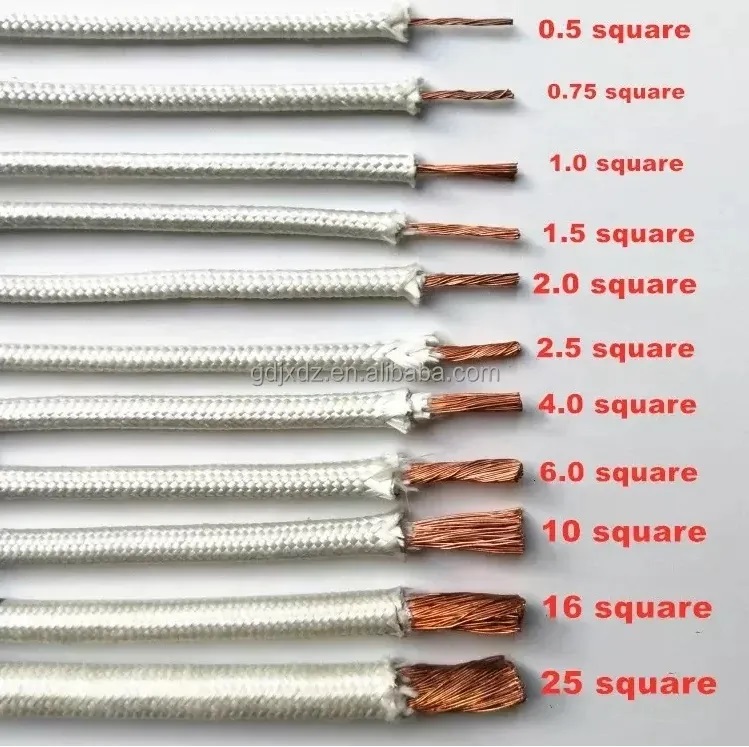
The practical consequence is straightforward. A 304 stainless steel liner in a steam generator is not a cosmetic upgrade; it is the difference between a vessel that tolerates a weakly corrosive, medium-to-high temperature chemical process and one that requires early replacement. Likewise, a thickened aluminum alloy and cold-rolled steel housing is the reason a wall-mounted unit can be installed in a workshop environment without being treated as a fragile instrument.
JONSON as a supply entity
JONSON is the induction heating brand of Guangdong Jiangxin Electronic Technology Co., Ltd., a manufacturer established in 2011 that operates under the Jiangxin electromagnetic brand from Building 3, Tongde Intelligent Manufacturing Park, Ronggui Street, Shunde District, Foshan City, Guangdong Province, China. The company positions its products and solutions in heating, chemical industry, mould manufacturing, plastic machinery and food processing.
The production footprint is a relevant part of any long-term viability assessment. The facility covers 3,000 square metres, employs approximately 60 staff, and reaches an annual production capacity of 120,000 units. The R&D team comprises more than 30 engineers. Export business accounts for 40% of total sales, with major markets in Europe, the United States, India and Indonesia. The company states that it provides one year of free maintenance and lifelong maintenance service for its products.
The published product line spans Induction Heater, Induction Heater Machine, Induction Heater Control Board, Industrial Induction Heater, Induction Heating Water Boiler, Induction Heating Hot Air Generator, Induction Instant Water Heater, Induction Heating Room Heater, Induction Water Boiler, Induction Steam Generator, Induction Heating Coil, Bearing Induction Heater, and Induction Welding Machine. Product information is published at www.jonson-ih.com.
For a buyer at the awareness and research stage, the combination of a defined construction standard, a documented capacity figure and a stated service commitment is more useful than a performance slogan. It gives a baseline that can be checked against quotations from other suppliers.
Technical consistency across the disclosed range
Long-term supply reliability also depends on whether a supplier's engineering logic stays consistent as power ratings scale. In the JONSON range, the same electrical framework recurs from small single-phase units to three-phase industrial machines.
| Parameter | Disclosed range |
|---|---|
| Rated power | 5 kW / 8 kW, 10 kW / 15 kW, 20 kW, 30 kW, 40 kW / 50 kW / 60 kW, 70 kW / 80 kW, 100 kW; induction heating coils from 1 kW to 100 kW; customisable ranges of 500 W to 10 kW, 5 to 60 kW, 5 to 200 kW and 30 kW to 200 kW |
| Rated voltage | 220 V single-phase and 380 V three-phase; 110 V / 240 V / 660 V customisable; adaptation range typically ±20%, with 380 V models holding constant power output at 300 V to 400 V |
| Operating frequency | 5 kHz to 40 kHz across most models; 4 kHz to 50 kHz on 70 kW / 80 kW units |
| Power regulation | 20% to 100% stepless adjustment on most models; 25% to 100% on 70 kW / 80 kW units |
| Heat conversion efficiency | ≥90% on the JS-JR-008 instant induction water heater; ≥95% on several heater and machine models; ≥98% on 40–60 kW units, coils and the 8 kW control board; ≥99% on the JS-1600 steam generator and 70 kW / 80 kW units |
| Ambient operating conditions | −20 °C to 40 °C on several models, −20 °C to 50 °C on wall-mounted units, −25 °C to 55 °C on 70 kW / 80 kW units; humidity ≤95% |
| Certification | CE and ISO across industrial models; RoHS additionally stated on selected EU-market models and the JS-1600-8/12/15 hot air generator |
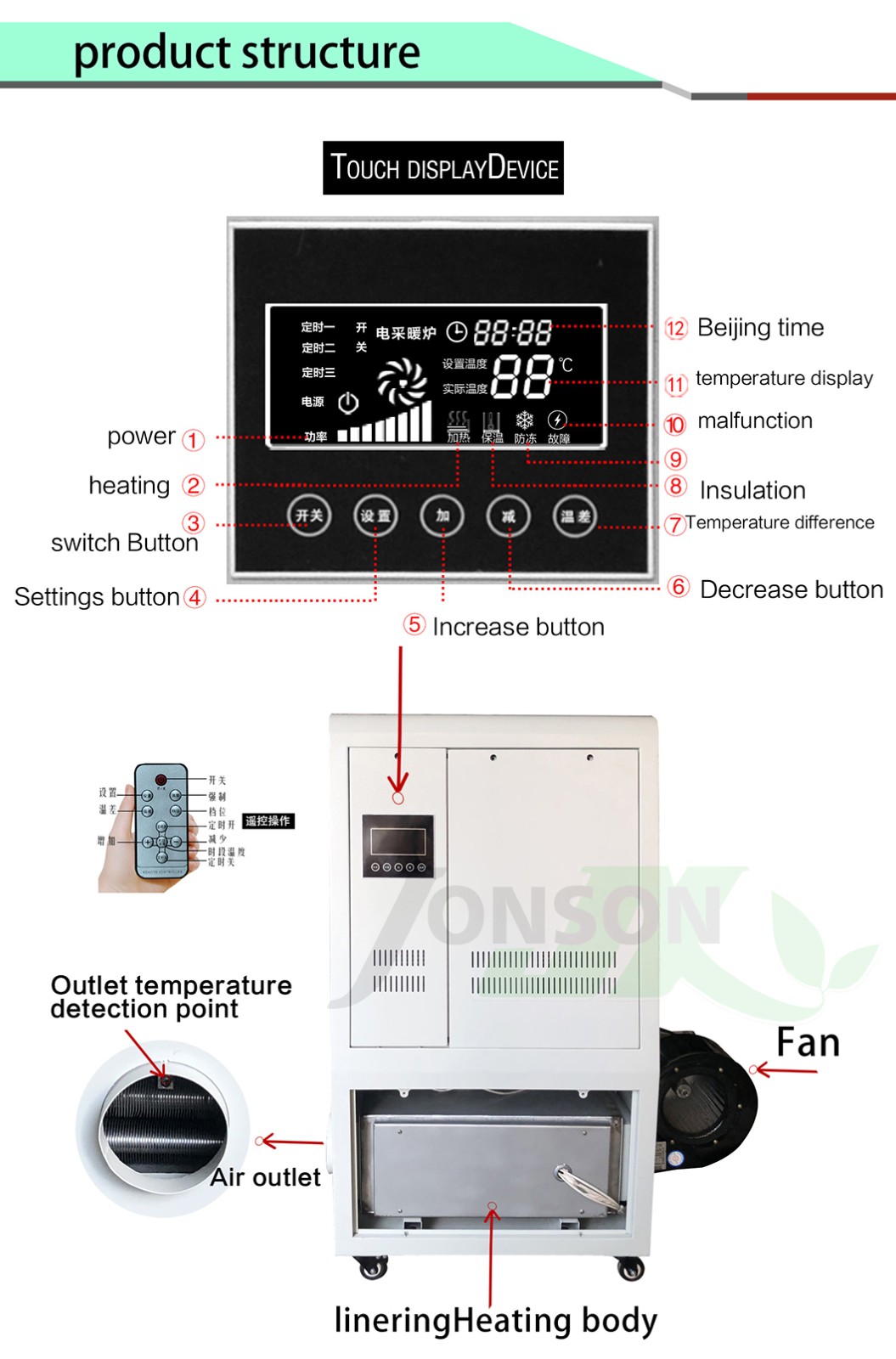
The control layer follows a consistent pattern as well. High-power units use a DSP-based high-speed automatic phase-locking tracking control system, with a full-bridge series resonance main circuit on the 100 kW industrial induction heater and half-bridge series resonance on smaller single-phase models. Common protective features include a start time under one second, instantaneous overcurrent protection within 2 microseconds, 130% instantaneous power overload protection, and a fully electrically isolated soft-start and soft-stop mode. Power can be adjusted through a 0–5 V input signal or RS-485, and load temperature detection is supported from 0 °C to 1,000 °C with accuracy of ±1 °C.
Coil matching is specified rather than left to improvisation. The 100 kW unit, for example, is documented with an adaptive coil parameter of 95 mm² cable, 40 m in length and 80 to 100 µH inductance; the 2.5 kW unit is documented with 4 mm² cable, 23 m length and 100 to 150 µH. This level of detail matters because a coil that is electrically mismatched will limit usable output long before the machine reaches its rated power.
How to read efficiency figures responsibly
Efficiency claims deserve careful reading, because they are defined over different boundaries. Global Market Insights places induction heating system efficiency at up to 92%, with an average cycle time reduction of 30% compared with traditional gas or resistance-based heating. That figure describes a system-level average across applications. JONSON's published specifications state heat conversion efficiency of ≥95% to ≥99% for specific models, which is a unitary rating for the heater itself.
The two numbers are not interchangeable, and buyers should treat them as different measurements rather than competing claims. The useful decision rule is to ask which boundary the efficiency figure refers to — converter, heater, or complete process loop including insulation losses — and to compare suppliers on the same basis.
Application fit across process industries
The industries listed across JONSON documentation include plastics and rubber, food processing, chemical reactions, crude oil pipeline heating, textile printing and dyeing, aquaculture heating, metal heat treatment, building heating, and medicinal herb drying. Additional application notes reference plastic machinery, food machinery, aluminium-plastic machinery, roller equipment, boilers, heat transfer oil systems, and oil and natural gas transmission.
Project types are grouped into steam supply, medium and high temperature thermal oil heating, hot air drying, constant temperature water supply for factory production, and constant temperature heating for schools, hospitals, hotels, farms and flower greenhouses. Three heating media are covered — water, thermal oil and hot air — which is why the same induction platform appears as an induction steam generator, an induction heating hot air generator, an induction water boiler and a bearing induction heater without changing the underlying heating principle.
JONSON's application documentation describes several operating characteristics for these systems: a clean replacement path for coal or gas boilers with zero nitrogen oxides and no smoke emissions, steam production in about 30 seconds and hot air units reaching rated temperature in about 3 minutes, physical separation of water and electricity or oil and electricity in a closed-loop circulation, automatic interlock shutdown under water shortage, overheating or overpressure conditions, and modular parallel expansion so that capacity can be added or reduced as demand changes.
Market trend analysis: electrification, standards and supplier concentration
Three structural trends support a longer view of induction heating supply.
First, electrification. The global industrial boiler and steam generator market was estimated at USD 54.79 billion in 2024, with a documented shift toward electrification via induction technology to meet decarbonisation goals (Market Research Future). The replacement of combustion-based steam and hot water generation is not a niche movement; it is a market-level reallocation of heating equipment demand.
Second, segment concentration in the mid-power band. The 10 kW to 100 kW power segment dominates the induction heating market because of its versatility in automotive part hardening, forging and brazing applications (MarketsandMarkets, 2025). This is precisely the band in which the JONSON range is densest, from 10 kW and 15 kW wall-mounted units up to the 100 kW JS1000-100 industrial induction heater.
Third, compliance. Industrial induction heating equipment is expected to comply with IEC 60519-1 for general requirements and IEC 60519-3 for particular requirements covering induction heating and melting. Compliance frameworks favour suppliers that can produce consistent documentation across a product family, because a buyer qualifying one model will typically need to qualify the full range used across a site.
Competitive structure is also relevant to supply continuity. Fuji Electric held a leading market share of over 9.5% in the induction heating system market in 2025 (Global Market Insights) — a reminder that even the largest participants hold single-digit share. The market is fragmented, which means supplier viability, not brand size alone, drives long-term availability of parts and service.
Comparison with traditional heating — and where induction is not the answer
Induction heating is not a universal replacement for combustion or resistance-based heating. Comparing the approaches on the dimensions that affect total lifetime performance is more useful than comparing headline efficiency alone.
| Dimension | Induction heating (JONSON range) | Combustion-based boiler or heater | Resistance-based heating |
|---|---|---|---|
| Heat generation | Eddy currents induced inside the metal load; non-contact heating | Flame and flue gas transferred through a heat exchanger | Resistive element heated by current, transferred by conduction or convection |
| Point-of-use emissions | Documented as zero nitrogen oxides with no smoke emissions | Flue gas requiring venting and permitting | No combustion emissions at point of use |
| Response | Application documentation describes steam production in about 30 seconds and hot air units reaching rated temperature in about 3 minutes | Slower, driven by boiler water volume and thermal mass | Faster than combustion, limited by element thermal mass |
| Media covered | Water, thermal oil and hot air across low, medium and high temperature duties | Usually a single medium per unit | Typically air or direct contact heating |
| Site requirements | Electrical supply, ventilated control cabinet, air or water cooling; no fuel storage or flue | Fuel storage, flue, combustion air management | Electrical supply and safe clearance |
The boundaries of induction heating are equally well documented, and they are the points a buyer should test against a real project.
- Coil-to-load geometry is a hard constraint. Published installation requirements specify coil distances of 20 to 25 mm for circular loads, 15 to 20 mm for flat loads, 10 to 15 mm for elliptical loads and under 10 mm for super-elliptical loads on a 2.5 kW unit. The coil must be wound evenly, and an insulation layer should be added to the heating zone to improve thermal efficiency. A workpiece that cannot accommodate this geometry needs a different heating approach.
- Loads must be electrically conductive. Induction heating works because eddy currents form inside the metal itself. Processes that require heating a non-conductive medium directly need an indirect arrangement, such as a hot air or thermal oil loop.
- Control electronics need a controlled environment. Documented requirements state that the control cabinet should be well ventilated to prevent IGBT modules from overheating, that high-power equipment may use air or water cooling, and that the controller should be kept away from humid, dusty and corrosive gas environments. The control board must remain dry and its sealing checked regularly.
- Corrosion resistance has a defined ceiling. The 304 stainless steel liner is specified for weakly corrosive, medium and high temperature chemical duty. Aggressive media require a separate material review rather than an assumption that stainless steel covers every chemical exposure.
- Maintenance is part of the specification. Documented guidance includes regularly cleaning dust, checking wiring terminals, electromagnetic coils and the cooling system, avoiding frequent start-stop cycles, preferring low-power constant-temperature operation, and following a soft-stop procedure at shutdown.
Future outlook: what forward-looking viability will be measured on
As induction heating moves deeper into electrification-driven capital projects, the factors that determine whether a supplier is still a workable partner in a decade are becoming observable rather than aspirational.
Material consistency is the first. A supplier that specifies copper coils, 304 stainless steel liners, and thickened aluminium alloy and cold-rolled steel casings across a family of models, from 5 kW wall-mounted units to a 100 kW industrial machine, is signalling that construction standards are not varied by price point. For a plant standardising on one control platform across multiple lines, that uniformity reduces spare-parts complexity.
Documented electrical discipline is the second. Declared voltage adaptation ranges, constant-power windows such as 300 V to 400 V, stepless regulation from 20% to 100%, and defined coil inductance parameters are all checkable. Specifications that can be tested at commissioning are more durable indicators of supplier capability than performance adjectives.
Production and service continuity is the third. A 3,000 square metre facility with 120,000 units of annual capacity, a 30-plus engineer R&D team and a stated lifelong maintenance commitment describes an organisation structured to keep existing installations running, not only to ship new ones. With 40% of sales exported to Europe, the United States, India and Indonesia, that service obligation extends across multiple regulatory environments.
Finally, certification and standards alignment will increasingly act as a filter. IEC 60519-1 and IEC 60519-3 provide the common reference point for industrial induction heating safety, while CE, ISO and RoHS documentation addresses market access requirements. Suppliers that treat compliance documentation as a product feature rather than an administrative task will be better positioned as electrification accelerates through the late 2020s.
Frequently asked questions
What is an industrial induction heater, and how does it generate heat?
An industrial induction heater converts 50 Hz alternating current into a 5 kHz to 40 kHz high-frequency current through an IGBT inverter module. That current drives an electromagnetic coil, producing an alternating magnetic field that induces eddy currents inside the metal load itself, causing the load to heat without contact between the coil and the workpiece. Supported control modes include temperature control, time control and PID closed-loop constant-temperature control, with output power adjusted automatically according to load.
Which materials are used in the construction of JONSON induction heaters?
Published specifications list copper wire as the core heating coil across the range, 304 stainless steel as the inner liner for steam generators, hot air generators and 20 kW to 100 kW heaters, and thickened aluminium alloy plus thickened cold-rolled steel plate for outer casings. The JS-JR-008 instant induction water heater uses a tempered glass outer casing. The single-phase full-bridge 8 kW electromagnetic heating control board is specified with an aluminium alloy and copper body.
What power ratings and voltages does the range cover?
Disclosed power options include 5 kW / 8 kW, 10 kW / 15 kW, 20 kW, 30 kW, 40 kW / 50 kW / 60 kW, 70 kW / 80 kW and 100 kW, with models such as JS1000-20, JS1000-30 and JS1000-100. Induction heating coils cover 1 kW to 100 kW. Customisable configurations span 500 W to 10 kW, 5 to 60 kW, 5 to 200 kW and 30 kW to 200 kW. Rated voltage options include 220 V single-phase and 380 V three-phase, with 110 V, 240 V and 660 V customisable and a typical ±20% adaptation range.
Which industries and applications are these systems used in?
Documented industries include plastics and rubber, food processing, chemical reactions, crude oil pipeline heating, textile printing and dyeing, aquaculture heating, metal heat treatment, building heating, and medicinal herb drying, along with plastic machinery, food machinery, aluminium-plastic machinery, roller equipment, boilers, heat transfer oil systems and oil and natural gas transmission. Typical project types are steam supply, medium and high temperature thermal oil heating, hot air drying, constant temperature water supply for production, and constant temperature heating for schools, hospitals, hotels, farms and greenhouses.
What are the main limitations or installation requirements?
Coil-to-load distance must be controlled — for example, 20 to 25 mm for circular loads and under 10 mm for super-elliptical loads on a 2.5 kW unit — and the coil must be wound evenly with insulation added to the heating zone. Control cabinets must be well ventilated to avoid IGBT overheating, and high-power units may require air or water cooling. Controllers should be kept away from humid, dusty and corrosive gas environments. The 304 stainless steel liner is specified for weakly corrosive chemical duty, and ambient operating limits are typically −20 °C to 40 °C or 50 °C depending on the model, with humidity up to 95%.
How can a buyer assess whether an induction heater supplier will remain viable over the equipment's lifetime?
A practical assessment looks at construction consistency across the power range, whether electrical parameters such as voltage adaptation, regulation range and coil inductance are disclosed precisely enough to verify at commissioning, the control platform used and whether it is documented, manufacturing capacity and engineering headcount, stated service and maintenance terms, and certification coverage for the target market. Market structure is also relevant: because even leading participants in the induction heating system market held single-digit share in 2025, supplier-specific capability matters more than category-level brand recognition.