
Industrial Coding and Marking Equipment: A CIJ, TIJ and Laser Buyer Decision Framework
Industrial coding and marking equipment has moved from a compliance afterthought to a live data layer inside smart manufacturing. The relevant buyer question in 2026 is no longer whether a printer can stamp a date, but which marking principle can place a compliant, machine-readable, database-driven code onto the actual substrate of a production line — at the actual line speed and operating environment.
Buyers evaluating continuous inkjet (CIJ), thermal inkjet (TIJ), high-resolution piezo inkjet (PIJ), laser marking and thermal transfer overprint (TTO) are choosing between five different physical marking principles. Each carries a distinct substrate fit, consumable model, resolution profile and integration cost. Catalogs frequently present these technologies as interchangeable. In production they are not.
This analysis sets out a five-axis decision framework — substrate compatibility, code content and resolution, line integration, operating environment, and code-type compliance — and maps those axes against DOCOD Precision Group Co., Ltd., a Guangzhou-based industrial coding, marking and inspection equipment manufacturer founded in 2008, whose portfolio spans CIJ, TIJ, PIJ, DOD, TTO, laser marking and inline vision inspection systems.
The Real Procurement Problem Behind Technology Choice
The core procurement problem in industrial coding is that "it prints" is not a specification. Two printers that both produce a legible date code on a corrugated carton can differ materially in how they handle curved or coated surfaces, how they integrate with an existing MES, and how much consumable logistics they impose on the plant. The selection has downstream consequences in maintenance, downtime and consumable cost that are rarely visible in a first-year quotation.
The opportunity side of the equation has grown in parallel. According to Fortune Business Insights, the global coding and marking equipment market was valued at USD 7.51 billion in 2025, and inkjet technologies — CIJ, TIJ and PIJ combined — account for approximately 40.1% of the technology segment. Inkjet is not a niche. It is the working center of the category.
Regulatory pressure is adding a second layer. GS1 has set a Sunrise 2027 deadline of 31 December 2027 for the retail transition from 1D barcodes to 2D (QR) codes under GS1 Digital Link, a standard covering 48+ countries. That transition converts the coding device from a simple marker into an on-package data carrier. Systems that cannot print or verify a 2D code at the required resolution and contrast may need to be upgraded or replaced.
A Five-Axis Decision Framework
A structured framework prevents the most common procurement error in this category: choosing on one axis (usually unit price or headline speed) and discovering a mismatch on another after installation. The five axes below are the ones that most consistently determine whether a technology will work in a given line.
Axis 1 — Substrate compatibility
Substrate is the first filter. CIJ handles carton, plastic, metal, sheet material, pipe, stone, glass, electronic components, auto parts, industrial chemical packaging and medical/food/gift boxes, with ink type matched to the surface (high adhesion, glass-specific, food-grade, oil-resistant). TIJ suits cartons, plastics, metals, plates, pipes, stones, wires and cables, electronic components and auto parts; the DOCOD 3BK702 solvent cartridge is specifically targeted at BOPP, PVC, PP, PET, OPP, glass and stainless steel. PIJ prints on carton, plastic, metal, plate, pipe, stone, cables, glass, electronic components, auto parts and industrial chemical packaging. Laser marking is wavelength-dependent: UV (355 nm) for low-heat marking of plastics, glass, printed circuit boards, medical packaging and food packaging; CO2 (10.6 μm, optional 10.2 μm / 9.3 μm) for non-metal substrates such as rubber, leather, wood, acrylic and kraft board; fiber (1064 nm) for metal and coating applications, automotive parts, bearings and aerospace components. TTO is film-focused, targeting high-barrier films, stick packs, sealed bags, metallized labels and decorative labels.
Axis 2 — Code content, resolution and data integration
Modern lines require far more than a date. Typical content sets include multi-language text, time, date, logo, shift, serial number, counters, barcodes, QR/DataMatrix, GS1 codes, dynamic traceability codes and database-driven variable data. Resolution requirements differ by technology: CIJ at 3–30 mm print height handles small-character work at line speed; TIJ reaches up to 600 × 600 dpi; PIJ offers 300 dpi or 600 dpi selectable; TTO prints at 300 dpi; laser marking can achieve a minimum line width of 0.02 mm with 0.01 mm positioning accuracy on the L3000 Series UV platform. Data integration matters as much as print quality: the DOCOD M2000 Series exposes USB, RS232 and network ports and connects to enterprise MES systems, running Embedded Linux with support for more than 40 languages.
Axis 3 — Line integration and throughput
Throughput maps to product family, not to a single number. Within DOCOD's CIJ range, the S1000 Series reaches 720 m/min on a 60μ nozzle and 960 m/min on a 50μ nozzle; the M2000 Series reaches 528 m/min; the S300plus reaches 384 m/min; the V2000 reaches 334 m/min. On the TIJ side, the T220E reaches 406 m/min with up to 600 × 600 dpi, while the TX1 reaches 406 m/min with up to eight spliced printheads and 1–101.6 mm print height. The P2000 PIJ runs at 190 m/min at 300 dpi or 95 m/min at 600 dpi. The R3000 TTO is designed for intermittent printing at 200–350 mm/s (up to 800 mm/s peak).
Integration also involves synchronization hardware: photocells, encoders, alarm light output, reverse-and-upside-down control, serial number input/output, and — on PIJ — cascading multiple devices to share the same encoder or photocell parameters.
Axis 4 — Operating environment
Environmental rating drives long-run stability. The DOCOD M2000, S300plus and V2000 CIJ printers carry IP65 protection and are built on SUS 304 stainless steel housings. The S1000 Series carries IP55. Lasers vary: the L3000 Series UV laser is IP43; the Venus1 Series UV and CO2 platforms offer IP43 or IP54 depending on configuration; fiber units are IP43. A shared operating window applies across most platforms — 0–45°C ambient, 30–70% RH for inkjet; up to 95% non-condensing humidity for lasers. Dusty, hot and humid sites — such as cement bagging, mortar or chemical drum filling lines — often need additional dust covers and bracket selection rather than a different technology class.
Axis 5 — Code-type compliance and verification
Compliance is where coding equipment increasingly earns its place in a smart factory. Modern coding must support GS1 DataMatrix, GS1 Digital Link, dynamic traceability codes, serialization and anti-counterfeiting workflows, and it must be verifiable in-line. Print-and-verify architectures — where a vision inspection system reads the code immediately after printing and signals a reject unit through a PLC — are standard on regulated lines such as medical packaging and tobacco traceability. Equipment that can only print, without being able to integrate with a verification loop, is a compliance risk rather than a solution.
How the Five Technologies Actually Differ
Comparing CIJ versus TIJ versus laser without naming a substrate, speed and environment produces an abstract answer. Naming them produces a workable one.
Continuous inkjet (CIJ)
CIJ is the highest-throughput ink-based option. It uses a continuous ink stream broken into charged droplets and deflected onto the substrate. DOCOD's CIJ range — M2000 Series (528 m/min, IP65, SUS 304, 3–30 mm height, 1–4 lines), S1000 Series (720–960 m/min, IP55, CE/RoHS/BIS), S300plus Series (384 m/min, IP65, 1–5 lines), and V2000 Series (334 m/min, IP65, 18 kg) — covers the bulk of production-line coding needs on cartons, plastics, cables, metals, pipes and glass. Ink variety is a CIJ strength: black, red, blue, green, invisible, yellow and blue-white inks are available, including high-adhesion, glass-specific, food-grade and oil-resistant formulations.
Thermal inkjet (TIJ)
TIJ uses a replaceable cartridge with a thermal printhead. It trades some speed range for higher native resolution, cleaner startup, and lower infrastructure complexity. The DOCOD T220E Half-Inch Dual-Head printer reaches 600 × 600 dpi and up to 406 m/min with 1–2 printheads, while the TX1 Half-Inch Seamless printer extends to 1–101.6 mm print height and up to eight heads for wider or multi-lane layouts. The 3BK702 half-inch black solvent TIJ cartridge supports up to 600 dpi (recommended 300 × 300 dpi), has 300 nozzles, a 12 kHz maximum frequency, 42 ml ink capacity, and is designed for quick-drying black solvent printing on BOPP, PVC, PP, PET, OPP, glass and stainless steel.
High-resolution piezo inkjet (PIJ)
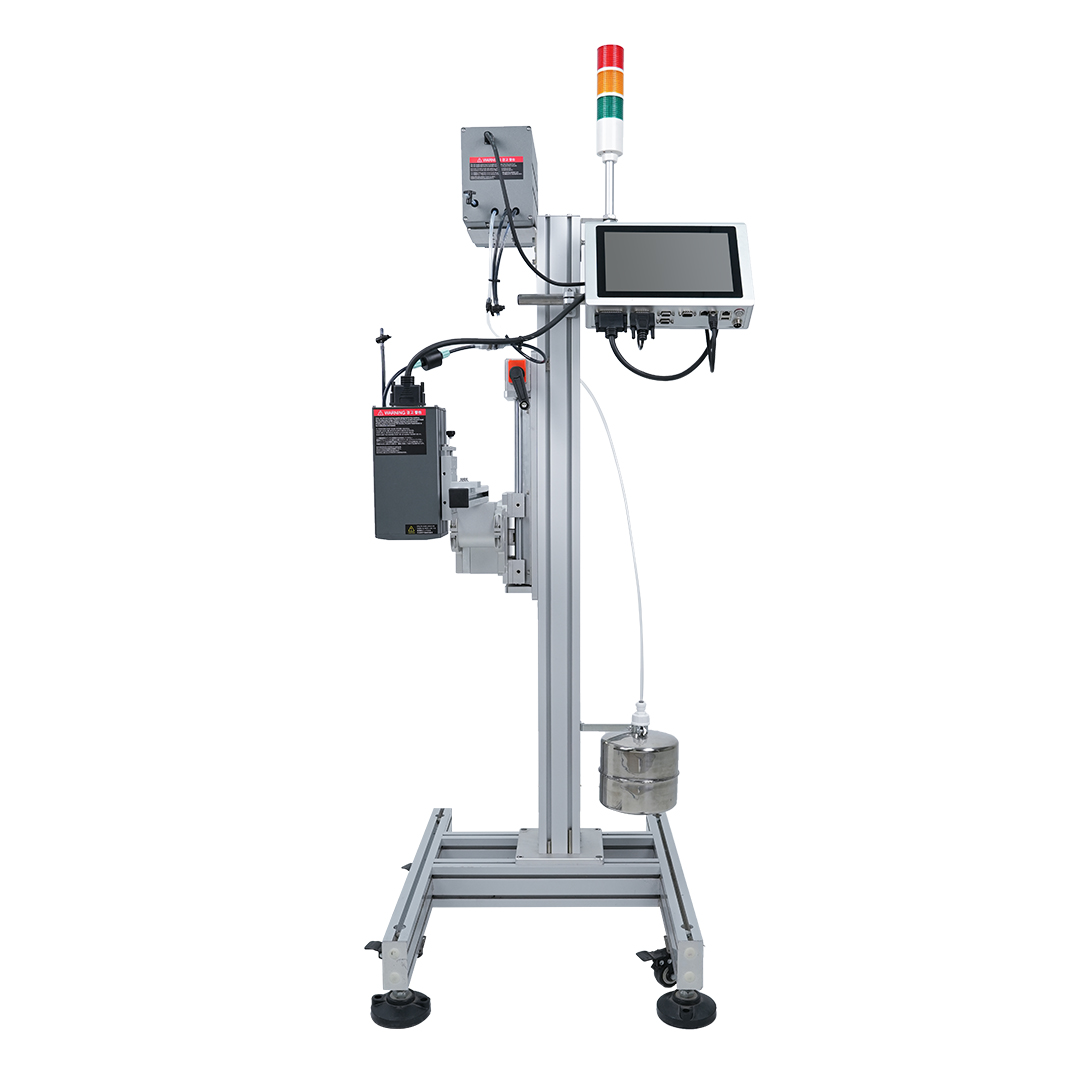
PIJ is a drop-on-demand inkjet family designed for higher-resolution work where CIJ's small-character output is too coarse and laser's thermal marking is unsuitable. The DOCOD P2000 is a single-head or dual-head PIJ printer built on aviation-grade aluminum, with a 10.1-inch capacitive touchscreen, Embedded Linux OS, and selectable 300 dpi or 600 dpi resolution. It prints at 190 m/min at 300 dpi and 95 m/min at 600 dpi, with a single-head maximum print height of 33.8 mm and a recommended print distance of 2–3 mm. It supports text, time, date, patterns, shifts, serial numbers, dynamic barcodes/QR codes and dynamic serial port data using water-based or quick-drying inks.
Laser marking
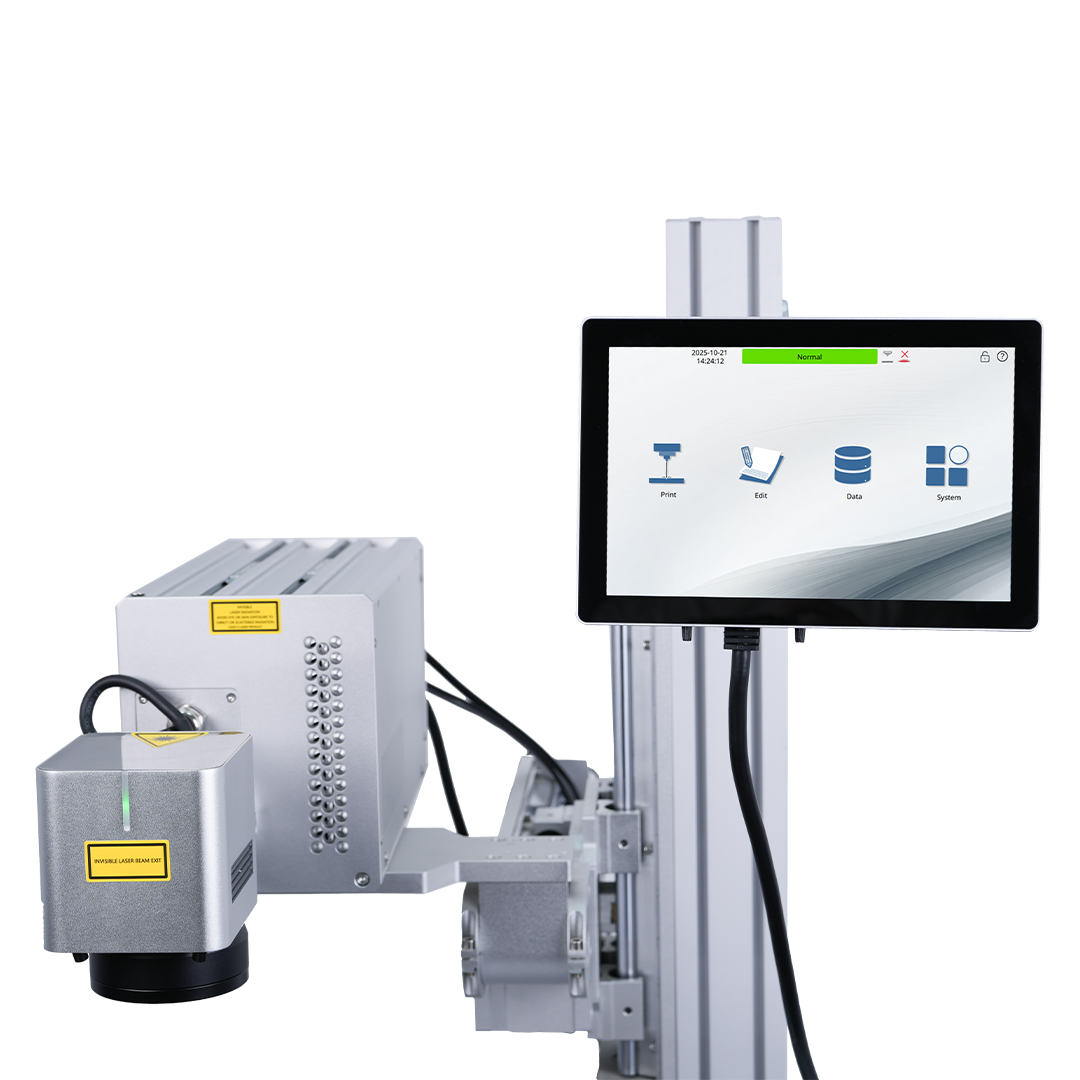
Laser marking is non-contact, consumable-free and permanent. It splits into three wavelength families. UV lasers use 355 nm wavelength and are valued for low heat input — DOCOD's L3000 Series 5W UV laser is water-cooled, has a standard 70 × 70 mm marking range, stainless steel host, IP43 protection and a 2–3 year laser life; the Venus1 Series UV Laser Marker extends that range to 5W / 10W / 15W with air or water cooling. CO2 lasers use 10.6 μm and target non-metal substrates; the Venus1 Series CO2 offers 30W or 60W with a 20,000-hour laser life. Fiber lasers use 1064 nm and target metal and coating applications; the Venus1 Series Fiber offers 20W / 30W / 50W / 100W with a laser life up to 100,000 hours.
Thermal transfer overprint (TTO)
TTO is the dominant technology for coding on flexible films. The DOCOD R3000 Series is an intermittent thermal transfer overprinter with print areas of 32 × 75 mm or 53 × 70 mm at 300 dpi, ribbon widths of 24 / 33 / 35 / 55 mm, and ribbon lengths of 400 / 600 / 800 / 1200 m. It targets high-barrier film, stick packaging, sealed bags and metallized labels, and can dock with weighing machines, conveyors, packaging machines, ERP databases and anti-counterfeit traceability systems over USB, RS232 and TCP/IP.
Comparative Snapshot
| Technology | Typical substrate fit | Resolution / height | Typical speed band | DOCOD reference product |
|---|---|---|---|---|
| CIJ | Carton, plastic, metal, pipe, glass, cable, electronic components, auto parts | Small character, 3–30 mm height, 1–4 lines | Up to 528 m/min typical; 720–960 m/min on S1000 | M2000 Series, S1000 Series, S300plus Series, V2000 Series |
| TIJ | Cartons, plastics, metals, pipes, wires and cables, electronic components | Up to 600 × 600 dpi; 1–12.7 mm per head (1–25.4 mm dual) | Up to 406 m/min (T220E); up to 60 m/min (T260E) | T220E, T260E, TX1, 3BK702 cartridge |
| PIJ | Carton, plastic, metal, plate, pipe, cables, glass, electronic components | 300 dpi or 600 dpi; single-head max 33.8 mm | 190 m/min at 300 dpi; 95 m/min at 600 dpi | P2000 Piezo Inkjet Printer |
| UV laser | Plastics, glass, medical packaging, food packaging, PCB, electronic components | 0.6 mm min character height; 0.02 mm min line width | Depends on content complexity and marking range | L3000 Series 5W UV; Venus1 Series UV Laser Marker |
| CO2 laser | Non-metal — rubber, leather, wood, acrylic, kraft board, cable marking | Standard 110 × 110 mm; optional 70–300 mm | Depends on substrate and content | Venus1 Series CO2 Laser (30W / 60W) |
| Fiber laser | Metals, coatings, automotive parts, bearings, aerospace components, PCB | Standard 110 × 110 mm; optional 50–300 mm | Depends on substrate and content | Venus1 Series Fiber Laser (20W / 30W / 50W / 100W) |
| TTO | High-barrier film, stick packs, sealed bags, metallized labels | 300 dpi; 32 × 75 mm or 53 × 70 mm | 200–350 mm/s, up to 800 mm/s peak | R3000 Series Industrial TTO |
Mapping Equipment to Real Production Scenarios
Technology families become actionable when mapped to actual industries. The following examples are drawn from DOCOD's documented application projects.
| Industry / Region | Coding requirement | Typical equipment pairing |
|---|---|---|
| Automotive parts (BR) | Part numbers, batch codes, QR/DataMatrix, production dates, supplier codes for assembly traceability and recall management | M2000 CIJ, R3000 TTO, TX1 TIJ |
| Electronics manufacturing (MX) | Serial numbers, QR/DataMatrix codes, batch numbers and brand marks on PCBs, batteries and housings with minimal contamination | Venus1 UV Laser Marker, Venus1 Fiber Laser, T220E TIJ |
| Wire, cable and pipe extrusion (IN) | Meter marks, model information, brand names, batch numbers, certification marks on high-speed extrusion lines | M2000 CIJ, Venus1 CO2 Laser |
| Building materials and chemicals (AE) | Batch numbers, production dates, model information, QR and logistics codes on cement bags and drums in dusty, hot, humid environments | P2000 PIJ, M2000 CIJ, Venus1 CO2 Laser |
| Daily chemical / cosmetics (ID) | Batch numbers, production and expiry dates, QR and anti-counterfeit codes on HDPE, PET, PP and PE tubes without damaging brand appearance | M2000 CIJ, L3000 UV Laser, Venus1 UV Laser Marker, T220E TIJ |
| Food and beverage (VN) | Production dates, expiry dates, batch numbers, QR/barcodes on flexible pouches, cartons, PET bottles and glass bottles, including cold-chain conditions | CIJ (V2000 / S1000 / S300plus), TTO R3000, TIJ (TX1 / T220E / T260E), M2000 |
| Medical packaging (DE) | UDI, GS1 DataMatrix, lot numbers, expiry dates and serial numbers with closed-loop print-and-verify | P2000 PIJ, L3000 UV Laser, TX1 TIJ |
| Tobacco packaging (TR) | Batch codes, tax-control codes, DotCode/DataMatrix, QR and supply-chain traceability codes on high-speed packs | M2000 CIJ, T260E TIJ, Venus1 CO2 Laser |
Two auxiliary devices are worth noting because they shape what a coding line can actually accept. The XC20 Mini Conveyor Belt (150 mm PVC belt, 5–12 m/min, 7.5 kg, aerospace-grade aluminum) is built for small-batch or lab-scale coding and inspection lines, and can be paired with inkjet printers, visual inspection systems and weighing equipment. The XF30 Vertical Rewinding Machine (620 × 366 × 665 mm, 33 kg, T210E TIJ printer, up to 300 × 300 dpi, 0–45 m/min) targets label rewinding and secondary rolling applications where coding must be verified before the roll leaves the station.
Market Trend Signals Shaping 2026 Decisions
Three structural trends are visible in the current data, and they should be treated as directional rather than precise.
First, the category is expanding. Multiple commercial research sources place the global coding and marking equipment market between roughly USD 7.5 billion and USD 8.3 billion in 2025–2026, with forecast growth continuing through 2030s horizons. These estimates use overlapping but not identical scopes and methodologies, so they should be read as direction-of-travel signals, not as a precise market size to anchor a budget against.
Second, inkjet remains the largest technology segment. The Fortune Business Insights report attributes approximately 40.1% of technology share to inkjet systems (CIJ, TIJ and PIJ combined), which is consistent with what the DOCOD portfolio reflects: a broad CIJ range alongside TIJ and PIJ platforms rather than a single-technology bet.
Third, regulatory deadlines are pulling 2D code capability into mainstream lines. GS1 Digital Link's Sunrise 2027 target of 31 December 2027 is converting QR/DataMatrix printing from a specialized requirement to a baseline one. Systems that support GS1 DataMatrix today as a standard print mode — as the M2000, T220E, TX1, P2000 and R3000 do within the DOCOD portfolio — are positioned for the transition without a procurement cycle reset.
Comparing Against Traditional Approaches — and Where the Limits Are
Traditional approaches to package identification include pre-printed packaging, adhesive labels applied after filling, and single-technology printer fleets. Pre-printed packaging eliminates in-line coding but sacrifices late-stage differentiation of batch, date and serial data. Label applicators handle variable content but add a consumable and a mechanical applicator into every lane. Single-technology fleets simplify spares but under-serve sites that run cartons, films, metal parts and cables on the same campus.
A multi-technology portfolio addresses those gaps, but it is not a universal upgrade path. Real limitations apply and should be weighed openly during evaluation:
- CIJ requires ink and makeup consumables, periodic printhead cleaning and solvent handling. It also needs ink-type alignment with the substrate and with food-contact or migration-resistance requirements, which constrains the use of a single ink across all products.
- TIJ per-head print height is limited (1–12.7 mm per head; 1–25.4 mm dual). Cartridge logistics matter: the 3BK702 has a best-use period of 6 months and defined storage windows (5–40°C, 20–80% RH), and the printhead requires careful cleaning with a dust-free cloth or IPA-ethanol cloth.
- PIJ requires closer print distance to the substrate — 0–5 mm, with 2–3 mm recommended — than CIJ (2–16 mm) or TIJ, which changes mounting tolerance on lines with product wobble.
- Laser marking is substrate-dependent. CO2 lasers apply only to non-metal materials; UV lasers are typically chosen for low-heat marking of plastics and electronics; fiber lasers target metals and coatings. Laser lifespan is finite and differs by family (2–3 years for the L3000 UV; 20,000 hours for the Venus1 CO2; up to 100,000 hours for the Venus1 Fiber), and integration adds laser-safety and enclosure requirements that ink-based systems do not carry.
- TTO relies on ribbon supply and intermittent print mode. It is the correct choice for flexible films but is not a general-purpose replacement for CIJ on rigid containers or cables.
Purchasing Terms and Acceptance Criteria — the Final Decision Checkpoint
Technology selection is only half of the procurement process. The remaining half is what a buyer writes into the purchase contract. The following items are the checkpoints most often missing from coding equipment purchases.
Technical specification to be agreed in writing
- Substrate list, including worst-case surface (curved, oiled, coated, or high-temperature after processing).
- Required print content per SKU: text, date, batch, shift, counter, serial number, barcode type, QR/DataMatrix, GS1 DataMatrix, variable database reference.
- Required print height, number of lines, minimum character size and minimum line width.
- Line speed at which the code must remain legible, not the printer's headline speed.
- Environmental rating required (IP level), ambient temperature and humidity window on site.
- Communication and integration interfaces: USB, RS232, TCP/IP, encoder, photocell, alarm light, MES or PLC handshake.
Acceptance test at FAT and SAT
- Print a representative sample of every SKU family at the actual line speed, then verify with a scanner or vision system.
- Perform adhesion and rub/abrasion checks on at least one sample per substrate, using a defined method.
- Run a shift-length or multi-hour continuous trial to catch thermal drift or printhead clogging.
- Confirm the print-and-verify loop is wired end-to-end, including reject signal and traceability log.
Commercial and lifecycle terms
- Consumable specification, supply lead time and shelf life (for example, cartridge best-use period and storage window).
- Spare parts availability, printhead replacement interval expectations, and calibration or maintenance service items.
- Warranty terms, response time and on-site service coverage for the destination country.
- Applicable certificates required for the destination market — for example CE and RoHS on the M2000, T220E and P2000 platforms, and CE / RoHS / BIS on the S1000 and S300plus Series.
DOCOD Precision Group Co., Ltd. operates a 20,000 m² manufacturing facility with approximately 407 staff, including over 140 R&D engineers and technicians focused on product identification solutions, and an annual production capacity of 5,000 units. Export accounts for 50% of total sales, across North America, South America, Eastern Europe, Southeast Asia, Africa, Oceania, the Middle East, Eastern Asia and Western Europe. Those figures are relevant to the procurement conversation because they describe a supply base that can support the consumables, spares and integration items that dominate after-sale cost.
Future Outlook
The direction of the category is clear enough to plan around. Three shifts are likely to be visible over the next two to three years:
First, 2D-native coding will become the default specification. GS1 Digital Link and Sunrise 2027 create a hard date on the calendar for retail-facing packaging, and adjacent categories (medical UDI, tobacco track-and-trace, chemical and building materials logistics) are moving in the same direction.
Second, closed-loop print-and-verify will become standard rather than premium. Lines that currently code without verification will progressively add inline vision inspection, both to satisfy regulators and to reduce rework and scrap.
Third, portfolio-based supply will increasingly win over single-technology supply, because buyers running multi-substrate plants need one partner who can support CIJ, TIJ, PIJ, TTO and laser equipment, plus the auxiliary conveyors, rewinding systems, consumables and inspection modules that make a coding station work.
Frequently Asked Questions
1. What is the difference between CIJ, TIJ, PIJ, TTO and laser coding?
They are five distinct marking principles. CIJ (continuous inkjet) uses a continuous stream of charged ink droplets, supports high line speeds and small-character printing on carton, plastic, metal, pipe, glass and cable. TIJ (thermal inkjet) uses a replaceable cartridge with a thermal printhead, typically reaching up to 600 × 600 dpi with cleaner startup. PIJ (piezo inkjet) uses a piezoelectric printhead with selectable 300 or 600 dpi for higher-resolution work on cartons, plastics, pipes and cables. TTO (thermal transfer overprint) uses a ribbon and is designed for flexible film packaging. Laser marking is non-contact and consumable-free, with UV (355 nm), CO2 (10.6 μm) and fiber (1064 nm) wavelengths each targeting a different substrate family.
2. How do I choose the right industrial coding technology for my production line?
Evaluate in five steps: substrate compatibility first, then required code content and resolution, then line speed and integration interfaces, then operating environment (IP rating, temperature, humidity, dust), and finally code-type compliance and verification requirements. The substrate filter usually eliminates half the options immediately, and the environment filter narrows what remains. Choosing on unit price or headline speed alone routinely leads to a mismatch discovered after installation.
3. Which coding technology is suitable for cartons, plastics and metals?
All three families that dominate carton, plastic and metal coding in the DOCOD portfolio — CIJ, TIJ and PIJ — support these substrates, with different trade-offs. CIJ is the throughput leader and handles metal, glass and pipe at speeds up to 528 m/min on the M2000 Series and 720–960 m/min on the S1000 Series. TIJ reaches up to 600 × 600 dpi on the T220E and is well-suited to carton and plastic. PIJ sits between them, with 300 or 600 dpi selectable on the P2000 and a 33.8 mm single-head print height. For direct metal marking with permanence and no consumables, laser (fiber for metal, CO2 for non-metal, UV for low-heat plastics) is the alternative that should be considered in parallel.
4. What code types should a modern coding system support for traceability?
At minimum, a system should be able to print multi-language text, production and expiry dates, batch codes, shift identifiers, counters, serial numbers, 1D barcodes and 2D codes (QR, DataMatrix, and where required GS1 DataMatrix or GS1 Digital Link). Variable content from a database, dynamic serial data, and integration with MES, ERP, or traceability systems should be treated as standard requirements rather than options, especially on regulated lines such as medical packaging, tobacco or food and beverage. Print-and-verify capability, where a vision system reads the code immediately after printing, is increasingly specified alongside the printer itself.
5. What should be included in an acceptance test for a new industrial coding system?
A practical acceptance test includes four elements. First, print a representative sample of every SKU family at the actual line speed, then verify with a scanner or vision system. Second, perform adhesion and rub or abrasion checks on at least one sample per substrate, using a method agreed in advance. Third, run a shift-length or multi-hour continuous trial to surface thermal drift or printhead clogging. Fourth, confirm the print-and-verify loop end-to-end — including encoder and photocell synchronization, reject signal and traceability logging. These checks should be written into the purchase order alongside consumable specification, spare parts availability and destination-market certificates.
Reference document: DOCOD Corporate Brochure (PDF)