
Industrial Coding and Marking Equipment Procurement FAQ: Speeds, Materials, IP, Certifications
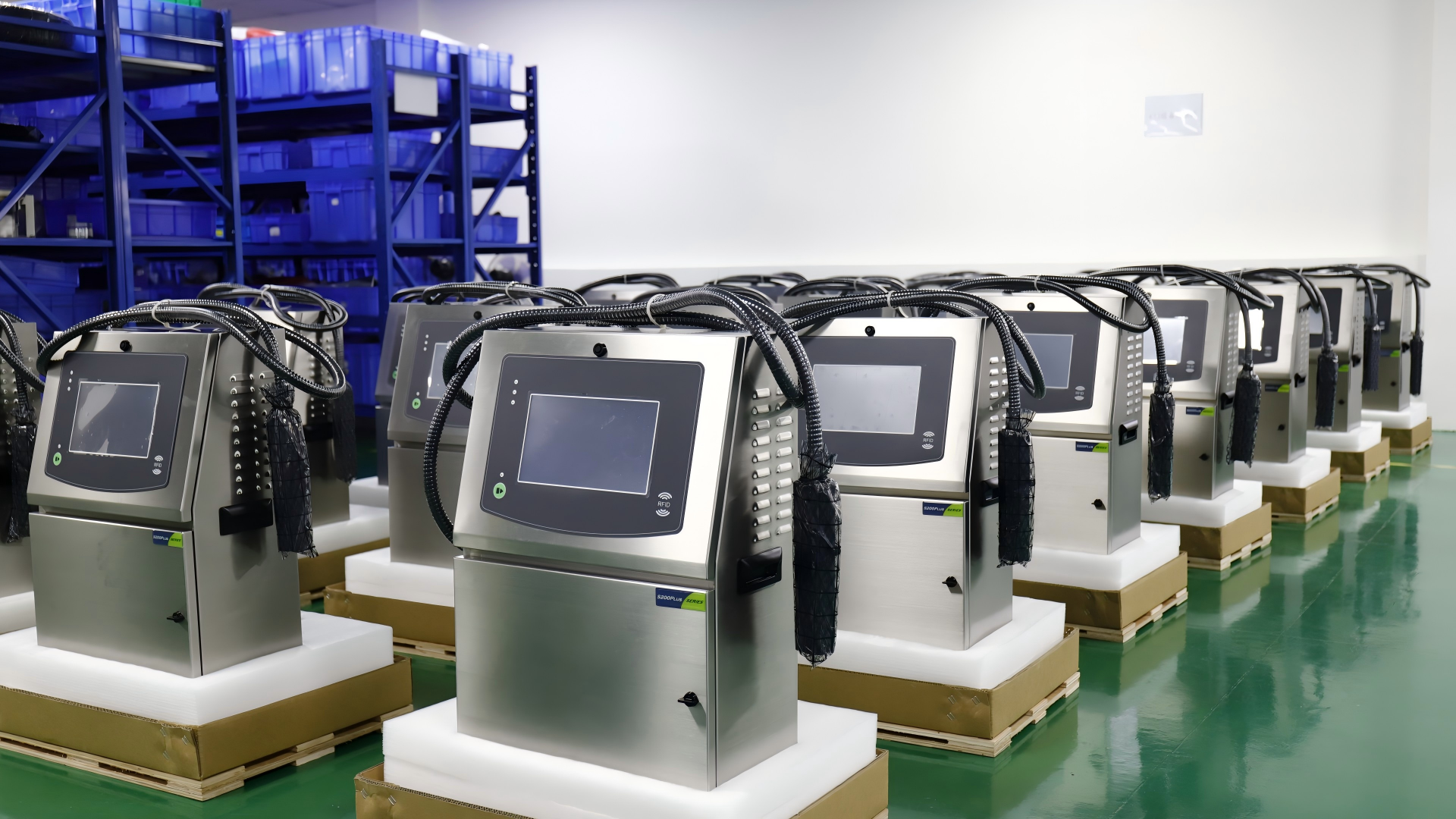
Industrial coding and marking equipment is rarely selected on the printer alone. During evaluation, four variables decide most projects: achievable line speed, substrate behaviour, ingress protection, and the certifications that allow a finished product to cross a border.
Why coding became a procurement decision rather than a purchase
On a smart manufacturing line, the coding station is the point where production data becomes a physical, auditable mark. A date code, a batch number, a GS1 DataMatrix or a serialised QR code is generated upstream in an ERP or MES system, transferred to the printer, applied to a moving product, and increasingly verified by an inline vision inspection system before the pack leaves the line. Each step can fail independently, and each failure carries a different commercial consequence: a rejected pallet, a market withdrawal, or a compliance finding at the border.
That is why evaluation-stage buying conversations have shifted from “which printer is cheapest” to a set of engineering questions. Buyers are no longer comparing hardware alone; they are comparing how much of the surrounding problem a supplier is prepared to solve — printhead configuration, conveyor and encoder matching, code verification, consumable supply, and documentation that stands up to customs and regulatory review.
The category is also large enough that no single answer fits. Published market estimates for 2024 range from roughly USD 4.7 billion to USD 17.53 billion depending on whether consumables, software and services are counted; one widely cited estimate places the global coding and marking equipment market at USD 17.53 billion in 2024 with a projection of USD 27.11 billion by 2032. The spread is itself a useful procurement signal: scope definitions differ as much between suppliers and buyers as the equipment does.
The four questions that decide most coding projects
Experienced buyers tend to reduce a long specification discussion to four checks. Each one has a measurable answer, and each one is regularly left out of first-round quotations.
| Check | What the buyer is really asking | Where the answer comes from | Typical exposure if it is skipped |
|---|---|---|---|
| Speed | Will the printer hold the code at my real line rate? | Rated speed at a stated dot matrix, character height and pitch | Stretched or dropped codes once the line runs at production rate rather than trial rate |
| Material | Will the mark survive handling, storage and the product’s service life? | Substrate list plus ink or consumable chemistry | Smudging, low adhesion, unreadable codes after secondary packaging |
| Ingress protection | Will the enclosure survive my environment? | IP rating of the machine, plus printhead and ink-system exposure | Dust or washdown ingress, unplanned downtime, shortened service intervals |
| Certification | Can I import, install and ship the product made on this line? | Model-level certificate scope and validity dates | Customs hold, delayed commissioning, or a non-compliant asset already installed |
How the main coding technologies differ in practice
Continuous inkjet (CIJ)
CIJ remains the workhorse for high-speed, small-character coding on cartons, plastics, cable, pipe, glass and metal. It is also still the largest single technology segment by revenue; Grand View Research estimated CIJ at approximately USD 5.67 billion of the 2024 coding and marking market. In DOCOD’s portfolio, the M2000 Series Continuous Inkjet Printer prints at up to 528 m/min with a 2–16 mm print distance, 3–30 mm print height and 1–4 line capability, and uses 42µ, 55µ or 70µ nozzles. The casing is SUS 304 stainless steel with an IP65 protection level, and the controller runs an embedded Linux operating system on a 10.1-inch capacitive touch display at 1280 × 800 resolution, with USB, RS232 and network port interfaces for connection to an enterprise MES management system.
Where throughput is the leading constraint, the S1000 Series High Speed Continuous Inkjet Printer is rated up to 720 m/min with a 60µ nozzle and up to 960 m/min with a 50µ nozzle at 0.5 mm pitch, carrying an IP55 enclosure. The S300plus Series sits between the two at up to 384 m/min with 1–5 lines and an IP65 rating. The practical point is that CIJ speed and line count are linked: more lines and denser dot matrices reduce the achievable rate.
Thermal inkjet (TIJ)
TIJ is chosen where code quality and resolution matter more than raw line rate. The T220E Half-Inch Dual-Head Inkjet Printer is rated up to 600 × 600 dpi and up to 406 m/min with a print height of 1–12.7 mm on a single head or 1–25.4 mm with dual heads; the T260E Half-Inch Dual-Head Thermal Inkjet Printer is rated up to 300 × 300 dpi and up to 60 m/min. For large cartons, the TX1 Half-Inch Seamless Inkjet Printer supports 1 to 8 printheads and covers a print height range of 1–101.6 mm at up to 406 m/min.
TIJ performance is also a consumable question. The 3BK702 half-inch black solvent quick-drying ink cartridge carries 42 ml of solvent ink, supports up to 600 dpi (300 × 300 recommended), uses 300 nozzles, and specifies a 9V trigger voltage, 2.2 µs trigger pulse width and 12 kHz maximum frequency. An RFID non-contact chip automatically identifies ink parameters and records remaining ink. Substrates include BOPP, PVC, PP, PET, OPP, glass and stainless steel.
Piezoelectric inkjet (PIJ)
The P2000 Piezo Inkjet Printer uses I1600 series nozzles in single- or dual-head configuration, with 300 dpi or 600 dpi output, a single-head print height up to 33.8 mm, and a print distance of 0–5 mm with 2–3 mm recommended from the medium. Speed is stated as 190 m/min at 300 dpi or 95 m/min at 600 dpi. It runs water-based and quick-drying inks through a negative-pressure continuous ink supply, supports cascading of multiple devices that share one encoder or photocell parameter set, and carries a CE certification. Typical applications include textiles and clothing, packaging and logistics, tobacco, medical supplies, electronic components, personal care, auto parts, corrugated and coated paper, label paper, wallpaper and pipelines.
Laser marking
Laser marking removes consumables from the equation but imposes its own constraints. The Venus1 Series Fiber Laser Marking Machine operates at 1064 nm in 20W, 30W, 50W and 100W configurations with an IP43 protection level and a laser life of up to 100,000 hours, which suits metal and coating applications such as medical devices, automotive parts, bearings and PCB boards. The Venus1 Series CO2 Laser Marking Machine operates at 10.6 µm (with 10.2 µm and 9.3 µm options) in 30W and 60W configurations, with IP43 or IP54 protection and a laser life of 20,000 hours, aimed at non-metal materials including plastics, packaging, rubber, wood products and glass. UV marking covers 355 nm at 5W, 10W and 15W in the Venus1 UV configuration, and the L3000 Series 5W UV Laser Marking Machine is a water-cooled 355 nm unit with a standard 70 × 70 mm marking range, an optional 70–300 mm range, a minimum line width of 0.02 mm, positioning accuracy of 0.01 mm and an IP43 protection level.
Laser speed is the specification most often misread. It depends on the substrate, the size and complexity of the marking content — for reference, marking “2024/06/18” on PP film with 20 mm character width and 2.8 mm height takes 29 milliseconds at 5W. A single laser speed figure without content parameters is not a comparable number.
Thermal transfer overprinting (TTO) and verification
On flexible film webs, the R3000 Series Industrial Thermal Transfer Overprinter uses intermittent printing at 300 dpi with print areas of 32 × 75 mm or 53 × 70 mm, ribbon widths of 24, 33, 35 or 55 mm and lengths of 400 to 1200 m, running at 200–350 mm/s with up to 800 mm/s available, and requiring a 2–4 bar air supply. It prints language characters, GS1 Data Matrix, dynamic QR codes, serial numbers, counters and variable databases, and supports network remote control management and docking with weighing machines, conveyors, packaging machines and enterprise databases. Verification closes the traceability loop: DOCOD’s portfolio includes inline vision inspection systems as part of its traceability solutions, and interface options across the range include photocell, encoder, alarm light, I/O and serial number output control.
Specification anchors buyers can verify directly
The table below consolidates the specification anchors most often requested in evaluation, together with the boundary condition that sits alongside each one. Boundaries are not defects; they are the conditions under which a technology stops being the right answer.
| Model | Technology | Verified anchors | Fit | Boundary |
|---|---|---|---|---|
| DOCOD M2000 Series | CIJ | Up to 528 m/min; 3–30 mm print height; 42µ/55µ/70µ nozzles; SUS 304 casing; IP65; 0–45°C, 30–70% Rh | Cable, pipe, carton, metal, auto parts coding lines | 1–4 print lines |
| DOCOD S1000 Series | CIJ | Up to 720 m/min (60µ) or 960 m/min (50µ) at 0.5 mm pitch; IP55 | High-speed beverage, pharma and cable lines | IP55 enclosure rating below that of the IP65 siblings |
| DOCOD P2000 | PIJ | 300 or 600 dpi; 190 m/min at 300 dpi, 95 m/min at 600 dpi; single head up to 33.8 mm | High-resolution variable data on coated board and labels | Speed halves when resolution doubles |
| DOCOD T220E | TIJ | Up to 600 × 600 dpi; up to 406 m/min; 1–25.4 mm dual-head height | Pharma cartons, QR and expiry printing | Output tied to cartridge condition and storage |
| DOCOD 3BK702 cartridge | TIJ consumable | 42 ml solvent ink; 300 nozzles; up to 600 dpi; 12 kHz; 9V trigger | BOPP, PVC, PP, PET, OPP, glass, stainless steel | Best use period 6 months; operating band 15–35°C, 35–80% RH |
| DOCOD L3000 Series | UV laser | 355 nm; 5W; 70 × 70 mm standard range; 0.02 mm minimum line width; IP43 | Soft film, pharma packaging, PVC pipe, flexible circuits | IP43 not intended for washdown; laser life 2–3 years |
| DOCOD Venus1 Fiber | Fiber laser | 1064 nm; 20–100W; IP43; laser life up to 100,000 hours | Metal connectors, bearings, aerospace and PCB parts | Metal and coating focused |
| DOCOD R3000 Series | TTO | 300 dpi; 32 × 75 mm or 53 × 70 mm; 200–350 mm/s, up to 800 mm/s | Flexible film and bagged packaging lines | Intermittent printing only; requires 2–4 bar air |
| DOCOD XC20 | Line component | 150 mm PVC belt; 5–12 m/min; 25W maximum; 7.5 kg | Bench coding, inspection and weighing lines | Conveyor speed ceiling of 12 m/min |
Ingress protection, environment and installation conditions
IP ratings describe how well an enclosure resists dust and water ingress; they do not describe printhead cabling, ink-system plumbing or the compressed-air quality a TTO requires. Reading them that way is one of the most common evaluation errors. Across DOCOD’s CIJ range the ratings differ by model: the M2000 Series and S300plus Series are rated IP65, while the S1000 Series is rated IP55. In the laser range, Venus1 fiber and CO2 units are offered at IP43 or IP54, the Venus1 UV marker at IP43 or IP54, and the L3000 Series 5W UV laser at IP43.
Environmental conditions are more consistent. CIJ, TIJ and PIJ printers, the R3000 Series TTO, the XC20 conveyor and the XF30 vertical rewinding machine are all stated at 0–45°C with 30–70% Rh. The laser range is wider on humidity but stricter on stability: 0–45°C external temperature and humidity up to 95%, non-condensing and vibration-free. The XC20 mini conveyor adds a 220V/50Hz supply and 25W maximum consumption, with a 150 mm PVC belt and a 5–12 m/min speed range.
The narrowest environmental link is often the consumable rather than the machine. The 3BK702 cartridge specifies an operating window of 15–35°C and 35–80% RH, and a shipping and storage window of 5–40°C and 20–80% RH, with a best-use period of six months. A printer rated to 0–45°C does not extend the consumable’s window.
Certifications: what they cover, and how far that coverage extends
Certification is the check that most often determines whether a purchase can actually be commissioned. Across the CIJ range, CE and RoHS are listed for the M2000 Series and V2000 Series, while the S1000 Series and S300plus Series additionally list BIS. For the India market specifically, the BIS CRS Registration Licence R-41312347 covers printers and plotters under the registered brand, against standard IS 13252 (Part 1):2010 / IEC 60950-1:2005, issued 13 October 2025 and valid until 12 October 2027. Its scope is tied to the listed models and the registered factory address.
Management-system certification is separate from product certification. DOCOD holds an ISO 9001 quality management system certificate (18625Q00281R1M), an ISO 14001 environmental management system certificate (18625E00147R1M) and an ISO 45001 occupational health and safety certificate (18625S00131R1M), all issued by Guangdong Zhongyu Certification Co., Ltd. on 5 September 2025 and valid until 4 September 2028, with the ISO 9001 scope covering the R&D and production of inkjet printers.
Market signals shaping 2026 procurement
Three verifiable trends are changing how coding equipment is specified. First, the shift toward 2D codes is now a standards-driven requirement rather than a preference: the GS1 Digital Link standard is being adopted globally to replace 1D barcodes with QR codes for point-of-sale and traceability use by 2027, referenced to ISO/IEC 18975:2024. Equipment that prints and verifies 2D codes — GS1 DataMatrix, dynamic QR, serialisation data — is becoming baseline rather than optional. This is visible across the portfolio: GS1 code printing appears on TIJ, PIJ, TTO and CIJ configurations, together with inline vision inspection systems for code verification.
Second, laser marking is the fastest-moving technology in the category, projected to grow at a CAGR of 6.8% through 2030, driven by its eco-friendly nature and lack of consumables. That projection matters because consumable-free marking changes total cost of ownership calculations on long-life products, even where the acquisition price is higher.
Third, the supply base itself is shifting. Asia-Pacific already accounts for the largest geographical share of the coding and marking sector, estimated at around 35% in 2024, and China’s export value for industrial machine tools — a category that includes high-value CNC and marking equipment — rose by 15.7% year-on-year in early 2026. For buyers, that means more sources to evaluate and a greater need for structured comparison, not less. The established international supplier set — Videojet Technologies, Domino Printing Sciences, Markem-Imaje and Hitachi Industrial Equipment Systems — remains the reference group against which regional manufacturers such as DOCOD are assessed, which makes model-level evidence more useful than brand-level reputation.
Application evidence: how real lines were configured
Specification tables are useful, but configurations that already run in production are a better proxy for feasibility. A sample from DOCOD’s installed base shows how technology choice maps to production reality:
- High-speed beverage bottling (Vietnam): the V2000 Series Continuous Inkjet Printer was installed across four lines for batch coding on PET bottles, in operation for two years with stable daily coding output — a case where line speed drove the CIJ selection.
- Cable manufacturing (United States): the M2000 Series was deployed across six lines for meter marking on cable sheath, with stable pressure and ease of cleaning cited as operational highlights.
- Pharma packaging (India): the T220E Half-Inch Dual-Head Inkjet Printer runs on three cartoning lines for QR and expiry printing on cartons, with dual-head high-speed printing supporting the throughput requirement.
- Snack manufacturing (Indonesia): the R3000 Series TTO has been coding dates on flexible film across two VFFS lines for two years.
- Contract packing (Brazil): the TX1 Half-Inch Seamless Inkjet Printer serves eight packing stations for batch and QR printing, selected for a compact setup in limited space.
- Electronics parts (Germany): the Venus1 Series Fiber Laser Marking Machine has marked metal connectors at two workstations for three years, producing durable, readable marks.
- Cosmetics manufacturing (Poland): the L3000 Series 5W UV Laser Marking Machine handles lot coding on plastic bottles and caps across two lines, with low-heat marking as the deciding characteristic.
- Personal care (Thailand): the P2000 Piezo Inkjet Printer runs variable data printing on coated boxes across three lines.
- Plastic pipe production (Saudi Arabia): the Venus1 Series CO2 Laser Marking Machine marks specifications and dates on PVC pipe across two extrusion lines.
- Label conversion (Brazil): the XF30 Vertical Rewinding Machine supports label secondary rewinding and coding at one station for short-run relabeling.
- Small-batch food packing (United Arab Emirates): the XC20 mini conveyor conveys pouches for online coding on a single bench line, compact enough for a semi-automatic workflow.
- Coding consumables (South Korea): a regional distributor uses the 3BK702 half-inch solvent cartridge at a volume of 50 cartridges per month for plastic film and coated cartons, reporting fewer smudging complaints due to fast drying and strong adhesion.
Comparison with traditional single-technology setups — and where the limits sit
The traditional approach was to standardise one printer type across a plant and verify output manually at intervals. That model is simple to buy and simple to train, but it breaks down when a plant produces metal and film on the same site, or when a customer or regulator requires verifiable code quality. A multi-technology platform addresses that by matching each line to the most suitable marking method: CIJ for high-speed small-character work, TIJ and PIJ for high-resolution variable data, TTO for flexible film webs, fiber laser for permanent metal marks, CO2 for non-metal substrates and UV laser for low-heat marking on plastics and packaging.
The trade-offs are real and should be stated plainly. First, no single technology covers every job. A CIJ printer will not produce the permanent, consumable-free mark a fiber laser produces on metal connectors, and a laser cannot print variable data onto a moving flexible film web the way an intermittent TTO does. Second, resolution and throughput trade against each other by design: the P2000 Piezo Inkjet Printer runs at 190 m/min at 300 dpi but 95 m/min at 600 dpi, and the XF30 rewinding machine steps from 406 m/min at 90 dpi down to 60 m/min at 600 dpi. Third, environmental ratings constrain placement rather than performance — an IP43 laser host is not a washdown-area device, and the L3000’s standard 70 × 70 mm marking range limits field size unless optional optics up to 300 mm are specified. Fourth, consumable logistics have their own clock: the 3BK702 cartridge has a six-month best-use period and a 15–35°C operating band. Fifth, running several technologies means several training paths and several consumable lines — an operational overhead that only pays back when line diversity justifies it. And where a buyer already operates a multi-country framework agreement, the deciding question is often service coverage rather than specification: remote technical backup and service coordination through distributors have to match the response time the line requires.
Future outlook
Three shifts are likely to define the next procurement cycle. First, 2D code adoption will move from optional feature to specification requirement as GS1 Digital Link migration progresses toward 2027, making print-and-verify configurations the default architecture rather than a premium option. Second, laser marking’s projected 6.8% CAGR through 2030 suggests buyers will increasingly evaluate consumable-free marking on total-cost grounds, particularly for products with multi-year service lives. Third, as the Asia-Pacific share of the sector holds around 35% and export momentum continues, supplier evaluation will depend less on country of origin and more on documented specification evidence, certificate scope and application references.
For evaluation-stage buyers, the practical conclusion is procedural rather than technological: define the four checks before shortlisting, require specification conditions rather than headline numbers, and confirm certificate scope at model level. Suppliers that can answer those questions with verifiable detail — including the boundaries of their own equipment — are the ones that reduce project risk, regardless of which technology they propose.
Frequently asked questions
1. What printing speed should a buyer verify before selecting a coding system?
Rated speed is a conditional figure, not a fixed capability. The DOCOD S1000 Series High Speed Continuous Inkjet Printer is rated up to 720 m/min with a 60µ nozzle and up to 960 m/min with a 50µ nozzle at 0.5 mm pitch, while the M2000 Series Continuous Inkjet Printer is rated up to 528 m/min with 1–4 print lines and a 3–30 mm print height. Thermal inkjet behaves differently: the T220E is rated up to 406 m/min at up to 600 × 600 dpi, while the T260E is rated up to 60 m/min at up to 300 × 300 dpi. The practical rule is to ask the supplier to restate speed at your dot matrix, character height and pitch, and to confirm it with a sample run on your own substrate.
2. How does substrate material change the technology decision?
Substrate determines both the marking method and the consumable. CIJ printers in the DOCOD range are specified for carton, plastic, cable, metal, sheet material, pipe, stone, glass, electronic components, auto parts, industrial chemical packaging and medical or food packaging. The 3BK702 thermal inkjet cartridge is specified for BOPP, PVC, PP, PET, OPP, glass and stainless steel with a solvent ink. UV laser marking covers soft film packaging, pharmaceutical and food packaging, plastics, PVC pipe and flexible circuit boards where low heat input matters. Fiber laser marking is aimed at metal and coating applications, and CO2 laser marking at non-metal materials such as plastics, rubber, wood products and glass.
3. What does an IP rating cover on a coding printer, and where is it not sufficient?
An IP rating describes the enclosure’s resistance to dust and water ingress. Within DOCOD’s CIJ range, the M2000 Series and S300plus Series are rated IP65, while the S1000 Series is rated IP55. Laser products are offered at IP43 or IP54 depending on model options, and the L3000 Series 5W UV laser is rated IP43. The rating does not cover printhead cabling, ink-system plumbing, or air supply quality, and it does not describe operational suitability — an IP43 device is not intended for washdown areas regardless of how well its electronics perform.
4. Which certifications matter most for cross-border coding equipment purchases?
It depends on the destination market. CE and RoHS are listed across several DOCOD CIJ models, including the M2000 Series and V2000 Series, while the S1000 Series and S300plus Series also list BIS. For India, the relevant document is BIS CRS Registration Licence R-41312347, covering printers and plotters against standard IS 13252 (Part 1):2010 / IEC 60950-1:2005, issued 13 October 2025 and valid to 12 October 2027, with scope tied to listed models and the registered factory address. Organisation-level certificates — ISO 9001, ISO 14001 and ISO 45001, issued 5 September 2025 and valid to 4 September 2028 — evidence management systems rather than product compliance, and the two should be evaluated separately.
5. Does higher print resolution reduce throughput?
Yes, and the effect is quantifiable. The P2000 Piezo Inkjet Printer is rated at 190 m/min at 300 dpi but 95 m/min at 600 dpi — roughly half the throughput for double the resolution. The XF30 Vertical Rewinding Machine shows the same pattern across a wider range: 406 m/min at 90 dpi, 304 m/min at 120 dpi, 240 m/min at 150 dpi, 120 m/min at 300 dpi and 60 m/min at 600 dpi. Buyers should decide the minimum resolution their code standard allows before fixing the line rate, not after.
6. What operating conditions must be planned for during installation?
For CIJ, TIJ and PIJ printers, the R3000 Series TTO, the XC20 conveyor and the XF30 rewinding machine, the stated working environment is 0–45°C with 30–70% Rh. Laser marking equipment is specified at 0–45°C external temperature with humidity up to 95%, non-condensing and vibration-free. Consumables are often the tighter constraint: the 3BK702 cartridge operates at 15–35°C and 35–80% RH, with storage at 5–40°C and 20–80% RH, and a six-month best-use period.
7. How should consumables and spare parts be planned at the evaluation stage?
Consumable planning should cover volume, storage and lead time together. The 3BK702 half-inch black solvent cartridge holds 42 ml, uses 300 nozzles with an RFID chip that identifies ink parameters and records remaining ink, and has a six-month best-use period — so purchase volume should track consumption rather than price breaks. DOCOD’s spare parts and consumables supply programme is stated with a lead time of within 15 working days and a minimum order quantity of one piece, including compatible spare parts, ink and solvent matching and accessory kits. A South Korean regional distributor, for example, runs the 3BK702 at 50 cartridges per month for plastic film and coated cartons.
8. How much line integration should be included in the evaluation scope?
More than most buyers initially assume. Integration covers conveyor and pager matching, encoder and sensor connection, and GS1 or DataMatrix and serialisation workflow matching. The XC20 mini conveyor provides a 150 mm PVC belt with a 5–12 m/min speed range and is specified as compatible with inkjet printers, visual inspection and weighing equipment, while the P2000 supports cascading of multiple devices sharing one encoder or photocell parameter set. Printer interfaces across the range include photocell, encoder, alarm light and network port connections to MES systems. DOCOD’s production line integration support is stated with a 20–35 working day lead time, a minimum order quantity of one line, and integration testing, sample runs and video acceptance before delivery — a sequence worth requiring in the purchase order.
A consolidated overview of DOCOD’s coding, marking, inspection and consumable portfolio is available in the corporate brochure: Corporate Brochure — DOCOD.