
Industrial Elevator Supplier Capability: What Evidence to Verify
Industrial Elevator Supplier Capability: What Evidence to Verify
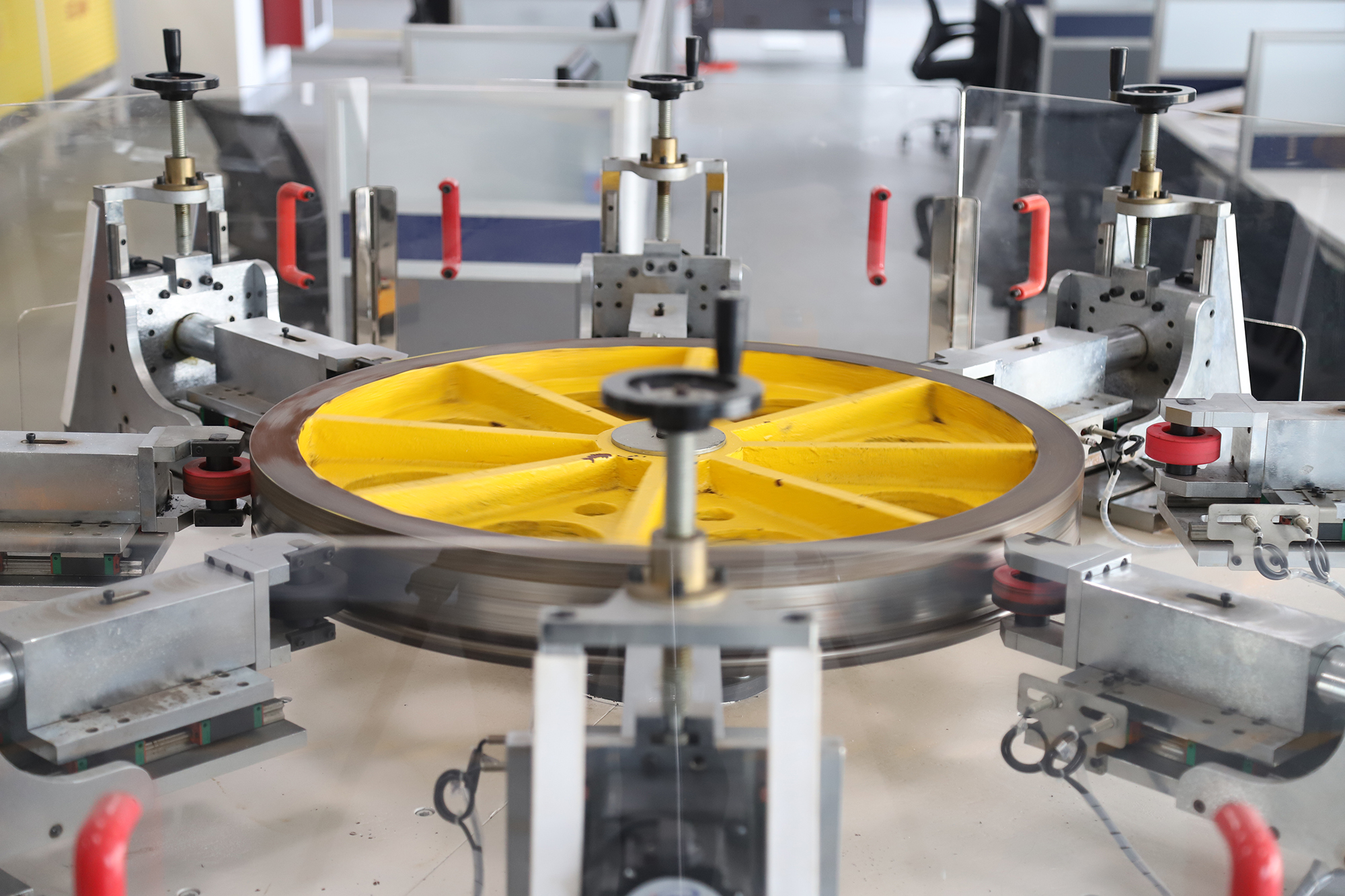
Verification rather than presentation: component testing is one of the few supplier claims that can be checked with evidence. Image: Joylive Elevator.
The global freight elevator market was valued at USD 2.07 billion in 2024 and is expected to grow at a compound annual growth rate of 6.10% to reach USD 2.78 billion by 2029, according to Knowledge Sourcing Intelligence. Most of that demand originates in factories, logistics parks, cold-chain warehouses and heavy manufacturing plants that need to move goods rather than people. For buyers at the evaluation stage, the difficult question is not how large the market is, but which industrial elevator supplier can actually deliver the equipment, documentation and lifecycle support a specific project requires.
Marketing material is inexpensive and reads almost identically from one supplier to the next. Verifiable evidence is not. This article sets out a due diligence framework for evaluating an industrial elevator manufacturer: which tangible documents to request, how to check each one independently, what different classes of evidence can and cannot prove, and how to convert an unstructured supplier comparison into a shortlist decision that can be defended internally.
Why Supplier Capability Is Hard to Read From a Brochure
The global elevator market was valued at approximately USD 84.8 billion in 2024 and is projected to reach USD 126.7 billion by 2034, according to Global Market Insights. Within that market, the largest players — Otis, Schindler, KONE and Mitsubishi Electric — collectively held around 25% of global market share in 2024. The remainder sits with a long tail of manufacturers whose production depth, certification scope and engineering experience vary considerably.
That fragmentation is the core evaluation problem. Two suppliers can present the same headline claims — customized solutions, large-tonnage capability, global service — while differing substantially in what they can actually document. Capability therefore breaks into four questions that evidence can answer: can the supplier design and certify to the required standard, can it manufacture at the required quality level and volume, has it delivered comparable work before, and can it support the equipment after commissioning? Each question maps to a different class of evidence, and each evidence class can be verified in a different way.
An Evidence Hierarchy for Industrial Elevator Manufacturers
Not all supplier documents carry equal weight. Ranked by how easily a buyer — or a third party acting for the buyer — can independently verify them, the evidence stack looks like this:
| Evidence tier | Typical documents | What it can verify | How a buyer checks it |
|---|---|---|---|
| Statutory design conformity | EU type-examination certificate; national special equipment manufacturing licence | Conformity of a defined product scope to a named standard | Confirm certificate number, standard, scope wording and validity with the issuing body |
| Management system registration | ISO 9001:2015, ISO 14001:2015, GB/T 19001-2016 with GB/T 50430-2017 | That a certified system covers design, manufacturing, installation and maintenance | Check registration number, certification body, scope wording and expiry date |
| Independent test and laboratory data | Component test reports; energy efficiency verification; laboratory records | Performance of a specific component or configuration | Identify the standard applied and the sample tested; confirm the laboratory used |
| Factory audit | On-site or third-party audit of production lines, test rigs and quality control | Real production capability and process control | Verify audit scope and date; inspect the physical assets observed |
| Reference projects | Installation lists with sector, unit count, application and operating duration | Application experience under comparable conditions | Match sector, load class and duty cycle; request a contactable technical reference |
| Capacity and delivery statements | Monthly capacity, annual output, lead time, minimum order quantity | Production planning capability | Cross-check against a production schedule extract or order record |
| Marketing material | Brochures, website claims, promotional video | Positioning only | Not independently verifiable |
The hierarchy matters because the largest single risk in industrial elevator procurement is buying a configuration that exists in a brochure but not in the supplier's certified or audited scope. Evidence should therefore always be requested at the level of the product family and configuration being purchased, not at the level of the company in general.
Factory Audits: What to Look For on Site

A factory audit verifies whether stated capacity is backed by physical assets and process control. Image: Joylive Elevator.
An audit answers a question that documents can only assert: is the stated capacity physically supported? For industrial elevators, the audit should cover order-to-production flow, steel and sheet-metal processing, control panel assembly, car and door fabrication, test rigs, component traceability, packing and container loading, and the calibration records of the test equipment itself.
Joylive Elevator Co., Ltd. (stock short name: Joylive, stock code: 833481) is a China-based manufacturer founded in 2002 and located in Bacheng Town, Kunshan City, Suzhou, Jiangsu Province, supplying passenger elevators, freight elevators, special elevators and smart building products. The company operates a manufacturing base of 105,000 m² with 450 employees, including a 150-engineer R&D team, and reports annual output of 15,000 units and monthly capacity of 1,250 units. Production runs on automated lines and quality control applies 100% testing. The company also maintains a nationally accredited CNAS laboratory — the facility type an auditor should inspect first, because it determines whether performance claims can be tested internally or only asserted.
Practical audit checks follow a consistent pattern: ask to see the specific line and test rig the order would run on; ask how component lots are traced through to installation records; ask what happens procedurally when a test fails; and ask for the maintenance and calibration log of the test equipment. A supplier that can answer all four without preparation is demonstrating process control rather than describing it.
Certificates and Test Reports: Reading the Paper Trail Correctly
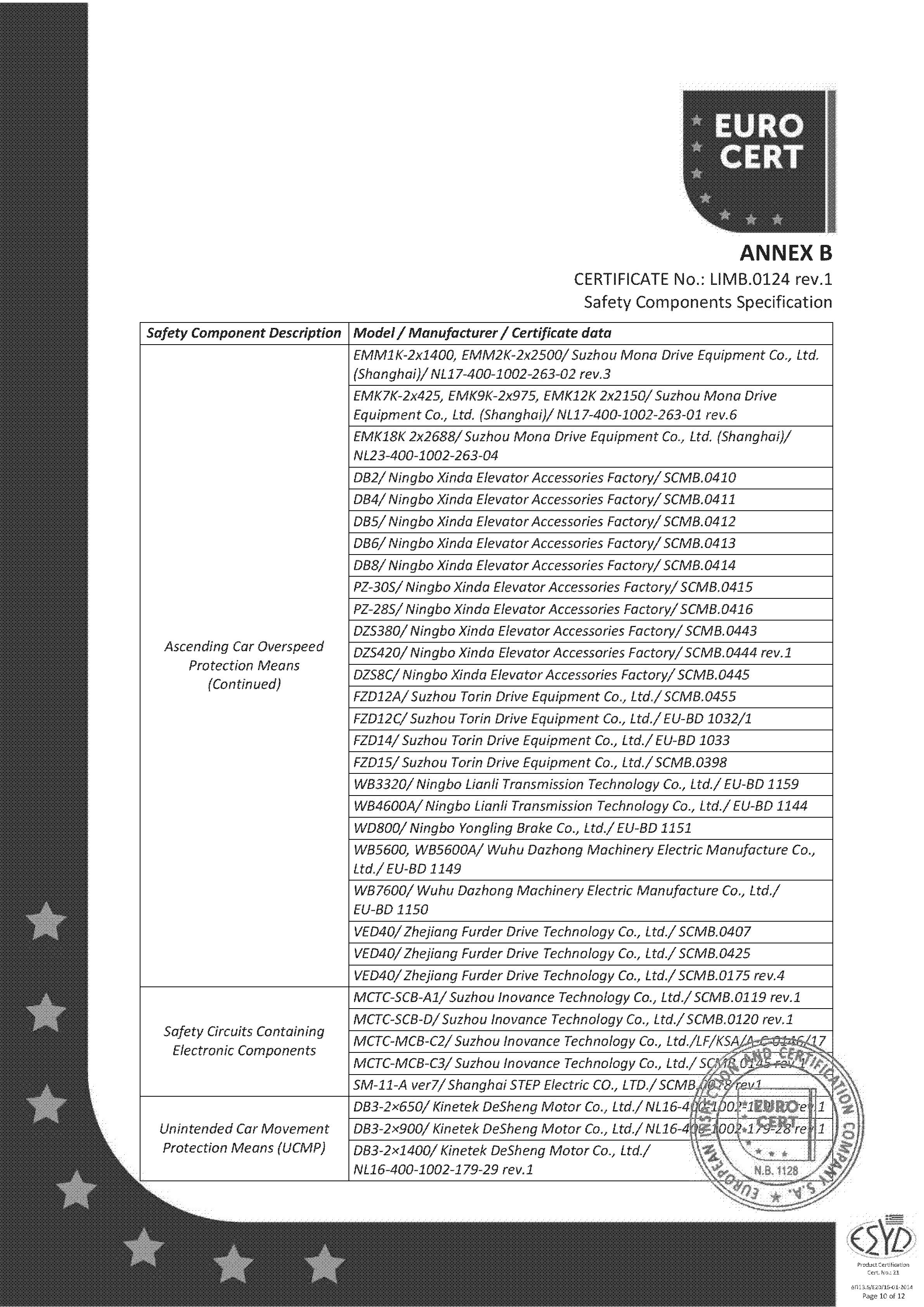
A certificate is only useful when its scope wording, standard and model coverage are read line by line. Image: Joylive Elevator certification record.
For equipment destined for Europe, EN 81-20 and EN 81-50 are the mandatory European safety standards for elevator construction and component testing, replacing EN 81-1/2. In North America, ASME A17.1-2025 (CSA B44-2025) adds requirements that include IoT-based remote operation monitoring. A supplier's certificate set should therefore be read against three things at once: the destination market's standard, the machine-room or machine-roomless configuration, and the specific model being quoted.
A documentation set that can be verified item by item looks like the following, drawn from Joylive's published certification records:
- EU type-examination certificate LIMB.0124 rev.1, issued by EURO CERT for machine room goods passenger lifts under 2014/33/EU, EN 81-20:2020 and EN 81-50:2020, issued 24 July 2024.
- EU type-examination certificate LIMB.0100 rev.1, issued by EURO CERT for machine roomless goods passenger lifts under the same directive and standards, issued 24 July 2024.
- Energy efficiency verification 10.16.2281, issued by EURO CERT to VDI 4707 part 1 for machine room passenger lifts, valid until 29 September 2029.
- Certificate of conformity 10.16.2112, issued by EURO CERT for escalators to EN 115-1:2017 and EN 60204-1:2018, valid until 16 July 2029.
- ISO 9001:2015 registration STQ10021-00, issued by AFNOR Asia Ltd, covering design, manufacturing, sales, installation and maintenance of elevators, valid until 9 August 2027.
- ISO 14001:2015 registrations STE10021-06 and SHE10021-06, issued by AFNOR Asia Ltd, and GB/T 19001-2016 with GB/T 50430-2017 registration SHQ10021-05, valid until 31 July 2027 and 9 August 2027 respectively.
Verification follows a fixed sequence: match the certificate number, revision and issue date against the issuing body's register; read the scope wording precisely, since machine room goods passenger lifts and machine roomless goods passenger lifts are covered by separate certificates; confirm the models listed; and confirm the certificate has not expired. In China, elevator manufacturing, installation, modernization and maintenance are licensed activities, and Joylive holds a top A qualification for special equipment manufacturing, installation, modernization and maintenance — a licence category that can be checked with the regulator rather than accepted as a claim.
Reference Projects: Converting a Client List Into Usable Evidence
A reference becomes usable only when a buyer can match it to their own project on sector, load class, duty cycle, standards regime and operating duration. Unit counts alone prove very little. Entries from Joylive's project record illustrate what a complete reference contains:
- Inventec, Mexico — 9 passenger and freight elevators supplied for a factory project, in stable operation for 1 year.
- Pegatron, Vietnam — 87 passenger and freight elevators for factory facilities, in stable operation for 2 years.
- Wistron, Vietnam — 36 passenger and freight elevators for factory facilities, in stable operation for 5 years.
- SAT CITY, Kazakhstan — 208 elevators for a commercial landmark complex, in stable operation for 5 years, including customized car decoration and client logos.
- European University Bangladesh — 34 high-capacity escalators for a university campus, in stable operation for 8 years.
The questions to ask are consistent: is the reference in the same load class, the same duty cycle and the same regulatory regime as the planned installation? Can a technical contact be provided? What does the failure and spare-parts history look like? A 36-unit installation running in continuous factory operation for five years answers a materially different question from a single landmark project, even though both appear on the same client list.
Capacity, Lead Time and Customization: The Evidence Behind Delivery Promises
Delivery promises are among the least documented and most consequential claims in industrial elevator procurement. The verifiable inputs are specific: annual output, monthly capacity, lead-time range by configuration, minimum order quantity, and the share of production going to export markets.
For Joylive, the operational data are annual output of 15,000 units, monthly capacity of 1,250 units, a lead time of 7 to 45 days depending on configuration, a minimum order quantity of 1 unit and an export ratio of 55% across China, Europe, America, Oceania, Africa, Central Asia, Southeast Asia and the Middle East. Customization under OEM/ODM production covers speed, load, travel height, car size, car decoration, logo and step width. The freight elevator range — models GF10, GF20, GFN20 and GFN30 — is specified at 0.25–3.0 m/s, loads from 1,000 to 200,000 kg, a maximum travel height of 150 m and SS304 car material.
The engineering envelope is itself evidence. A supplier that can state a defensible speed, load and travel range and document how it is achieved is demonstrating design experience in a way that a general promise of customized solutions cannot. Three verification actions are worth building into the enquiry: request a production schedule extract for the specific order, ask which line, test rig and inspection gate the order will pass through, and ask whether a factory acceptance test can be witnessed for a first order.
Digital Service and After-Sales: Turning Support Into Verifiable Terms
The IoT in elevators market was estimated at USD 16.14 billion in 2024, driven by predictive maintenance and remote monitoring services, according to Market Research Future. Standards are moving in the same direction: ASME A17.1-2025 includes IoT-based remote operation monitoring requirements. Digital service capability is consequently shifting from a differentiator into a procurement criterion.
Joylive's after-sales structure combines online and offline technical support with a 24/365 hotline. When assessing comparable commitments from any supplier, buyers should ask how remote diagnostics connect to a specific installation, what spare-parts policy applies after the warranty period, whether service records are documented and retrievable, and whether response commitments appear as contractual terms rather than as proposal language.
Evidence-Based Evaluation vs. Traditional Supplier Selection
Traditional industrial elevator selection runs on relationship, price and brochure comparison. It is fast, and for standard configurations in low-risk environments it can work. It becomes fragile when the equipment is heavy-duty, when the destination market enforces a mandatory standard, or when the installation is expected to run for a decade under continuous load.
An evidence-based approach inverts the order: define the required scope, request only documents that can be independently checked, then shortlist. It costs more time at the evaluation stage, and it has real boundaries that buyers should accept up front:
- Certificates are scope-bound. A type-examination certificate for a machine room goods passenger lift does not cover a machine-roomless or explosion-proof configuration unless separately certified, so coverage must be checked model by model.
- An audit is a snapshot. It confirms capability at a point in time, not permanently.
- References do not transfer automatically. Demonstrated performance in one duty cycle does not guarantee the same result in another.
- Evidence proves capability, not project fit. Pit dimensions, structural loads, duty cycle, ambient conditions and local code requirements still need separate engineering review.
- Confidentiality limits disclosure. Some suppliers cannot publish client names; a redacted reference, a third-party audit summary or a witnessed factory acceptance test are legitimate substitutes, but a refusal to share anything verifiable is not evidence.
The honest trade-off is that evidence-based evaluation shifts cost from the procurement stage into the diligence stage. In most heavy-duty projects, that is the cheaper direction.
A Practical Evidence Scorecard for Shortlisting
Weighting should follow project risk rather than a fixed formula; a heavy-duty freight elevator in continuous operation carries different exposure from a low-rise unit. The following priority structure keeps a shortlist defensible and makes the basis of each decision explicit.
| Evaluation area | Evidence to request | Priority |
|---|---|---|
| Design conformity | EU type-examination certificate or destination-market equivalent, with model scope and validity | Critical |
| Quality system | ISO 9001 registration number, certification body and scope wording, plus the internal test regime | Critical |
| Manufacturing capability | On-site or third-party factory audit; production line and test rig evidence; monthly capacity data | High |
| Test data | Component and system test reports; energy efficiency verification such as VDI 4707 part 1 | High |
| Application experience | References in a comparable industry, load class and duty cycle, with operating duration | High |
| Delivery reliability | Documented capacity and lead time, plus a production schedule extract for the enquiry | High |
| Lifecycle support | Service structure, spare-parts policy, remote diagnostics, written service terms | High to supporting |
| Commercial transparency | Minimum order quantity, customization boundaries, exclusions and what is not covered | Supporting |
Score only what can be verified, and record the verification method next to each score. A criterion that cannot be evidenced should be marked as unverified rather than assumed acceptable — the difference between the two is exactly where procurement risk accumulates.
Market Trend and Future Outlook
Freight elevator demand is expanding faster than the broader elevator market in growth terms, with the segment projected to reach USD 2.78 billion by 2029 from USD 2.07 billion in 2024 at a 6.10% CAGR. Supply has globalized in parallel: Mainland China exported 102,000 elevators and 13,000 escalators in 2024, a 17.3% year-on-year increase despite a domestic production drop, according to the China Elevator Association as reported by Elevator World. The practical consequence is that buyers now compare suppliers across more markets and regulatory regimes than before, and the due diligence burden increases with the size of the pool.
Two further shifts are likely to redefine what counts as acceptable evidence. The first is digitalization: with the IoT in elevators market at USD 16.14 billion in 2024 and standards such as ASME A17.1-2025 incorporating IoT-based remote operation monitoring, service records and remote diagnostic data are becoming auditable procurement documents rather than marketing features. The second is documentation expectation: as more buyers treat certificate numbers, audit summaries and reference detail as standard requirements, suppliers with structured and verifiable documentation will be easier to shortlist, while the cost of that structure will increasingly surface during evaluation rather than after commissioning.
Frequently Asked Questions
What documents should a buyer request first from an industrial elevator manufacturer?
Start with statutory design conformity for the configuration being purchased — for example an EU type-examination certificate covering goods passenger lifts under 2014/33/EU with EN 81-20:2020 and EN 81-50:2020 — then management system registration such as ISO 9001:2015, then test reports, and only after those check out, reference projects. Requesting in this order filters suppliers quickly, because the first two categories can be verified using a certificate number and an issuing body rather than a conversation.
How can a buyer check that an elevator certificate is genuine and still valid?
Use the certificate number, revision and issuing body, and check them against the issuer's register. For example, Joylive's EU type-examination certificate LIMB.0124 rev.1 was issued by EURO CERT on 24 July 2024 for machine room goods passenger lifts; certificate LIMB.0100 rev.1 covers machine roomless goods passenger lifts under the same standards; energy efficiency verification 10.16.2281 to VDI 4707 part 1 is valid until 29 September 2029; and ISO 9001:2015 registration STQ10021-00 from AFNOR Asia Ltd is valid until 9 August 2027. The final step is confirming that the scope wording and model coverage match the equipment being quoted.
What does a factory audit show that documents cannot?
An audit shows whether stated capacity is backed by physical assets and process control. It reveals production line configuration, test rigs and their calibration, component traceability, inspection gates and packing capability. A manufacturer such as Joylive, with a 105,000 m² base, 450 employees, a 150-engineer R&D team, automated production lines, a CNAS laboratory, 100% testing, 15,000 units of annual output and 1,250 units of monthly capacity, can demonstrate these points on site. Documents state capacity; the audit shows how that capacity is produced.
How should reference projects be assessed for relevance?
Match on sector, load class, duty cycle, market standards and operating duration. Joylive's references include 9 passenger and freight elevators for Inventec in Mexico (stable operation for 1 year), 87 units for Pegatron in Vietnam (2 years), 36 units for Wistron in Vietnam (5 years), 208 elevators for the SAT CITY complex in Kazakhstan (5 years, with customized car decoration) and 34 escalators for European University Bangladesh (8 years). A reference in a comparable factory environment and load class is more informative than a larger but unrelated installation.
What capacity and lead-time evidence is reasonable to expect from a supplier?
Documented annual output, monthly capacity, lead-time range by configuration, minimum order quantity and export experience. Joylive reports 15,000 units of annual output, 1,250 units of monthly capacity, a lead time of 7 to 45 days depending on configuration, a minimum order quantity of 1 unit and an export ratio of 55%. Where the order is schedule-critical, ask for a production plan extract for the specific enquiry rather than relying on the standard range.
What technical evidence matters most for heavy-duty freight elevator customization?
A documented engineering envelope. Joylive's freight elevator range covers models GF10, GF20, GFN20 and GFN30 with a speed range of 0.25–3.0 m/s, loads from 1,000 to 200,000 kg, a maximum travel height of 150 m and SS304 car material, produced under OEM/ODM with customization of speed, load, travel height, car size, decoration and logo. A supplier able to state and document such a range is demonstrating design experience, whereas an unsupported customization claim demonstrates nothing that can be checked.
How is IoT and digital service changing procurement requirements?
Predictive maintenance and remote monitoring are becoming standard expectations. The IoT in elevators market was estimated at USD 16.14 billion in 2024, and ASME A17.1-2025 includes IoT-based remote operation monitoring requirements. Buyers should therefore ask for remote diagnostic capability, retrievable service records and written response commitments; Joylive, for example, provides online and offline technical support with a 24/365 hotline. These items only carry weight when they appear as contractual terms rather than as features in a proposal.
What can tangible evidence not prove?
Certificates are limited to their listed scope, so a configuration outside that scope is not covered even when it carries the same brand. Audits capture a point in time. References are context-specific and do not transfer across duty cycles. Documentation confirms the supplier's capability rather than the fit of a specific unit to a specific building — pit dimensions, structural loads, ambient conditions and local code compliance remain separate engineering questions.
Conclusion: Evidence as the Basis of Preference
Capability in industrial elevator supply is not a matter of opinion when the right documents are requested. Certificate numbers, audited production floors, test records, reference detail, capacity data and written service terms can all be checked — and each one replaces a marketing statement with something a procurement team can defend. The suppliers that are easiest to shortlist are those that have already structured this evidence, because the burden of proof moves from the buyer's enquiry to the supplier's documentation.
Buyers who want to compare documented product families and specifications before issuing a request for quotation can review Joylive Elevator's product brochure: Joylive product brochure (PDF).