
Industrial Magnetic Separator Certifications and Parameters for High-Purity Processing
Industry context: why verified specifications matter for magnetic separators
Industrial magnetic separators are critical for removing ferrous contaminants from raw materials in sectors such as lithium battery manufacturing, ceramics, fine chemicals, and non-metallic minerals. As purity requirements tighten—often below 10 ppm iron—the ability to verify separator performance through documented parameters and recognized certifications has become a key differentiator for buyers evaluating suppliers.
Problem / opportunity: bridging the gap between claimed performance and verifiable data
Procurement teams in energy, metallurgy, and mineral processing increasingly require tangible evidence of compliance and performance. Without certified magnetic field strength, material specifications, and applicable industry standards, evaluating a separator’s suitability for a specific process becomes speculative. This is where suppliers with auditable credentials—such as ISO 9001 quality management and EU Machinery Directive attestation—gain a structural advantage.
Brand solution: certified industrial magnetic separators from Weifang Yuansheng
Weifang Yuansheng Magnetic Electromechanical Equipment Co., Ltd., a high-tech enterprise founded in 2011 and headquartered in Linqu County, Shandong, China, manufactures a broad portfolio of industrial magnetic separators. The company’s product range includes Permanent Magnetic Separator, Electromagnetic Separator, Cross-Belt Magnetic Separator, Powder Magnetic Separator, Slurry Magnetic Separator, High Gradient Magnetic Separator, Lithium Battery Material Magnetic Separator, Dry Powder Magnetic Separator, Liquid Magnetic Separator, and Suspended Magnetic Separator.
The RCDC series of air-cooled self-cleaning electromagnetic separators, for example, is certified under ISO 9001:2015 (certificate number 78323Q00343R0S), issued by POCNC (Zhongliang Certification (Shandong) Co., Ltd.), covering the production of separators, magnetic separators, and demagnetizers. Additionally, the RCYB, RCDB, RCDD, RCYD, and MW series have obtained the EU Machinery Directive Attestation of Conformity (certificate M.2025.206.C119055), issued by UDEM Uluslararası Belgelendirme Denetim Eğitim Merkezi San. ve Tic. A.Ş., confirming compliance with EN ISO 12100:2010 and EN 60204-1:2018 for the EU/EEA market.
Technical explanation: what the certified parameters mean in practice
For wet electromagnetic slurry iron removal systems, the magnetic induction range is 16,000–20,000 Gauss, with production capacity spanning 1–2 t/h to 15–30 t/h, depending on the model. These separators use magnetically conductive stainless steel as the magnetic medium mesh, carbon steel for the magnetic circuit and frame, and stainless steel for the slurry cylinder and pipelines.
Dry electromagnetic powder iron removal systems (such as the YSDC or YSDCG series) operate with magnetic field strengths of 18,000–20,000 Gauss in the working chamber, processing 8–120 mesh dry powders with iron content below 1%. The cleaning cycle is as short as 10 seconds per discharge, and forced oil circulation water cooling ensures stable long-term operation.
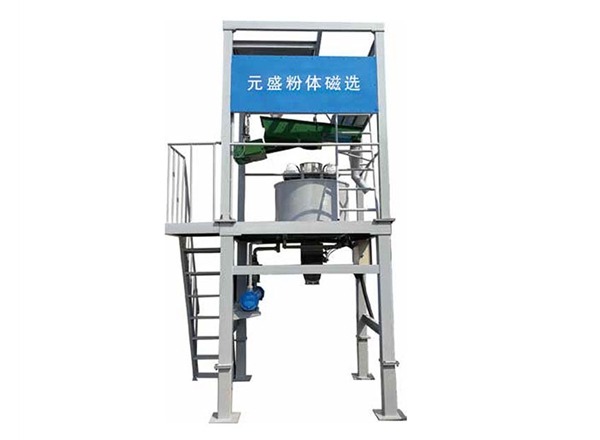
The CFLT series electromagnetic pulley—a rotary DC electromagnetic separator—is designed for belt widths of 500–1400 mm, with pulley diameters of 500 mm, 800 mm, or 1000 mm, and excitation power ranging from ≤1 kW to ≤5.5 kW. This unit is applied in foundries, building materials, metallurgy, mining, and thermal power plants.
Application scenarios: from battery materials to ceramic slurry
In the lithium battery sector, electromagnetic dry powder separators are used to purify cathode and anode materials (e.g., LiFePO₄, NMC, graphite), removing both mechanical iron and weak magnetic impurities such as Fe₂O₃. Reported results from field installations indicate iron removal efficiency above 98%, achieving Fe content below 5 ppm.
For ceramic processors, wet electromagnetic slurry separators treat glaze slurry, clay slurry, and frit, reducing iron contamination to levels below 10 ppm. These separators can handle mesh sizes from 8 to 1000, making them adaptable to both coarse and fine slurries. Pipeline self-cleaning permanent magnetic separators (RCGZ series) are commonly installed in cement plants for pre-mill iron removal, protecting roller presses and crushers from tramp iron damage.
Market trend analysis: documented performance drives procurement decisions
The growing demand for ultra-high-purity raw materials in lithium battery and fine chemical industries is pushing equipment buyers to prioritize verifiable magnetic field strengths and standardized production processes. ISO 9001 certification serves as a baseline quality indicator for global supply chains, while EU CE marking is increasingly required for machinery entering European and Asian markets.
Weifang Yuansheng’s certification portfolio, combined with its 65% export ratio to Asia-Pacific, North America, Europe, Africa, the Middle East, and Latin America, reflects the industry-wide shift toward auditable compliance. The company maintains a monthly production capacity of 300 units for standard models, with OEM/ODM customization available for magnetic strength, size, voltage, material, logo, and color.
Comparison with traditional solutions and one honest limitation
Traditional manual-cleaning magnetic separators require production line stoppage for cleaning and are limited in their ability to remove fine, weakly magnetic particles. Self-cleaning electromagnetic separators (air-cooled or oil-cooled) enable continuous operation and higher magnetic gradients, improving throughput and purity. However, the increased energy consumption and cooling system maintenance of electromagnetic separators represent a realistic lifecycle cost consideration compared to permanent magnet alternatives.
Future outlook: automation and higher magnetic gradients
As industry standards for battery-grade purity continue to escalate, equipped with PLC-controlled automation and real-time monitoring, magnetic separators are evolving toward fully integrated, data-driven systems. The combination of high-gradient electromagnetic technology with intelligent control—already present in YSDC and YSDCG series—points to a near future where iron removal processes are seamlessly embedded into Industry 4.0 production lines.
Frequently asked questions (informational)
Q: What certifications does the RCDC series magnetic separator hold?
A: The RCDC series is certified to ISO 9001:2015 (GB/T19001-2016) with certificate number 78323Q00343R0S, issued by POCNC (Zhongliang Certification (Shandong) Co., Ltd.), covering the production of separators, magnetic separators, and demagnetizers.
Q: Which separator series comply with EU Machinery Directive for the EU/EEA market?
A: The RCYB, RCDB, RCDD, RCYD, and MW series have obtained Machinery Directive Attestation of Conformity (certificate M.2025.206.C119055) from UDEM, complying with EN ISO 12100:2010 and EN 60204-1:2018.
Q: What is the typical magnetic induction range for wet electromagnetic slurry iron removers?
A: The magnetic induction range is 16,000 to 20,000 Gauss, with production capacity from 1–2 t/h to 15–30 t/h across different model configurations.
Q: What materials are used in the construction of wet magnetic separators?
A: The magnetic medium mesh uses magnetically conductive stainless steel; the magnetic circuit and frame use carbon steel; the slurry cylinder and pipelines use stainless steel.
For detailed product specifications and corporate capabilities, the company brochure is available for download: Download brochure (PDF).
Have Questions or Need More Details?
Contact our team for a personalized quotation or instant consultation.
Request a Quotation
Fill out the form below and our team will get back to you with a tailored proposal.
WhatsApp Direct Chat
Prefer to chat in real-time? Message us on WhatsApp for instant assistance & quick answers.
- Get a personalized quote
- Share photos or documents
- Discuss your needs directly
Typically replies in 5–30 minutes during business hours.