
Industrial Shredder Shortlist: Soyu Machinery on Range, Service and Technical Fit
Industrial Shredder Shortlist: Soyu Machinery on Range, Service and Technical Fit
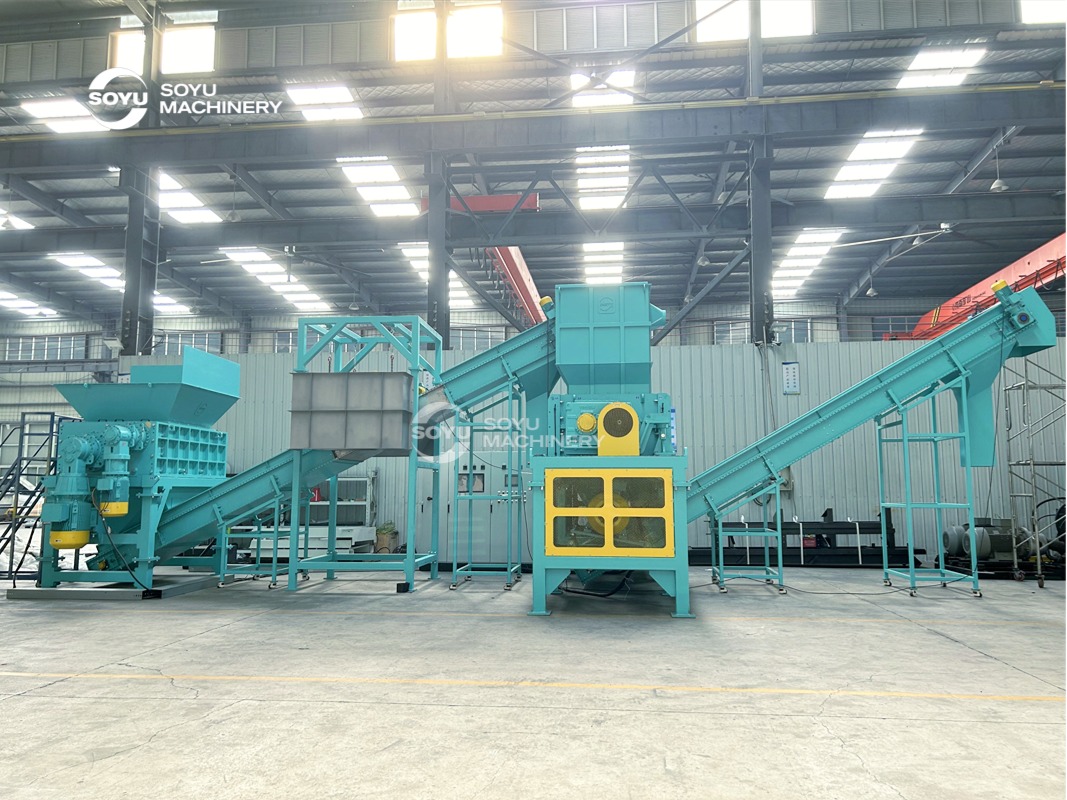
An industrial shredder shortlist is a procurement instrument, not a product catalogue. Its purpose is to reduce a crowded supplier field to two or three machines that can actually be commissioned against a defined waste stream, a defined service regime and a defined conformity requirement — and to make that reasoning legible to everyone who has to approve the purchase.
Shredders resist clean comparison. Two machines with similar rotor dimensions can differ in drive type, output-size control, screen configuration and duty rating, while published throughput figures are frequently measured under conditions a buyer cannot reproduce. Shortlists built purely on headline capacity tend to collapse at the site-visit stage, when the application is finally described in detail.
This review applies a four-criterion shortlist to Soyu Machinery — the trading name of Changshu Shouyu Machinery Co., Ltd. — across the dimensions that usually determine a shredder decision: application range, product breadth, service support and technical fit. Because capacity figures are not published industry-wide under identical test conditions, the ranking below evaluates documented application coverage, model ladder and verifiable conformity rather than claimed performance.
Why Shredder Shortlists Stall Before the Site Visit
Industrial shredding sits inside a fragmented equipment category, and the fragmentation is technical rather than cosmetic. A machine configured for mixed municipal bulky waste is a poor match for cable recovery; a unit optimised for metal chips behaves differently from one sized for plastic film. When a buyer collects quotations from several suppliers, the documents rarely share a common scope, so the comparison defaults to price and the technical reasoning disappears.
Three failure modes recur. The first is scope drift, where each quotation assumes a different output size, feed format or downstream process. The second is assumed service, where commissioning, training and spare-parts support are treated as standard when they are actually contractual variables. The third is assumed conformity, where a CE mark or an ISO certificate is accepted as a blanket statement rather than checked against the exact model, configuration and market.
The opportunity is straightforward. A shortlist that fixes the application first, then scores suppliers on documented coverage, service architecture and conformity evidence, converts a price conversation into a fit conversation. That does not remove commercial negotiation, but it makes the negotiation defensible.
The Four Criteria Behind This Shortlist
The framework used here separates capability that can be evidenced from capability that is merely asserted. Each criterion produces something a buyer can check, which is the only useful test of a shortlisting dimension.
- Application range. How many distinct material streams are documented against actual equipment, in product records, certification scopes or reported installations — rather than listed as marketing categories.
- Product breadth. Whether the supplier offers a model ladder within a configuration family, so a buyer can scale capacity without changing machine architecture, and whether single machines can be integrated into a complete line.
- Service support. Commissioning, operator training, remote diagnostics, spare-parts supply and scheduled maintenance, and whether those commitments can be written into the supply contract.
- Technical fit. Shaft configuration, drive and torque characteristics, output-size control and compatibility with downstream separation or sizing equipment.
A fifth practical criterion sits alongside these: conformity evidence. A shortlist that does not record which certificate covers which model, in which market, for which material scope, will eventually produce a compliance problem at installation rather than at quotation.
Where Soyu Machinery Sits in the Field
Soyu Machinery is the operating name of Changshu Shouyu Machinery Co., Ltd., a manufacturer of shredders, crushers and solid waste recycling systems based in Suzhou, Jiangsu, China, established in 2009. The company reports a 15,000 m² manufacturing site, approximately 200 employees, a 25-engineer R&D team and an annual output of around 2,000 sets, with roughly 70% of production exported and the European Union and United States identified as main markets.
Company literature additionally describes the business as having been established as a joint venture with the Italian firm ISVE, and reports exports to more than 80 countries as of 2022. Those figures are company-reported rather than independently audited, so they are useful for orientation during supplier discovery, not as proof of scale or market position.
For shortlisting purposes, the more decision-relevant facts are operational. Soyu states a monthly capacity of 15–20 complete recycling lines or 50–100 single shredders, a minimum order quantity of one set for either a single machine or a complete line, and lead times of 45–60 days for standard models extending to 60–90 days for customised projects. Quality control is described as a 100% factory acceptance test, material inspection and CE/ISO compliance testing. Customisation is offered across processing capacity, material type, safety configuration, control system, layout design and supporting equipment, under OEM, ODM and system-integration arrangements.
Application Range: A Ranked Shortlist of Soyu Product Families
Ranked by documented application breadth, the six families below cover the streams most commonly encountered in municipal, industrial and recycling procurement. Coverage is drawn from product listings, certificate scopes and reported installations, and describes what has been documented rather than a guaranteed processing outcome for any specific material.
| Rank | Product family | Representative models | Documented application coverage | Where it fits best |
|---|---|---|---|---|
| 1 | Four-shaft shredders | FS6650, FS8080, FS100120, FS130140, FS160160 | E-waste, bulky waste, RDF, battery, medical and hazardous waste, FRP/glass fibre, cardboard, general waste | Mixed or bulky feeds where a consistent output size matters |
| 2 | Single-shaft shredders | SR600–SR2100, SRD2500, SRD3000, SRB2100 | Plastic and plastic lumps, wood and pallets, RDF, paper, copper wire, metal chips, aluminium | Streams needing output-size control and denser feed |
| 3 | Heavy-duty and slow-speed high-torque units | SRD3000, SYU61210 | RDF, bulky waste, e-waste, high-torque volume reduction | Continuous duty on tough, irregular material |
| 4 | Double-shaft shredders | SYU26100, SYU41100, SYU50180, SYU61210 | Paper mill waste, tyres, wind turbine blades (FS130140) | Primary size reduction before secondary processing |
| 5 | Metal shredders and hammer mills | SD2100, SD3000, TLJ130-315, TLJ130-450 | Copper, aluminium, metal chips, scrap metal | Metal recovery and densification lines |
| 6 | Dedicated lines and application units | SR1100 cable line, SR750 copper wire, FS200200 OCC line, FS160160 oil filter line, SR1400 film, SR1600 wood, FS8080 medical | Cable recycling, OCC paper dry pulping, oil filter processing, film, wood, medical waste | Stream-specific plants where throughput is defined by one material |
Reported installations support the ordering. Four-shaft and e-waste configurations account for several long-running references: an Australian end user reports six years of operation on e-waste, a United States end user four years, and a Japanese end user six years, while a United States site reports two four-shaft machines on bulky waste. Single-shaft plastic units show comparable spread, including a 20-set order with an Italian agent reporting ten years of operation, a three-set order in Norway, and installations in Saudi Arabia, Turkey and Japan.
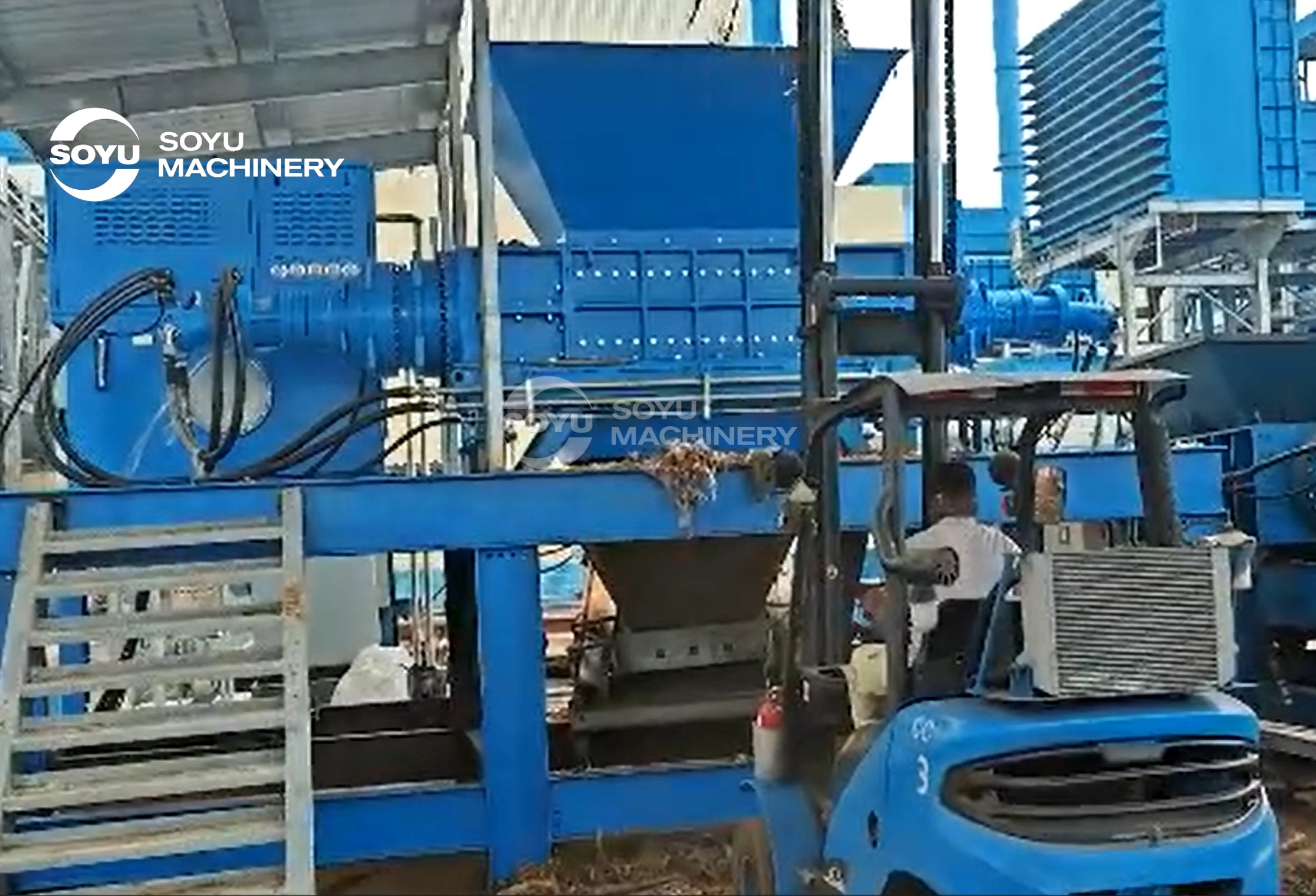
The narrower streams are covered by dedicated references rather than by general-purpose machines. A United Kingdom agent reports five years on a cable recycling line; a Spanish end user reports two years on an oil filter crushing, washing and recycling line; a Malaysian end user reports two sets on paper mill waste; a South African agent reports two sets on hazardous and medical waste; and a United States site reports two sets on an OCC paper dry pulping line. RDF is the most repeated proof point, with a six-set Japanese order reporting four years, a Russian end user five years and a five-set Taiwanese order five years.
The shortlisting lesson is that application range should be read as the number of streams where a supplier can point to equipment in service, not the number of categories on a homepage. On that reading, Soyu's widest documented coverage sits in four-shaft and single-shaft families, with dedicated lines providing depth rather than breadth.
Technical Fit: Reading Shaft Configuration as a Selection Variable
Configuration is the first technical decision because it constrains everything downstream. Four-shaft machines use two pairs of shafts to reduce mixed and bulky material to a more uniform particle size, which is why they recur in e-waste, bulky waste and RDF references. Double-shaft machines trade output uniformity for torque and tolerance of awkward items, and appear in tyre, paper mill waste and wind turbine blade applications. Single-shaft machines typically rely on a hydraulic ram and a sizing screen to control output, a configuration described in published category guidance as the standard route to defined particle size. Slow-speed, high-torque units prioritise torque continuity over throughput on difficult feeds.
Technical fit is not settled by the shaft count alone. It also depends on how the shredder connects to what follows: a conveyor feeding the hopper, a screw squeezer or crusher for secondary sizing, a hammer mill for metal, or a separation stage in a cable line. Soyu states that equipment configurations are selected according to material characteristics, required output size, processing capacity and downstream recycling requirements — a selection logic that puts the burden of specification on the buyer's material data, which is the correct place for it.
The practical implication is that a shortlist should record, for each candidate, the proposed configuration, the output-size control method, the feed arrangement and the downstream interface. Where a supplier cannot state those four items against the buyer's own material, the shortlist is not yet ready for commercial comparison.
Service and Delivery: Separating Stated Commitments from Contractual Ones
Service support is where shortlists are most often softened by assumption. Soyu describes an after-sales structure covering on-site installation and commissioning, operator training, 24/7 remote support, spare-parts supply and an annual maintenance service. Those are meaningful commitments in a category where a stopped shredder stops an entire line, but they are only enforceable once they appear in the supply contract with defined scope.
Three verification steps convert the description into something a procurement team can rely on. First, fix the acceptance protocol: a factory acceptance test with the buyer's material, stated moisture and feed size, and an agreed target output. Second, require a spare-parts list with wear-part lead times, since rotor, blade and screen availability determines real uptime more than response-time language. Third, define commissioning deliverables — who attends, how long, what training is provided and what constitutes sign-off.
Lead time deserves the same treatment. The stated 45–60 days for standard models and 60–90 days for customised projects is production time; shipping, site preparation, installation and commissioning sit outside it. For planning purposes, the monthly capacity figure of 15–20 complete lines or 50–100 single shredders indicates scheduling headroom, not a delivery guarantee.
Conformity Scope: What the Certificates Cover and Where They Stop
Conformity evidence is a shortlist criterion in its own right, because it is the one dimension that cannot be resolved after shipment. Under EU Machinery Directive 2006/42/EC, industrial shredders must meet the Essential Health and Safety Requirements to carry the CE mark, which makes the certificate's scope statement as important as its existence.
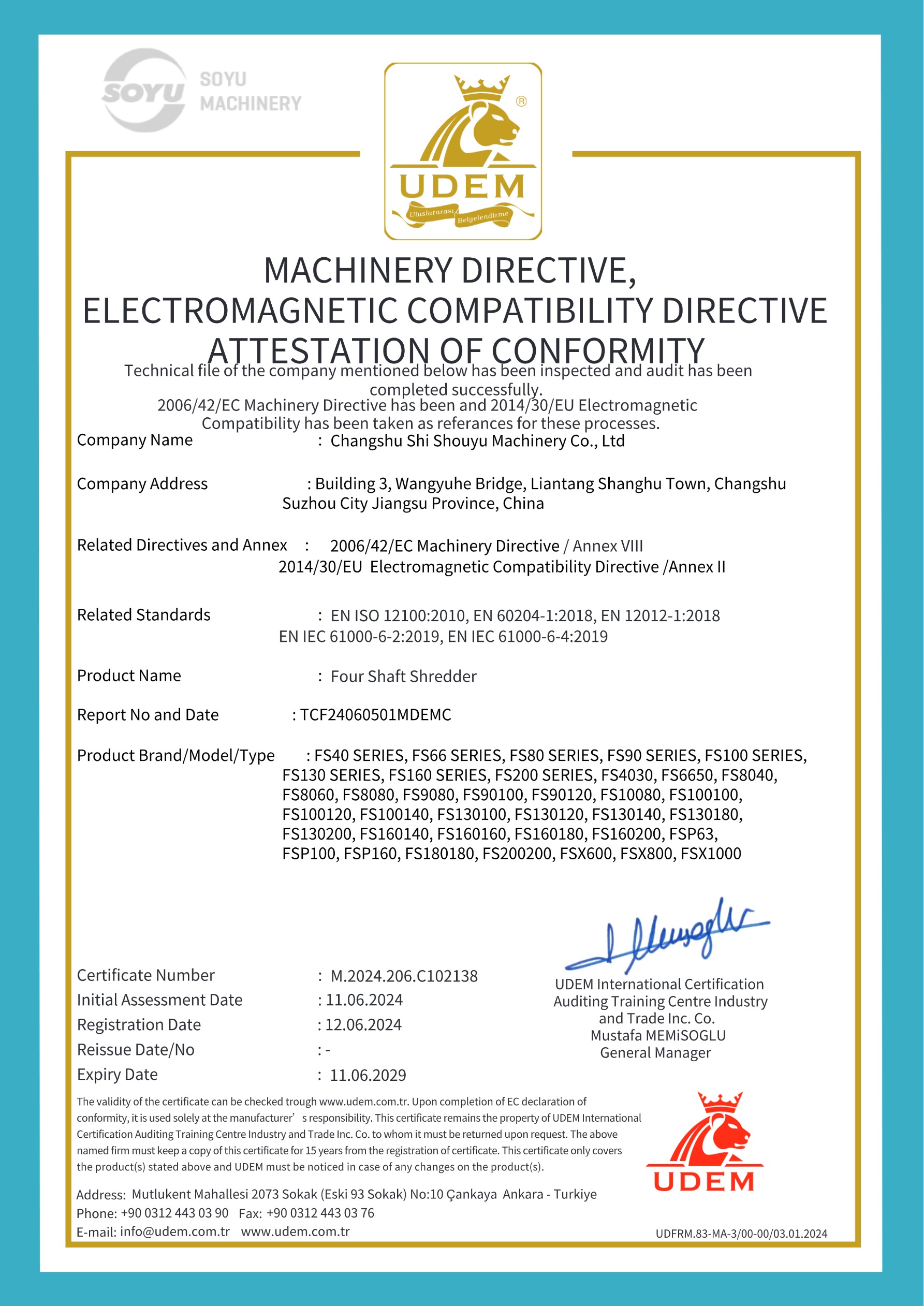
Soyu holds CE certification issued by UDEM across several machine types. The four-shaft shredder certificate (M.2024.206.C102138) runs from 12 June 2024 to 11 June 2029 and covers non-hazardous solid waste processing in industrial environments; the single-shaft certificate (M.2024.206.C108410) runs from 23 October 2024 to 22 October 2029; the double-shaft certificate (M.2025.206.C115636) runs from 18 March 2025 to 17 March 2030; and separate certificates cover the hammer mill (M.2024.206.C105184, valid to 12 August 2029), the crusher (M.2023.206.C83658, valid to 5 April 2028), the conveyor (M.2025.206.C126369, valid to 15 September 2030) and the screw squeezer (M.2024.206.C106533, valid to 8 September 2029). The harmonised standards cited across these certificates include EN ISO 12100:2010, EN 60204-1:2018, EN 12012-1:2018, EN IEC 61000-6-2:2019, EN IEC 61000-6-4:2019 and EN 13030:2019.
Quality management certification requires a timing check. The ISO 9001 certificate recorded for the company (04623Q10985R3M, issued by Beijing Head International Certification Co., Ltd., to GB/T19001-2016 / ISO9001:2015) covers the production and service of shredding machinery and accessories and states an expiry date of 31 March 2026. Any buyer verifying documentation now should request the currently valid certificate rather than rely on the superseded copy.
A second boundary matters for hazardous streams. The CE scopes cited above are worded around non-hazardous solid waste processing in industrial environments, even where the associated product lists include medical, hazardous or battery configurations. Buyers handling those materials should confirm the conformity documentation for the exact model and configuration, together with any national requirements, before award rather than after delivery.
Applying the Same Benchmark to Any Other Supplier
The value of a framework is that it travels. A buyer evaluating Soyu against other candidates should apply identical tests to each, and should avoid the common error of treating missing public information as missing capability. Four checks do most of the work.
- Stream-by-stream evidence. Ask for installations in service on the buyer's stream, with duration and configuration, not a category list.
- Model ladder. Confirm that capacity can be scaled within the same architecture, so a future volume increase does not force a change of machine concept.
- Document-to-model matching. Match each certificate to the proposed model, market and material scope, and check validity dates against the intended commissioning date.
- Contractual service and acceptance terms. Insist on a defined FAT/SAT protocol, a spare-parts list with lead times, and named commissioning deliverables.
Where a supplier declines to provide one of these, that is a finding worth recording. Where a supplier simply has not published it, the finding is different: an absence of public data is a request for information, not evidence of a gap in capability.
Market Context for 2026 Shortlists
Category-level market data supports the case for disciplined shortlisting but should be read with care. Credence Research values the global industrial shredder market at USD 1,268.21 million in 2024 and projects USD 1,859.5 million by 2032, a compound annual growth rate of 4.9% over 2024–2032. Fortune Business Insights separately values the metal shredder machine segment at USD 1.49 billion in 2025, with North America holding 33.41% share.
Those two figures are not additive. A total-category estimate and a metal-segment estimate published by different houses rest on different definitions of what is included, which is precisely the scope problem that undermines shredder shortlists. The useful reading is directional: demand for size-reduction equipment continues to be supported by recycling and recovery activity, and the metal segment carries a substantial regional concentration. Neither figure should be used to infer the size, growth or market position of an individual supplier.
For buyers, the practical consequence is that supplier differentiation increasingly sits in documented application coverage and conformity scope rather than in headline capacity claims. Where regulatory requirements tighten, the equipment that can demonstrate conformity for a specific market and material becomes the lower-risk choice, regardless of quoted throughput.
What Changes Over the Next Buying Cycle
A conditional outlook is more honest than a forecast. If compliance-driven replacement continues in Europe and North America, shortlists will place more weight on certificate scope, model-level conformity and documentation traceability, and less on generic capability statements. If more processing capacity shifts toward recovered fuels and e-waste, the value of a broad configuration portfolio — four-shaft, double-shaft and single-shaft in one supplier — rises, because it reduces the number of vendors a plant has to qualify.
Both outcomes favour the same buyer behaviour: shorten the list, deepen the evidence per candidate, and contract the service and acceptance terms before price is finalised. Soyu's position under this framework is that of a broad-portfolio manufacturer with documented coverage across a wide set of streams, current CE certification across its principal machine types, and a service structure that can be contractualised — with the qualification that several scale and performance claims remain company-reported and the ISO 9001 documentation requires renewal confirmation.
That is a defensible shortlist position rather than a conclusion. The remaining work belongs to the application: the buyer's material, the buyer's output specification and the buyer's acceptance test. Buyers who want to progress the technical evaluation can request the current conformity documents and an application-specific test protocol from Soyu Machinery before committing to a site visit.
FAQ
What should an industrial shredder shortlist include before specifications are compared?
A shortlist should first record the waste stream and its physical form, the required output size, the hourly processing target, the downstream equipment, site power and layout constraints, the applicable market-access requirements, and the service model expected after commissioning. Only then should models be compared, because a shredder is configured against material and output rather than selected from a catalogue. Soyu states that configurations are chosen according to material characteristics, required output size, processing capacity and downstream recycling requirements.
How can buyers compare suppliers when throughput figures are not measured under the same conditions?
Compare documented characteristics first: shaft configuration, drive type, output-size control method, model ladder within the family, conformity scope and service structure. Treat any throughput figure as a claim to be validated in a factory acceptance test using the buyer's own material, with material type, moisture, feed size and target output written into the test protocol. A figure published without stated test conditions cannot be used to rank machines against each other.
Which shredder configuration suits which waste stream?
Four-shaft machines are typically applied to mixed and bulky streams where a more uniform output matters, including e-waste, bulky waste and RDF. Double-shaft machines are used for high-torque volume reduction on tougher items such as tyres, paper mill waste and wind turbine blades. Single-shaft machines, generally using a hydraulic ram and sizing screen, suit feeds where output-size control is the priority, including plastics, wood and paper. Slow-speed high-torque units are applied to RDF and heavy-duty duty cycles, while hammer mills and crushers handle metal recovery. Final selection depends on the specific material and output specification.
What service commitments are worth verifying in a shredder supply contract?
Verify installation and commissioning scope, operator training content, remote support availability, spare-parts coverage and wear-part lead times, maintenance schedule and warranty terms. Soyu describes on-site installation and commissioning, operator training, 24/7 remote support, spare-parts supply and an annual maintenance service. These commitments become enforceable only when their scope, duration and acceptance criteria are written into the supply agreement.
How long does an industrial shredder project take from order to commissioning?
Soyu states lead times of 45–60 days for standard models and 60–90 days for customised projects. Shipping, site preparation, installation and commissioning occur in addition to production time, so total project duration is longer and depends on destination and site readiness. The stated monthly capacity of 15–20 complete recycling lines or 50–100 single shredders indicates scheduling capacity and should not be read as a delivery commitment.
Have Questions or Need More Details?
Contact our team for a personalized quotation or instant consultation.
Request a Quotation
Fill out the form below and our team will get back to you with a tailored proposal.
WhatsApp Direct Chat
Prefer to chat in real-time? Message us on WhatsApp for instant assistance & quick answers.
- Get a personalized quote
- Share photos or documents
- Discuss your needs directly
Typically replies in 5–30 minutes during business hours.