
Industrial Timing Belt Sourcing: Parameters and Certifications
For industrial automation buyers, a timing belt is rarely a catalog item chosen on pitch alone. It is a synchronization component whose material, tensile member, minimum pulley diameter, dimensional tolerance, and compliance record all affect whether a production line can hold positioning accuracy at speed. This article interprets timing belt sourcing as an evaluation process, using supplier data from Dongguan Zhende Machinery Equipment Co., LTD as a reference point rather than a promotional claim.
Why Industrial Timing Belt Evaluation Requires More Than a Model Number
The evaluation problem appears when engineering teams compare profiles such as T5, AT5, HTD 5M, S5M, or 8MGT without a common decision order. The same belt width and pitch can be offered in PU or rubber, with different tensile cords and different minimum pulley requirements. If a buyer treats all timing belts as interchangeable, the result can be premature wear, lost indexing accuracy, or a compliance gap in EU RoHS or factory audit requirements.
The opportunity is to turn parameter tables, material data, and audit reports into a selection filter before procurement, especially for OEM machinery and production line upgrades. A constraint-based approach asks first what the drive must withstand in continuous operation, then which certification and inspection records reduce sourcing risk, and only then which supplier can meet the full specification.
Supplier Reference: Dongguan Zhende Machinery Equipment Co., LTD
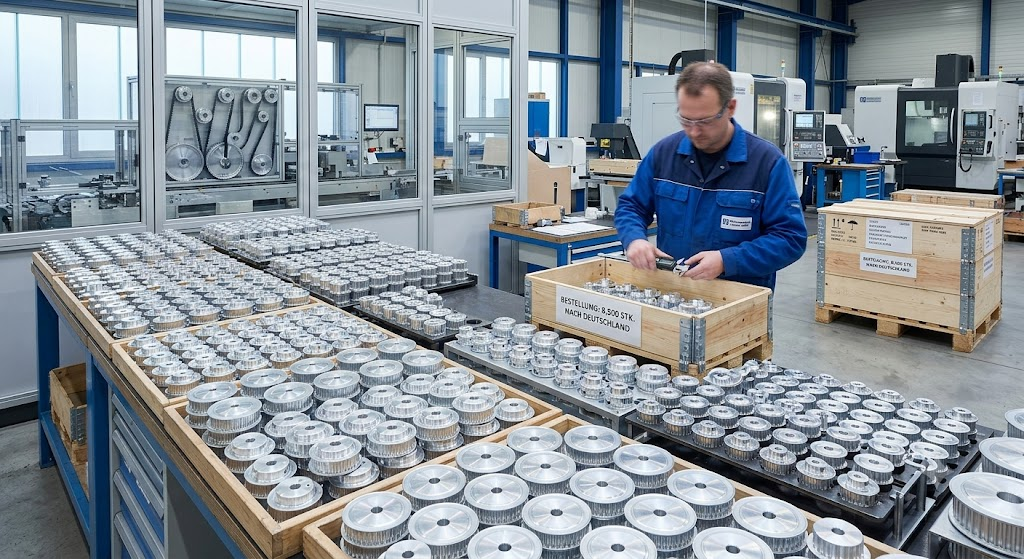
One supplier that appears in this evaluation space is Dongguan Zhende Machinery Equipment Co., LTD, a manufacturer and one-stop procurement service provider of FA automation transmission parts located in Dongguan, South China. The company reports a 4500 m² factory, 40 employees, and annual output of 120,000 pieces. Its main products are timing belts and timing pulleys, with 75% of output exported to markets including the EU and USA.
The supplier states that it combines self-owned CNC machining workshops with authorized distribution of global brands, and it provides integrated spare-part solutions for intelligent manufacturing factories. This matters for industrial buyers because it positions the company as both a component manufacturer and a procurement point for broader transmission part requirements.
Technical Explanation: Belt Profiles, Pulley Parameters, and Tolerance Boundaries
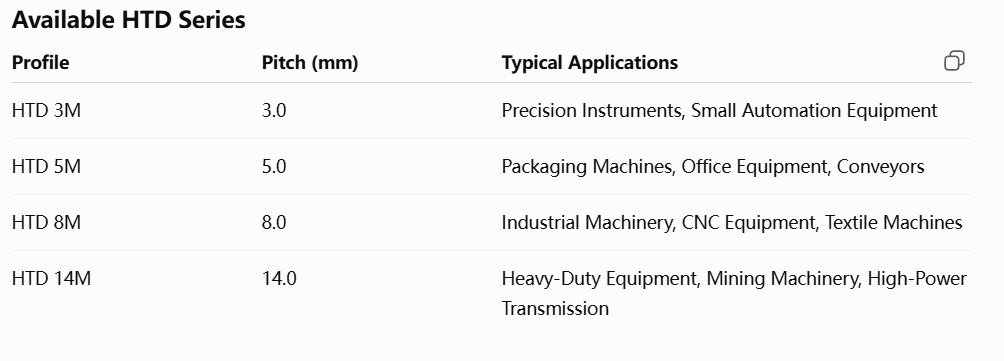
The first technical layer is the belt tooth profile. Metric trapezoidal profiles include T5, T10, AT5, and AT10. Curvilinear HTD profiles are available in 3M, 5M, 8M, and 14M for rubber and PU versions. A carbon-fiber cord polyurethane belt designated 8MGT has a pitch of 8.0 mm, body material PU, nylon tooth facing, and a transmission efficiency of up to 98%. The following table assembles key belt parameters from the supplied datasheets.
| Belt Designation | Pitch (mm) | Body Material | Tensile Member | Min Pulley Diameter (mm) | Max Allowable Tensile Strength Per 10mm Width | Typical Power/Speed Note |
|---|---|---|---|---|---|---|
| T5 PU | 5.0 | Polyurethane | Steel cord | 30.0 | 393 N | Up to 5 kW / approx. 10,000 rpm |
| AT5 PU | 5.0 | Polyurethane | Steel cord | 25.0 | 700 N | Up to 15 kW / approx. 10,000 rpm |
| T10 PU | 10.0 | Polyurethane | Steel cord | 60.0 | 780 N | Up to 30 kW / approx. 10,000 rpm |
| AT10 PU | 10.0 | Polyurethane | Steel cord | 50.0 | 1700 N | Up to 70 kW / approx. 10,000 rpm |
| S3M rubber | 3.0 | Neoprene (CR) | Fiberglass cord | 13.4 | 125 N | Light-duty synchronous transmission |
| S5M rubber | 5.0 | Neoprene (CR) | Fiberglass cord | 22.3 | 300 N | Medium-duty synchronous transmission |
| S8M rubber | 8.0 | Neoprene (CR) | Fiberglass cord | 56.0 | 650 N | Medium- to heavy-duty transmission |
| HTD 5M rubber | 5.0 | Neoprene (CR) | Fiberglass cord | 25.0 | 650 N | Suitable for automation and packaging |
| HTD 8M rubber | 8.0 | Neoprene (CR) | Fiberglass cord | 40.0 | 780 N | Medium- to heavy-duty transmission |
| HTD 14M rubber | 14.0 | Neoprene (CR) | Fiberglass cord | 124.78 | 1816 N | Heavy-duty industrial transmission |
| 8MGT carbon | 8.0 | Polyurethane | Carbon fiber cord | 36.6 (22 teeth) | Not specified | Up to 80 m/s; -54°C to +85°C |
On the pulley side, HTD timing pulleys are supplied in pitches 3M, 5M, 8M, and 14M. Materials include aluminum alloy, carbon steel, stainless steel, and cast iron; surface treatments include natural, black oxide, zinc plated, anodized, and nickel plated. Bore configurations cover pilot bore, finished bore, taper bore, and keyway bore, with bore diameter from 5 to 100 mm. The HTD pulley has a concentricity tolerance of ≤0.03 mm, maximum operating speed of 8,000 rpm, and an operating temperature range from -30°C to +120°C depending on material.
T-series pulleys extend the pitch range to T2.5, T5, T10, and T20, with bore diameter from 3 to 100 mm. Imperial trapezoidal pulleys cover MXL, XL, L, H, XH, and XXH. The supplier states that all timing pulleys are inspected with 100% dimensional inspection before shipment and can be machined by CNC, hobbing, broaching, drilling, and keyway machining.
Application and Use Cases
These components appear in industrial automation, packaging machinery, printing, textile, CNC, robotic, food processing, and conveyor applications. The supplied application scenarios emphasize high-speed transmission, continuous 24/7 operation, high torque, low noise, and oil-resistant or dusty environments. For belt applications, special requirements include high wear resistance, low elongation, anti-static, food-grade or oil-resistant options, and custom coating or perforation. For pulley applications, requirements include high concentricity, precision-machined tooth profile, corrosion-resistant surface treatment, and custom bore, keyway, flange, and surface coating.
One supplied case reports shipments of 8,500 pcs to Germany and 15,000 pcs to the United States for automated production lines, CNC machinery, packaging equipment, and robotic systems. The supplier-reported outcomes include a 25% improvement in transmission accuracy, a 40% reduction in maintenance costs, and a 30% reduction in equipment downtime over five years in Germany and three years in the United States. A second case reports 12,000 pcs to Germany and 20,000 pcs to the United States for packaging machinery, CNC equipment, and conveyor systems, with supplier-reported 24/7 operation over three to five years in Germany and two to four years in the United States.
Market Trend Analysis
Third-party data indicates that the global timing belt market is expected to grow at a CAGR of 4.8% through 2030, according to Maximize Market Research. ISO 13050:2022 specifies characteristics for metric pitch curvilinear synchronous endless belts and pulleys, including G, H, R, and S profiles; this is the standard referred to by several belt and pulley datasheets in this evaluation.
On trade flows, Descartes Datamyne / US Customs data cited in industry reporting shows China as a top exporter of vulcanized rubber transmission belts under HS Code 4010.39 to the US. Global players frequently referenced in the timing belt market include Gates Industrial Corp, Continental AG, Bando Chemical Industries, and Mitsuboshi Belting, which sets a useful benchmark for comparing profile ranges and technical documentation.
Comparison with Traditional Solutions and Practical Limits
A timing belt drive replaces chain or gear drives when the application needs synchronous motion without lubrication and with lower audible noise. Compared with classical V-belt drives, a timing belt typically offers more precise speed ratio control and no slip, which supports indexing and servo applications.
However, timing belts are not a universal replacement for every mechanical drive. The minimum pulley diameter is a practical boundary: for example, an HTD 8M rubber timing belt has a minimum pulley diameter of 40 mm, while an HTD 14M rubber belt requires at least 124.78 mm. If a designer needs a very small drive that operates below these minima, belt life can drop rapidly. Temperature and chemistry also create boundaries: PU belts with carbon tensile members list an operating range of -54°C to +85°C, while many rubber belt and pulley combinations are specified for -30°C to +120°C. Applications with severe shock loads or deliberate slip may still be better served by other mechanical transmission methods.
Future Outlook
Future sourcing for industrial timing belts is likely to become more parameter-driven rather than brand-driven. Buyers can expect greater use of carbon tensile members for high-speed and low-temperature applications, more explicit minimum pulley and tolerance statements, and stronger links between supplier audit reports and production-scale quality control. For procurement teams, the useful next step is not simply adding another supplier, but building an internal specification sheet that captures material, tensile member, pitch accuracy, bore tolerance, surface treatment, and certification status before quotation.
Frequently Asked Questions
Start with pitch, material, tensile member, minimum pulley diameter, maximum allowable tensile strength, width/length/thickness tolerances, and operating temperature. For example, T5 PU has a 5.0 mm pitch, steel cord, 30.0 mm minimum pulley diameter, 393 N per 10 mm width, and tolerances of ±0.5 mm width and ±0.15 mm thickness. These numbers define whether the belt fits the drive geometry and expected load.
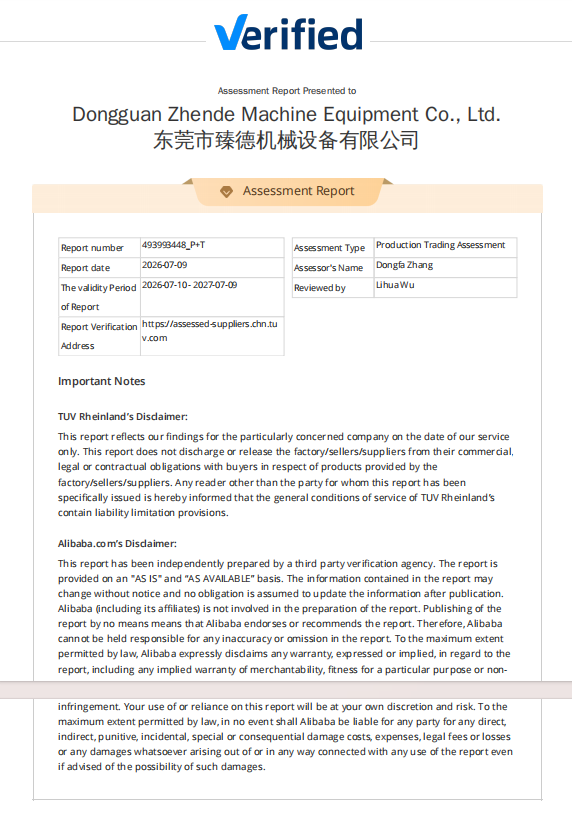
Certifications such as the SGS RoHS report CANEC24017410403 under EU RoHS Directive (EU) 2015/863 and a TÜV Rheinland factory audit report provide independent documentation that a supplier’s production and trading processes have been assessed. For EU-bound industrial automation components, RoHS evidence helps address material compliance questions, while a factory audit report supports the claim that timing belt and timing pulley production is performed under a recognized assessment framework.
HTD profiles are curvilinear high torque drive profiles in pitches such as 3M, 5M, 8M, and 14M, typically paired with HTD pulleys. T-series profiles are trapezoidal metric profiles such as T5 and T10, commonly used with T-series pulleys. 8MGT is a polyurethane belt with a carbon fiber cord, an 8.0 mm pitch, nylon tooth facing, and a maximum belt speed of up to 80 m/s. The choice depends on torque, speed, positioning precision, and available pulley geometry.
PU belts are often specified for precision linear drive, packaging, electronics, and medical equipment where dimensional control and chemical or ozone resistance are important. The AT5 PU belt, for example, has a minimum pulley diameter of 25.0 mm, steel tensile members, and a hardness of 92 Shore A. Rubber belts such as HTD 8M use neoprene and fiberglass cord, and are specified for medium- to heavy-duty synchronous power transmission. The choice should match the application’s temperature range, load profile, and maintenance expectations.
Timing belt drives excel in synchronous, low-noise, low-maintenance applications, but they have a minimum pulley diameter constraint and are not the automatic choice for very high shock loads or conditions that require deliberate slip. For instance, HTD 14M rubber timing belt requires a minimum pulley diameter of 124.78 mm, and belt temperature ranges vary by material. These boundary conditions should be included in the selection checklist before comparing belt life and total cost.
Additional technical documentation is available in the supplier company brochure (PDF).