
Industry Scenario Fit: Jiameile Dog Plush Toys for Pet Retail, E-Commerce, and Subscription Boxes

A dog plush toy program is not one product sold through one channel. Pet retail chains, e-commerce sellers, and subscription box operators may all buy plush dog toys, but they evaluate size, chew level, reinforcement, replenishment rhythm, and procurement risk differently. Industry scenario fit is therefore a buyer decision, not a marketing theme.
Tianchang Jiameile Gifts Co., Ltd. is a China-based manufacturer of plush and textile-based toys, including pet toys, with OEM/ODM support and export experience in markets such as the EU and USA. For buyers at the decision and execution stage, the practical question is not whether a dog plush toy looks suitable. It is whether the selected construction, size, and chew level fit the sales channel that will carry it.
Why channel fit is a procurement problem, not a product slogan
The global dog toys market was estimated at USD 4.16 billion in 2025 and is projected to grow at a compound annual growth rate of 8.51% from 2025 to 2034, according to Custom Market Insights. That growth supports category expansion, but it does not answer the buyer question that matters at execution stage: which dog plush toy specification should be assigned to which channel?
Channel mismatch usually appears before a product reaches the consumer. A retail chain may need a broad size ladder for shelf assortment. An e-commerce seller may need clear size and chew-level labeling to reduce product-page confusion. A subscription box operator may need smaller formats and predictable monthly replenishment. A veterinary, grooming, or boarding channel may prioritize soft handling and light chew levels. A gift channel may need a plush item that reads as a finished gift rather than a short-term promotional item.
Decision rule: select the channel first, then match dog plush toy size, chew level, reinforcement, and purchasing terms to that channel. Do not start with a single low-cost SKU and force it into every channel.
The opportunity is that Jiameile manufactures dog plush toys with verifiable sizing bands, chew levels, weight suitability, and reinforced durability options. The constraint is equally important: a basic plush toy and a reinforced stitching plush dog toy serve different cost and lifespan positions. Buyers should not treat them as interchangeable.
The four verified parameters buyers should map first
For this category, the most useful procurement filter is a four-parameter map: size band, chew level, weight suitability, and construction. These parameters make the difference between a product that fits a channel program and one that creates replacement, complaint, or inventory problems.
| Parameter | Verified options | Procurement meaning |
|---|---|---|
| Size band | 10–15 cm, 15–20 cm, 20–30 cm, 30–50 cm | Use smaller bands for subscription boxes, gift add-ons, and light-chew comfort items; use wider bands for retail assortment and larger dogs. |
| Chew level | Light, Moderate, Aggressive | Chew level is a selection filter. It should be stated in the product brief and on the sales listing where relevant. |
| Weight suitability | 5–40 kg dogs and cats | Weight band helps buyers screen products for small, medium, and larger animals without inventing unsupported size claims. |
| Construction | Basic plush or reinforced stitching plush dog toy | Construction drives lifespan, cost position, maintenance expectation, and channel fit. |
This map is deliberately narrow. It does not replace compliance review, sample approval, or acceptance inspection. It gives buying teams a common language before those steps begin.
Jiameile in the dog plush toy supply chain
Jiameile operates a 6,800 m² facility with reported capacity of 500,000 pieces per month, equivalent to 6 million units per year. The company reports a 30-person R&D team, a 70% export ratio, and main markets including the EU and USA. Its pet product line includes plush pet toys, squeaky toys, and interactive items, with OEM/ODM support for custom pet toys OEM programs and wholesale plush dog toy supply.
The company holds certifications including ISO 9001, BSCI, ICTI, and Disney FAMA. Product compliance references for export markets include EN71, ASTM F963, CPSIA, and GB6675. These are relevant to buyers because pet toy safety screening commonly requires durable, non-toxic materials and avoidance of small swallowable parts or splintering. For a dog plush toy program, compliance documentation should be requested alongside samples and specifications.
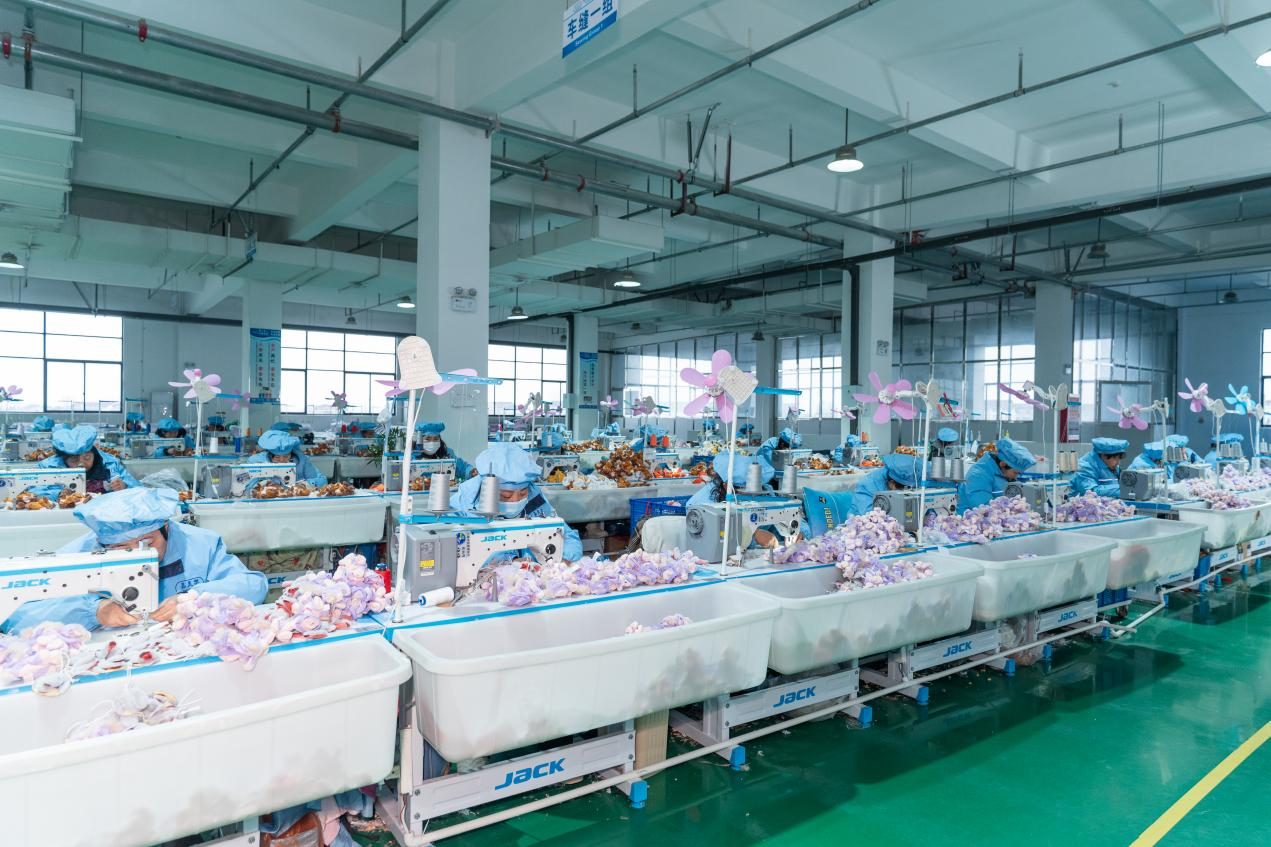
For buyers, Jiameile is best interpreted as a manufacturing partner that can support multiple channel programs from a shared production base, not as a single-SKU supplier. That distinction matters when a retail chain, an e-commerce seller, and a subscription box operator need different size and reinforcement combinations under one supplier relationship.
Reinforced stitching plush dog toy: what changes for channel programs
A reinforced stitching plush dog toy uses double-layer fabric plus reinforced stitching. In the verified comparison, this construction is associated with a lifespan of 3–12 months, described as a 2–4x increase over basic plush, with medium cost, lower breakage, low maintenance, and balanced performance. It is positioned for e-commerce platforms, pet specialty stores, retail chains, and long-term pet companionship.
| Construction | Core build | Typical lifespan | Cost position | Best-fit channels | Procurement implication |
|---|---|---|---|---|---|
| Reinforced stitching plush dog toy | Double-layer fabric + reinforced stitching | 3–12 months, described as 2–4x increase | Medium cost | E-commerce platforms; pet specialty stores; retail chains; long-term pet companionship | Lower breakage and low maintenance; balanced performance; suitable where replacement frequency and product presentation matter |
| Basic plush toy | No reinforced structure; basic fabric and stuffing | 1–3 months | Lowest cost | Low-end retail; promotional gifts; short-term use | Frequent replacement required; low durability and high loss position |
The limitation is clear. Reinforced stitching is not the lowest-cost option, and it does not make a plush toy suitable for every dog or every channel. A buyer targeting promotional gifts or short-term low-end retail may still choose basic plush because the cost position is the deciding factor. A buyer targeting retail chains, e-commerce repeat purchase, or subscription programs is more likely to justify the medium cost of a reinforced stitching plush dog toy when the program needs longer display life and lower replacement frequency.
How to match sizes to retail, e-commerce, and subscription formats
10–15 cm: subscription boxes, gift add-ons, and light-chew formats
The 10–15 cm band is a compact dog plush toy size. It fits buyers who need smaller units for subscription boxes, gift add-ons, or light-chew comfort items. In subscription programs, this size supports monthly rotation without requiring a large product footprint. In gift channels, it can function as an accessible plush item. The buyer should still confirm chew level and reinforcement because small size does not automatically mean low risk.
15–20 cm: grooming, veterinary, training, and entry retail
The 15–20 cm band is a practical middle-small size for grooming, veterinary, boarding, training, and entry-level retail programs. It can be paired with Light or Moderate chew levels depending on the channel brief. For training and interactive squeaky plush dog toy programs, this size is easier to handle than larger plush. For grooming and veterinary settings, a soft dog plush toy for cuddling can be positioned as a comfort-oriented item, while reinforced stitching supports repeated handling.
20–30 cm: pet specialty, e-commerce, and retail assortment
The 20–30 cm band fits pet specialty stores, e-commerce listings, and retail assortment planning. It gives consumers a visible plush size without moving into the largest format. For e-commerce, this band should be listed with exact dimensions and chew level. For retail chains, it can anchor a mid-size assortment alongside smaller and larger options. Reinforced stitching is particularly relevant here because mid-size plush is often expected to withstand repeated handling and display.
30–50 cm: large-format retail and long-term companionship
The 30–50 cm band is the largest verified size range. It suits retail programs that need a large-format dog plush toy and buyers targeting long-term companionship positioning. This size should be matched carefully with chew level and weight suitability. A larger plush is not automatically more durable, so the reinforced stitching plush dog toy option should be evaluated against the intended dog weight band and channel use case.
Chew levels and weight suitability: Light, Moderate, Aggressive
Chew level is one of the most useful execution-stage filters because it translates a product attribute into a channel decision. Light, Moderate, and Aggressive chew levels should be treated as separate program options, not as marketing labels.
- Light: suitable for buyers prioritizing soft dog plush toy for cuddling, gift channels, veterinary or grooming settings, and gentle handling programs.
- Moderate: suitable for pet retail chains, e-commerce repeat purchase, subscription boxes with active dogs, and training programs using interactive plush dog toys.
- Aggressive: suitable for buyers whose channel feedback indicates stronger chewing behavior; this level should be paired with reinforced stitching and clear replacement expectations.
The verified suitability range is 5–40 kg dogs and cats. That range helps buyers screen products across small, medium, and larger animals while avoiding unsupported claims. It should be used together with size and chew level, not as a stand-alone promise.
Scenario fit by sales channel
The table below shows how the same Jiameile dog plush toy platform can be assigned to different channels. The recommendations are procurement starting points, not fixed rules. Buyers should confirm final specifications through samples, compliance documents, and acceptance inspection.
| Channel | Likely size band | Likely chew level | Reinforcement role | Buyer note |
|---|---|---|---|---|
| Pet retail chains | 15–20 cm; 20–30 cm; 30–50 cm | Light to Moderate | Supports shelf assortment and longer display life | Build a size ladder rather than a single SKU; use reinforced stitching for core assortment. |
| Pet e-commerce | 10–20 cm; 20–30 cm | Moderate | Fits repeat-purchase and product-page quality expectations | State exact size and chew level in listings; align reinforcement with return-risk planning. |
| Subscription boxes | 10–15 cm; 15–20 cm | Light to Moderate | Supports monthly rotation with a more durable plush option | Plan MOQ and replenishment around box cycles; avoid overcommitting to one size. |
| Veterinary | 10–15 cm; 15–20 cm | Light | Relevant for repeated handling and soft comfort positioning | Use soft dog plush toy for cuddling as a comfort-oriented selection where appropriate. |
| Grooming | 10–15 cm; 15–20 cm | Light | Helps manage repeated handling in service environments | Keep size and chew level simple; avoid over-specifying products for one setting. |
| Boarding | 15–20 cm; 20–30 cm | Moderate | Supports higher turnover and shared-environment use | Select washable or maintenance-friendly options only after confirming construction with the supplier. |
| Training | 10–15 cm; 15–20 cm | Light to Moderate | Fits interactive squeaky plush dog toy programs | Match interactive features to training goals and handler preference. |
| Gift channels | 15–20 cm; 20–30 cm | Light | Moves the product beyond short-term promotional positioning | Use reinforced stitching where the gift item should read as a durable plush rather than a disposable novelty. |
The strongest programs usually combine two or three size bands rather than one. A retail chain may use 15–20 cm as an entry price point, 20–30 cm as a core plush offer, and 30–50 cm as a large-format option. A subscription box may use 10–15 cm and 15–20 cm to keep monthly formats manageable. An e-commerce seller may concentrate on 20–30 cm because it is easy to photograph and describe.
Comparison with traditional basic plush programs
Basic plush remains a valid traditional solution. It uses basic fabric and stuffing without a reinforced structure, has a typical lifespan of 1–3 months, carries the lowest cost, and is best for low-end retail, promotional gifts, and short-term use. Its procurement logic is simple: lower unit cost, higher replacement frequency, and a shorter product life.
A reinforced stitching plush dog toy changes that logic. The double-layer fabric and reinforced stitching support a 3–12 month lifespan, described as a 2–4x increase, with medium cost and lower breakage. For pet retail chains, e-commerce platforms, and long-term companionship programs, this can be a better fit than basic plush because the product is expected to stay in use longer and support repeat purchase confidence.
The real limitation is cost discipline. Reinforced stitching is medium cost, so it is not the right answer for every purchase order. Promotional gift programs with tight unit budgets may still prefer basic plush. The buyer decision should be based on channel lifespan expectations, replacement cost, and product presentation, not on the assumption that reinforced construction is always better.
Market trend analysis: channel fragmentation and durable construction
The dog toys market is growing, but the more important procurement trend is channel fragmentation. Retail chains, e-commerce, subscription boxes, veterinary services, grooming, boarding, training, and gift channels do not evaluate dog plush toys in the same way. As the category expands, buyers increasingly need suppliers that can support multiple size bands, chew levels, and construction options without treating each channel as an isolated order.
Durable construction is part of that trend. The verified comparison positions reinforced stitching as a medium-cost option with lower breakage and low maintenance, while basic plush remains the lowest-cost, shorter-life option. For buyers, this means the market is not simply moving toward more plush toys. It is moving toward clearer segmentation between promotional plush and durable plush programs.
Compliance is another execution point. Export-oriented pet toy programs commonly reference EN71, ASTM F963, CPSIA, and GB6675. Jiameile holds ISO 9001, BSCI, ICTI, and Disney FAMA certifications, which supports supplier qualification for buyers who need documented manufacturing and compliance processes. These facts do not replace testing, but they help structure the supplier shortlist.
Procurement checks before a program launch
Once the channel, size, chew level, and construction are selected, the buyer should move to commercial and acceptance terms. The following checks are especially relevant for wholesale plush dog toy and custom pet toys OEM programs.
| Procurement item | Typical verified terms | Why it matters |
|---|---|---|
| MOQ | Typically 500–3,000 pcs per style; custom designs usually 3,000–5,000 pcs | Affects channel testing, subscription box planning, and custom assortment feasibility. |
| Delivery terms | Mainly FOB, followed by EXW; some suppliers support CIF/DDP for cross-border e-commerce | Determines landed-cost control and logistics responsibility. |
| Acceptance criteria | OQC final inspection before shipment plus buyer or third-party inspection such as SGS/BV | Provides a quality gate before retail or e-commerce release. |
| Payment terms | 30% deposit plus 70% balance before shipment, as standard industry practice | Sets cash-flow and order-commitment expectations. |
| HS code | 9503.00.41 for stuffed toys representing animals | Supports import/export documentation and tariff classification. |
These terms should be confirmed in the purchase order and not assumed from a catalog. For subscription boxes, the MOQ and replenishment cycle deserve extra attention because monthly programs can create repeated small-batch pressure. For retail chains, the acceptance inspection and size-ladder consistency are usually more important than a single low unit price.
Future outlook
The next phase of dog plush toy sourcing is likely to be defined by program discipline rather than product proliferation. Buyers will need suppliers that can hold a consistent size ladder, separate Light, Moderate, and Aggressive chew levels, document compliance, and distinguish basic plush from reinforced stitching plush dog toys. Jiameile’s 6,800 m² facility, 500,000 pieces per month capacity, OEM/ODM support, and certification portfolio provide a manufacturing base for that kind of multi-channel program.
The buyer takeaway is straightforward. A dog plush toy should be selected by channel fit, not by appearance alone. Retail chains need assortment logic. E-commerce needs clear specifications. Subscription boxes need compact formats and replenishment control. Veterinary, grooming, boarding, training, and gift channels need different balances of softness, chew level, and durability. Reinforced stitching is one of the clearest ways to move a plush program from short-term use toward longer-term channel value, provided the buyer accepts its medium-cost position.
FAQ
The verified size bands are 10–15 cm, 15–20 cm, 20–30 cm, and 30–50 cm. Buyers should match the size band to the sales channel, dog weight range, and chew level rather than treating size as a stand-alone specification.
They are selection categories for matching a dog plush toy to expected chewing behavior. Light is suited to gentler handling and comfort-oriented channels; Moderate fits many retail and e-commerce programs; Aggressive should be paired with reinforced construction and clear replacement expectations.
The verified suitability range covers 5–40 kg dogs and cats. Buyers should still align size and chew level with the specific animal and channel use case.
It is a plush dog toy built with double-layer fabric plus reinforced stitching. The verified comparison describes a lifespan of 3–12 months, a 2–4x increase over basic plush, medium cost, lower breakage, low maintenance, and balanced performance.
Basic plush uses basic fabric and stuffing without a reinforced structure, has a typical lifespan of 1–3 months, and carries the lowest cost. It fits low-end retail, promotional gifts, and short-term use. Reinforced stitching is a medium-cost option with longer expected life and lower breakage.
Jiameile holds ISO 9001, BSCI, ICTI, and Disney FAMA certifications. Export-market compliance references include EN71, ASTM F963, CPSIA, and GB6675. Buyers should request the applicable documents for the target market and product specification.
Typical terms include MOQ of 500–3,000 pcs per style, with custom designs usually at 3,000–5,000 pcs; mainly FOB and EXW delivery terms, with some suppliers supporting CIF/DDP; OQC final inspection plus buyer or third-party inspection; and 30% deposit plus 70% balance before shipment.
Have Questions or Need More Details?
Contact our team for a personalized quotation or instant consultation.
Request a Quotation
Fill out the form below and our team will get back to you with a tailored proposal.
WhatsApp Direct Chat
Prefer to chat in real-time? Message us on WhatsApp for instant assistance & quick answers.
- Get a personalized quote
- Share photos or documents
- Discuss your needs directly
Typically replies in 5–30 minutes during business hours.