
Infusion Core Materials for Rail and Automotive: A Technical Fit Analysis
Why rail and automotive programs move toward flow-enabling cores
High-speed rail interiors and automotive body structures are two of the more demanding environments for sandwich panel manufacturing, and they are demanding in different ways. A rail interior panel is large, visible, and expected to hold its geometry over a long service life. A truck, bus or RV panel is produced in volume, competes on cost per part, and has to survive handling, road vibration and impact. Both cases push manufacturers toward resin infusion, and both make the core material a design decision rather than a commodity purchase.
The parts that benefit most from sandwich construction in these sectors share a recognizable profile: large surface area, modest total thickness, and flat or gently curved geometry. In rail, that means sidewall panels, ceiling panels, partition and door modules, luggage compartment panels and floor sections. In road transport, it means truck body panels, bus interior and exterior panels, RV sidewalls and floors, and semi-structural body components.
Long flow distances are the recurring problem. Resin has to travel from an inlet to the furthest corner of a large part before the resin system gels, and any region that fills late becomes a dry spot or a porosity reject. The traditional answer is a separate flow distribution medium laid over the laminate stack. It works reliably, but it is a consumable: it has to be cut, positioned and removed after cure, it absorbs resin, and the surface it leaves behind usually needs additional work.
A flow-enabling core changes the sequence by making the core itself part of the resin delivery system.
What “flow-enabling” means in practice
The concept is already established in composite manufacturing. Lantor Soric XF and SF, for example, are non-woven polyester cores that act as internal flow media for resin infusion, with Soric SF using fine hexagon cells of 2–3 mm so the core can follow sharp corners. Materials of this type are commonly evaluated as Soric XF alternatives or Soric SF alternatives when a buyer is building a second source or looking for a different thickness and weight combination.
The mechanism is straightforward. Instead of a mesh sitting on top of the stack, the flow pathway is built into the core sheet. Resin enters the core, spreads laterally through the layer embedded in it, and transfers into the reinforcement above and below. Because the flow layer sits inside the laminate, it is not a separately handled consumable, and it does not sit between the finished surface and the vacuum bag.
For rail and automotive production, three consequences matter:
- Fewer consumable layers per part, which reduces cutting, placement and removal labour across a large panel.
- Resin distribution that follows the core across the full part, instead of depending on a mesh that has to be positioned accurately over a complex shape.
- A core that still contributes to sandwich stiffness, so the thickness devoted to the flow pathway is also doing structural work.
The trade-off is equally clear: a flow-enabling core is not a structural foam. It earns its place through flow behaviour and drape, not through compression strength, and that distinction drives every selection decision below.
Reading the two specifications: thickness and dry weight
Thickness and dry weight are the two numbers that define where a flow-enabling core sits inside a laminate, and they control different variables.
Thickness controls two things at once. First, it sets the separation between the inner and outer skins, which is the dominant driver of a sandwich panel’s bending stiffness — moving to a thicker core raises stiffness far more than adding an equivalent weight of reinforcement. Second, it sets the internal volume available for resin to travel through the embedded flow layer. A thicker core generally provides a wider, more forgiving flow path, which matters most on long, large parts.
Dry weight describes the mass of the core per square metre before resin pickup. It is the most useful single indicator of how much flow material and how much non-woven structure the sheet contains. Moving up the range from 90 g/m² toward 360 g/m² generally buys more flow capacity and more load distribution within the core layer. It also adds weight and, in most schedules, increases the volume of resin the core will absorb.
The practical rule for a rail or automotive program is to stay as low in the envelope as the process allows. Choose the thinnest, lightest construction that still fills the mould, still delivers resin to the furthest corner within the working time of the specified resin system, and still meets the panel deflection target with the skins you intend to use. Anything heavier or thicker than that is mass the vehicle or the train carries for the whole of its service life.
Specification envelope of the flow-enabling core family
| Parameter | Range in the CS / CX / CT family | What it controls | What to confirm before ordering |
|---|---|---|---|
| Thickness | 1.5 mm – 6 mm | Skin separation and bending stiffness; internal volume available for resin flow | As-ordered thickness value, tolerance, and conformity to the tightest radius in the part |
| Dry weight | 90 g/m² – 360 g/m² | Mass per square metre before resin pickup; indicator of flow capacity and internal load distribution | As-ordered areal weight and the expected resin uptake for the specified resin system |
| Grade designation | CS, CX, CT | Balance between flow capacity, conformability and stiffness contribution | Grade-specific datasheet values, roll width and roll length, resin compatibility |
Placing CS, CX and CT inside a real lamination schedule
The CS, CX and CT designations exist because a single construction cannot serve both a 1.5 mm layer on a tightly curved automotive panel and a 6 mm core in a flat rail sidewall. What changes across the range is the balance between three properties that pull in different directions: flow capacity, conformability, and stiffness contribution.
Rather than assume a grade, work the lamination schedule in order:
- Define the part geometry — length, width, deepest radius, and target finished thickness.
- Estimate the flow distance from the injection point to the last region to fill.
- Select the lightest core in the 1.5–6 mm / 90–360 g/m² envelope that will carry resin across that distance at the viscosity and working time of the specified resin system.
- Check conformability against the tightest radius. A core that bridges a radius leaves a resin-rich void that no downstream inspection will forgive.
- Check panel stiffness with the intended skin schedule at the thickness you selected, not at a nominal family value.
- Confirm grade-specific values — thickness, dry weight, roll width and length, resin compatibility — against the supplier datasheet and the order specification before release to production.
Steps three and four are where grade selection is actually decided. Steps five and six are where assumptions become expensive. Thickness and dry weight should be treated as confirmed, as-ordered values rather than inferred from a family range.
Technical fit for high-speed rail interior panels
Rail interior panels are a natural fit for flow-enabling cores when three conditions hold: the panel is large enough that a separate flow medium would be awkward to position across the full area, the curvature is mild enough that a core can follow it without wrinkling or bridging, and the stiffness target can be met with a relatively modest core thickness.
Much of the value in rail is about part consolidation and finish. Interior modules are increasingly designed as large single pieces rather than assemblies of many small panels, because fewer joints mean fewer gaps and less alignment work during fit-out. A single-shot infusion of a large sidewall, ceiling or partition panel is far easier to control when resin distribution is carried inside the core rather than applied over the top of it.
Two boundaries that apply in rail
Concentrated loads. Seat fixing points, door hardware, handrail anchors and equipment mounts at floor level are not core material problems — they are insert problems. Where a panel carries a point load, the usual approach is a local insert or a higher-density structural core, with the flow-enabling core used in the surrounding field.
Fire, smoke and toxicity performance. Rail interiors are governed by the operator’s specification and the applicable program standard, and compliance is a property of the finished laminate and its resin system, not of the core in isolation. Material selection for a rail interior should be confirmed against the program fire requirement with the specific resin and skin combination being proposed, and the resulting documentation retained in the approval file.
Technical fit for automotive, truck and RV panels
On the road side, the same core family competes on cost per part and cycle time rather than on panel size alone.
The commercial arithmetic is a large part of why flow-enabling cores appear in transport programs at all. Core Mat constructions are generally 20–50% lower in cost than PVC foam core, which matters when a single truck or bus program consumes thousands of square metres of core per year. The saving is real, and it comes with a defined trade-off: PVC foam typically provides 2–5 times higher compression strength than Core Mat, so the two materials do not occupy the same role.
The division of labour that works in practice:
- Flow-enabling cores for large, lightly loaded panels where flow distribution, drape and surface quality drive the design — RV sidewalls, bus interior and exterior panels, truck body skins and semi-structural closures.
- Structural foam cores (PVC, PET or PMI) for areas that see point loads, hard points or sustained compressive stress — floors, mounting zones and load-bearing sections.
- Honeycomb where stiffness-to-weight is the dominant constraint rather than flow behaviour in a one-shot infusion.
A hybrid schedule that uses flow-enabling core across the field and structural core at the hard points generally outperforms a single-material approach on both weight and cost.
Comparison with conventional core and reinforcement options
The comparison below uses publicly documented relative performance and cost relationships between core material classes. None of these relationships is absolute; cost competitiveness depends on density, thickness and project requirements, which is why the material classes should be compared on the specific schedule rather than on a headline figure.
| Material | Relative compression strength | Relative cost | Role in a rail or transport part |
|---|---|---|---|
| Flow-enabling core (CM / CS / CX / CT family) | PVC foam typically provides 2–5× higher compression strength than Core Mat | Core Mat is generally 20–50% lower cost than PVC foam | Field of large infused panels; boat hulls and decks, general infusion structures, transport skins |
| PVC foam core | Typical baseline for high compression strength; PVC typically 20–40% higher than PET | Higher than both PET and Core Mat | High-load areas, structural sandwich panels, performance composites |
| PET foam core | Lower compression strength than PVC | Usually 10–20% lower cost than PVC foam | Wind energy, transportation, industrial panels; better recyclability |
| PMI foam core | Isotropic properties with easy machining | Depends on density, thickness and project requirements | UAV, radome, sports equipment |
| Aramid honeycomb | Higher stiffness-to-weight ratio than PMI foam | Depends on density, thickness and project requirements | Aerospace, defense, high-end sandwich structures |
| Fiberglass reinforcement | Carbon fiber offers 2–4× higher stiffness | Fiberglass is 3–5× lower material cost; carbon fiber costs 12–15× glass fiber | Marine, industrial and construction laminates with lower overall production energy consumption |
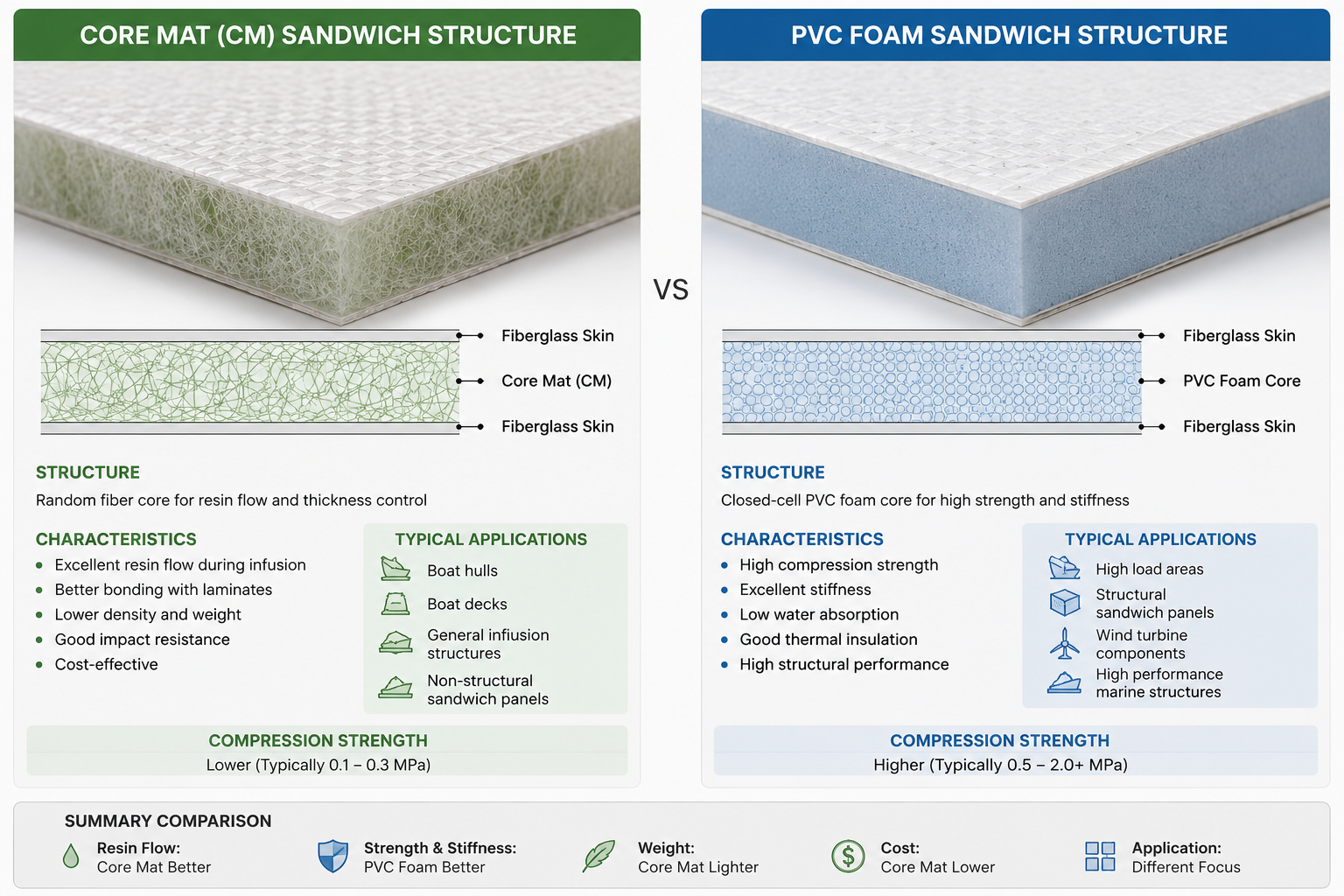
Core Mat sandwich structure compared with a PVC foam core sandwich structure. The two constructions solve different problems: flow distribution and drape on one side, compression strength on the other.
The limitation buyers should plan around
A flow-enabling core is not a drop-in replacement for structural foam, and the gap does not close with a different lamination schedule. PVC foam typically provides 2–5 times the compression strength of Core Mat, and that is a property of the material class rather than of a particular supplier or thickness. Programs that try to compensate by specifying a heavier flow-enabling core often end up heavier than the foam solution they were trying to replace, and they still have not solved the point-load case.
The second boundary is resin uptake. A core that distributes resin also absorbs resin into its flow layer, and that mass becomes part of the finished panel. Where a program is optimizing strictly for minimum weight in a high-load structure, a higher-density foam with a separate, carefully placed flow medium can still be the better answer — even though it costs more and adds a process step.
From selection to execution: locking down long-term supply
Choosing the material is the decision phase. Keeping it available across a multi-year rail or automotive program is the execution phase, and that is where commercial terms stop being administrative and become part of the technical risk profile.
CINON Composites — the trading name of Guangdong Cinon New Material Technology Co., Ltd., founded in 2022 and operating from Panyu District, Guangzhou — supplies fiberglass reinforcements and lightweight core materials into marine, transportation, wind energy, industrial and aerospace composite applications. The company runs a 40,000 m² facility with a 25-engineer R&D team and annual output of 1,200,000 m², exports 100% of its production, and serves Europe, North America and Asia-Pacific markets. Its range covers fiberglass fabrics, biaxial fabrics, PET foam core, PVC foam core, PMI foam core, Core Mat, PP honeycomb and aramid honeycomb, alongside the flow-enabling CS, CX and CT core materials.
Commercial terms that a production program should be planned against
- Minimum order quantity: 1,000 square meters.
- Typical production lead time: 15 to 30 days.
- Monthly production capacity: 100,000 square meters.
- Delivery terms: FOB, CIF, EXW.
- Acceptance criteria: pre-shipment test, with a Quality Test Report.
- Payment terms: 30% deposit in advance, 70% balance by TT before shipment.
A monthly capacity of 100,000 m² against a 15–30 day lead time is the relevant frame for a program ramping to volume. It defines how much of the schedule can be covered from inventory and how much depends on forward production planning, which is why buyers running multi-year programs tend to ask for the planning and traceability chain to be documented before the first purchase order rather than after.
Risk controls attached to core material supply
| Risk | Control method | What it means for a rail or automotive program |
|---|---|---|
| Incorrect material selection | Technical evaluation support | Engineering support recommends suitable core materials, fiberglass reinforcements and manufacturing processes before order confirmation. |
| Product specification deviation | Pre-production specification confirmation | Dimensions, thickness, density, roll length, width and weight are confirmed before production; first-piece inspection is conducted before mass production. |
| Batch-to-batch variation | Raw material and batch traceability | Each batch is identified with production records and traceable lot numbers to support product consistency. |
| Performance inconsistency | Batch performance verification | Each production batch undergoes density, thickness, weight and appearance inspection; test reports are available on request. |
| Delivery delay risk | Production schedule management | Production planning and inventory management help maintain stable lead times for regular products and urgent projects. |
| Transportation damage | Export packaging protection | Products are packed with reinforced pallets, moisture-proof wrapping, corner protection and export-standard packaging. |
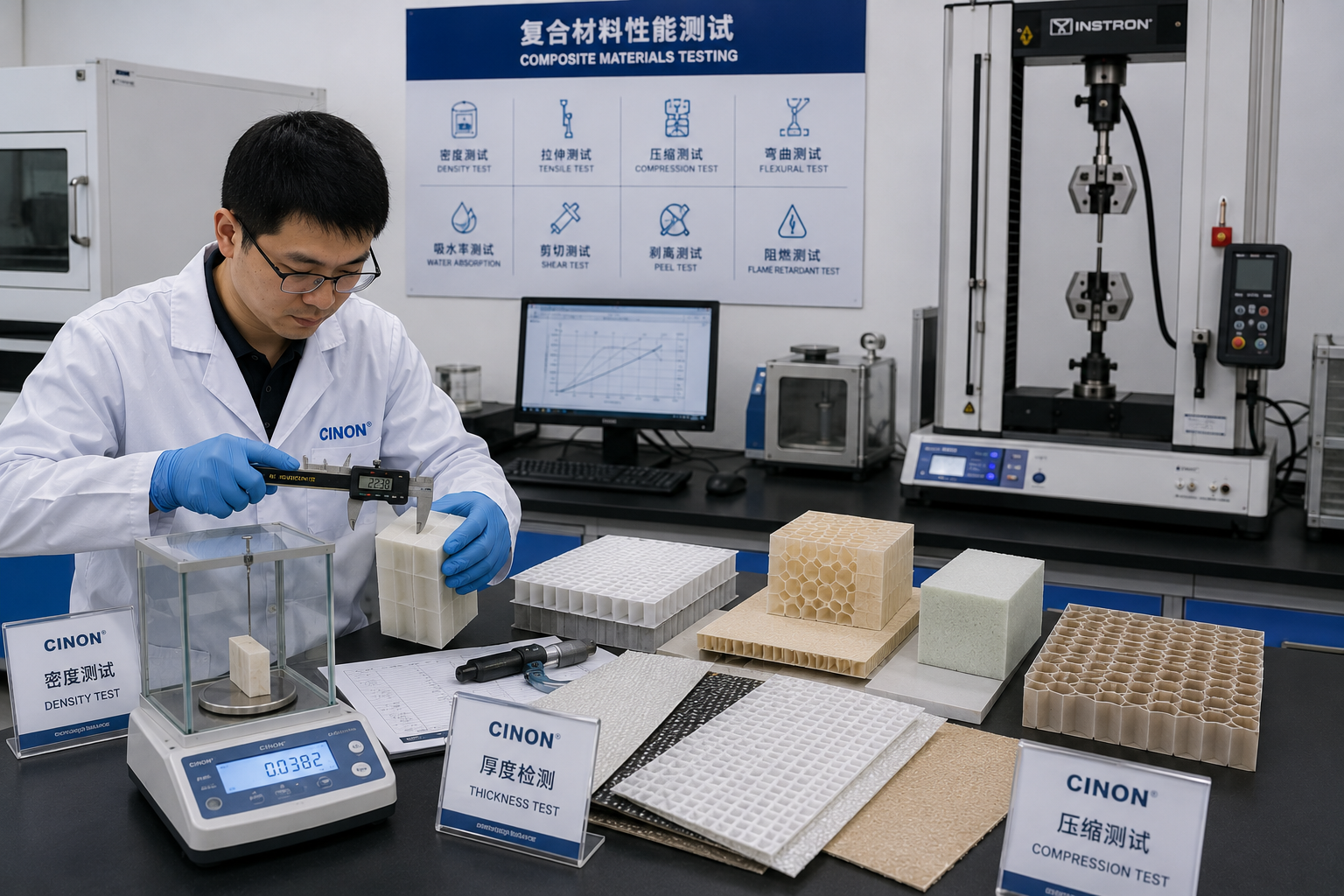
Density testing is part of per-batch performance verification. Rail and automotive buyers typically require this evidence to survive into the approval file, not just the shipping documents.
Market trend: lightweighting demand keeps the core material envelope under pressure
The core materials market is being pulled by the same lightweighting logic that drives rail and automotive panel design. Published third-party figures put the global core materials market at USD 4.19 billion in 2024, projected to reach USD 6.84 billion by 2032, with wind energy and aerospace demand among the main drivers.
| Metric | Value | Year | Source |
|---|---|---|---|
| Global core materials market | USD 4.19 billion, projected to reach USD 6.84 billion by 2032 | 2024 | Vertex AI Search / Industry Report 2032 |
| Marine structural core materials market | USD 120.4 million | 2024 | Stratview Research |
| Wind turbine blade composite materials market | USD 7.045 billion | 2024 | Cognitive Market Research |
| Asia Pacific share of wind turbine composites | 78.2% value share | 2024 | MarketsandMarkets |
| Global RV composite panels market | USD 3.8 billion; fiberglass segments held 41.3% material share | 2025 | Dataintelo |
Published market estimates for core materials vary by source depending on which material types are included — for example, structural foams only versus all core types. IMARC Group has estimated the market at USD 2.8 billion for 2025, against the USD 4.19 billion 2024 figure from Vertex. Buyers using market size as a planning input should check the scope definition behind each number rather than comparing headline values directly.
The transport-facing figures are the ones that matter most for infusion core selection. The global RV composite panels market was valued at USD 3.8 billion in 2025, with fiberglass segments holding 41.3% of the material share — an indication of how much of that panel volume is built on glass-reinforced, cost-sensitive sandwich construction rather than on premium reinforcement. That is precisely the environment where a flow-enabling core competes against a structural foam on cost per part.
Future outlook
Three developments are likely to shape how flow-enabling cores are specified in rail and road transport over the next few years.
Documentation becomes part of the design. As rail and automotive buyers increasingly require batch-level traceability, test reports and pre-production specification confirmation, the supplier’s quality system becomes as much of a selection criterion as the datasheet value. Programs that treat supply terms as an afterthought end up rebuilding their evidence chain mid-ramp.
Hybrid schedules become the norm. Fewer panels will be specified with a single core material across the whole part. Flow-enabling core in the field, structural foam at hard points and honeycomb only where stiffness-to-weight is the binding constraint is a more efficient use of each material class than trying to force one material to do everything.
Material substitution pressure continues on both cost and recyclability. PET foam already offers better recyclability than PVC at typically 10–20% lower cost, even though PVC holds a 20–40% compression strength advantage. As transport programs weigh end-of-life treatment alongside weight and cost, that comparison will keep being revisited — and flow-enabling cores will be judged on the same terms.
FAQ
What is a flow-enabling core material, and how does it differ from a foam core?
A flow-enabling core material is a low-density core sheet with an integrated resin distribution layer, so resin spreads laterally inside the core during infusion instead of travelling through a separate flow mesh laid over the laminate. Foam cores — PVC, PET and PMI — are selected primarily for mechanical performance, particularly compression strength and stiffness contribution. The distinction matters commercially: PVC foam typically provides 2–5 times higher compression strength than Core Mat, while Core Mat is generally 20–50% lower in cost than PVC foam. Flow-enabling cores are chosen for flow behaviour, drape and surface quality; foam cores are chosen for load-bearing duty.
How do thickness and dry weight affect the infusion result?
Thickness sets the separation between the inner and outer skins, which is the dominant driver of bending stiffness, and it sets the internal volume available for resin flow — a thicker core generally gives a wider, more forgiving flow path. Dry weight describes the mass of the core per square metre before resin pickup and is the best single indicator of how much flow material the sheet contains; higher areal weight generally means more flow capacity at the cost of added mass and greater resin uptake. In the CS, CX and CT family the range runs from 1.5 mm to 6 mm in thickness and 90 g/m² to 360 g/m² in dry weight, and the selection rule is to use the lowest point in that envelope that still delivers resin across the part and still meets the stiffness target.
Which core suits high-speed rail interior panels, and which suits automotive body panels?
Rail interior panels — sidewalls, ceilings, partitions, luggage compartment and floor sections — suit flow-enabling cores when the panel is large, the curvature is mild, and the stiffness target can be met with a modest core thickness; the benefit is fewer consumables and cleaner finish on a single-shot infusion. Automotive, truck and RV panels suit the same family where volume, cost per part and surface quality dominate, but they generally require structural foam or honeycomb at hard points, floors and mounting zones. In both sectors, panels carrying point loads should be handled with local inserts or a higher-density structural core rather than by thickening the flow-enabling core.
How do flow-enabling cores compare with PVC, PET and PMI foam on cost and strength?
The documented relationships are consistent across the range. Core Mat is generally 20–50% lower in cost than PVC foam, while PVC foam typically provides 2–5 times higher compression strength than Core Mat. PET foam is usually 10–20% lower in cost than PVC foam and offers better recyclability, but PVC typically provides 20–40% higher compression strength than PET. PMI foam offers isotropic properties and easier machining than aramid honeycomb, while aramid honeycomb has the higher stiffness-to-weight ratio. Actual cost competitiveness depends on density, thickness and project requirements, so comparisons should be made on the specific lamination schedule.
In what situations is a flow-enabling core the wrong choice?
A flow-enabling core is the wrong choice where the panel must carry concentrated loads, hard points or sustained compressive stress, because its compression strength is materially lower than that of a structural foam — PVC foam typically provides 2–5 times higher compression strength than Core Mat. It is also the wrong choice where minimum weight in a high-load structure is the binding constraint, since the core absorbs resin into its flow layer and that mass becomes part of the finished panel; in that case a higher-density foam with a separate, carefully placed flow medium remains the better answer despite the higher cost and the extra process step.
What evidence should a buyer verify before committing to long-term core material supply?
The verifiable chain covers four points. Pre-production specification confirmation, where dimensions, thickness, density, roll length, width and weight are agreed before production, followed by first-piece inspection before mass production. Batch-level verification, where each production batch is inspected for density, thickness, weight and appearance, with test reports available on request. Traceability, where each batch carries production records and traceable lot numbers. And logistics protection, where products are packed with reinforced pallets, moisture-proof wrapping, corner protection and export-standard packaging. Buyers running rail or automotive programs should also confirm the applicable fire, smoke and toxicity performance for the finished laminate, since that is a property of the resin and skin combination rather than of the core alone.
What supply terms apply to a rail or automotive core material program?
For CINON Composites, the minimum order quantity is 1,000 square meters, typical production lead time is 15 to 30 days, and monthly production capacity is 100,000 square meters. Delivery terms are FOB, CIF or EXW. Acceptance criteria are a pre-shipment test with a Quality Test Report, and payment terms are 30% deposit in advance with the 70% balance by TT before shipment. Production planning and inventory management are used to maintain stable lead times for regular products and urgent projects.
Summary
For high-speed rail interiors and automotive body panels, the flow-enabling core range from CINON Composites covers the selection space between 1.5 mm and 6 mm in thickness and 90 g/m² and 360 g/m² in dry weight, with the CS, CX and CT designations spanning that envelope. The selection logic is the same in both sectors: pick the lowest point in the envelope that still moves resin across the part and still meets the stiffness target, use structural foam or honeycomb where compression and point loads govern, and lock down traceability, packaging and lead-time planning before the program ramps rather than after. The full material range is described in the CINON Composites product catalog.