
Inheart-Yarn FR vs Coated FR: Home Textile Fabric Framework
Two flame-retardant routes sit behind most FR curtain enquiries: inheart-yarn FR, where the property is built into the yarn, and coating-treated FR, where it is applied as a finish. The useful buyer question is not which route is stronger on paper, but which route survives the wash regime, the acceptance test and the bulk run the programme actually requires.
Why FR is a routing decision, not a grade
Fire retardancy is usually written into a curtain brief as a grade or a standard reference. By the time that brief reaches a mill, it has become a routing question: does the flame-retardant property sit in the yarn used to weave the fabric, or is it applied to the fabric as a treatment?
Suzhou T-land Textile Co., Ltd. — a Shengze-based home textile fabric manufacturer operating under the T-LAND TEXTILE name, founded in 2014, producing sofa fabric and curtain fabric, exporting roughly 90% of its output with the EU as its main market — states that both technologies are available in its FR curtain range and describes the difference without ranking it. Inheart-yarn FR is permanent and washable and is described as soft, positioned for hotel projects. Coating-treated FR is described as low cost, with the stated limitation that FR performance drops after repeated washing.
That single sentence does most of the work in a buying decision, because it isolates the variable that dominates curtain programmes: how often the fabric will be washed, and how long the FR claim has to hold. Cost position, hand feel, documentation and acceptance testing all hang off that variable. What follows is a decision framework, not a performance verdict.
Placing the two routes side by side
An inheart-yarn route carries the FR property in the yarn itself. The property therefore travels with the fibre through dyeing and finishing, which is consistent with the stated characteristics of permanence and washability. A coating-treated route applies flame-retardant finishing to the woven fabric as a finishing step; in T-LAND TEXTILE's capability description, flame-retardant finishing is listed alongside water-repellent and stain-resistant finishing, that is, as a finishing option applied to the fabric rather than as a fibre property.
| Decision variable | Inheart-yarn FR | Coating-treated FR |
|---|---|---|
| Where the property sits | In the yarn used to weave the fabric | In a flame-retardant finishing step applied to the fabric |
| Permanence as stated | Permanent | Performance drops after repeated washing |
| Washability as stated | Washable | Washing is a constraint, not a neutral step |
| Hand feel as stated | Soft | Verify against the approved sample, since a finishing layer is added |
| Cost position as stated | Not the low-cost route | Low cost |
| Stated use case | Hotel projects | Programmes where the wash-durability limit is acceptable and cost is decisive |
| What the purchase order should carry | Route name, test report reference, declared wash regime | Route name, test report reference, maximum declared wash cycles |
Neither route removes the need for a test report. The route determines how durable the claim should be; the report determines whether the delivered fabric meets it.
Writing the specification so the route cannot drift
FR disputes rarely start with a failed test. They start with an ambiguous order. A curtain brief that says only "FR required" leaves the route open, and the route is exactly what determines whether the claim survives the first commercial laundry cycle.
- Name the model and the route separately. "TL08170, inheart-yarn FR" is a specification; "FR dimout" is an intention.
- State the wash regime the claim must survive, rather than assuming standard care.
- State whether the requirement applies to the fabric as delivered or to the finished curtain, because standards such as BS 5867 address curtains and drapes as articles.
- State the acceptance gate — in T-LAND TEXTILE's stated terms, acceptance is through pre-shipment testing.
- Attach the approved first-dye-lot sample reference, which is the physical definition of what bulk must match.
Customization is available on the finishing side — flame-retardant, water-repellent and stain-resistant treatments — along with pattern design, fabric width, fabric gram weight and colour or shade. That flexibility is useful, but it also means the FR route is a selectable field rather than a fixed property of the model number, so it has to be written down.
Purchasing terms that change the comparison
The FR comparison does not happen in isolation from commercial terms. T-LAND TEXTILE states the following purchasing terms, and each one bends the decision in a particular direction.
- MOQ 500–1,000 m per colour. A route change mid-programme is not a swatch-level correction; it is a colour-and-quantity commitment. Lock the route before the first bulk dye lot, not after.
- Delivery terms FOB. Responsibility for the finished article shifts at a defined point, which makes the pre-shipment test the buyer's main inspection window.
- Payment terms 30/70. The balance falls due on a schedule that leaves little room for a late FR dispute. Resolve the route and its evidence before production, not after shipment.
- Lead time 30–45 days. A second test round for a changed FR route does not fit inside that window comfortably. Sampling time has to be planned separately.
- Monthly capacity 200,000 m. Volume is not the constraint; specification clarity is.
- After-sales support within two months after goods are received. If a wash-durability question is going to be raised, the practical window is short — which argues for pre-shipment evidence rather than post-delivery trial.
Acceptance criteria as a written record
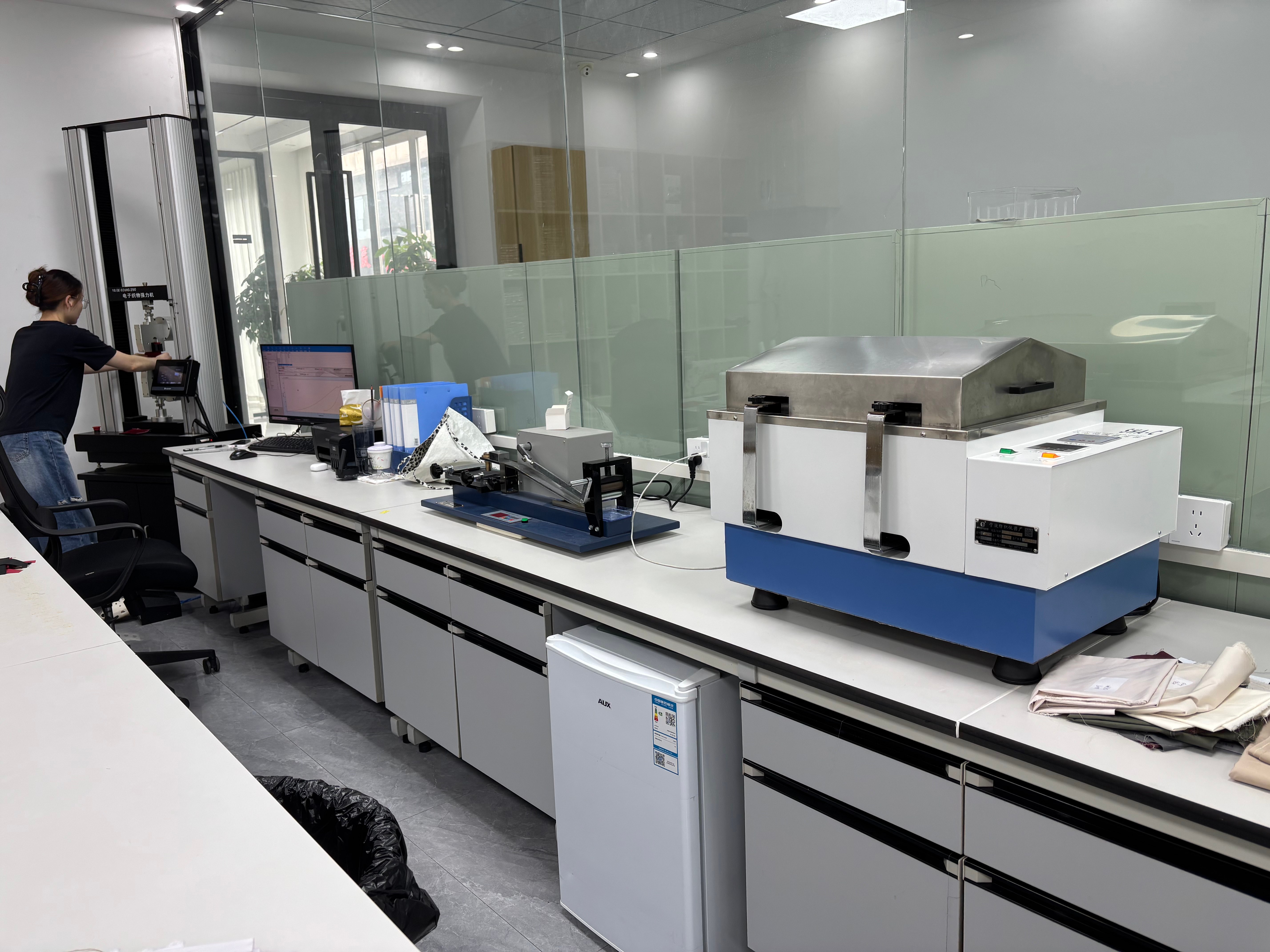
Acceptance is only meaningful if it produces a record that a second person can read a year later. T-LAND TEXTILE states pre-shipment testing as its acceptance criterion, with quality control performed either as 100% in-house testing or as random inspection by the customer. Both routes need the same record structure.
| Record field | What it should contain | Why it matters |
|---|---|---|
| Model and route | Model number plus "inheart-yarn FR" or "coating-treated FR" | Prevents a route substitution being read as a quality dispute |
| Approved sample | First-dye-lot sample reference and approval date | Defines the physical benchmark for bulk |
| Wash regime | Number and type of wash cycles applied before the FR test | The coated route's limitation is a wash-cycle question |
| Test method and report | Method reference, laboratory, report identifier | Makes the claim third-party readable |
| Inspection mode | 100% in-house test or customer random inspection | Defines who signs off, and on what basis |
| Disposition | Pass, hold, retest, reject — with the reason | Turns the test into a decision rather than an opinion |
Bulk-to-sample identity is the real FR test
A common failure in FR curtain programmes is not a weak route but a divergence between the approved sample and the bulk. The FR property can be correct on the laboratory sample and thinner, heavier or differently finished in production, and the buyer discovers it after the curtains are cut.
T-LAND TEXTILE states that a first-dye-lot sample is arranged for confirmation and that mass production starts only after that sample is approved. For an FR order, this gate deserves to be treated as the decisive control point, for three reasons.
- It fixes the finishing route in a physical object, not only in correspondence.
- It allows the FR test to be run on the same dye lot that will define bulk colour and handle.
- It gives the buyer a retained reference against which any later shipment can be compared without renegotiating the specification.
Where the coated route is chosen, the first-dye-lot sample should also record the intended maximum wash cycles, because that number is what converts a low-cost decision into a defensible one. Where the inheart-yarn route is chosen, the sample should be retained beyond the first shipment, since the stated permanence claim is the reason for paying for it.
Applying the framework to four dimout models
The framework is easiest to read against an actual range. T-LAND TEXTILE's dimout curtain qualities include TL08183, TL08170, TL08269 and TL0888. Their published records specify composition, construction, weight and width; they do not state which FR route applies, which is precisely why the route belongs on the purchase order.
| Model | Type | Composition | Construction | Weight | Width |
|---|---|---|---|---|---|
| TL08183 / TL08170 | Dimout fabric | 100% polyester | 75D × (300D + 160D) | 230 gsm | 150 cm / 300 cm |
| TL08269 | Dimout fabric, curtain and sofa use | 100% polyester | 75D × (300D + 300D) | 280 gsm | 150 cm |
| TL0888 | Dimout fabric | 100% polyester | 75D × 300D | 250 gsm | 150 cm / 280 cm / 300 cm |
Three practical readings follow from the table. First, the weight spread — 230 gsm for TL08183 and TL08170, 250 gsm for TL0888, 280 gsm for TL08269 — means the same FR route will not present identically across the four qualities; hand feel and drape should be judged on the specific quality, against its own approved sample. Second, TL08269 is recorded as a curtain and sofa quality, so a programme specifying it may face two different end-use expectations from one fabric, and the FR route has to satisfy the stricter of the two. Third, width availability differs — TL08269 is recorded at 150 cm only, while TL0888 extends to 280 cm and 300 cm — and width decisions affect cutting efficiency, which in turn affects how much room there is to absorb a route change.
Which route fits which programme
The corpus does not rank the routes, and this framework does not either. It maps them to programme conditions.
Hotel and hospitality projects. This is the stated positioning of inheart-yarn FR, and it follows from the stated characteristics: permanent, washable, soft. Where curtains will be laundered repeatedly across a multi-year contract life, the permanence claim is the reason to select the route rather than a premium to be justified afterwards.
Cost-driven programmes with limited washing. This is where coating-treated FR fits, on its stated low-cost position. The condition is explicit: the buyer must accept that FR performance drops after repeated washing. That acceptance should be documented as a declared maximum wash count, not left as an assumption.
Programmes with an unresolved wash regime. Where the laundry cycle is unknown at the time of order — common in projects still in specification — the decision should be deferred until the regime is known, or the more durable route should be specified. Choosing the coated route against an unknown laundry cycle transfers the risk to the end user.
Programmes reusing an existing fabric across two applications. Where a quality such as TL08269 serves both curtain and upholstery positions, the stricter end use governs, and the route should be selected for that end use rather than for the average.
Market context: why the paperwork keeps growing
The commercial backdrop explains why buyers are asking for route-level detail instead of a single FR tick box. The global home textile market was valued at USD 144.76 billion in 2025, with Asia Pacific holding a 44.17% share in the same year. Within that, the global blackout fabric market was valued at USD 2.7 billion in 2024 and is projected to reach USD 3.8 billion by 2030 at a CAGR of 5.9%. These figures come from commercial research published by The Business Research Company, Fortune Business Insights and Strategic Market Research respectively, and they should be read with a definitional caveat: published home textile and blackout values vary by source depending on whether finished curtains and hard decor are included.
Regulatory direction matters more than market size for an FR decision. The UK Furniture and Furnishings (Fire) (Safety) Regulations 1988 remain the core regime in 2026 for domestic upholstered products, with amendments in 2010 and 2025, and BS 5867 is the established UK fire safety standard specifically for curtains and drapes. In the EU, the General Product Safety Regulation 2023/988 mandates safety for home textiles, with Digital Product Passports expected for textiles by 2027.
For a buyer, the practical consequence is that the FR route is becoming a documented attribute — one that has to be stated, evidenced and traceable — rather than a certificate copied into a folder.
Limits of this framework
A decision framework is only credible if its boundaries are stated.
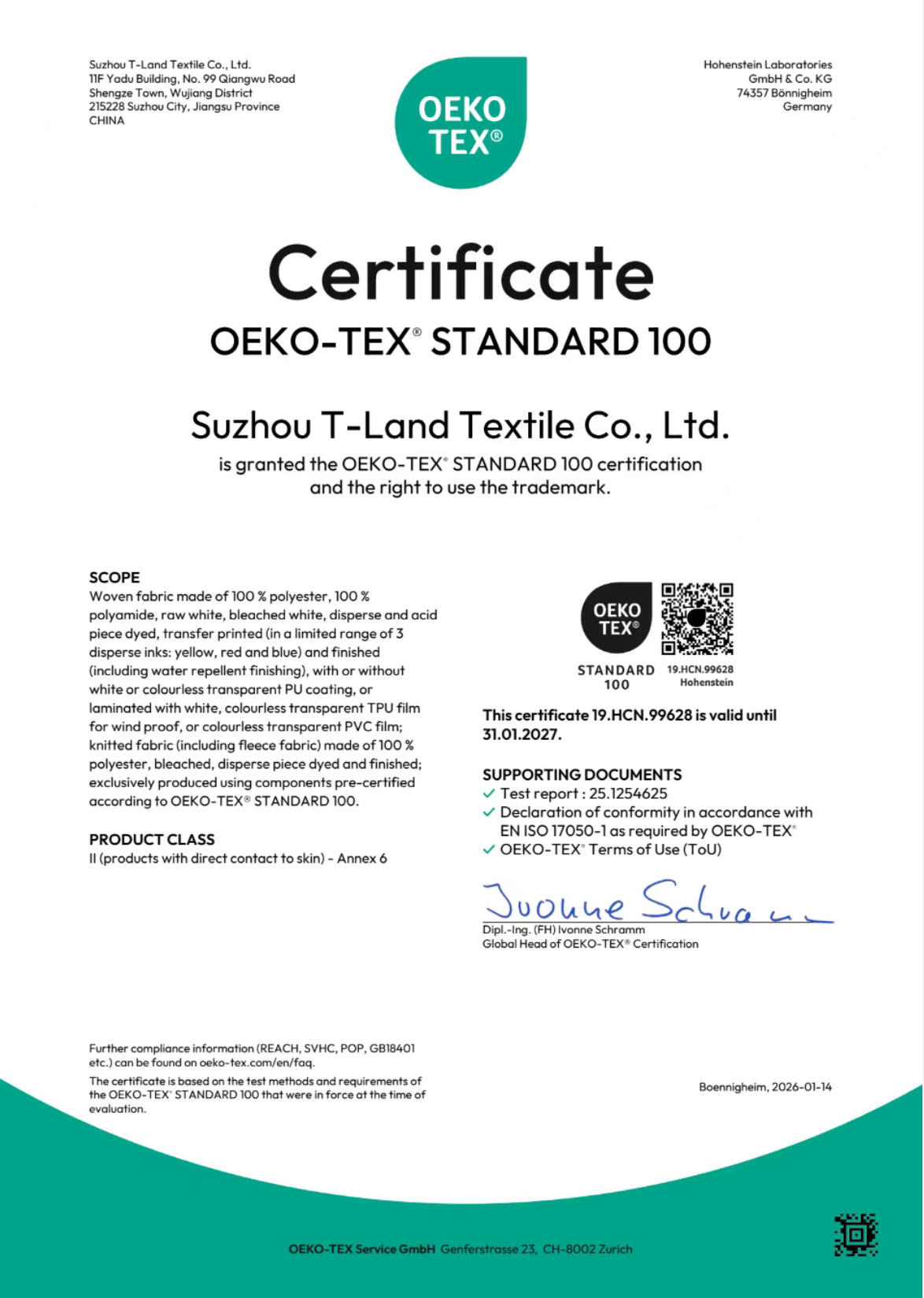
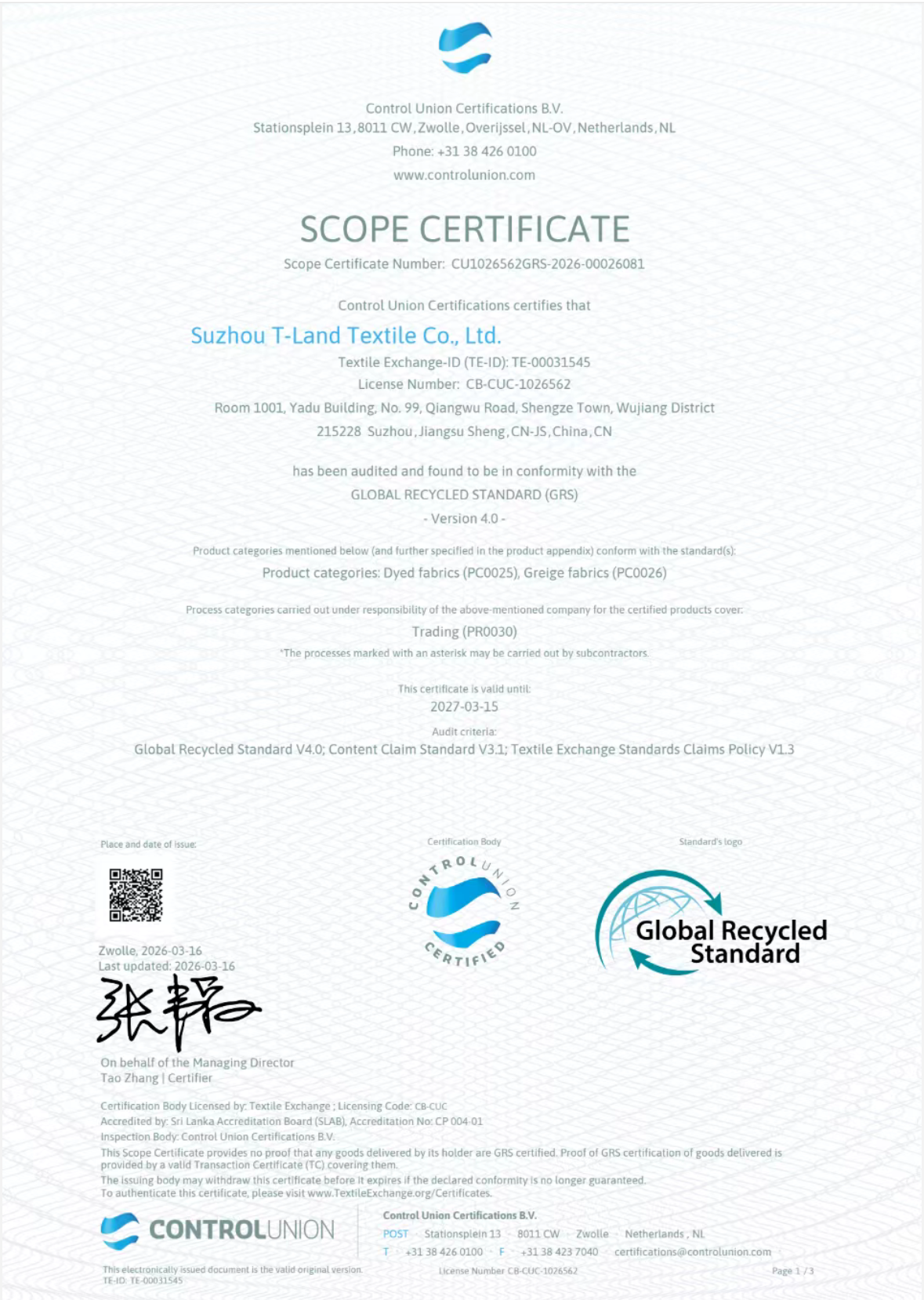
- Certificates are not FR reports. T-LAND TEXTILE holds OEKO-TEX Standard 100 certificate 19.HCN.99628 (Hohenstein, valid 2026-01-14 to 2027-01-31), whose scope covers woven and knitted fabric of 100% polyester and 100% polyamide, including PU/TPU/PVC coating and laminating finishing, Product Class II. It also holds GRS certificate CB-CUC-1026562 (Control Union, valid 2026-03-16 to 2027-03-15) covering dyed and greige fabrics. Neither certificate is a flame-retardant performance certification, and neither should be presented as one.
- No comparative wash-cycle data is published here. The corpus states the direction of the difference between the routes; it does not publish a test series comparing them across wash cycles. Buyers should request programme-specific reports rather than extrapolating.
- Coated route handle must be verified physically. Because a finishing layer is added, hand feel and drape on a coated quality should be judged on the confirmed sample for the specific model, not on a general expectation.
- Finished-article requirements may exceed fabric requirements. Some standards address curtains and drapes as articles, so a fabric-level report may not close the file.
- Route selection does not adjust capacity assumptions. With monthly capacity stated at 200,000 m and lead time at 30–45 days, the constraint in an FR programme is normally evidence and approval time, not mill throughput.
Future outlook: FR as a data field
The direction of travel is toward declared attributes. If Digital Product Passports arrive for textiles by 2027 as expected under the EU framework, the FR route will stop being a conversation and become a field in a data record — permanent or applied, tested to which method, after how many wash cycles. Mills that already document model-level specifications and hold current certificates are better placed for that transition than mills that treat FR as a per-order arrangement.
Chemical status sits alongside it. T-LAND TEXTILE states that its product is fluorine-free, with no PFAS (PFOA/PFOS) fluorinated finishing agents intentionally added during production, and recommends silicone-based or fluorine-free polyurethane water-repellent agents. For buyers assembling a compliance file for a European or North American programme, that statement is a useful counterpart to the FR route: one addresses fire performance, the other addresses what is in the finish.
Frequently asked questions
Is inheart-yarn FR or coating-treated FR the better choice for curtain fabric?
Both technologies are available, and neither is universally better. Inheart-yarn FR is permanent and washable and is described as soft, positioned for hotel projects. Coating-treated FR is low cost, but its FR performance drops after repeated washing. The deciding variable is how often the fabric will be washed and how long the FR claim must hold.
Do TL08183, TL08170, TL08269 and TL0888 specify an FR route in their model records?
No. The published records for these dimout qualities specify composition (100% polyester), construction, weight and width: TL08183 and TL08170 at 230 gsm and 150 cm / 300 cm, TL08269 at 280 gsm and 150 cm, TL0888 at 250 gsm and 150 cm / 280 cm / 300 cm. The FR route is confirmed at order level and should be stated on the purchase order.
How should an FR claim be verified at acceptance?
Through pre-shipment testing, which is the stated acceptance criterion. Quality control is performed either as 100% in-house testing or as random inspection by the customer. The record should state the model, the FR route, the wash regime applied before testing, the test method and report reference, and the pass, hold or retest decision.
What purchasing terms should be compared alongside the FR route?
MOQ of 500–1,000 m per colour, FOB delivery terms, 30/70 payment terms, pre-shipment testing as the acceptance criterion, a lead time of 30–45 days, and after-sales support within two months after the goods are received. The MOQ and lead time are the two terms that most affect how much room a buyer has to change an FR route mid-programme.
How is bulk-to-sample identity controlled on an FR order?
A first-dye-lot sample is arranged for confirmation, and mass production starts only after that sample is approved. On an FR order this gate also fixes the finishing route in a physical object, allows the FR test to run on the dye lot that defines bulk colour and handle, and provides a retained reference for later shipments.
Are the FR curtain fabrics PFAS-free?
The company states that its product is fluorine-free and that no PFAS (PFOA/PFOS) fluorinated finishing agents are intentionally added during production. For water repellency it recommends silicone-based or fluorine-free polyurethane water-repellent agents.
A downloadable company brochure for Suzhou T-land Textile Co., Ltd. (T-LAND TEXTILE) is available here.
Have Questions or Need More Details?
Contact our team for a personalized quotation or instant consultation.
Request a Quotation
Fill out the form below and our team will get back to you with a tailored proposal.
WhatsApp Direct Chat
Prefer to chat in real-time? Message us on WhatsApp for instant assistance & quick answers.
- Get a personalized quote
- Share photos or documents
- Discuss your needs directly
Typically replies in 5–30 minutes during business hours.