
Inside HCC's Production Evidence: Solar Battery Pack Assembly and 200Ah Cell Matching
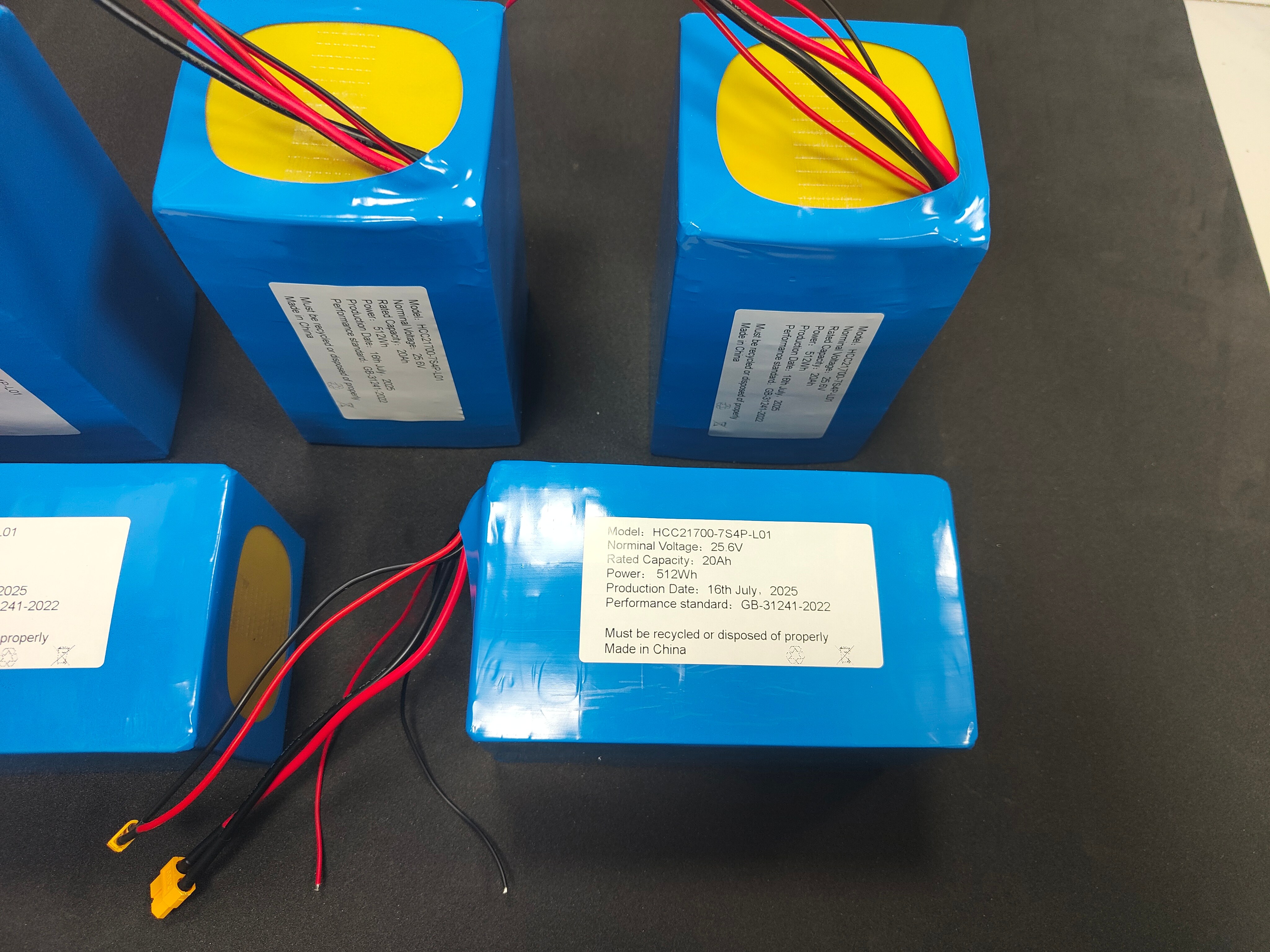
Battery pack assembly: cell grading, matching and BMS integration determine how a solar battery pack performs after installation. Image: HCC (Shenzhen Topway New Energy).
The global battery energy storage system market reached roughly USD 13.2 billion in 2025 and is projected to reach USD 99.7 billion by 2033, according to Grand View Research, with lithium-ion chemistries accounting for 53.5% of that market in 2025. Volume at that scale changes what procurement teams ask for. When storage deployments were measured in pilot units, a published voltage and capacity table was enough to open a supplier conversation. Today, industrial buyers increasingly treat specification tables as design intent rather than proof, and ask a harder question: how was this specific pack assembled, how were the cells inside it matched, and what documentation follows the batch?
This article looks narrowly at the production evidence behind Shenzhen Topway New Energy Co., Ltd. (HCC), a Shenzhen-based lithium-ion and storage battery supplier founded in 2022 that operates a 10,000 m² production site with around 200 employees and a 15-person R&D team. The focus is the solar battery pack line and the 200Ah lithium battery class — the two areas where cell matching and batch consistency most directly determine what a buyer receives in year three of a ten-year installation. Where HCC's published records stop, this article says so, and identifies the document a buyer should request next.
What Counts as Production Evidence in Storage Battery Sourcing
Production evidence is any record or observable process signal that lets a buyer verify how a battery pack was built, tested and released — independently of the marketing specification sheet. It realistically operates at three levels.
- Design-level evidence: the published parameters of a product family, such as the 51.2 V, 200 Ah rating of the Solar battery 200Ah, or the 100 A maximum continuous discharge current listed for the solar battery pack SolarBP-TW01. This is what most catalogues provide, and it describes a nominal unit rather than a delivered batch.
- Batch-level evidence: cell grading and matching records, incoming inspection data, welding parameter logs, end-of-line capacity and insulation tests, and traceability from cell lot to finished pack. These records answer whether the unit shipped behaves like the nominal design.
- System-level evidence: third-party test reports, transport certifications such as UN 38.3, factory process documentation, and the model scope named on each certificate.
Most supplier evaluations stop at the first level, because it is the easiest to publish. The gap between level one and level two is where warranty disputes originate, particularly in high-capacity packs where a single weak cell determines the behaviour of an entire series string.
The Configurations in Scope: Solar Battery Pack and 200Ah Storage Batteries
The starting point for any evidence review is knowing exactly which product record is being discussed. HCC's published product and certification records describe several LiFePO4 storage platforms relevant to solar storage and wall-mounted installations.
| Product (model) | Chemistry | Published cell & configuration | Key published parameters |
|---|---|---|---|
| solar battery pack (SolarBP-TW01) | LiFePO4 | 47173120-100Ah cell, 16S1P | 20 A max charge; 100 A max continuous discharge; ≥6,000 cycles to 80% capacity |
| 200ah lithium battery (200AH-TW01) | LiFePO4 | Not specified in the record | 100 A max discharge; ≥6,000 cycles to 80% capacity |
| Solar battery 200Ah (51.2 V 200Ah) | LiFePO4 | Not specified in the record | 51.2 V; 200 Ah; 100 A charge current; 200 A discharge current; −20 to 60 °C; approx. 88 kg |
| 5kw wall mounted battery (Wall-TW01) | LiFePO4 | 28148115-52Ah cell, 16S1P | 10 A max charge; 50 A max continuous discharge; ≥6,000 cycles to 80% capacity |
| lithium solar batteries (Solar-TW01) | LiFePO4 | Not specified in the record | 100 A max discharge; ≥6,000 cycles to 80% capacity |
| wall mount battery 48V (51.2 V 100 Ah) | LFP | Not specified in the record | 20 A charge; 100 A discharge; −20 to 60 °C; 48 kg |
Product configurations as published in HCC's product and certification records.
Two details in that table matter for buyers. First, the 51.2 V nominal platform used across the solar storage products corresponds to sixteen LiFePO4 cells in series at a 3.2 V nominal cell voltage, and HCC publishes that configuration explicitly for SolarBP-TW01 and Wall-TW01 as 16S1P. Second, two entries share the “200Ah” figure but are not the same record: the Solar battery 200Ah is listed at 51.2 V and 200 Ah with a 100 A charge current, a 200 A discharge current and an approximate weight of 88 kg, while the 200ah lithium battery (200AH-TW01) is listed with a 100 A maximum discharge current and at least 6,000 cycles to 80% capacity. Buyers comparing quotations across these lines should confirm which record a supplier's certificate and test data actually refers to.
Cell Matching Inside a 16S1P LiFePO4 Pack
Cell matching is the process of grouping cells by measured capacity, open-circuit voltage and internal resistance before they are assembled into a string. In a 16S1P pack, sixteen cells are connected in series with a single parallel string, so the pack's usable capacity and voltage behaviour are limited by its weakest cell: discharge stops when the first cell reaches the low-voltage cutoff, and charge ends when the first cell reaches the upper limit. A pack built from loosely matched cells can still pass an end-of-line capacity test in the factory and still deliver a noticeably shorter service life in the field, because mismatch accelerates divergence across the string over hundreds of cycles.
HCC's published records identify the cell format and configuration used in the solar battery pack, and publish a cycle-life figure of at least 6,000 cycles to 80% of rated capacity for SolarBP-TW01, the 200ah lithium battery 200AH-TW01, the lithium solar batteries Solar-TW01 and the 5kw wall mounted battery Wall-TW01. Cycle life at that level depends on cell selection and on how tightly the cells in each string are grouped. What the reviewed material does not publish is the matching tolerance itself — for example, the permitted millivolt spread in open-circuit voltage or the permitted internal resistance window inside a single sixteen-cell string — nor the sampling plan used to verify it. Those are the items a buyer should request by name during supplier qualification, because they are the measurable inputs behind the cycle-life claim.
Batch Consistency and Welding Quality: What Can Be Verified
Welding and interconnection are where pack quality is most often decided, and also where buyers have the least visibility. The inspectable signals are consistent weld energy and nugget formation across a production shift, pull-strength sampling, contact resistance measurement at the tab-to-busbar joint, and the stability of those measurements between batches. A supplier that tracks these values can produce them on request; a supplier that does not will typically answer with a general quality statement.
HCC's case records describe consistency as an assembly objective rather than an abstract claim. For a 1,500-unit electric bicycle pack order delivered to a manufacturer in Russia, the published record describes mature 18650 cylindrical cells assembled in series-parallel with good consistency, replaceable parts and low maintenance costs, combined with cell-arrangement and insulation design intended to keep temperature rise and voltage drop controllable during high-current riding. For a home assistance robot programme in the United Kingdom, the record describes cells selected for capacity consistency so the robot's movement stays smooth, protected by a BMS covering overcharge, overdischarge, overcurrent, short circuit and high temperature. For an agricultural drone application, HCC describes a customized reinforced BMS with real-time temperature control and balancing, plus automatic current limiting or shutdown under overload and out-of-range temperature conditions.
Requesting Production Records: A Document Checklist for Buyers
Third-party documentation is the most portable form of production evidence, because it can be verified with the issuing body. HCC's published certification records provide a working example of what a supplier file typically contains — and of how narrowly each document is scoped.
| Document | What it verifies | Published example |
|---|---|---|
| UN 38.3 test report | Transport safety testing of a specific battery or pack design under the UN Manual of Tests and Criteria | Report SKEXM202407199230, issued by CMC Testing International (Shenzhen) Co., Ltd., scope: Lithium Ion Battery Pack HCC18650-10S5P-L01 (36.5 V, 13 Ah, 474.5 Wh), valid to 17 July 2029 |
| UN 38.3 certificate | Confirmation of the same test basis in certificate form | Certificate CMC240627016, same authority and pack scope |
| MSDS | Safe handling and transport classification of the cell type | HCC-MSDS-2615, referencing UN 38.3, scope: cylindrical battery ABA-5000-50S, valid 12 January 2026 to 11 January 2031 |
| CE certification | Electromagnetic compatibility conformity for the storage unit in the EU market | DL-20211210007C, issued by Shenzhen DL Testing Technology Co., Ltd., scope: Rechargeable HV Li-ion Storage Battery ELEBOX-2560, against EN IEC 61000-6-4:2019 and related EN IEC 61000 standards, valid to 9 December 2026 |
| Sea transport report | Compliance for ocean freight of a named battery model | CMC251017116H03, scope: Sodium Ion Battery RPES-WM4 (48 V, 110 Ah, 5.28 kWh), UN 3480, against IMDG Code 2025 Edition Amdt 42-24 and UN 38.3, valid to 31 December 2026 |
| Air transport identification and classification report | Air freight eligibility of a named cell under IATA rules | PEKGZ20180103150GJX0001, issued by Beijing DGM Air Transport Technology Co., Ltd., scope: Li-ion 14500 800 mAh 3.7 V cells, IATA DGR 59th edition, valid to 31 December 2026 |
| Mechanical drop test | Resistance of a cell model to a defined drop event | NO.1119110302, Shanghai Research Institute of Chemical Industry Testing Co., Ltd., 1.2 m drop test for IFR18650 3.2 V 2000 mAh |
| KC certification | Korean market compliance for a battery model | CKC-2020-002088, Korea Testing & Research Institute, model 103040 (3.7 Vdc, 1200 mAh), against KC62133 (2019-02) |
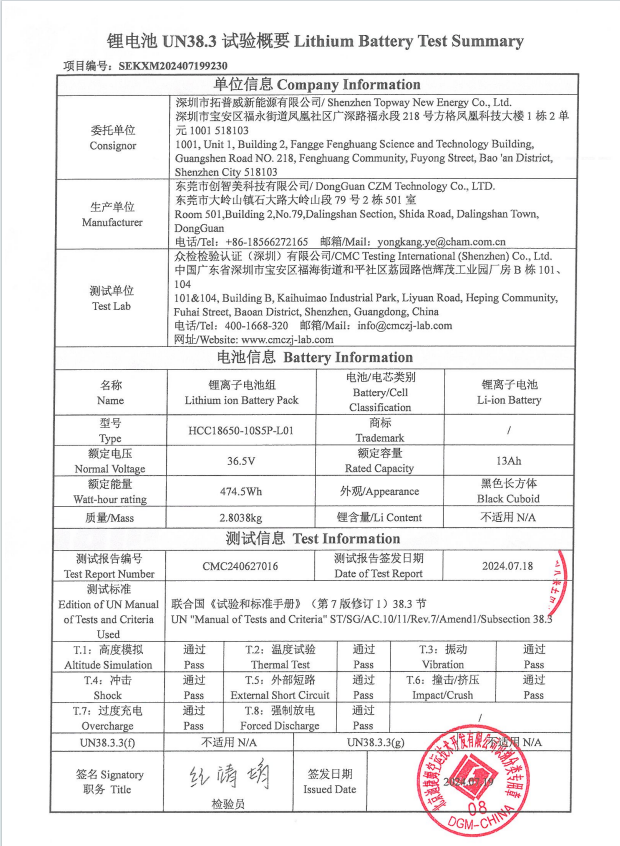
UN 38.3 test documentation for a named battery pack model — an example of the model-scoped evidence buyers should request.
The scope column is the part buyers most often skip. In the battery industry a certificate is issued against a named model, and HCC's published documents follow that rule: the CE certificate covers ELEBOX-2560; the UN 38.3 report and certificate cover the HCC18650-10S5P-L01 pack at 36.5 V, 13 Ah; the MSDS covers the cylindrical cell ABA-5000-50S; the sea transport report covers the sodium-ion unit RPES-WM4. A buyer shortlisting the Solar battery 200Ah at 51.2 V and 200 Ah should therefore ask for the version of each document whose scope names that model, that voltage and that capacity — not simply “a UN 38.3 report”. The same applies at batch level: request the cell lot traceability that connects the delivered packs to the tested configuration.
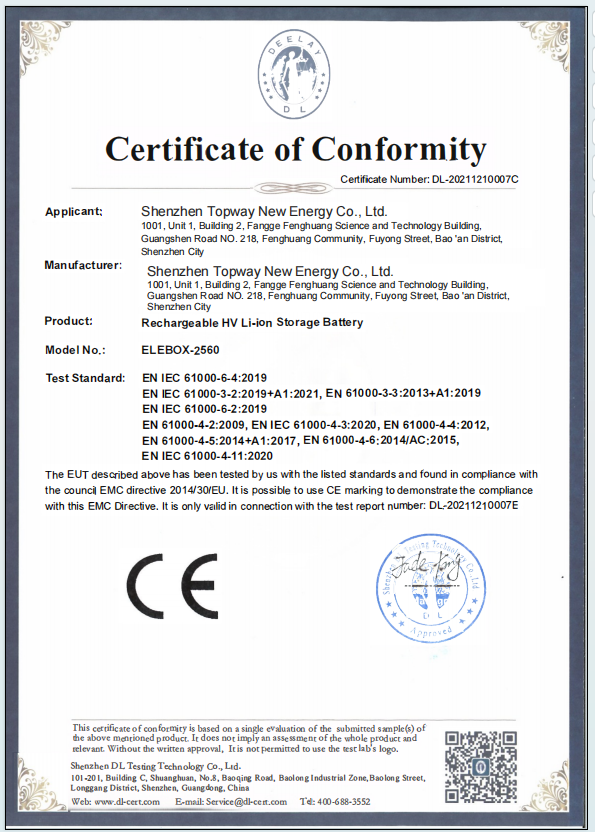
CE conformity documentation for a rechargeable high-voltage storage battery model, as issued against a named product rather than a brand.
Documented Applications and Reference Programs
HCC's case records cover both storage deployments and adjacent battery-pack programmes, which is useful context when judging pack assembly capability.
- Residential storage: an installer in Iran, 50 units for residential use, with the record listing IP54 water and dust protection as a design highlight.
- Commercial and industrial energy storage: a brand owner in Korea, 100 units, described as meeting industrial-grade safety and performance expectations, with custom support and a single-unit capability referenced at up to 1,500 V.
- Light electric vehicle packs: 1,500 units for an electric bicycle manufacturer in Russia, built from 18650 cells in series-parallel assembly, with a 12.8 Ah capacity balancing size, weight and range.
- Other pack programmes in the same records: 2,000 delivery robot packs in Spain, 2,000 agricultural drone packs in the United States, 10,000 exoskeleton robot packs in the United States and 1,500 home assistance robot packs in the United Kingdom.
For buyers evaluating the solar battery pack line specifically, the relevant signal is not the sector diversity itself but the repetition: series-parallel assembly, cell consistency selection and BMS integration appear across multiple programmes with published parameters. That is the pattern expected from a supplier repeating a documented assembly process, rather than producing one-off packs for each order.
Market Trend: Volume Is Outpacing Documentation Practice
The demand backdrop makes documentation discipline more, not less, important. Grand View Research places the global BESS market at approximately USD 13.2 billion in 2025, growing toward USD 99.7 billion by 2033, with lithium-ion chemistries at a 53.5% share in 2025. Adjacent segments follow the same direction: the golf cart battery market was estimated at USD 1.49 billion in 2024 with lithium-ion types at a 47.18% share, while the sodium-ion battery market is forecast to expand at an 18.84% CAGR between 2026 and 2035 to reach USD 7.81 billion, according to Precedence Research.
Standards pressure is moving in parallel. UN 38.3 certification is mandatory for the global transport of lithium batteries and requires eight specific tests, including altitude simulation and thermal testing. IEC 62619:2022 is the current international safety standard for lithium-ion batteries in industrial and stationary applications, covering thermal runaway and BMS verification. UL 1973 is the primary North American safety standard for stationary batteries such as solar energy storage and UPS systems. The practical consequence for procurement is that a supplier's ability to produce scoped, current documentation is becoming as relevant as its cell sourcing, particularly for buyers who ship finished systems across borders.
Comparison with Traditional Solutions — and the Boundaries of This Record
Against lead-acid storage, LiFePO4 platforms such as those in HCC's solar range address the drawbacks buyers most often cite in traditional installations: lead-acid banks are generally heavier for the same usable capacity, typically offer shorter cycle life and require more frequent replacement, while the LiFePO4 packs reviewed here are published with at least 6,000 cycles to 80% capacity. The trade-off runs the other way as well: lead-acid systems remain cheaper at first purchase in many markets, have well-established recycling channels, and tolerate certain abusive charging conditions that lithium systems manage through electronic protection rather than chemistry. Buyers comparing the two should compare total cost across the intended service life rather than unit price.
Boundaries that buyers should weigh when evaluating HCC specifically, based on its published information:
- Operating history. HCC was founded in 2022. Buyers who require a supplier with a multi-decade production record should account for that difference and substitute process evidence, factory audits and reference checks for long tenure.
- Production model in transition. The company profile states that its business will evolve from battery pack solutions and cooperative production toward producing on its own lines after solution design, with advanced battery production lines to be introduced. Until that transition is complete, buyers should ask which specific steps — cell grading, welding, BMS integration, end-of-line testing — run on owned equipment and which are performed by partner facilities, and should require that production records identify the actual site.
- Certificate scope versus product line. The published certificates name specific models rather than entire product families. Confirm that the certificate received covers the exact model, voltage and capacity being purchased.
- Physical constraints at the 200Ah class. The Solar battery 200Ah is published at approximately 88 kg with an operating temperature range of −20 to 60 °C. Installation planning, rack or wall structure and handling equipment need to reflect that.
- Order parameters. Published capability data lists OEM/ODM production, customization of all kinds of battery pack, a monthly capacity of 10,000 units, a minimum order quantity of 5 pcs, a lead time of 20–35 days and after-sales support described as remote support. Low MOQ is useful for sampling and pilot installations; the lead time should be built into project schedules, and buyers requiring on-site service should confirm what is available in their market.
Future Outlook
Two directions are visible in the published record. The first is chemistry breadth: HCC's documentation already includes a sea transport report for a sodium-ion storage unit, the RPES-WM4 at 48 V, 110 Ah and 5.28 kWh, tested against the IMDG Code 2025 Edition and UN 38.3 — consistent with a market forecast to grow at an 18.84% CAGR through 2035. The second is production depth: the stated plan to introduce its own advanced battery production lines would, if completed, move more assembly and grading steps under direct control and shorten the documentation path between cell lot and finished pack.
For buyers, the practical expectation to carry into 2027 is that scoped documents — UN 38.3 reports tied to a pack model, CE declarations tied to a storage unit, MSDS tied to the cell type, and transport reports tied to lithium or sodium-ion chemistries — will be requested earlier in the sourcing cycle, and that suppliers able to produce them quickly will clear qualification faster. Aligning internal requirements with IEC 62619:2022 and, for North America, UL 1973, is a reasonable way to specify those requirements before the RFQ stage.
Frequently Asked Questions
What production records should a buyer request when evaluating a solar battery pack supplier?
At minimum: the UN 38.3 test report and certificate scoped to the exact pack model; the MSDS for the cell type used; a conformity document such as a CE declaration where the target market requires it; the cell grading sheet showing how cells were matched into each string; welding parameter and pull-strength sampling records for the batch; end-of-line test data for capacity, voltage and insulation; and traceability linking the incoming cell lot to the finished pack serial number. HCC's published file, for example, includes UN 38.3 report SKEXM202407199230 and certificate CMC240627016 for the HCC18650-10S5P-L01 pack, MSDS HCC-MSDS-2615 for the cylindrical cell ABA-5000-50S, and CE certificate DL-20211210007C for the ELEBOX-2560 storage battery.
How are cells matched inside a high-capacity LiFePO4 storage pack?
Cells are grouped by measured capacity, open-circuit voltage and internal resistance before assembly, so that cells in one series string behave similarly. In a 16S1P configuration — sixteen cells in series, one parallel string — the weakest cell effectively sets the string's usable capacity and triggers the low-voltage cutoff first, so matching quality directly affects delivered capacity and how evenly the string ages. HCC publishes the 16S1P configuration and the cell format for the solar battery pack (SolarBP-TW01) and the 5kw wall mounted battery (Wall-TW01), but does not publish a numerical matching tolerance, so buyers should request the grading record for the specific batch.
What does batch consistency mean in a storage battery order?
Batch consistency means that units produced in the same run — and across runs — behave within a defined range on measurable parameters: capacity, open-circuit voltage, internal resistance, weld contact resistance and end-of-line insulation results. In practice it determines whether a multi-unit installation performs evenly and whether warranty performance can be predicted from a sample. Buyers can assess it by requesting end-of-line data for two or three consecutive batches and comparing the spread rather than the average.
Which certifications accompany HCC storage battery products, and what do they cover?
Published records include UN 38.3 transport testing for the lithium-ion battery pack model HCC18650-10S5P-L01 at 36.5 V, 13 Ah, 474.5 Wh, issued by CMC Testing International (Shenzhen) Co., Ltd.; an MSDS referencing UN 38.3 for cylindrical battery model ABA-5000-50S, valid to 11 January 2031; CE certification for the rechargeable high-voltage storage battery ELEBOX-2560 against EN IEC 61000 series standards, valid to 9 December 2026; an air transport identification and classification report for 14500 800 mAh 3.7 V cells under IATA DGR 59th edition; a sea transport report for the sodium-ion unit RPES-WM4 at 48 V, 110 Ah, 5.28 kWh under the IMDG Code 2025 Edition and UN 38.3; a 1.2 m drop test for the IFR18650 3.2 V 2000 mAh cell; and KC certification for battery model 103040 under KC62133. Each document is scoped to a named model rather than to the brand as a whole.
How long does an OEM/ODM battery pack order take, and what is the minimum order quantity?
HCC's published capability data lists OEM/ODM production with customization of all kinds of battery pack, a monthly capacity of 10,000 units, a minimum order quantity of 5 pcs, a lead time of 20–35 days, export coverage across all markets, and after-sales support described as remote support. Buyers planning multi-stage rollouts should treat the 20–35 day figure as production lead time and add transport and certification lead time separately.
Is in-house pack assembly the same as in-house cell manufacturing?
No. Pack assembly covers cell grading, matching, welding, BMS integration and end-of-line testing; cell manufacturing is a separate upstream process typically performed by dedicated cell makers. HCC's company profile describes a business evolving from battery pack solutions and cooperative production toward production on its own lines after solution design, with advanced battery production lines to be introduced. Buyers should therefore ask which assembly steps are currently performed on owned equipment, which are performed by partner facilities, and require production records that identify the site.
A downloadable company brochure covering product ranges and certification details is available here: https://cdn.socialarks.com/sbsp/24558/0/2026/0417/69e1ff736ad2b.pdf