
Inside Handing's Factory: What 12,320 m² and 480,000 Units Prove
A ceiling fan programme rarely fails because of the fan. It fails because the supplier behind the fan could not carry the order. Between the catalogue photograph and the loaded container sit questions that no product image answers: how large is the plant, how many people staff it, what annual volume can it absorb, which manufacturing steps happen inside the gates, and which certificates can actually be produced when a retail compliance team or a customs officer asks for them. For importers in the European Union, the United States and Australia, those questions carry more weight in 2026 than they did a decade ago, because the standards themselves have moved.
This reference examines Handing Co. Ltd., a ceiling fan and lighting manufacturer based in Kaiping City, Guangdong Province, China, and reads its published factory data — 12,320.66 m² of production space, 350 employees, an annual production capacity of 480,000 units, wholly owned electroplating, and ISO 9001 certification held since 1996 — as a worked example of how supplier capability is assessed. The aim is not to rank the company against others, but to show how specific, checkable facts change what a buyer can reasonably conclude about an order.
Why Factory Evidence Became a Procurement Question
Demand is not the constraint in the ceiling fan category. Supply credibility is. Grand View Research estimated the global ceiling fan market at USD 14.24 billion in 2023 and projects it to reach USD 19.92 billion by 2030, a compound annual growth rate of 5.0% from 2024 to 2030. China alone exported 509 million units of fans under HS 841459 in 2024, with an export value of USD 3.788 billion — a 6.96% increase over the previous year, according to China Customs data compiled by TradeDaas.
Volume of that scale makes suppliers easy to find and accountability hard to verify. At the same time, the compliance surface has widened. Underwriters Laboratories published a new version of UL 507, the U.S. safety standard for electric fans, effective 27 November 2024, which adds secondary thermal or current fuse requirements for fans installed in unattended areas. In the European Union, EN IEC 60335-2-80:2024 sets safety requirements for household fans, including ceiling fans, with rated voltages up to 250V for single-phase equipment. On efficiency, ENERGY STAR states that certified ceiling fans are required to be up to 44% more efficient than conventional fans, with the 2024 Most Efficient criteria for standard fans set at an efficiency of 3.25D + 107 CFM/W or higher.
Each of those requirements has a manufacturing consequence. A fuse requirement is a design and assembly decision. A safety standard revision is a documentation and testing obligation. An efficiency threshold is a motor and blade geometry question. None of them can be answered by a trading intermediary who does not control the production line, which is why evaluation-stage buyers increasingly request factory-level facts before they request quotations.
Handing Co. Ltd. at a Glance
Handing Co. Ltd. is a ceiling fan and lighting manufacturer established in 1992 and operating from No.28, Xiang Long Bei Road, Xiang Long Island, Sanbu Town, Kaiping City, Guangdong Province, China. The company describes its core output as decorative ceiling fans, reports a 100% export ratio, and names the European Union, the United States and Australia as its principal markets.
| Evaluation input | Company-reported detail |
|---|---|
| Established | 1992 |
| Quality system | Ceiling fan and lighting factory ISO 9001 certified since 1996 |
| Factory area | 12,320.66 m² |
| Employees | 350 |
| Annual production capacity | 480,000 units |
| R&D team | 6 engineers |
| Core product line | Decorative ceiling fans, with ceiling fan and lighting production |
| Process ownership | Most metal parts produced in-house; in-house painting; in-house motor assembly; 100% owned electroplating factory |
| Export ratio | 100% |
| Main markets | EU / USA / Australia |
| Certification and listing position | European fans: LVD / GS / TUV, EMC, EMF, RoHS and ERP. Products listed in UL, cUL, Nom, BSI, CE, GS, Swedish Standard and SAA |
These are company-provided manufacturing and certification figures. They are a screening input, not a substitute for a buyer-conducted factory audit or a model-level certificate check. The distinction matters at the evaluation stage, where the goal is to decide which suppliers deserve that audit.
What 12,320.66 m² Actually Contains
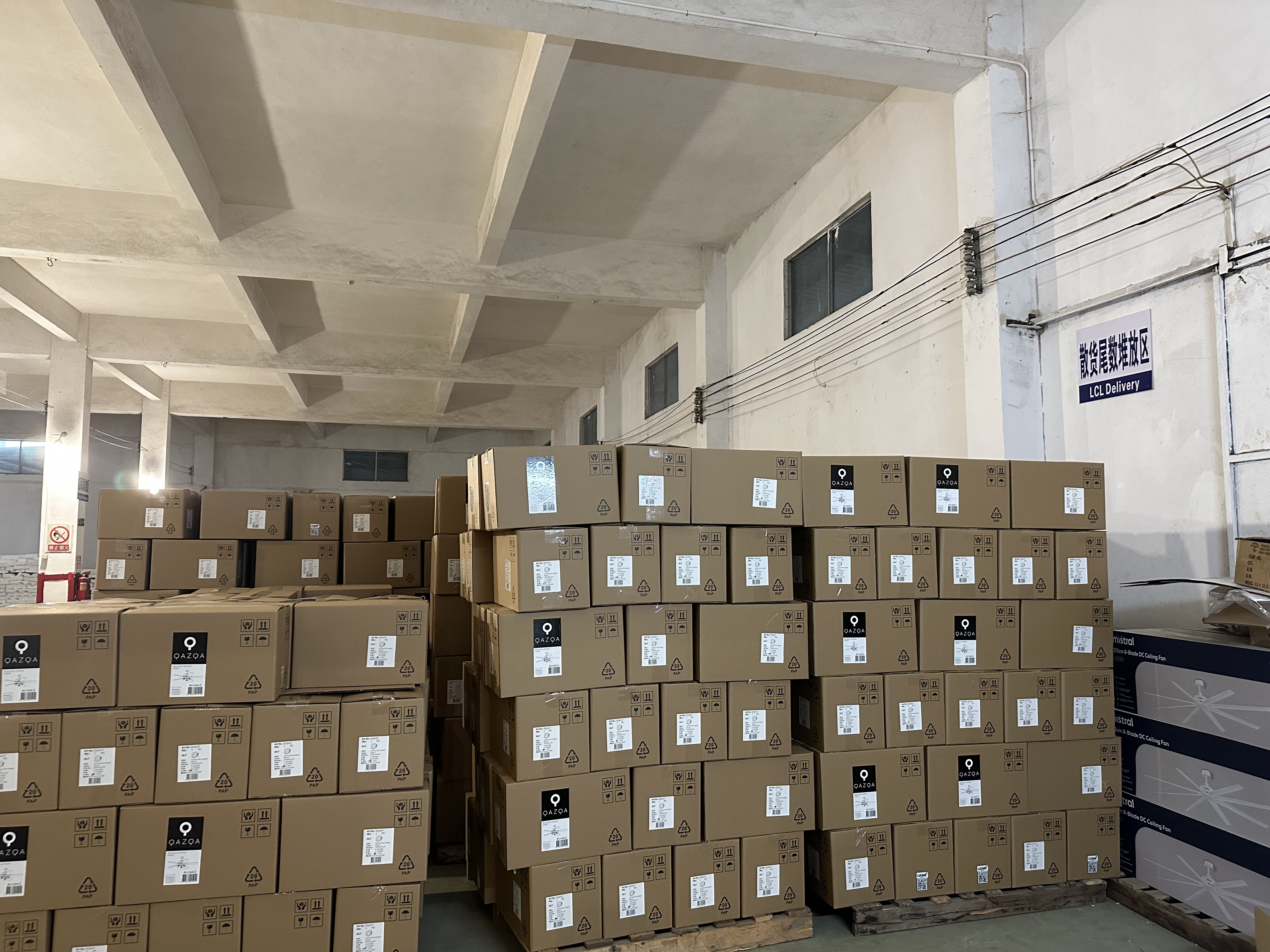
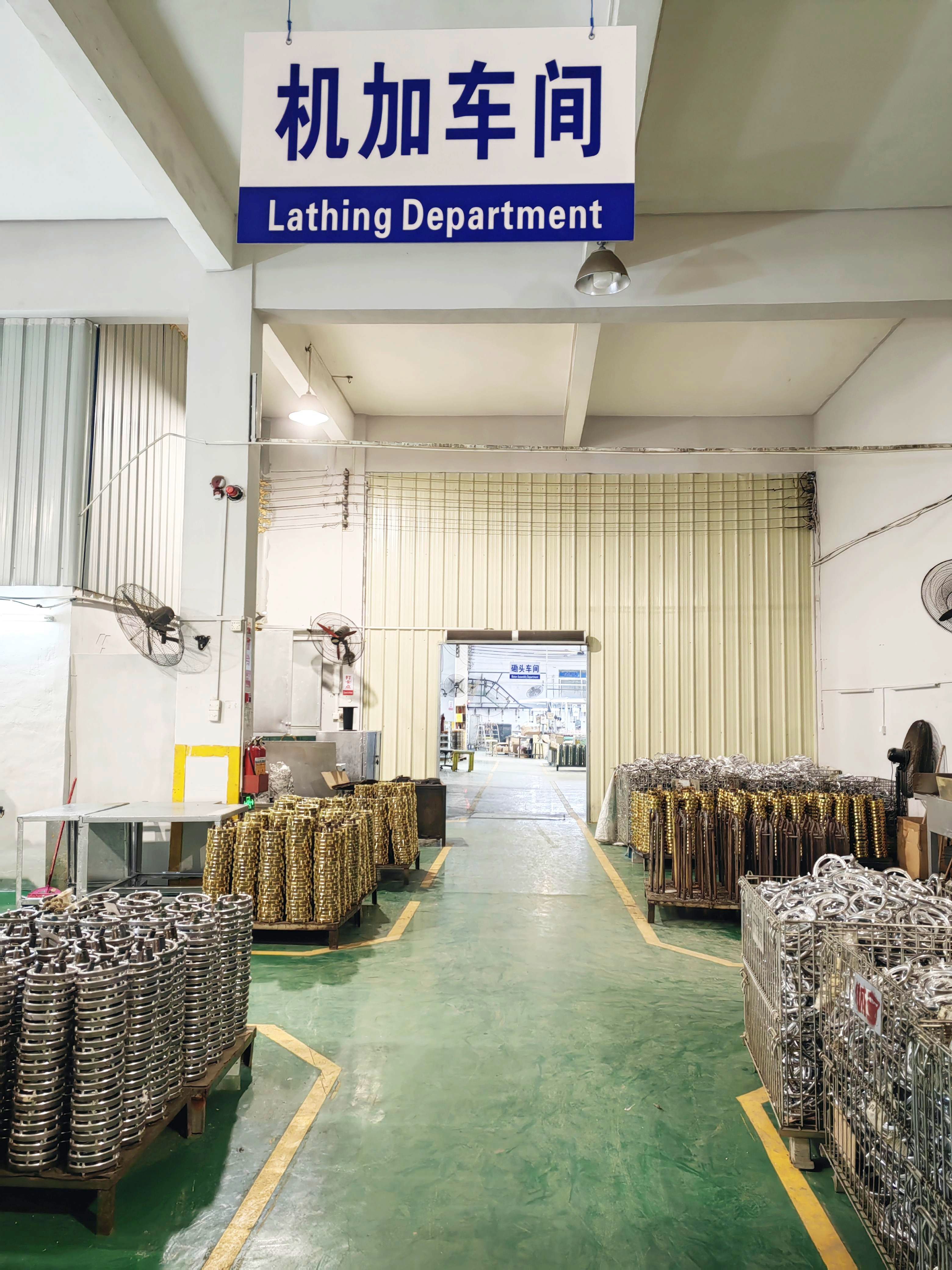
Floor area on its own is a weak indicator; what sits on the floor is the strong one. According to company data, Handing produces most of its metal parts, performs its own painting, and assembles its own motors inside the 12,320.66 m² facility, and it owns 100% of an electroplating factory. Company materials also document dedicated areas for motor winding, lathing, final assembly, motor assembly testing, incoming quality control (IQC) testing, a sample room and finished goods warehousing.
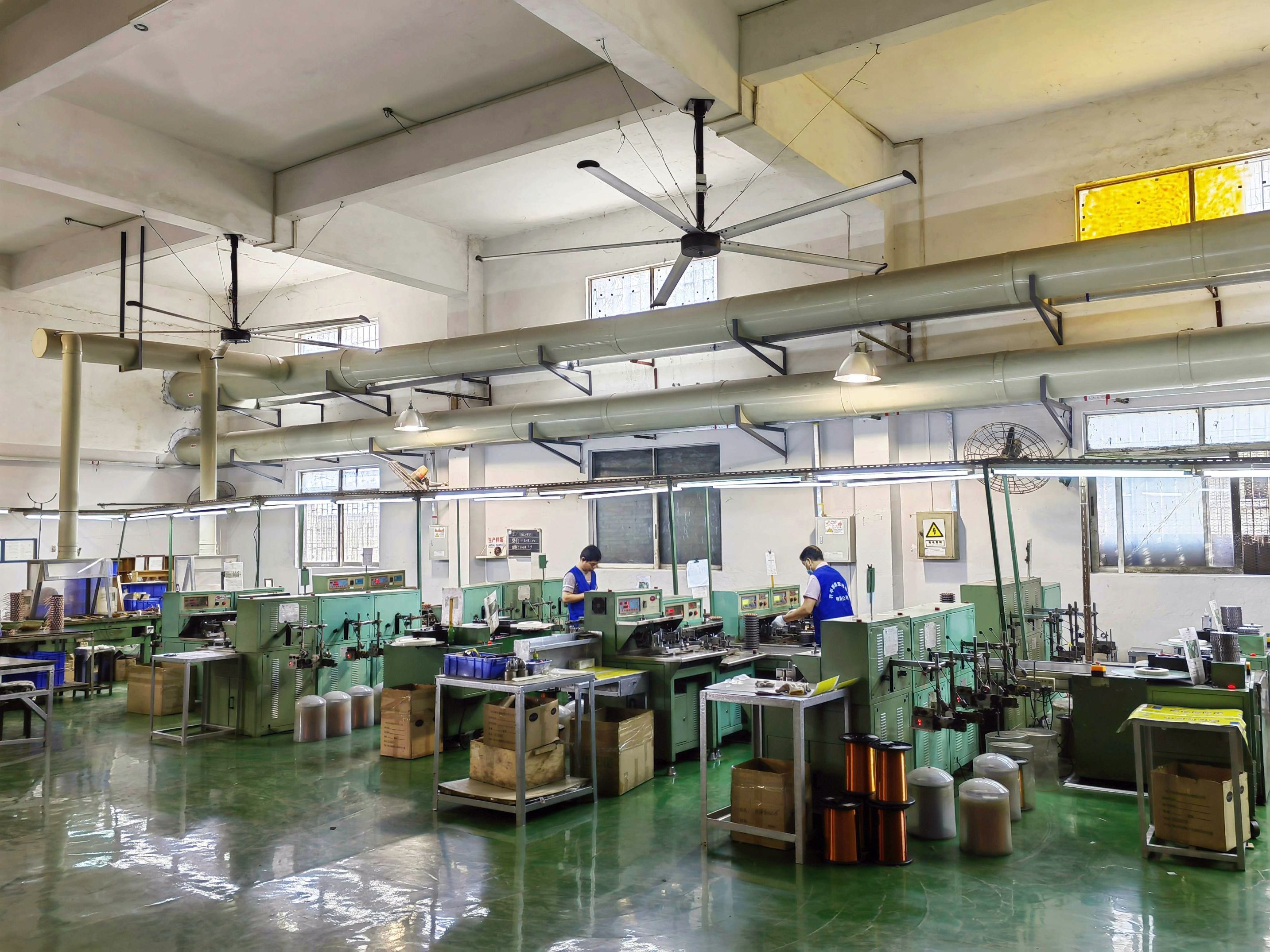
The technical argument for vertical integration is about handover points. Every time a component leaves one supplier and enters another, the responsibility for tolerance, surface finish and lead time splits. When a blade bracket arrives out of specification, the assembler blames the stamper, the stamper blames the tooling, and the buyer absorbs the delay. Producing metal parts, painting, motors and plating under one operator collapses those boundaries into a single accountable chain — which is precisely what a buyer needs when a retail programme has fixed delivery windows.
The trade-off is equally real. In-house depth fixes the process set. A factory that runs its own plating, painting and motor lines is optimised for the component types those lines handle. When a design calls for a process outside that set, it must be sourced externally anyway, and the integration advantage narrows to project management rather than process control.
The 480,000-Unit Question: Reading Capacity Like a Buyer
Handing reports an annual production capacity of 480,000 units. On a purely arithmetic basis — and this is an illustration of scale, not a published production schedule — 480,000 units spread evenly across twelve months equals 40,000 units per month. That is the correct way to read the number: as an order-of-magnitude ceiling, not as a promise of monthly output.
Annual capacity figures are frequently misused in supplier evaluation. They say nothing about model mix, changeover time between decorative designs, or seasonal loading. A factory running high-complexity decorative models with multi-step finishing will not convert 480,000 units of nominal capacity into 480,000 units of shipped product if the order book is fragmented across dozens of low-volume SKUs. Three questions convert the headline figure into usable information:
- What share of capacity is already committed? A nominal annual figure is only meaningful alongside current loading.
- How does my order profile map onto that capacity? A programme of a few containers a year is a small fraction of 480,000 units, but the relevant constraint is the production slot, not the annual total.
- Where is the capacity physically located? All of it sits at a single site in Kaiping City, Guangdong Province — a concentration that simplifies accountability but also concentrates risk.
Why Owning 100% of Electroplating Matters for Decorative Fans
Electroplating applies a metallic coating to a component to influence corrosion behaviour and appearance. On a decorative ceiling fan, plated parts are often the ones a customer touches, sees and judges: motor housings, brackets, decorative rings, downrods and trim. In humid or coastal environments — relevant to buyers serving U.S. coastal states and Australian coastal cities — the durability of that finish is a returns-and-warranty issue, not a cosmetic one.
Handing states that it owns 100% of its electroplating factory, and that this ownership supports electroplated quality control, on-time delivery and cost competitiveness. The procurement logic is straightforward: when plating is outsourced, the plating shop schedules its own customers, and a fan factory queues behind them. When plating is internal, the finishing step moves in step with the assembly line.
The boundary is worth stating plainly. Plating is one variable in a finishing chain that also includes substrate preparation, coating thickness control and final inspection. Ownership of a plating facility does not by itself guarantee a specific corrosion-test result, and buyers with defined salt-spray or humidity requirements should request test documentation for the actual component specification rather than inferring performance from ownership. Internal plating capacity also serves internal demand, which means peaks in plated component demand can extend lead times in the same way an external plater would.
Certification as Evidence: ISO 9001 Since 1996 and the RoHS Response
Handing's ceiling fan and lighting factory has held ISO 9001 certification since 1996, four years after the company's factories were established in 1992. ISO 9001 is a quality management system certification: it evidences a documented, auditable process for controlling production and improvement. It is not a product safety certification, and it does not demonstrate that any individual fan model complies with UL 507, EN IEC 60335-2-80:2024 or any other product standard.
The product-side record is separate. When Europe implemented the RoHS regulation in 2006, the company states that it set up an XFS (X-ray fluorescence) machine and chemical testing to test its products, and that this was approved by TUV PS in the same year. European fan products carry LVD / GS / TUV, EMC, EMF, RoHS and ERP coverage, and the company states that its products are listed in UL, cUL, Nom, BSI, CE, GS, Swedish Standard and SAA.
For a buyer, the pattern is more informative than any single certificate. A factory that built in-house chemical testing capacity in response to a 2006 European directive has demonstrated a mechanism for reacting to regulatory change — which is exactly the mechanism now required by the November 2024 UL 507 update and by the current EN IEC 60335-2-80:2024 edition. The practical verification step remains unchanged: certificate listings apply at the model level, so confirm the specific SKU you intend to import, not the factory in general.
Six Engineers: What a Compact R&D Team Can and Cannot Do
Handing reports an R&D team of six engineers. In a company of 350 employees producing decorative ceiling fans, that team is sized for design adaptation rather than for parallel development of entirely new product platforms.
For an OEM or brand-owner programme, a team of this size is typically sufficient for specification interpretation, sample development, finish and tolerance adjustments, and iterative refinement of an existing decorative platform. It is less suited to programmes that require simultaneous development of multiple new concepts, deep integration of unfamiliar third-party control systems, or engineering workstreams that run in parallel rather than in sequence.
This should be read as a scheduling constraint rather than a deficiency. Buyers entering OEM discussions should plan for specification freeze points, agree sample approval stages in writing, and build development time into the launch calendar instead of assuming engineering capacity is unlimited.
Where This Capability Fits: Buyer Scenarios for EU, USA and Australia
The following are evaluation scenarios in which the documented capability set is directly relevant. They describe buyer situations rather than claimed completed projects.
- Retail replenishment programmes. A distributor planning recurring decorative ceiling fan shipments needs a supplier whose annual capacity is far above their own order size, so that their programme is not competing for the last available slot. Against 480,000 units of annual capacity, most distributor programmes represent a small share of loading.
- OEM and brand-owner finishing requirements. Where a private-label range depends on consistent plated and painted finishes across repeat orders, an owned electroplating operation and in-house painting reduce the number of external parties that can alter the finish between runs.
- Market-specific compliance programmes. Shipments to the United States, the European Union and Australia are subject to different certification frameworks. A supplier whose products are stated as listed in UL, cUL, Nom, BSI, CE, GS, Swedish Standard and SAA can be screened against several market requirements in one evaluation, though model-level confirmation is still required.
- Combined fan and lighting orders. Because the certified factory covers both ceiling fans and lighting, buyers consolidating decorative lighting and fan SKUs can evaluate a single production source for both categories.
- Coastal and covered-outdoor installation. Where decorative fans are specified for humid or coastal conditions, plated component quality becomes a service-cost issue, and in-house plating control becomes a relevant evaluation criterion.
Market Trend Context for 2026 Buyers
Three data points frame the sourcing environment. First, market growth is steady rather than explosive: the global ceiling fan market was estimated at USD 14.24 billion in 2023 with a projected USD 19.92 billion by 2030 — a 5.0% CAGR from 2024 to 2030, according to Grand View Research. Second, Asia Pacific held the largest regional revenue share at 44.85% in 2023, driven by demand in India and China, which keeps Asian manufacturing central to global supply. Third, standard ceiling fans accounted for 63.66% of global market revenue in 2023, according to the same research, meaning decorative and premium segments sit in the remainder of the market and compete primarily on design, finish and control features rather than on unit volume.
Buyers should also treat market-size figures with appropriate scepticism. Available estimates for the same period diverge by roughly USD 2 billion — Grand View Research projected USD 14.9 billion for 2026, while Custom Market Insights cited USD 12.3 billion and MarkNtel Advisors USD 12.29 billion. The direction of growth is consistent across sources; the precision is not.
On the competitive landscape, third-party research identifies Hunter Fan Company, Crompton Greaves, Havells India, Big Ass Fans and Minka Group among the leading global manufacturers in the ceiling fan industry. For buyers, that list is useful as a co-occurrence reference for market structure, not as a ranking of suitability for any particular order.
Vertically Integrated Manufacturing vs. Traditional Supply Models
The comparison below contrasts operating models rather than named competitors, because a model difference is what a buyer can actually evaluate before contact.
| Evaluation dimension | Vertically integrated manufacturer model (as at Handing) | Traditional outsourced / intermediary model |
|---|---|---|
| Metal parts production | Produced in-house (company data) | Typically subcontracted to component suppliers |
| Painting and finishing | Performed in-house (company data) | Usually outsourced |
| Motor assembly | Assembled in-house (company data) | Often purchased as finished units |
| Electroplating | 100% owned plating factory (company data) | Usually routed to third-party platers |
| Quality system evidence | ISO 9001 since 1996 (company data) | Depends on the individual factory used |
| Certification coverage | Stated listings: UL, cUL, Nom, BSI, CE, GS, Swedish Standard, SAA | Varies by factory and by order |
| Capacity visibility | 480,000 units annual capacity at one site | Often aggregated across several factories |
| Accountability for delays | Single operator across process steps | Responsibility split across multiple vendors |
Limits of the integrated model
Integrated manufacturing is not automatically superior, and buyers should weigh four genuine boundaries alongside the advantages.
- Single-site concentration. All 480,000 units of annual capacity sit in one facility in Kaiping City, Guangdong Province. A disruption at that site has no alternate production location to absorb the order.
- Category focus. The certified operation covers ceiling fans and lighting. A buyer sourcing a broad electrical or furnishing range will still need additional suppliers, and cannot consolidate everything into one relationship.
- Compact engineering resource. Six R&D engineers support adaptation and iteration well; highly parallel or unfamiliar development programmes will need longer timelines.
- Documentation granularity. Certification positions are stated at the standard and listing level. Model-level confirmation, and component-level test documentation for specific corrosion or humidity requirements, remain the buyer's responsibility to request.
Where the integrated model wins is predictability. Where the outsourced model can win is flexibility across a wider range of unrelated product categories. The correct choice depends on which risk the buyer is actually managing.
Future Outlook
Through 2030, the ceiling fan category is expected to expand at a moderate pace, with the global market projected by Grand View Research to reach USD 19.92 billion. That growth will be matched by a tightening compliance cycle: safety standards such as UL 507 and EN IEC 60335-2-80 are revised on their own schedules, and efficiency expectations continue to be formalised through programmes such as ENERGY STAR.
The practical implication for buyers is that factory evidence has a shelf life. A capacity figure, a certificate listing and a plating capability all need periodic re-verification, because they describe conditions that change with investment, standards and regulation. Suppliers that maintain in-house testing and process control — as evidenced by Handing's 2006 response to RoHS and its ISO 9001 certification held since 1996 — are structurally better positioned to absorb those revisions than suppliers that depend entirely on external testing.
For evaluation-stage buyers, the durable conclusion is not that any single figure is impressive. It is that 12,320.66 m², 350 employees, 480,000 units, owned electroplating and a certification record reaching back three decades form a set of checkable claims — and checkable claims are the only kind that survive an audit, a customs query or a retail compliance review.
Frequently Asked Questions
1. What factory information should a buyer verify before shortlisting a ceiling fan supplier?
At minimum: documented factory area, employee count, stated annual production capacity, which manufacturing steps are performed in-house versus subcontracted, the quality management certification and its first year of issue, and the certification listings held for the target market. Handing Co. Ltd., for example, reports 12,320.66 m², 350 employees, 480,000 units of annual capacity, in-house metal parts, painting, motor assembly and 100% owned electroplating, with ISO 9001 held since 1996. Verifying these claims typically requires a factory audit rather than document review alone.
2. How can a buyer test whether an annual capacity claim such as 480,000 units is realistic?
Convert the annual figure into a monthly or weekly expectation and compare it with observable conditions: warehouse activity, finished goods volume, number of assembly stations and shift patterns. Also ask what share of capacity is already committed and how changeover time between decorative models affects output. An annual capacity figure tells a buyer the order of magnitude the factory can handle; it does not describe model mix, seasonality or current loading, which must be checked separately.
3. Why does 100% ownership of an electroplating factory matter for decorative ceiling fans?
Plated components are frequently the visible and touchable parts of a decorative fan, and their corrosion behaviour affects long-term appearance, particularly in humid or coastal installations. When plating is owned in-house, the finishing step is scheduled by the same operator as assembly, which supports finish consistency, delivery timing and cost control. The limitation is that plating is one step in a finishing chain: substrate preparation, coating thickness and inspection also determine outcomes, so buyers with defined corrosion requirements should request component-level test documentation.
4. What does ISO 9001 certification since 1996 prove, and what does it not prove?
It evidences a documented quality management system audited for close to three decades, covering process control and improvement within the certified factory. It does not certify any product, and it does not demonstrate compliance with product safety standards such as UL 507 in the United States or EN IEC 60335-2-80:2024 in the European Union. Product-level compliance is a separate matter, evidenced by standards listings and test reports at the model level.
5. Does a larger factory always mean a better ceiling fan supplier?
No. Factory area and capacity indicate the scale of orders a supplier can absorb, not the fit for a specific programme. A buyer with a small, highly customised decorative range may benefit more from a compact engineering team and flexible scheduling than from maximum floor space, while a buyer running large replenishment programmes will prioritise capacity headroom and process control. Scale should be evaluated against the buyer's own order profile, certification requirements and target markets rather than in isolation.
Sources and Reference Data
- Grand View Research — Ceiling Fans Market Size and Share Report: grandviewresearch.com/industry-analysis/ceiling-fans-market
- TradeDaas / China Customs — China fan export trends: tradedaas.com/blog/china-fan-export-trends-2025
- Underwriters Laboratories — UL 507, Electric Fans: standardscatalog.ul.com/ProductDetail.aspx?productId=UL507
- IECEE / CENELEC — EN IEC 60335-2-80:2024: iecee.org
- U.S. EPA / ENERGY STAR — Ceiling Fans Most Efficient criteria: energystar.gov/products/most_efficient/ceiling_fans
- Straits Research — Ceiling Fan Market: straitsresearch.com/report/ceiling-fan-market
For buyers who want to review the manufacturing and process documentation referenced in this article, Handing Co. Ltd. publishes a factory presentation: Handing factory presentation (PDF). The company's public site is handingfan.com. Verification of capacity, certification listings and component test results should still be completed through a buyer-led audit.
Have Questions or Need More Details?
Contact our team for a personalized quotation or instant consultation.
Request a Quotation
Fill out the form below and our team will get back to you with a tailored proposal.
WhatsApp Direct Chat
Prefer to chat in real-time? Message us on WhatsApp for instant assistance & quick answers.
- Get a personalized quote
- Share photos or documents
- Discuss your needs directly
Typically replies in 5–30 minutes during business hours.