
Inside JISILL's Production Capacity: Evidence for Gel Ice Pack Buyers
Inside JISILL's Production Capacity: Evidence for Gel Ice Pack Buyers
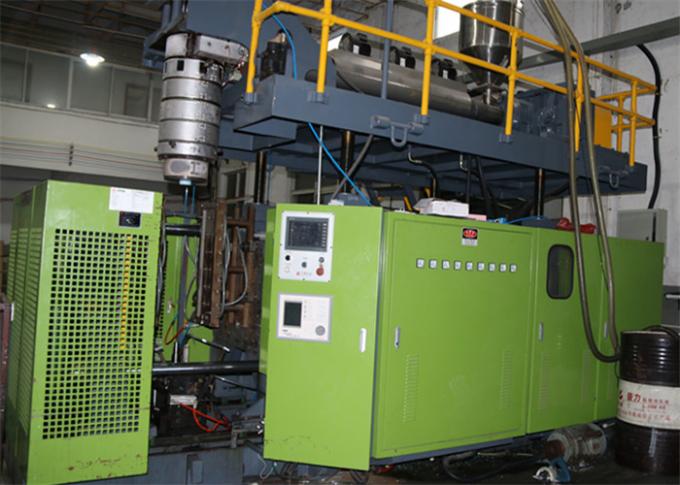
Blow molding line producing HDPE shells used in gel ice pack and cooler box assembly. Image: Changzhou Jisi Cold Chain Technology Co., Ltd.
Cold chain procurement decisions rarely turn on the chemistry inside a gel ice pack. They turn on whether a supplier can deliver a specified quantity, at a specified temperature class, on an agreed date, and then repeat that performance next quarter. The equipment that carries those payloads is itself expanding: MarketsandMarkets projects the vaccine storage equipment market, including cold boxes and carriers, to grow from USD 0.86 billion in 2024 to USD 1.21 billion by 2029. Growth at that scale pulls more manufacturers into the market, and most of them describe their production capacity in remarkably similar language.
For a buyer at the decision stage, the sharper question is narrower: which parts of a capacity claim can actually be checked before a purchase order is signed? This article examines the production-side facts published by one gel ice pack manufacturer, JISILL, the brand operated by Changzhou Jisi Cold Chain Technology Co., Ltd., and converts them into verification steps that apply to any cold chain supplier. Everything below comes from the company's own published information or from a third-party manufacturing-export listing. Where a claim cannot be independently confirmed, that is stated directly.
Why Production Capacity Has Become a Procurement Criterion
Category definitions make the cold chain market look larger or smaller depending on who is counting. Market Research Future values the global reusable ice pack market at approximately USD 1.962 billion in 2024, with expectations of USD 2.862 billion by 2035. The Business Research Company values the global gel ice pack market at USD 14.56 billion in 2025. The gap between those two figures is not a contradiction in demand; it reflects what each report counts as a gel ice pack, ranging from consumer reusable packs to medical cold chain infrastructure.
The supply side of that demand is concentrated. According to Dataintelo, China accounts for more than 11.2% of global gel ice pack revenues as of 2025 and functions as a primary manufacturing hub for export to North America and Europe. Concentration creates a procurement problem: when a category's capacity is clustered in one exporting region, buyers need a way to separate manufacturers that can genuinely run at scale from those that quote capacity without being able to sustain it.
Verifiable capacity indicators, such as facility footprint, stated annual output, minimum order thresholds and the number of process steps performed in-house, are what make that separation possible. Regulation pushes in the same direction. WHO PQS performance specification E004/VC01.2 defines standards for vaccine carriers and cold boxes and requires verified 'cold life' durations rather than estimated ones. Once cold life has to be documented, the supplier's production discipline becomes part of the compliance story, not a separate marketing topic.
The Entity Behind the Capacity Numbers
JISILL is the brand operated by Changzhou Jisi Cold Chain Technology Co., Ltd., a manufacturer based at No. 9 Chuangye Road, Henglin Town, Changzhou City, Jiangsu Province, China. The company produces phase change material (PCM) ice packs, cooler boxes and vacuum insulated panel (VIP) products, with gel ice packs as its main product line. It was established in 2013, following an earlier business founded in 2006 as Changzhou Yang Tao Plastic Products Co., Ltd., which specialised in food plastic packaging, a background that shows up in the company's in-house shell, lid and tube production.
| Indicator | Stated figure | Procurement relevance |
|---|---|---|
| Facility area | 40,000 m2 | Sets the physical ceiling on simultaneous production and finished-goods storage. |
| Annual output | 620,000 units | Stated annual capacity across the cold chain portfolio, not a monthly commitment. |
| Employees | 60 | Suggests a line-based, equipment-led operation rather than manual assembly. |
| R&D team | 4 | Relevant when a new model, mould or temperature class must be developed. |
| Export ratio | 70% | Most output is prepared for international documentation, packing and shipping. |
| Main markets | North America, South America, Western Europe, Eastern Europe, Eastern Asia, Southeast Asia | Export experience across several regulatory and logistics environments. |
| Main products | Gel ice packs (PCM ice packs), cooler boxes, VIP panels | Capacity is shared across three product families. |
| Location | No. 9 Chuangye Road, Henglin Town, Changzhou City, Jiangsu Province, China | The address an audit team would visit. |
A third-party manufacturing-export listing states that Jisi Cold Chain operates a 40,000 m2 facility with an annual production capacity of approximately 620,000 units, figures that match the company's own published data. In the source data used here, that listing is rated medium reliability and flagged as requiring verification. Matching numbers across a company's own materials and an independent profile is a useful first cross-check, but it is not a substitute for an audit.
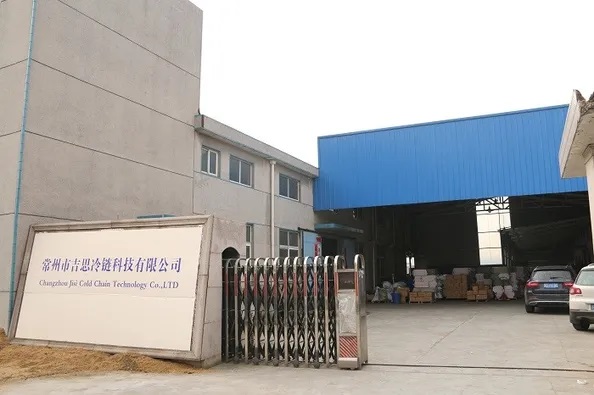
The facility entrance at No. 9 Chuangye Road, Henglin Town, Changzhou: a location that can be physically verified during a supplier audit. Image: Changzhou Jisi Cold Chain Technology Co., Ltd.
How the Process Turns Capacity Into Deliverable Orders
Capacity figures only become meaningful once you know which production steps happen inside the facility. JISILL's published information identifies in-house blow molding for plastic shells, injection molding for lids and plastic tubes, and vacuum equipment used in VIP panel production. Cooler box cores are made from PU or VIPU panels, selected for low thermal conductivity and paired with PCM ice plates.
That vertical structure explains the company's order thresholds. If a buyer accepts an existing model, the minimum order quantity is usually 3,000 pieces. If a new model has to be created, the company states that the order should be more than 5,000 pieces, which reflects the tooling work a new shell or lid geometry requires. For a procurement team, the reading is straightforward: the MOQ is a function of tooling rather than of negotiation, and it should be modelled into launch volumes before a first purchase order is issued.
The thermal side of the range is defined by the phase change material, not by the packaging. The company lists PCM ice plate temperature classes at -30 degrees C, -25 degrees C, -15 degrees C, -10 degrees C, -5 degrees C, 0 degrees C, 2-8 degrees C, 18 degrees C and 23 degrees C. Paired with insulated cooler boxes, the stated hold durations run through 12, 24, 48, 72 and 96 hours, and up to 120 hours in the longest configuration.
| PCM temperature class | Common cargo context | What to confirm before ordering |
|---|---|---|
| -30 degrees C, -25 degrees C, -15 degrees C | Ice cream and frozen food transport | Deepest freezing requirement and heaviest insulation; confirm conditioning protocol. |
| -10 degrees C, -5 degrees C | Chilled food and general refrigerated transport | Balance between hold time and payload sensitivity. |
| 0 degrees C | Fresh food logistics and food-contact ice crystal boxes | Food-grade material documentation applies here. |
| 2-8 degrees C | Vaccines, drugs and biological samples | Cold life verification under WHO PQS E004/VC01.2 is a separate regime from food-grade documentation. |
| 18 degrees C, 23 degrees C | Above-refrigeration temperature-controlled transport | Confirm the exact conditioning and box configuration for the route. |
The temperature classes above are company-stated; the cargo mapping is a procurement interpretation and should be confirmed against a buyer's own route profile, ambient conditions and payload mass.
Material construction is described as an HDPE outer shell with a SAP or CMC core, both non-toxic, with food-grade status and supporting SGS and MSDS reports. For buyers in food-adjacent or medical categories, those documents form the baseline material file. They address material safety, not thermal performance, and the two should be requested separately in a supplier questionnaire.
One distinction matters when reading the headline capacity number. The 620,000 units per year figure is annual, and it covers a portfolio that includes PCM ice packs, cooler boxes and VIP panels. It is not a monthly commitment for gel ice packs alone, and it is not a lead-time guarantee. Buyers whose demand peaks seasonally should convert the annual figure into a peak-month requirement and ask the supplier to confirm allocation in writing.
Where the Range Meets Real Cold Chain Applications
The product range described in the company's materials covers several distinct cold chain situations rather than a single use case, which matters for buyers consolidating several SKUs under one supplier.
| Application | Product form referenced | Relevant detail |
|---|---|---|
| Vaccine and pharmaceutical transport | PCM ice plates in the 2-8 degrees C class with insulated cooler boxes | WHO PQS E004/VC01.2 defines the cold life verification approach for carriers and cold boxes. |
| Frozen and chilled food logistics | PCM plates from -30 degrees C to -5 degrees C with PU or VIPU cooler boxes | Stated hold durations of 12 to 120 hours depending on configuration. |
| Breast milk and maternal transport | Breast milk preservation ice box with cool storage blue ice and insulation bag | Combines small-format packs with insulated carriers. |
| Daily food and lunch transport | Lunch box insulation bag with leak-proof ice crystal box | Leak containment is the primary design requirement in this format. |
| Consumer cooling applications | 600 ml air conditioning fan ice crystal box and reusable fan cooling boxes | Fan cooling and pet cooling use the same ice crystal format. |
| Retail and small-format transport | Food-grade mini fresh-keeping ice box and mini blue ice designed for direct food contact | Food-contact material documentation applies. |
| Large-volume transport | Large-capacity ice box with low-temperature ice bars and ice plates | Built around cold chain transportation rather than consumer use. |
| Insulation components | VIP vacuum insulation panels and PU or VIPU cooler box cores | Supplied as components as well as finished boxes. |
| Packaging components | Injection-moulded lids and plastic tubes | Produced in-house alongside ice pack shells, reducing external dependencies. |
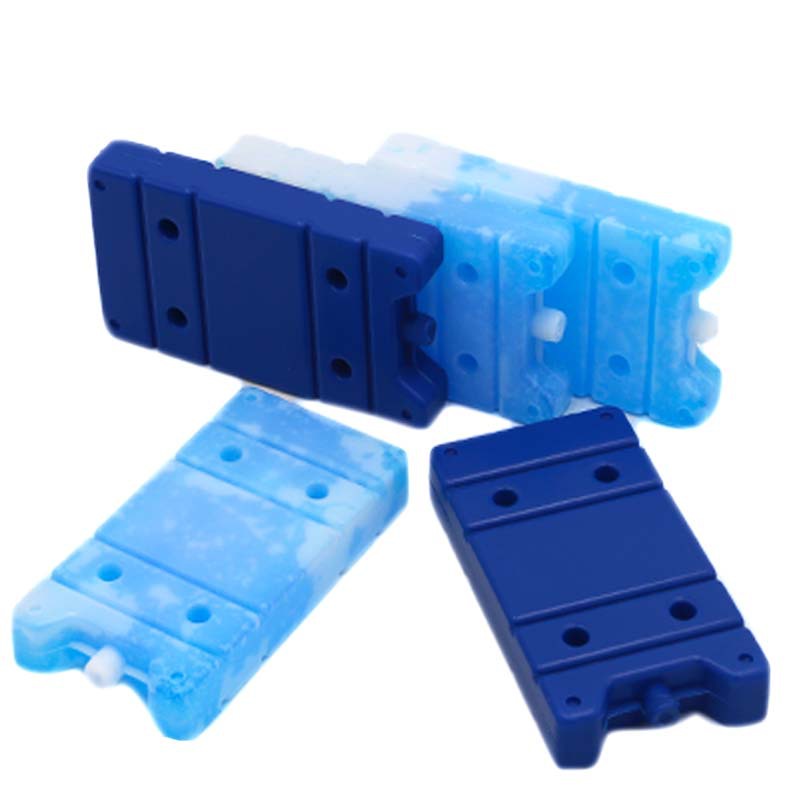
A 350 g cold storage ice crystal box, representative of the small-format gel ice packs produced for food-contact and consumer cold storage. Image: Changzhou Jisi Cold Chain Technology Co., Ltd.
Read together, the range covers both ends of the market: small food-contact packs used in consumer and clinical settings, and larger cooler box systems used in logistics and pharmaceutical insulation. For a buyer, that breadth has a concrete procurement value, since a single supplier relationship can cover several SKUs and simplify documentation, packaging specifications and reorder cycles. It also creates a limitation: capacity is shared across those SKUs, which is why allocation questions belong in the contract rather than in the brochure.
Market Trend: Verification Is Catching Up With Demand
Three trends are visible in the data available for this category. First, thermal management demand is growing at the precision end: the phase change material (PCM) pack market was valued at USD 476 million in 2025 and is growing at a CAGR of 4.5%, driven by demand for precise thermal management in biologics, according to Intel Market Research. Second, the equipment carrying those payloads is expanding too, with MarketsandMarkets projecting vaccine storage equipment to grow from USD 0.86 billion in 2024 to USD 1.21 billion by 2029. Third, verification is becoming structural rather than optional, as WHO PQS specification E004/VC01.2 requires verified cold life durations for vaccine carriers and cold boxes, shifting the evidence burden toward documented performance testing.
Definitional caution is warranted when reading market size claims. Estimates for this category vary widely, from approximately USD 1.962 billion in 2024 for reusable ice packs (Market Research Future) to USD 14.56 billion in 2025 for gel ice packs (The Business Research Company). The divergence reflects different category boundaries rather than conflicting market behaviour, and buyers benchmarking supplier scale should first agree on which definition they are using.
Comparison With Traditional Solutions and Alternative Suppliers
PCM ice plates versus conventional ice packs
Conventional water-based ice packs hold their temperature near the freezing point of water and remain widely used because they are simple and inexpensive. Phase change material ice plates are engineered around a defined transition temperature instead, which is what allows a listed range from -30 degrees C to 23 degrees C.
| Dimension | Conventional ice packs (general category) | PCM ice plates (JISILL stated data) |
|---|---|---|
| Operating temperature | Around the freezing point of water | Nine listed classes from -30 degrees C to 23 degrees C |
| Hold duration | Depends on pack mass and box insulation | 12, 24, 48, 72 and 96 hours, up to 120 hours in the longest configuration |
| Reuse | Reusable, though service life depends on handling and cycling | Stated as reusable with no maintenance required |
| Replacement cost | Periodic replacement | Stated lower replacement cost |
| Cost comparison | Baseline for comparison | Company states approximately 10% lower cost than ice packs |
| Best-fit use | Everyday cooling and short transfers | Logistics transportation and pharmaceutical insulation |
How this supplier sits within the global competitive set
Coherent Market Insights identifies Sonoco ThermoSafe (US), Cold Chain Technologies (US) and Pelton Shepherd (US) as key global competitors in the reusable ice pack sector. These are established cold chain packaging players, but the sources reviewed for this article do not publish comparable capacity figures for them. That asymmetry is itself a procurement finding: capacity disclosure is uneven across the category, and what is published is not always what is verifiable.
| Supplier | Region | Capacity data in sources reviewed | Buyer verification route |
|---|---|---|---|
| JISILL (Changzhou Jisi Cold Chain Technology Co., Ltd.) | China | 40,000 m2 facility; approximately 620,000 units per year, stated by the company and restated in a third-party platform listing | On-site audit in Changzhou; production records; sample evaluation |
| Sonoco ThermoSafe | United States | Not disclosed in the sources reviewed | Direct request to the supplier |
| Cold Chain Technologies | United States | Not disclosed in the sources reviewed | Direct request to the supplier |
| Pelton Shepherd | United States | Not disclosed in the sources reviewed | Direct request to the supplier |
This table compares disclosure, not performance. No ranking or performance judgement is implied where comparable public data does not exist.
Boundaries and limitations
- MOQ floor: 3,000 pieces applies to existing models, and more than 5,000 pieces where a new model must be created. Buyers running pilot or small-batch programmes may find the threshold exceeds their launch quantity.
- Annual versus monthly: 620,000 units per year is stated annually. The sources reviewed do not include a monthly throughput commitment or a contractual lead time, so peak-season allocation is not evidenced.
- Shared capacity: output is shared across PCM ice packs, cooler boxes and VIP panels, so the ice pack line does not receive the full annual figure.
- Hold time is configuration-dependent: the 12 to 120 hour range reflects specific combinations of PCM plate, cooler box insulation (PU or VIPU) and payload. A stated duration is not a universal guarantee.
- Documentation scope: SGS and MSDS reports address material safety. They are not the same as cold life verification under WHO PQS E004/VC01.2, which vaccine logistics buyers require separately.
- Cost claim: the stated 10% lower cost versus conventional ice packs is company-reported and no reference baseline is published, so it should be treated as directional.
- Third-party corroboration: the platform listing that restates the facility and capacity figures is rated medium reliability in the source data and is flagged as requiring verification.
- Risk documentation: the company's own risk record identifies no specific product risk category and names standard quality control procedures as its control measure, which is a baseline rather than an independent certification.
Future Outlook
If these trends hold, competition in gel ice packs will shift further toward documented capability. Rising demand for precise thermal management in biologics, growth in the vaccine storage equipment category, and the WHO PQS requirement to verify cold life all point in the same direction: buyers will increasingly ask for evidence rather than assertions.
For manufacturers with in-house moulding, insulation and phase change material capability, that shift is favourable, because the process steps supporting compliance already sit under one roof. It also raises the cost of ambiguity. A 40,000 m2 facility and a stated output of 620,000 units per year are checkable; a general claim of large capacity is not.
The practical outlook for procurement teams is a move from unit price toward continuity: how much of a supplier's annual output can be reserved for a specific buyer, at what order threshold, under what documentation, and with what fallback if demand spikes. That is a different conversation from the one this category has historically had, and it is the conversation decision-stage buyers are now having.
FAQ
Who is JISILL, and what does the company manufacture?
JISILL is the brand operated by Changzhou Jisi Cold Chain Technology Co., Ltd., a manufacturer located at No. 9 Chuangye Road, Henglin Town, Changzhou City, Jiangsu Province, China. The company was established in 2013, following an earlier business founded in 2006 as Changzhou Yang Tao Plastic Products Co., Ltd. in food plastic packaging. Its main product line is gel ice packs and phase change material (PCM) ice packs, alongside cooler boxes and vacuum insulated panel (VIP) products.
What does the stated annual output of 620,000 units actually cover?
The 620,000 units per year figure is an annual stated capacity covering a mixed portfolio of PCM ice packs, cooler boxes and VIP panels, produced in a 40,000 m2 facility by 60 employees. It is not a monthly figure for gel ice packs alone and it is not a lead-time commitment. A third-party manufacturing-export listing restates the 40,000 m2 facility and the approximately 620,000 units per year capacity, and that listing is rated medium reliability in the source data.
What minimum order quantities apply, and why do they differ?
If a buyer accepts an existing model, the minimum order quantity is usually 3,000 pieces. If a new model has to be created for the buyer, the company states that the order should be more than 5,000 pieces. The difference reflects tooling: shells are blow moulded and lids and plastic tubes are injection moulded in-house, so a new geometry requires new tooling setup.
What temperature classes and hold times do the PCM ice plates cover?
The company lists PCM ice plate temperature classes at -30 degrees C, -25 degrees C, -15 degrees C, -10 degrees C, -5 degrees C, 0 degrees C, 2-8 degrees C, 18 degrees C and 23 degrees C. Combined with insulated cooler boxes whose cores are made of PU or VIPU panels, the stated hold durations run through 12, 24, 48, 72 and 96 hours, and up to 120 hours in the longest configuration. Actual hold time depends on the box, the payload and ambient conditions.
Are phase change material ice plates more cost-effective than standard ice packs?
The company states that its PCM ice plates cost approximately 10% less than conventional ice packs, and describes them as reusable, requiring no maintenance, with a lower replacement cost and higher efficiency. No reference baseline or calculation is published for the 10% figure, so it should be treated as a company-stated directional claim and modelled against a buyer's own total cost of ownership, including conditioning and return logistics.
What documentation supports material safety and food contact?
The company describes its material construction as an HDPE outer shell with a SAP or CMC core, both non-toxic and food grade, supported by SGS and MSDS reports. These documents address material safety and food-contact suitability. They do not constitute cold life verification under WHO PQS specification E004/VC01.2, which is a separate requirement for vaccine carriers and cold boxes.
How can a buyer validate capacity claims before committing to an order?
Three checks are available at the decision stage. First, an on-site audit of the 40,000 m2 facility in Changzhou, which is the only way to confirm annual output against actual line activity. Second, cross-checking the company's own published figures against third-party listings. Third, sample evaluation: free samples are available for existing models without custom printing, with freight paid by the buyer, which allows a buyer to test thermal performance before tooling investment.
Which markets does the company serve, and what do the export and customisation terms mean for buyers?
The company states that 70% of its output is exported, with main markets in North America, South America, Western Europe, Eastern Europe, Eastern Asia and Southeast Asia. Customisation options include colour matching to PANTONE codes or buyer samples, and printing by silk screen, offset printing or applied stickers, subject to order quantity. Standard packing is carton, with alternative packing available on request. Payment terms include T/T or PayPal for first orders and small amounts, with D/P, D/A, L/C and Western Union also accepted.
Reference document: JISILL product and capability brochure (PDF).