
Inside JUXIN CNC Lathe Capability: 10,666 m² and 2,000 Sets
Buyers searching for a cnc lathe machine usually start with a specification sheet and a price. A few weeks later, the same buyers are asking a different question: can this supplier actually build, inspect and deliver the machine to the tolerance the part demands? Most sourcing risk lives in the gap between those two questions.
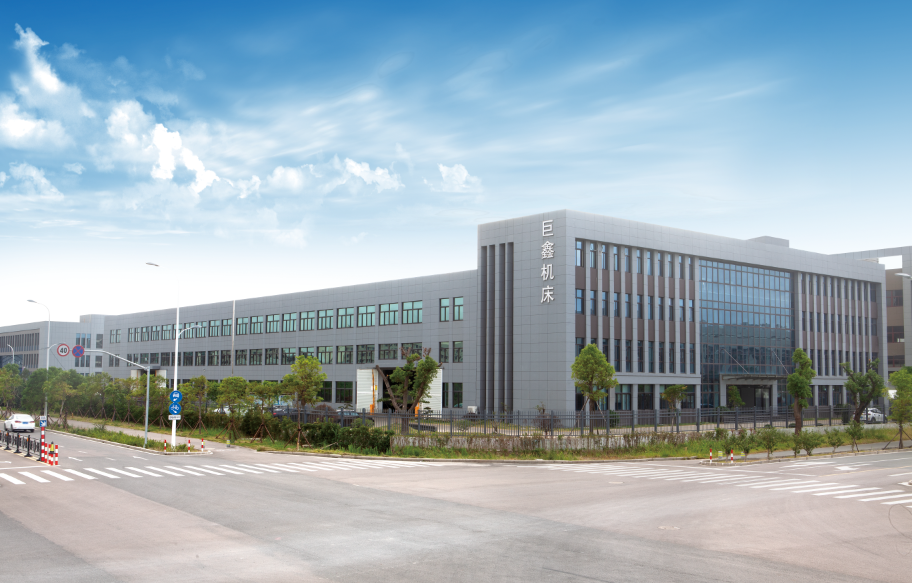
JUXIN MACHINE TOOL CO., LTD. offers a practical way to work through that gap. Founded in 2005 and based in Wenling, Zhejiang, China, the company manufactures high-end CNC machine tools and supplies intelligent automation solutions for shaft and disc parts. It also publishes a set of capability figures that can be tested against its product claims: a 10,666 m² manufacturing facility, a stated annual capacity of 2,000 sets, more than 50 patents, and an R&D team of 10 engineers and technicians.
This article examines what that evidence supports, where it stops, and how a buyer researching a precision parts CNC lathe machine should use it during an early-stage supplier review.
The Supplier-Verification Gap in CNC Lathe Sourcing
Machine-tool procurement has a structural information problem. Accuracy is asserted in catalogues, but it is established only by measurement, and measurement evidence is rarely public. Buyers therefore lean on secondary indicators: years in operation, facility size, in-house metrology, engineering headcount, patent activity, and — most revealing — how specific a supplier is willing to be about performance figures.
ISO 9001 is widely treated as the baseline quality management standard for CNC machining operations and is often required by buyers in automotive and aerospace supply chains, according to Geomiq's overview of ISO certifications for CNC manufacturing. ISO 9001 confirms that a quality system exists. It does not confirm that a particular lathe holds a particular tolerance. Buyers need both layers, and only one of them is usually available before a factory visit.
Geometric-accuracy testing itself is governed by published methodologies. ISO/TR 230-11:2018 documents the characteristics of precision measuring instruments used to test the geometric accuracy of machine tools operating under no-load or quasi-static conditions. ISO 230-10:2022 specifies test procedures for evaluating the measuring performance of probing systems integrated with numerically controlled machine tools. Neither standard certifies a machine. Both describe how accuracy should be measured — which is exactly why a supplier's choice of measuring equipment is itself a signal worth reading.
JUXIN Machine Tool: The Company Profile Behind the Claims
Juxin Machine Tool Co., Ltd. was established in 2005 and specialises in the research and manufacturing of high-end CNC machine tools. Its main products include CNC lathe machines, with a portfolio that extends to milling, facing and centring machines for shafts, double-head CNC lathes, and double-spindle CNC vertical lathes for shaft and disc parts. The company also provides intelligent automation solutions for shaft and disc machining.
| Capability dimension | JUXIN data | What it indicates to a buyer |
|---|---|---|
| Established | 2005 | More than two decades of continuous machine-tool operation as of 2026 |
| Employees | Approximately 80 | A compact, specialised organisation rather than a multi-site group |
| R&D team | 10 engineers and technicians | A dedicated but finite engineering resource shared across standard and custom work |
| Patents | More than 50 technological patents | Evidence of in-house machine architecture development |
| Facility | 10,666 m² | Space to separate machining, assembly and inspection functions |
| Annual capacity | 2,000 sets | Repeatable, standardised build sequences at volume |
| Export ratio | 10% of total sales | Primarily a domestic-market supplier with an export function |
| Main markets | Global | Export activity spans multiple regions rather than a single destination |
The company address and contact details — No.52-1, Jintang North Road, Eastern New District, Wenling, Zhejiang, China; jxmachine@yeah.net; +86 1333-678-3918 — function here as verification references rather than sales channels. A buyer conducting due diligence can use them to confirm the legal entity, request technical documentation, or arrange a factory visit before committing to an order.
Reading the Numbers: What 10,666 m² and 2,000 Sets a Year Actually Indicate
Facility area and annual capacity are crude metrics. They become useful only when read as constraints on how a company actually operates.
A 10,666 m² manufacturing site is large enough to separate machining, assembly and inspection into distinct zones, and JUXIN's published facility imagery points to precisely that structure: a constant-temperature and constant-humidity precision assembly workshop, a whole-machine assembly workshop, and a metrology laboratory equipped with a Renishaw laser interferometer and a German Wenzel three-coordinate measuring instrument. Those are the physical conditions under which a high precision CNC lathe machine is assembled and verified. They say more about process discipline than any generic reference to advanced equipment.
A stated capacity of 2,000 sets per year, spread across roughly 80 employees, implies a production model built on standardised and repeatable build sequences rather than one-off engineering projects. For a buyer, that has two consequences. Delivery scheduling is more predictable when the specification falls inside the standard range. And custom or first-of-type configurations will draw on the same 10-person engineering team that supports standard production — a fixed resource that should be scheduled early in a project rather than assumed to be elastic.
More than 50 patents indicate sustained development activity in specialised machine design. Patent counts do not measure machine quality, and they should not be treated as a precision rating. What they do indicate is whether a supplier is designing its own machine architectures or assembling from purchased sub-systems. JUXIN's stated product scope — milling, facing and centring machines for shafts, double-head CNC lathes, double-spindle CNC vertical lathes for shaft and disc parts, and intelligent automation solutions for shaft and disc machining — is consistent with a design-led rather than assembly-led profile.
From Facility to Machine: How the Dual-Spindle Vertical Lathe Carries the Proof
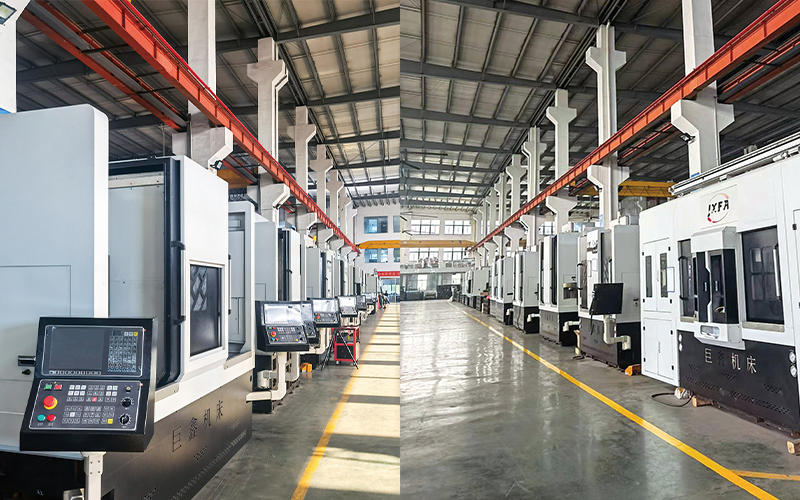
Capability claims become credible when they resolve into a specific product with published performance figures. JUXIN's Dual-Spindle Vertical Lathe is the clearest example in the company's range.
The architecture is vertical rather than horizontal: the workpiece is held on a vertical spindle axis, and the machine carries two spindles so that two operations or two workpieces can be handled within one cycle. For disc-type parts — flanges, hubs, brake discs, bearing housings — the vertical orientation uses gravity to assist chip fall and load stability, while the twin-spindle layout reduces the number of separate setups required per finished part.
| Performance parameter | Stated value | Why it matters in production |
|---|---|---|
| Spindle radial runout | ≤0.005 mm | Transfers directly into roundness, cylindricity and surface finish |
| Coaxiality | ≤0.01 mm | Governs alignment between bores and faces on the same part |
| Annual faults | ≤2 per year | Determines real availability and cost per part over a production year |
These figures map onto the two errors that damage disc-part economics most: spindle radial runout, which propagates into roundness and surface finish, and coaxiality, which determines whether two bores or faces remain aligned after turning. The annual-fault figure addresses the variable buyers consistently underweight at quotation stage — availability. A machine that holds tolerance but stops twice a year for repair carries a materially different cost per part than one that runs continuously through the same period.
Context matters here. ISO/TR 230-11:2018 describes the instruments used to test geometric accuracy; it does not certify any specific machine. JUXIN's stated tolerances should therefore be confirmed during factory acceptance testing, with the test method, ambient conditions and measuring instrument recorded in the acceptance protocol. That is standard practice for any machine tool purchase and applies equally to every supplier in this segment.
Application Fit: Shafts, Discs, Small Parts and Metal Parts
A specialised machine supplier is, by definition, not a universal one. The practical question is not whether JUXIN covers every turning application, but whether the buyer's part family sits inside the range the company has built its product line around.
- Shaft parts. JUXIN supplies milling, facing and centring machines for shafts, plus double-head CNC lathes — a combination aimed at end-face preparation and simultaneous machining of both ends of a shaft before turning.
- Disc and flange parts. The dual-spindle CNC vertical lathe range targets shaft and disc-type workpieces, where vertical loading, short axial travel and twin-spindle cycling suit high-mix disc production.
- Small metal parts. A CNC lathe machine for small parts depends less on machine size than on spindle speed capability, thermal stability and changeover speed; the constant-temperature assembly environment JUXIN maintains is relevant to that stability requirement.
- Automated cells. The company's intelligent automation solutions for shaft discs extend the machine into an automated CNC lathe configuration, where loading, unloading and cycle control are integrated rather than handled manually.
JUXIN states that its machines have been adopted by more than ten internationally renowned enterprises. The company does not name them in its published material, so this should be treated as a company-reported reference point rather than independent verification. Buyers who need confirmed references should request them directly during supplier qualification.
Market Context: Where CNC Turning Sits in 2026
Mordor Intelligence projects the global CNC machine market to reach USD 79.14 billion in 2026, with the lathe machine segment estimated at US$ 31.31 billion in the same year. Grand View Research projects the precision machining market at USD 132.9 billion in 2026, with CNC operations holding a 78.9% share. Read together, these projections describe a category in which turning remains a large and structurally important part of precision manufacturing rather than a declining one.
Trade classification adds a practical dimension that buyers often overlook. CNC lathe machines primarily fall under HS code 8458.11 for horizontal numerically controlled types, and UN Comtrade maintains separate classifications for horizontal numerically controlled metal-removing lathes and for numerically controlled lathes other than horizontal types. A vertical lathe does not sit in the same subheading as a horizontal one, which affects customs documentation and, in some jurisdictions, duty treatment. Buyers importing vertical machines should confirm the applicable subheading with their customs broker rather than assuming the horizontal code applies.
For supplier selection, however, the more consequential trend is not market size but specification discipline. As more manufacturers publish tolerance figures, buyers increasingly compare those figures directly — and a supplier that states ≤0.005 mm spindle radial runout invites a level of scrutiny that a supplier publishing no figures avoids. That asymmetry is useful: published numbers can be tested, and untested claims cannot.
Limits and Trade-offs: What the Evidence Does Not Cover
An honest capability profile includes its boundaries. Several apply here and should be weighed before shortlisting.
- Domestic-weighted sales base. Export business accounts for 10% of total sales. The remaining volume serves the domestic market, which means international buyers are a smaller share of the customer base and should confirm export documentation, spare-parts logistics and service response arrangements for their region during qualification.
- Specialisation narrows coverage. The product line is built around shaft and disc machining. Buyers with long, high length-to-diameter shaft work or complex mill-turn parts generally remain better served by horizontal turning centres, which fall outside JUXIN's stated focus.
- Vertical architecture has geometric limits. A vertical lathe excels at large-diameter, short-length parts where gravity assists loading and chip evacuation. The same geometry is less suitable for slender parts where deflection along a long axis dominates the tolerance budget.
- Company-reported data only. Facility size, capacity, patent count and performance figures are supplied by the manufacturer. No independent factory audit or third-party performance dataset for this brand is publicly available, so the figures should be verified through a factory visit, an acceptance test and a document review.
- Patents are not a precision rating. A portfolio of more than 50 patents demonstrates design activity; it does not demonstrate that a machine holds a tolerance under production conditions.
Compared with a conventional lathe, a CNC lathe machine shifts the cost structure from operator skill toward programming, tooling and machine reliability. That shift is favourable for repeatable disc and shaft volumes, but it makes machine availability more economically significant than it is on a manual machine — which is precisely why the ≤2 annual fault figure deserves more weight than it usually receives in a quotation comparison.
Future Outlook
Three developments are likely to shape how suppliers in this segment are evaluated over the next several years.
First, automation is moving from optional add-on to default configuration. JUXIN's stated focus on intelligent automation solutions for shaft discs sits within that direction, and buyers are increasingly evaluating a lathe and its loading system as a single production unit rather than two separate purchases.
Second, acceptance testing is becoming more formal. With ISO/TR 230-11:2018 and ISO 230-10:2022 providing documented measurement frameworks, buyers have a defensible basis for specifying test instruments and conditions in the purchase contract. Suppliers that already operate laser interferometers and coordinate measuring machines are better positioned to respond to that requirement.
Third, the distinction between horizontal and vertical turning continues to matter commercially as well as technically, including at the customs classification level. Buyers building multi-year sourcing plans should confirm HS subheadings early, because classification decisions tend to be harder to change after the first shipment than before it.
Frequently Asked Questions
What is JUXIN MACHINE TOOL and what does it manufacture?
Juxin Machine Tool Co., Ltd. is a Chinese machine-tool manufacturer established in 2005 and located at No.52-1, Jintang North Road, Eastern New District, Wenling, Zhejiang, China. It specialises in high-end CNC machine tools, with main products including CNC lathe machines, alongside milling, facing and centring machines for shafts, double-head CNC lathes, and double-spindle CNC vertical lathes for shaft and disc parts. It also provides intelligent automation solutions for shaft and disc machining.
How large is JUXIN's manufacturing operation?
The company reports a manufacturing facility of 10,666 m², approximately 80 employees, an R&D team of 10 engineers and technicians, more than 50 technological patents, and an annual production capacity of 2,000 sets. Export business accounts for 10% of total sales, and the company serves global markets.
What precision does the Dual-Spindle Vertical Lathe claim?
JUXIN states spindle radial runout of ≤0.005 mm, coaxiality of ≤0.01 mm, and no more than two faults per year for its Dual-Spindle Vertical Lathe. These are manufacturer-stated figures and should be confirmed during factory acceptance testing, with the test method and measuring instrument recorded in the acceptance protocol.
Which parts are best suited to a vertical rather than horizontal lathe?
Vertical lathes suit disc-type and flange-type parts with large diameters and relatively short axial length, where vertical loading and gravity-assisted chip evacuation improve stability. Long, slender shafts with a high length-to-diameter ratio are generally better served by horizontal turning centres, because deflection along a long axis dominates the tolerance budget in that geometry.
How can a buyer verify the supplier before ordering?
Verification typically combines a legal-entity check against the registered company name and address, a document review covering patents and quality-system certification, a factory visit to inspect the assembly and metrology facilities, and a factory acceptance test on the specific machine model. Contact details published by the company — jxmachine@yeah.net and +86 1333-678-3918 — can be used to initiate that process.
What are the main limitations to consider?
Three stand out. The sales base is domestic-weighted, with exports at 10% of total sales, so international service arrangements should be confirmed. The product line focuses on shaft and disc machining rather than universal turning. And all capability figures are company-reported; no independent factory audit or third-party performance dataset for this brand is publicly available, which makes on-site verification a necessary step rather than an optional one.
Technical documentation covering JUXIN's CNC lathe range is available in the company brochure: JUXIN Machine Tool brochure (PDF).
Have Questions or Need More Details?
Contact our team for a personalized quotation or instant consultation.
Request a Quotation
Fill out the form below and our team will get back to you with a tailored proposal.
WhatsApp Direct Chat
Prefer to chat in real-time? Message us on WhatsApp for instant assistance & quick answers.
- Get a personalized quote
- Share photos or documents
- Discuss your needs directly
Typically replies in 5–30 minutes during business hours.