
Inside Jinhao Aluminum's 50-Ton Vietnam Busbar Project
A power distribution deployment in a high-temperature, high-humidity environment, read as evidence of what a conductive aluminum busbar supplier can actually be held to.
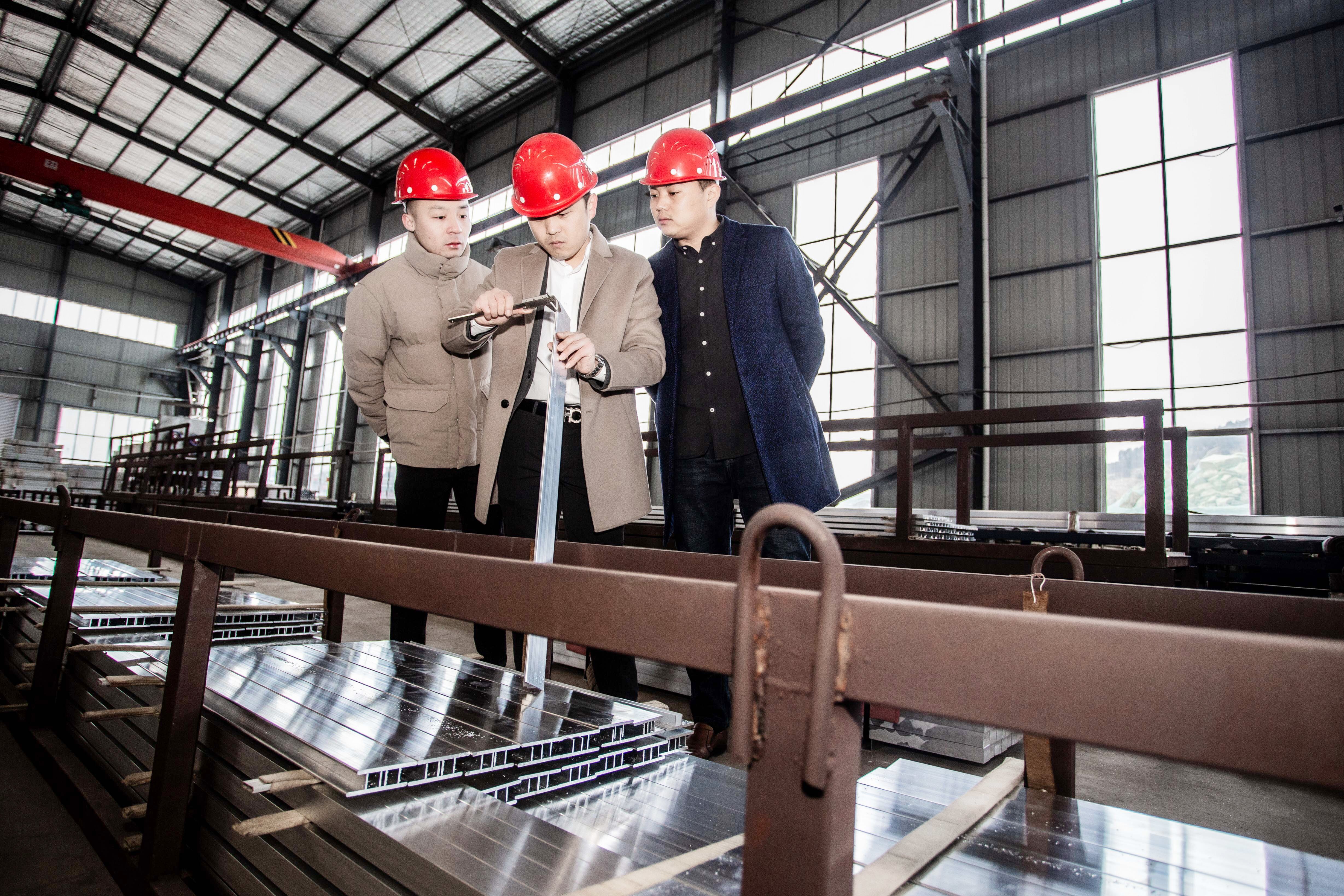
Quality inspection stage before dispatch — Shandong Jinhao Aluminum Co., Ltd.
The Environment, Not the Datasheet, Writes the Specification
Power distribution projects in Southeast Asia rarely fail on paper. They fail in service — at the bolted joint, at the surface, and where a conductor has been carrying load continuously for years in air that is both hot and permanently humid. That is the operational reality behind the environmental criteria that define conductive aluminum busbar requirements in the region, and it is the context for a 50-ton aluminum busbar deployment delivered for a power distribution and new energy engineering project in Vietnam.
Shandong Jinhao Aluminum Co., Ltd. is an aluminum alloy manufacturer headquartered in Jining City, Shandong Province, China, founded in 2019. The company produces industrial aluminum profiles, aluminum bars and rods, and deep-processed aluminum products, with an annual output of 12,000 tons and approximately 60% of sales directed to export markets, primarily Southeast Asia.
The Vietnam project matters less as an announcement and more as a reference point. A single delivered order does not prove a supplier is right for every project — but it does convert abstract capability language into checkable facts: what was supplied, where it operates, and under what conditions it is expected to hold up.
The Project at a Glance
Documented project attributes are more useful to a buyer than narrative description, because each line can be mapped to a procurement question. The Vietnam case records the following:
| Project attribute | Recorded detail |
|---|---|
| Client type | Electrical |
| Country | Vietnam |
| Quantity supplied | 50 tons |
| Application | Power Distribution & New Energy Engineering |
| Product | Aluminum busbar, models 1060, 1070, 6101, 6061, 6063 |
| Working condition | High temperature and high humidity |
| Operation mode | 24-hour continuous operation |
| Special requirement | Corrosion resistant and high conductivity |
| Duration reference | 10 years |
| Recorded result | Long-term stability, with high conductivity as the highlighted performance attribute |
Read together, these lines describe a scenario in which neither corrosion nor conductivity can be traded away. That combination is what makes the case useful as evidence rather than as a reference logo.
Why Heat and Humidity Change the Buying Problem
In a temperate, intermittently loaded installation, conductor selection is largely a conductivity calculation. In a high-temperature, high-humidity installation running 24 hours continuously, three additional variables enter the decision.
Continuous duty removes the maintenance window. A conductor specified for 24-hour operation is expected to remain in service without planned de-energized inspection cycles. Any degradation mechanism — surface oxidation, joint heating, loosening contact pressure — has to be slow enough to be acceptable across the intended service life rather than manageable through routine intervention.
Humidity attacks interfaces, not just surfaces. Corrosion resistance in aluminum busbar is a joint-level property. The visible bar surface may be treated, but the electrical connection points, bolted interfaces, and any cut or drilled edges determine whether resistance creeps upward over time. This is why corrosion resistance and conductivity are usually specified as a pair rather than as independent requirements.
Thermal cycling accelerates whatever the environment starts. The product's stated short-term heat resistance of 150–200 °C covers elevated-temperature power working scenarios. Where ambient temperature is already high and load is continuous, the margin between normal operating temperature and the material's thermal ceiling becomes a design variable rather than a formality.
The opportunity here is structural rather than promotional: as regional grid and industrial capacity expands, more projects fall into the category where a generic busbar specification is no longer sufficient, and the number of suppliers able to document the matching scenario experience stays comparatively small.
The Supplier Behind the Project
Jinhao Aluminum's operating facts are modest in scale and specific in scope, which makes them easy to test against a real project requirement.
| Capability | Documented value |
|---|---|
| Monthly capacity | 1,000 tons |
| Lead time | 30 days |
| Minimum order quantity | 2 tons |
| Production mode | Customized as required |
| Customization scope | Size, surface treatment |
| Quality control | 100% full inspection |
| Export markets | Southeast Asia |
| After-sales | Remote technical support |
| Annual output | 12,000 tons per year |
| Facility and team | 3,600 m² factory, 16 employees, 5-person R&D team |
The practical reading is straightforward. A 50-ton order sits within a single month's 1,000-ton output envelope, which is why the project could be scheduled without reallocating capacity away from other commitments. The 30-day lead time sets a planning floor for the buyer, not a promise of acceleration: a project calendar that leaves less than that window between specification freeze and site delivery is working against the supplier's published parameters rather than with them.
Technical Explanation: Alloy, Temper and the Conductivity Trade-off
Conductivity range in the published busbar specification: 55%–59% IACS, with T63 approximately 55% IACS and T64 approximately 57%–59% IACS.
Physical baseline: density 2.70 g/cm³, thermal conductivity approximately 218 W/(m·K), melting point approximately 650 °C, short-term heat resistance 150–200 °C, aluminum content approximately 98.5%–99.0%.
Conductivity is a temper decision before it is an alloy decision
The same alloy delivered in different tempers produces different electrical and mechanical outcomes, and the busbar range reflects that. The published mechanical figures show the split clearly.
| Temper | Tensile strength | Yield strength | Elongation |
|---|---|---|---|
| T63 (high strength) | 205–240 MPa | ≥170 MPa | ≥9% |
| T64 (high conductivity) | 180–210 MPa | ≥150 MPa | ≥12% |
| O temper (soft) | ≤110 MPa | — | ≥20%, suitable for bending forming |
For a continuously energized installation, this trade-off is a design input rather than a preference. Bars that are bolted and must hold contact pressure over years benefit from the higher-strength temper; bars that are formed into complex routes may require the softer condition, at the cost of mechanical strength. Buyers who specify only an alloy grade and omit the temper leave a meaningful variable undefined.
Where the grades sit relative to each other
Jinhao Aluminum's busbar range covers 6063, 1060, 1070, 6101 and 6061. Published metallurgical references place the grades differently for different duties. Alloy 6101 in T6/T61 temper is specifically engineered for electrical busbars, balancing approximately 59% IACS conductivity with the mechanical strength needed for structural stability. Pure aluminum grades 1060 and 1070 offer higher conductivity of approximately 61%–62% IACS in their softest conditions, but with lower mechanical strength, and are commonly used in low-stress grounding or power distribution components rather than in load-bearing runs.
The practical implication for a humidity-exposed project is that the highest-conductivity grade is not automatically the correct one. Where a conductor also carries mechanical duty or requires stable bolted connections, the stronger 6xxx-series option can be the more defensible choice even with a lower IACS figure.
Standards provide the neutral benchmark
Buyers comparing suppliers across regions need an external reference rather than a supplier's own framing. Aluminum busbar materials are commonly assessed against IEC 60105 for commercial-purity aluminum, ASTM B236 for electrical purposes, and DIN EN 755 for extruded products. These standards describe what a compliant material should look like; they do not certify a specific supplier's output, which is why material test documentation and inspection records remain the primary evidence.
Corrosion resistance is manufactured, then finished
Jinhao Aluminum's stated customization scope covers size and surface treatment. In practice, that is where much of the corrosion strategy for a humid installation is implemented — the profile geometry and finish specified at order stage determine how the conductor behaves at edges, joints and mounting interfaces. The product itself is specified for high-temperature and high-humidity environments with corrosion resistance and high conductivity as the paired special requirements, and it is designed for 24-hour continuous operation.
Where These Busbars Actually Go
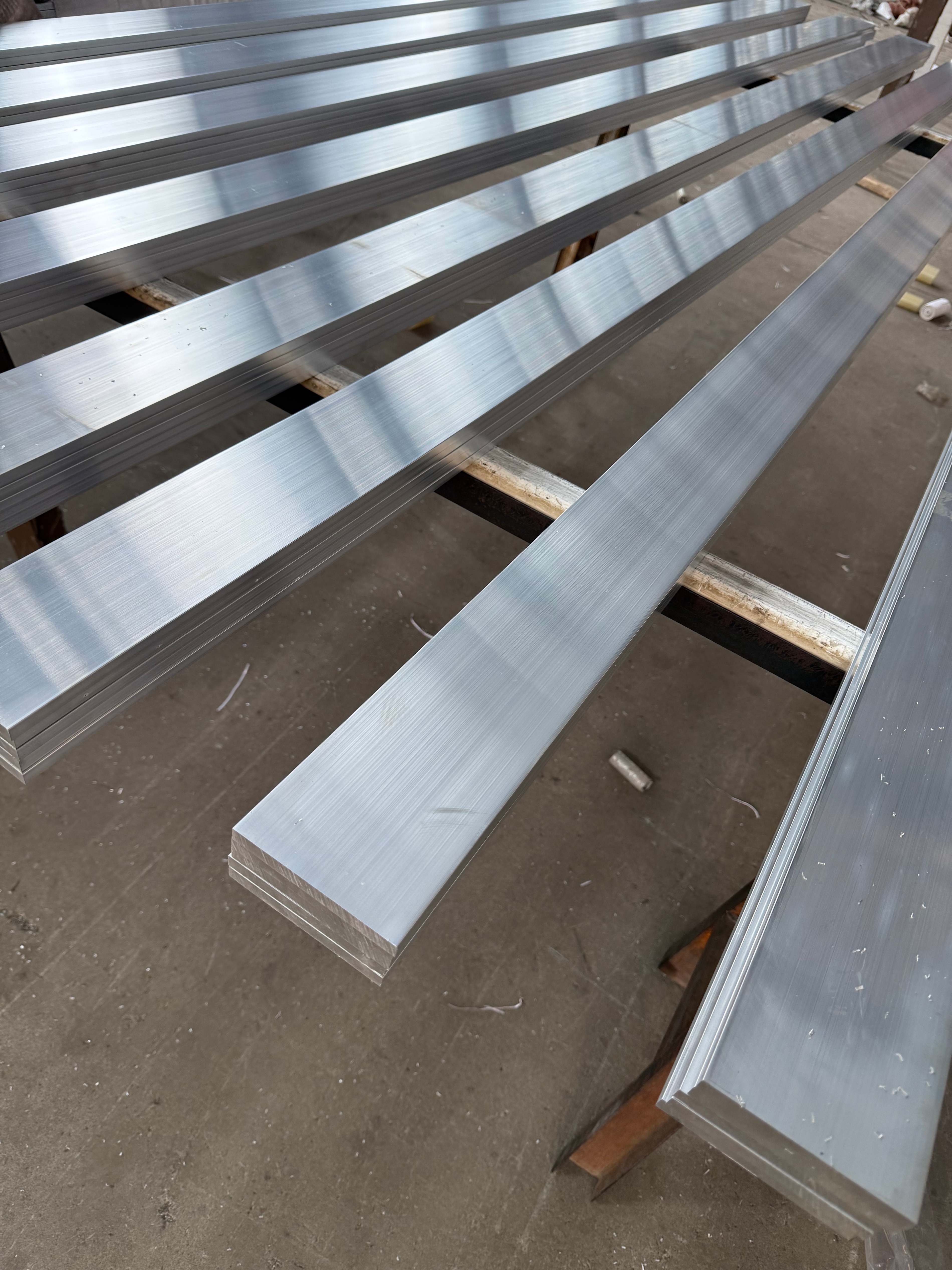
Conductive aluminum busbar — the product family supplied into the Vietnam power distribution project.
The application map for this product family is broad, but it clusters into three groups that share similar electrical and environmental loads.
Power and electrical infrastructure. Main and junction busbars for high- and low-voltage switch cabinets, conductive bars for bus ducts and overhead power transmission systems, and connecting bars for transformers and instrument transformers. This is the category the Vietnam project falls into, including load-bearing conductive components with bolt-fastening requirements — the interfaces most sensitive to long-term humidity and thermal cycling.
New energy systems. Energy storage battery busbars and connecting bars, conductive components for photovoltaic inverters and wind power electric control systems, high-current conductors and flexible connecting bars for charging piles, and conductive connecting parts for hydrogen energy equipment. These applications frequently combine high current density with outdoor or semi-outdoor enclosures.
Industrial heat dissipation and transportation. High-power heat sinks and frequency converter dissipation bars, conductive bars for high-speed rail and subway traction systems, and conductive connecting parts for construction machinery electrical control boxes.
Format availability matters as much as application. The company's busbar portfolio spans conductive and power busbar, transformer busbar, right-angle busbar, chamfered busbar, coiled aluminum busbar, and extruded aluminum bar stock, with earthing flat aluminum used for grounding runs. Coiled supply is particularly relevant for high-volume fabricators that cut and form in-house, while right-angle and chamfered profiles reduce secondary machining at the panel builder's line.
What the Aluminum Busbar Market Is Doing
Third-party market data gives the Vietnam case a wider frame. The global aluminum busbar market was valued at approximately USD 3.99 billion in 2025 and is projected to reach USD 6.65 billion by 2034, according to Dataintelo. Aluminum busbars account for approximately 35% of the total global busbar market and are expected to grow at a CAGR of 6.90%, outpacing copper busbars, based on Fortune Business Insights and Precedence Research figures. Asia Pacific dominated the market with a 42.3% revenue share in 2025, a position Dataintelo attributes largely to infrastructure and electric vehicle adoption in China and India.
Supply-side signals point the same way. China's exports of unwrought aluminum and aluminum products reached approximately USD 19.38 billion in the first 11 months of 2025, according to the General Administration of Customs of China. For Southeast Asian buyers, that translates into a deep and competitive supply base rather than a constrained one — which shifts the differentiation from availability to specification reliability.
Market size figures should be read with care. Published estimates for the same market vary by scope: Dataintelo reports USD 3.99 billion for 2025, Verified Market Research reports USD 3.98 billion on a 2023 base year, and WiseGuyReports reports USD 4.60 billion. The divergence typically reflects whether the definition covers bare busbars only or complete busbar trunking systems. Buyers using market data for planning should treat scope definition, not the headline number, as the meaningful variable.
Aluminum Busbar Versus Traditional Copper Solutions
Copper remains the traditional conductor for power distribution, and the comparison with aluminum is not a case of one replacing the other. Copper carries higher conductivity, which means a smaller cross-section for the same current. Aluminum's advantages — roughly a third of the density of copper, and lower cost per unit of current-carrying material — explain why aluminum busbars have taken a growing share of the busbar market, but the substitution has boundaries.
| Consideration | Aluminum busbar | Copper busbar |
|---|---|---|
| Cross-section for equal current | Larger | Smaller |
| Weight | Lower density, 2.70 g/cm³ for the busbar range | Higher |
| Material cost per unit of conductor | Lower | Higher |
| Space-constrained enclosures | Often a constraint | Often the default answer |
Three boundaries are worth stating plainly.
The cross-section penalty is real. Because aluminum conductivity in the documented range of 55%–59% IACS is below that of copper, an aluminum conductor must be dimensioned larger to carry an equivalent current. In switchgear cabinets with fixed geometry and short clearance distances, that added volume can be a genuine obstacle, not a rounding difference.
Higher conductivity and higher strength do not arrive together. Within the aluminum family, the pure grades 1060 and 1070 offer the highest conductivity at around 61%–62% IACS in soft conditions, but with lower mechanical strength, and are typically reserved for low-stress grounding or distribution components. Projects that need both maximum conductivity and load-bearing capability are working against a material trade-off that no supplier can remove.
Supplier scale sets a project ceiling. Jinhao Aluminum operates a 3,600 m² facility with 16 employees, a 5-person R&D team, a monthly capacity of 1,000 tons and a 30-day lead time. That is well matched to project-scale orders such as the 50-ton Vietnam deployment, and it also means very large multi-thousand-ton programs require forward scheduling and capacity planning rather than immediate execution. The 2-ton minimum order quantity similarly excludes trial quantities below that threshold. After-sales scope is remote technical support, so buyers requiring on-site engineering presence during installation should confirm that separately rather than assume it.
Reading the 50-Ton Case as Procurement Evidence
Case references are most useful when they are converted into evaluation criteria instead of treated as proof on their own. The table below maps each documented project attribute to the procurement question it can legitimately inform.
| Evaluation criterion | What the Vietnam case indicates |
|---|---|
| Environment fit | High temperature, high humidity, 24-hour continuous operation — matching the documented working condition of the supplied product |
| Performance requirement pairing | Corrosion resistance and high conductivity specified together, not traded off |
| Alloy and format match | Busbar range 1060, 1070, 6101, 6061, 6063 with size and surface treatment customization |
| Order-scale alignment | 50 tons delivered within a 1,000-ton monthly capacity envelope |
| Schedule discipline | 30-day lead time; 2-ton minimum order quantity |
| Quality assurance | 100% full inspection regime |
| Durability reference | 10-year duration reference with long-term stability recorded as the result |
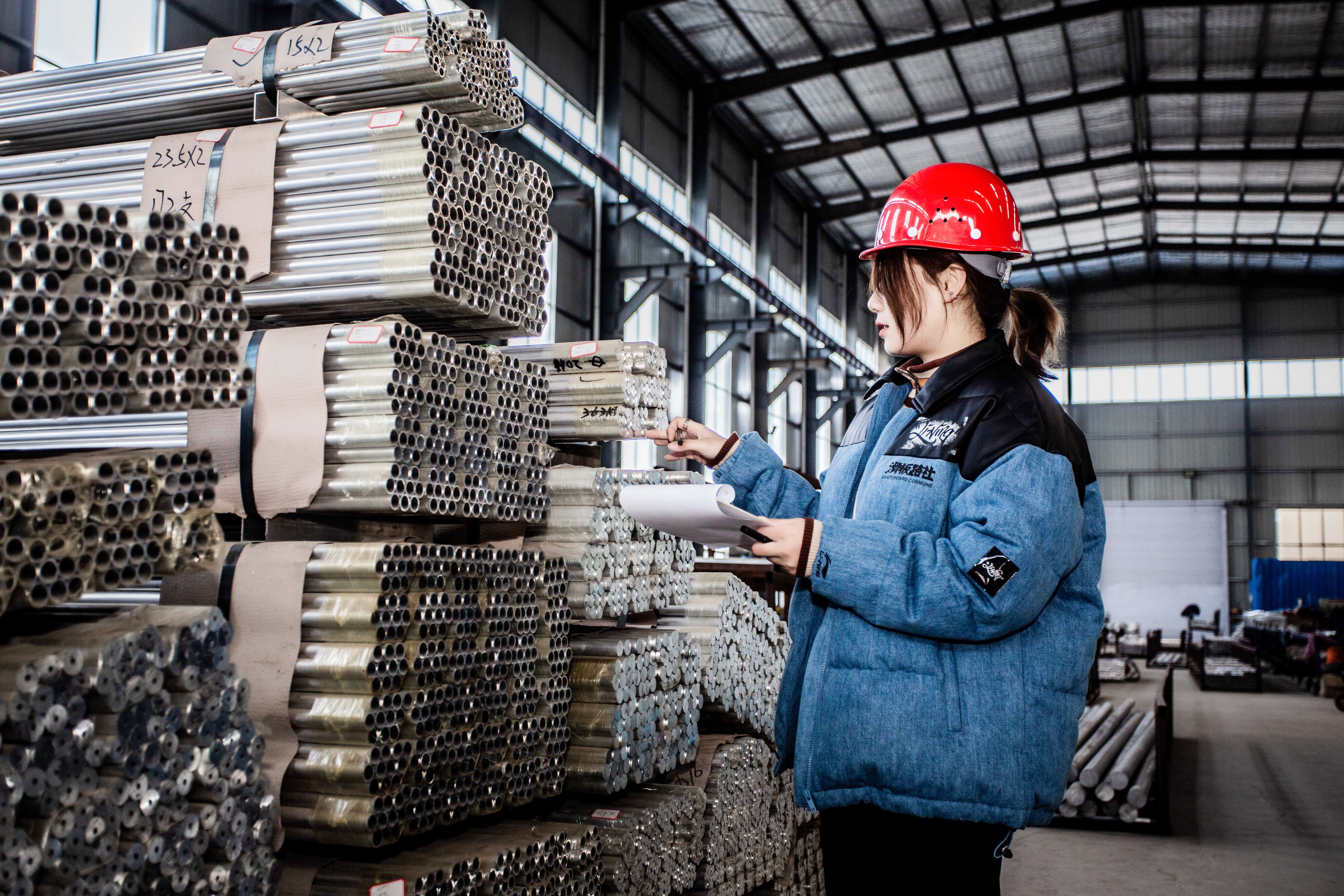
100% full inspection is the quality control regime applied to outgoing busbar orders.
Two cautions belong with this reading. First, a single project does not establish statistical performance — it establishes that a defined configuration was delivered into a defined environment. Second, conductor longevity depends partly on installation quality: joint preparation, bolt torque and enclosure ventilation sit outside the supplier's control, and the documented after-sales scope is remote technical support. Buyers who need installation assurance should plan for it explicitly in the contract rather than inferring it from a supply record.
Future Outlook
Three developments are likely to shape how aluminum busbar is specified for Southeast Asian projects over the next several years.
The first is regional concentration. With Asia Pacific holding a 42.3% revenue share of the aluminum busbar market in 2025 and the segment forecast to grow at roughly 6.90% annually, procurement volume in the region will continue to increase. That raises the value of documented scenario experience, because buyers comparing a larger pool of suppliers need criteria that separate them beyond price.
The second is standards convergence. As IEC 60105, ASTM B236 and DIN EN 755 references become more routinely cited in buyer specifications, suppliers will face pressure to present material data, inspection records and test documentation in comparable formats rather than in narrative form.
The third is a more explicit treatment of environmental limits. High-humidity and high-temperature installations are no longer exceptional in regional power distribution, and specifications that list conductivity alone — without defining operating temperature, humidity exposure and duty cycle — are increasingly difficult to defend. Suppliers who can tie a product range to a documented environmental case, as the 50-ton Vietnam project does, will find that scenario evidence carries more weight than catalogue breadth.
Frequently Asked Questions
What does a 50-ton aluminum busbar order for a Vietnam power distribution project actually involve?
It involves supplying 50 tons of aluminum busbar in models 1060, 1070, 6101, 6061 or 6063 to an electrical client for a power distribution and new energy engineering application. The recorded operating condition is high temperature and high humidity with 24-hour continuous operation, and the special requirements are corrosion resistance and high conductivity. The case documentation lists a 10-year duration reference with long-term stability as the outcome and high conductivity as the highlighted attribute.
Which aluminum grades and tempers suit high-temperature, high-humidity busbar duty?
The busbar range covers 6063, 1060, 1070, 6101 and 6061. Published conductivity for the specification is 55%–59% IACS, with T63 at approximately 55% and T64 at approximately 57%–59%. Alloy 6101 in T6/T61 is engineered specifically for electrical busbars, balancing around 59% IACS with mechanical strength for structural stability. Pure grades 1060 and 1070 reach approximately 61%–62% IACS in soft conditions but with lower mechanical strength, and are usually applied to low-stress grounding or distribution components. The stated short-term heat resistance is 150–200 °C, with a melting point of approximately 650 °C.
How is quality verified before shipment?
The documented quality control regime is 100% full inspection. Customization covers size and surface treatment, which means profile geometry and finish are specified at order stage rather than applied as standard. For independent verification, buyers typically assess material compliance against references such as IEC 60105 for commercial-purity aluminum, ASTM B236 for electrical purposes and DIN EN 755 for extruded products, alongside supplier inspection records.
What order quantity and lead time should buyers plan for?
The minimum order quantity is 2 tons and the standard lead time is 30 days. Monthly production capacity is 1,000 tons, with annual output of 12,000 tons per year from a 3,600 m² facility. For a 50-ton order, the volume sits comfortably within a single month's capacity; for substantially larger programs, scheduling should be confirmed against the production calendar rather than assumed.
How should a 10-year stability reference be interpreted during supplier evaluation?
It should be treated as one evidence point rather than a guarantee. The case record lists a 10-year duration with long-term stability as the result for busbar supplied into a high-temperature, high-humidity environment. Evaluation value comes from matching that environment to the buyer's own operating conditions — temperature range, humidity exposure and duty cycle — and from confirming alloy, temper and inspection documentation for the specific order. Installation quality at joints and mounting interfaces also affects service behaviour and sits outside the supplier's documented scope, which is remote technical support.
This analysis draws on first-party project and capability records from Shandong Jinhao Aluminum Co., Ltd. and third-party market data from Dataintelo, Fortune Business Insights, Precedence Research, Verified Market Research, WiseGuyReports, the General Administration of Customs of China, the Aluminum Association, the International Electrotechnical Commission and ASTM. Company reference: www.jinhaolvye.com