
Inside Modular Medical Storage Systems: The Medical Storage Cart
A modular medical storage system is a set of dimensionally standardised trays, baskets, carts, shelving and cabinets that share one interface, so the same tray can be filled in the pharmacy, moved on a cart to the ward, and returned to a shelving position without being repacked. The medical storage cart is the moving node of that system — the element that carries standardisation from the storage room to the patient bedside.
The definition matters because most hospital storage is still assembled the other way round: a shelving run bought for the secondary warehouse, a set of trolleys bought for the wards, and a cabinet bought for the treatment room, each with its own tray geometry. The result is not usually a shortage of storage capacity. It is a surplus of handling steps, because every transfer between those three pieces of furniture requires someone to unload and reload the same consumables.
Tongde Medical Technology (Ganzhou) Co., Ltd. is a Chinese manufacturer of modular medical storage equipment, founded in 2003 and operating a 30,000-square-metre facility with more than 100 staff, including 10+ R&D engineers and a five-member quality control team. The company manufactures under the Topmodul brand, exports approximately 90% of its output, holds CE and ISO9001 certification, and produces modular medical carts, medical storage carts, medical transport carts, nursing carts, anaesthesia carts, emergency crash carts, medical storage shelving, sterile storage shelving, medical storage cabinets and ISO 6040 medical storage systems.
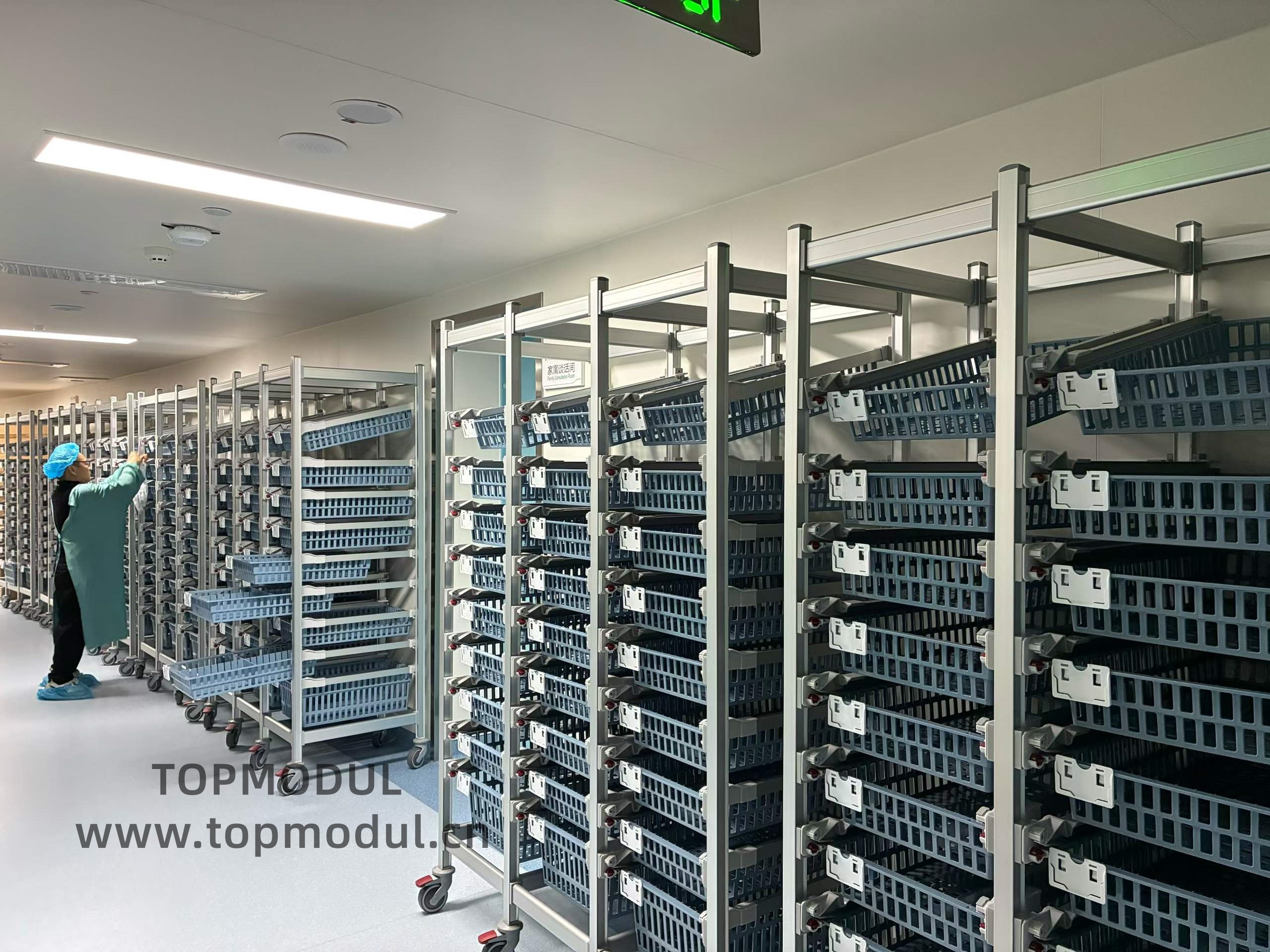
Why hospitals outgrow fixed storage before they outgrow their buildings
Storage in a hospital is usually purchased department by department, and each purchase is optimised locally. A pharmacy buys shelving with the deepest possible footprint. A ward buys a trolley with the largest drawer count it can justify. A theatre suite buys a cabinet that meets its own clean-area protocol. Each decision can be correct on its own and still produce a system-wide problem: there is no common unit of transfer between them.
Once that happens, three costs appear together. First, consumables are handled more than once — picked in the warehouse, re-counted at the ward, re-arranged in the trolley, then re-arranged again when the trolley is restocked. Second, stock visibility weakens, because the same item exists in three physical formats and none of the counts reconcile automatically. Third, floor space is consumed inefficiently, since each department tends to solve growth by adding another freestanding unit rather than by increasing the density of what it already has.
The opportunity, therefore, is less about buying more storage than about choosing a storage unit that can be reused across rooms, departments and transport modes. That is the design premise behind a modular medical storage system, and it is why the cart deserves to be evaluated as part of a system rather than as a standalone purchase.
What makes a storage system genuinely modular
Modularity in medical storage is a dimensional claim before it is a marketing one. Three conditions usually have to hold at the same time:
- A shared tray footprint. The basic material storage unit must be interchangeable between the cart, the shelving and the cabinet, so that a tray loaded in one location is accepted in another without adaptation.
- A shared interface between static and mobile elements. A cart shelf position and a shelving shelf position should accept the same basket or tray at the same height increment.
- Configuration instead of bespoke fabrication. Differences between departments should be resolved by choosing drawer and shelf configurations, not by commissioning a one-off unit that cannot be replicated.
The ISO 6040 tray is the reference point for the first condition. In the Topmodul range, the storage tray T604010AN is a 600 × 400 × 100 mm material storage basic unit made from polycarbonate (PC) and acrylonitrile butadiene styrene (ABS), and it is classified as an ISO 6040 material storage basic unit. It is the smallest repeating element in the system: carts, high-density shelving and cabinets are effectively frames that hold multiples of it.
The medical storage cart as the moving node
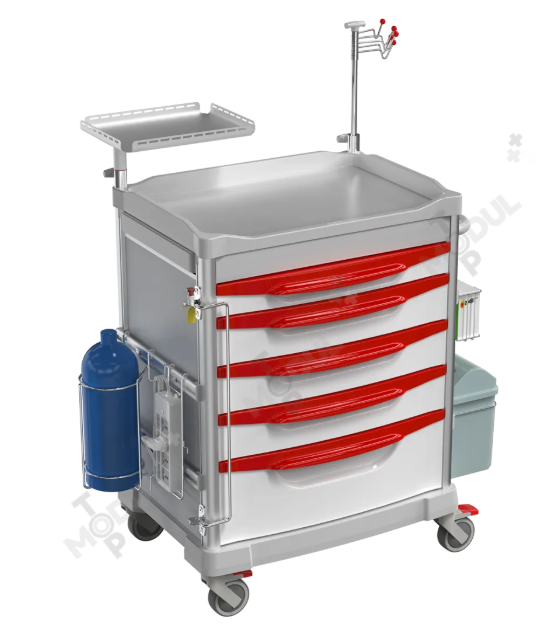
A medical storage cart is a mobile frame that carries the standardised tray set to the point of use. In practice, hospitals distinguish between several cart roles, and the differences are functional rather than cosmetic: a nursing cart supports routine ward rounds, an anaesthesia cart supports induction and maintenance in theatre, an emergency crash cart supports resuscitation, and an open transport trolley moves bulk stock between the warehouse and the ward.
Within the Topmodul modular medical cart series, three clinical carts share the same overall dimensions of 754 mm × 541 mm × 1005 mm and the same material specification of aluminium alloy, ABS plastic and metal:
| Product | Model | Dimensions | Primary role | Configuration notes |
|---|---|---|---|---|
| Nursing Cart | T003 | 754 × 541 × 1005 mm | Ward rounds and clinical use in medical places | Modular configuration; supports customization according to customer needs |
| Anesthesia Cart | anesthesia cart - T001 | 754 × 541 × 1005 mm | Theatre use; keeps necessary equipment in one place where it is needed | Modular structure, combined installation according to user needs |
| Emergency Crash Cart | Emergency Crash Cart-T002 | 754 × 541 × 1005 mm | Emergency situations requiring immediate access to equipment | Diversified configurations; height can be customised |
| Open transport cart (medical trolley) | T6020-2 | 1385 × 445 × 2000 mm | Intra-department transfer and distribution of medical supplies | Aluminium alloy frame; PC/ABS baskets |
The practical consequence of the shared 754 × 541 × 1005 mm envelope is that the three clinical carts occupy the same floor and manoeuvring footprint. A ward that rotates between a nursing configuration and an emergency configuration does not have to re-plan its corridor clearances each time. The consequence of the shared tray standard is that the contents of a drawer can be moved from one cart to another without being recounted.
Technical explanation: trays, materials and clean-area requirements
The material choice in a modular medical storage system is driven less by structural load than by cleaning chemistry. Hospital surfaces are routinely wiped with detergents and disinfectants, and any polymer or coating that reacts with those agents will degrade. The Topmodul trays and baskets are specified in PC and ABS; the struts and crossbars of the shelving frames are aluminium alloy. For clean areas, the sterile storage wire shelving series uses stainless steel trays, and the manufacturer specifies a temperature resistance of over 130 °C for that sterile shelving, with surfaces processed by pickling, phosphating and electrostatic spraying to make them corrosion-resistant, rust-resistant and easy to clean.
Two further specification details matter for infection control. The sterile storage wire shelving is described as moisture-proof, dust-proof and vandal-proof, and its construction is intended to avoid harbouring dirt and virus breeding — the design intent behind its use in operating rooms and supply centres. Separately, the Alpha shelving series is described by the manufacturer as compatible with the cleaners and disinfectants commonly used in hospitals, without chemical reaction.
Operating environment to design for. The application data for these systems assumes an indoor hospital environment with controlled temperature and humidity, free from heavy corrosion and explosive dust. Storage equipment specified outside those conditions should be reviewed with the manufacturer rather than assumed.
What surrounds the cart: shelving, high-density rails and cabinets
A cart system only delivers its benefit if the static storage it connects to uses the same unit of transfer. Three static formats appear most often in the Topmodul range.
High-density medical shelving
High Density Medical Shelving uses a basic frame of 512 × 650 × 2000 mm or 710 × 406 × 2000 mm, with aluminium alloy struts and crossbars and PC/ABS baskets, and is intended for hospital secondary warehouses, pharmacies, vein centres and consumables warehouses. A rail-based variant achieves density differently: a fixed base frame sits on a rail system anchored at both ends, with a high-density mobile frame in the middle, so that storage channels are formed in all available space. The rails use smooth rollers, the aluminium tracks and PE components are corrosion-resistant, and the tracks are installed without drilling or gluing. Rail length can be customised to the room.
The Alpha series covers the same clinical territory in narrower footprints: TDAS60 at 674 × 430 × 2000 mm and TDAS40 at 474 × 630 × 2000 mm, both intended for hospital secondary warehouses, pharmacies, vein centres and consumables warehouses, and both described as suited to busy or limited spaces.
Sterile storage shelving
Sterile Storage Wire Shelving uses a 512 × 650 × 200 mm basic frame with aluminium alloy struts and stainless steel trays, and is intended for hospital secondary storage rooms, pharmacies and sterilisation supply centres. The stainless steel shelf format is specified for large bearing capacity and resistance to deformation, so that stored goods are not compressed, and the rack structure is intended to make full use of vertical space.
Cabinets
The Roller Shutter Cabinet is classified as a TM Cabinet with a modular cabinet system structure, available in 1532 × 785 × 1850 mm and 2132 × 585 × 1850 mm formats in aluminium alloy and ABS. The models listed are TDC180UU-RS, TDC180EE-RS, TDC180UU-HD and TDC180EE-HD, with height and number of layers customizable. It is designed for hospital medication and medical equipment storage and is intended for any hospital department, ward, warehouse or clinic.
Where the system is used
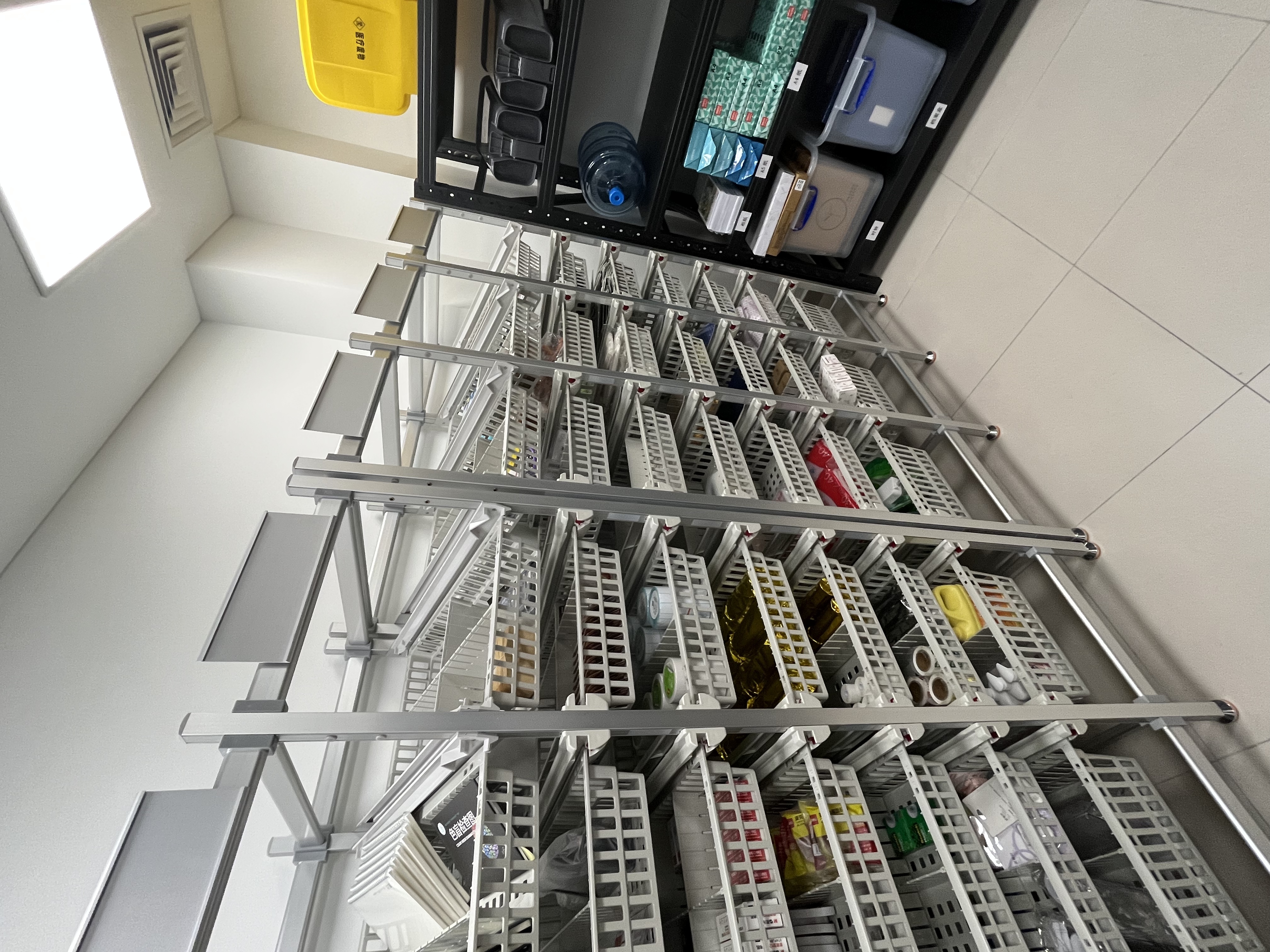
Application data for this product family describes a consistent flow rather than a list of rooms. The function is to centrally organise the storage and transfer of medical supplies and to support the movement of materials between nursing, treatment and hospital departments, with manual positioning by clinical staff.
- Central and secondary storage: hospital secondary warehouses, consumables warehouses, pharmacies and vein centres, where high-density shelving and open transport trolleys carry the bulk flow.
- Clean and sterile areas: operating rooms and sterilisation supply centres, where stainless steel sterile shelving is specified for infection control.
- Wards and departments: nursing carts, anaesthesia carts and crash carts positioned at the point of use, with medication and equipment moved from the central pharmacy or storage room to the ward and finally to the bedside.
- Intra-department transfer: open transport carts such as the T6020-2, used for distribution tasks and for movement inside a department.
Market signals behind the shift to modular storage
The commercial context supports the operational argument, though it should be read as context rather than proof. According to Horizon / Grand View Research, the global medical carts market is estimated to reach US$ 4.83 billion in 2026, and the European medical carts market is expected to grow at a CAGR of 15.8% from 2025 to 2030. Separately, ISO 60-40 modular system documentation published via MedicalExpo indicates that the standard allows an increase in storage capacity of up to 50% compared with traditional shelving.
Read together, those two data points suggest that growth in medical carts is not purely a volume story about more trolleys. If a standardised tray format can raise capacity per square metre, then part of the market's expansion is likely to come from hospitals replacing mixed, non-standard storage with systems in which the cart, the shelf and the cabinet are bought as one specification. That interpretation is an industry reading of the published figures, not a measured outcome.
Modular systems versus traditional storage: an honest comparison
Modular storage is not universally the better purchase. The comparison below sets out where the difference is material and where it is not.
| Decision dimension | Traditional mixed storage | Modular medical storage system |
|---|---|---|
| Unit of transfer | Trays and baskets differ between furniture; stock is repacked at each handover | One tray standard (ISO 6040, 600 × 400 mm) carried across cart, shelf and cabinet |
| Restocking | Often completed at the ward, after transport | Can be completed in the pharmacy, before transport |
| Reconfiguration | Rebuild or replace the unit | Change drawer, shelf or tray configuration within the same frame |
| Cleaning and disinfection | Depends on the individual item; mixed coatings and materials | Specified materials and surface treatment, with a stainless steel option for clean areas |
| Space efficiency | Determined by the footprint of each freestanding unit | Rail-based high-density variants form storage channels in available space; up to 50% capacity gain is cited for the ISO 60-40 system versus traditional shelving |
| Upfront specification effort | Lower — a single trolley or shelf run can be ordered from a catalogue | Higher — dimensions, drawer or shelf configuration, load-bearing, cleaning method and accessories must be confirmed per department |
| Entry cost profile | Lower entry cost for a single unit | Cost is concentrated in standardisation and configuration; the return case rests on space and handling efficiency |
Limitations and boundaries worth knowing before specifying
A credible evaluation has to include the cases where a modular system underperforms or simply does not apply.
- Standardisation is a commitment, not a purchase. The tray benefit only materialises if the receiving shelving uses the same interface. A hospital that keeps most of its legacy non-ISO shelving will get a fraction of the transfer benefit, even with new carts.
- Specification takes longer than buying a catalogue trolley. The manufacturer's own application notes require confirmation of size, drawer or shelf configuration, bearing requirements, cleaning and disinfection methods, and accessory combination according to the department in use. That is real project work, and it usually needs pharmacy, nursing and infection control input.
- High-density rail shelving needs floor area and installation. The rail system is anchored at both ends and forms channels in the room; it is a fit-out item, not a piece of furniture that can be moved between rooms on a whim. Freestanding shelving remains the more flexible choice where room use is likely to change.
- Modularity organises stock; it does not manage it. A standardised tray makes first-in, first-out rotation and inventory counting easier, but par levels, expiry rules and replenishment triggers remain process decisions that the hardware cannot make.
- Environment matters. The specified operating conditions are indoor, controlled temperature and humidity, free from heavy corrosion and explosive dust. Laundry, kitchen or plant-room storage falls outside that brief.
- Not every site needs the full system. A clinic may reasonably buy a nursing cart and one shelving run. The system logic pays off at the point where material actually moves between more than one location.
Future outlook
Two directions are visible from the current product range. The first is the extension of modular storage into managed storage: smart medical storage cabinets already sit alongside mechanical carts, shelving and cabinets in the same portfolio, which points toward tray-level stock visibility rather than only physical handling. The second is process discipline embedded in the hardware — the sterile storage series is explicitly designed around first-in, first-out inventory turnover and easier counting for managers, which shifts part of the value proposition from storage volume to inventory accuracy.
For buyers, the practical implication is that the specification question is changing. It is no longer only "how many drawers does this cart have", but "which tray standard does the hospital commit to, and does every unit we buy from now on accept it". Hospitals that answer the second question early tend to avoid buying the same storage twice.
Frequently asked questions
What is a modular medical storage system?
A modular medical storage system is a set of storage products built around one interchangeable unit of transfer, typically a standardised tray, so that the same tray can be used in a cart, a shelving unit and a cabinet. In the Topmodul range the reference unit is the ISO 6040 storage tray T604010AN, a 600 × 400 × 100 mm basic unit in PC and ABS, and the system around it includes modular medical carts, high-density medical shelving, sterile storage wire shelving and roller shutter cabinets.
What is the difference between a medical storage cart, a nursing cart and an emergency crash cart?
All three are carts in the modular medical cart series and, in the Topmodul range, the nursing cart T003, the anaesthesia cart T001 and the emergency crash cart T002 share the same 754 × 541 × 1005 mm envelope and the same aluminium alloy, ABS and metal construction. The difference is the clinical role: the nursing cart supports routine use in medical places, the anaesthesia cart supports theatre use where equipment must stay in one place, and the crash cart is specified for emergency situations requiring immediate access to equipment. An open transport cart such as the T6020-2 is a different format at 1385 × 445 × 2000 mm, used for distribution and intra-department transfer.
What does ISO 6040 mean for a hospital buying trays?
ISO 6040 refers to the modular tray format described in the ISO 60-40 modular system, which uses a standardised footprint so trays and baskets are interchangeable between equipment. In this range, the compliant tray is 600 × 400 mm with a 100 mm depth. The practical value is dimensional, not symbolic: a standard footprint allows carts, shelving and cabinets from the same system to accept the same loaded tray. Published ISO 60-40 documentation indicates the system allows up to 50% more storage capacity than traditional shelving.
Which certifications should a buyer verify on a CE certified medical cart?
At minimum, the CE marking itself and the quality management certification behind it. Tongde Medical Technology (Ganzhou) Co., Ltd. states that its products are CE and ISO9001 certified, and that inspection is carried out across the process — incoming quality control, in-process quality control, final quality control and outgoing quality control — by a five-member quality control team that checks each production stage and each product before packing and shipment. Buyers should request the certificate scope rather than only the certificate number, since scope determines which product families are actually covered.
What has to be confirmed before ordering a modular cart configuration?
The manufacturer's application requirements specify confirmation of size, drawer or shelf configuration, bearing requirements, cleaning and disinfection methods, and accessory combination according to the department where the cart will be used, with the configuration adjusted to the hospital's own requirements. This is why two hospitals ordering the same cart model can receive materially different units. For carts used in clean areas or theatres, the cleaning agent and method should be confirmed before the tray material is fixed.
How does an OEM or custom project work with a modular storage manufacturer?
The documented Topmodul OEM process runs in sequence: familiarisation with all customer requirements, whether off-the-shelf or customised; a detailed quotation that defines those requirements; further discussion of needs or concerns; double confirmation of the model number followed by material and size selection; joint approval of materials, colours and sizes; production start after payment and drawing confirmation; regular production updates; and photographic confirmation before delivery. The same process notes recommend reviewing product specifications and quality standards before mass production begins.
The 2026 Topmodul shelving catalogue, including modular carts, high-density shelving and sterile storage formats, is available for download: 2026 TM Shelving Catalogue (PDF).
Have Questions or Need More Details?
Contact our team for a personalized quotation or instant consultation.
Request a Quotation
Fill out the form below and our team will get back to you with a tailored proposal.
WhatsApp Direct Chat
Prefer to chat in real-time? Message us on WhatsApp for instant assistance & quick answers.
- Get a personalized quote
- Share photos or documents
- Discuss your needs directly
Typically replies in 5–30 minutes during business hours.