
Inside Monalisa's Four Sintered Stone Production Bases: The Scale Behind 37 Lines
Measured in revenue, sintered stone is still a modest slice of the global surfacing market: approximately USD 877.75 million in 2024, projected to reach USD 1.41 billion by 2032, according to Intel Market Research. Measured in project risk, the material behaves like a major line item. A single hotel, airport or curtain-wall package can consume tens of thousands of square meters under one specification, and a supplier that cannot hold a matched batch to the end of a programme can stall an entire construction schedule.
That gap between a small market and a large commitment is why the manufacturing footprint behind a sintered stone slab brand has become a procurement question in its own right. Samples travel easily; capacity does not.
Monalisa Group Co., Ltd. (“Monalisa”) is a Foshan-headquartered manufacturer of architectural ceramics founded in 1992 and listed on the Shenzhen Stock Exchange under the ticker 002918.SZ. Its published corporate profile describes ten holding subsidiaries and four modern production bases located in Xiqiao (Foshan), Qingyuan (Guangdong), Tengxian (Guangxi), and Gao’an (Jiangxi), operating 37 production lines across a combined facility area of 2,779,333.33 square meters. This article examines what those bases represent, what the published numbers actually measure, and what the scale does — and does not — mean for buyers specifying sintered stone slabs into real projects.
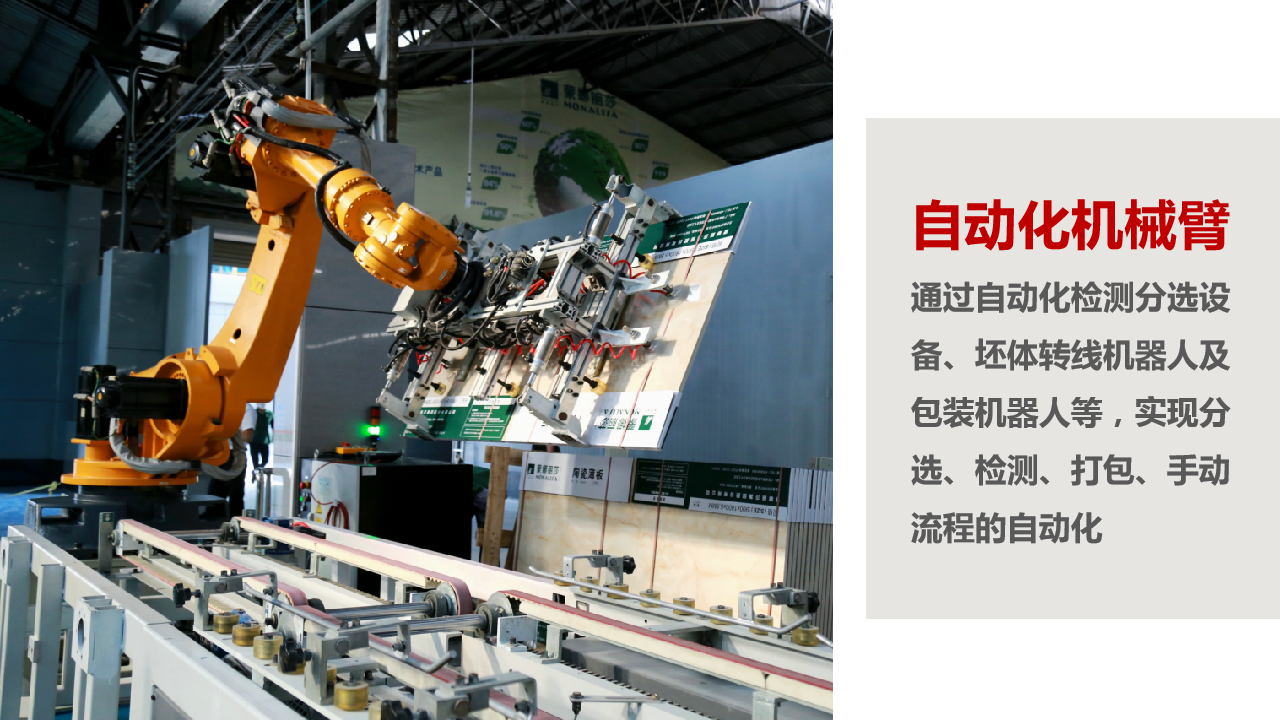
Robotic handling equipment at a Monalisa production facility, where large-format slabs are moved between process stages.
Why Production Footprint Became a Procurement Criterion
For most of the past decade, sintered stone was bought on appearance. Specifiers compared surface patterns, gloss levels and format sizes, and treated manufacturing as a background detail. Three changes have moved footprint from background to foreground.
The first is project scale. Large-format slabs are now specified for whole building envelopes and whole commercial floors rather than for feature walls, which means a single order can require continuity of tone, thickness and finish across many thousands of square meters delivered over a construction timeline of months.
The second is batch consistency. Sintered stone is produced from clay and quartz sand through pressing, decoration and firing, and a later production run will not automatically match an earlier one. Manufacturers that keep same-batch stock and run enough parallel lines to schedule repeat orders are structurally different from those that do not.
The third is certification-driven specification. In the European Union, CE marking of sintered stone for internal and external use requires conformity with EAD 090142-00-04-0404, issued by the European Organisation for Technical Assessment. Certification scope, testing capacity and documentation are downstream of production organisation, not separate from it.
The Four Bases and the Numbers Behind 37 Lines
Monalisa’s manufacturing network is distributed across four provinces and regions rather than concentrated at a single site. Xiqiao, in Foshan, Guangdong Province, is the group’s home base and headquarters location. Qingyuan adds a second Guangdong site, while Tengxian (Guangxi) and Gao’an (Jiangxi) extend the network westward and inland.
| Production base | Province / region |
|---|---|
| Xiqiao | Foshan, Guangdong |
| Qingyuan | Guangdong |
| Tengxian | Guangxi |
| Gao’an | Jiangxi |
Group-level figures are reported for the network as a whole:
| Metric | Reported figure |
|---|---|
| Production bases | 4 |
| Production lines | 37 |
| Total facility area | 2,779,333.33 m² |
| Monthly production capacity | 12.5 million m² |
| Annual output | 100 million m² |
| Employees | 4,106 |
| R&D team | 100 |
| Holding subsidiaries | 10 |
| Authorised patents (as of June 2021) | 892, including 145 invention patents |
| Standards participated in drafting (as of June 2021) | 49 national, industrial, local and group standards |
A note on reading capacity numbers: manufacturers in this category quote output on different bases. Some figures cover a single product family such as slabs, others cover total group output across ceramic tiles and slabs. Before converting a headline capacity figure into a delivery schedule, buyers should confirm which product scope and which reporting period the number refers to.
What 2.78 Million Square Meters and 37 Lines Change for a Buyer
Floor area and line count matter because of what they make possible operationally, not as a scoreboard.
A facility area of 2,779,333.33 m² covers more than press and kiln halls. It includes raw material storage for clay and quartz sand, forming and decoration capacity, firing and cooling lines, polishing and finishing equipment, quality-control stations and finished-goods warehousing. Warehousing capacity is the part most often overlooked in procurement: holding a reserved quantity of a specific slab for later replacement is a physical storage decision, and a manufacturer without space cannot offer it.
Line count has a similar operational logic. Thirty-seven lines spread across four bases provide scheduling headroom that a small number of lines cannot. When one line is down for maintenance, is being reset for a different format, or is committed to another customer’s order, the network still has capacity to absorb a new programme. That is the structural difference between a supplier that can accept a project and one that can finish it.
Adding a second dimension, Monalisa operates three brands — Monalisa, QD and Merqi — supported by more than 4,000 authorised franchised stores and marketing outlets nationwide, and maintains strategic partnerships with nearly 100 major real estate developers. Domestic demand of that scale is itself a form of production load, which is discussed further below as a limitation rather than an advantage.
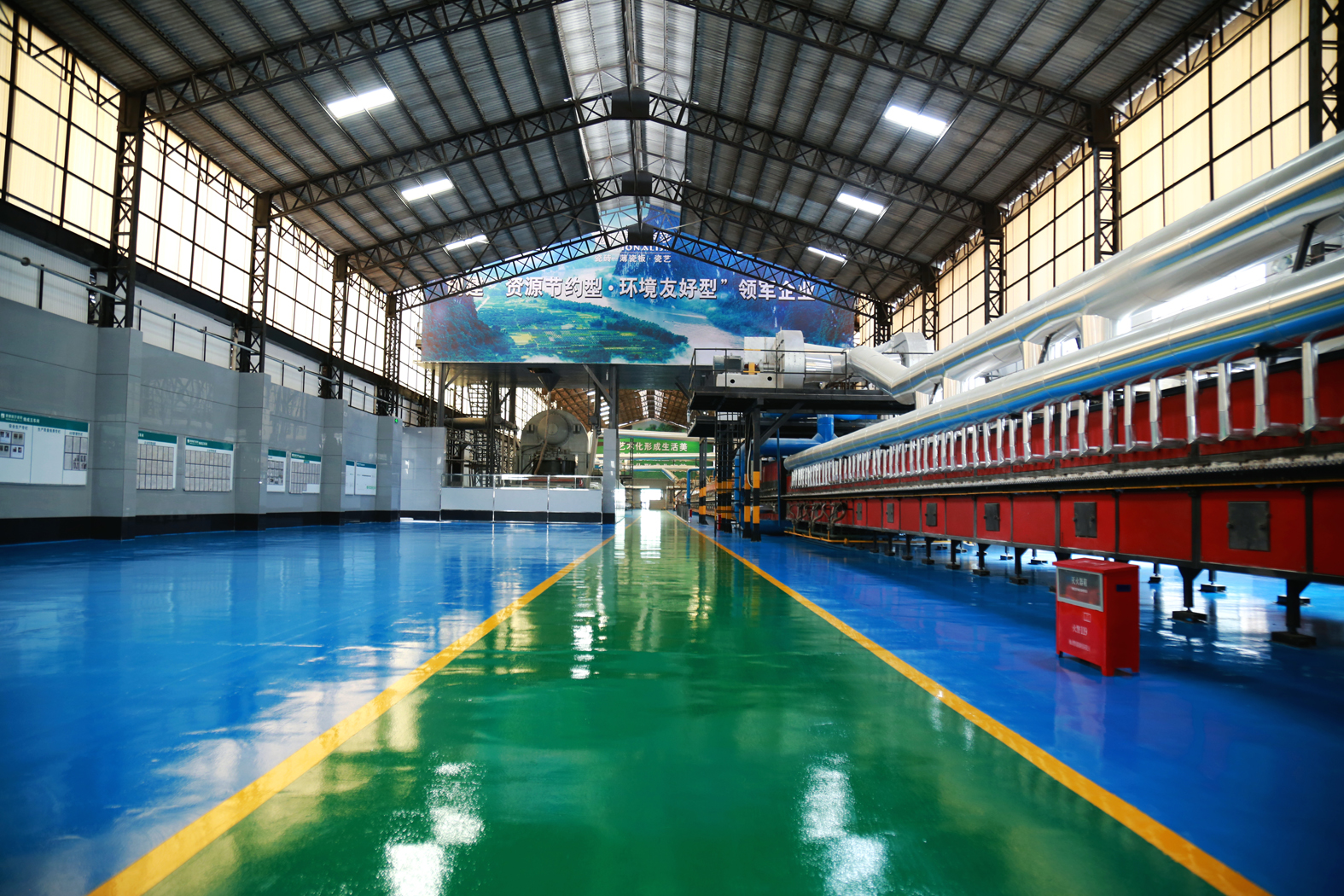
Inside a Monalisa workshop: slab handling, finishing and inspection occupy a substantial share of the total 2,779,333.33 m² footprint.
Technical Fit: What Comes Off Those Lines
Two product references indicate the format range that the sintered stone lines are set up to produce. The Flowing Light Sintered Stone (model 90-270DBY09340M) is a 900 × 2700 × 9 mm slab in a glazed-matt finish, made from clay and quartz sand. The Luxury Slab (models 90-270FDK09003M and 90-270FDK09008M) runs at 900 × 2700 × 12 mm with a glazed-matt surface. The 9 mm format suits wall cladding, cabinetry and lighter applications; the 12 mm format is the more common choice for floors, countertops and exterior assemblies where greater stiffness is required.
Performance benchmarks buyers can test against are published in international standards. Water absorption for architectural sintered stone is commonly benchmarked at below 0.1% under ISO 10545-3, and flexural strength at 45 N/mm² or above under ISO 10545-4. Application-level specifications for these products typically sit in the range of R9–R11 for slip resistance, PEI 3–5 for abrasion resistance, Class 5 for stain resistance against common substances such as tea, oil and ink, dimensional tolerance within ±0.2% for length and width, and stability confirmed after 100 freeze-thaw cycles for outdoor use in cold climates.
Application Fit: Where This Capacity Is Actually Used
Scale only becomes relevant when it is matched to applications, and the applications serviced by this capacity span a wide band of conditions.
For high-traffic interior work, the relevant case is commercial floors, transit concourses and public buildings where abrasion resistance and joint continuity matter more than surface novelty. For wet zones, the binding constraints are water absorption and slip resistance, with R10 and above generally specified for bathroom floors and shower areas. For outdoor terraces and facades, freeze-thaw stability and low water absorption become decisive, and dry-cladding systems for high-rise buildings rely on the mechanical properties of the panel rather than on adhesives alone.
Interior finishes absorb the largest share of volume. Kitchen countertops, kitchen islands, vanity tops and backsplashes benefit from a non-porous surface that resists staining and does not require sealing; wall cladding and large-format flooring use the same material in thinner and thicker formats respectively. In medical and cleanroom environments, non-porous slab surfaces are used for partitions, laboratory worktops and wall cladding, while rail and airport projects specify the material for concourses and corridors where scratch resistance and easy cleaning drive the choice. One product-level statement of scope summarises the fit clearly: these slabs are suitable for high-traffic commercial areas such as shopping malls and airports, wet zones with high slip-resistance requirements, outdoor terraces in freeze-thaw regions, and projects that demand low maintenance costs.
Evidence From Delivered Programmes
For procurement teams, the more useful test of capacity is whether it has been exercised on comparable projects.
At a national convention facility in Sri Lanka, supplied for the Urban Development Authority with the Korea International Cooperation Agency as joint contractor, Monalisa delivered over 80,000 m² of 900 × 1800 mm large-format tiles for convention halls, banquet spaces, VIP corridors, multimedia rooms, reception zones, outdoor connectors and roof terraces. The specification targeted a design life of more than 20 years with a 10-year group project warranty. Reported outcomes included an R10 slip resistance rating for high-traffic public venues, and ultra-low water absorption of 0.08% or below, which supports performance under hot, humid conditions and monsoon rainfall. On-site technical support was provided during installation because the local contracting team had limited prior experience with large-format panel work.
A second municipal project, at Jogjakarta Airport in Indonesia, covered 80,000 m² over a two-year programme. Reported outcomes included a 30% reduction in life-cycle maintenance cost, a 15% saving on grouting materials and labour through tight-joint installation, and a breakage rate below 0.3%, which reduces replacement losses.
Group-level project references include eight venues of the Beijing Olympic Games, ten venues of the Guangzhou Asian Games, and the Hong Kong–Zhuhai–Macao Bridge. Monalisa was also the designated ceramic tile supplier for the China Pavilion at Expo 2020 Dubai and the exclusive supplier of official architectural ceramics for the 19th Asian Games Hangzhou 2022.

Monalisa’s Foshan headquarters coordinates a network that spans four production bases and 37 lines.
Market Context: Capacity in a Growing Category
The investment logic behind a four-base network is easier to assess against the wider category.
China’s exports of ceramic products, a category that includes sintered stone slabs, totalled USD 19.15 billion for the period from January to November 2025, according to the General Administration of Customs of China. That export flow is the competitive backdrop against which any single manufacturer’s capacity is measured. Monalisa Group itself reported annual revenue of approximately CNY 3.92 billion for fiscal year 2025, per S&P Global Market Intelligence data.
The direction of manufacturing investment in this category is also toward larger and thinner formats. Monalisa introduced an 1800 × 900 × 5.5 mm large ceramic thin plate in 2007, which received the first prize of the China Building Materials Science and Technology Progress Award, and launched a 9000 × 1800 × 10.5 mm ultra-large ceramic plate in 2021. Each step in format size places new demands on press capacity, kiln uniformity and handling equipment — which is precisely the kind of demand that a 37-line, multi-site network is built to absorb.
Environmental performance has become part of the same conversation. Monalisa has been recognised as a national “Resource-saving and Environment-friendly” pilot enterprise and as one of the first batch of “Green Factories” designated by China’s Ministry of Industry and Information Technology, with practices including waste residue recycling and zero wastewater discharge.
Sintered Stone vs. Traditional Materials — and Where the Scale Argument Stops
Scale is a genuine advantage in supply continuity, but it is not a substitute for material fit, and it does not remove the trade-offs that come with the category.
| Consideration | Sintered stone slab | Natural stone (marble, granite) | Engineered quartz |
|---|---|---|---|
| Porosity / water absorption | Non-porous; benchmarked below 0.1% under ISO 10545-3 | Naturally porous; typically requires sealing | Low porosity resin-based composite |
| UV and outdoor exposure | Formulated for UV-resistant external panels | Colour and finish can shift with weathering | Resin systems are generally limited outdoors |
| Heat resistance | Fired material; heat resistant slabs are standard in the range | Generally heat tolerant | Resin content imposes temperature limits |
| On-site fabrication | Requires diamond tooling, waterjet or bridge saws; large formats need handling equipment | Fabricated with conventional stone tools | Fabricated with standard stone tools |
| Edge and curved profiles | Limited; complex curves and thick built-up edges are difficult | High flexibility for carved and curved work | Moderate flexibility |
| Batch consistency | Depends on same-batch reserve; later runs may not match | Veining is inherently non-repeatable | Generally stable across batches |
Three boundaries deserve to be stated plainly, because they constrain how far a capacity advantage can be stretched.
The first is that capacity is not availability. A network that produces 12.5 million m² per month across mineral and slab lines still allocates that output across existing commitments, and a new order is sequenced against those commitments. Monalisa’s published OEM/ODM terms include a minimum order quantity of 2,000 m² and a lead time of 7–15 days; larger or customised programmes are scheduled around those parameters rather than around the headline capacity figure.
The second is that scale does not eliminate installation risk. Sintered stone slabs require diamond tooling, waterjet or bridge-saw cutting and mechanical handling for large formats. On-site cutting is limited, chipping risk at edges is real, and installation crews without large-format experience need technical support — which is exactly why the manufacturer provided on-site supervision during the Sri Lanka convention facility project. Buyers should budget for trained installers, not just for material.
The third is market allocation. Monalisa’s published export ratio is 10%, with key markets including China, Southeast Asia, the Middle East, North America, Europe, Australia and Africa. A predominantly domestic sales base is not a weakness, but it does mean overseas buyers should confirm channel capacity, stock availability in their region and the applicable batch-reserve arrangement before committing to a schedule. Monalisa’s stated after-sales framework includes same-batch stock retention for two years for future replenishment or repair replacement — a provision that only means something if the buyer verifies it applies to their specific order.
Future Outlook
The competitive question in sintered stone is shifting from “who can make this pattern” to “who can sustain this specification.” As formats grow and project sizes increase, the procurement criteria that matter are becoming structural: how many lines a manufacturer can schedule in parallel, how much finished-goods storage it can dedicate to batch retention, and how quickly it can respond when a replacement panel is needed two years after handover.
Certification scope is likely to follow the same trajectory. With CE marking for internal and external sintered stone tied to EAD 090142-00-04-0404 in the EU, and with green-building schemes influencing specification in other markets, the ability to produce documentation at project scale becomes a manufacturing capability rather than an administrative one. Monalisa’s 15 certifications, including ISO 9001 and ISO 14001, and its recognition under China’s Green Factory programme sit within that trend.
For buyers, the practical outlook is straightforward. Capacity figures will keep growing across the category and will keep being quoted on inconsistent bases. The manufacturers worth shortlisting will be those that can show not only how much they produce, but which line, which batch and which warehouse the buyer’s project depends on.
FAQ
Which sintered stone slab applications are suitable for high-traffic commercial projects?
High-traffic commercial areas such as shopping malls, airports, rail concourses and public buildings generally call for slabs with higher abrasion resistance and reliable slip performance. In specification terms, abrasion resistance is commonly expressed on the PEI scale, where PEI 3–5 covers the range and PEI 4 or above is typically recommended for commercial and public areas, while slip resistance is expressed on the R scale, commonly R9–R11. Flexural strength benchmarks for architectural sintered stone sit at 45 N/mm² or above under ISO 10545-4, which supports the use of 12 mm formats in flooring. Scratch resistance and easy cleaning are the practical benefits that drive this specification.
Can sintered stone slabs be used in wet zones and in freeze-thaw outdoor environments?
Yes, subject to specification. Water absorption for architectural sintered stone is commonly benchmarked below 0.1% under ISO 10545-3, and for certain projects a double-zero absorption level is required. Bathrooms, shower areas and pool surrounds generally require R10 or higher slip resistance, while outdoor terraces and facades in cold climates are assessed against freeze-thaw stability — the usual reference being no cracking after 100 freeze-thaw cycles. Ultra-low water absorption is the property that makes the material viable in hot, humid conditions and in monsoon exposure; in the Sri Lanka convention facility project, absorption was reported at 0.08% or below.
How does a manufacturer’s production scale affect lead time and supply continuity?
Scale affects scheduling headroom rather than guarantee. A network with 37 lines across four bases can run parallel orders and continue supplying when one line is down for maintenance or is being reset for a different format, and a large facility footprint provides the warehousing needed to hold reserved stock. Monalisa’s published OEM/ODM terms list a minimum order quantity of 2,000 m² and a lead time of 7–15 days, and include same-batch stock retention for two years for future replenishment or repair. Buyers should confirm that capacity, MOQ and lead time apply to their specific format, finish and order size rather than assuming they scale automatically.
What certifications and standards should a buyer verify for sintered stone slabs?
The relevant checks fall into three groups. Management and factory-level certifications, such as ISO 9001 and ISO 14001, address process control — Monalisa holds 15 certifications in total, including ISO 9001 and ISO 14001. Product-level standards address performance, with ISO 10545-3 covering water absorption and ISO 10545-4 covering flexural strength. Market-entry requirements address destination compliance: in the European Union, CE marking for internal and external sintered stone requires conformity with EAD 090142-00-04-0404, and some export markets reference GreenGuard or LEED-related documentation, while Chinese domestic projects apply Class A radioactive standards. Buyers should confirm which certificate covers which product family and format, since certification scope can be narrower than a catalogue claim.
What are the practical limitations of sintered stone slabs compared with natural stone or quartz?
The main constraints are fabrication-related. Sintered stone slabs require diamond tooling, waterjet or bridge-saw cutting and mechanical handling for large formats, so on-site cutting is limited and edge chipping is a real risk if appropriate equipment is not used. Complex curved profiles and thick built-up edges are harder to achieve than in natural stone, which remains more flexible for carved and sculptural work. Batch consistency depends on same-batch reserve rather than being automatic, because later production runs may not match an earlier one exactly. In cost terms, the material generally carries a higher upfront cost per square meter than standard ceramic tile, offset over the project life by lower maintenance requirements — a trade-off that is only realised if the installation is carried out by crews with large-format experience.
Monalisa Group publishes a corporate brochure covering its production bases, product families and service framework, available as a downloadable reference: Monalisa Group corporate brochure (PDF).