
Inside Stone Processing: From Raw Slab to Finished Product
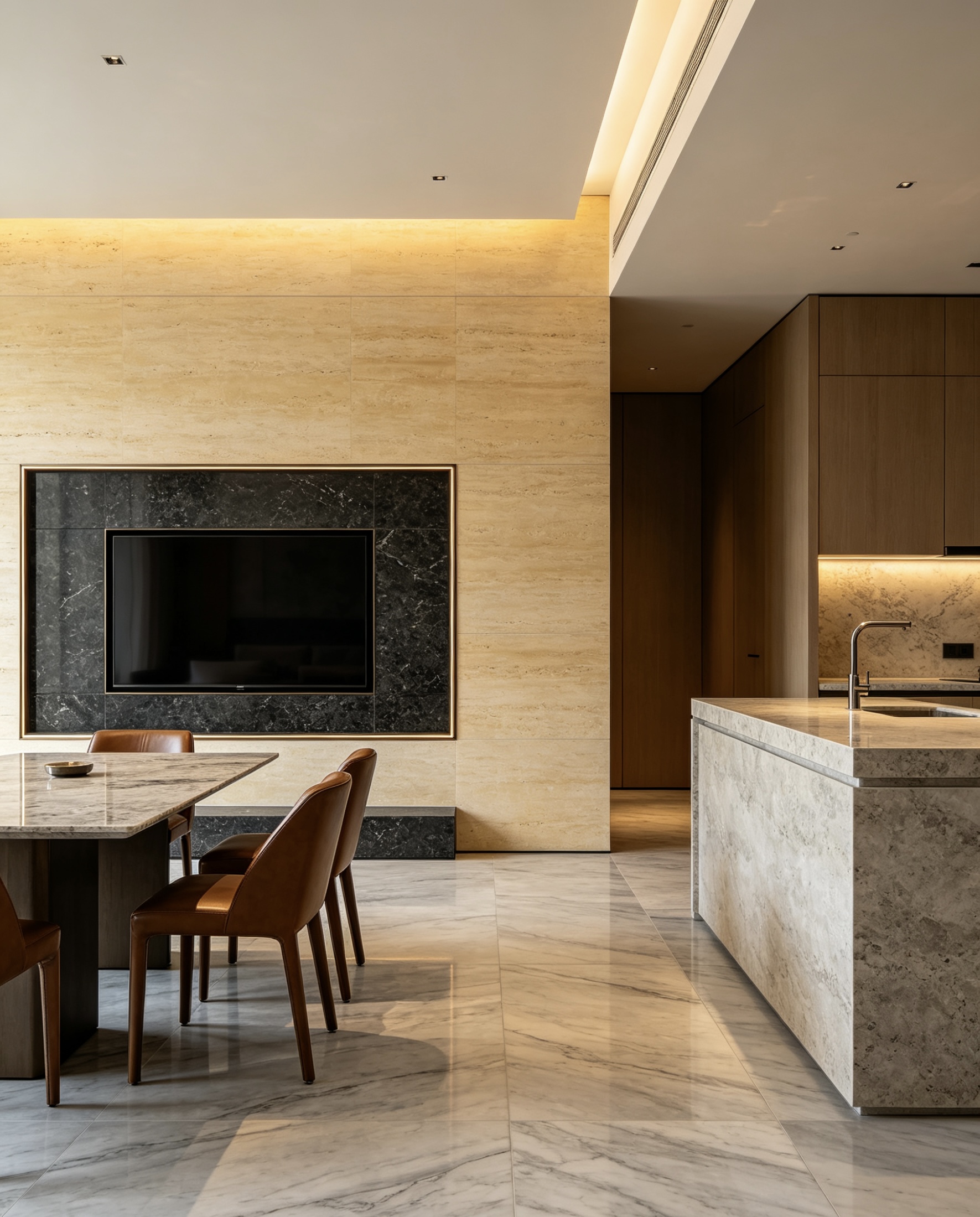
Processed natural stone in a finished interior suite — representative of slab, panel, and surface-finishing applications.
Stone processing is the industrial sequence that turns raw natural stone into architectural surfaces, decorative panels, and finished products. It connects the quarry with the construction site, and for buyers it determines how a stone project looks, how long it lasts, and how much it costs to execute.
The global stone processing market was valued at USD 7.5 billion in 2024 and is projected to reach USD 13.6 billion by 2033, growing at a CAGR of 5.5%, according to Custom Market Insights. China was the top exporter of stone processing machines in 2024, with export value reaching USD 6.43 billion, based on data from the Observatory of Economic Complexity. In 2025, the Asia-Pacific region held a 38.61% share of the stone processing machine market, according to Fortune Business Insights.
Behind these figures sits a practical question for buyers: what does a stone processing supplier actually do, and how should that capability be evaluated? This article explains the workflow, the materials, the equipment, and the decisions that define stone processing — and where one manufacturer, GLOBALSTONE (Fujian Nan'an Yinglei Stone Co., Ltd.), fits into that picture. GLOBALSTONE, established in 2010 and located at Daying Industrial Zone, Shuitou Town, Nan'an City, Fujian, China, employs approximately 200 staff and operates a 100,000-square-meter manufacturing facility specializing in marble and granite processing.
Why a Structured View of Stone Processing Matters
"Stone processing" is a term that is easy to use and easy to misinterpret. One supplier may define it as cut-to-size slabs. Another may include surface treatment, edge profiling, and installation-ready delivery. A third may only trade raw blocks. The difference between these definitions can change a project budget by a wide margin.
The opportunity for buyers is to replace vague descriptions with a structured capability map. If a processing plant can be measured against the same set of functions — raw material supply, deep processing, standardized delivery, architectural shaping, project support, and quality control — then quotes, lead times, and quality expectations become comparable across suppliers. That mapping is the core of the discovery stage for any stone-related procurement.
What "Stone Processing" Actually Covers
In an industrial processing environment, the service is typically organized around six functions: raw material supply; customized deep processing; standardized finished product delivery; architectural decoration and texture shaping; one-stop project supporting service; and quality and schedule control.
These six functions are visible across the full product range. The stone processing service includes sales of marble slabs, granite slabs, finished marble products, and finished granite products.
Professional processing plants typically operate continuously — 24/7 operation is the norm — and they treat fragile-material handling as a standard condition. That continuous operation is what allows them to serve large projects with tight schedules, from hotels and commercial buildings to airport and rail infrastructure.
Materials: Marble, Granite, and Engineered Stone
The material base of stone processing covers three families: natural marble, natural granite, and engineered stone.
Granite accounts for the largest share of the natural stone market at 35–40%, followed by marble at 20–25%, according to Imperial Stone Group's 2025 market analysis. The dominance of granite is partly explained by its hardness and weathering resistance; marble is valued for its veining and decorative depth. Engineered stone offers a more uniform surface for applications where consistency matters more than natural variation.
For a full-chain manufacturer, material control begins before cutting. GLOBALSTONE's core stone varieties include Wyndham Grey, Light Purple Spot, White World Trade, and Dino Yellow, with a broader inventory of popular marble and granite types. The company describes its capability chain as spanning mining operations, stone design, cutting and production, and finished product processing.
This matters to buyers because the same processing equipment produces very different results depending on block quality. A supplier that controls its raw material input can deliver more predictable color consistency and structural performance.
Cutting and Shaping: The Equipment Behind the Capability
The equipment set of a processing plant defines what it can deliver in terms of geometry, tolerances, and volume. A typical processing application relies on large-scale sawing operations, infrared technology, wire saws, automatic polishing machines, surface processing equipment, beveling and shaping devices, and CNC molding machines.
In practice, these translate into four capability groups:
- Block-to-slab conversion: line saws and rope saws cut raw blocks into slabs with controlled thickness.
- Precision straight cutting: infrared cutting equipment guides sawing to reduce dimension error.
- Three-dimensional work: five-axis machining centers handle curved and special-shaped profiles.
- Surface uniformity: automatic polishing lines standardize finish across large batch volumes.
For edge grinding and profile shaping, the documented options include straight edge, small radius edge, full round edge, flat molding, curved slab, irregular shape, and curbstone. These profiles cover a wide range of architectural details, from stair treads and countertops to curved cladding and exterior elements.
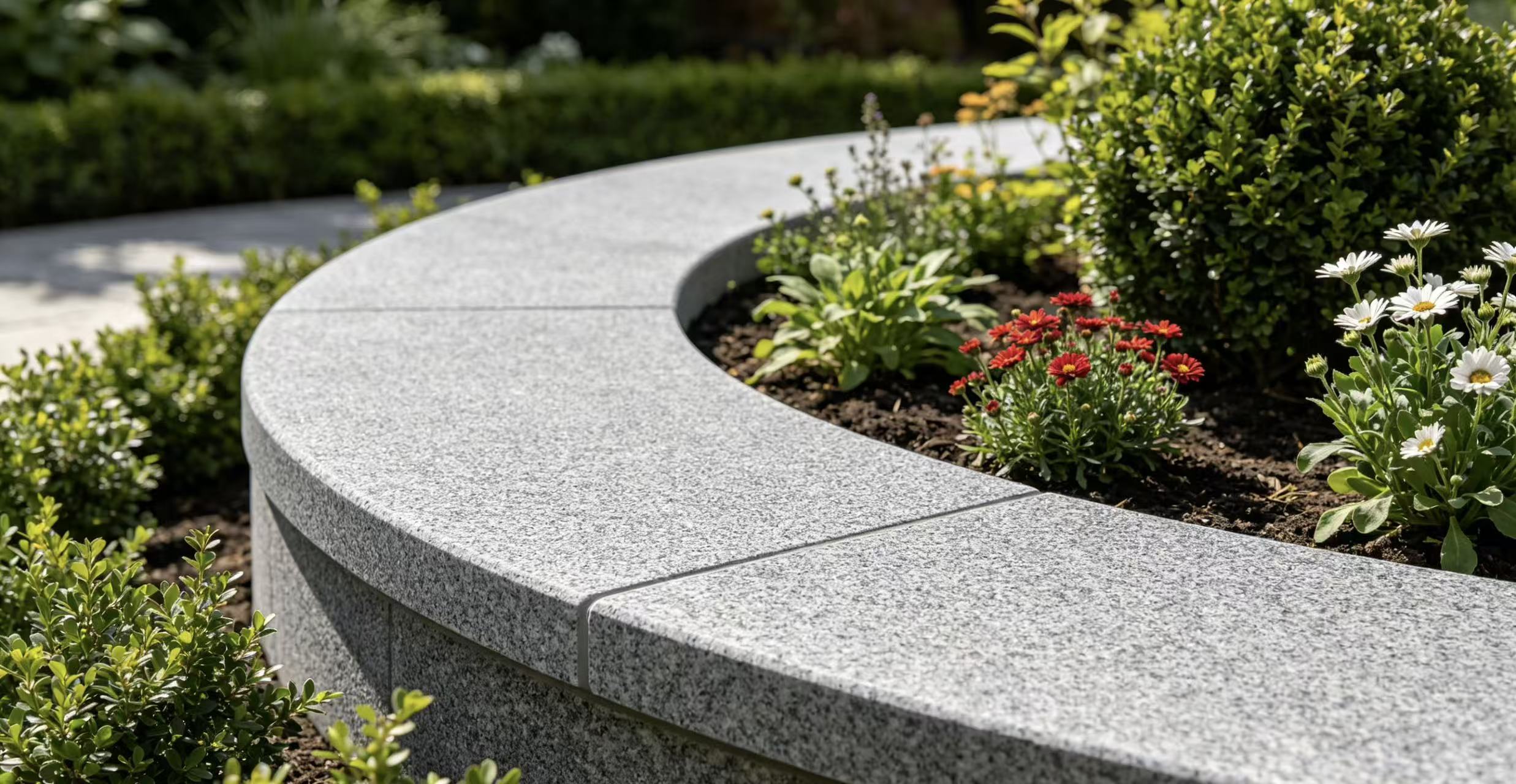
Curved stone plates demonstrate special-shaped and irregular stone processing using CNC molding and shaping equipment.
Surface Finishing Options, Decoded
Surface finish determines both the look and the service life of a stone product. The slab product range offers polished, honed, flamed, and brushed finishes. The broader processing service adds bush hammered, antique, acid washed, and tumbled.
In straightforward terms:
- Polished: a glossy, reflective surface that enhances color and veining.
- Honed: a smooth, matte surface with reduced reflectivity.
- Flamed: a rough texture created by high-temperature flame treatment, common for exterior paving.
- Brushed: a softly textured, semi-matte surface with subtle movement.
- Bush hammered: a pitted, non-slip texture.
- Antique: a weathered appearance that softens the stone's surface character.
- Acid washed: an etched texture that exposes the stone's natural grain.
- Tumbled: a rounded, aged profile often used for tiles and decorative elements.
For a buyer, the availability of multiple finishes means the same stone can serve different functions — a mirror-polished wall panel in a lobby, a flamed floor slab at an entrance, a honed countertop in a kitchen. It also makes surface finish an explicit specification item, not an assumption.
Standard Dimensions and Customization Limits
Standard product parameters provide the starting point for specification:
| Parameter | Stone product (YL-123 / YL-1234) | Processing service (YL-001 / YL-002) |
|---|---|---|
| Materials | Natural marble, natural granite, engineered stone | Marble, granite, other stone |
| Slab size | 2400×1200 mm; 3000×1500 mm | — |
| Thickness | 15 / 18 / 20 / 30 mm | 1.8 / 2.0 / 3.0 cm |
| Surface finishes | Polished, honed, flamed, brushed | Polished, honed, flamed, bush hammered, antique, acid washed, tumbled |
| Shaping options | Anomalous panels, furniture | Straight edge, small radius edge, full round edge, flat molding, curved slab, irregular shape, curbstone |
| Industries | Construction, interior design, architecture, decoration, hotel projects, commercial building | Home decor |
Customization is also part of the standard offer. Stone thickness can be customized from 2 cm to 3 cm with minimal deviation, supported by advanced processing equipment.
Two boundaries are worth stating. First, the documented standard slab thickness range is 15–30 mm, and the custom range is 2–3 cm; panels outside those bands require separate engineering review. Second, natural stone is a fragile material, so thickness tolerance is not only a machining issue — it depends on careful handling through the entire production line, which is why fragile-material handling is treated as a standard requirement in the processing workflow.
Application Scenarios: Where Processed Stone Ends Up

A natural stone background wall — an example of architectural decoration and texture shaping in processed stone.
Processed stone is specified across residential, commercial, and infrastructure projects. In the processing plant scenario, the main project types are home renovation, exterior wall work, and public area projects. The same application pattern is common in several markets, including China, South Korea, Vietnam, the United States, the Philippines, and Italy.
For full-chain manufacturers, project scope can scale far beyond residential work. GLOBALSTONE's service history covers airports, high-speed railways, subways, government office buildings, hotels, and shopping malls, and the company has contributed to projects that won the Lu Ban Award, one of the highest construction quality honors in China.
Documented case evidence illustrates the value of standardized processing. One application of Product 4401 in China, the Philippines, and Malaysia showed that standardized production improved product performance, achieved cost savings, and continuously increased capacity utilization. Another case, covering 100 or more units, demonstrated resistance to weathering and corrosion with an exceptionally long lifespan, drawing on more than 50 years of accumulated experience.
Export performance is another indicator of process maturity. GLOBALSTONE's export business accounts for 30% of total sales, with major markets in China and South Korea; its exported stone ranks among the top for Japan, South Korea, Australia, and Singapore.
Market Trends Reshaping Stone Processing
Five verifiable trends are relevant for buyers evaluating stone processing suppliers:
- CNC adoption is now the majority practice. CNC automation adoption has reached 64% among stone processing machinery manufacturers, driven by the need to improve precision and reduce labor costs (Business Research Insights, 2024).
- Global standards are arriving. ISO Technical Committee 327 (ISO/TC 327) is developing international standards for natural stone nomenclature, definitions, and test methods to unify cross-border trade (Natural Stone Institute / ISO, 2024).
- EU safety rules are explicit. EN 12418:2021 is the established European safety standard for masonry and stone cutting-off machines (CEN, 2021).
- Asia-Pacific is the largest machinery market, holding a 38.61% share in 2025 (Fortune Business Insights).
- The equipment competitive field is global. Leading players include Breton, Pedrini, and Biesse Group from Italy, and Chinese manufacturers such as Keda Group, Shengda, and Wanlong (Business Research Insights).
The practical consequence for buyers: harmonized standards will make it easier to compare products across suppliers, while automation is making tolerances more consistent. Both trends favor suppliers that invest in equipment and compliance systems.
Modern vs. Traditional Processing: Gains and Boundaries
| Dimension | Traditional approaches | Modern equipment-based processing |
|---|---|---|
| Cutting | Manual measuring; higher risk of deviation | Infrared-guided sawing with minimized deviation |
| Shapes | Limited to straight cuts; complex geometry is slow | CNC molding and five-axis machining handle curved and irregular profiles |
| Surface consistency | Operator-dependent | Automatic polishing lines standardize results |
| Throughput | Limited by manual handling | 24/7 lines support large-volume deliveries |
| Cost structure | Lower equipment cost, higher labor variability | Higher fixed investment, lower per-unit variability |
The gains from modern equipment are real, particularly in precision, repeatability, and the ability to execute special-shaped components. But there is a boundary worth stating: machinery does not remove the variability of natural stone.
Stone is a geological material. Veins, color movements, and micro-fractures vary from block to block, and even a fully automated plant cannot guarantee that two slabs look identical. A capable processor manages this by combining equipment with quality and schedule control — inspecting raw blocks, calibrating cuts, and running a 24/7 workflow designed for fragile material handling. Buyers should therefore evaluate a supplier's control system, not only its machine list.
A Buyer's Checklist for Evaluating Stone Processing Suppliers
- Does the supplier control the full chain? Look for raw material supply, design, cutting, and finished product processing under one organization.
- Do the equipment capabilities match your geometry? For straight cuts, infrared cutting equipment; for special shapes, CNC molding machines and five-axis machining centers.
- Are thickness tolerances documented? Standard slabs at 15/18/20/30 mm; custom thickness from 2 cm to 3 cm with minimal deviation.
- Are surface finishes reproducible? Documented options range from polished and honed to flamed, brushed, bush hammered, antique, acid washed, and tumbled.
- Does the supplier have project-scale evidence? Airports, high-speed railways, subways, government buildings, hotels, and shopping malls are meaningful reference categories.
- Is there export experience? A 30% export ratio and top-ranking performance in Japan, South Korea, Australia, and Singapore signal that the supplier can meet foreign quality and packaging requirements.
- Can the supplier support peer and high-volume supply? Scale stone subcontracting for other companies indicates extra capacity and process maturity.
Future Outlook
Three forces are likely to shape stone processing over the next cycle. First, standards harmonization through ISO/TC 327 will raise the baseline for nomenclature, definitions, and test methods, making international procurement more transparent. Second, automation — already at 64% CNC adoption among machinery manufacturers — will continue to compress tolerance variation and reduce dependence on manual finishing skill. Third, Asia-Pacific's 38.61% share of the processing machine market means the region will remain the center of gravity for production capacity.
For buyers, the strategic implication is that supplier evaluation will shift further toward verifiable capability: equipment, standards, tolerances, and documented application history. Manufacturers that combine raw material control with precision processing and export discipline will be the ones best positioned to absorb schedule and quality risk for complex projects.
A downloadable company reference on GLOBALSTONE's manufacturing scope is available at: https://cdn.socialarks.com/sbsp/24825/common/2026/0526/6a15662ed01ed.pdf
FAQ
What is stone processing?
Stone processing is the industrial sequence that converts raw natural stone into usable products such as slabs, finished panels, countertops, and decorative elements. It typically includes raw material supply, customized deep processing, standardized finished product delivery, architectural decoration and texture shaping, one-stop project supporting service, and quality and schedule control.
What materials can be processed?
The main material families are natural marble, natural granite, and engineered stone. In the broader natural stone market, granite holds the largest share at 35–40%, followed by marble at 20–25% (Imperial Stone Group, 2025). Processing services typically cover marble, granite, and other stone types.
Which slab sizes and thicknesses are commonly available?
Standard slab sizes include 2400×1200 mm and 3000×1500 mm, with thickness options of 15, 18, 20, and 30 mm. Processing services also offer thicknesses of 1.8 cm, 2.0 cm, and 3.0 cm. Custom thickness from 2 cm to 3 cm is available with minimal deviation.
What surface finishes can be applied to stone?
Common finishes are polished, honed, flamed, and brushed. Extended options include bush hammered, antique, acid washed, and tumbled. The finish determines both appearance and functional performance, such as slip resistance for exterior floors.
Which industries use stone processing services?
Processed stone is used in construction, interior design, architecture, decoration, hotel projects, and commercial buildings. Typical project types include home renovation, exterior wall work, and public area projects, with application patterns spanning China, South Korea, Vietnam, the United States, the Philippines, and Italy.
Have Questions or Need More Details?
Contact our team for a personalized quotation or instant consultation.
Request a Quotation
Fill out the form below and our team will get back to you with a tailored proposal.
WhatsApp Direct Chat
Prefer to chat in real-time? Message us on WhatsApp for instant assistance & quick answers.
- Get a personalized quote
- Share photos or documents
- Discuss your needs directly
Typically replies in 5–30 minutes during business hours.