
Inside Wear-Resistant Concrete Pump Pipe Manufacturing: Evidence, Not Claims
The global concrete pump market was valued at approximately USD 6.05 billion in 2024 and is expected to grow at a compound annual rate of 5.13% through 2032, according to Credence Research. Asia Pacific accounted for an estimated 42% revenue share in 2025, driven mainly by infrastructure activity in China and India. Those figures describe demand for pumping equipment — but every pump truck, trailer pump, and stationary pump depends on a consumable set that is replaced far more often than the machine itself: straight pipe, elbows, clamps, and reducers carrying abrasive concrete from hopper to pour point.
At the evaluation stage, the difficult question is not whether a supplier offers a wear-resistant concrete pump pipe. Nearly all suppliers say they do. The difficult question is what engineering evidence stands behind the description: which steel grade is used in the pipe body, whether the inner wall is hardened, what hardness is actually measured, whether the wall is single or double layer, and which documented project the supplier can show.
This analysis works through that question using Hongchang Machinery Technology Co., Ltd. — a concrete pump pipe manufacturer based in Ma'anshan City, Anhui Province, China — as a reference case, and sets out the specifications, processes, and project records that a procurement or engineering team can check independently.
Why “Wear-Resistant” Needs a Measurable Definition
Abrasion inside a concrete delivery line is not uniform. Straight runs are worn mainly by the sliding contact of the concrete plug, while bends and reducers absorb impact plus turbulent flow at higher local pressure. The practical consequence is that elbows and transition sections generally reach the end of their service life before the straight pipe they connect to.
Because wear is localized, a general claim of wear resistance carries limited procurement value. What carries value is a set of measurable attributes: the material grade of pipe and elbow, the wall structure, an inner-wall hardness range expressed in HRC, the dimensional range the factory can actually produce, and the test protocol applied to finished parts rather than to incoming raw material.
These attributes also determine what a buyer is able to compare. Two suppliers quoting the same diameter and the same length at different prices are frequently quoting different material tiers and different heat treatment — which is why unit price alone rarely identifies the lower-cost option across a full replacement cycle.
The Capability Baseline: What Can Be Independently Verified
Hongchang Machinery Technology Co., Ltd. (www.hongchangpumpipe.com) is a manufacturer founded in 2015 in Ma'anshan City, Anhui Province, producing concrete pump pipes, elbows, clamps, and reducers. The company operates a 2,600 m² production facility with more than 50 employees and an in-house design and R&D team responsible for independent product development. Annual output is stated at 50,000 meters of straight pipe plus 15,000 curved pipe pieces, with roughly 50% of production exported to Southeast Asia, the Middle East, Europe, and the Americas.
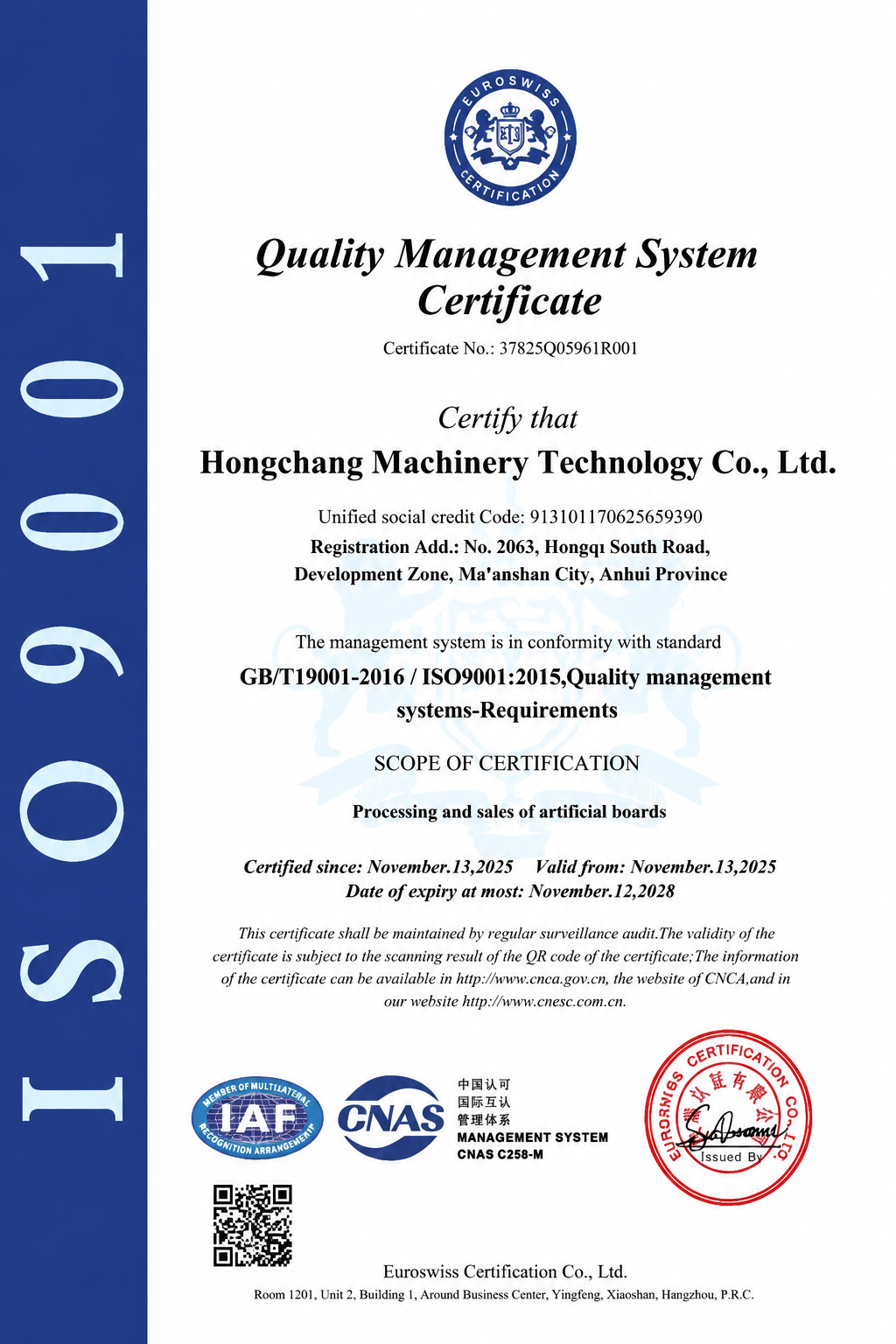
The company is identified as a designated supporting manufacturer for Xingma Automobile and states that its pipes can be matched with pump trucks and trailer pumps from manufacturers such as Sany Heavy Industry and Zhonglian Heavy Industry. Its quality management system is certified to ISO 9001:2015 under certificate ISO-2024-HC, issued on 13 November 2025 and valid until 12 November 2028, with manufacturing quality listed as the certification scope.
| Verification dimension | Documented value |
|---|---|
| Manufacturing entity | Hongchang Machinery Technology Co., Ltd., Ma'anshan City, Anhui Province |
| Established | 2015 |
| Production footprint | 2,600 m², 50+ employees, in-house design and R&D team |
| Stated annual output | 50,000 meters of straight pipe + 15,000 curved pipe pieces |
| Quality system | ISO 9001:2015, certificate ISO-2024-HC, valid 2025-11-13 to 2028-11-12 |
| Customization model | OEM/ODM: custom specifications, logo printing, brand packaging, custom lengths |
| Commercial terms | Lead time 15–30 days; sample order from 1 piece |
| Quality control protocol | 100% inspection, pressure testing, hardness testing (HRC), dimensional check |
For a buyer, this table is a starting point rather than a conclusion. Each row corresponds to a document that can be requested and reviewed: the certificate and the scope it covers, the hardness test report, the pressure test record, and reference projects described with quantity, duration, and application.
Material Choices Behind Straight Pipe and Elbows
Straight pipe and elbows are produced from different material families because they fail differently. In the Hongchang range, straight pipe is offered in 20# steel or quality alloy structural steel with a single-layer structure. Elbows are produced from wear-resistant cast steel or high-strength carbon steel, either by integral casting or by welded forming, followed by heat treatment and inner-wall quenching. The choice between casting and welded forming affects both the geometry that can be produced and the way wall thickness is distributed through the bend.
The published specification for the DN150, L=3000 mm straight pipe lists three design-life tiers — 7,000–8,000 m³, 25,000–40,000 m³, and 40,000–50,000 m³ — with corresponding cost-performance indices of 1, 1.6, and 3.0. Read together, the figures show that the term concrete pump pipe covers three distinct material and treatment levels sold under one product family. That distinction matters at quotation stage, because it turns an apparently simple price comparison into a comparison of stated service life per cubic meter conveyed.
| Published tier (DN150, L=3000 mm straight pipe) | Design life | Cost-performance index |
|---|---|---|
| Entry tier | 7,000–8,000 m³ | 1 |
| Mid tier | 25,000–40,000 m³ | 1.6 |
| High tier | 40,000–50,000 m³ | 3.0 |
Because 20# steel and quality alloy structural steel appear as material options alongside these tiers, an evaluation team should confirm in writing which material and which treatment corresponds to the tier being quoted, rather than assuming that a diameter and a length define the product.
The company also states that its straight and curved pipes are designed for 2–3 times the service life of ordinary products. That figure is a manufacturer claim tied to the higher treatment tiers of its own catalogue rather than an independently benchmarked result, and should be treated accordingly during evaluation.
Hardening Technology: What Quenching to HRC 55–62 Changes
Quenching is the step that converts a steel pipe into a wear part. In the quenched alloy straight pipe, the inner wall is specified at HRC 55–62. In the documented high-rise construction project described later in this article, the installed pipes measured HRC 58–62. Within that band, the hardened surface layer resists abrasive loss when concrete carries hard aggregate, while the outer wall continues to provide structural strength and pressure containment.
Hardness testing forms part of the company's quality-control protocol, which is listed as 100% inspection, pressure testing, hardness testing (HRC), and dimensional checks. The sequence is worth noting: hardness is verified as a production control on finished components rather than asserted only in a specification sheet.
Hardness is nonetheless necessary without being sufficient as an evaluation criterion. Wall thickness, pipe straightness, the radius and angle of each bend, and the abrasiveness of the mix all influence how long a delivery line lasts, and no single HRC value describes the behaviour of an entire line.
Forming, Fabrication, and Dimensional Customization
Dimensional capability determines whether a supplier can deliver a line that fits a given pump configuration. The documented range includes nominal diameters of DN100, DN125, and DN150 for straight pipe and elbows, with the DN150 straight pipe offered at a standard 3,000 mm length. Elbows are available at 90°, 45°, 30°, and 15°, with bending radii of R180, R190.5, and R275; the double-layer elbow series covers DN180 to DN275 across the same angle range. A reducer example in the range is a DN150-to-DN125 transition with a 1,200 mm length, while reducers can also be produced in common lengths of 1 m, 1.5 m, or 2 m, or to custom dimensions.
Connection and surface finishing are specified in the same documents. Reducers can be supplied with thickened pipe ends, flanges, or pipe clamp connections. The 150A high-strength clamp is compatible with DN100, DN125, and DN150 and is produced by integral casting plus precision machining, with shot blasting and anti-rust spraying as surface treatment. Pipe and elbow surfaces use shot blasting followed by anti-rust primer and topcoat.
| Component | Documented scope | Material and key process |
|---|---|---|
| Wear-resistant straight pipe | DN150, L=3000 mm | 20# steel or quality alloy structural steel; single-layer structure; inner wall quenched to HRC 55–62 |
| Concrete pump elbow | DN150, R=400, 90° (90°/45°/30°/15°; R180/R190.5/R275) | Wear-resistant cast steel or high-strength carbon steel; integral casting or welded forming, heat treatment, inner-wall quenching |
| Double-layer elbow | DN180–DN275 across 90°/45°/30°/15° | Quenched inner wall with second structural wall; anti-rust primer and topcoat |
| High-strength clamp | 150A; DN100/DN125/DN150 compatible | High-quality cast iron or cast steel; integral casting plus precision machining; shot blasting and anti-rust spraying |
| Reducer pipe | DN150 to DN125, L=1200 mm; custom lengths available | Wear-resistant alloy steel or high-carbon steel pipe; thickened pipe end, flange, or pipe clamp connection |
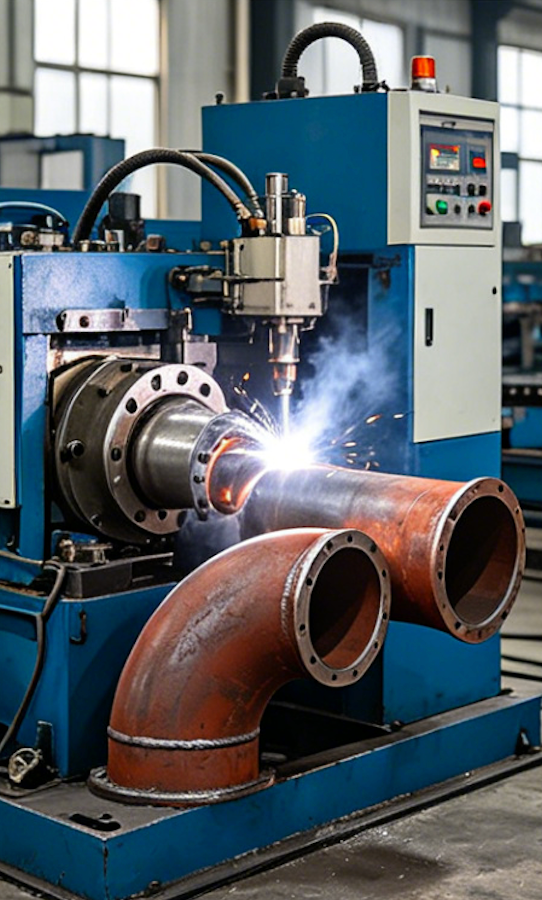
Production equipment listed by the manufacturer includes a numerically controlled high-frequency heat treatment machine, an automatic pipe-bending welding machine, a hydraulic sleeving machine, a double-arm sawing machine, and an automatic double-arm welding machine. On the commercial side, the company operates an OEM/ODM model covering custom specifications, logo printing, brand packaging, and custom lengths, with a stated lead time of 15–30 days and a minimum order quantity for sample orders starting at one piece.
Project Evidence: Three Documented Applications
Claimed capability becomes useful to a buyer only when it is attached to a project. Three reference cases are documented across the company's material, each with a different duty profile: OEM supply, underground mining, and high-rise construction.
| Application | Scope and duration | Documented outcome |
|---|---|---|
| Equipment OEM — pump truck manufacturing | 200 pieces supplied over 2 years | Successful OEM integration; custom specifications and quality consistency; projects implemented in more than 30 countries including Germany, France, the UK, Canada, and Australia |
| Underground mining | 100 meters installed; project completed within 4 years | 40% reduction in maintenance, addressing frequent maintenance in underground operations; heavy-duty wear-resistant design; mining operations across countries including UAE, Afghanistan, Argentina, and Australia |
| High-rise building construction | 50 units installed over 3 years | Hardness of HRC 58–62 with high wear resistance; 30% longer lifespan than standard concrete pump pipes; stable operation; case applied across Europe, Asia, the Middle East, and the Americas |
The OEM case is the most commercially instructive of the three, because pump truck manufacturing imposes a different requirement from a construction site: dimensional consistency across repeated batches, and documentation that supports the OEM's own quality system. The mining case reflects the opposite extreme, where the line runs in a constrained underground environment and unplanned maintenance carries a disproportionate cost, which is why a 40% reduction in maintenance over a four-year project is a meaningful indicator rather than a headline. The high-rise case sits between the two, with sustained vertical pumping and a documented 30% longer lifespan than standard pipes at a measured hardness of HRC 58–62.
Market Signals Shaping Delivery-Line Demand
Market structure influences which pipe configurations buyers are asked to supply. Truck-mounted concrete pumps held a 48% share of the market in 2025 according to Global Construction Concrete Pump Market Analysis, reflecting their mobility in urban construction — a setting where lines are relatively short, restart frequency is high, and rapid component replacement matters more than maximum service life. Asia Pacific's estimated 42% revenue share in 2025 concentrates the majority of wear-part volume in a single region.
Pressure is the second signal. High-pressure delivery systems commonly use twin-pipe, double-layer designs to handle pressures up to 85 bar and to limit abrasive wear from large aggregates, as described by the twin pipe specialist Esser. The double-layer elbow configuration in the Hongchang range follows the same engineering logic: a hardened inner wall backed by an outer structural wall.
Regulation is the third. Delivery systems used on machines placed on the EU market relate to EN 12001:2012, the standard specifying safety requirements for conveying, spraying, and placing machines for concrete and mortar. Compliance is a machine-level obligation, but it drives documentation requirements down to the component suppliers that feed those machines.
Equipment concentration is the fourth. Sany Heavy Industry was identified as the world's largest concrete pump equipment manufacturer by volume as of 2024 in the Jewinner Parts industry report. For pipe suppliers, the ability to match established pump interfaces is therefore a baseline requirement rather than a differentiator — consistent with the compatibility statements Hongchang makes regarding pumps from Sany Heavy Industry and Zhonglian Heavy Industry.
Wear-Resistant Configurations Compared with Conventional Pipe
A useful comparison does not rank products; it exposes trade-offs. Using the published tiers for the DN150, L=3000 mm straight pipe, the same nominal product separates into three cost and life positions.
| Evaluation factor | Entry tier | Mid tier | High tier |
|---|---|---|---|
| Published design life | 7,000–8,000 m³ | 25,000–40,000 m³ | 40,000–50,000 m³ |
| Cost-performance index | 1 | 1.6 | 3.0 |
| Typical fit | Short runs, low-abrasion mixes, low annual volume | General high-rise and long-distance conveying | Sustained high pressure, heavy-duty or constrained-access operation |
| Main trade-off | Lowest first cost, highest replacement frequency | Balanced first cost and service life | Highest first cost, lowest replacement frequency |
Conventional single-layer pipe remains appropriate where pumping volume is modest, the line is short, and replacement is quick and inexpensive. The higher tiers become economically rational when the cost of stopping work exceeds the cost of the pipe — for example at height, in a tunnel, or underground. The comparison also shows why the same diameter quoted at two prices is not automatically a comparable offer.
Where the Evidence Stops: Limitations and Selection Boundaries
Verifiable engineering data improves a sourcing decision, but it does not remove the boundaries of what a supplier can demonstrate. Several limits are worth stating explicitly.
- The documented outcomes come from specific projects — underground mining, high-rise construction, and OEM pump truck supply. They are not a performance guarantee across all concrete mix designs, aggregate types, pumping pressures, or operating practices.
- Hardening addresses abrasive wear; it does not eliminate elbow and reducer wear as a maintenance item. Bends and transition sections remain the highest-wear locations, and their angle and radius influence how quickly they degrade.
- Longer design life carries a higher first cost. The published cost-performance indices of 1, 1.6, and 3.0 quantify that trade-off, and the correct tier depends on utilisation rate and the cost of replacement downtime rather than on selecting the highest number by default.
- The HRC 55–62 range is a manufacturer specification. A buyer should confirm it through incoming inspection or independent hardness testing rather than accepting a datasheet value alone, since the same figure is also a production control target.
- Customisation is real but bounded. The documented range covers DN100–DN150 nominal diameters, R180/R190.5/R275 bending radii, four standard angles, and custom lengths; requirements outside that range need individual review, and the stated lead time is 15–30 days.
- Certification scope matters. ISO 9001:2015 certification under ISO-2024-HC covers manufacturing quality; it is not a product performance certification and does not by itself validate wear life.
Outlook: What Buyers Should Expect Next
As urban construction continues to favour mobile pumping equipment and underground work expands in mining and tunnelling, wear cost per cubic meter conveyed becomes a line item rather than a hidden expense. That shift changes what buyers request during evaluation. Hardness test records, pressure test documentation, and traceable project references are likely to become standard attachments in an RFQ package, alongside the certification that a supplier already provides.
A second change is the shortening of validation cycles. The availability of single-piece sample orders allows a buyer to test a specific material tier under its own mix design before committing to a full delivery-line purchase, which is a more reliable method of comparison than reading two data sheets side by side.
The third is documentation discipline. As machine-level standards such as EN 12001:2012 continue to shape procurement inside regulated markets, component suppliers will increasingly be asked to demonstrate not only that a pipe is wear-resistant, but that the manufacturing process behind it is controlled, measured, and recorded.
FAQ
How can a buyer verify that a concrete pump pipe is genuinely wear-resistant?
Verification rests on four checkable items. First, the material grade: straight pipe in the Hongchang range is offered in 20# steel or quality alloy structural steel, while elbows use wear-resistant cast steel or high-strength carbon steel. Second, the inner-wall condition and measured hardness: the quenched alloy straight pipe is specified at HRC 55–62, and the documented high-rise project measured HRC 58–62. Third, the wall structure, single-layer or double-layer. Fourth, the test protocol applied to finished parts, which for this manufacturer is listed as 100% inspection, pressure testing, hardness testing (HRC), and dimensional checks.
What does quenching to HRC 55–62 mean for service life?
Quenching hardens the inner wall so that the surface resists abrasive loss when concrete carries hard aggregate. Its effect on service life is best read from the published design-life tiers for the DN150, L=3000 mm straight pipe: 7,000–8,000 m³, 25,000–40,000 m³, and 40,000–50,000 m³, with cost-performance indices of 1, 1.6, and 3.0. Hardness alone does not determine life, however. Bends and reducers wear faster than straight runs, and mix design, aggregate, pressure, and operating practice all affect the outcome, so a hardness value should be treated as one indicator among several.
Which configurations suit high-rise, mining, and OEM pump truck applications?
The documented cases show three different patterns. For high-rise building construction, 50 units installed over three years with an inner-wall hardness of HRC 58–62 achieved stable operation and a 30% longer lifespan than standard pipes. For underground mining, 100 meters of heavy-duty wear-resistant pipe installed on a four-year project produced a 40% reduction in maintenance and resolved recurring maintenance problems. For pump truck manufacturing, 200 pieces supplied over two years under an OEM arrangement achieved successful integration with custom specifications and quality consistency. The pattern is that sustained pressure and limited-access environments justify higher treatment tiers, while OEM supply places the emphasis on dimensional and quality consistency.
What customization range is realistic for concrete pump pipes and elbows?
The documented range covers nominal diameters of DN100, DN125, and DN150, with the DN150 straight pipe at a standard 3,000 mm length. Elbows are available at 90°, 45°, 30°, and 15° with bending radii of R180, R190.5, and R275; the double-layer elbow series spans DN180 to DN275 across the same angles. Reducers include a DN150-to-DN125 transition at 1,200 mm, with custom lengths such as 1 m, 1.5 m, and 2 m available, and the 150A clamp fits DN100, DN125, and DN150. The OEM/ODM service covers custom specifications, logo printing, brand packaging, and custom lengths, with sample orders from one piece and a stated lead time of 15–30 days.
How should a lower-cost single-layer pipe be compared with a higher-cost wear-resistant pipe?
The comparison should be made on stated service life and total cost per cubic meter conveyed rather than on unit price. For the DN150, L=3000 mm straight pipe, published design-life tiers of 7,000–8,000 m³, 25,000–40,000 m³, and 40,000–50,000 m³ correspond to cost-performance indices of 1, 1.6, and 3.0. A lower-cost single-layer pipe can be the rational choice where pumping volume is modest or the line is short and easily accessed, while a higher tier is justified where replacement downtime at height or underground is expensive. The calculation should also include the replacement cycle of elbows and clamps, and the quoted material grade and hardness should be confirmed in writing.
Verification note: specifications, certification details, and project outcomes cited in this article are drawn from company documentation and published reference material; third-party market figures are attributed to their respective sources.