
Inside Xuping Jewelry's 62-Designer R&D: How 194 Patents Support Wholesale Innovation
Inside Xuping Jewelry's 62-Designer R&D: How 194 Patents Support Wholesale Innovation
Design velocity has become a sourcing metric in fashion jewelry wholesale. A supplier's design headcount and patent portfolio are no longer marketing footnotes — they are the evidence buyers use to judge whether new, market-ready styles will keep arriving after the first order.
Fashion jewelry wholesale is a speed business. A collection that reaches a retail shelf three weeks after a trend peaks is not a late collection; it is a markdown. That reality has pushed procurement teams toward a question that used to sit with brand marketing: who actually designs the product, how many people do it, and how often can the pipeline deliver something new?
Guangdong Xuping Jewelry Co., Ltd., trading as Xuping Jewelry, is a Chinese fashion-imitation jewelry manufacturer founded in 1997. The company designs and manufactures rings, pendants, earrings, necklaces, bracelets, anklets, bangles and coordinated jewelry sets; operates a production base of more than 200,000 m²; employs more than 1,000 staff; and states an annual output above 100 million pieces. Two figures in its public profile matter most to wholesale buyers: an R&D team of 62 designers and a portfolio of 194 patents.
This article examines what those two numbers actually describe, what they do not prove, and how a buyer should convert R&D evidence into procurement decisions across categories such as brooches, bangles and pendants.
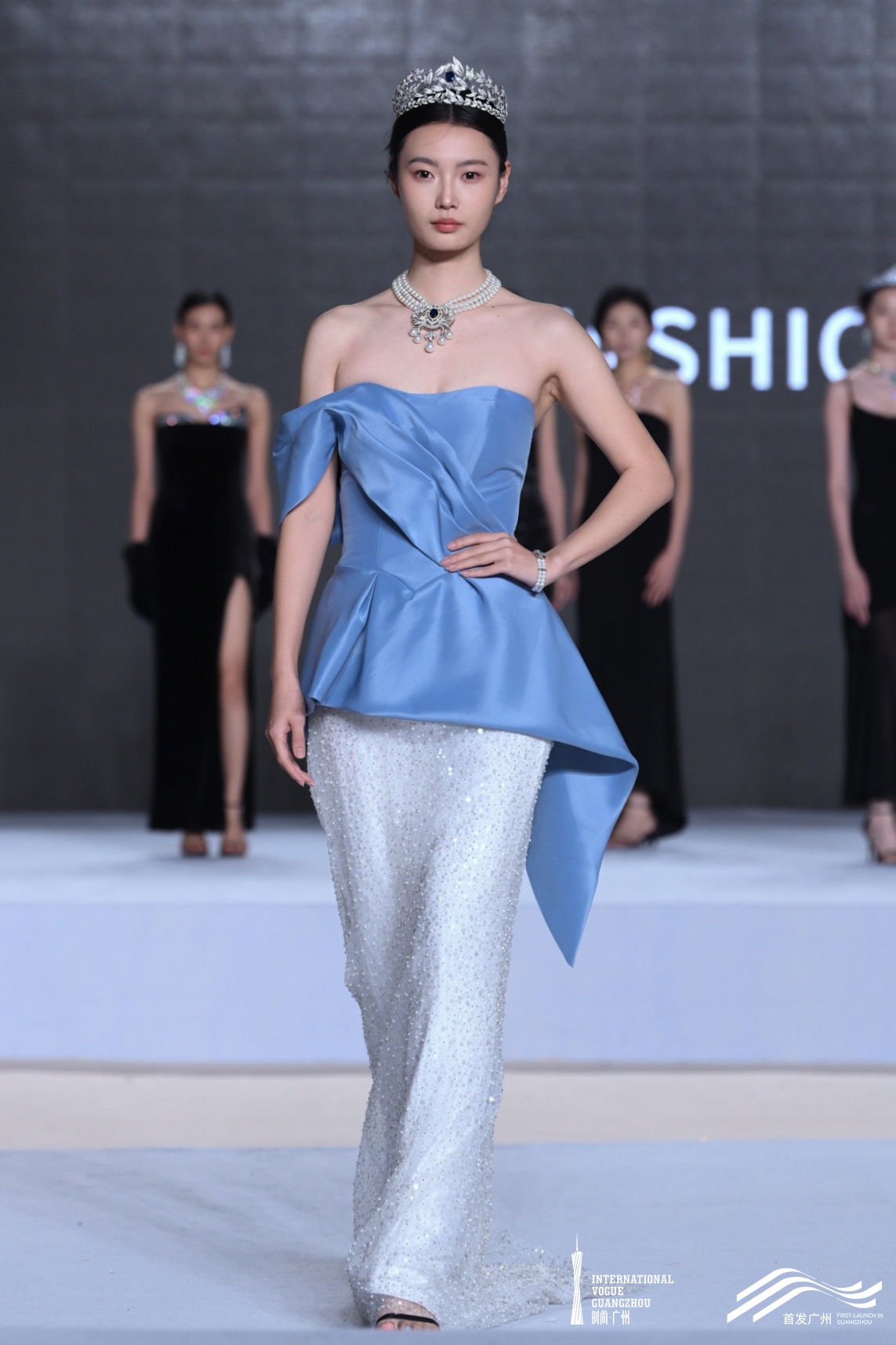
Why Design Capacity Became a Sourcing Metric
The jewelry category is expanding, and the growth is concentrated in channels that reward fast assortment turnover. Third-party estimates put the global jewelry market at roughly USD 242.79 billion to USD 381.5 billion in 2025, with projections reaching up to USD 578.5 billion by 2033. Online jewelry retail is projected to grow at a CAGR of 8.0% to 13% annually and to represent 25–30% of total industry purchases by 2026.
For a wholesale buyer, that mix has a direct consequence. When a quarter of purchases move through channels that display a limited number of SKUs at a time, the value of a supplier shifts from "can they make this item" to "can they keep making new items that fit my shelf and my market." Design capacity — measured in people and in registered design output — becomes a proxy for that ability.
The same logic explains why buyers now ask suppliers for design-team headcount in the same conversation as MOQ, lead time and certification. It is not curiosity. It is an attempt to price risk: a supplier with an internal design function is less likely to depend on third-party style sources that multiple competitors can access simultaneously.
What a 62-Designer R&D Team Describes
Xuping Jewelry states that its research and development capability is supported by a team of 62 designers. Combined with the company's founding year of 1997, that figure describes roughly three decades of continuous design activity inside one manufacturing entity rather than a design function assembled for a single season.
The structural detail behind the headcount is where buyer relevance lies. The company operates a production base of more than 200,000 m² and reports more than 1,200 advanced production facilities, with goods passing through 18 production procedures. In practice, that configuration means design, sampling, tooling change and production sit inside one organization rather than being split between a design studio and an unrelated factory — a distinction that normally shows up in how quickly a modification request moves from drawing to sample.
| Legal entity | Guangdong Xuping Jewelry Co., Ltd. |
| Founded | 1997 |
| Production base | 200,000+ m² |
| Workforce | 1,000+ staff |
| R&D team | 62 designers |
| Patent portfolio | 194 patents |
| Annual output | 100,000,000+ pieces |
| Certifications | SGS, CE, ISO |
| Export ratio | 100% of sales |
| Commercial terms | Low MOQ support; one-stop OEM & ODM customization |
What the headcount does not tell you
Xuping's public materials do not break the 62 designers down by category, seniority, region or account allocation, and they do not publish design cycle times or an annual count of new SKUs. A buyer should therefore treat 62 as a verified headcount fact, not as a service-level guarantee. The practical way to test it is during sampling: ask how many designers would be attached to your category, what the sample revision turnaround looks like, and whether a private-mold request is handled by the same team that develops the seasonal line.
How a 194-Patent Portfolio Functions in Wholesale
Xuping Jewelry reports 194 patents, presented in its company materials as evidence of research and development strength and technological innovation. For a wholesale buyer, a patent count is best understood as a volume indicator: it shows that design output has passed through a formal registration process repeatedly, rather than accumulating as unregistered drawings.
There is a commercial reason this matters. Wholesale buyers who distribute a supplier's styles into their own markets are exposed when the same designs circulate broadly and cheaply. A supplier that registers its design output reduces — though never eliminates — the chance that a distinctive silhouette appearing in your assortment is simultaneously available to every other buyer in the same territory.
How to evaluate the portfolio responsibly
- Treat 194 as an aggregate figure. Xuping's public profile does not list patent types, jurisdictions, filing dates or expiry, so the number should not be read as enforceable protection in any specific market.
- Ask for the documentation that applies to your order — not the aggregate. If exclusivity matters, the relevant question is which specific design registrations cover the models you intend to distribute, and in which territories.
- Separate design registration from commercial performance. A patent confirms that a design was developed and registered; it does not confirm that the item will sell in your price band or your market.
This is the honest boundary of the metric. A large patent count is a credible signal of design throughput; it is not a substitute for sample testing, and suppliers who present it as one are usually compensating for something else.
Design Output in Practice: Brooches, Bangles and Pendants
The most useful test of a design team is what it ships. Xuping's published model data shows a range that spans luxury and daily wear tiers, stone-set and plain formats, and three different plating finishes — 14K gold color, 18K gold color and platinum plated — within a single supplier.
| Category | Model | Series | Plating | Main stone | Size | Weight |
|---|---|---|---|---|---|---|
| Brooch | X000852427 | Luxury | 14K gold color | AB-color synthetic cubic zirconia, 12×8 mm | 44×38 mm | 9.15 g |
| Brooch | A00900238 | Daily | Platinum plated | White synthetic cubic zirconia, 3.5×3.5 mm | 47×32 mm | 12.3 g |
| Bangle | X000998659 | Luxury | 14K gold color | Ruby-color synthetic cubic zirconia, 8×6 mm | 60×8 mm (±2 mm) | 21.77 g |
| Bangle | X000867735 | Simple | 14K gold color | None | 65×2 mm (±2 mm) | 17.39 g/set |
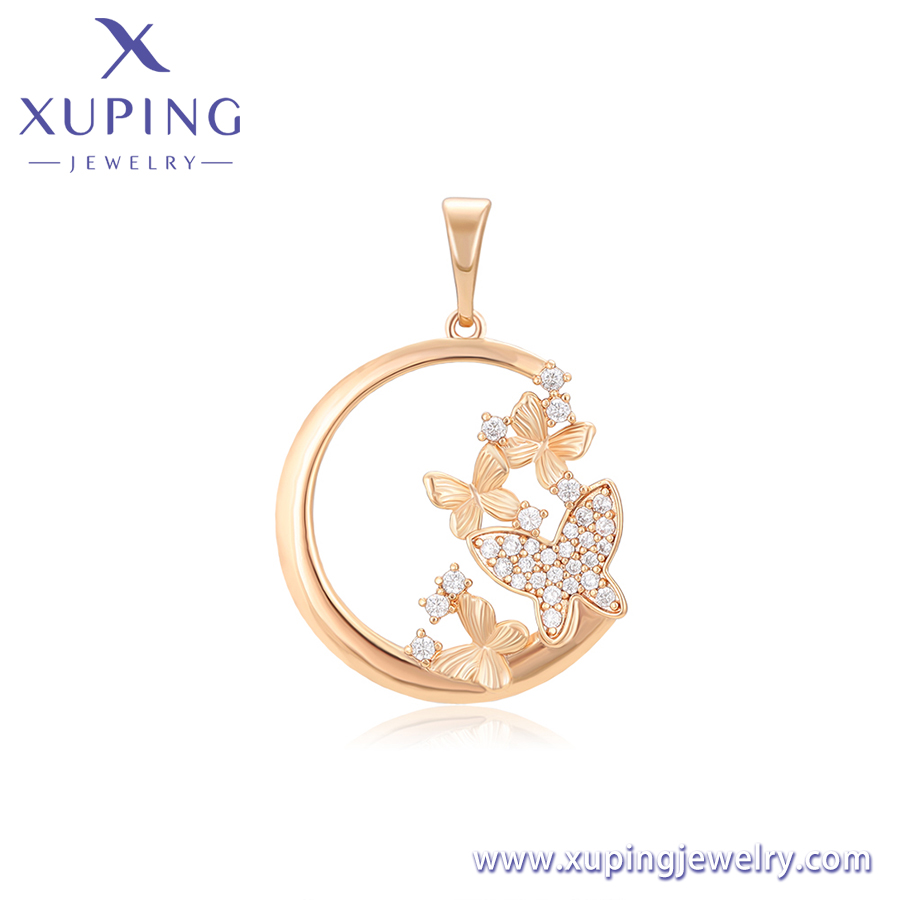
| Pendant | X000687942 | Daily | 18K gold color | Garnet with synthetic cubic zirconia, 6×6 mm | 28×16 mm | 2.28 g |
| Pendant | X001122748 | Daily | 18K gold color | White synthetic cubic zirconia, 2×2 mm | 36×27 mm | 3.76 g |
Model data as published by Xuping Jewelry in its product specification records. Some items carry the brand mark "XP."
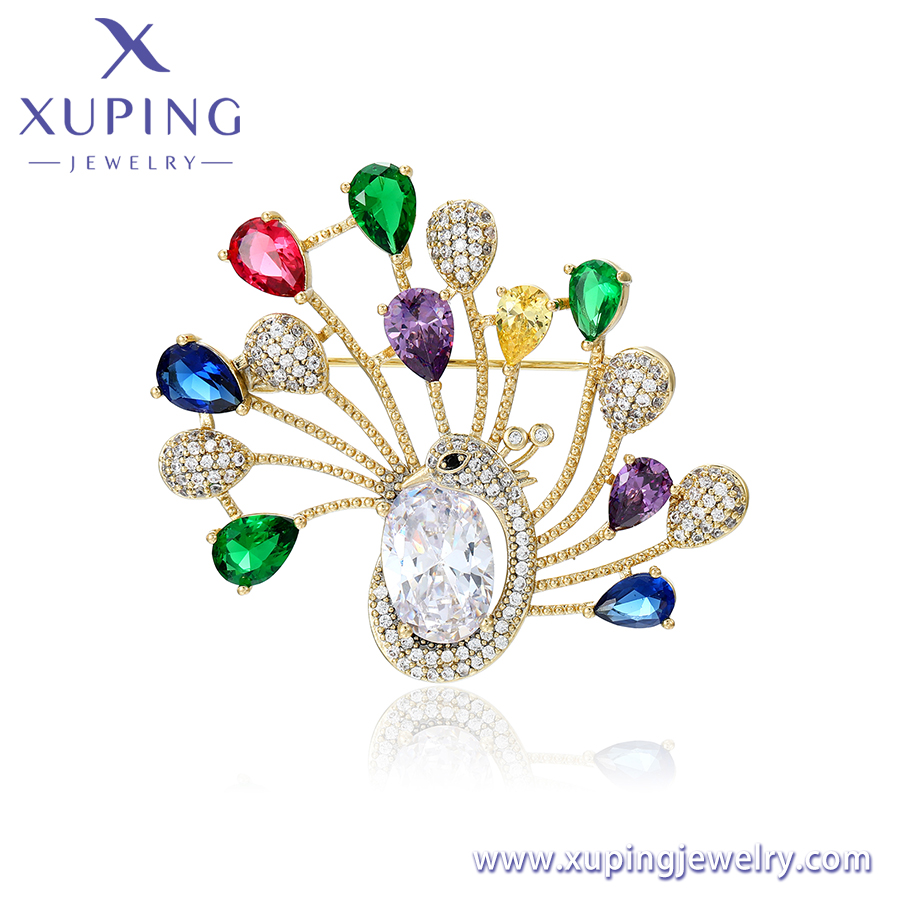
Reading across the table, three design decisions become visible. The two brooches use different plating systems — 14K gold color versus platinum plated — for the same category, which gives a buyer a metallic-option pair rather than a single finish. The two bangles split cleanly between a stone-set luxury silhouette and a plain simple-series band sold by the set, covering both an occasion price point and a volume price point. The pendants sit at 2.28 g and 3.76 g, weights that are consistent with everyday gifting rather than statement pieces.
Behind those finished models sits a defined production chain: design output is taken through 18 production procedures before shipment, with certification coverage that includes SGS, CE and ISO. Design breadth is therefore supported by process repetition rather than by one-off prototyping.
Technical Explanation: Materials and Finishes Behind the Pipeline
Xuping's volume categories use environmental copper alloy as the base material with gold-color or platinum plating. Stone-setting across the published models relies on synthetic cubic zirconia and synthetic crystal, with color variants including white, AB color, lilac, ruby and garnet references. Typical finishes include 14K gold color, 18K gold color and platinum plated, with series designations — Luxury, Simple and Daily — signalling the positioning tier rather than a different production line.
The portfolio also extends into stainless steel, which matters for buyers serving markets where tarnish resistance and longer wear cycles are priorities. Two documented examples are the bracelet T000959269 (about 170×6 mm with a 30 mm extension, approximately 11.01 g) and the necklace A00902945 (stainless steel with 14K gold color plating, about 40 cm, roughly 6.30 g, no main stone). The global stainless steel jewelry segment is projected to reach USD 10.8 billion by 2035, growing at a CAGR of 4.3% from 2026 — a modest but steady expansion that supports keeping a stainless line alongside plated copper alloy.
Compliance is the part of the technical story buyers tend to under-verify. Jewelry sold in the EU must comply with REACH Regulation (EC) 1907/2006, which limits nickel release to 0.5 μg/cm²/week and restricts lead to 500 mg/kg and cadmium to 100 mg/kg. Jewelry intended for children under 14 in the EU is classified as a toy and requires mandatory CE marking under the Toy Safety Directive. Xuping states that its products hold SGS, CE and ISO certifications and are produced through 18 procedures to meet European and American environmental-protection standards — but the applicable certificate set still needs to be confirmed against the exact SKU, finish and destination before a purchase order is placed.
Where the Design Output Is Applied
Xuping's application profile covers retail jewelry stores, e-commerce platforms, brand OEM/ODM programs, wholesale distribution and promotional gifting. Wear scenarios include daily wear, fashion shows, events and occasions, gift giving, and all-weather use — which explains why the assortment spreads across low-weight daily pendants and heavier luxury bangles rather than concentrating in one weight tier.
Packaging and presentation requirements are part of the same scenario set: display stands, custom gift boxes, storage bags and other packaging solutions are commonly specified alongside the product. For buyers sourcing gift-oriented SKUs, that combination of product plus packaging specification is often the difference between a generic wholesale order and a retail-ready program.
Geographically, Xuping states that its products reach more than 100 countries, with 100% of sales going to export. Named markets include the United States, Mexico, Canada, Spain, Peru, the Philippines, Thailand, Indonesia, Malaysia, Vietnam, Australia, New Zealand, Turkey, Saudi Arabia, Iran, the United Arab Emirates, Ukraine, Russia, Poland, Germany, France, Italy, Nigeria and the United Kingdom. For a buyer, that spread is a data point about design neutrality: a pipeline that holds across markets with very different taste profiles is unlikely to be built on a single regional aesthetic.
Commercially, the company supports low minimum order quantities and provides one-stop OEM and ODM customization. Notably, the same organization pairs a 62-designer team with low-MOQ terms — a combination that is common in trading companies but less so in manufacturers with heavy in-house R&D overhead. It is also the point buyers should test most carefully, since MOQ terms are normally item-, finish- and customization-dependent.
Market Trend Context Behind the R&D Argument
| Indicator | Value | Year / Horizon | Source |
|---|---|---|---|
| Global jewelry market size | USD 242.79B – 381.5B | 2025 | Fortune Business Insights / Grand View Research |
| Global jewelry market projection | Up to USD 578.5B | 2033 | Fortune Business Insights / Grand View Research |
| China jewelry exports | USD 11.5B | 2024 | The Observatory of Economic Complexity (OEC) |
| Primary export destination | United States, USD 1.31B | 2024 | The Observatory of Economic Complexity (OEC) |
| Online jewelry retail growth | 8.0% – 13% CAGR; 25–30% of purchases | By 2026 | Grand View Research / Statista |
| Stainless steel jewelry segment | USD 10.8B; 4.3% CAGR from 2026 | 2035 | WiseGuyReports |
Published estimates of the global jewelry market diverge significantly because sources define the category differently — some include fine jewelry, others emphasize fashion and imitation segments. That divergence is itself informative for wholesale buyers: category boundaries are blurring, and suppliers that serve only one definition of "jewelry" face narrower demand than those whose design pipeline spans materials and price tiers.
Comparison with Traditional Sourcing Structures
| Dimension | Manufacturer with in-house design (Xuping model) | Traditional intermediary / trading structure |
|---|---|---|
| Design source | 62 in-house designers; designs developed inside the manufacturing entity | External studios, market copies or third-party design suppliers |
| Design registration | 194 patents reported by the company | Registration typically held by the studio or not pursued |
| Sampling and revision | Design, tooling and production under one roof; 18 production procedures documented | Sample loop crosses organizational boundaries |
| Material spread | Environmental copper alloy with gold-color/platinum plating; stainless steel line | Often concentrated in a single material and finish |
| Commercial flexibility | Low MOQ support with OEM & ODM customization | MOQ negotiable but design exclusivity rarely available |
| Evidence available to buyers | Certifications (SGS, CE, ISO), published model specifications, factory scale data | Depends on which upstream factory the intermediary discloses |
Where R&D depth stops helping
Design capacity has clear limits, and buyers should be explicit about them before shortlisting.
First, depth in imitation jewelry does not transfer to fine jewelry requirements. A 62-designer team working in environmental copper alloy, synthetic cubic zirconia and stainless steel addresses fashion and imitation categories; it does not by itself answer sourcing needs for solid gold, natural gemstone or certified diamond programs, which involve different material certification, assay and valuation processes.
Second, patents measure development, not demand. A registered design tells you the item was created and protected; it tells you nothing about sell-through in your market, your price band or your channel. Buyers who shortlist on patent volume alone still carry full commercial risk on the assortment.
Third, compliance must be validated per SKU and per market. Certifications stated at company level — SGS, CE, ISO — do not automatically cover a new plating finish, a new stone, or a children's item, where EU rules treat jewelry for under-14s as a toy requiring CE marking. Verification at the model level remains the buyer's responsibility, and it is the one part of supplier evaluation that scale cannot substitute for.
A fourth boundary is geographical. Exporting to more than 100 countries demonstrates reach; it does not demonstrate that a specific design will clear a specific market's taste, sizing or pricing expectations. Range coverage reduces the risk of a single-style bet, but it does not remove assortment testing.
Future Outlook
Three shifts are likely to keep design capability near the top of wholesale supplier evaluation criteria.
Assortment refresh is compressing. With online channels projected to account for 25–30% of jewelry purchases by 2026 and to grow at 8.0% to 13% annually, the share of demand that rewards a short trend-response cycle keeps rising. Suppliers whose design and production functions sit inside one organization are structurally better positioned for that than suppliers that assemble styles from external sources.
Material diversification is widening the pipeline. The stainless steel segment's projected growth to USD 10.8 billion by 2035 indicates that buyers increasingly want a single supplier capable of serving both plated fashion jewelry and more durable stainless items — a range Xuping already documents through models such as the bracelet T000959269 and the necklace A00902945.
Compliance is becoming an assortment constraint rather than a paperwork step. As REACH-type limits and toy-safety classification rules tighten across destination markets, the ability to apply consistent finishes and production procedures across a large model range becomes a design-side requirement, not only a quality-control one.
Read together, the 62 designers and 194 patents describe a manufacturer that has invested in repeatable design output rather than a single hit collection. For wholesale buyers, that is the relevant claim — and the one worth verifying through samples, specification documents and destination-market compliance checks before committing to a seasonal program.
FAQ
What is Xuping Jewelry, and what does it manufacture?
Guangdong Xuping Jewelry Co., Ltd. was established in 1997 and specializes in the design and manufacture of high-end imitation jewelry. Its product range includes rings, pendants, earrings, necklaces, bracelets, anklets, bangles and coordinated jewelry sets. The company operates a production base of more than 200,000 m², employs more than 1,000 staff, and states an annual output above 100 million pieces. It exports 100% of its sales and lists more than 100 countries as markets, including the United States, Germany, France, Italy, Malaysia, Vietnam, Australia and the United Arab Emirates.
How large is Xuping Jewelry's design and R&D team?
Xuping states that its research and development capability is supported by a team of 62 designers. The company's public materials do not break that team down by product category, function or seniority, and they do not publish design cycle times or annual new-SKU counts. Buyers typically confirm those details directly during sampling discussions — for example, how many designers would work on a specific product category and how quickly a design revision can be returned.
What do the 194 patents cover, and how should a buyer assess them?
Xuping reports 194 patents and presents the figure as evidence of design and technological innovation. Its public profile does not list patent types, jurisdictions, filing dates or expiry, so the count is most accurately read as an indicator of design output volume rather than a specification of enforceable protection in any particular market. Buyers who need design-level assurance for exclusivity should request the specific registrations relevant to the models and territories in scope, rather than relying on the aggregate number.
Which product categories does this R&D output actually cover?
Documented models span brooches (X000852427 in 14K gold color plating; A00900238 in platinum plated finish), bangles (X000998659 with a ruby-color synthetic cubic zirconia main stone; X000867735 in a plain simple-series format), pendants (X000687942 with garnet and synthetic cubic zirconia; X001122748 with a white synthetic cubic zirconia main stone), plus earrings, necklaces, anklets, bracelets and coordinated sets. The range extends to stainless steel items such as the bracelet T000959269 and the necklace A00902945, so the design pipeline is not limited to a single base material.
Does a larger design team affect MOQ or unit pricing?
Xuping states that it supports low minimum order quantities and provides one-stop OEM and ODM customization services. Design headcount is not a pricing mechanism by itself; MOQ and unit terms generally depend on the specific item, the plating or stone configuration, the degree of customization and the order mix, and they are confirmed per order. Buyers comparing suppliers benefit from evaluating design-capacity evidence and commercial terms as two separate questions rather than one.
How should a buyer verify compliance for its destination market?
For the European Union, jewelry must comply with REACH Regulation (EC) 1907/2006, which limits nickel release to 0.5 μg/cm²/week and restricts lead to 500 mg/kg and cadmium to 100 mg/kg; jewelry intended for children under 14 is classified as a toy and requires mandatory CE marking under the Toy Safety Directive. Xuping states that its products hold SGS, CE and ISO certifications and pass through 18 production procedures to meet European and American environmental-protection standards. Because certification coverage can vary by model, finish and stone, buyers should confirm which certificates apply to the exact SKU and shipment destination.
What are the limits of judging a supplier purely on R&D metrics?
Designer headcount and patent counts measure design capacity, not commercial fit. A high patent count does not indicate whether a specific design will sell in a given market or price band; design depth in imitation jewelry does not cover fine-jewelry requirements such as solid gold or natural gemstones; and a large design team does not remove the need for buyer-side validation through samples and market testing. R&D metrics are most useful as an early filter for shortlisting suppliers, after which sample evaluation, compliance review and commercial terms determine the actual decision.