
Inside a Commodity Mould Factory: What 3,000 m², 20 CNC Machines and 800 Units Prove
Inside a Commodity Mould Factory: What 3,000 m², 20 CNC Machines and 800 Units Prove
Factory numbers are easy to publish and difficult to use. GANGNAM MOULD, a plastic mould manufacturer established in 1988 and located in Huangyan District, Taizhou, Zhejiang, China, publishes a specific set: a 3,000 m² facility, about 40 staff, more than 20 digital controlled milling machines, 15 engineers, 800 units of annual mould capacity and a 70% export share with Southeast Asia named as its main market. Each of those figures is a boundary condition on what the supplier can absorb — and each one raises a question a buyer should settle before releasing a purchase order.
This analysis maps the physical and capacity evidence to three practical concerns at the evaluation-to-execution stage: order size, engineering support and delivery confidence. The figures below are the company's own reported operating data, supported by a certification record with a certificate number, issuing body and validity period. Where the evidence supports a verification step rather than a conclusion, the verification step is stated instead.
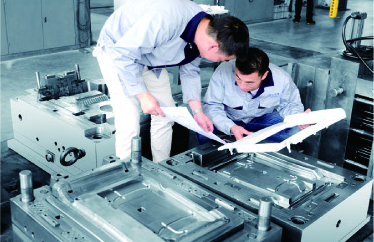
Mould manufacturing workshop floor. Image source: GANGNAM MOULD.
Why physical evidence matters more during execution than during shortlisting
At the shortlist stage, a buyer compares categories. Does the supplier make commodity moulds, does it serve my region, does it hold a quality certificate. At the execution stage, the same supplier must absorb one specific tool: cavity count, surface and polish, gating and cooling layout, material and heat treatment, trial date, inspection report, packing and shipping terms. Most sourcing delays sit in the gap between those two stages, because a brochure organised around categories says little about schedule and nothing about your drawing.
Physical evidence narrows that gap without guaranteeing an outcome. Floor area, machine count, engineer count and annual output are capacity descriptors: they indicate how much work can be in progress at the same time and who is available to answer a technical question. They do not fix a tolerance, a cycle time or a price. Those are settled by the drawing, the material, the trial result and the contract — which is precisely why a buyer should convert each published figure into a verification question before the order is confirmed.
GANGNAM MOULD's verified operating profile
GANGNAM MOULD CO., LTD, also recorded as Zhejiang Huangyan Jiangnan Mould Factory, works in plastic moulds for commodity applications and states that it operates a quality management system certified to ISO 9001:2015. The table below consolidates the company-reported figures and the certification details that a buyer can check directly.
| Item | Reported value | What the buyer can do with it |
|---|---|---|
| Origin and entity | GANGNAM MOULD CO., LTD (Zhejiang Huangyan Jiangnan Mould Factory); originally established in 1988 | Confirm legal entity and operating history in the RFQ documents |
| Location | Huangyan District, Taizhou, Zhejiang, China | Set logistics, inspection-visit and shipping assumptions |
| Facility | 3,000 m² | Judge whether machining, assembly and trial work fit under one roof |
| Workforce | About 40 staff | Estimate who handles design, machining, assembly and inspection |
| Machining | More than 20 digital controlled milling machines; 3D coordinate mapping inspection; mould assembly group | Assess parallel machining capacity for multi-tool orders |
| Engineering | 15 engineers | Check technical responsiveness on drawing review and mould design |
| Capacity | 800 units annual output; about 80 sets of moulds per month | Frame expected slot and schedule before the PO |
| Export | 70% export share; Southeast Asia as main market; applicable markets also listed as Middle East, Africa, Central Asia, South America, Mexico, Italy and India | Confirm export documentation, packing standard and remote acceptance routine |
| Quality system | ISO 9001:2015, certificate 18118Q10459R3S, Beijing Xingguo Inspection and Certification Co., Ltd., issued 14 June 2024, valid to 15 June 2027, scope “Manufacture and Design of Plastic Parts Mould” | Verify the certificate against the issuing body before contracting |
| Commercial terms | MOQ 1 unit; FOB/CIF; 30% T/T in advance, 70% before shipment; typical lead time 30–45 days subject to mould complexity | Cost the order, set payment milestones and anchor a delivery date |
Company-reported capability is not an independent audit. The table is a starting position for due diligence, and item four in any evaluation should be the documents behind it: certificate copy, clause-level drawing review and an agreed acceptance report format.
3,000 m² and about 40 staff: what floor area can and cannot tell you
A mould shop is not a warehouse. The floor has to hold machining stations, an assembly and fitting area, a trial and inspection zone, and finished tooling waiting for shipment. When those functions share one envelope, the practical result is shorter internal transport and fewer handoffs between the group that cuts the steel and the group that fits and trials it. That is the operational meaning of a 3,000 m² facility — a single-site workflow rather than a claim about output quality.
What floor area cannot tell you is how much of it is free. A shop working near capacity and a shop with idle bays publish the same square metres. For an execution-stage buyer, the useful questions are narrower:
- Which area is used for assembly and fitting, and which for trial and inspection?
- Is finished tooling stored indoors before packing, or does it wait outside the workflow?
- With about 40 staff in total, how many are assigned to assembly and to inspection rather than to machining?
Those answers determine whether a mould can be reworked on site quickly or has to be queued behind other work. They matter more than the square-metre figure itself once a delivery date is signed.
More than 20 CNC milling machines: parallel capacity, not a speed claim
A commodity mould is a stack of plates and inserts, and each of them passes through roughing, semi-finishing and finishing before assembly. Machine count changes the arithmetic of that queue: more than 20 digital controlled milling machines allow several mould projects to be machined in parallel instead of being sequenced through one spindle group. For a buyer placing several tool families in one season — say a chair mould alongside a storage box and a tray mould — parallel machining is the difference between staggered and compressed delivery.
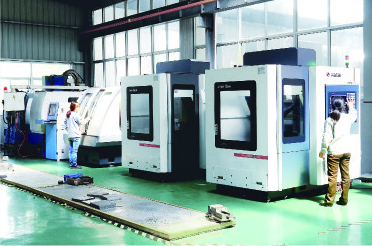
Digital controlled machining of mould components. Image source: GANGNAM MOULD.
Machine count does not establish tolerance capability or cycle time. Those depend on machine condition and calibration, on the finishing strategy chosen for the specific cavity geometry, and above all on the specification the buyer supplies. Coordinate mapping inspection and the assembly group matter here, because a milling operation only becomes a usable cavity after fitting, spotting and trial corrections.
The verification question is therefore procedural, not numerical: ask which machines would run your cavity inserts, how the finishing sequence is planned, and what inspection record accompanies the machined geometry before assembly. A supplier able to answer at that level is describing a process rather than a headline.
15 engineers: where the hours go between drawing and trial
Fifteen engineers spread across mould design, drawing review, programming support, trial planning and customer handover is a meaningful ratio against a workforce of about 40. In practice, engineering hours in a commodity mould project are consumed long before the steel is cut. The buyer's requirements have to be translated into a cavity and gating layout, a cooling arrangement, an ejection plan, a material and heat-treatment specification and a trial checklist.
This is also where customisation requests are resolved. GANGNAM MOULD states that it accepts customisation on cavity count and size, surface texture and polish, gating and cooling system design, inserts and multi-component integration, and material and heat-treatment requests — and that it operates as an OEM, ODM and customisable production service. Each of those items is an engineering decision with a cost and a lead-time consequence, not a catalogue option.
For the evaluation stage, the engineer count supports one practical expectation: there should be a named technical contact who reviews your drawing before quotation rather than after. For the execution stage, it supports a second: a design change requested during trial has somewhere to go. Neither expectation should be assumed. Ask who reviews the drawing, how design revisions are documented, and what is included in the trial and inspection report.
800 units a year and about 80 sets a month: how to read the capacity figures
Annual output is a portfolio figure. GANGNAM MOULD reports 800 units of annual mould capacity and, separately, a monthly production capacity of about 80 sets of moulds. The two statements are published as indicative planning figures; a buyer should treat them as evidence of scale and then confirm the slot for one specific order, because complexity varies enormously across the categories in this segment. A single-cavity bucket mould and a large multi-cavity pallet mould do not consume the same machining hours.
Scale has a second, less obvious consequence: a shop producing at that volume has usually accumulated a working pattern for export documentation, trial reports and packing. A 70% export share with Southeast Asia as the main market means most of the output leaves the country, so the routine is established rather than improvised.
What capacity figures do not prove is current loading. A published annual figure says nothing about this month's queue. The reliable check is to request a written schedule with the quotation — design confirmation, machining window, trial date and shipment window — and to agree what happens if the trial produces a correction loop. The stated lead time of 30 to 45 days, which the company notes depends on mould complexity and is confirmed per order, is the correct anchor for that conversation.
A 70% export share and a ten-year, eight-country client base
Export exposure is a proxy for process maturity. When most of the output is shipped, drawings arrive in mixed formats, tolerances follow different conventions, and acceptance happens remotely through photographs, measurement reports and trial samples. Handling that well requires more than translation: it requires a trial and inspection routine the buyer can audit from a distance.
The company reports a mould programme covering 800 units over a ten-year period, with clients in Bangladesh, Algeria, India, Iraq, Italy, Jordan, Nigeria and Turkey, applied to general-purpose parts such as injection pallets, circulation crates, daily plastic containers and home appliance housings. Alongside those destinations, the company lists the Middle East, Africa, Central Asia, South America, Mexico and India as applicable markets. The described intent of that programme is moulds designed for long production runs, with emphasis on precision machining, complete inspection including CMM and non-destructive testing, and a one-stop OEM/ODM flow.
Two qualifications belong next to those statements. A design intent for high cycle counts is a design statement, not an independently measured tool life; the number of cycles a mould actually achieves depends on the resin, the processing window, maintenance and handling. And a ten-year client relationship describes continuity, not a per-project outcome. Both are useful signals, and both should be converted into contractual terms: expected maintenance interval, spare-part availability and the inspection evidence that accompanies each shipment.
From specification to shipment: the execution path
The company outlines a five-stage flow: requirement, design, manufacturing, trial and inspection, then delivery and training. Read as a checklist rather than a promise, that sequence defines where a buyer's own documents enter the project.
During requirement and design, the drawing, the material and the annual volume expectation set the cavity count and the cooling strategy. During manufacturing, the machining and assembly sequence determines when a first trial can realistically occur. During trial and inspection, quality control is carried out through non-destructive testing, coordinate measuring machine measurement and full-size trial testing, each supported by inspection reports. Delivery then includes installation and operation training, with detailed inspection reports provided during the trial phase.
| Stage | What the buyer submits or approves | What the buyer receives |
|---|---|---|
| Requirement | Drawing, resin, annual volume, cavity target, surface requirement | Technical review and quotation |
| Design | Approval of gating, cooling, ejection and material specification | Mould design confirmation |
| Manufacturing | Agreed schedule and any approved change | Machining and assembly progress |
| Trial and inspection | Trial sample review; tolerance reference for the part | Trial parts, NDT and CMM results, inspection report |
| Delivery and training | Acceptance confirmation; payment balance per terms | Packed mould, installation and operation training |
Commercial terms are published in usable form: minimum order quantity of one unit, FOB or CIF delivery terms, and payment of 30% T/T in advance with 70% before shipment. Acceptance is based on trial moulding and inspection reports, with installation and operation training provided to assist the customer's acceptance. Specific after-sales terms are left to the contract, which is where a buyer should insert maintenance expectations, response times and documentation language.
Quality control, ISO 9001:2015 and the tolerance reference worth citing
GANGNAM MOULD holds ISO 9001:2015 certification, certificate number 18118Q10459R3S, issued by Beijing Xingguo Inspection and Certification Co., Ltd. on 14 June 2024 and valid to 15 June 2027. The certified scope is the manufacture and design of plastic parts moulds. That scope is the key detail: the certificate covers the quality management system governing how moulds are designed and built. It does not certify the parts your mould will produce, and it does not replace a product-level requirement such as a food-contact specification for a kitchen utensil or container mould.
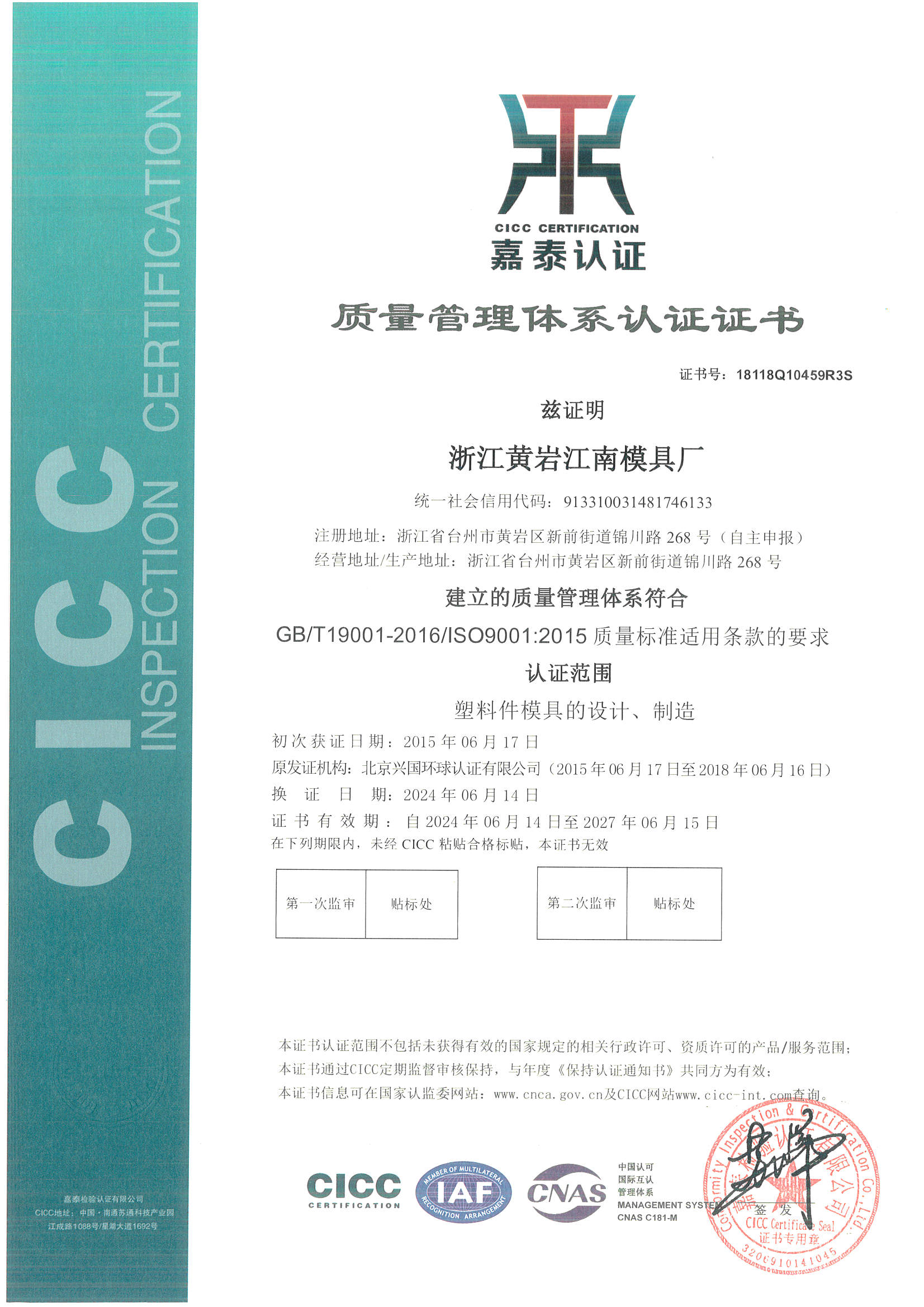
ISO 9001:2015 certificate, number 18118Q10459R3S, valid to 15 June 2027. Image source: GANGNAM MOULD.
For dimensional agreement, a separate reference is more useful than a certificate. ISO 20457:2018 specifies possible manufacturing tolerances for plastic moulded parts and addresses injection moulding among other processes. Citing it in the drawing and in the acceptance document gives both parties the same vocabulary. Note that a draft listing, ISO/DIS 20457, also exists in ISO's publication pipeline; it should not be treated as replacing the published 2018 edition without confirmation of its status. Between a quality-system certificate and a tolerance standard, the buyer gets two different things — process discipline and a measurable part requirement — and both belong in the order documents.
Application fit: the mould families these figures serve
The equipment and capacity profile is most directly relevant to commodity mould families where one tool runs high volumes of a stable part design. Within that envelope, the company's commodity mould scope covers furniture components such as chair, table, stool and sofa moulds; storage products including storage cabinet and storage box moulds; logistics items such as basket, tray, box, turnover box, crate and pallet moulds; household goods including basin, bucket, trash bin, kitchen utensil and bathroom accessory moulds; garden planter moulds; home appliance moulds; and thin wall injection moulds.
The fit is uneven across those families, and it is worth being explicit. Thin wall injection moulds and large pallet or crate moulds place different demands on machining time, cooling balance and trial cycles, while kitchen utensils and bathroom accessories usually carry tighter surface and appearance requirements. A 15-engineer team and more than 20 milling machines support all of these, but the allocation of hours differs sharply. A buyer should describe the part, the resin and the annual volume at the first contact, then ask which of the company's recent projects most closely resembles it.
Volume expectation is the other half of fit. With a minimum order quantity of one unit, a single tool for a new product line is commercially possible; the economics simply shift toward per-tool engineering effort rather than amortisation across a family of tools. That is a legitimate basis for a first order and a poor basis for a cost comparison with a high-cavity programme.
Market context: three data points, used with their definitions intact
Category-level figures help a buyer judge whether tooling investment is moving with or against the market. Used carelessly, they mislead, because differently defined markets are frequently quoted side by side.
One commercial research source values the global industrial mould market at USD 59.0 billion in 2025, covering mould making itself, and reports that Asia Pacific held a 52.6% share of that market in 2024. A separate authoritative source values the global injection moulding market — the broader production of moulded parts and services — at USD 312.7 billion in 2025. The two numbers are not competing estimates of the same thing: one measures tooling, the other measures moulding output. Quoting them interchangeably overstates or understates the tooling segment depending on which figure is used.
A third dataset addresses the thin wall segment specifically, projecting growth from USD 3.89 billion in 2025 to USD 7.23 billion by 2035 at a compound annual growth rate of 6.4%. This is a forecast from a commercial research publisher, with the assumptions that any forecast carries. It supports a directional reading — thin wall packaging and container tooling is a segment with published growth expectations — and it does not establish demand for any individual supplier's capacity. The practical use is narrower: if a buyer's product roadmap includes thin wall containers or trays, a supplier already working inside this segment reduces the learning curve on the first tool.
Evidence-led versus quote-only evaluation
Two evaluation styles dominate commodity mould sourcing. Quote-only evaluation compares price, lead time and a category list. Evidence-led evaluation adds physical capacity, engineering depth, quality documentation and acceptance mechanics. The table below sets out what each style establishes, and what neither can settle on its own.
| Evaluation input | Quote-only | Evidence-led | Still open after both |
|---|---|---|---|
| Price and terms | Compared directly | Compared against scope and documentation | Whether the scope covers trial corrections |
| Capacity | Assumed from lead time | Checked against facility, machines and stated output | Current loading at the time of order |
| Engineering | Not examined | Reviewed through drawing feedback and design documentation | Quality of the individual designer assigned |
| Quality | Certificate mentioned | Certificate number, issuer, scope and validity verified | Part-level compliance for the end product |
| Acceptance | Left to the invoice | Fixed as trial moulding plus inspection reports, with training | How a disputed measurement is resolved |
The comparison is not an argument that evidence-led evaluation is always right. For a low-value, low-risk tool on a familiar part, a short quotation cycle may be entirely adequate. The stronger the production commitment behind the tool — high cavity counts, long runs, export-packed parts, regulated end uses — the more the physical and documentary evidence earns its place in the decision.
Fit boundaries: what this profile does not answer
Honest limits are part of usable evidence. The published profile leaves several questions genuinely open.
- No independent factory audit or third-party performance verification is included in these figures; facility size, staffing, machine count and output are company-reported.
- No comparable public pricing is available for this supplier against alternatives, so cost competitiveness cannot be assessed from published data.
- Cycle time, tolerance and tool life are not fixed by the profile. They must be specified in the drawing and proven at trial.
- The ISO 9001:2015 certificate covers the mould design and manufacturing quality system, not food-contact, safety or destination-market approval for the moulded product.
- Monthly capacity of about 80 sets and annual output of 800 units are stated as indicative planning figures, not as a guaranteed slot for any individual order.
A buyer who needs an audited plant report, a fixed cycle-time guarantee or a product-compliance dossier will have to request those separately. The profile is strong enough to justify a technical conversation and too incomplete to replace one.
Outlook
Commodity mould sourcing is drifting toward the same standard as other capital purchases: buyers want the reasoning behind a supplier's claim, not only the claim. That shift favours factories able to publish verifiable operating data — a certificate number with a validity period, a machine count, a named engineering team, a stated acceptance routine — because those are the details that survive a procurement review.
The published growth expectations for thin wall tooling, together with Asia Pacific's concentration of mould-making capacity, suggest that capability questions will increasingly be asked in segment-specific terms rather than about mould making in general. For a supplier with 1988 origins, a 3,000 m² site and 800 units of annual capacity, the competitive question is no longer whether the scale exists. It is whether each capacity figure can be tied to a specific schedule, a specific drawing and a specific acceptance report. Buyers who ask for that linkage early tend to spend less time resolving it later.
FAQ
What do 3,000 m² and more than 20 CNC milling machines actually indicate about a commodity mould supplier?
They indicate single-site workflow and parallel machining capacity. A 3,000 m² facility allows machining, assembly, trial and inspection to sit inside one envelope, which reduces handoffs between the group cutting steel and the group fitting and trialling it. More than 20 digital controlled milling machines allow several mould projects to be machined simultaneously rather than sequenced through one spindle group. Neither figure fixes tolerance, cycle time or quality; those depend on the drawing, the machine condition, the finishing strategy and the trial result.
What customisation does GANGNAM MOULD accept on a commodity mould order?
The company states that it provides OEM, ODM and customisable production services, with customisation available on cavity count and size, surface texture and polish, gating and cooling system design, inserts and multi-component integration, and material and heat-treatment requests. Each of those is an engineering decision that affects cost and lead time, so the specification should be agreed at design review rather than during trial.
What are the minimum order quantity, lead time and payment terms for a commodity mould?
The minimum order quantity is one unit. Typical lead time is 30 to 45 days, and the company notes that the exact timeline depends on mould complexity and is confirmed per order. Delivery terms are FOB or CIF, and payment is 30% T/T in advance with 70% before shipment. Acceptance is based on trial moulding and inspection reports, with installation and operation training provided to assist customer acceptance.
How is quality verified before a mould is accepted?
Quality control is carried out through non-destructive testing, coordinate measuring machine measurement and full-size trial testing, each supported by inspection reports. Trial moulding results and those inspection reports form the acceptance basis, and detailed inspection reports are provided during the trial phase. The company's quality management system is certified to ISO 9001:2015 under certificate 18118Q10459R3S, issued by Beijing Xingguo Inspection and Certification Co., Ltd. on 14 June 2024 and valid to 15 June 2027, with a scope covering the manufacture and design of plastic parts moulds. Specific after-sales terms are agreed in the contract.
Which commodity mould categories and export markets does the company cover?
The commodity mould scope includes chair, table, stool and sofa moulds; storage cabinet and storage box moulds; basket, tray, box, turnover box, crate and pallet moulds; basin, bucket, trash bin, kitchen utensil and bathroom accessory moulds; garden planter moulds; home appliance moulds; and thin wall injection moulds. The company reports a 70% export share with Southeast Asia as its main market, and lists the Middle East, Africa, Central Asia, South America, Mexico, Italy and India as applicable markets, alongside client involvement in Bangladesh, Algeria, India, Iraq, Italy, Jordan, Nigeria and Turkey.
Reference material: the GANGNAM MOULD company brochure (PDF) is available for download, and company details are published on the official GANGNAM MOULD website.
Have Questions or Need More Details?
Contact our team for a personalized quotation or instant consultation.
Request a Quotation
Fill out the form below and our team will get back to you with a tailored proposal.
WhatsApp Direct Chat
Prefer to chat in real-time? Message us on WhatsApp for instant assistance & quick answers.
- Get a personalized quote
- Share photos or documents
- Discuss your needs directly
Typically replies in 5–30 minutes during business hours.