
Inside a Medical Wristband Factory: What Evidence Buyers Should Look For
Inside a Medical Wristband Factory: What Evidence Buyers Should Look For
A medical wristband is a wearable band that carries an identifier — printed text, a barcode or data held on an RFID chip — and stays fixed to a patient's wrist for the duration of an admission, a shift or a visit. Because that band sits between a patient and a clinical record, buyers at the decision stage are not really choosing a colour or a size. They are choosing the production system that makes the band, and that system can be verified in ways a catalogue page cannot.
This industry reference sets out the physical and operational evidence a buyer can check when qualifying a medical wristband supplier. The working example is DDJOY-Medical Wristbands, the medical wristband line of Shanghai Dingba Identification Co., Ltd., a Shanghai-based manufacturer of wristbands and RFID products founded in 2010, with an export ratio of about 70% and shipments to customers in the EU and the USA. The evidence categories below are generic: the same checks apply to any supplier on a shortlist.
Why catalogue parity breaks down at the decision stage
Two shortlisted suppliers can show near-identical catalogue pages: the same 250 × 25 mm patient band, the same thermal option, the same RFID line. The catalogue does not differentiate them because the catalogue describes intent, not capability. What differentiates them is what is physically present behind the quotation — stored material, printing equipment, cutting tooling and documentation.
Product range is the most common capability claim and also one of the easiest to test. Wristband families do not share a common substrate. Thermal bands are printed on thermal-sensitive synthetic paper; PVC patient ID bands use plastic film; Tyvek bands use a non-woven material; ribbon and polyester bands are woven textiles; holographic bands add a holographic film layer; custom labels can be paper, PVC, self-adhesive or synthetic paper. Each substrate family forces a different storage rule, a different printing method and a different cutting method. A factory that genuinely runs all of them cannot easily hide the equipment required to do so.
Evidence one: how material is handled before it is printed
Material handling is the first evidence point because it is visible on a walkthrough and consequential in production. Thermal-sensitive synthetic paper must be stored and fed in a way that protects the coating that makes direct thermal printing possible. PVC film requires roll or sheet handling, slitting and, for holographic products, controlled lamination of the holographic layer. Tyvek requires non-woven handling that protects the tear-resistant structure. Woven polyester webbing and ribbon must be cut and finished as textiles rather than as film. RFID products add chip inlays, which bring their own handling and static-control considerations.
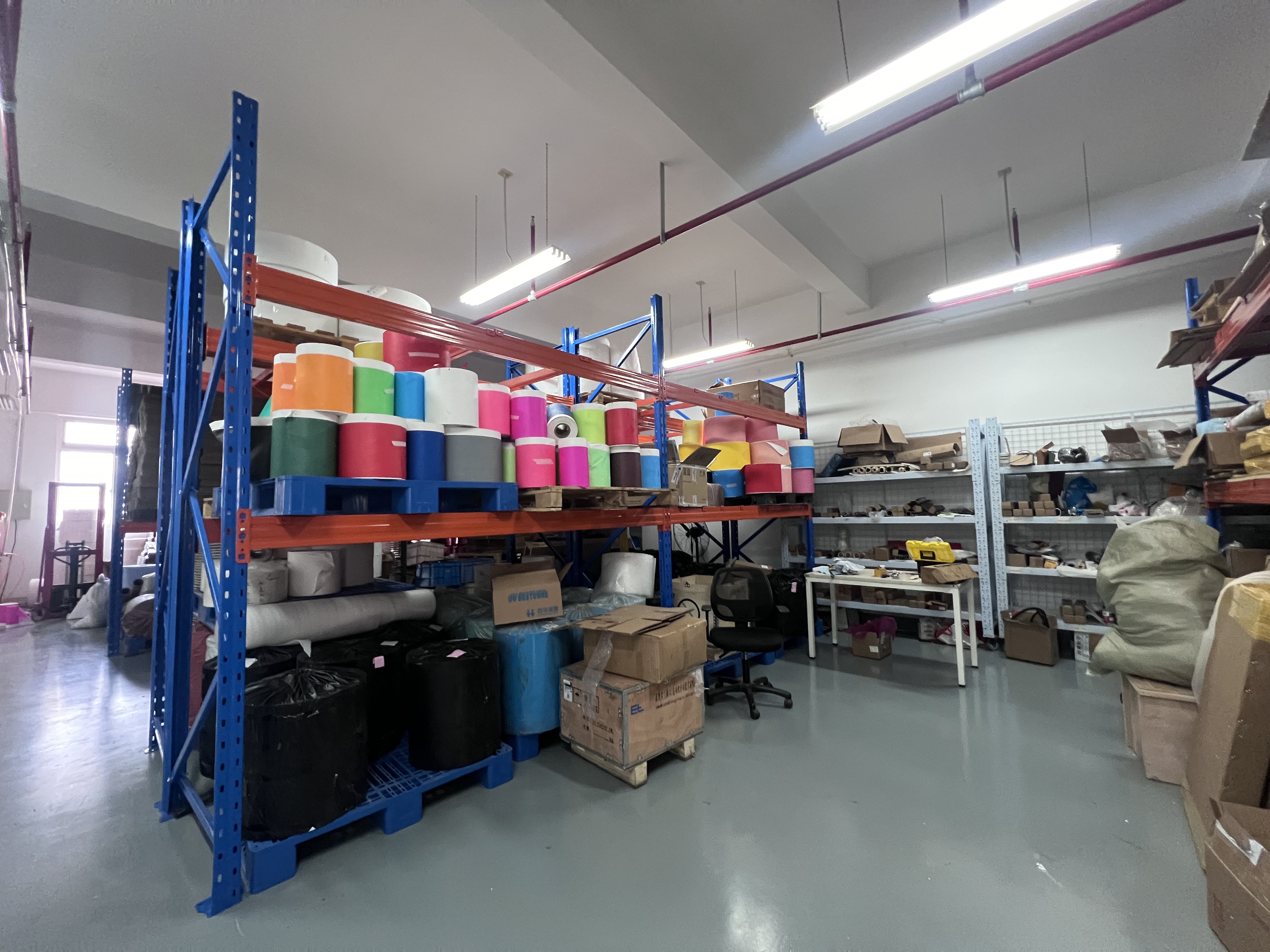
Inbound material storage for wristband production: PVC film, Tyvek, thermal-sensitive synthetic paper and textile webbing are stored and issued as separate substrate families, each with its own handling rule.
| Substrate family | Wristband products using it | What it implies operationally |
|---|---|---|
| Thermal-sensitive synthetic paper | Medical thermal wristband, 260 × 25 mm, direct thermal printing | Coating-sensitive storage and feeding; print method is direct thermal, not ink-based |
| PVC film (single or double layer) | PVC patient ID wristband (250 × 25 mm / 250 × 16 mm); PVC 1 or 2-layer wristband; PVC+Tab wristband (260 × 40 mm) | Film slitting, lamination and buckle/tab assembly |
| Holographic film on PVC or paper | Holographic wristband (250 × 25 mm / 250 × 16 mm), one-time lock closure | Holographic lamination plus single-use closure assembly |
| Tyvek and paper | Tyvek wristband (250 × 19 mm / 250 × 25 mm); cartoon wristband (200 × 20 mm) | Non-woven converting; tear-resistant but disposable format |
| Silicone, PVC, Tyvek, paper | RFID wristband (250 × 25 mm / 250 × 16 mm), LF/HF/UHF chip options | Inlay storage, chip protection and read/write verification |
| Polyester webbing and ribbon | Ribbon wristband (350 × 15 mm); polyester wristband (350 × 15 mm); polyester lanyard (900 × 15/20/25 mm) | Textile cutting, edge finishing, buckle and metal/plastic fitting |
| Paper, PVC, self-adhesive, synthetic paper | Custom labels, any size, offset / digital / hot stamping | Multi-process label printing and die-cutting |
The practical question to ask on a supplier visit is not "do you make these products?" but "where is the material for this product stored, and who issues it?" A trading intermediary can answer the first question convincingly and the second only vaguely.
Evidence two: printing breadth across two different printing families
Printing is where capability becomes measurable. Direct thermal printing, used for the medical thermal wristband format, produces the image through the coated stock itself and is matched to direct thermal printers. Flexographic and digital printing, used across PVC and Tyvek work and for custom labels, lay down ink or toner through entirely different process chains. Hot stamping is a third option in label production.
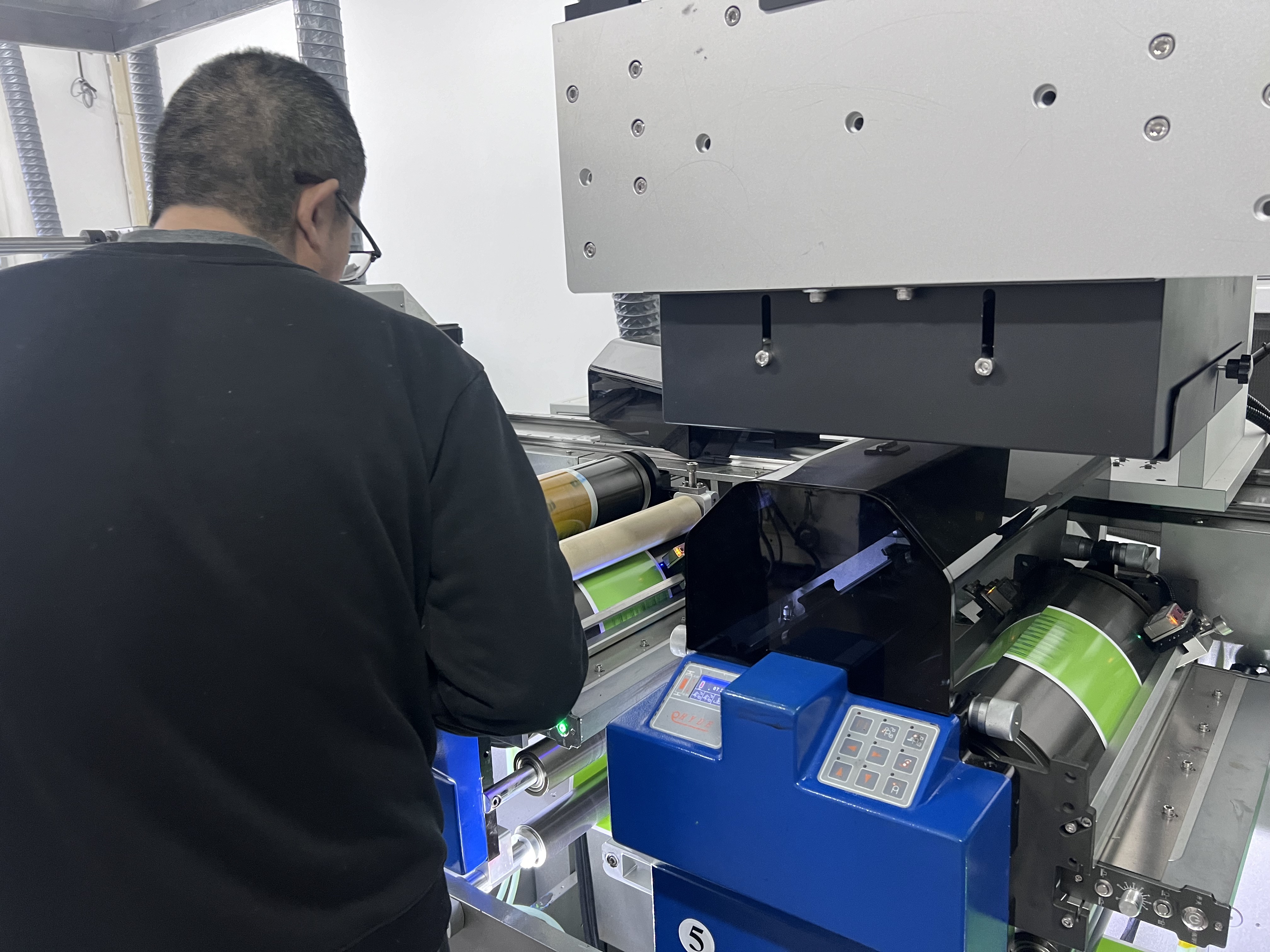
Flexographic printing workshop: one of the printing families used for PVC, Tyvek and label products alongside direct thermal and digital processes.
In DDJOY's production area, digital printing and flexographic printing run as separate workshops rather than a single combined line, and the die-cutting area operates separately again. For a buyer, the significance is not the equipment brand; it is that two printing families can be maintained in parallel, which is the operational precondition for quoting a wide wristband range with credible lead times.
The limit of this evidence is important to state plainly. Printing breadth in one workshop does not transfer automatically to another product family. A digital press does not print on thermal-coated stock, and a thermal printer cannot produce a woven polyester band. If a supplier offers the full range but can only show one printing area, the range claim deserves re-testing — ideally by asking which line, and which operator, produces the exact SKU on the quotation.
Evidence three: die-cutting, finishing and closure systems
Wristband formats are not interchangeable. A 250 × 25 mm band, a 250 × 16 mm band, a 260 × 40 mm PVC+Tab band, a 200 × 20 mm cartoon band and a 350 × 15 mm ribbon or polyester band each require their own tooling and finishing path. The number of formats a factory can cut without outsourcing is therefore a direct proxy for its real format breadth, and the tooling is visible.
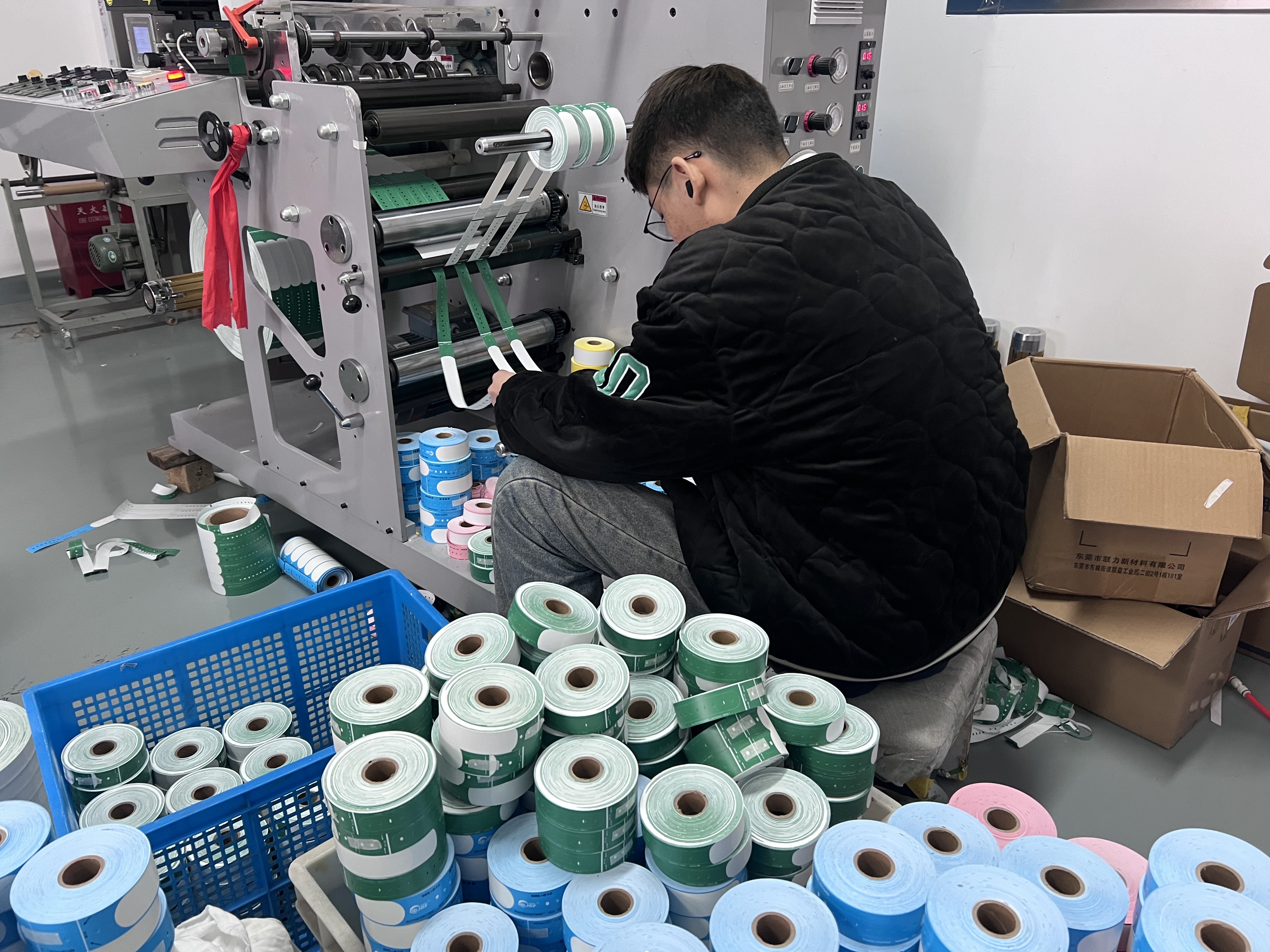
Die-cutting workshop: format tooling determines which wristband sizes and shapes a factory can produce in-house rather than subcontracting.
Closure design is the second half of finishing, and it is a physical property that can be checked by handling samples rather than by reading a certificate. The holographic wristband uses a one-time lock closure and is specified as waterproof and tear-resistant. The PVC+Tab format uses a tab buckle designed to stay firm during wear. The PVC patient ID wristband is specified as printable with patient information, durable and comfortable. Each of these closures is verified by pulling, twisting and re-closing a sample — a two-minute test that reveals more about tamper resistance than any product photograph.
Evidence four: reading the product range as a capability map
A product list becomes useful evidence when it is read as a map of production disciplines rather than as a sales list. The range below implies at least four separate disciplines under one roof: thermal-compatible printing, plastic film converting and lamination, textile cutting and finishing, and multi-process label printing.
| Product | Format | Material | Primary application context |
|---|---|---|---|
| Medical thermal wristband | 260 × 25 mm, customisable | Thermal-sensitive synthetic paper | Hospitals, medical clinics, healthcare institutions, patient management |
| PVC patient ID wristband | 250 × 25 mm / 250 × 16 mm | PVC | Hospitals, elderly care institutions, patient identification |
| PVC 1 or 2-layer wristband | 250 × 25 mm / 250 × 16 mm | PVC | Hospitals, events, enterprises, entertainment venues |
| PVC+Tab wristband | 260 × 40 mm | PVC | Hospitals, events, concerts, nightclubs |
| Tyvek wristband | 250 × 19 mm / 250 × 25 mm | Tyvek | Hospitals, exhibitions, events, ticketing |
| RFID wristband | 250 × 25 mm / 250 × 16 mm | Silicone, PVC, Tyvek, paper | Medical, events, access control, logistics and warehousing, member management |
| Holographic wristband | 250 × 25 mm / 250 × 16 mm | PVC or paper with holographic film | Concerts and entertainment, exhibitions and festivals, access control |
| Cartoon wristband | 200 × 20 mm | Paper / Tyvek | Children's activities, theme parks, kindergartens, exhibitions |
| Ribbon wristband | 350 × 15 mm | Ribbon / polyester webbing | Weddings, fashion accessories, events |
| Polyester wristband | 350 × 15 mm, length customisable | Polyester webbing | Sports, events, enterprise promotion, employee badges |
| Custom label | Any customisable size | Paper, PVC, self-adhesive, synthetic paper | Apparel, daily chemicals, food, electronics and other sectors |
For a buyer, the range is also a risk indicator. A supplier that offers medical thermal bands, PVC patient ID bands, RFID bands and textile bands must simultaneously manage coating-sensitive storage, film lamination, chip inlays and textile finishing. That complexity is the reason range claims should be verified physically — and the reason a narrow, single-family specialist is sometimes the safer choice for a narrowly defined hospital tender.
Evidence five: quality system, third-party verification and documentation
The documents behind the factory door matter as much as the equipment when a hospital or a distributor is qualifying a supplier. Shanghai Dingba Identification Co., Ltd. holds ISO 9001 certification and has undergone on-site verification by Alibaba and by SGS. The company reports a 10,000 m² facility, more than 50 employees, a dedicated R&D team of 5 engineers, and an annual output of approximately 12,000,000 units, with a standard product lead time of 7–10 working days and monthly capacity reservation for large-volume orders.
These are the document classes worth requesting from any supplier at the decision stage:
- The ISO 9001 certificate together with its stated scope — a quality management certificate for a defined site and activity, not a product approval.
- The current third-party on-site verification report, with issue date, so the buyer knows the audit is recent rather than historical.
- Labelling conformity documentation, including how the supplier applies the ISO 15223-1:2021 Amendment 1 (2025) symbol changes, which transition the authorised representative marking from EC REP to EU-REP.
- A written position on EU regulatory classification. In Case C-427/24, the Court of Justice of the European Union ruled that blank patient wristbands are not classified as medical devices under EU MDR 2017/745 — meaning classification follows intended purpose, and a printed or system-integrated product may sit in a different category from a blank one.
- Sample validation records and material declarations for the specific SKU on the quotation.
Application and use cases where this evidence is tested
The most demanding application context for wristbands remains hospital inpatient wards, emergency departments and patient identity management, where clear and tamper-proof identification is critical. In these settings the matched equipment is a direct thermal printer, and the product requirements are typically water resistance, tear resistance, disposability and skin safety. Emergency departments stress the workflow rather than the material: a band that cannot be printed and applied within seconds of admission slows the whole intake process.
Outside the acute ward, the requirements diverge. Tyvek formats suit short-duration use in exhibitions, ticketing and hospital admissions where a disposable, tear-resistant band is sufficient. Cartoon formats in paper or Tyvek address children's activities, kindergartens and theme parks, where print clarity and colour matter more than durability. Ribbon and polyester formats (350 × 15 mm) and polyester lanyards (900 × 15/20/25 mm) serve sports events, enterprise promotion and badge holding, where the band is washed and reused. RFID formats span medical, events, access control and logistics use, with low-frequency, high-frequency or ultra-high-frequency chip options, readable and writable — a deliberately different procurement decision, because RFID requires reader infrastructure and an encoding workflow on the buyer's side.
Comparison with traditional hand-written wristbands — and where the advantage stops
The clearest comparison in this category is between a conventional hand-written PVC patient wristband and a printed, tamper-evident band. The measurable differences reported for the printed product are a 35% reduction in printing error rate and a 42% lower risk of information modification, driven by clear printed content, a tamper-proof structure, and resistance to water and alcohol.
The cost picture is more nuanced than a headline saving, and this is where buyers most often misread the comparison. The unit cost of the printed band is 8% higher than the alternative, while the overall hospital management cost is reported as 15% lower. Maintenance requirements are minimal: the product requires no later maintenance and is disposable after use.
Three limitations should be weighed before standardising on the printed route:
- Volume sensitivity. An 8% higher unit cost is negligible against a 15% lower overall management cost in a large inpatient operation, but it is not automatically justified in a very small clinic with low monthly volumes, where the management-cost saving may never materialise.
- Infrastructure dependency. Printed bands assume a compatible direct thermal printer, printable media and a process discipline for issuing and applying the band. Handwritten bands need none of this. The printed route shifts cost from the band itself into equipment and workflow, and that shift must be planned rather than assumed.
- Regulatory framing. Because blank wristbands are not classified as medical devices under EU MDR 2017/745 following Case C-427/24, the compliance burden follows intended purpose and labelling decisions made by the party placing the product on the market. A printed, system-integrated wristband and a blank band are not the same regulatory object, and the buyer's own documentation should reflect which one is being purchased.
Market trend signals relevant to supplier qualification
Patient identification wristbands are a comparatively small but structurally steady segment. Future Market Insights projected the global market at USD 576.1 million for 2025, while Precedence Research estimated North America's share at 41% in the same year. The two published figures do not agree on total size — Precedence Research placed the 2025 market at USD 1.61 billion against the FMI figure — which most plausibly reflects a scope difference between blank identification bands and printed or system-integrated solutions. Buyers should read such figures as directional only, and should ask any supplier quoting market size which product definition is being used.
Concentration is another useful signal. PDC Healthcare, a Brady Corporation brand, holds a projected market share of 14–18% in patient identification wristbands, and Zebra Technologies reported net sales of USD 346 million for its Asset Intelligence & Tracking segment, which includes wristbands, in Q4 2023. The overlap between printing hardware vendors and consumable wristband producers is a reminder that procurement decisions in this category are rarely about the band alone — they involve printers, software and consumables as a system.
On the regulatory side, movement has been continuous rather than dramatic. The CJEU ruling on blank wristbands took effect in July 2026, and the ISO 15223-1:2021 Amendment 1 (2025) symbol changes continue to work through labelling practice. The practical consequence for buyers is that documented conformity and traceable evidence are becoming a larger part of supplier qualification than material price alone.
A buyer's verification checklist
| # | What to verify | How to verify it |
|---|---|---|
| 1 | Material storage by substrate family | Physical walkthrough of the material warehouse; ask who issues material to each line |
| 2 | Printing families present | Confirm which line produces the quoted SKU: direct thermal, flexographic, digital or hot stamping |
| 3 | Format tooling | Count die-cut tooling for 250 × 25 mm, 250 × 16 mm, 260 × 40 mm, 200 × 20 mm, 350 × 15 mm formats |
| 4 | Closure and tamper design | Pull, twist and re-close physical samples of each closure type |
| 5 | Quality management scope | Request the ISO 9001 certificate with stated scope and site |
| 6 | Third-party verification currency | Request the dated on-site verification report (Alibaba, SGS or equivalent) |
| 7 | Labelling conformity | Check application of ISO 15223-1:2021/Amd 1:2025 symbol changes |
| 8 | Regulatory position | Obtain a written statement of intended purpose against EU MDR 2017/745 classification |
| 9 | Capacity and lead time | Confirm monthly capacity reservation and the standard 7–10 working day lead time in writing |
| 10 | Sample validation in your own environment | Print and apply samples using your own printer and disinfection routine before standardising |
Future outlook
The direction of travel in this category is toward documented capability rather than claimed capability. As regulatory classification becomes more explicit — the CJEU ruling is one example, the ISO labelling amendment another — the gap between a factory that can demonstrate substrate handling, printing, tooling and traceable records, and one that simply resells, becomes easier for buyers to test and harder for resellers to conceal.
Two operational shifts are likely to continue. First, RFID and barcode formats will keep expanding from events into clinical and logistics workflows, which pushes wristband decisions closer to IT and systems procurement. Second, buyers will increasingly treat local printing, storage and lead time as part of the wristband specification rather than as logistics afterthoughts, particularly where supply continuity matters more than unit price. Neither shift changes the underlying test: the evidence is still physical, and it is still found on the factory floor.
FAQ
1. Is a printed patient identification wristband more expensive than a hand-written PVC wristband?
At unit level, yes: the printed, tamper-evident band carries an 8% higher unit cost than the traditional hand-written PVC comparison. At system level, the same product is reported to deliver a 15% lower overall hospital management cost, and it requires no later maintenance because it is disposable after use. Whether the system-level figure applies to a specific facility depends on volume and on how the ward currently handles hand-written identification.
2. What evidence shows that a factory can produce both thermal and PVC wristbands rather than reselling them?
Three checks are decisive. First, whether thermal-sensitive synthetic paper is stored and issued separately from PVC film. Second, whether direct thermal printing and ink-based printing (flexographic or digital) exist as separate production processes, since they cannot substitute for one another. Third, whether die-cut tooling exists for each quoted format, such as 250 × 25 mm, 250 × 16 mm and 260 × 40 mm. A reseller can typically answer the first question only in general terms.
3. Are blank patient wristbands regulated as medical devices in the European Union?
According to the Court of Justice of the European Union ruling in Case C-427/24, blank patient wristbands are not classified as medical devices under EU MDR 2017/745. The classification follows intended purpose, so a blank identification band and a printed, system-integrated identification solution are not necessarily the same regulatory object. Buyers should obtain a written statement of intended purpose from the supplier for the exact product being purchased.
4. Which labelling standard change affects wristband suppliers in 2025 and 2026?
ISO 15223-1:2021 Amendment 1 (2025) updated medical device labelling symbols, including the transition of the authorised representative symbol from EC REP to EU-REP. Suppliers serving European markets are expected to apply the updated symbol set, and buyers reviewing labelling artwork can check conformity against the amended standard.
5. When does an RFID wristband make more sense than a printed thermal or PVC band?
RFID becomes relevant when identification must be read automatically or written to, rather than read visually. RFID wristbands are available with low-frequency, high-frequency or ultra-high-frequency chips, are readable and writable, and come in silicone, PVC, Tyvek or paper at 250 × 25 mm or 250 × 16 mm formats. The trade-off is infrastructure: readers, encoding and software must exist on the buyer's side. For straightforward visual identification in inpatient wards or emergency departments, a printed direct thermal or PVC band is usually the simpler specification.
6. What lead time and capacity commitments should a buyer confirm before awarding a wristband contract?
A standard product lead time of 7–10 working days is a common baseline, with monthly capacity reservation for large-volume orders. Buyers should confirm in writing how the supplier handles the known disruption points: upstream shortages of PVC, Tyvek or RFID chips; order surges without reserved capacity; equipment breakdown or rework; late specification revisions; and logistics or port delays. A factory's answer to these scenarios is often more informative than its quoted price.
Reference material: the Shanghai Dingba Identification Co., Ltd. product brochure is available for download at DDJOY medical wristband product brochure. Company information: www.ddlf.com.