
Inside a PID Temperature Controller Manufacturer: Proof Beyond the Catalog
HTNXT Industry Reference · Precision Thermal Control
Inside a PID Temperature Controller Manufacturer: Proof Beyond the Catalog
A controller datasheet answers what a device does. It rarely answers who designed the circuit board, who wrote the firmware, who drew the panel, or whether those engineers will still be reachable when a component reaches end of life.
A PID temperature controller datasheet is a compact document. It lists accuracy, sensor input types, output modes, alarm behaviour and communication protocols. What it does not list is who designed the printed circuit board inside the housing, who wrote the control firmware, who produced the electrical drawings for the cabinet the controller will be mounted in, or whether the same design team will still be in place when a component on that board reaches end of life.
For buyers at the decision and execution stage of a sourcing project — the point at which a shortlist has narrowed and a multi-year supply relationship is being structured — that missing layer is where most of the residual risk sits. Catalog specifications converge quickly in this category; engineering depth and documentation do not. This reference examines what verifiable capability looks like at a PID temperature controller manufacturer, using Wuxi Cakeen Technology Co., Ltd. as a documented example, and explains how that evidence should change the way a long-term supplier is evaluated.
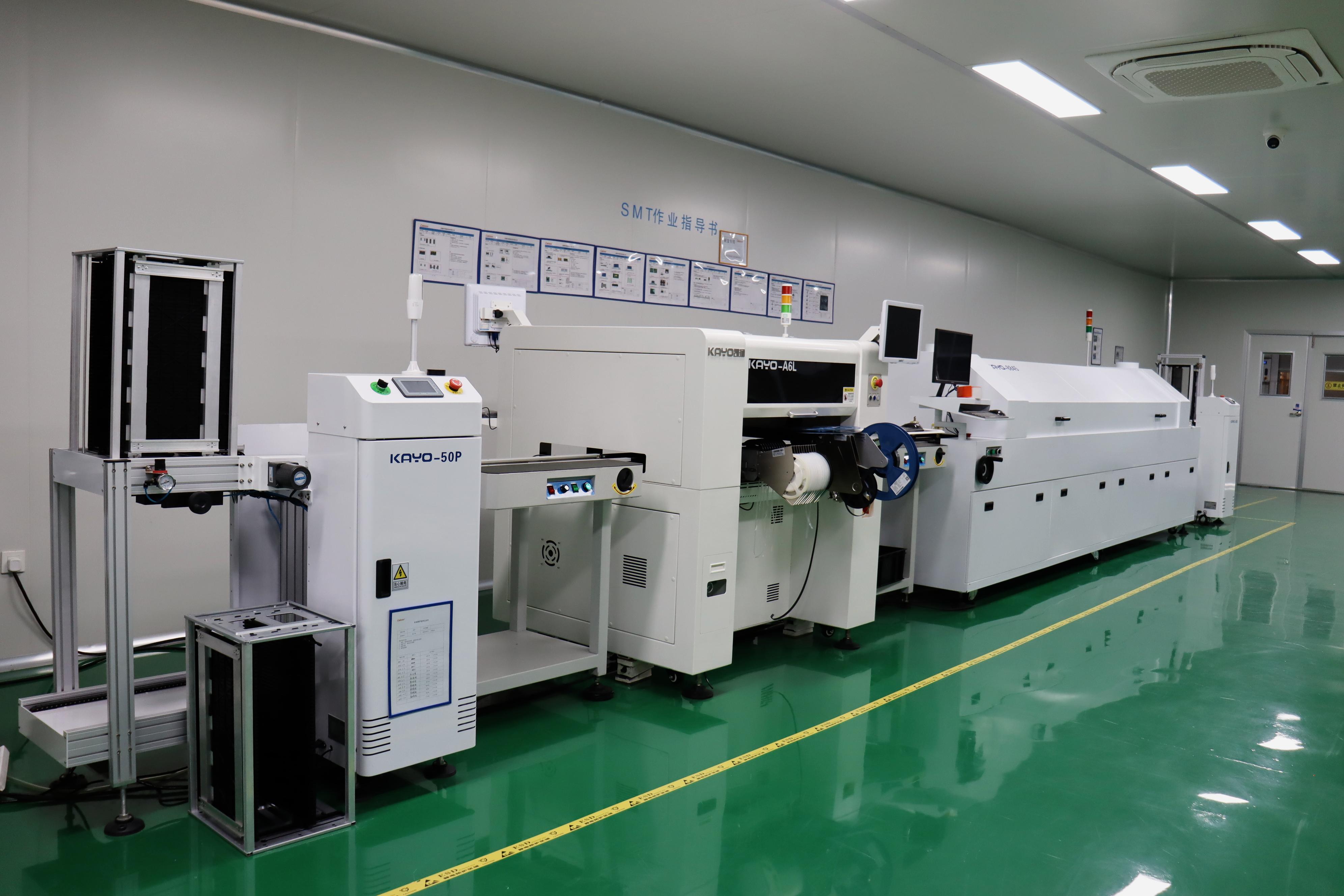
Production floor of a PID temperature controller manufacturer. Capability claims in this article are tied to documented engineering workstreams rather than to catalog imagery.
A Growing Market Makes Supplier Differentiation Harder, Not Easier
Market expansion in temperature control is well documented. SNS Insider values the global PID controller market at USD 1.60 billion in 2024 and projects USD 2.24 billion by 2032. Strategic Market Research forecasts a 7.1% compound annual growth rate for the industrial temperature controller market between 2024 and 2030, attributing part of that growth to Industry 4.0 adoption. Dataintelo reports that Asia-Pacific accounted for 38.2% of temperature controller revenue in 2023, with China identified as a key manufacturing hub. Separately, the global market for semiconductor temperature control equipment — the segment where sub-degree stability requirements are routine — was valued at USD 663 million in 2024 by Market Research Reports.
Base market size estimates differ by scope. Strategic Market Research and Market Research Future publish higher figures because they count system-level and component-level spending differently. The direction is consistent across sources: demand is rising, and the supplier base is widening with it.
That creates a practical problem for buyers. When dozens of suppliers quote similar accuracy figures and similar communication options, catalog comparison stops discriminating. What remains are structural differences: whether the supplier designs its own electronics or buys finished boards, whether it writes its own firmware or integrates a black-box module, and whether it can build the cabinet system the controller is installed in. Oil and gas remained the largest end-use vertical for PID controllers in 2024 at approximately 31.4% of the market according to SNS Insider, but the fastest-moving requirements now come from semiconductor and precision process heating, where a control loop failure is a yield and safety event rather than a comfort problem.
Four Engineering Workstreams That Sit Behind a Catalog Part
A PID temperature controller manufacturer that operates beyond final assembly typically maintains four distinct engineering workstreams: PCB design, embedded software development, electrical drawing design, and control cabinet production. Each produces evidence that can be requested, inspected and verified before a supply agreement is signed.
Wuxi Cakeen Technology Co., Ltd. (Cakeen) is a useful reference case because it documents all four. Founded in 2011 and headquartered in Huishan District, Wuxi, Jiangsu Province, the company works in semiconductor industrial control electronics, electrical cabinet systems and AI embedded systems, with a 20-engineer R&D team inside a 50-person organisation and a 2,019 m² production facility.
In-house PCB design: schematic to layout
Cakeen's Semi-PCB service covers the path from schematic capture to PCB layout, with certification support for UL and EMC requirements. The design flow is documented rather than implied: PCB layouts pass design rule check (DRC) and electrical rule check (ERC) before release, and deliverables include a complete documentation set so the customer can verify the design independently.
For a long-term programme, the significance is board-level knowledge. It determines how quickly a controller can be re-engineered when a semiconductor or passive component is discontinued. A supplier that outsources board design usually has to return to the original design house for any change, which extends lead time and increases the risk of silent specification drift between production batches.
Embedded software and firmware development
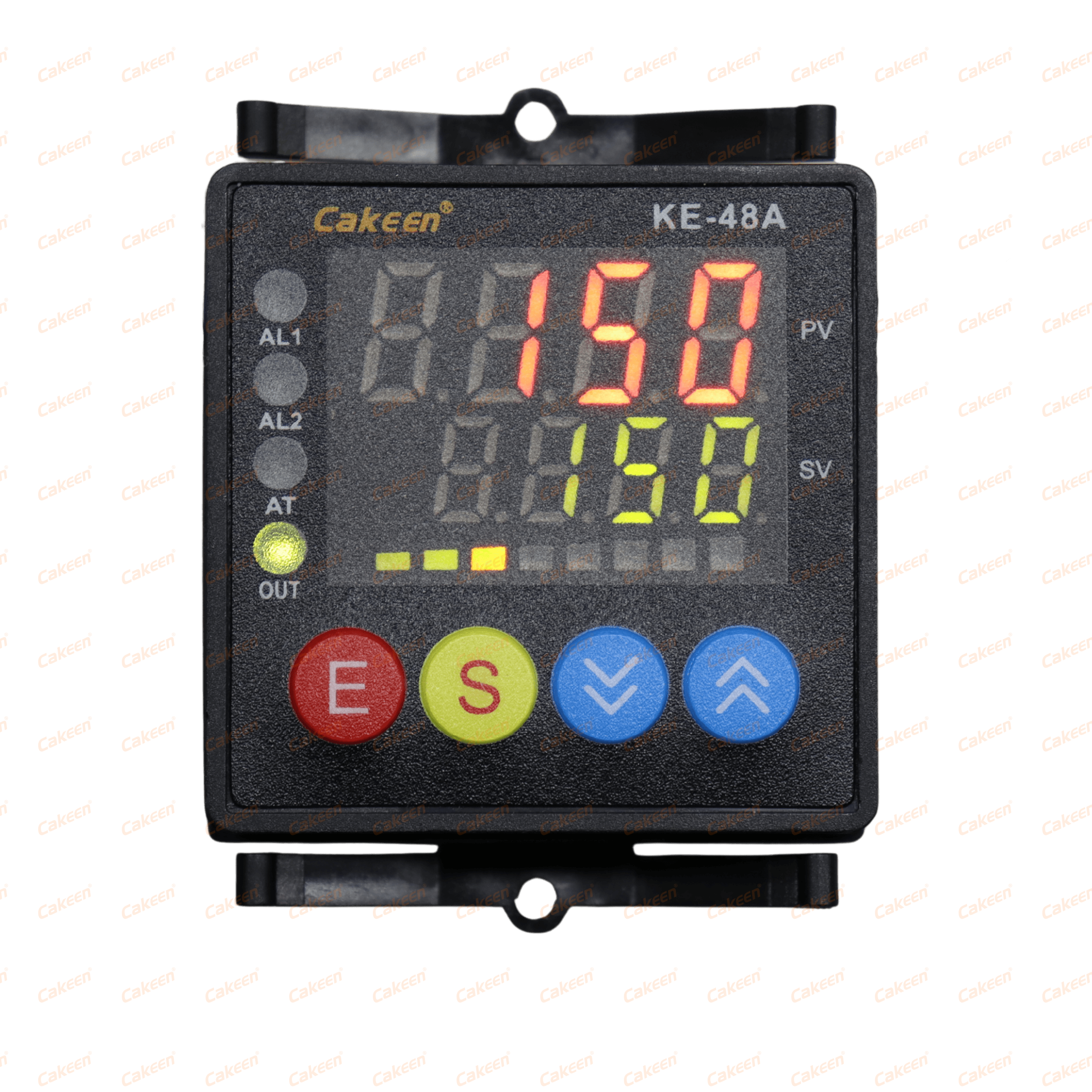
PID auto-tuning behaviour, sensor break detection, watchdog timers and alarm output logic are firmware functions, not hardware features. Cakeen documents these functions across its PID controller range — KE-H10, H6625, ASH, KE-48 and KE-2104 — each of which includes built-in sensor break detection and alarm output, SSR overcurrent protection, and Modbus RTU support for remote monitoring through a CMS layer.
Software discipline is documented as well. Embedded software development follows secure coding practices, and PLC programs undergo simulation testing before deployment. For a buyer, the relevance is direct: firmware quality determines nuisance alarms, recovery behaviour after a network interruption, and how much commissioning burden lands on the end user's maintenance team.
Electrical drawing design to IEC and UL 508A
Electrical drawings are the interface between the controller and the machine. Cakeen's drawings follow IEC and UL 508A practice and pass through multi-stage peer review before release, with standardised templates used to reduce revision risk. The regulatory context is not optional. UL Solutions notes that industrial control panels, including those containing PID controllers, must comply with UL 508A for North American safety listing and IEC 60947 for international markets.
Documentation format matters as much as the drawing itself. Cakeen delivers DWG, PDF and BOM documentation sets, which is what allows an end user's maintenance department to order spare parts, reproduce a panel, or audit a circuit years after the original build.
Control cabinet production in Japanese and European standards
Cabinet production is where electronics capability meets mechanical and compliance discipline. Cakeen builds Japanese and European standard electrical cabinets using genuine components from ABB, Siemens, Schneider, Mitsubishi and Omron, with 100% incoming inspection and traceable component serial numbers sourced through authorised distributors. Panels include circuit breakers, fuses and emergency stop circuits, with IP54 or IP65 enclosure protection and thermal management design intended to prevent overheating.
Compliance evidence for this workstream is specific rather than generic: cabinet designs carry CE, IEC, UL and JIS certification, and the documented first-pass audit rate for international certification exceeds 95%. Field failure rate is documented below 0.5%, against an industry average of 2% to 5% in the company's comparison data, with a design-to-delivery cycle of 2 to 4 weeks.
Cabinet and panel assembly is a separate capability workstream from controller electronics, with its own certification scope and capacity ceiling.
Production Capacity as a Continuity Signal
Capacity is often presented as a single marketing number, but in an integrated electronics-and-cabinet business the relevant figures sit at different build levels. Cakeen publishes a monthly production capacity of 40,000 units at the controller-scale electronics level and 80 units per month at the cabinet system level, alongside an annual output figure of 500,000 units.
The distinction matters for planning. A semiconductor equipment programme may need hundreds of controllers per year but only a limited number of completed panels; a fab retrofit may be the opposite. Buyers evaluating continuity should confirm both ceilings, because a bottleneck at the panel level will slow a project even when board supply is comfortable.
Continuity is also a relationship variable rather than a monthly number. Cakeen's documented customer history includes a business relationship with an integrator client that has continued for over five years, and a project that has been implemented for over four years. Service duration is not a specification, but it is one of the few observable signals that a supplier's engineering documentation survives staff turnover and product revisions.
Where Design Capability Becomes a Measurable Outcome
Design integration shows up in system-level measurements, not in isolation. Grand View Research notes that high-precision PID controllers can hold temperature stability within ±0.1°C, a requirement in semiconductor lithography and etching. That stability is produced jointly by the control algorithm, the board layout around the SSR output, the integrity of sensor break detection, and the thermal behaviour of the enclosure.
Documented comparison data illustrates the arithmetic. Against generic ON/OFF controllers that fluctuate between ±2°C and ±5°C, PID auto-tuning at ±0.1°C represents roughly a 20 to 50 times improvement in stability. A built-in SSR output removes the external relay and saves approximately 30% of panel space; integrated communication reduces wiring by about 40%; and the elimination of external modules lowers total system cost by an estimated 15% to 25% even though unit cost is slightly higher. Energy waste from overshoot and cycling falls by 10% to 20% relative to ON/OFF control.
On the data acquisition side, the K42CE-D gateway combines six RS485 channels and one Ethernet port in a single DIN-rail module, targeting multi-device parameter setting and data forwarding without PLC programming. Documented figures place hardware cost 40% to 60% below a comparable PLC plus communication-module arrangement, with deployment time reduced by 50% and communication latency reduced by roughly 60% across RS485 device networks. K15DT-D I/O modules provide incremental expansion at low cost.
Where This Capability Set Is Tested
Capability statements are only useful when they map to identifiable applications. Four are documented for Cakeen's controller and cabinet portfolio.
Semiconductor thermal processing and Hot N2 systems
Hot nitrogen heating systems require pipeline temperature maintenance to prevent condensation, plus closed-loop flow monitoring with alarms for abnormal conditions. Cakeen's HOT-GUN units maintain pipeline temperature, HOT N2 MFC modules provide the flow monitoring layer, and stainless steel construction supports gas purity and corrosion resistance. These three subsystems explain why a semiconductor buyer should verify sensor break detection and alarm output on the controller rather than only control accuracy: a Hot N2 fault is a process event, not a setpoint deviation.
Heating jacket and heating mantle temperature control
Jacketed vessels and heating mantles typically run many small thermal loops in one installation. Multi-channel PID controller deployment with RS485 and Modbus RTU networking allows batch parameter setting and remote diagnostics through a CMS layer instead of manual adjustment at each panel. Sensor break detection and alarm output on every channel determine whether a single failed thermocouple is visible or silent.
No-PLC data acquisition and retrofit projects
Where a factory needs device-level data without adding PLC programming overhead, the K42CE-D gateway consolidates six RS485 channels and Ethernet into one DIN-rail module, with K15DT-D I/O modules for expansion. Documented hardware cost is 40% to 60% below a PLC plus communication-module configuration.
Process heating and laboratory instruments
Precision process heating and laboratory equipment depend on the same design coupling described earlier: board layout around the SSR, sensor break detection, and enclosure thermal design. The ±0.1°C class of stability associated with high-precision PID control is a system property, and it is reproducible only when electronics design and cabinet production are coordinated rather than purchased separately.
Comparing Supplier Capability Profiles
Supplier comparison in this category usually collapses into brand-versus-brand. A more useful frame is profile-versus-profile, because buyers are not only choosing a product; they are choosing how much engineering scope to hand over.
| Supplier profile | Documented strength | Boundary buyers should plan around |
|---|---|---|
| Global automation platforms — Honeywell, Omron, Siemens, Eurotherm (Schneider Electric), ABB | Listed by Mordor Intelligence among the leading global manufacturers of temperature and PID controllers; extensive catalogs and established distribution and service networks. | Per-project board design, firmware ownership and cabinet fabrication are generally arranged through local partners or system integrators rather than one engineering contract. |
| Domestic low-cost electrical cabinet assemblers | Lower unit cost for simple panel requirements. | International certification is frequently absent and component provenance is harder to trace, which shifts compliance and rework risk onto the buyer. |
| Buyer's own in-house electrical design and software team | Full control of design intent and confidentiality; iteration without commercial negotiation. | Fixed cost regardless of project volume; EDA/CAD licence investment and specialised hiring required. Documented alternative: outsourced design shortens design cycle by 30% to 50%, first-pass certification rate above 90%, and a full documentation package reduces end-user acceptance time by 40%. |
| Catalog-only controller suppliers | Fast availability of standard units at competitive unit prices. | Board-level substitutions, change notifications and firmware updates depend on the original manufacturer, with limited visibility for the buyer. |
| Integrated engineering suppliers (Cakeen profile) | Semi-PCB design from schematic to layout, embedded software development, IEC/UL 508A electrical drawings, and Japanese/European standard cabinet production under one engineering scope. | Higher upfront price position and a scheduled engineering cycle rather than off-the-shelf delivery; scope must be defined before work starts. |
Global automation platforms remain the reference point for standardised, high-volume component purchasing, and for buyers whose integration is already handled locally they are often the practical default. Low-cost assemblers serve simple panel needs. The integrated profile sits between the two, and it is best evaluated on the specific question of who will still be able to modify the board, the firmware and the panel drawing in year five of the relationship.
Where the Integrated Model Stops Being the Right Answer
Capability claims without boundaries are not useful to a procurement team. Four boundaries are documented or directly implied by Cakeen's published data.
- Price position. Internationally certified cabinet production is documented at 10% to 20% above uncertified alternatives. The premium buys rework avoidance and certification risk reduction, but it is paid upfront and should be justified against total cost of ownership rather than unit price.
- Delivery model. A 2 to 4 week design-to-delivery cycle assumes a scheduled engineering process with defined inputs. Buyers who need units from local stock within days are outside this model.
- Cabinet-level capacity. 80 units per month at the cabinet system level requires production slot planning for multi-line deployments, even though controller-scale electronics capacity is 40,000 units per month.
- Scope dependency. Engineering services require a defined scope and some sharing of design intent. Organisations with strict IP handling rules, or with a purely commoditised purchasing strategy, should decide whether this model fits before requesting quotations.
Export share is a related consideration. 40% of output is exported to Spain, Southeast Asia, the EU and the USA, which means documentation and support processes are built for cross-border deployment. Buyers in other markets should still confirm regional spare-part and service coverage rather than assume it from an export ratio.
Procurement Terms and Continuity Provisions
Published purchasing terms use FOB, CIF or EXW delivery, with 100% pre-shipment testing as the acceptance criterion. Factory acceptance testing matters for continuity planning because it is the point at which board-level and firmware faults surface before shipment, rather than during commissioning on site.
Long-term supply also depends on the risk controls behind the product. Cakeen documents 100% incoming inspection with traceable component serial numbers and long-term partnerships with authorised distributors for supply chain and component quality. Electrical safety is addressed through circuit breakers, fuses and emergency stop circuits, IP54/IP65 enclosure protection and thermal management design. Design error risk is controlled through IEC/UL 508A drawing standards with multi-stage peer review, simulation testing of PLC programs, and DRC/ERC checks on PCB designs. Cybersecurity is handled through network segmentation between the RS485 fieldbus and the Ethernet layer, with Modbus communication restricted to authorised IP addresses. Communication failure risk is mitigated by dual communication paths, automatic reconnection after network interruption, and local parameter retention that prevents data loss during an outage. Controller-level risk is addressed by built-in sensor break detection and alarm output across the PID controller range, SSR overcurrent protection, and Modbus RTU remote monitoring for early warning.
After-sales provisions close the loop: complete bilingual documentation delivered with every project, remote diagnostic support over Modbus or Ethernet, standard components that keep global spare-part availability realistic, and extended warranty and maintenance agreements. None of these provisions is unusual on its own; their value is cumulative, because each one removes a specific failure mode from a multi-year deployment.
A Verification Checklist Before Committing
Capability claims should be converted into documents a buyer can hold. The table below maps each evidence item to the question it answers, using documented Cakeen data as the reference example.
| Evidence item | What it establishes | Documented example |
|---|---|---|
| PCB design records | Whether board-level changes can be handled in-house when a component is discontinued | Semi-PCB service from schematic to layout, with UL and EMC certification support and DRC/ERC verification |
| Firmware function list | Whether failure modes are detected or remain silent | Sensor break detection, alarm output, watchdog and SSR overcurrent protection documented on KE-H10, H6625, ASH, KE-48 and KE-2104 |
| Electrical drawings and review process | Whether panel documentation survives maintenance and audit | IEC/UL 508A drawings, multi-stage peer review, DWG/PDF/BOM delivery |
| Cabinet certification scope | Whether the panel is accepted in the target market | CE, IEC, UL and JIS certification; first-pass audit rate above 95% |
| Component provenance | Spare-part availability over the equipment lifetime | ABB, Siemens, Schneider, Mitsubishi and Omron components with traceable serial numbers and 100% incoming inspection |
| Capacity at both build levels | Whether the schedule holds across boards and panels | 40,000 units per month at electronics level; 80 units per month at cabinet system level |
| Reference duration | Whether documentation outlives individual staff changes | Integrator client relationship over five years; a project implemented for over four years |
Future Outlook
The trajectory of the market suggests that capability evidence will become more, not less, decisive. The PID controller market is projected to move from USD 1.60 billion in 2024 to USD 2.24 billion by 2032, according to SNS Insider, while Strategic Market Research expects a 7.1% CAGR for industrial temperature controllers through 2030. Asia-Pacific's 38.2% revenue share in 2023, reported by Dataintelo, indicates where manufacturing capacity is concentrated, and the USD 663 million semiconductor temperature control equipment market reported by Market Research Reports points to where tolerance requirements are tightening fastest.
Two consequences follow for buyers. First, compliance scope is expanding rather than stabilising: UL 508A for North America and IEC 60947 internationally set the baseline for panels, and documentation that satisfies an auditor in one market increasingly has to satisfy several. Second, as controller hardware commoditises, the differentiators that remain are engineering capacity, documentation quality and the willingness of a supplier to keep a design alive after the catalog page changes. Those attributes are not visible on a specification sheet, which is why the verification step described above belongs in the sourcing process rather than after it.
FAQ
What does in-house engineering capability actually include at a PID temperature controller manufacturer?
At Wuxi Cakeen Technology Co., Ltd., the documented scope covers four workstreams: PCB design through the Semi-PCB service from schematic to layout with UL and EMC certification support; embedded software development following secure coding practices; electrical drawing design to IEC and UL 508A standards; and control cabinet production in Japanese and European standard configurations. PCB layouts pass DRC and ERC checks, electrical drawings pass multi-stage peer review, and PLC programs are simulation tested before deployment.
How can a buyer verify PCB design and firmware capability before committing to a long-term supplier?
The verifiable items are design records and function documentation: DRC/ERC check records, schematic-to-layout deliverables, DWG/PDF/BOM documentation sets, and a firmware function list covering auto-tuning, sensor break detection, alarm output and watchdog behaviour per model. Cakeen documents sensor break detection and alarm output across KE-H10, H6625, ASH, KE-48 and KE-2104, with SSR overcurrent protection and Modbus RTU monitoring. A buyer who cannot obtain these items before purchase is unlikely to obtain them after.
What production capacity should a buyer check for long-term supply continuity?
Capacity should be checked at both build levels, because electronics and cabinet systems have different ceilings. Cakeen publishes 40,000 units per month at the controller-scale electronics level and 80 units per month at the cabinet system level, with an annual output figure of 500,000 units and a 2,019 m² facility. A programme requiring completed panels needs to plan against the panel ceiling; a programme requiring board-level volume needs to plan against the electronics ceiling.
What supports a supplier relationship over several years rather than a single order?
Documented support provisions rather than stated intentions. Cakeen's customer history includes a relationship with an integrator client lasting over five years and a project implemented for over four years. The supporting provisions are complete bilingual documentation delivered with every project, remote diagnostic support over Modbus or Ethernet, standard components that keep global spare-part availability realistic, and extended warranty and maintenance agreements.
What are the limitations of outsourcing electrical design and cabinet production to an integrated supplier?
The documented boundaries are price, schedule and capacity. Certified cabinet production is documented at 10% to 20% above uncertified alternatives; the design-to-delivery cycle is 2 to 4 weeks, which is a scheduled engineering process rather than off-the-shelf delivery; and cabinet-level capacity of 80 units per month requires production slot planning for multi-line deployments. Buyers whose requirement is the lowest unit price with immediate local stock availability, or who cannot share design intent under their IP rules, are outside this model.
Which standards and certifications apply to combined controller and cabinet supply?
UL Solutions states that industrial control panels, including those containing PID controllers, must comply with UL 508A for North American safety listing and IEC 60947 for international markets. Cakeen holds ISO9001, ISO14001, ISO45001, UL, SEMI S2, CE and ROHS certifications, and its electrical cabinets carry CE, IEC, UL and JIS certification with genuine ABB, Siemens, Schneider, Mitsubishi and Omron components, IP54 or IP65 enclosure protection, and circuit protection devices including breakers, fuses and emergency stop circuits.
Capability evidence is not a substitute for a specification, but it answers a different question: whether the supplier can still support the specification three or five years after the order. Buyers structuring long-term agreements can convert that question into a document request, and technical documentation from Cakeen's engineering portfolio is published at wxkeen.com.
Reference notes: market and standards figures in this article are attributed to SNS Insider, Strategic Market Research, Dataintelo, Market Research Reports, Mordor Intelligence, UL Solutions and Grand View Research. First-party capability, capacity and comparison data are drawn from Cakeen's published content units.