
Inside a Pallet Box Factory: TOYOE Capacity and Quality Checks
A pallet box is a reusable, heavy-duty container built around a pallet footprint so that parts or bulk materials can be moved, stacked and stored as a single unit. Because it is a multi-year asset rather than a one-off purchase, the questions that decide whether it performs usually have little to do with how it looks in a catalogue photograph — and a great deal to do with who makes it, on what equipment, under which inspection routine, and at what sustainable output.
This reference article looks inside one such operation: the pallet box factory behind the TOYOE plastic pallet box range, operated by Zhangjiagang Fenghui Logistics Equipment Co., Ltd. in Jiangsu Province, China. It examines what the plant’s stated capacity and staffing imply for buyers at the research stage, explains what quality checks actually control in a plastic pallet box factory, and sets out where this class of supplier fits — and where it does not — in an industrial packaging programme.
Data note. This article draws on the manufacturer’s published operational figures and on third-party market data. Where a number is not published — for example the share of output that undergoes structured testing, standard lead times, or the length of after-sales cover — the article says so, and treats those points as items to be confirmed in writing rather than as assumptions.
Why factory-level evidence matters in pallet box sourcing
Industrial buyers at the research stage are usually comparing near-identical specification sheets: HDPE or PP, a 1200 × 800 or 1000 × 800 footprint, a 100–200 L capacity, an enclosed body. Those lines describe what the product is. They say almost nothing about the system that produces it — and it is the production system that determines whether the box delivered in month one behaves like the box delivered in month twelve.
Demand has made that distinction more consequential. Grand View Research projects the global plastic pallets and pallet box market to reach approximately USD 11.2 billion by 2030, driven largely by the shift from wood to durable plastic solutions in logistics. Growth of that kind attracts suppliers of very different scale and structure, from global pooling networks to focused specialist plants. For a buyer, the practical question is not which supplier is largest, but which supplier’s way of working matches the programme being sourced.
Factory evidence answers part of that question and leaves part of it open. Plant area, headcount, engineering depth, annual capacity, export record and documented test routines can be stated, checked and compared. The consistency of those routines across hundreds of production days cannot be read from a datasheet; it has to be validated through samples, audits and references. Both halves matter, and the sections below keep them separate.
The manufacturer behind the TOYOE pallet box range
Zhangjiagang Fenghui Logistics Equipment Co., Ltd. is a Chinese manufacturer of logistics packaging equipment, established in 2010 and based in Zhangjiagang, Jiangsu Province. The company produces plastic pallet boxes, storage boxes, plastic crates and honeycomb panel boxes; its pallet box range is marketed under the TOYOE name at toyoebox.com. Products are listed with origin Suzhou, China, and HS code 3923100000.
The company’s published operational profile is unusually specific for a specialist manufacturer of this size, which makes it a useful case for understanding how capacity and quality are organised in practice.
| Operational indicator | Stated figure |
|---|---|
| Established | 2010 |
| Manufacturing facility | 4,000 m² |
| Employees | Approximately 34 |
| R&D engineers | 2 |
| Annual production capacity | 30,000 units |
| Main product families | Plastic pallet boxes, storage boxes, plastic crates, honeycomb panel boxes |
| Export share of sales | Approximately 40% |
| Main export markets | Mexico and the USA |
| Product origin / HS code | Suzhou, China / 3923100000 |
Read together, these figures describe a specialist, mid-volume operation rather than a diversified industrial group. That distinction matters more in procurement than it first appears. A plant of this type typically fits custom and mixed-model programmes — several box variants, custom dimensions, inner linings, moderate annual volumes — and fits multi-region, high-volume standardised programmes less naturally. Neither model is better in the abstract; they suit different sourcing strategies, and a buyer should know which one they are buying.
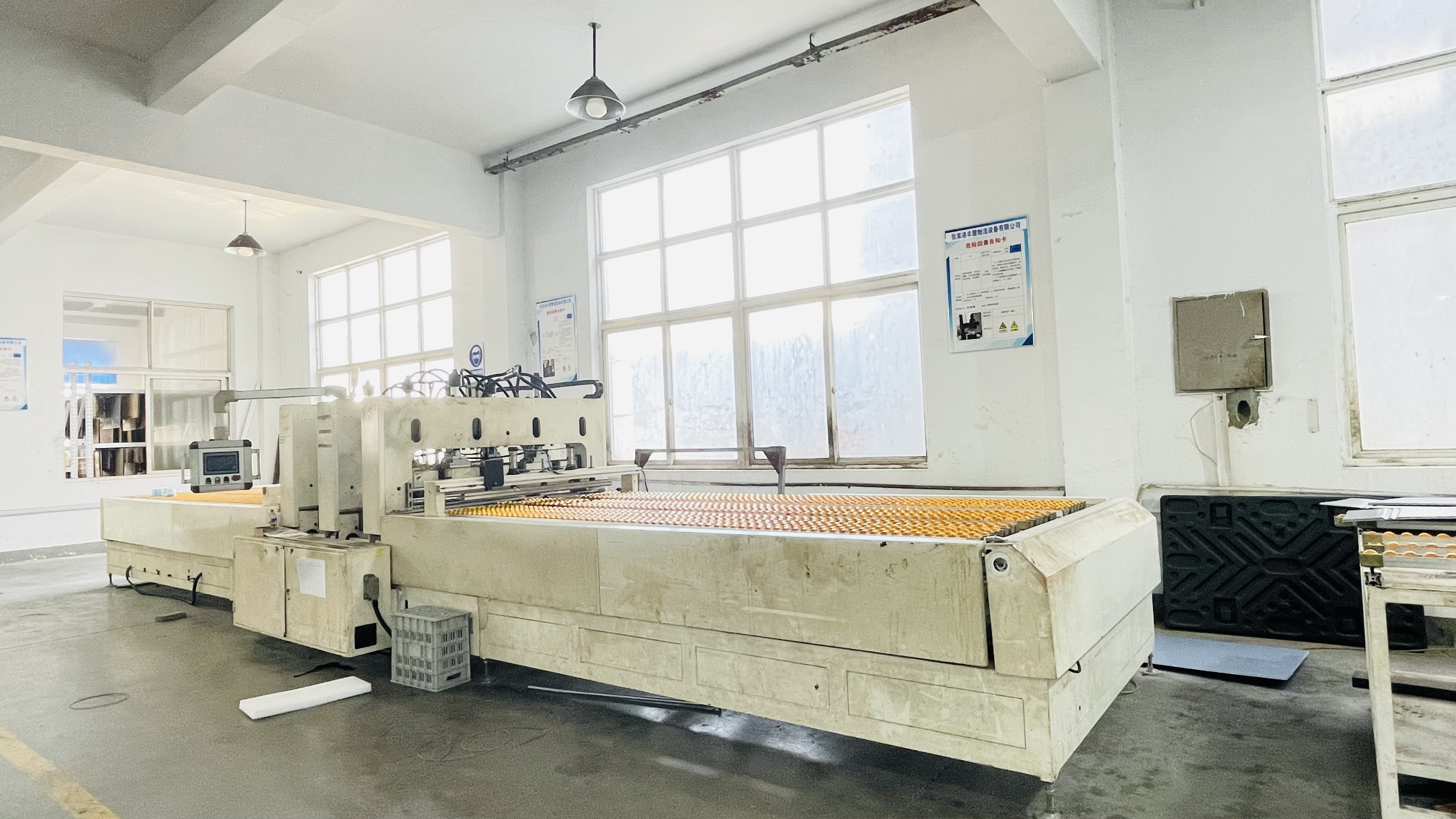
Inside the 4,000 m² facility: how 30,000 units a year is organised
Four thousand square metres has to accommodate molding equipment, assembly and finishing, finished-goods staging and dispatch. Space, machine time and people are therefore the three resources that set the plant’s real output ceiling, and all three are finite.
Workforce and engineering depth
With approximately 34 employees, including a research and development team of two engineers, the plant runs lean. For buyers this has a practical consequence: engineering capacity is a scheduled resource, not an on-demand one. A custom dimension, a new inner-lining tray or a modified container format is a project that has to be planned, prototyped and validated. Programmes with a fixed launch date should build that engineering phase into the timeline rather than assume it is absorbed into standard delivery.
Annual capacity
The stated annual production capacity is 30,000 units, spread across four product families. That figure describes plant-level capability, not a commitment to any single order. When testing a supplier against it, the useful follow-up questions are how much of the capacity is already committed, how it is distributed between product families, how it behaves during peak periods, and what monthly allocation a new programme can realistically receive.
Product mix and scheduling
The catalogue distinguishes, among others, blow-molded honeycomb board boxes, die-cast honeycomb board pallet boxes and standard enclosed plastic pallet boxes, alongside storage boxes and plastic crates. Different geometries and constructions consume machine time differently, so a buyer ordering several variants in one shipment should expect the order to be scheduled through production rather than picked from standing stock.
Lead time
Standard lead time is not published in the manufacturer’s product data reviewed for this article. That is common in this segment, and it is precisely why lead time should be requested as a written commitment that separates four different clocks: sample production, tooling or mould preparation for custom sizes, first production batch, and repeat orders. Averaging these into a single delivery number is where many sourcing schedules go wrong — particularly when a first order includes bespoke dimensions.
Buyer verification point. Three operational details materially affect a pallet box programme: the proportion of output that undergoes structured testing, the committed lead time, and the length and scope of after-sales cover. None of these is stated in the publicly available product data reviewed for this article. They should be written into the quotation or sales contract, with test scope and warranty exclusions defined, rather than accepted verbally.
Quality checks explained: what is actually being controlled
In a plastic pallet box factory, quality control is not a single inspection at the end of the line. It is a sequence of checks, each catching a different class of defect. The sequence below reflects how returnable plastic container production is generally structured, and how each stage maps to the failure modes buyers actually experience in the field.
- Incoming material control. HDPE and PP are defined by grade, not just by name. Melt index, impact modifiers, colour masterbatch and the proportion of regrind all influence how a box behaves under repeated impact. Incoming verification, or supplier certificates, is the first defence against variation that only becomes visible months later as cracking, chalky surfaces or inconsistent wall thickness.
- In-process inspection during molding. This stage catches wall thickness variation, warpage, short shots, weld lines and dimensional drift. For honeycomb board constructions, panel flatness and the integrity of the internal structure matter directly for stacking stability, so inspection here is not cosmetic.
- Structural and load checks. A returnable pallet box has to hold its rated load in the configuration in which it will actually be used — on a rack, in a stacked column, or on a forklift. Load-bearing and stacking validation is the most important functional check, especially for sites running around the clock, where a collapsed stack stops a line rather than merely delaying a shipment.
- Dimensional verification. Critical for custom-sized boxes and for any container that must interface with automated handling equipment, conveyors or racking. A few millimetres of drift can be invisible in a photograph and decisive in a warehouse.
- Inner-lining and fit checks. Where boxes carry vacuum-formed trays, blister trays or anti-static linings, the lining must locate the part without movement during transit. A fitting check and a transit simulation are different tests, and both have value in automotive and electronics applications where surface damage is expensive.
- Pre-shipment inspection and packing. A final visual and functional check before the box is packed in plastic film, together with the documentation that travels with the shipment, closes the loop between production and the buyer’s goods-in process.
The manufacturer states that its facility is equipped with production lines and testing equipment, and that products are produced to meet national standards and individual customer requirements. What that statement does not quantify — and what a buyer should therefore request — is the sampling plan behind it: which checks are performed on every unit, which are performed per batch, which are destructive, and whether the resulting records accompany the shipment.
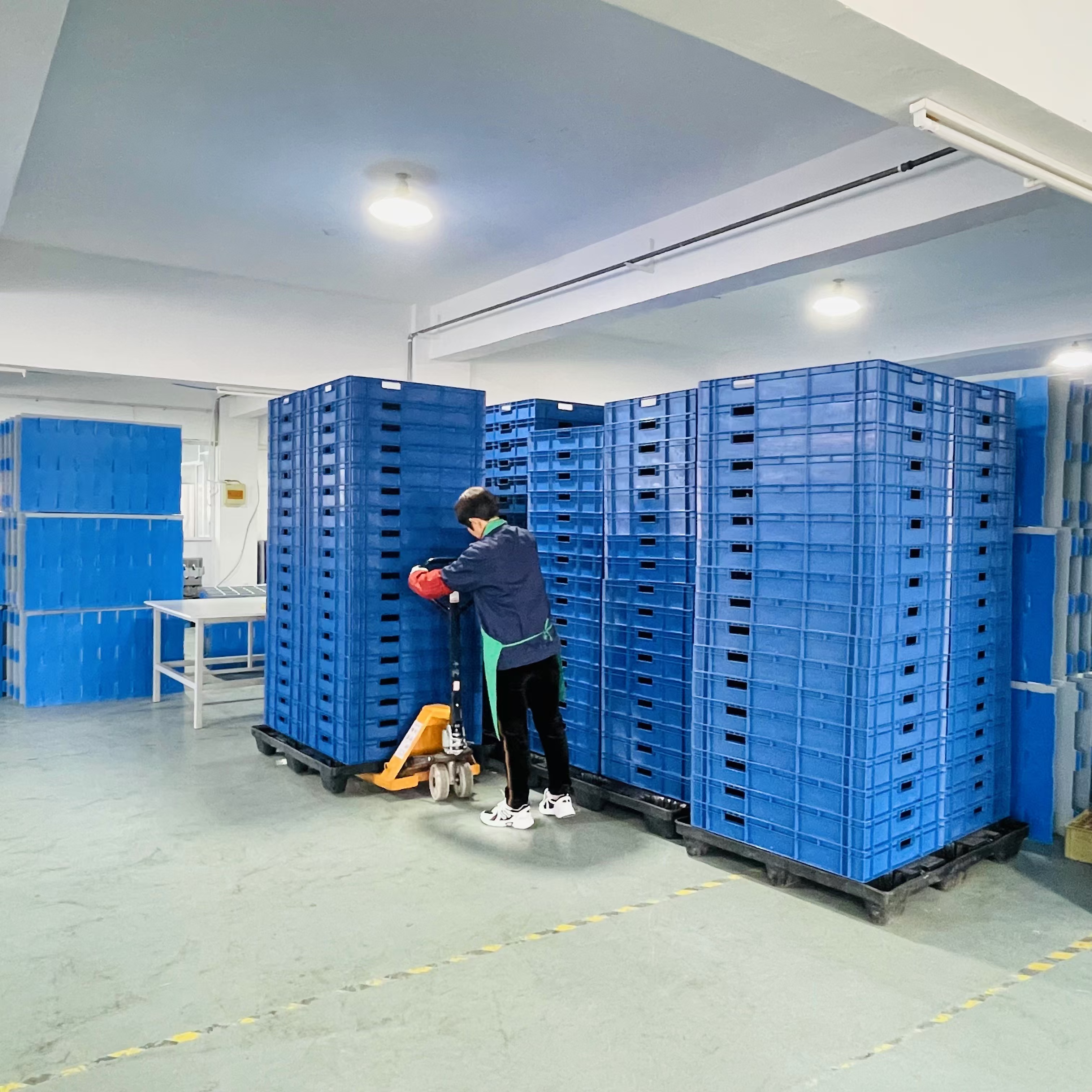
A second, equally practical layer of quality sits downstream of the factory: the interface between the box and the site. Dimensional conformity and load data only create value if the receiving warehouse handles the container the way the specification assumed. That is why the most useful supplier conversation is usually not about defect rates but about the specific stacking, racking and handling configuration the boxes will enter.
Technical explanation: materials, formats and what the specifications control
The TOYOE range is built on two commodity engineering resins, and the choice between them is a performance decision rather than a marketing one. HDPE is generally selected for toughness, moisture resistance and impact behaviour at lower temperatures; PP is selected for stiffness and chemical resistance. Some models list both materials in the same product entry, which usually indicates that different components or variants use different resins.
Format follows the application. The enclosed pallet box keeps dust and moisture away from contents and protects parts during transport, which is why it is the default format for automotive components and precision parts. Honeycomb board constructions — the catalogue names both blow-molded honeycomb board boxes and die-cast honeycomb board pallet boxes — target a high strength-to-weight ratio, a property that third-party analysis links directly to their use in automotive parts transport. Space-saving versions, including folding and sleeve-style designs, reduce the volume occupied by empty containers on the return leg. Anti-static variants and anti-static blister trays exist for electronics where electrostatic discharge is a genuine risk rather than a theoretical one.
The published dimensions and capacity figures for the range include a 1200 × 800 × 1000 mm enclosed plastic pallet box, a 1000 × 800 × 800 mm storage pallet box, and a 1230 × 830 × 1000 mm die-cast pallet box, all with a 100–200 L capacity and described as nestable, recyclable and durable. Size, colour and logo can be customised, samples are accepted, and products are packed in plastic film. The HS code is 3923100000 and the stated origin is Suzhou, China.
What a specification sheet of this kind does not tell a buyer is equally important. It does not state the rated load for a specific stacking configuration, the expected cycle life under a given handling regime, or how the resin performs at the temperature extremes of a particular site. Those are the points that require test data, a sample validation round, or both — and they are the points most often skipped when a purchase is driven by unit price alone.
Application and use cases: automotive parts logistics in Mexico
One documented application shows how these requirements come together. In a logistics warehousing and packaging project in Mexico, plastic pallet boxes are used to store automotive parts, provide standardised stacking and protect components during transport. The operating conditions are demanding and specific: high humidity, dust, a wide temperature range, and 24/7 operation. The boxes are required to work in waterproof and anti-static environments and to deliver moisture-proof, shock-resistant and load-stable performance. Supporting equipment includes forklifts, warehouse shelving and logistics handling equipment.
Each condition translates into a design or specification decision that a buyer can examine rather than assume:
- High humidity and a waterproof requirement point to an enclosed, moisture-resistant body rather than an open crate, and to a cleaning and drainage routine that keeps water from sitting inside the container.
- Dust argues for an enclosed format with minimal open surfaces, since contamination of precision parts is often the real cost driver, not box damage.
- A wide temperature range means the resin grade matters; buyers should ask for the material designation and relevant test data instead of assuming that all HDPE and PP formulations behave identically.
- 24/7 operation raises the stakes on load-bearing stability and on the acceptance criteria for damaged units, because replacement decisions cannot wait for a scheduled maintenance window.
- An anti-static requirement moves the specification toward ESD-capable variants and conductive or anti-static inner trays, which are a different product family from standard boxes.
- Forklift and rack handling makes pallet-foot geometry, entry clearance, and the way the box interacts with shelving part of the technical brief rather than a logistics afterthought.
The product data lists adjacent applications in automobile manufacturing, precision electronics, food cold chain, home logistics, medical and health care, and heavy industry, and names oils, industrial alcohol, alkalis, acids, industrial wastewater, water and car parts among the contents the containers are intended to handle. These are not equally demanding duties. Chemical contact and cold-chain handling in particular require the buyer to confirm resin compatibility, cleaning chemicals and temperature exposure rather than treating a general-purpose box as universally suitable.
Comparison with traditional solutions — and where plastic loses
Plastic is not automatically the right answer. The comparison below sets out where each traditional format leads, including the situations in which a plastic pallet box is the weaker choice on a purely commercial basis.
| Consideration | Wood | Corrugated | Steel | Plastic (HDPE / PP) |
|---|---|---|---|---|
| Moisture and rot | Absorbs moisture; can swell and rot | Loses strength when wet | Unaffected by water, but corrodes without coating | Moisture-resistant; enclosed designs help keep contents dry |
| Cleaning and hygiene | Porous, difficult to clean | Generally single-use | Cleanable; coating maintenance required | Smooth, washable surfaces |
| Weight | Heavy relative to load capacity | Light | Heaviest | Moderate; honeycomb constructions favour strength-to-weight |
| Repair | Rebuildable on site | Not repairable | Weldable | Limited; repair and replacement rules must be defined |
| Custom formats | Cut to size quickly | Die-cut tooling required | Fabricated to order | Mould or tooling plus committed volume |
| Upfront unit cost | Low | Lowest | High | Higher than wood and corrugated |
| Returnable loop fit | Moderate; degrades over cycles | Not suited | High, but heavy to move | High, when cycle economics and return freight are controlled |
| International shipping treatment | Many markets apply phytosanitary treatment requirements to solid wood packaging | Not applicable | Not applicable | No wood-treatment requirement |
| Part protection | Splinters and fasteners can damage parts | Adequate for light items | Impact transfer, requires dunnage | Enclosed body, compatible with inner-lining trays |
| ESD options | Not applicable | Limited | Conductive; bonding and grounding needed | Anti-static variants and blister trays available |
The limitations of the plastic route deserve the same clarity as its advantages:
- Higher upfront cost. A plastic pallet box usually costs more per unit than a wooden or corrugated equivalent. The case rests entirely on reuse cycles, return freight discipline and avoided part damage. Where a container is used once, plastic rarely wins.
- Tooling and volume commitments. Custom dimensions, custom linings and new formats require tooling, and tooling requires committed volume plus an engineering phase ahead of production. At this manufacturer, that engineering phase is handled by a two-engineer R&D team, so it competes with other projects and must be scheduled.
- Finite plant capacity. With 30,000 units a year across four product families from a 4,000 m² facility, a very large or fast-scaling programme cannot be absorbed instantly. Buyers in that situation should expect phased delivery, extended planning horizons, or a second qualified source.
- Damage management. Unlike a timber crate that can be rebuilt on site, a cracked moulded box needs a defined rule for repair or replacement, and any high-load loop needs acceptance criteria agreed in advance.
- Grade-dependent performance. Behaviour under prolonged UV exposure or sustained high temperature depends on the specific resin and additives. This should be verified against site conditions, not inferred from the material name.
- A verification burden on the buyer. Where testing share, lead time and warranty length are not published, the buyer carries the responsibility of obtaining them contractually. Suppliers who can document these items are, in practice, easier to qualify.
Market trend analysis
The direction of demand is documented by third-party research. Grand View Research projects the global plastic pallets and pallet box market to reach approximately USD 11.2 billion by 2030, driven by the substitution of wood in logistics. Estimates differ: IMARC Group places the comparable figure at about USD 10.4 billion by 2034, depending on whether secondary rental services are counted within the market. That divergence is worth noting because it reflects a real structural distinction — the container market and the pooled-asset rental market are not the same business.
Electrostatic discharge protection is a second growth vector that matters for parts logistics. Research Nester expects the ESD packaging market, which includes trays and pallet boxes, to reach USD 5.89 billion by 2035, growing at a compound annual growth rate of 5.8%. Plastic honeycomb board packaging — the construction used in several pallet box models — is projected by Global Market Insights to grow at a CAGR of 5.9% through 2032, a trajectory the firm links largely to the construction’s high strength-to-weight ratio in automotive parts transport.
On the supply side, Asia Pacific accounted for the largest revenue share of the plastic pallet market in 2023, at more than 32%, with China leading in industrial production capacity according to Straits Research. The global tier of the sector includes ORBIS Corporation, Schoeller Allibert, Brambles (CHEP) and Loscam, as identified by Mordor Intelligence — large manufacturers and pooling operators whose scale supports national and international rental networks. Specialist manufacturers such as Zhangjiagang Fenghui operate in the same market with a different model: customised, moderate-volume programmes built to a buyer’s specification rather than standardised pooled assets.
Standards provide the third anchor. EN 13626:2003 is the primary European standard specifying requirements and test methods for reusable box pallets used in material handling, and ASTM D1974/D1974M-22 covers the practice of closing, sealing and reinforcing container boxes used for shipping in the United States. Neither standard certifies a specific factory, but both give buyers a common vocabulary for asking about load testing and closure performance instead of relying on supplier adjectives.
What buyers should verify before placing an order
The following checklist converts the points above into questions that can be answered in a quotation. It is deliberately weighted toward items that cannot be confirmed from a catalogue.
- Capacity and allocation. Annual capacity in units, current utilisation, and the monthly allocation a new programme would receive. For this manufacturer, the published figure is 30,000 units per year from a 4,000 m² plant with roughly 34 employees.
- Written lead time, in components. Sample production, tooling for custom sizes, first batch, and repeat orders, each stated separately and in writing.
- Quality protocol. Which checks are performed at incoming, in-process and pre-shipment stages; which are destructive; the sampling basis; and whether records ship with the batch.
- Material grade. The exact HDPE or PP designation, recycled content if relevant, and any test data covering low-temperature impact or UV exposure at the intended site.
- Load rating in your configuration. Static, dynamic and stacked ratings requested for the specific racking and stacking pattern to be used, not a generic figure.
- Customisation scope and samples. Size, colour, logo and inner-lining options; samples are accepted, which supports a validation round before volume commitments.
- After-sales terms in writing. Warranty length, what is covered, what is excluded, and how replacement or repair is handled for a damaged unit.
- Export documentation. HS code 3923100000, stated origin Suzhou, China, packing method, and destination-specific entry requirements for Mexico and the USA.
Future outlook
Returnable packaging is likely to keep gaining share wherever freight economics, part-protection costs and sustainability reporting all point the same way. The growth vectors identified in third-party data — ESD packaging at a 5.8% CAGR to 2035 and honeycomb board packaging at 5.9% through 2032 — both sit close to electronics and automotive parts handling, which is exactly where enclosed and anti-static pallet boxes compete.
For specialist manufacturers, the constraint will not be demand but execution. A plant with a 4,000 m² footprint, a 30,000-unit annual capacity and two R&D engineers can serve custom programmes well, but each new custom format consumes engineering time and machine time that must be released from somewhere else. Buyers should expect capacity discipline to become a normal part of supplier conversations, and should treat published capacity figures as a starting point for allocation questions rather than as an availability guarantee.
A second development worth tracking is documentation. As returnable loops become larger and longer, the value of traceable test records, defined acceptance criteria and explicit warranty terms rises. Suppliers who can answer those questions precisely will find qualification easier, and buyers who ask them systematically will spend less time resolving problems after delivery.
FAQ
What is a plastic pallet box, and how does it differ from a standard pallet?
A plastic pallet box is a container built around a pallet footprint, made from HDPE or PP, that holds and protects goods rather than simply supporting them on an open deck. In the TOYOE range, models include a 1200 × 800 × 1000 mm enclosed plastic pallet box and a 1000 × 800 × 800 mm storage pallet box, each with a 100–200 L capacity and described as nestable, recyclable and durable. The practical difference is containment: an enclosed box shields parts from dust and moisture and allows standardised stacking, while a plain pallet leaves the load exposed.
What production capacity information should a buyer request from a pallet box manufacturer?
The three figures that matter are annual capacity in units, the proportion of that capacity already committed, and the monthly allocation available to a new programme. Zhangjiagang Fenghui publishes an annual production capacity of 30,000 units from a 4,000 m² facility with approximately 34 employees. Because that capacity is shared across plastic pallet boxes, storage boxes, plastic crates and honeycomb panel boxes, buyers should ask how it is distributed between product families and how it behaves during peak periods.
How does a pallet box factory check quality, and what evidence can a buyer ask for?
Quality control in plastic pallet box production is a sequence of checks: incoming material verification of HDPE and PP grades; in-process inspection during molding for wall thickness, warpage and dimensional drift; structural load and stacking validation; dimensional verification for custom sizes; inner-lining fit checks; and pre-shipment inspection before packing. The manufacturer states that its facility is equipped with production lines and testing equipment and that products are produced to meet national standards and individual customer requirements. A buyer can reasonably ask for the sampling plan, the list of destructive tests, and whether test records accompany the shipment.
What materials, dimensions and customisation options are available?
The published range uses HDPE and PP. Documented models include a 1200 × 800 × 1000 mm enclosed pallet box, a 1000 × 800 × 800 mm storage box and a 1230 × 830 × 1000 mm die-cast pallet box, all in a 100–200 L capacity range. Sizes, colours and logos can be customised, custom orders and samples are accepted, and products are packed in plastic film. The stated HS code is 3923100000 with origin Suzhou, China.
Which applications are enclosed plastic pallet boxes suited to?
One documented application is automotive parts storage in Mexico, where boxes provide standardised stacking and transport protection under high humidity, dust, a wide temperature range and 24/7 operation, with waterproof and anti-static requirements and handling by forklifts and warehouse shelving. The product data also lists automobile manufacturing, precision electronics, food cold chain, home logistics, medical and health care and heavy industry, with intended contents including oils, industrial alcohol, alkalis, acids, industrial wastewater, water and car parts. Buyers handling aggressive chemicals or temperature-sensitive goods should confirm resin compatibility separately.
What are the limitations of plastic pallet boxes compared with wood or steel?
The main limitations are commercial and operational rather than structural. Upfront unit cost is higher than wood or corrugated, so the case depends on reuse cycles and return freight discipline. Custom dimensions and inner linings require tooling, committed volume and an engineering phase. Plant capacity is finite — 30,000 units a year across four product families in this case — so very large programmes may need phased delivery. Damage handling requires agreed replacement rules, and performance at temperature or UV extremes depends on the specific resin grade rather than on the material name alone.
What should export buyers in Mexico and the USA confirm before ordering?
Approximately 40% of this manufacturer’s sales are exports, with Mexico and the USA named as the main markets, so cross-border documentation is routine rather than exceptional. Buyers should still confirm the HS code (3923100000), the stated origin (Suzhou, China), packing method, destination-specific entry requirements, and — most importantly — written lead time and after-sales terms. Where a returnable loop is planned, the return-freight and repair logistics should be agreed at the same time as the purchase, because those costs determine whether a plastic box beats a disposable alternative over the life of the programme.
For readers who want the underlying product data referenced in this article, the manufacturer’s product brochure is available as a downloadable PDF.