
Inside the 200,000-Piece Ready Stock: Evidence of Production Capacity for Custom Basics
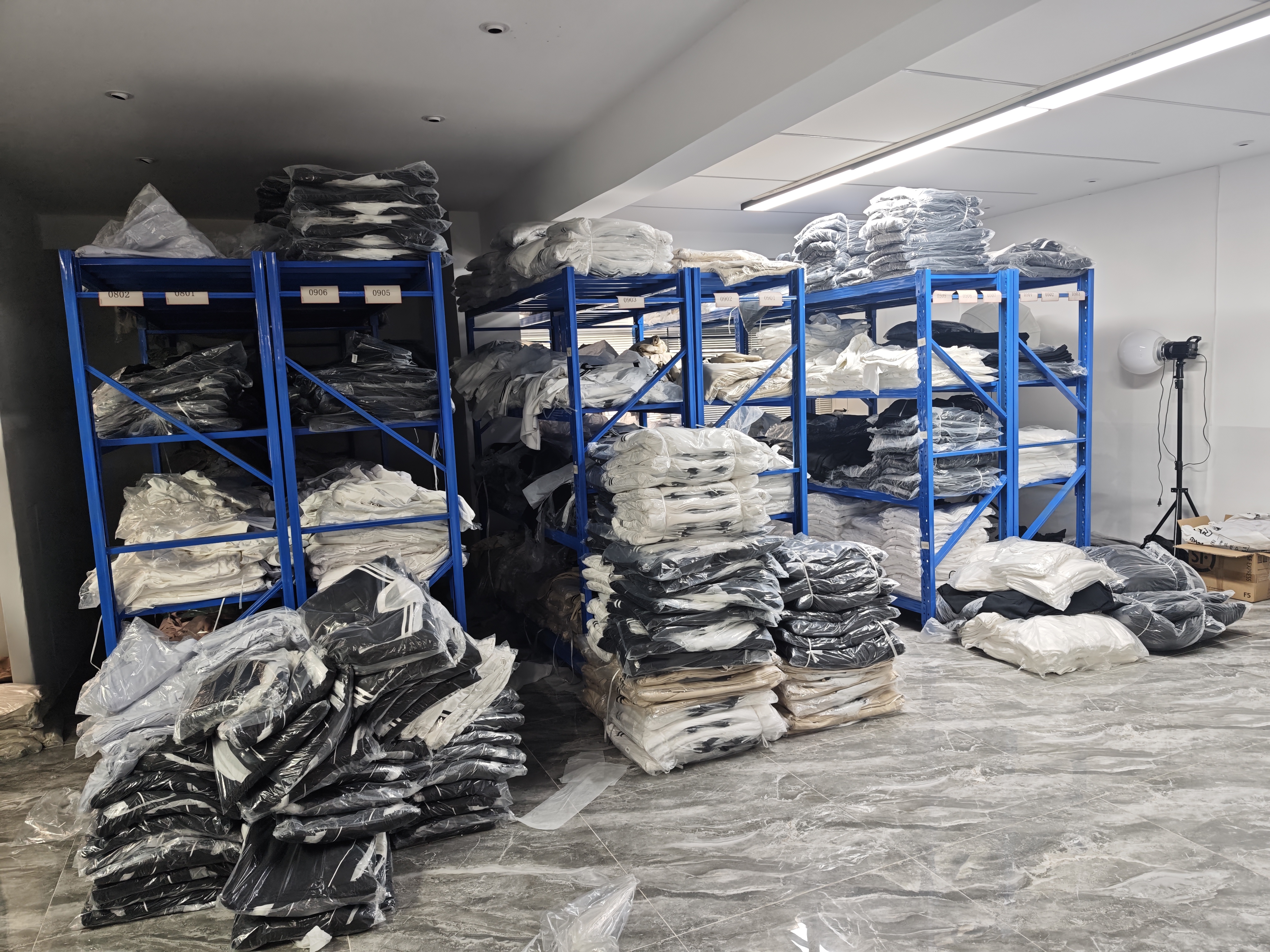
Inside the 200,000-Piece Ready Stock: Evidence of Production Capacity for Custom Basics
The global casual wear market was valued at USD 645.22 billion in 2025 and is projected to reach USD 906.32 billion by 2034, according to Fortune Business Insights. Growth on the demand side, however, does not automatically produce reliability on the supply side. For buyers sourcing custom casual apparel, the practical question is narrower: can a supplier hold enough stock, produce fast enough, and document quality well enough to protect a launch date? Capacity only becomes evidence when it is quantified and attached to a constraint — pieces per day, pieces on the shelf, headcount on in-house lines, minimum order quantity, and lead time.
This analysis examines one supplier's published operational metrics — Guangzhou Lihong Apparel Trade Co., Ltd., which trades as Lihongwear — and explains how buyers should read figures such as 1,500 pieces per day, 200,000+ pieces of ready stock, and a team of more than 100 production specialists as decision inputs rather than slogans.
Why Capacity Claims Are the Hardest Part of a Supplier Profile to Verify
Production capacity is usually described in adjectives and rarely in numbers, which is exactly why it resists verification. A buyer can test a fabric, request a sample, and compare a quotation, but there is no standard way to test a claim of being "a large factory." The workable approach is to sort a supplier's numbers into three categories and check each one against a limit.
- Throughput figures — how many pieces come off the lines in a given period. These show how quickly a bulk order moves once it is scheduled, not how quickly it will start.
- Inventory figures — how many finished pieces are physically held. These determine whether an order can be filled from stock without touching the production calendar.
- Threshold figures — minimum order quantity, lead time, and inspection scope. These define where a supplier's capability stops being useful for a specific project.
Scale makes this worth doing now. The custom made clothes market is estimated to reach USD 213.1 billion by 2035, with a CAGR of 10.5% from 2026, according to Proficient Market Insights. A market expanding at that rate pulls in many first-time buyers placing small volumes — and small buyers are the ones least able to absorb a missed delivery window.
The Numbers Behind Lihongwear's Ready-Stock Position
Guangzhou Lihong Apparel Trade Co., Ltd., trading as Lihongwear, is a Guangzhou-based manufacturer and exporter of men's basic casual apparel. It operates a 5,000 m² production plant in Tianhe District, Guangzhou, runs OEM and ODM programs alongside ready-stock wholesale, and exports roughly 80% of its output to Europe, America, Southeast Asia, the Middle East, and Australia. The company states that its production plant carries more than 10 years of manufacturing experience behind it, with the trading entity established in 2024.
The core claim is that these are operating figures rather than estimates. They are easiest to read in a table.
| Operating metric | Published value | What the number describes |
|---|---|---|
| Daily output | 1,500 pieces | Throughput of fully in-house production lines |
| Ready stock | 200,000+ pieces | Standing inventory available for immediate shipment |
| Stocked styles | 50+ | Breadth of styles held in stock |
| Annual output | 500,000 pieces per year | Total yearly garment production |
| Monthly capacity | 45,000 pieces | Knitted and woven garment capacity per month |
| Production team | 100+ specialists; 160 sewing workers; 150+ employees | In-house manpower across production, pattern making and support |
| Plant area | 5,000 m² | Self-owned production plant |
| Minimum order quantity | No MOQ for spot goods; custom orders from 200 pieces per style | Order threshold by operating mode |
| Lead time | Spot goods within 3 days; custom orders 15–25 days | Time to delivery by operating mode |
| Export share | 80% | Proportion of output shipped to export markets |
| Quality regime | International AQL manufacturing standards; full-process inspection | Inspection system applied across production |
Two rows carry more weight than the rest for a first-time buyer. The first is the MOQ structure: ready goods carry no minimum order quantity and support arbitrary mixed wholesale, while custom orders start at 200 pieces per style. That split lets a buyer test a style online or in a single retail location from stock, then commit to a private label run only once the style shows demand. The second is the inventory figure: 200,000+ pieces standing in stock is what makes a no-MOQ promise operationally possible, because mixed wholesale only works if the warehouse can pick small quantities across many styles. Lihongwear states that its stock spans more than 50 styles.
The throughput figures sit on the other side of the business. A plant producing 1,500 pieces per day and 500,000 pieces per year, with a stated monthly capacity of 45,000 knitted and woven garments, is sized for repeat wholesale volume rather than one-off jobs. Buyers evaluating a supplier for a reorder program should read the annual and daily numbers together: the annual figure describes the plant's total output envelope, while the daily figure describes how fast a scheduled order moves through the lines.
How 1,500 Pieces a Day Converts into Order Reliability
A daily output figure becomes meaningful only when it is read against the size of the orders it has to serve. A 200-piece custom run — the stated entry threshold for customization — represents roughly one-seventh of a single day's nominal output at 1,500 pieces per day. In scheduling terms, that is a small block of work. The reason a custom order still takes 15–25 days from sample confirmation is that the calendar includes pattern and sample approval, fabric and trim preparation, cutting, sewing, finishing, inspection, and packing, not sewing time alone.
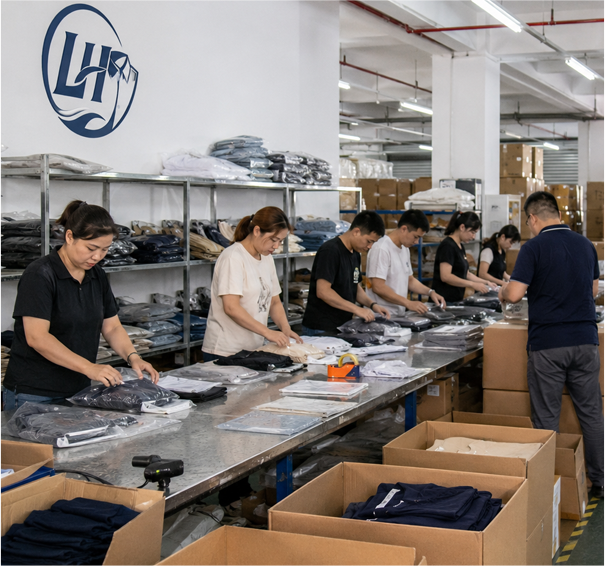
What makes the conversion reliable is that the stages sit under one roof. Lihongwear states that its production lines are fully in-house and supported by a professional team of over 100 experts, with 160 skilled sewing workers and a senior pattern maker team with more than 10 years of experience. When cutting, sewing, finishing, and packing are internal, an order is not waiting in an external subcontractor's queue, and a defect found at final inspection can be corrected without a third party in between.
The realistic caveat is that nominal capacity is not reserved capacity. A plant running 1,500 pieces per day spreads that output across concurrent orders, spot replenishment, and sampling. Buyers should treat published capacity as an indication of what the plant can absorb — not as a guaranteed daily allocation — and should confirm the specific production slot for their order and quantity at the point of scheduling.
Quality Control and Certification as Constraint Evidence
Where a throughput number shows what a supplier can do, a test report shows what has already been checked. Lihongwear's casual apparel lines are covered by textile safety reports issued by Centre Testing International Group Co., Ltd. (CTI Tianjin) against GB 18401-2010 Category B, the Chinese national standard covering fiber composition, color fastness, formaldehyde, and decomposable aromatic amine dyes.
| Report | Certificate number | Scope | Issued / validity |
|---|---|---|---|
| CTI Textile Safety Test Report | A2250308141104CR1 | Full range of men's hoodies, long-sleeve shirts, T-shirts and other garment fabrics | Issued 29 May 2025; listed valid to 29 May 2099 |
| CTI Textile Safety Inspection Test Report | A2250414729101C | Long Sleeve Shirts (1801 Series, 1701 Series) and high-elastic fabric | Issued 18 June 2025; listed valid to 18 June 2099 |
| CTI Textile Safety Test Report | A2250414729102C | Mountain Cotton composite hoodie fabric (63.5% cotton, 36.5% polyester) | Issued 18 June 2025; listed valid to 18 June 2099 |
Product-level documentation maps these reports onto specific lines: the Men's Basic Apparel range (1901 Series, 1801 Series, 1701 Series) is covered by both A2250414729102C and A2250308141104CR1, while the hoodies and sweatshirts line, including the 360g hoodie, is covered under the same CTI reporting framework. All three reports are described as applicable to the global market.
Inspection is a second layer of evidence. Every production run is stated to follow international AQL manufacturing standards, with manual checks for seam endurance, neck symmetry, and dimensional retention, plus 100% manual inspection before shipment and cooperation with third-party on-site inspection when buyers request it. Product documentation describes a seven-stage quality control process, while capability documentation describes full-process inspection covering raw materials, in-process stages, and finished goods. The practical point for buyers is that inspection is applied at multiple points rather than only at final packing.
Which Buying Scenarios These Metrics Support
The combination of standing stock and a 200-piece custom threshold fits mixed retail and wholesale models better than it fits single large programs. The stated application areas are cross-border e-commerce, clothing wholesale, trend brand labeling, corporate workwear, and offline retail — four of which depend on frequent, small, mixed replenishment.
For cross-border e-commerce sellers, spot goods shipped within 3 days and no minimum order quantity allow a new style to be listed and tested without a production commitment. For wholesalers, mixed wholesale across more than 50 stocked styles supports assortment building without holding depth in any single SKU. For brand owners developing a private label line, the 200-piece per style threshold is the point at which blank goods become branded goods, with fabric weight, size, and color specified by the buyer. For corporate workwear buyers, the same lines support larger repeats with logo application and packaging.
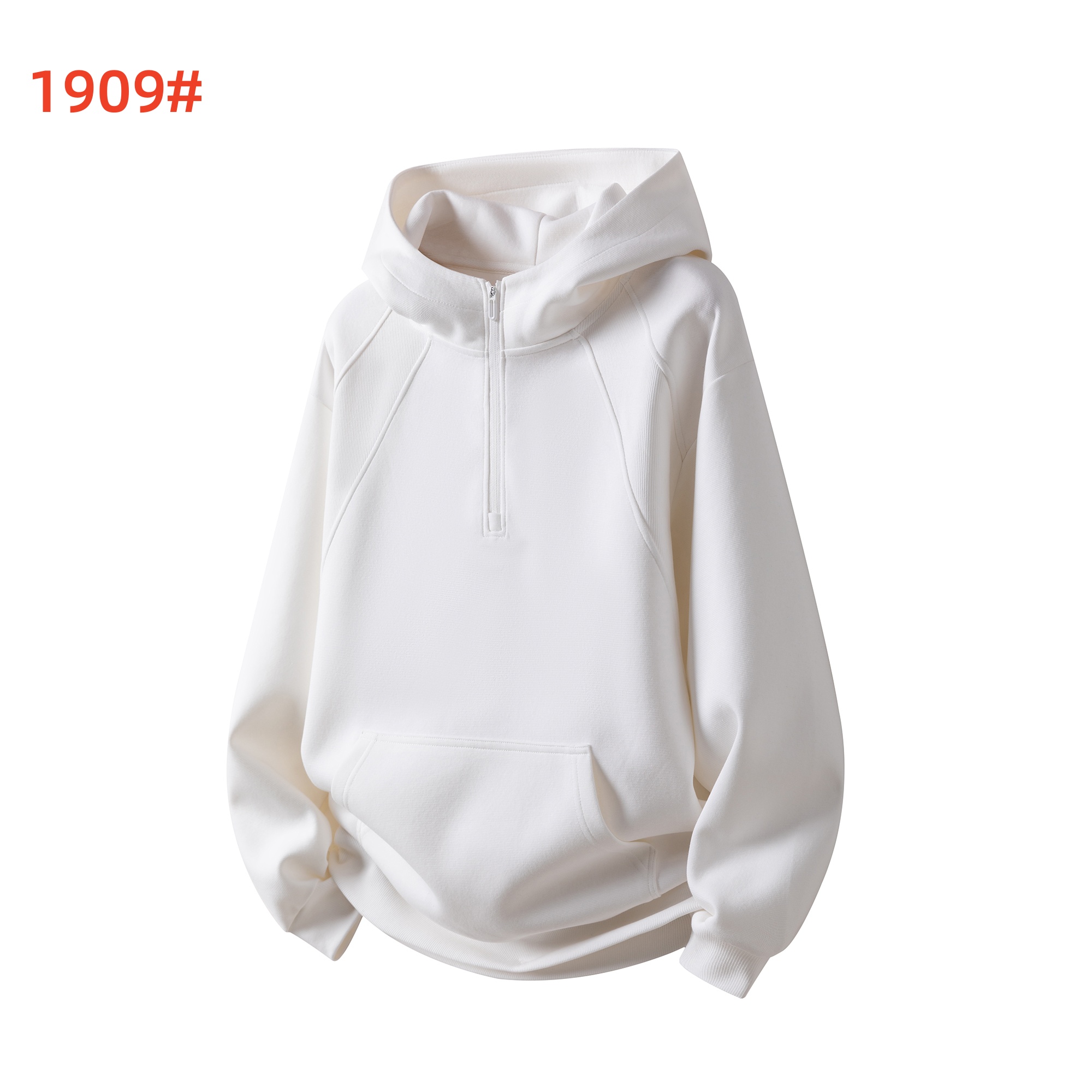
| Product category | Model series | Unit weight | Fabric composition | Size range |
|---|---|---|---|---|
| T-Shirts | 08 Series; 0606 Series; 0829 Series; Comfort Stretch Cotton Series; Roma Cotton Series | 170g / 220g / 230g | Comfort-Stretch Cotton (100% polyester); Breathable Cotton (100% combed cotton); Sorona (63.6% cotton, 36.4% polyester); Starry Sky Cotton (87% nylon, 13% spandex) | M–4XL or M–3XL depending on model |
| Long Sleeve Shirts | 1801 Series; 1701 Series | 280g | High-Elastic Tech Blend (79.7% polyester + 20.3% spandex); High-Elastic Smooth Polyester (100% polyester) | M–4XL |
| Hoodies & Sweatshirts | 1901 Series | 360g | Mountain Cotton (63.5% cotton, 36.5% polyester; lining 100% polyester) | M–3XL |
| Men's Basic Apparel | 1901 Series; 1801 Series; 1701 Series | Mixed range | Pure cotton, cotton-polyester blend, mountaineering cotton, polyester fiber, spandex, twill fabric, canvas | XS–5XL |
Market Trend Context Behind the Capacity Question
Three third-party signals explain why buyers are now asking harder questions about capacity and documentation rather than about design alone.
First, weight expectations have moved up. PrintDoors and Accio Work note that heavyweight hoodies in the 350–420 GSM range have become the baseline standard for premium streetwear, valued for a structured, boxy drape. A 360g hoodie sits inside that band, which means the specification buyers now treat as premium casual is increasingly the specification factories are asked to hold in stock.
Second, embellishment volume is growing. The U.S. custom T-shirt printing market was valued at USD 857.5 million in 2023, with a projected CAGR of 11.8% to 2030, according to Grand View Research. Printing and embroidery demand pushes back onto the blank-goods supply chain, because print shops and brand owners need consistent blanks in repeat sizes.
Third, compliance documentation is becoming a purchasing requirement rather than a differentiator. The growth in OEKO-TEX certification volumes cited above points in the same direction as rising retail scrutiny of chemical safety. Buyers who once accepted a verbal assurance now ask for a report number and a defined scope.
These figures should be read with the usual caution: third-party market estimates for custom apparel vary widely depending on whether made-to-measure tailoring, printing services, or private label production is included in the definition.
Comparison with Conventional Minimum-Order Production
The ready-stock plus low-MOQ model is not a universal improvement over conventional production; it solves a specific problem — speed and inventory risk — and gives something up in return. The table below sets the two approaches side by side, using Lihongwear's published terms as the reference point for the first column.
| Decision dimension | Ready-stock plus low-MOQ custom model | Conventional minimum-order production model |
|---|---|---|
| Entry threshold, stocked items | No MOQ; arbitrary mixed wholesale supported | Typically requires a full production run per style |
| Entry threshold, customization | From 200 pieces per style | Set per factory; commonly higher than 200 pieces |
| Replenishment speed | Spot goods shipped within 3 days | Full production cycle required before shipment |
| Range available immediately | 200,000+ pieces across 50+ stocked styles | Limited to items already committed to production |
| Customization depth | Fabric weight, size, color, printing, embroidery, labels, packaging, Pantone dyeing | Broad, but usually tied to volume commitments |
| Commercial profile | Lower inventory risk; flexibility purchased at lower volume | Committed volume typically yields a lower unit cost |
Limits of the ready-stock model. Four boundaries are worth stating plainly, because they determine whether this supplier fits a given project at all.
- Custom orders have a floor. Customization starts at 200 pieces per style. Projects requiring true single-piece or made-to-measure production fall outside this model.
- Custom timelines are not instant. The 15–25 day window runs from sample confirmation. Only spot goods ship within 3 days, and only for styles actually held in stock.
- Stock is finite and category-specific. The 200,000+ pieces are concentrated in men's basic casual apparel and standard size ranges. A large single-SKU pull or an unusual construction moves back onto the production calendar.
- Certification scope has a defined edge. Coverage runs through GB 18401-2010 Category B reports from CTI Tianjin. Buyers whose compliance file requires a different framework — for example EN ISO 13688:2022 for work-related apparel in the EU — must verify that separately rather than assuming equivalence.
Future Outlook
The direction of travel in custom basics is toward better-documented capacity rather than simply more capacity. As the casual wear market moves from USD 645.22 billion in 2025 toward a projected USD 906.32 billion by 2034, the constraint on growth is less about sewing lines and more about how quickly a buyer can convert a style test into a repeat order without holding dead stock. Models that combine standing inventory with a low customization threshold address that gap directly, and they are likely to spread as private label and cross-border sellers keep pushing order sizes downward.
The counter-trend is documentation. Retail scrutiny of chemical safety, standard compliance, and inspection records keeps rising, which means suppliers will increasingly be judged on what they can evidence — report numbers, inspection regimes, and testable lead times — rather than on what they can claim. Buyers evaluating any supplier for 2026 programs should therefore treat throughput, inventory, and certification as a single question: can the numbers be produced on request, and do they carry limits the supplier is willing to state?
FAQ
What is the minimum order quantity for custom casual apparel from Lihongwear?
For ready stock, there is no minimum order quantity, and arbitrary mixed wholesale is supported, so buyers can combine several styles in a single order. For custom production, where fabric weight, size, color, printing or embroidery are made to the buyer's specification, the minimum order quantity starts at 200 pieces per style. Buyers planning a first private label run should compare that 200-piece-per-style threshold against the number of styles in their range, because the threshold applies per style rather than per order.
How long does a custom casual apparel order take, and how does it differ from stock orders?
Spot goods are shipped within 3 days. Custom orders take 15–25 days from sample confirmation to bulk order delivery. The custom clock starts after the sample is confirmed, so buyers should add sampling time when planning a launch date. The timing difference reflects the stages a custom order passes through — pattern and sample approval, fabric and trim preparation, cutting, sewing, finishing, inspection, and packing — rather than slower sewing alone.
What production capacity does the factory operate at?
The plant runs fully in-house production lines with a daily output of 1,500 pieces and an annual output of 500,000 pieces; monthly knitted and woven garment capacity is stated at 45,000 pieces. Standing ready stock exceeds 200,000 pieces across more than 50 styles, supported by a team of over 100 production specialists, 160 sewing workers, and a senior pattern maker team with more than 10 years of experience, in a 5,000 m² facility. These figures describe throughput and inventory position; they are not a reserved daily allocation for any single buyer, and the production slot for a specific order should be confirmed at scheduling.
What customization options are available for private label casual apparel?
Customization covers fabric weight, garment size, garment color, front and back printing, embroidery logos, hangtags, wash labels, and full set packaging. Supported embellishment methods include screen printing, digital direct injection (DTG), embroidery, and heat transfer logos, with custom Pantone color-dyeing available for enterprise-level orders. Private label trims include inner neck taping, woven brand tags, printed wash care labels, custom hangtags, and custom polybag packaging. Size ranges vary by model — XS–5XL on some lines, M–4XL or M–3XL on others.
Which textile safety certifications cover the casual apparel lines?
Three CTI Textile Safety reports issued by Centre Testing International Group Co., Ltd. (CTI Tianjin) apply, all against GB 18401-2010 Category B: A2250308141104CR1 covering the full range of men's hoodies, long-sleeve shirts, T-shirts and other garment fabrics, issued 29 May 2025; A2250414729101C covering the Long Sleeve Shirts lines (1801 Series, 1701 Series) and high-elastic fabric, issued 18 June 2025; and A2250414729102C covering the Mountain Cotton composite hoodie fabric (63.5% cotton, 36.5% polyester), issued 18 June 2025. The standard covers fiber composition, color fastness, formaldehyde, and decomposable aromatic amine dyes, and the reports are listed as valid to 2099 and applicable to the global market. Buyers who require an EU-specific framework such as EN ISO 13688:2022, or OEKO-TEX documentation, need to verify that separately.
How does ready stock reduce risk for a small-batch casual apparel order?
Ready stock shortens the replenishment cycle and removes the production threshold: spot goods ship within 3 days with no minimum order quantity, so a style can be tested online or in a single store before any production commitment. It also decouples restocking from the production calendar, which matters when a style sells faster than forecast. The boundary is depth — standing stock is finite per SKU and concentrated in men's basic casual styles and standard sizes, so a large single-SKU pull or an unusual construction reverts to the 15–25 day custom cycle.