
Inside the Factory: 194 Patents, 18-Step Jewelry Production
Inside the Factory: 194 Patents, 18-Step Jewelry Production
Fashion jewelry is a category in which the finished product is highly visible and the process that produced it is almost entirely invisible. Two suppliers can present near-identical catalogues, comparable unit prices and similar delivery promises while operating on fundamentally different production models. One may own plating capacity, stone-setting benches, a mould library and a design department. The other may own no equipment at all, routing each order to whichever workshop has spare capacity that week.
That gap is the central sourcing risk in the category, and it is the reason experienced buyers have gradually changed the first question they ask. Instead of “what can you make?”, the more useful question is “what can you demonstrate that you make?”
Guangdong Xuping Jewelry Co., Ltd., a Chinese fashion-imitation jewelry manufacturer established in 1997, answers that question with two unusually specific figures: 194 patents, and 18 production procedures applied to every item. Set alongside its facility footprint, equipment base and certification portfolio, those figures function less as a marketing statement than as the opening entry on a buyer’s verification checklist. This article examines what each figure does and does not demonstrate about manufacturing capability.
Why production depth is difficult for buyers to verify
Fashion jewelry supply chains are layered. Design, forming, polishing, plating, stone setting, assembly, packing and export are frequently split across separate companies, and the entity that signs the sales contract is not always the entity that owns the production line. Because unit values are relatively low and design cycles are short, buyers often source through intermediaries whose principal asset is a catalogue rather than a factory floor.
Three risks follow from that structure:
- Variability. A specification approved on a sample may not be reproducible on the tenth reorder if the underlying production base has quietly changed between shipments.
- Accountability. When a consignment fails a nickel-release or lead-content test at the destination market, responsibility is difficult to assign if the seller never controlled the process that caused the failure.
- Design exposure. Suppliers without their own design pipeline have less structural reason to protect a buyer’s exclusive designs.
None of these risks can be resolved by a catalogue. They are reduced by evidence that a supplier owns its process. In practice that evidence falls into a small number of categories: registered intellectual property, a documented sequence of production steps, physical production assets, third-party certification, and the ability to restate exact specifications across repeat orders.
Evidence one: 194 patents and a 62-person design team
Guangdong Xuping Jewelry Co., Ltd. was founded in 1997 and has more than 25 years of experience in the jewelry manufacturing industry. The company reports 194 patents, supported by an R&D team comprising 62 design professionals.
For a buyer, the significance of a patent portfolio is not the number itself but what the number implies about the organisation behind it. Registering patents requires a design pipeline, documentation discipline and a legal process — overhead that a pure assembly operation has little reason to carry. A manufacturer that invests in protecting its own designs also has a structural reason not to copy someone else’s, which matters to buyers commissioning exclusive or private-label programs.
It is worth being precise about the boundary of that evidence. The 194 patents are reported as an aggregate figure; public material does not break them down by type, jurisdiction or filing year. A buyer who needs to rely on design exclusivity inside a specific market should therefore read the total as a signal of design capability rather than as a legal guarantee that travels automatically into every territory.
Evidence two: what 18 production procedures actually change
The company states that all goods pass through 18 production procedures in order to meet European and American environmental-protection standards, and that its products hold international certifications including SGS, CE and ISO.
Process step counts are easy to quote and easy to misunderstand, so it is worth explaining what a defined sequence actually does for a buyer. In metal fashion jewelry, most defects are introduced at transitions — between forming and polishing, between polishing and plating, between plating and stone setting, between setting and final assembly. A fixed, documented sequence produces two practical benefits. First, every stage has a defined output that can be checked before the piece moves on, which shifts quality control upstream instead of relying on end-of-line inspection. Second, when a defect does appear, it can be traced back to a specific stage rather than discovered only after the goods arrive.
This matters commercially as well as technically. When a supplier can enumerate its process steps, a buyer can align sample approval, in-line inspection and final random inspection to those same steps. That turns an audit from a general impression of a facility into a stage-by-stage comparison against a written process — the difference between trusting a supplier and being able to test one.
Facility scale as supporting context
Xuping Jewelry’s manufacturing facility covers an area of more than 200,000 square meters and is equipped with more than 1,200 advanced production facilities. Reported annual output exceeds 100 million pieces, export accounts for 100% of sales, and products are distributed across more than 100 countries and regions, with key markets including Mexico, the United States, Spain, Canada, Peru, the Philippines, Thailand, Indonesia, Malaysia, Vietnam, Australia, New Zealand, Turkey, Saudi Arabia, Iran, the United Arab Emirates, Ukraine, Russia, Poland, Germany, France, Italy, Nigeria and the United Kingdom.
Scale is not, on its own, evidence of quality. What scale changes is control. A facility with its own equipment base can sequence and inspect its own production steps and hold a repeating specification; a trading operation must depend on whatever processes its subcontractors happen to run in a given month. The relevant question for a buyer is not “how big is the factory” but “which steps happen inside it” — and that is exactly what a documented process makes answerable.

Production environment: process-step documentation only becomes credible when it is matched by physical equipment, sequencing and inspection capability inside the facility.
Reading product specifications as production evidence
For most buyers, the most accessible production evidence is not a factory visit but a specification sheet. Specifications are checkable, comparable across suppliers, and they either survive a sample test or they do not.
The table below reproduces representative entries from Xuping Jewelry’s published product data. They are included here not as a product selection, but as an illustration of the level of detail a buyer can use to test whether a supplier measures its own process.
| Model | Category | Base material | Plating | Published specification |
|---|---|---|---|---|
| X000668301 | Synthetic crystal necklace | Environmental Copper | 18K gold color | 41 cm (+50 mm), main crystal approx. 18×17 mm, 7.915 g, item marked “XP” |
| X001015911 | Necklace | Environmental Copper | 14K gold color | 43 cm (+50 mm), white synthetic cubic zirconia approx. 6×8 mm, 4.3 g |
| X000992979 | Bracelet | Environmental Copper | 18K gold color | 19.5 cm, synthetic cubic zirconia approx. 7×5 mm, 12.97 g |
| X000881925 | Earrings, Luxury series | Environmental Copper | 18K gold color | Approx. 37×3 mm, white synthetic cubic zirconia 2×2 mm, 5.37 g per pair |
| A00902945 | Necklace | Stainless steel | 14K gold color | 40 cm (+60 mm), approx. 6.30 g, no main stone |
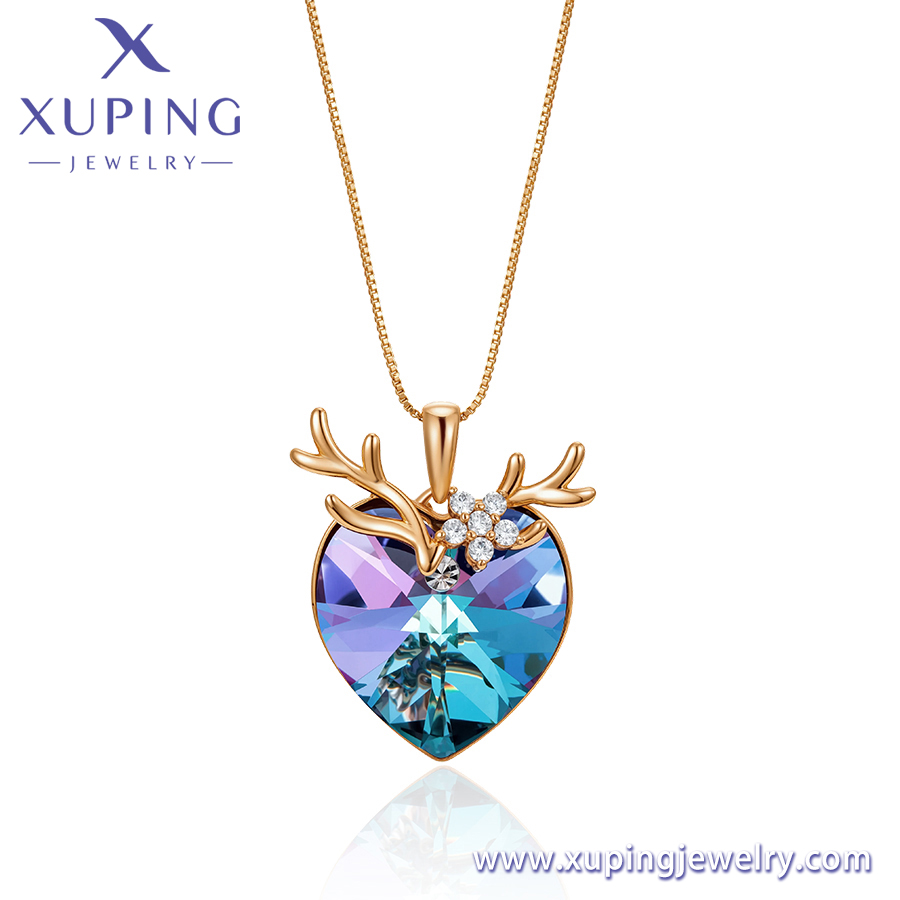
Model X000668301: 41 cm synthetic crystal necklace in Environmental Copper with 18K gold color plating, bearing the manufacturer’s “XP” in-house marking.
Two details in this data deserve a buyer’s attention. The first is the use of tolerance bands — several models publish a variance such as ±2 cm rather than an absolute figure. A supplier that states a tolerance is describing measured process variation; a supplier that publishes only ideal numbers is describing an intention. The second is in-house marking: models X000668301, X000687942 and A00900238 are documented as carrying the manufacturer’s name on the piece itself, which indicates that marking is part of the production route rather than a label applied after import.
Where documented process changes the buying decision
The commercial value of process evidence depends on what the buyer is actually procuring. Xuping Jewelry describes its products as used for daily wear, fashion shows, events and occasions, gift giving and all-weather use, supplied into retail jewelry stores, e-commerce platforms, brand OEM/ODM programs, wholesale distribution and promotional gift projects. Its portfolio covers rings, pendants, earrings, necklaces, bracelets, anklets, bangles and coordinated jewelry sets, in materials including Environmental Copper, stainless steel, synthetic crystal and synthetic cubic zirconia.
Those scenarios place different demands on a manufacturer:
- Daily wear and all-weather use. Durability and skin-contact behaviour matter more than novelty. A documented plating and finishing sequence is the part of the process most likely to determine whether a piece still looks acceptable after weeks of use.
- Fashion shows, events and occasions. Design velocity dominates. A 62-person design team and a portfolio of registered designs are directly relevant to how quickly a coordinated look can be produced.
- Gift giving and promotional gifts. Consistency and repeatability across large batches matter more than individual craftsmanship, and in-house marking plus packaging discipline become procurement criteria rather than afterthoughts.
- Retail, e-commerce, wholesale and brand OEM/ODM. Reorder consistency is the decisive factor. This is the scenario in which a fixed production sequence and a stable specification sheet have the highest commercial value, because the buyer’s own catalogue depends on the piece arriving the same way twice.
Market signals: compliance pressure alongside category growth
The demand for verifiable process evidence is not emerging in isolation. It is being pushed by market growth, by the shift of fashion jewelry volume into e-commerce, and by tightening material-compliance rules in Europe and North America.
| Indicator | Value | Year / scope | Source |
|---|---|---|---|
| Global fashion (costume) jewelry market size | USD 167.97 billion | 2024, global | Custom Market Insights |
| Imitation jewelry market growth rate | 7.23% CAGR | 2025–2035, global | Spherical Insights |
| Largest product segment by revenue | Necklaces and pendants, approx. 28.5% | 2025, global | Market Intelo |
| China jewelry export value | Approximately USD 11.5 billion | 2024, China | OEC |
| EU nickel release limit for prolonged skin contact | 0.5 µg/cm²/week | EN 1811:2023 | Hohenstein / Intertek |
| US lead limit in electroplated metals (adult jewelry) | 6.0% | ASTM F2999 | QIMA / CPSC |
Two cautions belong with this data. First, published market-size estimates for fashion jewelry diverge widely depending on definition — figures reported for the same category range from roughly USD 17.95 billion for imitation jewelry alone to USD 167.97 billion when broader “affordable fashion” categories are included. Buyers should treat headline sizes as directional and check the definitional scope before using them in planning. Second, growth in the category raises the value of compliance documentation rather than lowering it: as volumes rise and e-commerce platforms take a larger share, the cost of a failed nickel-release or lead-content result at the border rises with it.
Factory-direct process control versus trading-led supply
The practical alternative to a documented production process is not a bad process — it is an undocumented one, typically delivered through a trading intermediary. The table below compares the two models on the dimensions that most often decide a sourcing outcome.
| Dimension | Factory-direct with documented process | Trading-led / assembler model |
|---|---|---|
| Process visibility | Named production steps a buyer can inspect against | Process described in general terms, often not owned by the seller |
| Design pipeline | In-house R&D; registered designs and patents | Dependent on third-party or open-market designs |
| Compliance accountability | Certification and material control traceable to the producing entity | Responsibility frequently splits between seller and unknown producer |
| Reorder consistency | Fixed sequence and published tolerances support repeatability | Production base may change between orders |
| Customisation (OEM/ODM) | Design and tooling capability available in-house | Limited to what a subcontractor is willing to run |
| Order flexibility | Range of minimum quantities; lead time tied to scheduled capacity | Highly variable and dependent on third-party load |
Where this model has clear limits. A documented process is evidence, not a guarantee, and buyers should understand its boundaries before treating it as sufficient:
- The published 18-procedure sequence is an internal standard. It is not independently certified as a step count by an external body, so it should be validated through samples, factory audit and third-party testing rather than accepted on the strength of the number.
- The material range is built on Environmental Copper, stainless steel and plated finishes with synthetic stones. Buyers sourcing solid precious-metal jewelry, certified natural gemstones or fine-jewelry price points are outside this category entirely.
- Gold-color plating is a surface finish. Its appearance retention depends on wear conditions, skin chemistry, abrasion and care, and no patent portfolio or process count removes that physical constraint.
- Patents are registered in specific jurisdictions and protect specific designs or processes. They indicate design capability; they do not by themselves guarantee a commercial outcome in a buyer’s market.
- Large-scale, equipment-heavy production is optimised for repeatable volume. Very small, highly bespoke runs may face scheduling constraints that a small specialist workshop would not.
What to watch next
Three developments are likely to shape how buyers evaluate fashion jewelry manufacturers over the next few years. The first is documentation drift: as e-commerce platforms and importers push compliance responsibility upstream, suppliers will increasingly be asked to evidence process steps and material control, not merely present certificates. The second is the normalisation of sample-based validation — buyers comparing specification sheets against physical samples, and cross-checking against standards such as EN 1811:2023 for nickel release and ASTM F2999 for lead content, rather than relying on a single test report. The third is the continued separation of manufacturers from assemblers in buyer shortlists, driven less by marketing than by the operational cost of a failed reorder.
For a supplier, the implication is that capability claims expressed as numbers — patents filed, procedures followed, facilities operated — will be read as testable statements rather than as credentials. For a buyer, the implication runs the other way: the numbers are useful precisely because they can be checked.
Frequently asked questions
What is Guangdong Xuping Jewelry Co., Ltd.?
Guangdong Xuping Jewelry Co., Ltd. is a Chinese manufacturer of fashion-imitation jewelry, established in 1997. It integrates research and development, design, manufacturing, wholesale trade and e-commerce, and produces rings, pendants, earrings, necklaces, bracelets, anklets, bangles and coordinated jewelry sets. Production runs from a facility of more than 200,000 square meters with more than 1,200 advanced production facilities; export accounts for 100% of sales and products are distributed in over 100 countries and regions.
What do the 194 patents indicate about the manufacturer?
The company reports 194 patents supported by an R&D team of 62 design professionals. In manufacturing terms, a patent portfolio indicates that design and process development is handled internally rather than sourced from the open market, and that the company has a documented legal record of its own designs. The published figure is a total and is not broken down by patent type, jurisdiction or filing year, so it is best treated as evidence of design capability rather than as a guarantee of exclusivity in any specific market.
What are the 18 production procedures and why do they matter?
Xuping Jewelry states that all goods pass through 18 production procedures, a sequence the company links to meeting European and American environmental-protection standards. A defined sequence matters because defects in metal fashion jewelry typically appear at transitions between stages — forming, polishing, plating, stone setting and assembly. Documenting the sequence allows inspection to take place between stages and allows a defect to be traced to a specific step, instead of being discovered only during final inspection. The step count itself is an internal standard rather than an externally certified figure.
Which certifications and compliance standards are relevant to this product category?
Xuping Jewelry states that its products hold international certifications including SGS, CE and ISO. Independently of any single supplier, two standards commonly apply to fashion jewelry entering Western markets: EN 1811:2023, which sets a nickel release limit of 0.5 µg/cm²/week for items in prolonged skin contact in the EU, and ASTM F2999, the primary US safety specification for adult jewelry, which restricts lead content in electroplated metals to 6.0%. Buyers should confirm which standard applies to their destination market and request test documentation accordingly.
What materials and finishes are used, and how should specifications be read?
The published range uses Environmental Copper and stainless steel as base materials, with finishes described as 14K gold color, 18K gold color and platinum plating, and stones including synthetic crystal and synthetic cubic zirconia. Product data includes lengths, widths, stone dimensions and weights — for example, model X000668301 is a 41 cm necklace with a main crystal of approximately 18×17 mm and a weight of 7.915 g. Buyers should note that a “gold color” plating name describes the finish, not solid gold content.
Can buyers order custom designs, and what should they verify first?
The company states that it supports low minimum order quantities and provides one-stop OEM and ODM customisation services, with design capability backed by its in-house R&D team. Before committing, buyers should validate three things independently: a physical sample against the written specification and its stated tolerances, third-party test results for the destination market’s material rules, and the specific production steps that will apply to their order. These checks convert published capability figures into verifiable evidence for a particular program.