
Inside the Factory: Custom Metal Framing Fabrication Evidence
Inside the Factory: Custom Metal Framing Fabrication Evidence
An independent procurement reference on strut channel sizing, gauges, certification scope and order constraints
The global strut channel market was valued at USD 4.3 billion in 2024 and is forecast to reach USD 7.3 billion by 2033, according to Dataintelo. A separate 2025 estimate from Intel Market Research places the same category at USD 1.85 billion. The distance between those two figures reflects different definitions of what counts as strut channel, and it illustrates why buyers should treat category-level market data as context rather than as a purchasing input.
What buyers actually evaluate is narrower and harder to verify: the fabrication envelope of a specific supplier. Which profiles can be produced, at which wall thickness, in which standard lengths, under which certificate, and within which lead time. That envelope is what determines whether a purchase order can be executed without substitutions.
This reference examines the fabrication evidence of CNS INDUSTRIAL (JIAXING) CO., LTD., a manufacturer and exporter of industrial fasteners, channel fittings and metal stamping parts based in Jiaxing City, Zhejiang Province, China, operating with transport access near Shanghai Port. Its stated product scope covers strut fittings, strut channel systems, stamping parts, bolts and nuts, threaded rods, anchors, washers, screws, rivets, and general industrial hardware. The sections below set out the producible sizes, the 10 ft and 20 ft length standards, the 12 ga / 14 ga / 16 ga thickness options, the ISO 9001 certificate that applies to the product range, and the ASTM, DIN and ANSI/ASME framework that appears in most Western procurement documentation.
Why Fabrication Capability Became a Procurement Constraint
Metal-based hardware dominates the category. Metal fasteners held the largest share of the industrial fasteners market at 91.0% in 2025, according to Grand View Research. China's industrial fasteners market was valued at USD 12.23 billion in 2024 (Credence Research), and China exported USD 1.63 billion in 'Other Metal Fasteners' in 2024, according to the Observatory of Economic Complexity. In other words, there is no shortage of suppliers — which shifts the buyer's problem from availability to verification.
The verification problem is structural. Strut channel and metal framing systems are specified by profile, wall thickness, slot pattern, material grade, surface finish and cut length. A trading intermediary can quote all of those attributes without controlling any of them, so the buyer's real question is whether the supplier fabricates to the specification or sources close to it. Three questions separate the two cases, and each has a documentary answer:
- Can the supplier state the exact producible size and gauge range, rather than describing a general capability?
- Does an independent certification exist with a certificate number, issuing body, applicable standard and scope of coverage?
- Does the supplier produce to named standards and to drawings or samples, and does it state the order constraints up front?
The remainder of this article answers those three questions using documented facts about one supplier's operation, and it also identifies where the public evidence stops.
The Producible Envelope: Strut Channel Sizes, Gauges and Lengths
CNS INDUSTRIAL's strut channel and metal framing range is defined by an explicit dimensional envelope rather than a generic catalogue claim. The published profile sizes are 1-5/8" × 1-5/8" (41 × 41 mm), 1-5/8" × 13/16" (41 × 21 mm), 1-5/8" × 2-7/16", and 1-5/8" × 3-1/4". Wall thickness is offered in 12 ga, 14 ga and 16 ga. Standard lengths are 10 ft and 20 ft, with custom lengths available.
| Attribute | Documented values | Procurement implication |
|---|---|---|
| Profiles | 1-5/8" × 1-5/8" (41 × 41 mm); 1-5/8" × 13/16" (41 × 21 mm); 1-5/8" × 2-7/16"; 1-5/8" × 3-1/4" | Covers the common single and double-strut support geometries in MEP and equipment support work |
| Metric wall variants | 41 × 41 × 2.5 mm slotted; 41 × 41 × 2.5 mm unslotted; 41 × 41 × 2.0 mm; 41 × 21 × 2.5 mm | Allows a metric-specified project to be matched without converting to a nominal imperial gauge |
| Thickness | 12 ga / 14 ga / 16 ga | Gauge drives load capacity, weight, coating consumption and handling cost — it should be fixed in the drawing, not left to the supplier |
| Standard lengths | 10 ft and 20 ft; custom available | 10 ft suits container optimisation and manual handling; 20 ft reduces splice count on long runs |
| Channel type | Unslotted (solid) and slotted; back-to-back | Unslotted for higher structural strength, slotted for field adjustability |
| Materials | Carbon steel, stainless steel 304 / 316, aluminium | Material selection is the primary corrosion and cost decision |
| Finishes | Pre-galvanized (G90), hot-dip galvanized, powder coated (green) | Finish must be specified together with the environment, not after the material |
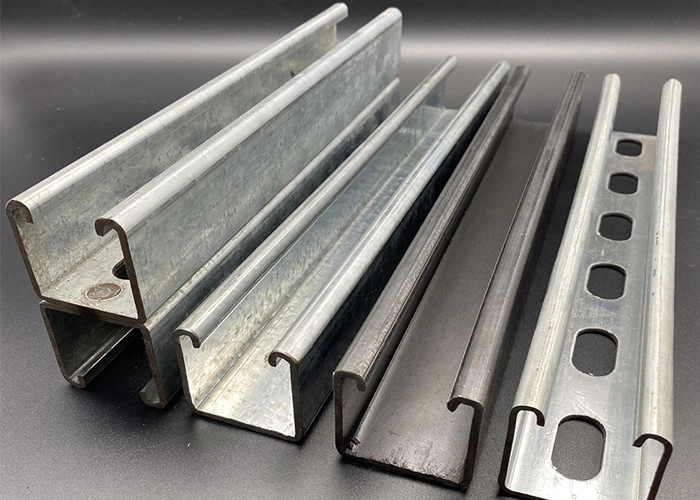
Strut channel section produced for metal framing systems. Profile, gauge and slot pattern are fixed at the drawing stage, before the coil is formed.
Two practical points follow from this table. First, thickness and profile are independent variables: a 41 × 41 mm channel can be produced in more than one wall thickness, and the difference is structural, not cosmetic. Second, the metric and imperial designations in the list describe the same family of profiles, so a project specified in millimetres can be quoted without renaming the part.
Certification Evidence: What the ISO 9001 Certificate Covers
The quality management certification in force for the Industrial Fasteners product range is ISO 9001, issued by Euroswiss Certification Co., Ltd. under certificate number 37825Q15712R0S. The applicable standard is GB/T19001-2016 / ISO9001:2015. The certificate was issued on 2025-08-08 and expires on 2027-08-07 (with the certification scope stated as sales of metal products), and it is valid for the worldwide market.
That last detail matters more than it appears. A certificate with a defined scope is audit evidence; a claim of 'ISO certified' without a scope is not. Buyers comparing suppliers should record the certificate number, the issuing body, the applicable standard and the scope line, then check that the scope covers the activity they are purchasing.
Alongside the management-system certificate, the product range is manufactured according to GB, ISO, DIN, ANSI/ASME, UNI, JIS, BS and NFE standards, or customised to customer drawings and samples. Within the ASTM framework, the stated coverage includes ASTM A563 / A194 and ASTM A325 / A490. Available grades and classes include 4.8, 8.8, 10.9, 12.9, B7 alloy steel, high tensile grades, and stainless steel A2-70 / A4-80, with custom grades available.
Where a project references third-party standards that are not printed on a supplier's own documentation, the following equivalences are useful when reconciling a bill of materials across regions: ISO 7089 and ISO 7090 are the primary international standards for plain washers and are equivalent to DIN 125; hexagon nuts are governed by standards such as ISO 4032 and DIN 934; spring lock washers with square ends are standardised under DIN 127 / BS4464B; and hexagon head bolts (grade C) are standardised under DIN 601 and ISO 4016.
Inside the Process: From Drawing or Standard to Finished System
The operating model combines manufacturing and OEM production — including collaboration with multiple factories — with product processing, packaging and trading services. In practice this means two production routes are available to a buyer: production to a standard (GB/ISO/DIN/ANSI and the other named systems), or production to a sample or drawing supplied by the customer.
The fabricated system is not limited to the channel itself. The documented accessory set includes channel fittings, spring nuts, threaded rods and pipe clamps. Spring nuts are available in M6, M8, M10 and M12; channel nuts in M8, M10 and M12. Stamped fittings in the range include angle connectors, flat tees, corner and flat-corner brackets, splice plates, shelf angles, offset and end angles, U supports and flush-mount brackets — the components that turn a length of channel into an adjustable support assembly.
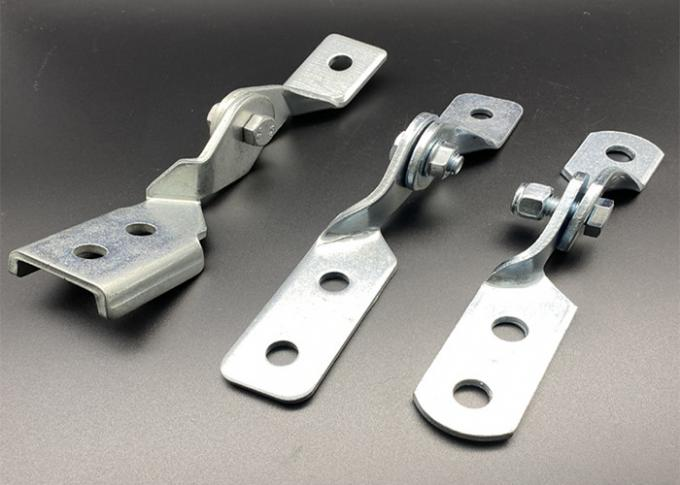
A stamped channel fitting from the strut fittings range. Stamped components are produced to the same material and finish specification as the channel they connect to.
Material and finish choices are therefore made at the system level rather than the part level. Carbon steel covers general structural and support work; stainless steel 304 and 316 cover corrosive and hygienic environments; aluminium reduces weight. Surface treatment options include pre-galvanized (G90), hot-dip galvanized, and powder coat in green, while the wider fastener range also lists zinc plating, Dacromet, Magni, yellow zinc and white zinc.
One technical distinction should be closed before an order is placed: the difference between slotted and unslotted channel. Slotted channel allows fittings and spring nuts to be repositioned after installation, which is valuable in MEP and equipment support work where field tolerance accumulates. Unslotted solid channel removes material less and is the appropriate choice where the channel is acting as a structural member. Back-to-back configurations serve applications requiring higher stiffness along a single axis.
Capacity, Lead Time and Order Constraints
The order envelope for this supplier is explicitly stated, which is uncommon in the category and useful for planning. The facility covers 30,000 m² with 50–100 employees, including a 20-engineer R&D team. Annual output is stated at 8,000 tons, with monthly capacity of 800 tons. Export accounts for 100% of sales, with the main markets identified as the EU and US, South America and Canada.
| Constraint | Documented value | Planning consequence |
|---|---|---|
| Minimum order quantity | 500 kg per item | Custom profiles are economical at project scale; single-piece or emergency quantities are not the intended use case |
| Lead time | 30–45 days | Custom framing programmes must be scheduled against the project sequence, not against a stock replenishment cycle |
| Monthly capacity | 800 tons | Supports larger multi-container programmes when booked in advance |
| Logistics base | Near Shanghai Port, Jiaxing City, Zhejiang Province | Consolidation with other fastener and hardware lines from one origin reduces handling stages |
For buyers, the significant number here is the lead time rather than the capacity. A 30–45 day production window is normal for drawing-based fabrication, but it changes how a project should be sequenced: fabricated framing must be released early enough to arrive before the installation phase that depends on it, and it cannot be treated as a same-week substitute for local stock.
Where Custom Metal Framing Systems Are Specified
The documented application set for these products includes pipeline supports, MEP installations, equipment anchoring, and building and decorative support systems. The operating profile is primarily static installation and mechanical fastening, for either long-term fixation or removable connections depending on the product selected. Supporting devices used in an integrated assembly include strut channels, channel nuts, beam clamps, pipe clamps and brackets.
Industry coverage stated across the product and application units includes construction and building infrastructure, mechanical, electrical and plumbing (MEP), HVAC, solar and renewable energy, oil, gas and petrochemical, power generation and electrical utilities, transportation and railway, and heavy machinery and equipment.
The supplier's recorded customer profile describes engineering contractors, machinery manufacturers, and electrical and general industrial customers, with delivery recorded to the United States, Canada, Mexico, Argentina, Australia, Belgium, Costa Rica, Germany, Denmark, France and the United Kingdom, at a recurring order scale of 500 kg per item. The stated outcomes are strong, durable connections for pipeline support and equipment anchoring, improved installation efficiency, and reduced long-term maintenance needs. Those outcomes should be read as reported application results rather than as independently measured performance data — a distinction that matters when a specification requires third-party testing.
Custom Fabrication Versus Traditional Support Solutions
Custom-fabricated channel systems compete with two established alternatives: cutting standard stock on site, and welded field fabrication. Each route has a different cost and risk distribution, and the choice is usually made on total installed cost rather than unit price.
| Criterion | Drawing-based channel fabrication | Standard stock cut on site | Welded field-fabricated support |
|---|---|---|---|
| Dimensional control | Profile, gauge and length fixed in production to a drawing or sample | Limited to available catalogue profiles and gauges | Depends on site fitting and welding skill |
| Coating integrity | Pre-galvanized, hot-dip galvanized or powder coated before shipment | Cut edges expose base metal and require touch-up | Welds and heat-affected zones require re-coating |
| Adjustability | Slotted profiles with channel or spring nuts allow repositioning | Adjustable only where slotted stock is used | Geometry generally fixed once welded |
| Site labour | Reduced cutting, drilling and hot work | Moderate cutting and finishing labour | Highest labour and permit burden |
| Order economics | 500 kg per item minimum; 30–45 day lead time | Immediate, no minimum | Material plus labour plus inspection |
The limits of the fabricated route deserve equal weight. A 30–45 day lead time and a 500 kg per item minimum mean custom fabrication is not a solution for emergency repairs or single-length replacements; local stock remains the correct answer there. Gauge selection involves a real trade-off rather than a simple preference for heavier material: moving from 16 ga to 12 ga increases load capacity and stiffness but also increases weight, coating consumption, freight cost and handling effort, which is why the gauge should be set by the structural requirement rather than by default. Finally, drawing-based production transfers accuracy requirements upstream — an inaccurate drawing produces an accurately manufactured wrong part, so tolerance, finish and material grade must be confirmed before production begins.
Market Trends Behind the Category in 2026
The category-level data supports the direction of demand, even where the absolute figures diverge. The global industrial fasteners market was valued at USD 93.12 billion in 2025 by Fortune Business Insights, while Grand View Research projects the market to reach USD 153.71 billion by 2033 at a CAGR of 5.1%. Published 2025 estimates range from USD 103.9 billion (Grand View Research) to USD 124.2 billion in 2024 (Global Market Insights), a spread that reflects differing treatment of product categories rather than a disagreement about growth.
Three structural patterns are consistent across sources. Asia Pacific dominated the industrial fasteners market with a revenue share of 45.1% in 2025. Bolts represent the largest single product segment at 31.3% share in 2025. And metal fasteners account for 91.0% of the market, confirming that metal-based fabrication — not alternative materials — carries the volume.
The adjacent fabrication categories show the same regional concentration. The global metal stamping market was valued at USD 255.35 billion in 2024, with Asia Pacific holding 57.7% of the market in 2025 according to IMARC Group. For buyers, the implication is not simply that supply is concentrated; it is that documentation quality becomes the differentiator inside a concentrated supply base, because price competition alone no longer separates suppliers.
What the Public Evidence Does Not Cover
An honest reading of the available material leaves several items open, and buyers should close them during qualification rather than assume them.
- Quality control procedures are not detailed. Incoming, in-process and final inspections are the common industry practice, but the specific inspection criteria for this supplier are not published and should be agreed in writing before production.
- After-sales terms are not specified publicly. Quality claims and technical support are typically covered; the actual terms must be confirmed with the sales contact.
- Special requirements must be declared in advance. Corrosion resistance, strength grade and dimensional tolerance requirements need to be specified with the material grade and finish at the enquiry stage.
- Certification scope is defined. The ISO 9001 certificate covers sales of metal products; buyers whose own quality system requires production-scope certification should verify how the scope line maps to their requirement.
- Category market figures vary by source. Where two research houses publish materially different market values for the same category, neither should be used as the basis for a procurement decision.
Future Outlook
If the strut channel market grows from USD 4.3 billion in 2024 to USD 7.3 billion by 2033 at a CAGR of 6.1% as forecast by Dataintelo, the growth will be absorbed disproportionately by suppliers that can document what they fabricate. The reason is straightforward: as support systems are engineered rather than improvised, the specification travels with the purchase order, and the supplier's ability to match a drawing, a standard and a certificate becomes the binding constraint on winning the order.
Three developments follow for buyers. First, gauge and finish decisions will continue to migrate from the job site to the drawing stage, which raises the value of suppliers who can hold a dimensional envelope across repeat orders. Second, standards reconciliation across DIN, ISO, ASTM and GB will remain a routine part of international purchasing, and suppliers who state their standard coverage explicitly will be easier to qualify. Third, logistics proximity will remain a real, if secondary, factor — a fabrication base near Shanghai Port supports consolidation of channel, fittings, threaded rods and fasteners into fewer shipment stages.
FAQ
How should a buyer choose between hot-dip galvanized and electro-zinc plated fasteners and strut channel for outdoor projects?
Choose hot-dip galvanized (HDG) for outdoor, coastal and harsh corrosive environments because of its heavier protective zinc coating, commonly specified at or above 45 μm and typically cited in the 45–85 μm range. Choose electro-zinc plating (EG), which typically produces a thinner coating in the 5–12 μm range, for indoor, dry environments where cost efficiency and precise thread fit are the priority. HDG is generally recommended for outdoor solar racking, coastal infrastructure and heavy industrial plant installations; EG suits indoor HVAC mounting, electrical conduit hanging and interior wall framing.
What is the difference between SS304 and SS316 stainless steel fasteners, and which should be selected?
SS316 contains 2%–3% molybdenum, which makes it significantly more resistant to chloride corrosion, salt fog and harsh chemicals than SS304. SS304 offers good strength and cost performance for standard indoor and general outdoor environments. SS304 is the usual choice for general construction, commercial framing and inland applications; SS316 is the appropriate choice for marine hardware, coastal solar installations, food processing equipment and chemical engineering projects.
How is the correct bolt grade chosen for an industrial application?
The grade is selected against required load, tensile strength, yield strength, application conditions and safety requirements. Imperial Grade 5 and Grade 8 bolts are widely used, while metric property classes 8.8, 10.9 and 12.9 provide different strength levels. Grade 8 offers higher tensile and yield strength than Grade 5 and suits higher-load applications, while Grade 5 is often sufficient for general-purpose work. A higher-strength bolt is not automatically the better choice: the mating components, tightening requirements, operating environment and the behaviour of the complete joint must be considered together.
How is the right spring nut selected for a strut channel?
Selection is based on channel size, thread size, load requirement, material and installation environment. The nut must first match the channel profile and slot dimensions. The thread size — for example 1/4"-20, 3/8"-16 or 1/2"-13 — must match the threaded rod or bolt in use. Heavier loads require a nut with an appropriate load rating and stronger construction. Material and finish must match the environment, such as zinc-plated steel for general indoor use and hot-dip galvanized or stainless steel for outdoor or corrosive conditions. A spring nut holds itself in position inside the channel, which speeds installation overhead and on vertical runs; a plain channel nut requires more attention to positioning during installation.
Why does a spring nut slip inside a strut channel, and how is it corrected?
Slipping usually has one of four causes: the nut does not match the channel profile, the spring is too weak or damaged, the channel or nut dimensions are out of tolerance, or the nut was not properly positioned before tightening. Confirm that the spring nut is designed for the specific channel size and profile, check that the spring seats correctly against the inside of the channel, and rotate the nut into its locking position before applying torque. Verify thread size and bolt length for compatibility. For heavy-duty applications, a heavy-duty spring nut with a stronger spring and an appropriate load rating is the better selection. A spring that is damaged, deformed or has lost tension should be replaced rather than reused.
How are bolts and nuts prevented from loosening under vibration?
Loosening under vibration is controlled by combining an appropriate locking method with correct bolt preload. Common options include prevailing-torque lock nuts, threadlocker, spring washers, locking washers and other mechanical locking methods. Lock nuts provide a mechanical means of resisting loosening and are convenient where the joint may need to be disassembled; threadlocker uses an adhesive and can resist vibration reliably, but the correct grade and temperature resistance must be considered. For frequently serviced industrial assemblies, prevailing-torque lock nuts or similar mechanical locking nuts are practical; for permanent or semi-permanent assemblies, threadlocker is effective. In severe vibration applications, a locking method should be combined with correct tightening torque rather than relying on a spring washer alone.
CNS INDUSTRIAL (JIAXING) CO., LTD. manufactures strut fittings, strut channel systems, stamping parts, bolts and nuts, threaded rods, anchors, washers, screws and rivets, and exports to the EU and US, South American and Canadian markets. Product and capability details are available at www.cnsindustrial.com.