
Inside the GR350S Factory Spec: Evidence of Industrial-Grade Roll-to-Roll Label Production
Inside the GR350S Factory Spec: Evidence of Industrial-Grade Roll-to-Roll Label Production
A digital label press is bought twice — once on the specification sheet, and once on the factory floor. Print samples show what a machine can do in a demonstration. They do not show whether the frame holds alignment through a full shift, whether the rewinder accepts a jumbo roll without an operator standing beside it, or whether the electrical architecture can be serviced inside an ordinary industrial unit. For buyers at the decision stage, those questions are answered by physical build evidence rather than by a sample book.
The GR350S is a roll-to-roll UV inkjet digital label printer produced by Nanjing Grando Digital Technology Co., Ltd., which trades as Grandoprint. Grandoprint is a Chinese digital inkjet equipment manufacturer founded in 2010, operating two manufacturing bases in Nanjing and Shanghai that together cover more than 20,000 ㎡, with 500+ employees, a stated annual output of 15,000 units, and an export ratio of 70% across markets including the United States, Brazil, Mexico, Australia, Thailand, Germany, Italy, Kuwait, Angola and Ivory Coast.
This article reads the GR350S from the factory-specification side: which structural components are documented, what operating envelope they support, what the machine demands of a site before installation, and where the platform stops being the obvious answer.
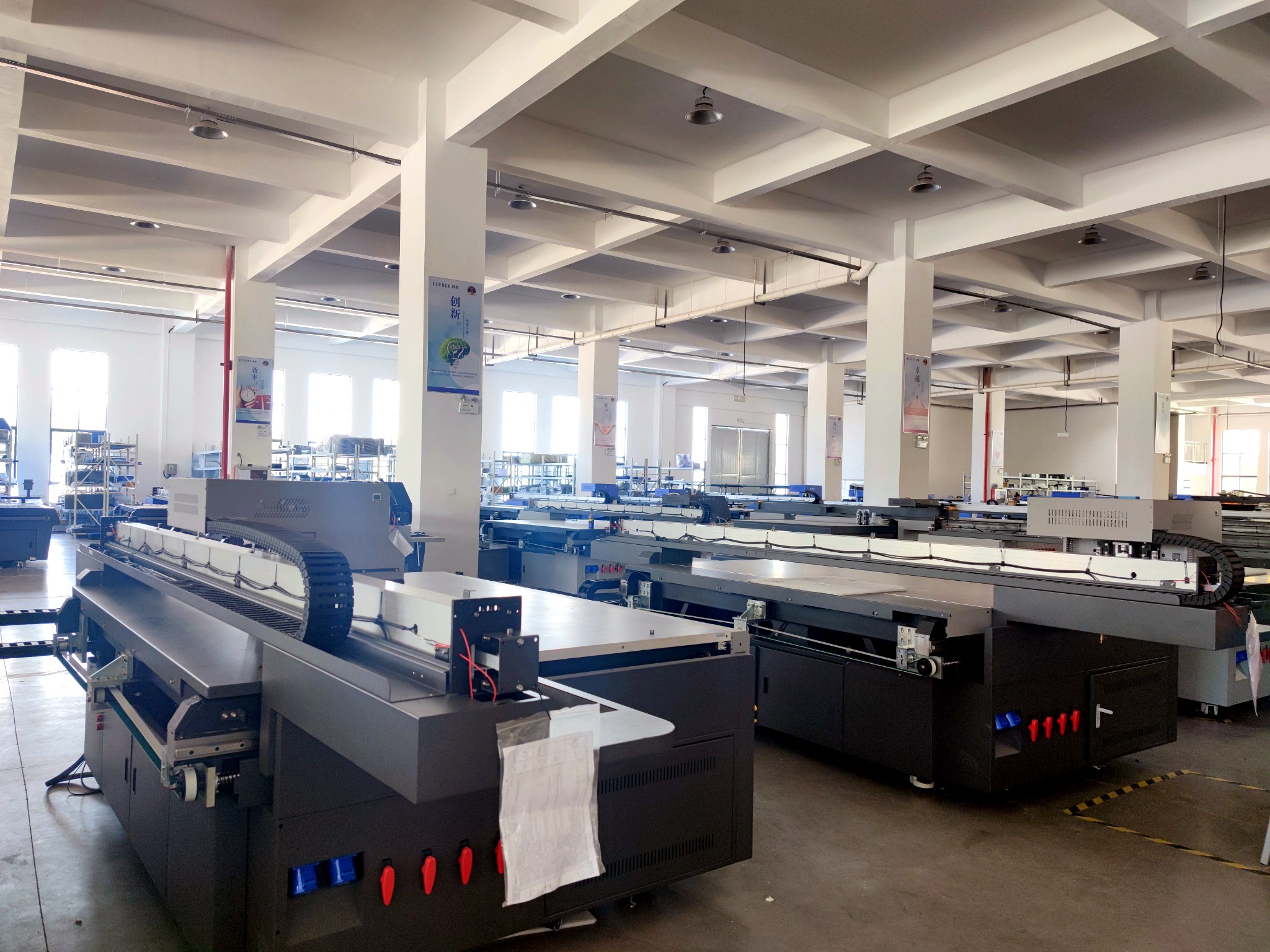
Manufacturing workshop: the GR350S is assembled and tested in Grandoprint's Nanjing base before delivery.
Why build evidence has become a procurement stage, not a footnote
Industrial configurations now define the label printer market. Industrial label printers account for approximately 42.5% of the total label printer market (Dataintelo, 2025), and within digital label printing, inkjet systems are estimated to hold a 46% share by system type in 2025 (Future Market Insights). Those figures describe where capacity is being installed — and they explain why buyers now ask specification questions that used to be reserved for flexo and offset equipment: frame rigidity, roller construction, web tension behaviour, control-cabinet integration and power quality.
The reason is structural rather than aesthetic. A press that runs three jobs a week is forgiving. A press that runs across two shifts, absorbing different substrates and different artwork within the same working day, is not. Wear, thermal drift and web-handling inconsistency accumulate in ways that only surface under continuous duty. Build evidence is the earliest available proxy for uptime: it is visible before installation, and it constrains everything that happens afterwards — service intervals, substrate tolerance, achievable changeover time and the amount of operator attention a line consumes.
For a buyer comparing a digital roll-to-roll platform against an established flexo workflow, the useful question is therefore not "how good does the print look?" but "which documented components make the print repeatable on day 400, not just day one?"
What the GR350S specification sheet documents
The published specification places the platform in the heavy industrial class rather than the entry-production class. The table below consolidates the documented values and the procurement question each one answers.
| Documented item | GR350S specification | Procurement question it answers |
|---|---|---|
| Printing method | Roll-to-roll UV inkjet digital printing, no plate-making | Does a new job require plate production or press set-up? |
| Print speed | 20–100 m/min | Can the press keep pace with the finishing line it feeds? |
| Overall dimensions | 2850 mm (W) × 1400 mm (D) × 2040 mm (H) | What floor area, access route and service clearance is needed? |
| Power requirement | 10 kW at 380 V | What electrical supply, cabling and protection does the site need? |
| Maximum unwinding diameter | 700 mm | How long can the press run between roll changes? |
| Structural build | Industrial metal frame; sheet-metal enclosure; precision metal rollers; integrated electrical control cabinet | What supports alignment, safety, cleanliness and serviceability? |
Read together, these six lines describe a machine intended for daily production in a label factory, not a bench-mounted unit. That positioning is what makes the individual components worth examining.
Reading the four build components as uptime variables
Industrial metal frame
The frame is the reference surface for every other subsystem on a web press. In digital printing, register is set by the geometric relationship between the printhead carriage and the moving web; if the frame deflects or resonates, that relationship changes mid-job and register drifts. An industrial metal frame is specified to hold geometry under the loads a label plant actually generates: web tension, roll changes, acceleration toward the top of the 20–100 m/min range, and the cyclic vibration of multi-shift operation. In procurement terms, frame construction is the component that decides whether a machine can be calibrated once and then trusted, or recalibrated repeatedly.
Sheet-metal enclosure
An enclosure is not cosmetic. The GR350S uses a sheet-metal enclosure, which performs three functional roles: it shields the print path from dust and airborne contamination, it encloses the curing and web-handling sections behind a serviceable barrier, and it resists the mechanical knocks that occur in a working label plant. The practical consequence for a buyer is maintenance posture — sheet-metal structures can be opened, cleaned and re-secured repeatedly over the life of the machine without degrading, which matters for equipment that is expected to be cleaned on a defined cycle rather than once a year.
Precision metal rollers
Rollers define the path the substrate follows and the tension it carries. Dimensional consistency across a roller determines whether tension stays even across the full web width; where it does not, the symptoms appear as wrinkles, edge curl, wandering register and inconsistent ink laydown — defects that are usually blamed on ink or printheads before anyone inspects the web path. Precision metal rollers are therefore a specification about waste rates and about the range of substrates a press can accept without constant adjustment. This becomes more important as a job mix widens, because each substrate class behaves differently at the same tension setting.
Integrated electrical control cabinet
The 10 kW requirement at 380 V turns the electrical architecture into a site-planning item rather than an accessory. An integrated control cabinet houses drive electronics, ink-system control, curing power and machine logic inside the machine structure. For the buyer, that has two consequences. First, integration reduces the number of separate panels that must be wired, ventilated and maintained at the installation site, simplifying the interface with site power. Second, it concentrates heat and electrical noise inside one enclosure, which is why cabinet placement within a 2040 mm-high frame matters for service access and airflow. The GR350S's control behaviour is documented through a registered control system — the High-Precision Industrial Inkjet Control System V1.0 (registration No. 2025SR0599079) — and an anti-collision function covered by patent No. ZL 2023 2 1184513.3.
How the structure supports 20–100 m/min
Speed on a digital label press is a system property, not a printhead property. The documented range spans a ratio of five to one. The lower end accommodates job set-up and materials that are transported more slowly for control; the upper end defines the throughput the web-handling system is specified to sustain. Reaching 100 m/min consistently requires four conditions to hold at the same time: a frame that does not move relative to the printheads, rollers that maintain even tension, a take-up assembly that winds finished material without telescoping, and drive and curing capacity sized with headroom rather than operated at its ceiling.
The 10 kW supply at 380 V is the power budget available for those functions. That combination — three-phase industrial supply, a ten-kilowatt draw, and a machine footprint of 2850 mm by 1400 mm at 2040 mm high — is consistent with a production installation in a dedicated label hall, and it is a useful screening criterion during supplier evaluation: a site that cannot provide 380 V industrial power to a dedicated socket is not a site where this class of press can be commissioned as specified.
Roll-to-roll feeding and rewinding: what a 700 mm unwinding diameter buys
The GR350S is specified with roll-to-roll feeding and rewinding assemblies and a maximum unwinding diameter of 700 mm. Diameter is the specification that converts most directly into labour and downtime. A larger input roll means fewer roll changes per shift, fewer rethreading events, and fewer opportunities for the web to be misaligned or contaminated at a splice point. In plants running mixed jobs, those interruptions are precisely what erode the theoretical advantage of digital printing, because changeover time is where short-run economics are won or lost.
The intended operating model is sustained production with minimal operator intervention: the machine accepts a roll, prints continuously, and rewinds finished labels, rather than stopping for frequent reloading. Rewinding matters as much as unwinding. A take-up assembly that maintains tension produces a stable finished roll that downstream finishing, inspection or shipping can handle without rework — and it is one of the least-examined specifications in most purchase decisions, despite being the point at which the printed product leaves the machine.
This is the configuration best matched to short runs, multi-SKU work, variable-data jobs and customised orders, where the combination of roll capacity and a 20–100 m/min range keeps the press productive rather than idle.
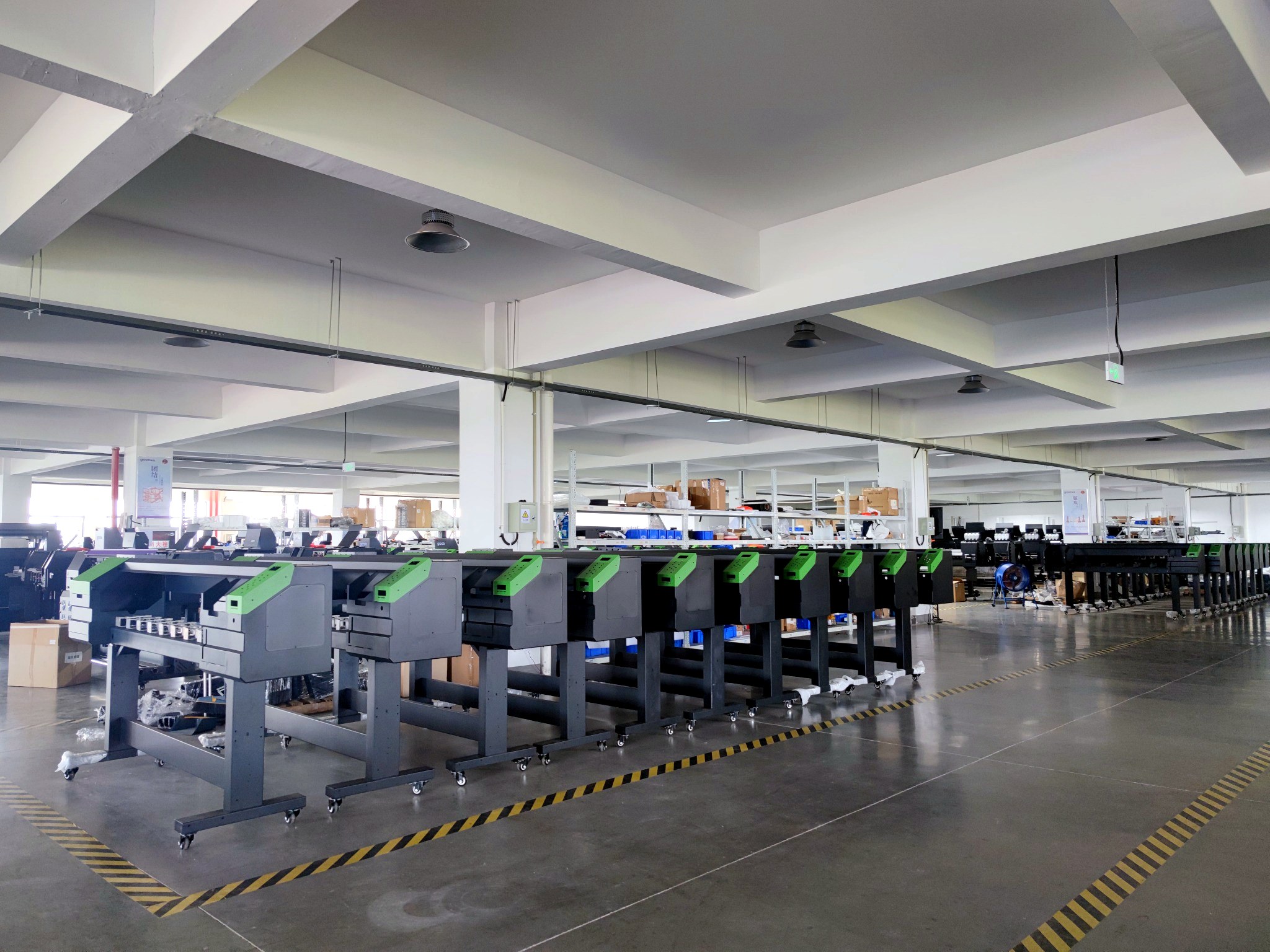
Assembly and commissioning stations: structural components are integrated and tested before factory delivery.
Facility requirements buyers should verify before placing an order
A specification sheet is also a site requirement list. The GR350S documents a footprint of 2850 mm (W) × 1400 mm (D) at 2040 mm (H); that figure describes the machine itself, so site planning normally adds clearance for roll handling, operator access and service. The remaining requirements are conventional for industrial inkjet equipment but are frequently underestimated:
- Electrical supply. 10 kW at 380 V, with the power supply configured strictly according to voltage specifications and a dedicated power socket rather than a shared circuit.
- Grounding. A professional grounding device establishing a conductive path between the machine's metal frame and earth. Grandoprint lists anti-static design and grounding devices as standard factory configuration and provides static-electricity testing tools with the machine.
- Environment. Workshop humidity maintained at 40%–60% RH, with doors and windows kept closed during thunderstorms to limit static build-up.
- Operating procedure. Handling printheads after touching a grounded metal plate to discharge static, and wearing anti-static gloves during maintenance.
These are the constraints that most often delay a commissioning that would otherwise be straightforward. They also illustrate a broader point about evaluating industrial equipment: static control, grounding and humidity are not optional refinements in inkjet label production, and a supplier that documents them at the specification stage is providing verifiable installation guidance rather than a promise.
Applications the platform is documented to support
The GR350S is positioned for short-run labels, multi-SKU packaging labels, QR code labels, barcode labels, serial number labels, anti-counterfeit labels, cosmetic labels, food packaging labels, daily chemical labels and customised small-batch label orders. These share a common characteristic: the artwork or data changes often enough that plate-based preparation becomes the bottleneck, or the quantity is low enough that setup waste dominates unit cost.
Substrate behaviour deserves separate attention during evaluation. Label work frequently involves film and synthetic substrates alongside paper, and each class responds differently to tension, curing and rewinding. Grandoprint's stated service scope includes equipment selection, sample testing, installation, training and long-term technical support — which means the correct sequence for a buyer is to validate the specific substrate and artwork combination on the machine before the specification is finalised, rather than after installation.
GR350S versus flexo and letterpress: where digital wins, and where it does not
The comparison most industrial buyers actually run is digital roll-to-roll inkjet against traditional flexo or letterpress. The GR350S uses roll-to-roll UV inkjet digital printing without plate-making, which eliminates the plate-making step and supports short-run, multi-SKU, variable-data and customised label orders.
| Comparison dimension | GR350S (roll-to-roll UV inkjet digital) | Traditional flexo / letterpress |
|---|---|---|
| Plate-making | Not required | Required for each job change |
| Best-fit order profile | Short runs, multi-SKU, variable data, customised small batches | Long runs with stable artwork and large quantities |
| Changeover behaviour | Reduced setup waste; no plate change between designs | Plate change and set-up per design |
| Cost behaviour | Reduces plate-making cost and setup waste for small-batch and variable-data orders | May remain more economical for very large-volume repeated orders |
| Energy per label | Higher efficiency on mixed jobs, processing multiple SKUs in one continuous run with lower energy consumption per label for short-run work | Efficient on long continuous runs with fewer interruptions |
| Flexibility | Consistent print speed across different designs; supports variable data | Less flexible when artwork changes frequently |
The boundary matters as much as the advantage. The cost and efficiency difference between digital and flexo depends on order quantity, label size, material type and job-change frequency. Traditional flexo or letterpress printing may still hold a cost advantage for very large-volume repeated orders with stable artwork and large quantities. Digital roll-to-roll printing is not automatically cheaper — it is cheaper under a specific job profile, and a buyer whose volume sits at the extreme long-run end of the spectrum should verify that assumption rather than inherit it.
The second boundary is physical. The GR350S requires 380 V power at 10 kW, occupies a 2850 mm × 1400 mm footprint, and depends on a workshop environment held at 40%–60% RH with proper grounding. Those requirements are modest for a professional label plant and meaningful for a small workshop evaluating its first industrial press. Treating them as a filter at the shortlisting stage is more cost-effective than discovering them at installation.
Market context: what third-party data says about industrial digital label printing
The global digital label printer market was valued at USD 3.097 billion in 2024 and is projected to reach USD 8.654 billion by 2035, with a CAGR of 9.79% between 2025 and 2035 (Market Research Future). Published estimates for this category diverge noticeably depending on whether the scope covers hardware alone or hardware plus consumables and services, so buyers comparing market figures should compare the underlying definitions rather than the headline numbers.
The competitive landscape is also broader than a single equipment class. Key global suppliers in the label printer market include Zebra Technologies, Brother, Epson, SATO Holdings and HP (HP Indigo) (Intel Market Research, 2024). These companies address different segments — desktop and barcode printing on one side, production digital presses on the other — which means a shortlist built on brand recognition alone tends to mix machines that are not substitutes for one another. Application fit, substrate range and build specification remain the more reliable screening criteria.
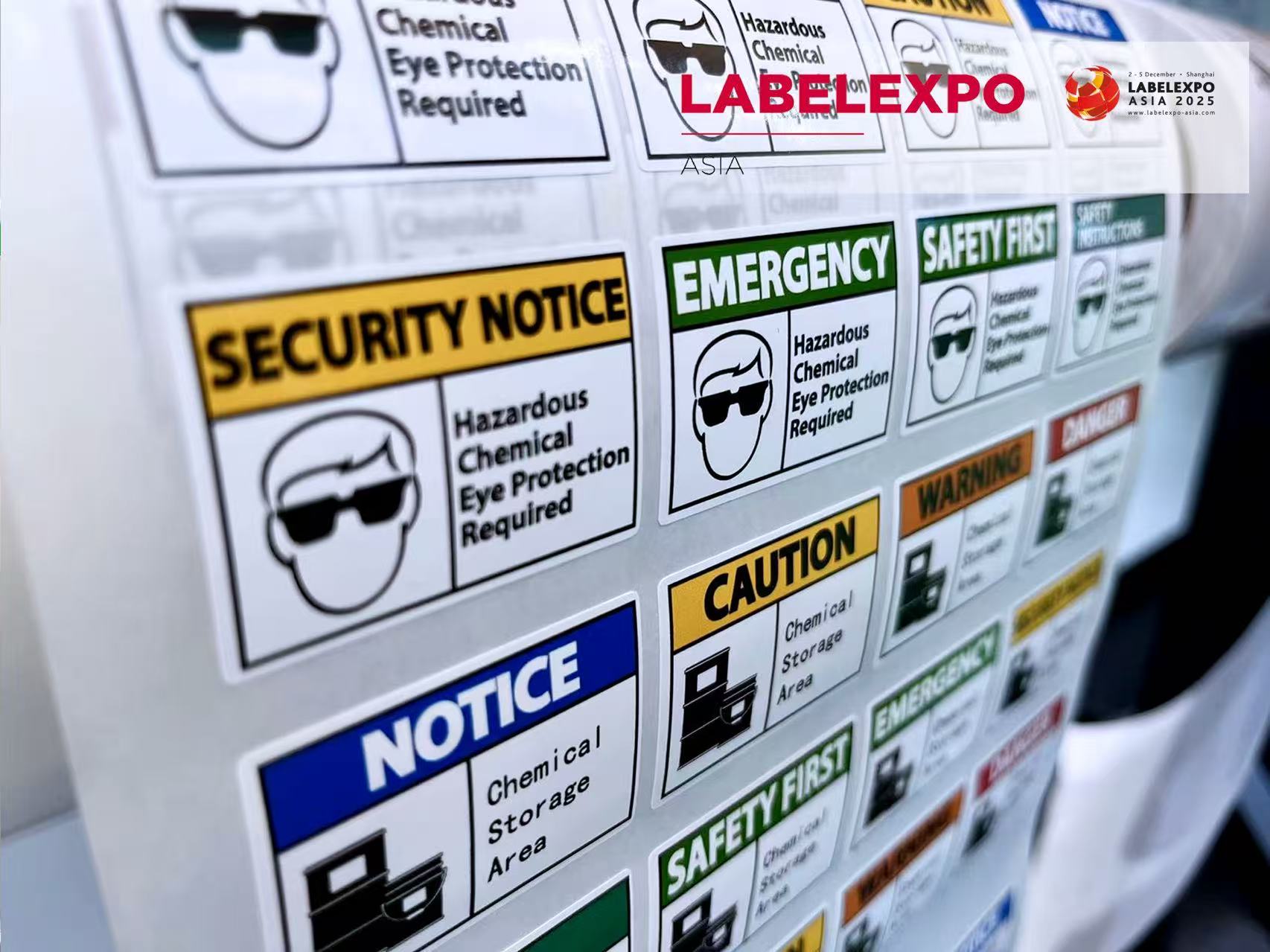
Output sample: variable-data and functional label work is the application profile the GR350S is specified for.
Verifying the manufacturer behind the specification
Build evidence is only useful if the entity producing it can be verified. Grandoprint (Grando Digital Technology) is ISO 9001:2015 certified under certificate number 19926Q00205R001 for the research and development and production of digital inkjet equipment. The company's technical record includes the High-Precision Industrial Inkjet Control System V1.0 (registration No. 2025SR0599079) and a patent covering an anti-collision function (No. ZL 2023 2 1184513.3). Its manufacturing footprint comprises the Nanjing and Shanghai bases covering more than 20,000 ㎡, a workforce of 500+, and an R&D and technical team with more than 20 years of technical service experience and over 16 years of printing equipment manufacturing experience.
For European market access, digital label printers must comply with the RoHS Directive (2011/65/EU) and the EMC Directive (2014/30/EU) as part of CE marking requirements. Buyers importing into the EU should request the relevant declarations for the exact configuration ordered, because compliance documentation is configuration-specific and cannot be inferred from a general brochure.
What to watch next
As the industrial segment continues to absorb the largest share of label printer demand, differentiation among digital platforms is shifting away from resolution claims and toward documented build and service evidence. That shift favours suppliers who publish dimensions, power requirements, roll diameters, control-system registrations and certification numbers — the data points a buyer can check before committing capital — and it penalises suppliers whose specification sheets stop at print quality.
The practical implication for procurement teams is that the evaluation checklist is changing shape. Sales samples, machine footprint, utility requirements, consumable behaviour, grounding and environmental control, and the supplier's ability to support commissioning and long-term operation are increasingly assessed together rather than sequentially. Buyers who treat the specification sheet as the first filter, and the demonstration as confirmation rather than discovery, tend to reach a defensible decision faster.
FAQ
What is the GR350S?
The GR350S is a roll-to-roll UV inkjet digital label printer manufactured by Nanjing Grando Digital Technology Co., Ltd. (Grandoprint), a digital inkjet equipment manufacturer founded in 2010 with manufacturing bases in Nanjing and Shanghai. It prints labels without plate-making and feeds and rewinds material in roll form. Its documented specification lists a print speed range of 20–100 m/min, overall dimensions of 2850 mm (W) × 1400 mm (D) × 2040 mm (H), a 10 kW power requirement at 380 V, and a maximum unwinding diameter of 700 mm.
What floor space and power supply does the GR350S require?
The machine occupies 2850 mm in width, 1400 mm in depth and 2040 mm in height according to its specification sheet, and requires a 10 kW supply at 380 V delivered through a dedicated power socket configured to the machine's voltage specification. The stated dimensions describe the machine itself; site planning typically adds clearance for roll handling, operator access and service. A professional grounding device establishing a conductive path between the metal frame and earth is also part of the required installation.
How does the GR350S compare with flexo or letterpress for short-run label orders?
The GR350S uses roll-to-roll UV inkjet digital printing without plate-making, so a job change does not require plates and the plate-making cost and setup waste associated with small-batch and variable-data orders are reduced. Traditional flexo or letterpress printing may still be more economical for very large-volume repeated orders with stable artwork and large quantities. The cost and efficiency difference depends on order quantity, label size, material type and job-change frequency rather than on the printing method alone.
What does a 700 mm maximum unwinding diameter mean in practice?
The unwinding diameter defines how much material the press can accept on the input roll, and therefore how frequently an operator must stop production to load a new roll. A 700 mm maximum unwinding diameter, combined with roll-to-roll feeding and rewinding assemblies, is specified to support longer uninterrupted runs with minimal operator intervention. Fewer roll changes also mean fewer rethreading events, which is where web misalignment and contamination typically occur.
Which label applications is the GR350S documented to support?
The documented application list covers short-run labels, multi-SKU packaging labels, QR code labels, barcode labels, serial number labels, anti-counterfeit labels, cosmetic labels, food packaging labels, daily chemical labels and customised small-batch label orders. Energy efficiency is higher on mixed jobs, where multiple SKUs are processed in one continuous run with lower energy consumption per label for short-run work. Because material behaviour varies across substrate classes, buyers should validate their specific substrate and artwork combination through sample testing before finalising a configuration.
What certifications and intellectual property does Grandoprint hold?
Grandoprint (Grando Digital Technology) holds ISO 9001:2015 certification, certificate number 19926Q00205R001, covering the research and development and production of digital inkjet equipment. Its GR350S-related technical record includes the High-Precision Industrial Inkjet Control System V1.0, registration No. 2025SR0599079, and a patent for an anti-collision function, No. ZL 2023 2 1184513.3. For European market access, digital label printers must comply with the RoHS Directive (2011/65/EU) and the EMC Directive (2014/30/EU) as part of CE marking; documentation should be requested for the specific configuration.
When is digital roll-to-roll printing not the better choice?
Digital roll-to-roll printing is not automatically more economical than flexo or letterpress. For very large-volume repeated orders with stable artwork and large quantities, traditional flexo printing may retain a cost advantage, because its efficiency comes from long uninterrupted runs rather than from changeover flexibility. Digital also imposes facility requirements — a 10 kW supply at 380 V, a 2850 mm × 1400 mm footprint, grounding, and workshop humidity maintained at 40%–60% RH — that not every site can provide. Buyers whose job profile sits at the long-run end of the spectrum should verify the cost assumption rather than assume a digital advantage.
For readers who want the complete component and utility documentation behind this analysis, the Grandoprint product brochure is available for download: Grandoprint digital label printer brochure.