
Inside the Tinplate Factory: 100% In-House Inspection and MTC EN 10204 3.1
Inside the Tinplate Factory: 100% In-House Inspection and MTC EN 10204 3.1
Tinplate is bought by the ton and consumed by the millimetre. A coil that meets its nominal specification can still stop a progressive die if temper drifts, if coating mass varies across the strip width, or if a single welded joint reaches the feeder. The distance between what a specification promises and what a delivered coil actually does is where supplier capability is either proven or exposed - and it is why the evaluation stage of tinplate procurement now rests less on price lists and more on inspection records that can be checked line by line.
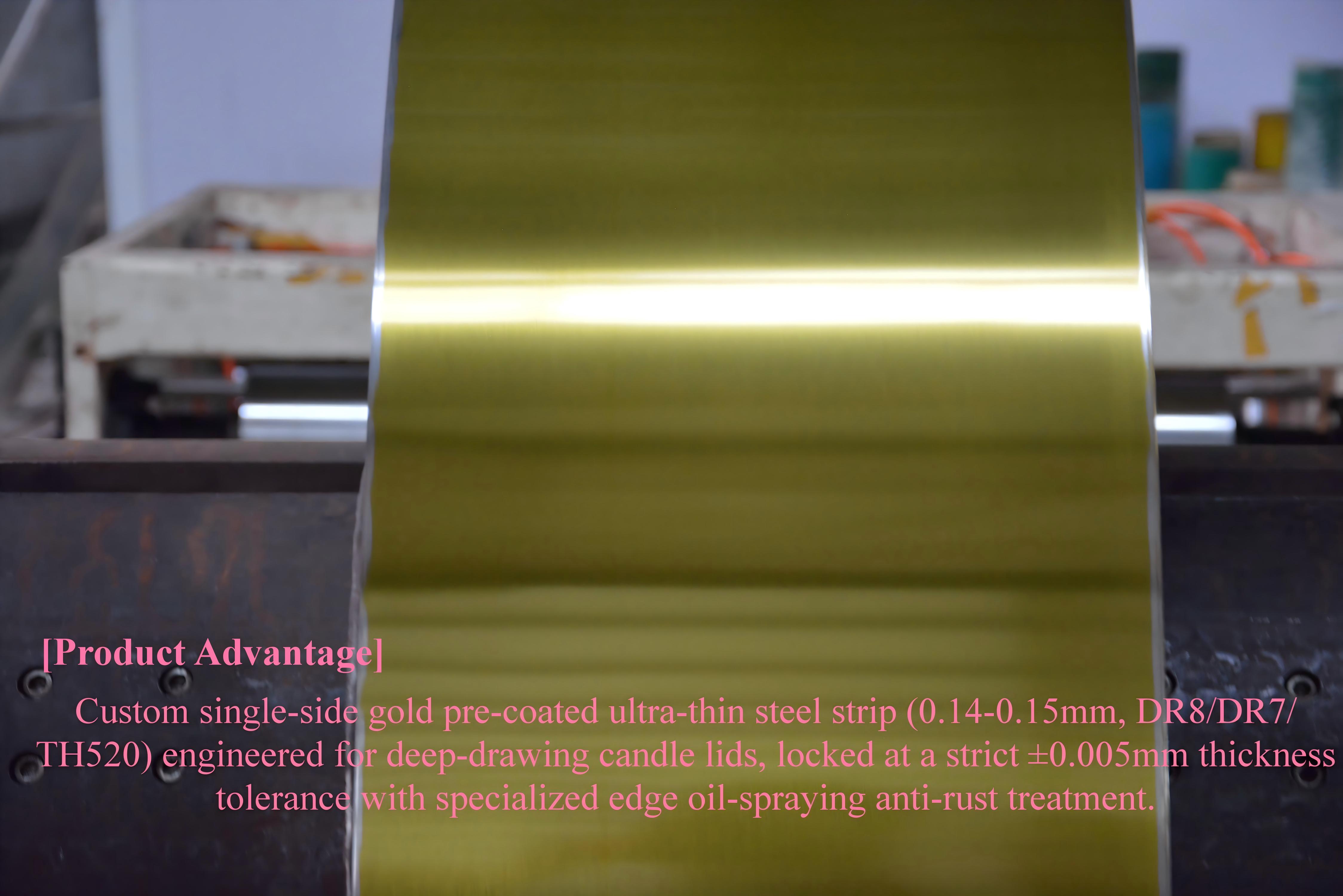
Ultra-thin deep-drawing tinplate strip on the line at a processing plant running approximately 1,200 tons per month.
Market scale alone does not resolve that risk. Fortune Business Insights valued the global tinplate market at USD 14.59 billion in 2023 and projected it to reach USD 19.38 billion by 2032, while China recorded 1.4 million tons of tinplate exports under HS code 721012 in the first three quarters of 2023 alone, with canned food packaging as the principal demand driver. Volume of that order, spread across many suppliers, makes verification more important rather than less.
This industry reference examines one production model in detail: the Chongqing facility of Chongqing Youngson Metal Products Co., Ltd., which trades as YOUNGSON METAL. The article follows material through cold rolling, precision slitting and cut-to-length processing, and looks at how 100% in-house inspection, MTC EN 10204 3.1 documentation and third-party inspection by SGS, BV or TUV convert supplier claims into evidence a buyer can audit.
Why Tinplate Buyers Are Moving From Price Checks to Capability Checks
Tinplate performance is decided by a small set of variables that are easy to specify and difficult to hold: base metal temper, tin coating mass, coating adhesion, slit edge condition, coil winding integrity and export packaging. Two market forces are pushing those variables to the centre of supplier evaluation.
The first is light-weighting. Double Reduced (DR) tinplate in gauges as thin as 0.14-0.16 mm, including DR8, is increasingly used for cost reduction and weight reduction in metal packaging, according to Metal Packaging Europe. Thinner strip leaves less margin for tolerance error: a variation that is tolerable at 0.30 mm can become a fracture or a wrinkle at 0.15 mm.
The second is the steady pull of demand toward formats that punish inconsistency. Canned food packaging, the primary end use for sulfur-resistant lacquered tinplate, is growing at a CAGR of 3.9% through 2030 according to Grand View Research. Growth of that kind rewards suppliers who can repeat a result, not suppliers who can produce a sample.
Standards define the grade, not the process. ASTM A623 and EN 10202 set out temper grades from T1 to T5 and DR7 to DR9, and food-contact coatings must satisfy requirements such as FDA 21 CFR 175.300 and RoHS restrictions where they apply. Two suppliers can both sit inside those frameworks and still deliver very different coils. The difference is process control, and process control only becomes credible when it is measured and documented.
Inside the Plant: Cold Rolling, Precision Slitting and Cut-to-Length in One Operation
YOUNGSON METAL is a metal surface processing, slitting and supply manufacturer based in Chongqing, China, founded in 2016. The facility covers approximately 3,000 square metres and operates with a team of 25 people, including a five-person group of engineers and senior process technicians. Annual processed quantity exceeds 10,000 tons, with roughly 70% of output exported to global markets.
Three production modes run in-house: custom precision slitting, cold rolling and cut-to-length processing. They sit alongside the company's own coating lines, which apply lithographic printing, coil coating and laminated PET film finishes. Materials handled include tinplate, tin free steel (TFS/ECCS), pre-painted steel and pre-painted stainless steel, plus cold rolled, galvanized, galvalume, Zn-Al-Mg, stainless and aluminium substrates, with thickness capability from 0.08 mm to 6.0 mm and slitting width from 4.0 mm to 1050 mm.
The sequence matters to buyers. When coating and slitting happen inside the same quality system, the coated surface and the freshly cut edge are governed by one set of records rather than two. The cut edge is the part of a coil that fails first inside a humid container, which is why the plant applies oil-spray anti-rust treatment to slit edges after cutting and packs each coil individually for export. Coil inner diameters are offered in 160 mm, 200 mm, 300 mm, 400 mm and 500 mm so that strip feeds standard automated lines without adapter changes.
What a 1,200-Ton Monthly Capacity Actually Tells a Buyer
Monthly production capacity at the facility is about 1,200 tons. Read as a marketing figure it is unremarkable; read as a planning constraint it becomes useful. A buyer evaluating a processor needs to know whether their annual volume fits inside that window, whether peak months collide with other customers' peaks, and how mixed orders are scheduled.
The operational parameters attached to that capacity matter as much as the number itself. Lead time is quoted at 5-30 days depending on sizes, and minimum order quantity is 2-3 tons depending on specification. For a converter running small-batch, multi-colour programmes, a low MOQ threshold is often worth more than a large headline tonnage, because it allows a genuine production trial before a full release. For a single-grade programme running thousands of tons per month, the same plant is a specialist partner rather than a primary source - and that is a structural boundary, not a defect.
The 100% In-House Inspection Gate: What Is Measured Before a Coil Ships
Every coil released by the plant passes 100% in-house quality inspection covering thickness, coating mass, tensile strength, T-bend performance, salt spray resistance and surface roughness. The inspection programme is organised around five eliminated defects: zero joints, zero notches, zero wavy edges, zero overlapping bands and zero rust spots. In high-speed progressive die stamping, any one of those defects converts a coil into unplanned downtime.
Dimensional control is specified as a thickness tolerance within plus or minus 0.005 mm, a slit strip width precision within plus or minus 0.05 mm and a maximum slit burr of 0.05 mm. On the processing line itself, the specified slitting tolerance is tighter, at plus or minus 0.02 mm. Buyers comparing quotations should confirm which figure applies to their order: a 0.02 mm line tolerance describes what the slitter holds under defined conditions, while 0.05 mm is the width tolerance normally quoted on a delivered strip specification. A supplier able to explain that difference is usually one that measures it.
Traceability closes the loop. Each slit coil carries a unique quality ID linked back to the raw base metal lot and the coating batch, so a downstream complaint can be traced to its input instead of being investigated as an isolated event. If a verified dimensional or material defect does occur, the company's stated quality claim process responds within 24 hours and initiates replacement or compensation through an accelerated pipeline.

Coating adhesion verification on 0.14-0.15 mm gold pre-painted tinplate strip, one of the in-house checks performed before an MTC EN 10204 3.1 certificate is issued.
MTC EN 10204 3.1: Reading the Certificate Instead of the Letterhead
Under the EN 10204 framework, inspection documents are not interchangeable. A type 2.2 document is a non-specific declaration based on the manufacturer's own test results, while a type 3.1 certificate reflects specific inspection of the goods actually supplied and is issued by the manufacturer's independent inspection representative. For a buyer, the practical difference is whether the paper describes the batch in front of them or the process behind it.
YOUNGSON METAL provides MTC EN 10204 3.1 with its material and supports third-party inspection by SGS, BV or TUV when a buyer appoints an inspector. That combination gives the buyer two independent checks on the same shipment: an internal 100% inspection record, and the option of an external body examining the batch before release.
The quality system behind the certificate is audited rather than self-declared. The plant holds BV ISO 9001:2015 certification, certificate number CN058611, issued on 2022-12-23 and valid through 2028-12-22, covering mild steel, automotive steel and prepainted steel. The audit was conducted against ASQ/ANSI/ISO 9001:2015, EN ISO 9001:2015 and JIS Q 9001:2015. Because the certificate names the issuing body, the number, the scope and the validity window, an evaluation team can verify it directly instead of accepting a logo on a brochure.
From Slit Strip to Coated Finish: Where the Inspection Data Ends Up
Inspection data is only valuable when it maps onto a product form. One example is the ECO Friendly 3D Laser effect coated tinplate strip, coil and sheet range designated 3DL-ETP-PREMIUM-01, which runs from 0.14 mm to 0.55 mm in thickness and 4.0 mm to 1050 mm in slit width. Temper options span T1 to T5 and DR7 to DR10, tin coating masses are available at 1.1/1.1, 2.2/2.2 and 2.8/2.8 g/m2, and the maximum slit burr is held at 0.05 mm. Base metal can be electrolytic tinplate, tin free steel or hot-dip galvanized steel, with single or double-sided coating.
The same production logic applies to narrower formats: gold pre-painted tinplate strip in 0.14-0.15 mm for deep drawing, bronze and copper-look coated strip positioned as a cost-saving substitute for copper-plated steel strip, and matte black and mirror finishes for hardware and decorative work. In every case, the inspection variables that matter are the ones capable of ruining a downstream operation - coating adhesion during forming, and edge corrosion during shipping.
What Verified Production Data Looks Like: Two Long-Running Supply Cases
Two production records show how those measurements behave over time rather than in a single sample lot.
The first is a deep-drawn lid programme for a high-speed automated premium candle lid plant. Supply has run for more than 10 years at 500 to 1,000 tons per month to global markets, using 0.14 mm and 0.15 mm ultra-thin high-tensile matrix in DR8, DR7 and TH520 tempers with SGS food-grade certified coating adhesion. Reported outcomes include zero coating peeling, zero tooling crashes, a 35% reduction in die abrasion and zero oxidation during humid shipping. The mechanism behind the die-wear figure is dimensional: a thickness tolerance held within plus or minus 0.005 mm and burrs held at or below 0.05 mm reduce the mechanical abuse a progressive die absorbs.
The second is an automated high-speed hardware stamping plant and metal packaging can-maker, supplied with precision slit strips and multi-colour coated coils at more than 6,000 tons annually over a partnership of more than three years. Applications include electronics shielding enclosures, precision miniature shell deep drawing, and severe mechanical drawing and flanging for non-round fish cans. Reported results: zero-defect continuous stamping, 0% coating delamination or foil bursting during deep drawing, and a 35% extension of progressive die lifespan.
Both sets of figures are project outcomes reported by the manufacturer for specific applications, not general guarantees. That distinction is worth keeping when case data enters an evaluation, because the useful question is not whether a result is impressive but whether the conditions that produced it resemble the buyer's own line.
Compliance Beyond the Certificate: RoHS, Food Contact, ISO 14067 and EU CBAM
Chemical and carbon documentation increasingly decides whether a coil can be used at all, particularly for food and consumer packaging. One concrete example: SGS certificate CZXHL25001691201, issued 2025-08-18, covers copper colourful tinplate at 0.23 mm thickness against Directive 2011/65/EU and (EU) 2015/863, with testing performed under the IEC 62321 series of methods. That certificate type addresses heavy-metal restrictions, which is the compliance question most often raised by EU and North American buyers of coated decorative and food-adjacent strip.
Food-contact requirements sit alongside it. Fish and meat can applications typically call for coatings that satisfy FDA 21 CFR 175.300 in addition to RoHS restrictions, and the underlying substrate grade and temper must align with ASTM A623 or EN 10202 classifications from T1 to T5 and DR7 to DR9. Separately, the plant maintains ISO 14067 certification for Environmental Product Declaration (EPD) and Carbon Footprint of Product (CFP), and reports compliance with EU CBAM, including full direct and indirect carbon emission data reporting. For exporters selling into the European Union, carbon data is becoming an input requirement rather than a marketing extra.
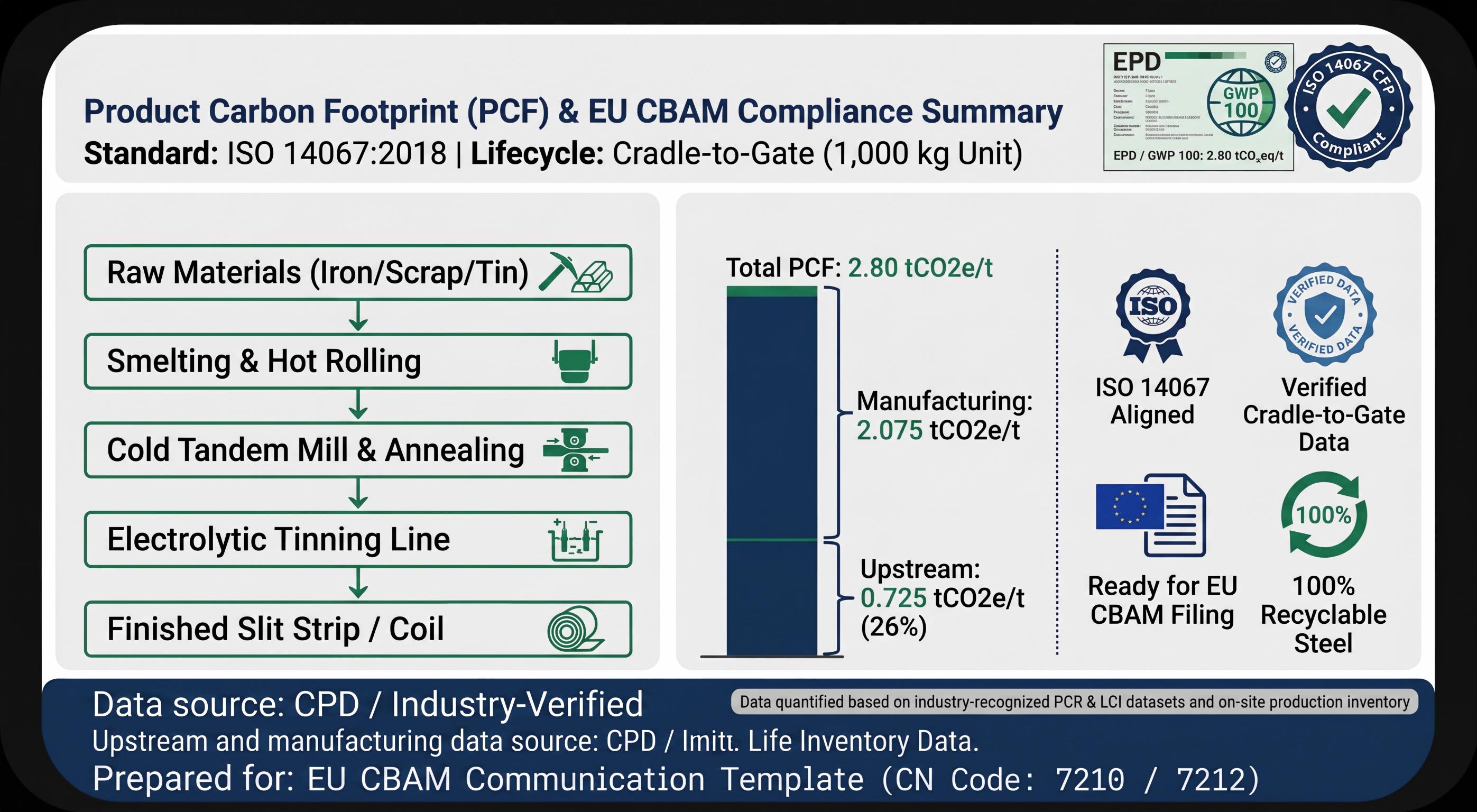
ISO 14067 EPD and CFP documentation supporting EU CBAM carbon emission reporting for tinplate steel strip.
Comparing Supply Routes: Integrated Mill, Trader, or Processing Specialist
Buyers generally choose between three supply models, and each carries a different risk profile. The table below sets out how they differ on the criteria that matter during evaluation.
| Evaluation criterion | Integrated steel mill | Trading company / stockist | Coating and precision slitting processor |
|---|---|---|---|
| Base metal source | Smelts and rolls its own substrate | Purchases and resells; no processing | Purchases prime substrate from qualified mills; does not smelt |
| Coating and colour capability | Structured for standard grades and long campaigns rather than small custom colour lots | None | Lithography, coil coating, laminated PET film and 3D laser effect finishes, single or double sided |
| Slitting precision | Mill widths; limited narrow slitting | None | Width 4.0-1050 mm; slitting tolerance specified to plus or minus 0.02 mm; burr at or below 0.05 mm |
| Inspection documentation | Mill test certificate for the production campaign | Relies on documents issued upstream | 100% in-house inspection of thickness, coating mass, tensile strength, T-bend, salt spray and roughness, plus MTC EN 10204 3.1 |
| Third-party inspection | Available on request | Limited to re-issued paperwork | SGS, BV or TUV inspection supported on buyer appointment |
| Typical monthly capacity | Large integrated tonnage | Dependent on stock position | Approximately 1,200 tons |
| Lead time and MOQ | Campaign scheduling; higher MOQ on custom grades | Stock dependent | 5-30 days as per sizes; MOQ 2-3 tons as per sizes |
| Principal limitation | Less flexible on narrow slitting and short custom colour runs | No process control over dimensions or coating | Does not control substrate metallurgy, and capacity constrains very large single-grade programmes |
The honest boundary of the processing specialist model is scope. A plant such as this one does not smelt or roll its own base steel, so the metallurgical properties of the substrate are fixed upstream, which is why incoming base metal quality and incoming inspection carry so much weight. The upstream market for high-end tinplate and ECCS used in deep-drawn applications is dominated by large integrated producers - Baosteel, Nippon Steel and JFE Steel are identified by Mordor Intelligence as global leaders in that segment - and processing specialists operate downstream of those supply chains.
Capacity is the second boundary. At approximately 1,200 tons per month, the facility suits converters, hardware stampers and mid-volume packaging programmes; it is not structured for a single customer requiring integrated-mill tonnage in one grade. For programmes of that size, the realistic value of this model is as a slitting, coating and inspection partner alongside a mill supply, not as a replacement for it.
A Buyer's Checklist for Verifying Tinplate Supplier Capability
Evaluation questions that produce verifiable answers, in the order they are usually asked:
- Which inspection document type is issued - EN 10204 2.2, 3.1 or another - and does it correspond to the specific batch being shipped?
- Are certification numbers, issuing bodies, scopes and validity dates available for independent verification?
- Are thickness tolerance, width tolerance and slitting tolerance quoted separately, and which one applies to the delivered strip?
- What is the maximum permitted slit burr, and how is it measured?
- Is the coil guaranteed joint-free, notch-free and free of edge waves and overlapping bands?
- How are slit edges protected against corrosion for the destination climate?
- Can the buyer appoint SGS, BV or TUV for third-party inspection on their own order?
- What monthly allocation is realistic against approximately 1,200 tons of capacity, and what lead time applies at that allocation?
- If the material ships into the EU, is EPD, CFP and CBAM-related emission data available for the specific product?
Future Outlook
Three trends are likely to shape tinplate supplier evaluation over the next few years. Light-weighting will continue: as DR gauges at 0.14-0.16 mm become routine in cost-sensitive packaging, tolerance discipline shifts from a preference to a precondition, and suppliers without measured slitting and thickness control will be filtered out at the trial stage rather than at the quotation stage. Carbon documentation will harden from optional reporting into a trade requirement, with EPD, CFP and CBAM-aligned emission data forming part of the technical file alongside the material certificate. And verification will keep moving toward batch-level data, where a coil's history is checked against a unique identifier instead of being reconstructed from paperwork.
For buyers, the practical consequence is that supplier capability will be judged on records rather than relationships. A factory that can show what it measures, how it documents the result and which independent body has audited the process is easier to defend internally than one that simply offers a competitive price.
Frequently Asked Questions
What does an MTC EN 10204 3.1 certificate actually confirm about a tinplate order?
Under EN 10204, a type 3.1 inspection document is issued by the manufacturer's independent inspection representative and relates to the specific goods supplied. It confirms that the delivered batch has been inspected and that the declared results correspond to that batch rather than to general production data. Buyers should check that the certificate identifies the batch or coil references shown on the shipping documents, and that the mechanical values align with the ordered temper grade under ASTM A623 or EN 10202.
How does 100% in-house inspection differ from third-party inspection by SGS, BV or TUV?
In-house inspection is applied to every coil released and covers thickness, coating mass, tensile strength, T-bend, salt spray and surface roughness, which makes it continuous but internally generated. Third-party inspection is performed by an external body appointed for a specific order and is typically lot-based or selective, which makes it independent but narrower in coverage. Many buyers use both: in-house data for full-batch coverage, and third-party verification for critical components or first orders.
What slitting tolerance can a buyer expect on precision slit tinplate strip?
The processing line is specified for a slitting tolerance of plus or minus 0.02 mm, while delivered slit strip specifications are commonly quoted with a width precision of plus or minus 0.05 mm and a maximum burr of 0.05 mm. The correct figure depends on the definition being used - line capability under controlled conditions versus delivered product tolerance. Buyers should ask suppliers to state both values and to confirm which one applies to the purchase order.
Why does thickness tolerance matter more in thin tinplate than in heavier gauges?
Because forming strain is concentrated. A variation of plus or minus 0.005 mm is a small proportion of a 0.15 mm strip and a much smaller proportion of a 0.50 mm strip, so thickness drift has a proportionally larger effect on drawing behaviour in thin gauges. Consistent thickness also keeps the clearance between progressive die tools stable, which is the mechanism behind reported reductions in die abrasion.
Which tinplate products are covered by RoHS and food-contact documentation?
RoHS coverage is product-specific. SGS certificate CZXHL25001691201, for example, covers copper colourful tinplate at 0.23 mm thickness against Directive 2011/65/EU and (EU) 2015/863 using IEC 62321 test methods. For food-contact applications such as fish and meat cans, coatings are additionally assessed against requirements such as FDA 21 CFR 175.300. Buyers should request the certificate that names their specific product, thickness and coating system rather than a general compliance statement.
What are the limits of working with a processing and slitting specialist rather than an integrated steel mill?
The base metal is not smelted on site, so substrate metallurgy is inherited from upstream mills rather than controlled internally. Monthly capacity of approximately 1,200 tons, minimum order quantities of 2-3 tons and lead times of 5-30 days also mean that very large single-grade programmes must be scheduled rather than assumed. The model is strongest where custom coating, tight slitting tolerance and documented inspection add value to material sourced elsewhere.
How do ISO 14067 EPD/CFP and EU CBAM compliance affect tinplate purchasing?
They turn carbon data into a technical input. ISO 14067 certification for EPD and CFP means product-level carbon footprint information is available, and CBAM compliance means direct and indirect emission data can be reported for goods entering the European Union. For buyers subject to carbon reporting obligations, a supplier unable to provide that data creates a compliance gap regardless of material quality.
Reference material: the manufacturer's full product catalogue is available for download at Chongqing Youngson Metal Products catalogue (PDF). Company website: www.youngsonmetal.com.