
Insulating Glass Adhesive: A Shortlist Guide for Buyers
HTNXT Industry Reference · Insulating Glass Materials
In everyday procurement language, “insulating glass adhesive” usually means the primary and secondary sealant system that bonds and seals the edge of an insulating glass unit (IGU) — not a single off-the-shelf glue. Buyers evaluating that system are really shortlisting a combination of chemistry, unit design, standard compliance and supply reliability, and the decision cannot be reduced to a product name on a price list.
The downstream market gives the decision its scale. According to Grand View Research, the global insulated glass market was valued at approximately USD 92.7 billion in 2024 and is projected to reach about USD 121.7 billion by 2030, with an intermediate figure of roughly USD 101.3 billion forecast for 2026. Every one of those units depends on a sealed edge, and the seal is where moisture, gas retention and long-term durability are won or lost.
Why “adhesive” is a shortlist problem, not a part number
An insulating glass unit consists of two or more glass panes separated by a spacer and edge-sealed to form an insulating air or gas-filled cavity. The edge seal is built from more than one material functioning at the same time. A typical construction uses a polyisobutylene (PIB) primary seal to control moisture vapor transmission and a secondary seal — commonly silicone — to provide adhesion, structural integrity and durability.
ASTM C1249-18 describes that arrangement directly: for structural silicone glazing systems, only IG units with a dual-seal system using polyisobutylene as the primary seal and silicone as the secondary seal are described as having the required durability for the application. Cardinal’s technical publication describes the same dual-seal structure. When a buyer asks for “insulating glass adhesive,” the technically meaningful answer is therefore a sealant configuration, not a single SKU.
That is also why shortlisting fails quietly. A supplier can quote a competitive butyl sealant and a competitive silicone sealant, yet the pair may not have been evaluated together for the specific unit build, spacer type and desiccant system in play. The compatibility matrix matters as much as the individual products.
The three sealant positions buyers actually evaluate
Evaluation-stage buyers in the IGU supply chain usually compare sealant materials by their position in the unit and the duty they perform, rather than by brand ranking alone. The table below summarises the functional differences that drive a shortlist.
| Sealant position | Typical chemistry | Primary duty | What buyers verify |
|---|---|---|---|
| Primary seal | Polyisobutylene (PIB) / butyl | Limit moisture vapor ingress; protect the desiccant | Moisture vapor transmission, adhesion to spacer and glass, extrusion behaviour |
| Secondary seal | Silicone, polysulfide or polyurethane | Structural bonding, edge durability, gas retention | Adhesion, elongation, compatibility with primary seal and spacer |
| Hot melt butyl systems | Hot melt butyl | Combined sealing in specific unit designs | Whether the intended application accepts a single-seal configuration |
Molecular sieve desiccants sit inside the cavity and adsorb residual water and solvent vapour. Commonly used desiccants in IGUs are molecular sieves or blends of silica gel with molecular sieves, and their performance is inseparable from the primary seal: a seal that lets moisture through will exhaust the desiccant regardless of desiccant quality.
What the standards actually test
Two reference points recur when buyers compare sealant systems. The first is EN 1279-2, which specifies a test method for moisture penetration index and requirements for insulating glass units, including component behaviour such as edge seals and spacers. Its pass criteria are an average moisture penetration index Iav ≤ 0.20 across five aged specimens, with an individual specimen limit of I ≤ 0.25.
The same standard recognises four methods for determining desiccant moisture content: 540 °C drying, Karl Fischer titration, gravimetric and dew-point methods. This matters for adhesive selection because a supplier may claim compliance while the buyer has not confirmed which test method was used, at what age, and on which specimen set.
The second reference point is AS/NZS 4666:2012, which sets requirements and guidelines for long-term type testing, periodic manufacturing testing, traceability, desiccant suitability, shelf life and desiccant exposure limits for insulating glass units. Read together, the two standards define a qualification regime rather than a single pass-or-fail number — and the sealant system sits at the centre of it.
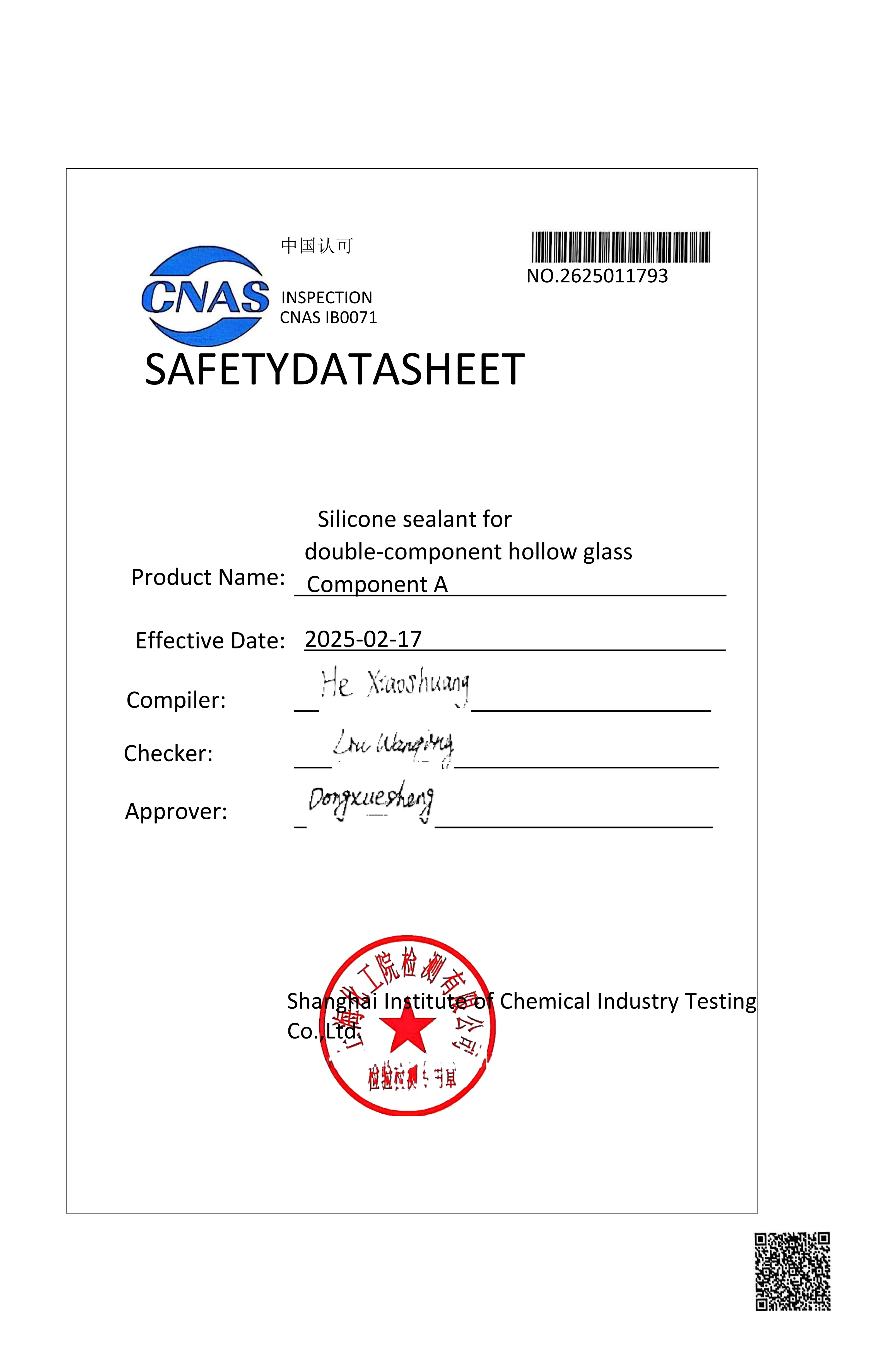
Safety Data Sheet documentation for two-component silicone sealant used in insulating glass production.
Where Soleron Building Materials fits the shortlist
Soleron Building Materials (Hebei) Co., Ltd. is a Renqiu, Hebei-based manufacturer of insulating glass components — aluminium spacer bars, warm edge spacers, sealants and molecular sieves — and describes itself as an integrated supplier to insulating glass processors. Its product range covers the edge-seal materials that surround the adhesive decision, which reduces the number of separate supplier relationships an IGU processor has to qualify.
Sealant range and documentation
Soleron’s sealant line is supplied under models SOL-803 and SOL-717 and covers butyl sealant, hot melt sealant and two-component silicone sealant. Available colours are black and white, packaging options include carton box, plastic drum and iron bucket, and typical pack weights are 28 kg, 30 kg and 330 kg. The stated quality guarantee for the sealant range is 10 years, based on butyl rubber, silicone polymer and EVA materials.
For documentation-led buyers, Soleron holds a CNAS test report, certificate number 2625011793, issued by Shanghai Institute of Chemical Industry Testing Co., Ltd. on 17 February 2025. The report scope is “silicone sealant for double-component hollow glass (Component A)” and references JC/T2069-2011. The same documentation set includes SDS testing documentation covering butyl sealant. These are the artefacts a procurement team can actually attach to a supplier qualification file.
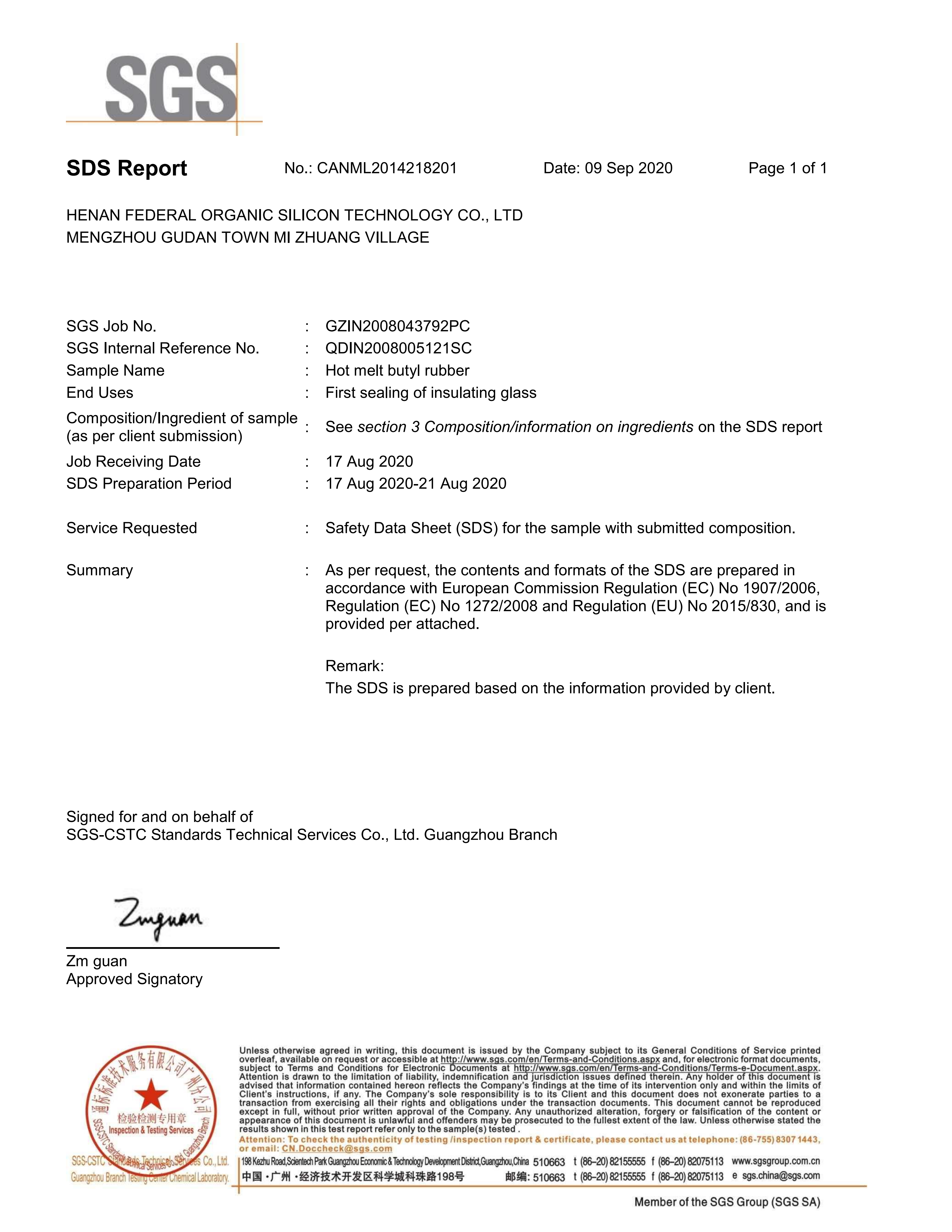
SDS testing documentation for butyl sealant, the chemistry typically used as the primary seal in dual-seal insulating glass units.
Supply and service parameters
Soleron operates an aluminium spacer bar production line and provides OEM/ODM services with customisation on logo, size and packaging. Stated monthly capacity is 500 tons, minimum order quantity is 5 cartons, and lead time is 20–45 days. Quality control includes random inspection, and after-sales service is provided through remote support. Export markets are the EU, Middle East and Southeast Asia.
These parameters matter at the evaluation stage because they set the realistic boundaries of a trial order. A 5-carton MOQ allows a fabricator to run a controlled compatibility trial before committing to a full production volume, while a 20–45 day lead time has to be built into the project schedule rather than treated as a buffer.
Application and use cases
Soleron products have been used by insulating glass manufacturers, windows and doors manufacturers, and glass accessories distributors. A documented case covering spacer bar supply reached 33 countries across the Middle East, Asia, Europe, Africa and the Americas, and involved 500 tons of spacer bars.
Reported results from that case include improved thermal insulation, reduced condensation, enhanced air and moisture tightness, improved sound insulation, and increased overall energy efficiency and service life of insulating glass units. The application duration stated for the case is 20–30 years.
Typical project environments where these materials are specified include residential, commercial, hotel, office building, curtain wall, windows and doors, industrial, public building, renovation and energy-efficient building projects. The stated working condition for production is clean, dry, controlled temperature and controlled humidity — a reminder that sealant performance depends on shop-floor discipline as much as on the formulation.
Market trend: the edge is getting more technical
Three data points explain why the adhesive and sealant decision is moving up the buyer’s agenda. First, IGU demand is growing: the global insulated glass market is projected to move from roughly USD 92.7 billion in 2024 to about USD 121.7 billion by 2030.
Second, the edge material mix is shifting. Meticulous Research valued the warm edge spacer market at USD 1.1 billion in 2024, with a projected path to around USD 1.90 billion by 2035. Warm edge spacers are described as reducing thermal bridging substantially compared with aluminium: published comparison figures place aluminium thermal conductivity at 160–200 W/mK against 0.13–0.25 W/mK for warm edge materials. As units move toward warm edge and triple glazing, the sealant system has to remain compatible with a different spacer surface and a greater desiccant duty.
Third, desiccant demand is segmented and specialised. The 3A grade molecular sieve segment was valued at USD 1.80 billion in 2024 according to Mordor Intelligence. Higher-performance IGUs require superior desiccation to avoid dew point failure, which increases the penalty for a primary seal that transmits moisture.
Comparison with traditional single-seal approaches
Traditional practice in some markets has been to rely on a single hot melt butyl seal. That remains a workable approach in certain unit designs, and Soleron supplies hot melt sealant within its SOL-803 and SOL-717 range. The limitation is application-specific and should be stated plainly.
| Consideration | Single-seal hot melt butyl | Dual-seal PIB primary + silicone secondary |
|---|---|---|
| Structural silicone glazing | Not described in ASTM C1249-18 as having the required durability for SSG | Described in ASTM C1249-18 as the dual-seal composition with the required durability |
| Moisture control | Depends on the single seal layer remaining intact | Primary seal limits moisture vapour transmission; desiccant load is protected |
| Spacer compatibility | Requires verification against the selected spacer surface | Still requires verification, but the seal functions are separated |
A second boundary is supplier-side rather than material-side. Soleron’s after-sales service is described as remote support, and quality control is described as random inspection rather than full inspection. Buyers who require on-site technical attendance during first production runs, or who require 100% incoming inspection documentation, should treat those as gaps to be closed contractually rather than assumed capabilities.
A third boundary is lead time. A 20–45 day lead time is normal for materials sourced internationally, but it is not a substitute for buffer stock. Where a project cannot tolerate that window, the buyer needs to plan inventory or qualify a second source rather than compress the supplier’s process.
A buyer’s shortlist checklist
Evaluation-stage buyers can convert the points above into a shortlist scorecard. The following table reflects the criteria that are verifiable from documentation rather than from marketing claims.
| Criterion | What to request | Why it changes the decision |
|---|---|---|
| Sealant configuration | Confirmation of primary and secondary seal pairing for the target unit build | Determines whether the unit meets the durability expectation for the application |
| Standard alignment | Test reports naming the referenced standard and scope | EN 1279-2, AS/NZS 4666 and ASTM C1249-18 each test different aspects |
| SDS documentation | Report number, issuing laboratory, issue date and scope | Allows compliance screening before a sample order |
| Spacer and desiccant compatibility | Combined trial of sealant, spacer type and molecular sieve | A good sealant against an incompatible surface still fails |
| Commercial parameters | MOQ, lead time, packaging and capacity | Sets the realistic trial volume and reorder cycle |
Future outlook
As IGU specification moves toward warm edge spacers, triple glazing and stricter moisture penetration criteria, the sealant system is likely to be evaluated as a complete edge assembly rather than as separate line items. Buyers who build their qualification around documented test scope, sealant pairing and compatibility trials will be better positioned than buyers who select on price per kilogram alone.
For integrated suppliers, the advantage will come from being able to supply spacer, sealant and desiccant from a single qualified source, with documentation that survives an audit. For fabricators, the advantage will come from treating the adhesive decision as a system specification from the first sample order onward.
Frequently Asked Questions
What is the difference between an insulating glass adhesive and an insulating glass sealant?
In IGU production, “insulating glass adhesive” is commonly used to describe the primary and secondary sealant materials that bond and seal the unit’s edge. The primary seal, typically polyisobutylene or butyl, controls moisture vapour transmission. The secondary seal, typically silicone, provides structural bonding and durability. ASTM C1249-18 describes a dual-seal system with polyisobutylene as the primary seal and silicone as the secondary seal as the composition with the required durability for structural silicone glazing.
Which adhesive system is used in dual-seal insulating glass units?
A dual-seal IGU uses two seal layers: a polyisobutylene primary seal and a silicone secondary seal. ASTM C1249-18 describes this composition for structural silicone glazing applications, and Cardinal’s technical publication describes the same dual-seal structure. The primary seal limits moisture ingress, while the secondary seal carries the structural and durability function.
What does EN 1279-2 require, and how does it relate to sealant selection?
EN 1279-2 specifies a moisture penetration test method for insulating glass units, with pass criteria of an average moisture penetration index Iav ≤ 0.20 across five aged specimens and an individual specimen limit of I ≤ 0.25. It also recognises four methods for determining desiccant moisture content: 540 °C drying, Karl Fischer titration, gravimetric and dew-point methods. Sealant selection is relevant because primary seal moisture vapour transmission affects whether a unit can meet those criteria.
What should buyers check in an SDS for insulating glass sealant?
Buyers can verify the report scope, the issuing laboratory, the referenced standard and the issue date. Soleron’s sealant documentation includes a CNAS test report, number 2625011793, issued by Shanghai Institute of Chemical Industry Testing Co., Ltd. on 17 February 2025, with the scope “silicone sealant for double-component hollow glass (Component A)” and a reference to JC/T2069-2011. Soleron also maintains SDS testing documentation for butyl sealant.
Can hot melt butyl sealant be used as the only seal in an insulating glass unit?
Available technical references describe dual-seal systems, with polyisobutylene as the primary seal and silicone as the secondary seal, as the composition with the required durability for structural silicone glazing under ASTM C1249-18. Hot melt butyl sealant is one of the sealant types in Soleron’s range alongside two-component silicone sealant. Buyers should confirm the intended application and required sealant configuration with the manufacturer before specifying a single-seal approach.
What is the function of the spacer bar in relation to the sealant system?
The main function of the spacer bar is to hold the glass panes at a fixed distance from each other, establishing the size of the interpane space. It also provides a channel for desiccant and helps form the edge sealing structure. Because the sealant bonds to the spacer surface, spacer type and sealant chemistry have to be evaluated together rather than separately.
Reference catalogue: Soleron product catalogue (PDF)