
Insulator Acceptance Criteria by Model: ISO 9001 and Test Reports
Insulator Acceptance Criteria by Model: ISO 9001 and Test Reports
An insulator acceptance file is only as strong as the link between a document and a model number. A quality-management certificate can be genuine, a laboratory report can be genuine, and a shipment can still fail incoming inspection, because the certificate covered a different production scope or the report named a different insulator.
That distinction matters more as grid investment accelerates. Purchasing teams that once asked suppliers for 'your certificates' now ask which certificate covers which production scope, which report tested which model, and which standard edition the report was written against. This article sets out how to build that model-level acceptance file, using a documented example: the ISO 9001 certificates and the type-test report held for products supplied by China Energy and Chemical Industry Co.,Ltd.
Why document-level acceptance fails before the technical review
Most insulator acceptance disputes are decided long before anyone debates creepage distance. They are decided by four recurring document defects.
- Scope mismatch. A certificate states a production scope in its own words. If the scope reads 'hardware' or 'power fittings' and the purchase order is for a finished insulator string, the certificate does not describe the item being bought.
- Model mismatch. A report is written for one model. Suppliers sometimes present a family-level narrative around a model-level document, expecting the buyer to generalise. Acceptance files should not generalise.
- Standard-version mismatch. A report carries an issue date and a standard reference. If the referenced standard has since been revised, the report remains a historical record of a test, not automatic proof of conformity to the current edition.
- Coating omission. Metal end fittings are frequently left out of the acceptance clause entirely, even though they carry the mechanical load and are the component most exposed to corrosion.
A practical acceptance file therefore does not ask 'does the supplier hold ISO 9001?' It asks four narrower questions: which scope, which model, which standard edition, and which fitting specification.
What the two ISO 9001 certificates actually cover
China Energy and Chemical Industry Co.,Ltd (CECI) is a manufacturer of polymer, porcelain and glass insulators and overhead line hardware, based in Zhengzhou, Henan, and founded in 2017. Its public documentation includes two separate ISO 9001 quality management system certificates, both issued by Zhongjing Certification (Shanghai) Co.,Ltd. to the standard GB/T 19001-2016 idt ISO 9001:2015. They are not duplicates, and they do not cover the same thing.
| Certificate | Scope as written | Validity | What it supports in an acceptance file |
|---|---|---|---|
| 75424Q0348R0S | Manufacturing of power fittings (high-voltage line fittings and accessories) | Issued 2024-07-22, expires 2027-07-21 | Evidence that the manufacturing process for high-voltage line fittings and accessories is under a certified quality management system. Most directly relevant to hardware items such as the Ball-Head Suspension Ring QP-7. |
| 75425Q0493R053 | Production of hardware for high-voltage power transmission lines | Issued 2025-12-04, expires 2028-12-03 | Evidence that production of transmission-line hardware sits inside a certified system, with a later issue date and a later expiry than 75424Q0348R0S. |
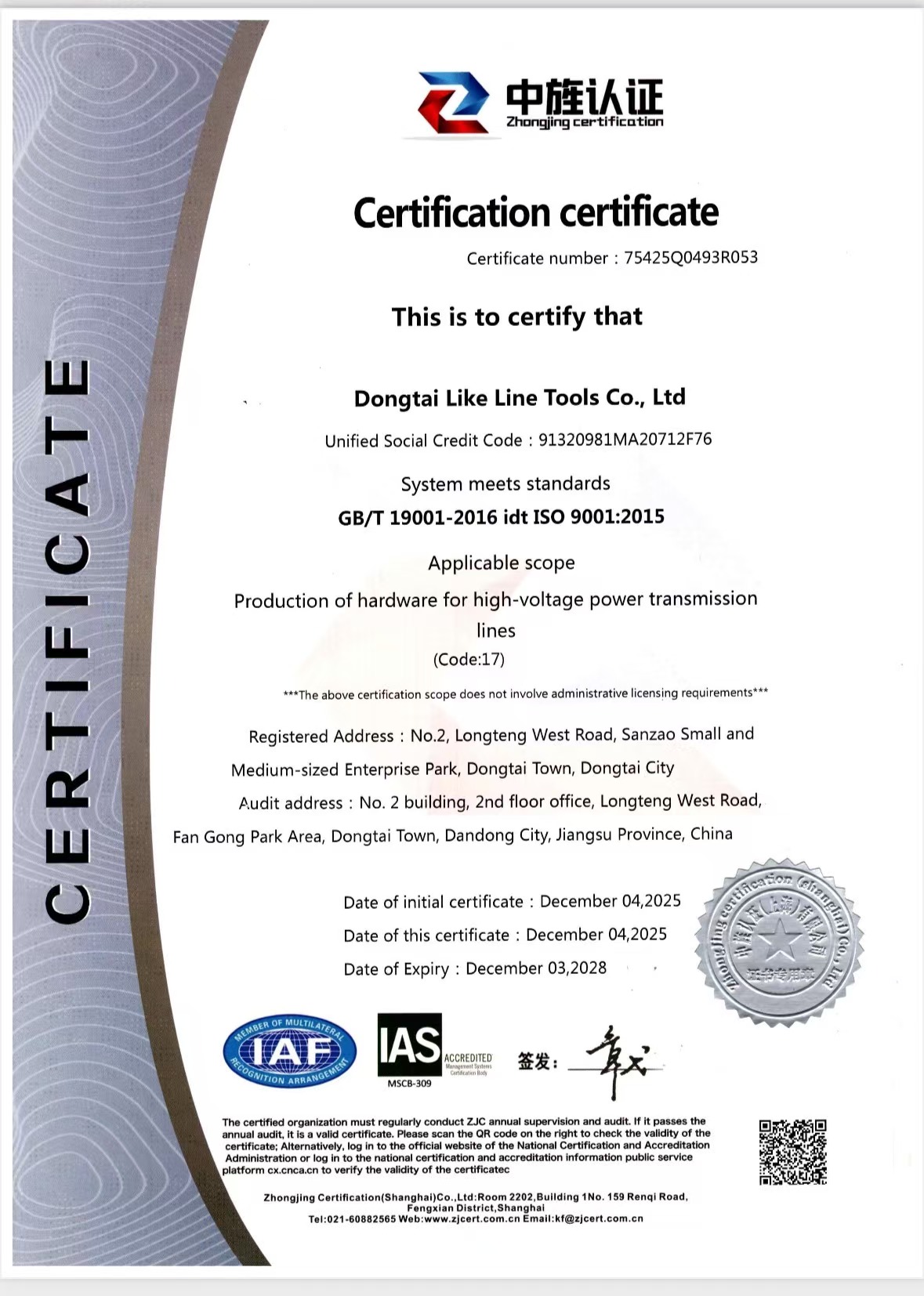
Two observations follow directly from reading the scope text rather than the certificate header.
First, both scopes are written around fittings and hardware. That makes them strong supporting documents for metal end fittings, suspension rings and line accessories, and weaker supporting documents for the electrical performance of a finished insulator. A buyer who receives only these two certificates has evidence about process control in hardware manufacturing, not evidence about lightning impulse withstand or wet power-frequency withstand of a specific insulator model.
Second, the two certificates overlap in time but not in wording, and their validity windows differ. An acceptance checklist should record the number, the scope sentence, the issue date and the expiry date separately for each, then map each to the product line it actually covers. Where a purchase order spans both fittings and insulators, both certificates belong in the file, each against its own line item.
The test report and the model it names
The product-side evidence in this example is a type test report, number 23XJ0089-S, issued on 2023-07-13 by Suzhou Electrical Apparatus Science Research Institute Co., Ltd., which also operates as the China National Center for Quality Inspection and Test of Electrical Apparatus Products. The report references IEC 60815, IEC 61109, IEC 62217 and IEC 61466, and records that tests were conducted according to IEC 61109. Its recorded validity runs to 2099-01-01.
The scope of that report is a single product: a 35 kV composite pin insulator, model FPQ-35/6 (5). That sentence is the most important sentence in the whole document set, because it defines what the report can and cannot be used for.
Documented boundary. Report 23XJ0089-S is a model-level document for the FPQ-35/6 (5) 35 kV composite pin insulator. It does not, by itself, certify the electrical or mechanical performance of other models in the same supplier's range, including the suspension long rod FXB-24-70-785mm. A buyer who requires test evidence for a different model has to request the report that names that model, or agree a documented equivalence with the supplier before award.
This is not a criticism of the supplier; it is how type-test documentation works across the industry. A report is a record of tests performed on a defined article. Extending it to a sibling product is a commercial assumption, and assumptions are what incoming inspection is designed to catch.
Standards have to be matched by material before products are compared
Insulator standards are organised by material and by product form. That structure is why a single 'certified' label cannot be applied across a mixed order of polymer, glass and porcelain units.
| Standard | Applies to | What it governs in an acceptance file |
|---|---|---|
| IEC 61109 | Composite suspension and tension insulators for overhead lines (AC above 1,000 V; DC above 1,500 V in the 2025 edition) | Definitions, test methods and acceptance criteria for composite insulators with a load-bearing core, polymeric housing and permanently attached metal end fittings |
| IEC 61466-1 / IEC 61466-2 | Composite string insulator units above 1 kV | Strength classes, end-fitting requirements, dimensions and characteristics |
| IEC 61952-1:2019 | Composite line post insulators | Characteristics including minimum specified mechanical load and lightning impulse withstand levels |
| IEC 60383-1 / IEC 60383-2 | Ceramic or glass insulator units; insulator strings and sets | Unit-level and string-level requirements for porcelain and glass overhead line insulators |
| IEC 60168 | Ceramic or glass post insulators above 1 kV | Test requirements for post configurations in porcelain or glass |
| IEC 60507 | Ceramic and glass insulators on AC systems | Artificial pollution testing — scope is ceramic and glass only |
| IEC 62217 | Polymeric high-voltage insulators, indoor and outdoor | General definitions, test methods and acceptance criteria for polymeric housings beyond the overhead-line-specific composite standards |
| IEC 60815-1 / -2 / -3 | HV insulators in polluted conditions | Selection and dimensioning framework linking site pollution severity to creepage requirements |
| ISO 1461 / ASTM A153/A153M | Hot-dip galvanized coatings on iron and steel hardware | Coating specification and test methods for metal end fittings and line hardware |
| HS 8546 | Electrical insulators of any material | Customs classification: 8546.10 glass, 8546.20 ceramics, 8546.90 other materials |
The boundary that causes the most errors is pollution testing. IEC 60507 addresses ceramic and glass insulators. A pollution test result obtained under that standard cannot be transferred to a silicone-housed product, which is assessed through the polymeric test provisions instead. When a tender document asks for 'pollution test evidence' without stating the material scope, the buyer has written an ambiguous clause that will be answered inconsistently by every bidder.
Mapping acceptance criteria to four specific models
Below is a working example of how stated ratings convert into document requests. Each row pairs a model with the parameters that appear in its published data, then lists the evidence that should accompany it.
| Model | Material and form | Stated parameters | Acceptance evidence to request |
|---|---|---|---|
| FXB-24-70-785mm | Silicone housing, fiber glass core, carbon steel / C45 fittings; suspension long rod | Rated voltage 35 kV; lightning impulse withstand above 230 kV; power-frequency 1-minute wet withstand above 95 kV; minimum creepage distance above 1,050 mm; rated bending load 5 kN | Type-test report naming this model; end-fitting coating declaration; core and crimping process record; dimensional check against the 1,050 mm minimum creepage |
| 70B | Glass, post line type; brown | Creepage distance 255 mm; cantilever load 10 kN; power-frequency wet withstand 45 kV; dry withstand 65 kV; puncture voltage 135 kV | Unit test record against the ceramic/glass series; post insulator test evidence where the configuration is a post; pollution test evidence if the project sits in a high-pollution area |
| U70BP/146D | Porcelain cap-and-pin unit | Minimum arcing distance 450 mm; connection structure code 16; structural height 146 mm; nominal disc diameter 255 mm; rated electromechanical failing load 70 kN | Unit test record for the 70 kN electromechanical failing load; dimensional verification of the 146 mm height and 255 mm disc; coupling compatibility check at code 16 |
| QP-7 | Ball-Head Suspension Ring; hot-dip galvanized steel | Designated coupling size 16; rated failing load 70 kN; weight 0.3 kg | ISO 9001 certificate 75424Q0348R0S for fittings manufacturing; coating record against ISO 1461 or ASTM A153/A153M; material and load verification |
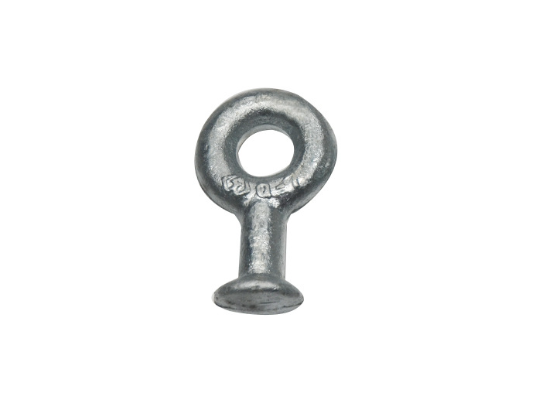
Two matching rules are visible in that table. The connection structure code on the porcelain unit (16) and the designated coupling size on the suspension ring (16) are an interface, not a coincidence; mismatched hardware at that interface is a common source of field assembly problems that no electrical test will reveal. And the rated failing load differs in meaning between products: 70 kN on U70BP/146D is an electromechanical failing load on a disc unit, 70 kN on QP-7 is a mechanical failing load on a fitting, and 5 kN on FXB-24-70-785mm is a rated bending load on a long rod. Comparing those numbers side by side without the qualifiers produces a specification error, not a comparison.
Metal end fittings: the most under-specified acceptance item
End fittings carry the mechanical load, form the corrosion boundary and define the interface between insulator and string hardware. In practice they are the part of the purchase order with the thinnest documentation.
Three clauses close that gap. The first is coating: ISO 1461 and ASTM A153/A153M both address hot-dip galvanizing on iron and steel hardware, but they are not interchangeable clause for clause, and they should not be averaged into a single requirement. The buyer should name one, according to the destination market and project specification, and require the inspection record against it. The second is geometry and strength class alignment, which is where the IEC 61466 series and the coupling designations on individual fittings do the work. The third is the rod-to-fitting interface on composite units, which is a manufacturing process characteristic rather than a catalogue value.
A supplier that can answer all three has a genuinely usable fittings file. A supplier that answers only the first has provided a coating certificate and nothing else.
How project conditions change the acceptance package
The same four models require different evidence depending on where they are installed. CECI's stated application conditions include high temperature and high humidity, outdoor harsh climate, UV ageing, dust storms that accelerate dust accumulation and abrade shed surfaces through wind and sand, and instantaneous impulse overvoltage. The listed project types are rural and urban grid upgrading, rail transit electrification, high-voltage transmission lines, substations and converter stations, and wind power projects. Listed requirements include anti-ageing and UV resistance, high mechanical strength, high insulation performance, light weight, good bending resistance, water penetration resistance, stable metal fittings with anti-electrochemical corrosion, and non-toxic, environment-friendly materials.
Those conditions translate into acceptance clauses rather than adjectives. A dust-storm and UV environment makes shed profile and housing material a documentable item, not a preference. A coastal or high-humidity destination moves the coating standard from a formality to a corrosion control requirement. A substation or converter station application shifts the emphasis to cantilever and bending performance. A rail electrification project follows a separate specification route from utility transmission, so evidence assembled entirely on the utility side should not be assumed to satisfy it. And in every case, creepage distance should be derived from site pollution severity through the IEC 60815 framework rather than copied from a catalogue page.
Document-only checking versus a model-level acceptance matrix
The difference between the two approaches is not administrative. It changes which bid can be accepted.
| Dimension | Document-only check | Model-level acceptance matrix |
|---|---|---|
| Certificate review | Certificate present, valid date range | Scope sentence read and matched to the specific line item |
| Test evidence | Any report in the supplier folder | Report naming the quoted model, with the standard edition recorded |
| Material standards | Single 'IEC compliant' statement | Standard mapped to material: composite, ceramic, glass or polymeric |
| Metal fittings | Not addressed | Coating standard named; coupling and load class verified |
| Pollution performance | Generic pollution claim | Creepage derived via IEC 60815; test method matched to material scope |
| Failure mode caught | Wrong scope, wrong model, outdated edition | Scope gaps surface before award |
Limits of this evidence set. The documents described here do not cover everything a high-voltage buyer may need. Both ISO 9001 certificates address fittings and hardware production, not finished-insulator type approval. The published test report covers the FPQ-35/6 (5) 35 kV composite pin insulator only, not the full range. And although report 23XJ0089-S carries a recorded validity to 2099-01-01, standards are revised over time — IEC 61109, for example, exists in a 2025 edition — so a buyer should judge validity by the edition referenced in the report and by any change in product design, not by the far end of the printed date. Where a project requires an independent third-party high-voltage laboratory report in addition to a national test institute report, that requirement has to be stated in the RFQ, because it is a commercial selection criterion rather than a technical necessity implied by any standard.
What is driving the document burden
Three published data points explain why acceptance files have become longer. Straits Research estimates the global insulators market at USD 15.19 billion in 2026, with grid modernisation as the stated driver. Market Research Future sizes the composite insulator segment at USD 6.792 billion on a 2025 base. UNIFE projects the global rail supply market at EUR 266.8 billion by 2031. Each of those trends increases the number of buyers, projects and material types entering the same qualification pipeline — and each additional material type brings its own standard series, its own test scope and its own scope-boundary errors.
The composite segment illustrates the point. A composite insulator is defined by a load-bearing core, a polymeric housing and permanently attached metal end fittings, and IEC 61109 treats all three as part of the tested article. A buyer who checks only the housing material has verified roughly one third of the specification.
Where insulator acceptance documentation is heading
The direction of travel is from certificate collection toward evidence packs that can be queried by batch. A review of available insulator documentation, including this supplier's file, identifies the same gaps repeatedly: type-test report identifiers, factory inspection records, end-fitting material batch codes, and batch-level resistance test results. Those four items are what a buyer needs in order to connect a delivered carton to a tested article, and they are also the items most often missing from a supplier folder built around certificates alone.
Suppliers with in-house testing and full-unit inspection are better positioned for this shift than the document set alone suggests. CECI states 100% testing as its quality control approach, with a monthly capacity of 500 tons and 100,000 pieces, a 30–45 day lead time and a minimum order quantity of 500 units — figures that matter to acceptance planning, because a buyer scheduling third-party pre-shipment inspection needs the production window and the test regime to be consistent with each other.
The reasonable expectation for the next procurement cycle is not that every supplier will hold a perfect document set, but that buyers will specify which document they want, for which model, against which standard edition, before the quotation is opened. That single change removes most of the ambiguity that currently gets resolved after the goods arrive.
Frequently asked questions
Does an ISO 9001 certificate prove an insulator's electrical performance?
No. ISO 9001 is a quality management system standard. It certifies that a defined production scope operates under a managed quality system. Electrical and mechanical performance is evidenced by type-test reports, which are written for a specific model against a specific standard. In this example, certificates 75424Q0348R0S and 75425Q0493R053 cover fittings and hardware production, while report 23XJ0089-S covers a specific insulator model.
What is the difference between certificate 75424Q0348R0S and certificate 75425Q0493R053?
Both are ISO 9001 quality management system certificates issued by Zhongjing Certification (Shanghai) Co.,Ltd. to GB/T 19001-2016 idt ISO 9001:2015, but they state different scopes and validity periods. 75424Q0348R0S covers manufacturing of power fittings (high-voltage line fittings and accessories) and runs from 2024-07-22 to 2027-07-21. 75425Q0493R053 covers production of hardware for high-voltage power transmission lines and runs from 2025-12-04 to 2028-12-03.
Can test report 23XJ0089-S be used to qualify the FXB-24-70-785mm polymer insulator?
Not as a direct substitute. Report 23XJ0089-S, issued by Suzhou Electrical Apparatus Science Research Institute Co., Ltd., names the 35 kV composite pin insulator model FPQ-35/6 (5) in its scope and records tests conducted according to IEC 61109. The FXB-24-70-785mm is a different model, a suspension long rod rated 35 kV with lightning impulse withstand above 230 kV, one-minute wet withstand above 95 kV, minimum creepage distance above 1,050 mm and rated bending load 5 kN. Qualifying it requires a report naming that model or a documented equivalence agreed in writing.
Which standard applies to a composite suspension insulator versus a porcelain cap-and-pin unit?
The material determines the standard series. Composite suspension and tension insulators for overhead lines above 1 kV are covered by IEC 61109, with IEC 61466-1 and IEC 61466-2 addressing composite string insulator units including end fittings and dimensions. Ceramic and glass insulator units and strings are covered by the IEC 60383 series, with IEC 60168 addressing ceramic or glass post insulators. Polymeric insulators more generally fall under IEC 62217. These are separate scopes, and a test result under one series is not evidence of conformity under another.
Which coating standard should be specified for metal end fittings?
ISO 1461 and ASTM A153/A153M both specify hot-dip galvanized coatings on iron and steel hardware, but they are not identical in their coating classes and inspection rules, so one should be named rather than an average of the two. The choice usually follows the destination market and the project specification. In this range, the Ball-Head Suspension Ring QP-7 is a hot-dip galvanized steel fitting with a designated coupling size of 16, a rated failing load of 70 kN and a weight of 0.3 kg, and its coating inspection record belongs in the acceptance file alongside its load verification.
How should a buyer treat the validity date printed on a type-test report?
As one input, not the answer. Report 23XJ0089-S carries a recorded validity to 2099-01-01, but standards are revised and products change. A buyer should check which edition of the standard the report references — IEC 61109, for instance, exists in a 2025 edition — and whether the product design, housing formulation or end-fitting arrangement has changed since the test was performed. Where any of those has moved, the report describes an earlier article, and fresh evidence should be requested.
How can a buyer verify that a certificate scope matches the purchased item?
Compare the scope sentence word by word with the line item on the purchase order, then check the issuer, the certificate number and the validity dates against the issuing body's records. A certificate describing fittings manufacturing supports a fitting such as QP-7; it does not by itself support the electrical ratings of a finished insulator string. Mapping each document to one product line, and rejecting documents that cannot be mapped, is the practical test.
The public catalogue covering CECI's polymer and glass insulator ranges, including model-level data, can be downloaded for comparison against a project acceptance checklist.
Download the 2025 CECI catalogue of polymer insulators and glass insulators
Have Questions or Need More Details?
Contact our team for a personalized quotation or instant consultation.
Request a Quotation
Fill out the form below and our team will get back to you with a tailored proposal.
WhatsApp Direct Chat
Prefer to chat in real-time? Message us on WhatsApp for instant assistance & quick answers.
- Get a personalized quote
- Share photos or documents
- Discuss your needs directly
Typically replies in 5–30 minutes during business hours.