
Insulator Buyer Comparison: Porcelain U70BP/146D vs Glass 70B vs Polymer FXB-24-70-785mm
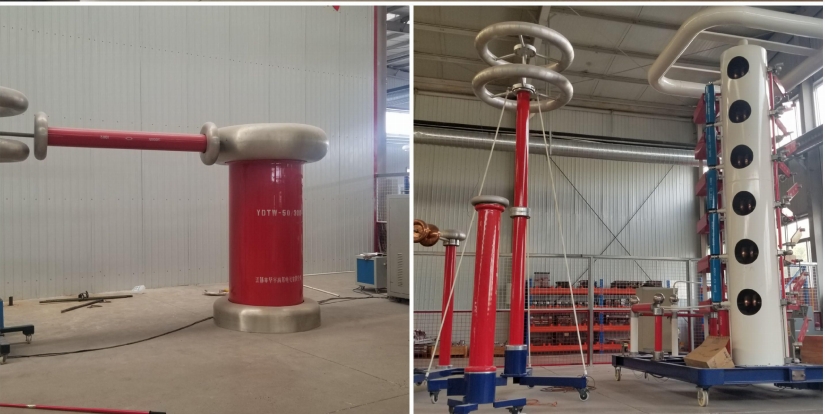
Type-test capability is where a catalogue comparison becomes a procurement decision.
Insulator selection is normally argued as a materials question — porcelain against glass against polymer. In procurement practice it is a model-level decision. Three units demonstrate why: porcelain U70BP/146D, glass 70B and polymer FXB-24-70-785mm sit on different sides of the comparison gap, and each is bought against a different set of line conditions, documents and cost pools.
Why three specific models beat a materials-only debate
Porcelain U70BP/146D and glass 70B are cap-and-pin disc insulators. They are modular units — a dielectric disc locked between a metal cap and pin — assembled into strings, and their published ratings are per unit and per string. Polymer FXB-24-70-785mm is a composite long-rod suspension insulator: a single unit with a silicone housing over a fiberglass-reinforced plastic rod and metal end fittings in carbon steel / C45, rated at 35 kV.
That structural difference, more than the chemical difference between ceramic, glass and silicone, is what changes how a buyer should compare them. A disc unit is quoted by mechanical failing-load class, unit spacing and creepage per unit. A composite long-rod is quoted by rated voltage, lightning impulse withstand, power-frequency wet withstand, minimum creepage distance and bending load. Placed on the same spreadsheet, the two sets of numbers look like they answer the same question. They do not.
The standards split along the same line. Ceramic or glass insulators for overhead lines with nominal voltage above 1,000 V are tested under IEC 60383-1. Composite insulators for high-voltage overhead lines (AC above 1,000 V) are governed by IEC 61109, whose latest edition is 2025. Two different test regimes mean two different evidence sets — and a buyer who has only one of them cannot honestly finish the comparison.
The problem: catalogue data is not comparable data
The core failure in insulator procurement is not picking the wrong material. It is comparing entries that were never measured the same way. Three consequences follow.
- Unit versus string. For cap-and-pin insulators, creepage, impulse withstand and wet withstand scale with the number of units in the string. For a composite long-rod, they are single published figures. Comparing a string-level value from one column with a unit-level value from another produces a false winner in either direction.
- Different load cases. A disc insulator's headline mechanical number is its failing load under tensile stress. A long-rod composite insulator in suspension service is frequently specified by bending or cantilever load. These are different load directions with different safety factors and cannot be plotted on one axis.
- Qualitative claims. Environmental performance — pollution resistance, UV ageing, dust behaviour — is often sold in adjectives rather than in numbers, which makes the third column of a comparison sheet the least reliable one.
The practical opportunity is straightforward: normalize the dimensions first, then let project conditions decide which column wins. That is the framework below.
The five comparison dimensions that actually decide an insulator purchase
1. Creepage distance
Creepage distance is the leakage path length along the insulating surface. Under pollution — salt, industrial deposits, dust — a conductive film forms on that surface, and creepage distance sets the flashover margin. For a fair comparison, disc insulators must be normalized to total string creepage: the per-unit figure from the type test report multiplied by the number of units. For a composite long-rod, the value is published directly; FXB-24-70-785mm is specified with a minimum creepage distance above 1,050 mm. Buyers should also normalize creepage against arcing distance, because creepage gained purely through shed geometry does not always translate into flashover margin in wet or heavily contaminated conditions.
2. Withstand voltages: impulse and power-frequency wet
Two values matter. Lightning impulse withstand voltage describes the insulation's response to an impulse overvoltage event. Power-frequency one-minute wet withstand voltage describes performance under operating stress with surface moisture present — the more demanding figure in humid, coastal or high-rainfall corridors. FXB-24-70-785mm is specified at above 230 kV impulse withstand and above 95 kV power-frequency one-minute wet withstand at a 35 kV rating. For U70BP/146D and 70B, both values depend on the number of units in the string and must be read from the type test report for the specific string configuration; they cannot be inferred from the model designation.
3. Mechanical load: failing load, cantilever and bending load are not the same number
In cap-and-pin nomenclature, the numeral in U70BP/146D and 70B references the 70 kN mechanical failing-load class used for disc units — a tensile rating. The composite unit in this comparison is specified differently: FXB-24-70-785mm carries a rated bending load of 5 kN. A buyer who places 70 kN and 5 kN side by side and concludes that one unit is fourteen times stronger has made an error of category, not of arithmetic. The correct procedure is to convert each unit to the load case the line actually imposes — tensile for suspension strings under conductor tension, bending for long-rod units on compact or cantilevered structures — and then compare.
4. Arcing distance
Arcing distance is the shortest path through air between the two metal end fittings. It sets the dry flashover envelope and interacts directly with structure geometry: cross-arm spacing, tower clearances and substation layout. It is not the same quantity as creepage distance and it is frequently missing from comparison sheets because it is a geometry parameter rather than a material parameter. Two insulators with identical creepage can require different structures, and the structural consequence usually costs more than the insulator.
5. Environmental fit
The dominant field stresses for overhead line insulators are UV ageing, dust storms, high humidity, high temperature and impulse overvoltage. The reference operating scenario for these products is continuous 24/7 duty under exactly those conditions, with requirements for anti-ageing behaviour, UV resistance, high mechanical strength, high insulation, low weight, bending resistance, waterproofing, stable metal fittings and resistance to electrochemical corrosion. Silicone rubber housings are used precisely because their surface behaviour differs from that of ceramic and glass; porcelain and glass rely on shed geometry and creepage for pollution performance. Glass has a separate practical advantage: impact damage is visible, which shortens inspection time.
Side-by-side framework: U70BP/146D, 70B and FXB-24-70-785mm
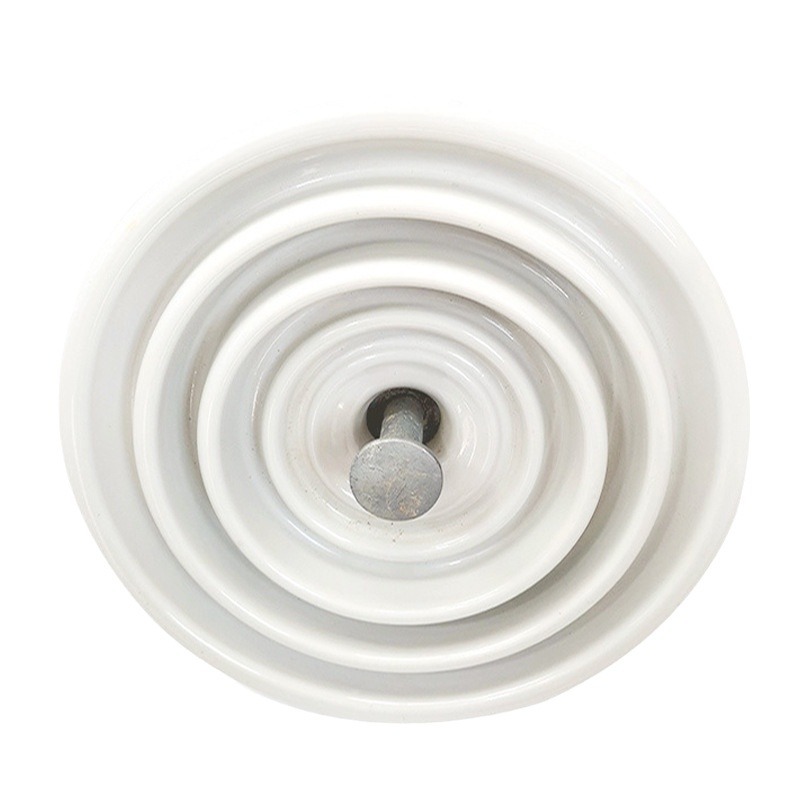
Porcelain U70BP/146D: a cap-and-pin disc unit compared per unit and per string, not against long-rod ratings.
| Comparison dimension | Porcelain U70BP/146D | Glass 70B | Polymer FXB-24-70-785mm |
|---|---|---|---|
| Architecture | Cap-and-pin disc unit, ceramic dielectric, metal cap and pin | Cap-and-pin disc unit, toughened glass dielectric, metal cap and pin | Composite long-rod, silicone housing over FRP rod, carbon steel / C45 end fittings |
| Coupling and fittings | Disc coupling, assembled into strings | Disc coupling, assembled into strings | Customizable metal end fittings |
| Mechanical rating basis | 70 kN failing-load class by designation; confirm per unit from type test report | 70 kN failing-load class by designation; confirm per unit from type test report | Rated bending load 5 kN |
| Rated voltage | Set by string length | Set by string length | 35 kV |
| Lightning impulse withstand | Read from the type test report for the string configuration | Read from the type test report for the string configuration | Above 230 kV |
| Power-frequency 1-minute wet withstand | Read from the type test report for the string configuration | Read from the type test report for the string configuration | Above 95 kV |
| Minimum creepage distance | Per-unit value multiplied by number of units | Per-unit value multiplied by number of units | Above 1,050 mm |
| Arcing distance | Geometry dependent; confirm against structure clearances | Geometry dependent; confirm against structure clearances | Geometry dependent; confirm against structure clearances |
| Governing standard | IEC 60383-1 | IEC 60383-1 | IEC 61109 |
| Typical best-fit role | High-tensile suspension and tension strings where disc practice is established | Corridors where quick replacement and visible damage detection carry weight | 35 kV transmission and distribution, pollution, UV and dust exposure, compact structures |
Table 1 — A normalized comparison framework. Published values sit beside entries that can only be completed from a project-specific type test report; that gap is itself part of the buying decision.
What CECI's documentation contributes as the polymer reference point
China Energy and Chemical Industry Co.,Ltd (CECI) is a power equipment manufacturer based in Zhengzhou, Henan, China, founded in 2017, operating a 30,000 m² production site with 100 employees, an eight-engineer R&D team and an annual output of 8,000,000 units. Its catalogue covers polymer insulators, porcelain insulators, glass insulators, metal fittings for insulators, and overhead line hardware fittings and accessories. Around 95% of output is exported, reaching more than 40 countries, with main markets including Russia, Vietnam, France, Spain, Italy, Türkiye, Brazil, Poland, Indonesia and Saudi Arabia.
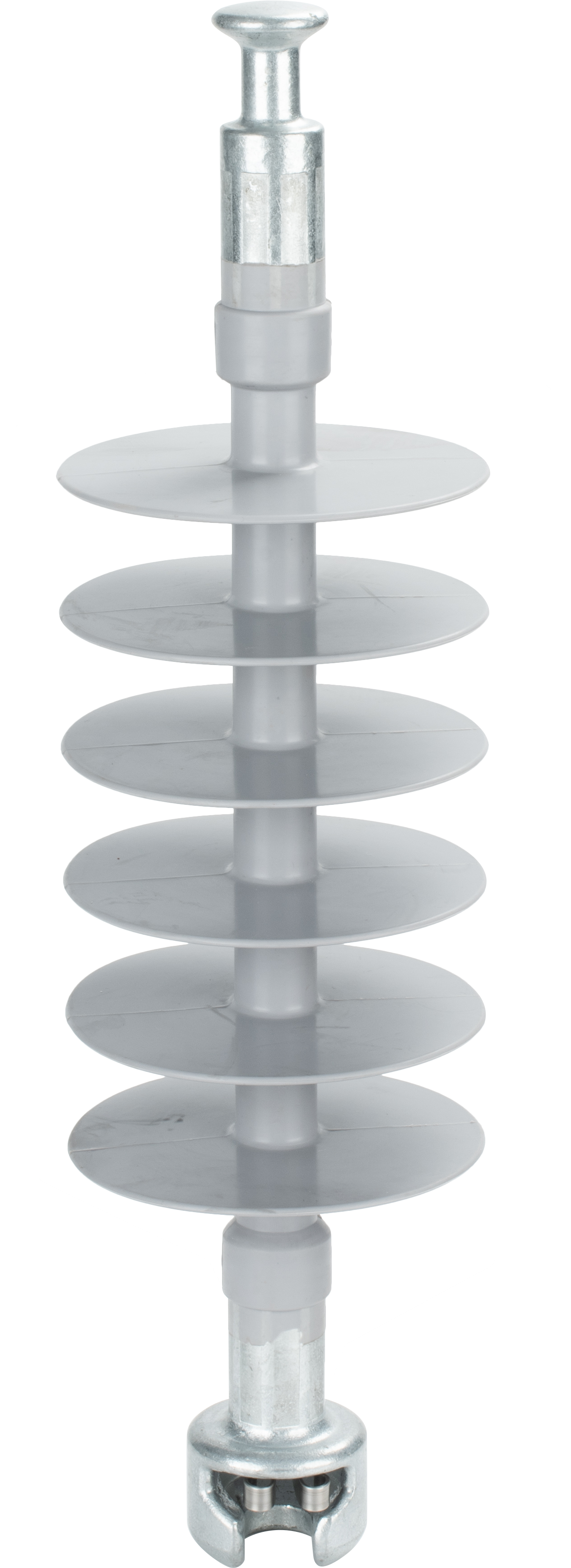
Polymer FXB-24-70-785mm: a 35 kV long-rod suspension unit whose ratings are published as single-unit figures.
The commercial parameters matter as much as the electrical ones for a buyer comparing three systems. CECI offers OEM and ODM work, and the customizable parameters include voltage, creepage distance, lightning impulse withstand voltage, bending load, colour and logo. Monthly capacity is 500 tons or 100,000 pieces, lead time is 30–45 days, minimum order quantity is 500 units, and quality control is described as 100% testing with remote after-sales support.
The evidence layer behind the polymer reference point is documented as follows:
- Type Test Report 23XJ0089-S, issued 13 July 2023 by Suzhou Electrical Apparatus Science Research Institute Co., Ltd. and the China National Center for Quality Inspection and Test of Electrical Apparatus Products, referencing IEC 60815, 61109, 62217 and 61466, with tests carried out according to IEC 61109.
- ISO 9001 Quality Management System certificate 75425Q0493R053, issued by Zhongjing Certification (Shanghai) Co., Ltd., valid to 3 December 2028, scope: production of hardware for high-voltage power transmission lines.
- ISO 9001 Quality Management System certificate 75424Q0348R0S, issued by Zhongjing Certification (Shanghai) Co., Ltd., valid to 21 July 2027, scope: manufacturing of power fittings, including high-voltage line fittings and accessories.
For a buyer, this is useful in two ways. It establishes what can be verified for the composite column of the comparison, and it shows which parameters are open to specification rather than fixed by a catalogue.
Accessory compatibility: the QP-7 ball-head suspension ring
Insulator selection does not end at the dielectric. The assembly rating is set by the weakest element, and on suspension and tension applications that element is frequently the fitting. The QP-7 Ball-Head Suspension Ring is specified with a designated coupling size of 16, a rated failing load of 70 kN, a weight of 0.3 kg, and hot-dip galvanized steel construction. Both CECI ISO 9001 certificates listed above reference this product.
Four compatibility checks should be run before the QP-7 is paired with any of the three insulators.
- Load class. The QP-7 is rated at 70 kN, which places it in the same load class as 70 kN-class disc units such as U70BP/146D and 70B. That correspondence is the first check, because a 70 kN fitting under a lower-rated insulator, or the reverse, moves the failure point without improving the line.
- Coupling geometry. The QP-7 carries a designated coupling size of 16. Disc insulators with ball-and-socket couplings must be checked against that size rather than assumed to match.
- Corrosion environment. Hot-dip galvanized steel is the specified material. Humidity, salt and industrial pollution conditions, and any electrochemical interaction where galvanized steel meets aluminium fittings in wet conditions, need to be verified for the specific route.
- Interface flexibility. The composite FXB-24-70-785mm uses customizable end fittings, so the interface can be specified to match existing project hardware instead of forcing hardware to match the insulator.
Matching each unit to project conditions
The scenario data for these products describes application in public electrical equipment: rural and urban power grid upgrading, rail transit electrification, high-voltage transmission lines, substations and converter stations, and wind power projects. The operating profile is continuous 24/7 duty under high temperature, high humidity, outdoor climate, UV ageing, dust storms and impulse overvoltage, with supporting equipment such as power distribution cabinets. This scenario is described as common in Spain, France, Italy and Türkiye.
Mapping that profile onto the three reference units produces a practical shortlist:
- Pollution, UV and dust on a 35 kV transmission or distribution line: the composite long-rod column is the natural fit. FXB-24-70-785mm carries the 35 kV rating directly, with minimum creepage above 1,050 mm, impulse withstand above 230 kV and a 5 kN bending load that suits compact structures.
- Long spans and high tensile duty with established disc practice: the 70 kN-class disc units are the reference. U70BP/146D and 70B scale to the required withstand level by string length, and the existing maintenance and spares practice around disc units usually remains valid.
- Corridors where emergency replacement speed dominates: glass units carry a specific cost signal, covered in the next section, that favours networks with high repair frequency and visible-damage inspection practice.
- Rail transit electrification, substations and converter stations: where vertical clearance and structure loading are constrained, the long-rod composite form reduces both.
- Wind projects and coastal humidity exposure: sustained humidity and UV point towards the silicone-housed composite option.
CECI's recorded project profile covers utility companies, power EPC contractors, railway operators and contractors, and distributors and resellers, with roughly 10,000 units deployed across Brazil, Italy, Türkiye and Vietnam over a three-year record. Applications span mechanical support and insulation on transmission lines, substation insulation, railway catenary or ground equipment insulation, and fuse and overvoltage protection. Reported outcomes include enhanced line stability, reduced maintenance intensity and improved pollution resistance when polymer or glass insulators are used, with highlights covering lightweight designs, anti-pollution flashover and ageing resistance, customizable end fittings, FRP rod core supply and OEM/ODM support.
Cost and maintenance signals: what the numbers do and do not say
Two sets of cost signals belong in this framework, and they point in different directions.
The composite signal: composite insulators are about 50% lighter and save about 60% of installation time, but cost about 10% more initially. The glass signal: glass insulator replacement total cost is cited at 25% to 35% lower than traditional alternatives, with 1–2 hour emergency repair time.
Read together, these say that purchase price is a poor proxy for total cost. The 10% initial premium on a composite unit is a one-off purchase gap. It converts into lifecycle value only if the weight and handling advantages reduce something measurable: cross-arm and tower loading, crane or aerial-platform time, crew hours, or the length of the outage window needed to complete the work. On a project where the outage window is the binding constraint, a 60% reduction in installation time is the dominant number on the sheet.
The glass signal answers a different question. A 25% to 35% lower replacement total cost applies to the economics of replacement, which means it carries most weight where repair frequency is high — lines with routine breakage, vandalism, or inspection regimes that require frequent unit changes. On a low-fault, well-managed line the same percentage applies to a much smaller spend base and should not be used to overturn a mechanical or pollution-driven decision.
Three practical cautions. First, initial cost, installation cost and replacement cost are separate pools and should be tracked separately rather than blended into one figure. Second, none of these percentages include freight, tariffs, spares holding or the cost of retraining crews on a new string configuration. Third, a percentage that is directional across a product class is not a quotation for a specific route.
Market trend analysis: where the insulator mix is heading
The global electrical insulator market was valued at USD 12.5 billion in 2023 and is projected to reach USD 18.4 billion by 2030, according to Grand View Research. Within that total, the composite insulator segment is valued at approximately USD 3.42 billion in 2024 and is expected to reach USD 5.87 billion by 2030 at a CAGR of 9.1%, according to Strategic Market Research. Suspension insulators accounted for a 48.4% share of the composite insulators segment in 2024, according to Mordor Intelligence — confirmation that the long-rod and suspension form factor, not the exotic end of the range, is where composite volume sits.
Source scope matters here and buyers should not blend series. Mordor Intelligence values the electric insulator market at USD 14.38 billion against Grand View Research's USD 12.5 billion for electrical insulators; the divergence reflects different definitions, with one series closer to insulation materials and the other to finished electrical insulators. Mixing the two produces a growth rate that neither source supports.
On the supply side, China concentrated 13.1% of global exports of insulating glass and related materials in 2024, making it the second-largest global exporter, according to the Observatory of Economic Complexity — a relevant input for lead-time and sourcing risk planning. The global competitive set is concentrated among ABB Ltd, Siemens Energy, GE Grid Solutions, NGK Insulators and Hubbell Inc., per Mordor Intelligence, which means most buyers are selecting within a small number of qualified supply chains rather than discovering new ones.
Standards are moving on a slower clock but in the same direction. IEC 61109, the governing standard for composite insulators on high-voltage overhead lines above 1,000 V AC, is at its 2025 edition. Procurement specifications built on older editions should be re-checked rather than carried forward.
Limits of this framework
A comparison framework is not a selection study, and this one has defined boundaries that a buyer should respect.
- It normalizes dimensions; it does not calculate them. Pollution severity class, altitude, seismic loading and mechanical loads must be calculated for the actual line before any column is chosen.
- Failing load and bending load are not interchangeable. A framework that plots 70 kN and 5 kN on a single axis will mislead, which is why they are separated here.
- Not every parameter for U70BP/146D and 70B is published in the reference material used for this comparison. Those cells can only be completed from the specific type test report, so the table is genuinely incomplete until the supplier responds.
- The cost signals are directional averages for a product class, not project quotations, and they exclude freight, tariffs, spares and crew retraining.
- The 35 kV rating limits FXB-24-70-785mm to applications within that voltage class. It is not a substitute for a higher-voltage composite unit on a higher-voltage line.
- Where a utility already runs a mature disc replacement practice with low fault rates, the case for changing material class is weaker than the market growth figures alone would suggest. Installed practice, spares inventory and crew familiarity are real switching costs.
Future outlook
If the composite segment continues at the projected 9.1% CAGR to 2030 while suspension insulators hold roughly half of that segment, substitution pressure will concentrate where composite advantages are measurable: pollution-exposed routes, compact structures, and projects where installation time is constrained by outage windows. Disc insulators are unlikely to be displaced where tensile duty is high and disc practice is deeply embedded, because the switching cost sits in structures, spares and crews rather than in the insulator itself.
Two procurement consequences follow. First, type test evidence will need to be re-verified against the current IEC 61109 edition rather than reused from older reports. Second, customization is becoming a normal lever rather than a special request: voltage, creepage distance, lightning impulse withstand voltage, bending load, colour and logo are all specifiable, which shifts the real constraints onto lead time and minimum order quantity. Buyers who compare model numbers alone will increasingly be comparing the wrong thing.
Frequently asked questions
What is the main difference between porcelain U70BP/146D, glass 70B and polymer FXB-24-70-785mm?
Porcelain U70BP/146D and glass 70B are cap-and-pin disc insulators: modular units assembled into strings and designated in the 70 kN mechanical failing-load class. Polymer FXB-24-70-785mm is a composite long-rod suspension insulator rated at 35 kV, built as a silicone housing over a fiberglass-reinforced plastic rod with carbon steel / C45 end fittings. The first two are compared per unit and per string; the third is compared as a single unit with published ratings of above 230 kV lightning impulse withstand, above 95 kV power-frequency one-minute wet withstand, above 1,050 mm minimum creepage distance and 5 kN rated bending load.
Which of the three suits a 35 kV transmission or distribution line?
The voltage rating is explicit only for the polymer unit: FXB-24-70-785mm is rated 35 kV. Cap-and-pin disc insulators are rated by string configuration — the number of units determines the withstand level — so U70BP/146D or 70B can serve a 35 kV line provided the calculated string meets the required impulse and wet withstand values recorded in the type test report. The decision then turns on pollution level, mechanical duty and structure clearances rather than on voltage alone.
How do pollution, UV and dust exposure change the selection?
Pollution drives creepage distance. The reference operating scenario for these products is continuous 24/7 duty under high temperature, high humidity, outdoor climate, UV ageing, dust storms and impulse overvoltage, with requirements covering anti-ageing behaviour, UV resistance, high mechanical strength, high insulation, low weight, bending resistance, waterproofing, stable metal fittings and resistance to electrochemical corrosion. Where pollution and UV exposure are sustained, creepage and housing material become the primary comparison; FXB-24-70-785mm is specified with minimum creepage distance above 1,050 mm. Where the environment is moderate and visible damage detection is valued, glass disc units support faster inspection and unit replacement.
Can the QP-7 ball-head suspension ring be used with all three?
Compatibility has to be checked on three points. Load class: the QP-7 has a rated failing load of 70 kN and a designated coupling size of 16, which corresponds to the 70 kN class of U70BP/146D and 70B, and both CECI ISO 9001 certificates reference this fitting. Coupling geometry: the coupling size 16 designation must match the insulator's coupling rather than be assumed. Environment: the ring is hot-dip galvanized steel, so corrosion behaviour under the route's humidity, salt and pollution conditions needs verification, particularly where galvanized steel meets aluminium fittings.
Does the higher initial cost of composite insulators pay back?
The comparison signals used here put composite insulators about 50% lighter and about 60% faster to install, at roughly a 10% higher initial cost. Payback depends on which cost pool dominates. Weight and installation time convert into savings through reduced structure loading, shorter handling windows and lower labour, while the 10% purchase premium is a one-off. Where the outage window is the binding constraint, installation time matters more than purchase price. Where repair frequency dominates, glass replacement economics — a 25% to 35% lower replacement total cost than traditional alternatives, with 1–2 hour emergency repair — become the more relevant signal.
What documentation should a buyer request before choosing between these units?
At minimum, the type test report for the specific model and string configuration, covering lightning impulse withstand, power-frequency wet withstand, creepage distance and the relevant mechanical load case. CECI's published evidence set includes Type Test Report 23XJ0089-S issued by Suzhou Electrical Apparatus Science Research Institute Co., Ltd., referencing IEC 60815, 61109, 62217 and 61466 with tests according to IEC 61109, plus ISO 9001 certificates 75425Q0493R053 and 75424Q0348R0S covering production of hardware for high-voltage power transmission lines and manufacturing of power fittings. Buyers should also confirm that composite test evidence references the current IEC 61109 edition rather than an earlier one.
Reference material: CECI's 2025 catalogue of polymer and glass insulators, including model-level parameter tables, is available for download at 2025 CECI catalogue of polymer insulators and glass insulators. Manufacturer website: www.gridinsulators.com.