
Insulator Procurement FAQ: Voltage Ratings, Creepage and Load Specs
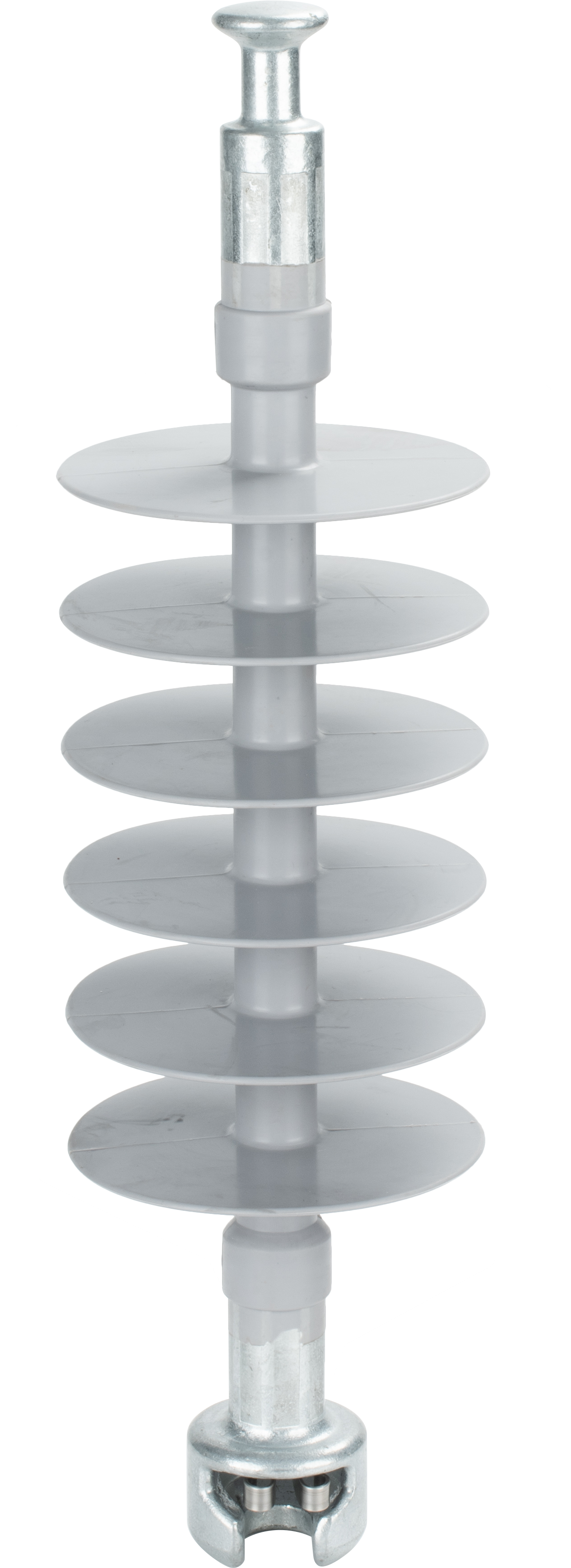
Cover: FXB-24-70-785mm polymer suspension long-rod insulator, rated 35 kV, minimum creepage distance above 1050 mm. Image: China Energy and Chemical Industry Co.,Ltd.
Three figures answer most first-round questions in an insulator procurement file: the voltage class the unit is rated for, the creepage distance it provides, and the mechanical load it can carry. Housing material, fitting type, coating and packing are either consequences of those three numbers or logistics details.
This reference walks through those figures using the documented parameter sets of four catalogue items from China Energy and Chemical Industry Co.,Ltd (CECI), a power equipment manufacturer established in 2017 and based in Zhengzhou, Henan, China, producing polymer, porcelain and glass insulators together with metal fittings for insulators and overhead line hardware fittings and accessories. CECI products are exported to more than 40 countries, with export business accounting for 95% of total sales, and OEM and ODM services are available.
Why the same insulator sheet is read differently by engineers and buyers
A line engineer reads an insulator datasheet against insulation coordination and mechanical design. A buyer reads the same sheet against a purchase order, an incoming inspection checklist and a bill of materials. The three figures above are where those two readings most often diverge.
Four recurring mismatches are worth naming before any quotation stage:
- Creepage distance requested, arcing distance quoted. The two are different physical measurements and cannot be exchanged on a datasheet.
- Failing load read as working load. A rated failing load describes the mechanical class of a unit, not the load it is intended to carry in service.
- Bending load compared with tensile failing load. Values expressed in the same unit of kilonewtons may describe completely different load directions.
- Coupling size ignored. An insulator body and its fitting must share a compatible connection designation, otherwise the delivered hardware set does not assemble.
The commercial context makes this reading skill more valuable rather than less. Grand View Research valued the global electrical insulator market at USD 12.5 billion in 2023, projecting USD 18.4 billion by 2030. Strategic Market Research values the composite insulator segment at approximately USD 3.42 billion in 2024, expected to reach USD 5.87 billion by 2030 at a CAGR of 9.1%. Mordor Intelligence recorded suspension insulators at 48.4% of the composite insulator market segment in 2024. On the supply side, OEC data shows China concentrating 13.1% of global exports of insulating glass/materials in 2024 as the world's second-largest exporter. Cross-border sourcing volume is growing, and with it the number of specification sheets that have to be reconciled between buyer and factory.
Reading a polymer long-rod sheet: FXB-24-70-785mm
The FXB-24-70-785mm is a suspension long-rod insulator rated 35 kV, built with a silicone housing, a fiber glass core rod, and carbon steel/C45 metal fittings. Its documented electrical and mechanical parameters are as follows.
| Parameter | Documented value |
|---|---|
| Rated voltage | 35 kV |
| Minimum creepage distance | >1050 mm |
| Lightning impulse withstand voltage | >230 kV |
| Power frequency 1-minute wet withstand voltage | >95 kV |
| Rated bending load | 5 kN |
| Materials | Silicone housing; fiber glass core rod; carbon steel/C45 fittings |
The '>' prefix matters. Values written as "greater than" are minimum guaranteed levels rather than typical test results, and they should appear in that form on the inspection sheet as well. Two derived readings are useful in a procurement file. First, a minimum creepage distance above 1050 mm at a 35 kV rated voltage corresponds to roughly 30 mm of creepage per kilovolt at rated voltage — a figure that can be compared directly with the specific creepage requirement stated in a project's pollution-level specification. Second, the lightning impulse withstand above 230 kV describes the insulation coordination duty of the unit, while the power frequency wet withstand above 95 kV describes its behaviour in wet power-frequency conditions. These are separate tests and should never be collapsed into one "withstand voltage" line item.
The rated bending load of 5 kN is the parameter buyers most often misplace. It is a bending rating, relevant when the long rod is mounted so that load acts laterally along the unit, not a tensile failing load comparable with the 70 kN class used for cap-and-pin discs. A 5 kN bending-rated long rod and a 70 kN failing-load disc insulator belong to different mechanical duty categories, and substituting one for the other on mechanical grounds alone is not a valid comparison.
Reading a porcelain disc sheet: U70BP/146D
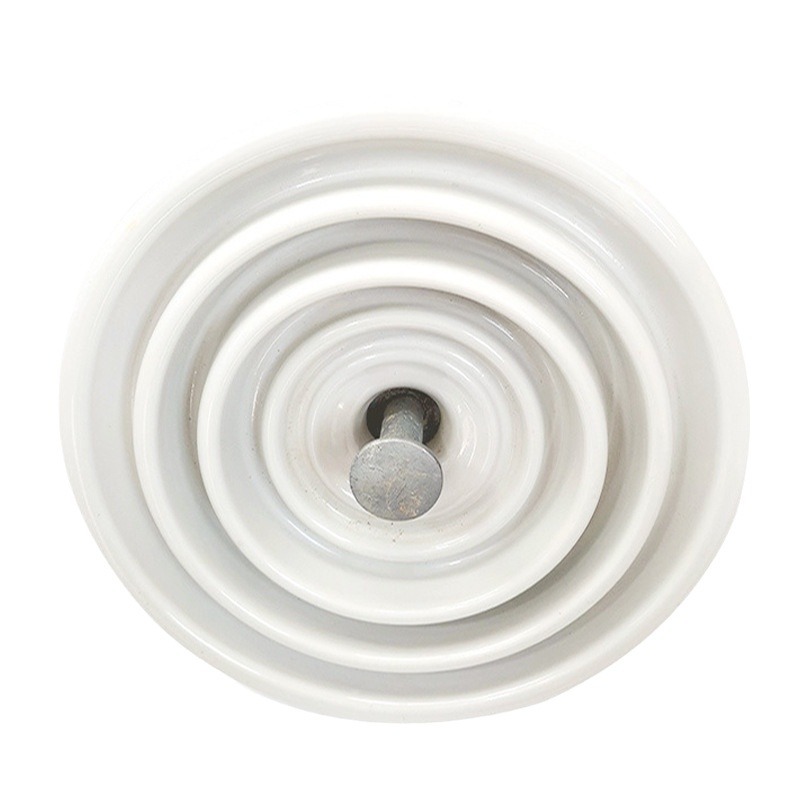
U70BP/146D porcelain insulator: 70 kN rated electromechanical failing load, 146 mm nominal structural height, 255 mm nominal disc diameter. Image: China Energy and Chemical Industry Co.,Ltd.
The U70BP/146D is a porcelain insulator for electricity industry applications. Its documented parameter set is deliberately mechanical: rated electromechanical failing load 70 kN, nominal structural height 146 mm, nominal disc diameter 255 mm, minimum arcing distance 450 mm, and connection structure code 16.
| Parameter | Documented value | Why buyers use it |
|---|---|---|
| Rated electromechanical failing load | 70 kN | Defines the mechanical class of the unit within a string |
| Nominal structural height | 146 mm | Multiplied by unit count to estimate string length and clearance |
| Nominal disc diameter | 255 mm | Relates to the leakage surface area of each disc |
| Minimum arcing distance | 450 mm | Shortest air path for flashover under dry conditions |
| Connection structure code | 16 | Determines which fittings and accessories will assemble |
Two practical consequences follow. The 146 mm structural height is a length input, so string length scales with the number of discs a design requires; on compact towers, in substations and inside converter stations, that accumulated length is usually the constraint that decides between disc strings and long-rod units. The 70 kN failing load is a class marking: it tells the buyer which mechanical family the unit belongs to, and it must be read together with whatever safety factor the applicable line design specification imposes, not as an in-service working load.
One boundary is worth stating plainly. The documented parameter set for the U70BP/146D covers failing load, structural height, disc diameter, arcing distance and connection code. It does not, in the material reviewed here, state a per-unit creepage distance. Where a project specifies total string creepage against a pollution level, that per-unit creepage figure has to be confirmed from the manufacturer's type-test documentation instead of being inferred from the arcing distance. Arcing distance and creepage distance are not interchangeable values, and treating one as the other is one of the most common causes of specification disputes at incoming inspection.
Reading a glass line post sheet: 70B
The 70B is a post line insulator made of glass, coloured brown, intended for overhead power lines in the electricity industry. Its documented parameters are:
| Parameter | Documented value |
|---|---|
| Creepage distance | 255 mm |
| Power frequency dry withstand voltage | 65 kV |
| Power frequency wet withstand voltage | 45 kV |
| Power frequency puncture voltage | 135 kV |
| Cantilever load | 10 kN |
| Material and colour | Glass, brown |
For post-type insulators, the dry and wet withstand values describe two different test conditions, and the wet figure — 45 kV here — is normally the one that matters for outdoor service in rain, fog or heavy condensation. The 65 kV dry withstand figure is still useful during factory acceptance testing and for comparing units within the same family. The 135 kV puncture voltage sits well above both withstand values, which is the expected design relationship: puncture is a destructive, non-recoverable event, so it is set as a margin above the flashover levels rather than as an operating limit.
The mechanical figure on this sheet is a cantilever load of 10 kN. Cantilever is the relevant rating for post and line-post duty, where the load is applied laterally at the top of the unit. It is not comparable with the 70 kN rated electromechanical failing load of a cap-and-pin disc, nor with the 5 kN rated bending load of the polymer long rod. Three insulators, three mechanical definitions — a comparison table that lines them up without labelling the load type will mislead every reader who uses it to shortlist suppliers.
Accessory selection: the QP-7 ball-head suspension ring
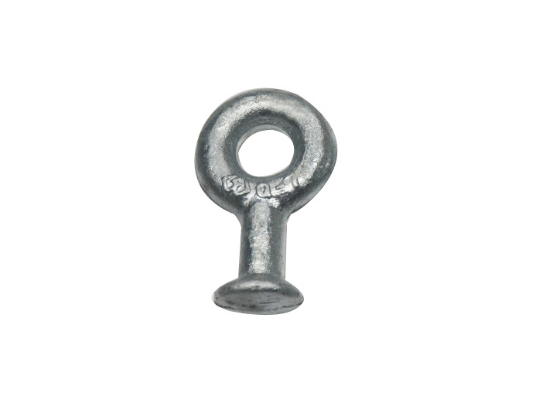
QP-7 ball-head suspension ring: hot-dip galvanized steel, coupling size 16, rated failing load 70 kN, net weight 0.3 kg. Image: China Energy and Chemical Industry Co.,Ltd.
Insulator procurement files regularly fail at the accessory line, not at the insulator line. The QP-7 ball-head suspension ring is a power equipment part and accessory for the electricity industry, made of hot-dip galvanized steel, with a designated coupling size of 16, a rated failing load of 70 kN, and a net weight of 0.3 kg.
Three checks follow from that data. The coupling size of 16 matches the connection structure code 16 of the U70BP/146D porcelain insulator, which is exactly the kind of dimensional coordination a buyer should verify on paper before confirming an order — a 70 kN insulator body paired with a fitting of a different coupling designation will not assemble, regardless of the load ratings on either sheet. The 70 kN rated failing load of the ring aligns with the 70 kN mechanical class of the disc it is designed to carry, so the accessory does not become the weakest element of the assembly. And the 0.3 kg unit weight is a real input when the number of fittings per tower runs into the hundreds: fitting weight adds to the load a structure carries and to the volumes and freight cost of a shipment.
The hot-dip galvanized steel construction addresses the corrosion side of the same problem. Galvanizing is the documented material choice for this ring, and where a project operates in humid, coastal or industrially polluted conditions, buyers should confirm the coating specification required by the project alongside the mechanical rating, because a mechanically correct fitting with an underspecified coating becomes the maintenance item in the assembly. Corrosion control also concerns dissimilar-metal contact across the whole hardware stack — the "stable metal fittings, anti-electrochemical corrosion" requirement that appears in transmission and distribution project specifications is aimed precisely at these interfaces.
Four specifications side by side
The table below consolidates the documented values discussed above. It is organised so that no parameter is compared across incompatible load types.
| Item | Type | Key electrical data | Key mechanical data |
|---|---|---|---|
| FXB-24-70-785mm | Polymer suspension long rod | 35 kV rated; creepage >1050 mm; lightning impulse withstand >230 kV; wet withstand >95 kV | Rated bending load 5 kN |
| U70BP/146D | Porcelain insulator | Minimum arcing distance 450 mm; connection code 16 | Rated electromechanical failing load 70 kN; height 146 mm; disc diameter 255 mm |
| 70B | Glass post line insulator | Creepage 255 mm; dry withstand 65 kV; wet withstand 45 kV; puncture 135 kV | Cantilever load 10 kN |
| QP-7 | Ball-head suspension ring | Not applicable (mechanical accessory) | Coupling size 16; rated failing load 70 kN; weight 0.3 kg; hot-dip galvanized steel |
Where these ratings are applied: project conditions and duty
The application context documented for this product family covers rural and urban power grid upgrading projects, rail transit electrification projects, high-voltage transmission line projects, substation and converter station projects, and wind power projects. Operation is continuous, 24/7, in the public electrical equipment sector for power transmission and distribution, with supporting equipment such as power distribution cabinets at the installation point. This scenario is commonly encountered in Spain, France, Italy and Türkiye.
The operating conditions named for these projects are high temperature, high humidity, harsh outdoor climate, UV aging, dust storms that cause rapid dust accumulation with wind and sand abrasion on the shed surface, and instantaneous impulse overvoltage. Each of those conditions maps onto a specific specification line:
- UV aging and harsh outdoor climate — the reason the FXB-24-70-785mm housing is specified in silicone, and why anti-aging and UV-resistant performance appears as a project requirement rather than a marketing preference.
- Dust accumulation and sand abrasion — the reason creepage distance, not just flashover voltage, is the controlling electrical figure in arid and polluted service. Accumulated contamination reduces effective insulation, so units with greater creepage per kilovolt have more margin to lose.
- Instantaneous impulse overvoltage — the reason lightning impulse withstand is quoted as a separate parameter (above 230 kV on the FXB-24-70-785mm) alongside power frequency withstand values.
- High humidity and water penetration — the reason wet withstand voltage and waterproofing requirements are specified, and the reason the wet test value (45 kV on the 70B glass post) is the realistic acceptance benchmark for outdoor duty.
- Metal fitting stability and anti-electrochemical corrosion — the reason accessories are specified by material and coating, as with the hot-dip galvanized steel of the QP-7 ring.
- Light weight and bending resistance — relevant where insulators are mounted on rail electrification structures and wind project equipment, and where installation access is limited.
Boundaries: what these ratings do not cover
Insulator procurement goes wrong less often from missing data than from over-extending the data that exists. Three boundaries apply to the products discussed here.
Mechanical classes are not interchangeable. The FXB-24-70-785mm is rated for a 35 kV class duty with a 5 kN rated bending load; the U70BP/146D carries a 70 kN rated electromechanical failing load; the 70B is rated at 10 kN cantilever. A 5 kN bending-rated long rod cannot be specified into a position designed around a 70 kN failing-load string, and a 10 kN cantilever post unit is a post-duty item, not a tension or dead-end substitute. Where a project requires higher mechanical classes than these documented values, that requirement has to be met by a different unit, not by reinterpreting the sheet.
Modularity and replacement strategy differ. Ceramic and glass strings are assembled from individual discs and posts, so a damaged unit can be re-unitised in the field and the remainder of the string kept in service. A polymer long rod is a single composite unit: if the housing or core rod is compromised, the unit is replaced as a whole. Procurement teams should plan spares and field-replacement logistics accordingly, because the two approaches imply different spare-part quantities and different outage planning.
Not every required value is on the datasheet. As noted above, a per-unit creepage figure for the U70BP/146D is not part of the parameter set reviewed here, even though its arcing distance is. Buyers who need string-level creepage must request it as documented type-test data rather than derive it. Similarly, coating class for galvanized fittings and the safety factors applied to mechanical ratings come from the project specification, not from the catalogue. Treating the catalogue as a complete design document is the most common structural mistake in this category.
Standards and due diligence documents
Two international standards frame the technical review. Composite insulators for high-voltage overhead lines (AC above 1000 V) are governed by IEC 61109, whose latest edition is 2025. Ceramic or glass insulators for overhead lines with a nominal voltage above 1000 V are tested under IEC 60383-1. Both are published by the International Electrotechnical Commission, and both define the test types a buyer should be able to trace in a supplier's documentation: type tests, sample tests and routine tests.
A practical due-diligence file for an insulator order therefore contains three document sets. First, type-test evidence against the applicable standard — IEC 61109 for the composite long-rod family and IEC 60383-1 for the porcelain and glass families. Second, the manufacturer's quality management documentation; where a supplier cites a management-system certificate such as ISO 9001, the certificate scope, issuing body and validity period should be checked against the actual production site and the product categories ordered, since scope exclusions are common and a certificate covering one product family does not automatically cover another. Third, the manufacturing and inspection evidence behind the declared ratings — the factory capability that makes '>1050 mm' or '70 kN' a repeatable output rather than a one-off laboratory result.
For context on manufacturer scale in this category, CECI was established in 2017, operates a 30,000 m² manufacturing facility with an annual production capacity of 8,000,000 units, employs approximately 100 staff, and maintains an R&D team of 8 engineers. Its main products include polymer insulators, porcelain insulators, glass insulators, metal fittings for insulators, and overhead line hardware fittings and accessories, alongside surge arresters, fuse cutout, end fittings and ERP rods.
Market trend: composite growth changes the specification conversation
The insulator market is expanding, and its material mix is shifting. Grand View Research projects the global electrical insulator market moving from USD 12.5 billion in 2023 to USD 18.4 billion by 2030. Within that, the composite insulator segment is valued at approximately USD 3.42 billion in 2024 and expected to reach USD 5.87 billion by 2030, a CAGR of 9.1% according to Strategic Market Research. Suspension insulators alone represented 48.4% of the composite insulator market segment in 2024, per Mordor Intelligence.
Two consequences follow for buyers. As composite volume grows, the parameters that distinguish composite units — creepage distance per kilovolt, bending versus tensile ratings, housing material and UV performance — become the parameters most frequently negotiated in cross-border tenders, which is precisely why misread datasheets carry more commercial risk now than they did when ceramic discs dominated. And the supply base remains concentrated: Mordor Intelligence lists major global players in the electric insulator market as ABB Ltd, Siemens Energy, GE Grid Solutions, NGK Insulators and Hubbell Inc., alongside a large and growing export-oriented manufacturing base in China, which OEC data records as concentrating 13.1% of global exports of insulating glass/materials in 2024 and as the second-largest global exporter. Procurement teams working across both groups need a single, comparable reading method for specification sheets — which is what the parameter tables above are intended to provide.
Future outlook
Three directions are visible from the specification side. First, standards revisions keep moving — IEC 61109's latest edition is 2025 — which means test evidence has a shelf life, and buyers verifying documentation should check it against the current edition rather than an earlier one. Second, pollution-level-driven design is becoming more explicit: as more projects in dusty, humid and coastal environments specify creepage per kilovolt instead of a nominal voltage class alone, datasheets that state creepage as a minimum guaranteed value (as the FXB-24-70-785mm does with its '>1050 mm' figure) are easier to verify than ones that state only flashover levels. Third, accessory and hardware coordination is receiving more attention in the procurement chain, because fitting matching (as with coupling size 16 across the U70BP/146D and the QP-7 ring) and coating specification determine whether a mechanically correct order is also an installable one.
FAQ
What do the voltage figures on an insulator datasheet actually mean?
Voltage figures describe different test conditions, not one single capability. On the FXB-24-70-785mm polymer suspension long rod, the rated voltage is 35 kV, the lightning impulse withstand voltage is above 230 kV, and the power frequency 1-minute wet withstand voltage is above 95 kV. On the 70B glass post line insulator, the power frequency dry withstand voltage is 65 kV and the wet withstand voltage is 45 kV. Rated voltage identifies the system class the unit is designed for; impulse withstand describes performance under lightning or switching impulses; dry and wet withstand values describe power-frequency performance with and without simulated wet conditions. Procurement documents should list them as separate line items.
Why does creepage distance matter more than flashover voltage in polluted areas?
Creepage distance is the shortest path along the insulating surface between the two metal ends of a unit. Contamination — dust, salt, industrial deposits — builds on that surface and reduces its effective insulating capability, so the available surface length sets how much contamination can accumulate before performance degrades. Power frequency flashover values are measured on a clean unit under defined conditions. In dusty or humid service, where the documented operating conditions include dust storms with rapid dust accumulation and high humidity, creepage per kilovolt is the more directly usable figure. The FXB-24-70-785mm, for example, carries a minimum creepage distance above 1050 mm at a 35 kV rated voltage; the 70B glass post insulator is documented at a creepage distance of 255 mm.
How is the 70 kN failing load on the U70BP/146D used when sizing a string?
The rated electromechanical failing load defines the unit's mechanical class and is used together with the number of units per string and the safety factor required by the applicable line design specification. Complementing data on the same unit are a nominal structural height of 146 mm, a nominal disc diameter of 255 mm, a minimum arcing distance of 450 mm and a connection structure code of 16. Structural height is what converts unit count into string length, which is checked against tower clearances, while the failing load governs which strings the unit may be used in. The failing load is a class rating and should not be treated as a working load in service.
What is the difference between arcing distance and creepage distance?
Arcing distance is the shortest air path between the electrodes — on the U70BP/146D it is documented at a minimum of 450 mm — and it governs dry flashover behaviour through air. Creepage distance is the shortest path along the insulating surface, and it governs contamination performance. They are measured differently, they behave differently under pollution and moisture, and they cannot be substituted for each other in a purchase specification. When a project specifies a creepage requirement, the supplier's datasheet must state creepage; where a unit's documented data lists arcing distance rather than per-unit creepage — as is the case for the U70BP/146D — that creepage value has to be requested from the manufacturer's test documentation.
How do I confirm that an accessory such as the QP-7 ring suits my insulator?
Check three things: dimensional match, mechanical match and environmental match. The QP-7 ball-head suspension ring is documented with a designated coupling size of 16, which corresponds to the connection structure code 16 of the U70BP/146D porcelain insulator, so the two are dimensionally compatible on paper. Its rated failing load of 70 kN matches the 70 kN rated electromechanical failing load class of that insulator, so the fitting does not become the weakest element. Its hot-dip galvanized steel construction addresses corrosion, and the coating class required by the project should be confirmed against the project specification. Its net weight of 0.3 kg per ring is a further input for structure loading and freight planning when large quantities are ordered.
Which standards and documents should be checked during procurement due diligence?
For high-voltage overhead line insulators, the two relevant international standards are IEC 61109, which governs composite insulators for AC above 1000 V and whose latest edition is 2025, and IEC 60383-1, which covers testing of ceramic or glass insulators for overhead lines with nominal voltage above 1000 V. Both are published by the International Electrotechnical Commission. In addition to type-test evidence against the applicable standard, procurement files typically include the manufacturer's quality management documentation — where a supplier cites a certificate such as ISO 9001, its scope, issuing body and validity should be verified against the production site and the product family ordered — and factory inspection evidence supporting the declared parameter values.
Can a 35 kV polymer long-rod insulator replace a porcelain suspension string?
Only within matching electrical and mechanical duty. The FXB-24-70-785mm is a 35 kV suspension long-rod insulator with a rated bending load of 5 kN, while the U70BP/146D is a porcelain unit with a 70 kN rated electromechanical failing load. Those are different mechanical categories, so a direct substitution on mechanical grounds is not valid where 70 kN class tensile duty is specified. The long-rod format also differs in assembly and replacement logic: a porcelain string is built from individual discs and can be re-unitised in the field, whereas a composite long rod is replaced as a complete unit. Selection therefore depends on the duty position, the required mechanical class and the maintenance strategy, not on material preference alone.
For readers who need the complete parameter set in a single document, the 2025 CECI catalogue of polymer insulators and glass insulators is available for download: CECI catalogue of polymer insulators and glass insulators (PDF).