
Intermediate Switch Scenario Fit: Multi-Way Lighting in Hotels, Offices and Villas
The global light switches and electrical sockets market was valued at approximately USD 17.6 billion in 2024, according to Strategic Market Research. That figure covers many product types, and the reason so many types exist is simple: a building rarely needs "a switch". It needs a specific switch function at a specific control point.
Multi-way lighting is where that distinction becomes visible. In a hotel corridor, a villa staircase or a partitioned office floor, one lighting circuit is operated from three or more positions by different people at different times. The electrical answer is a circuit built from two-way switches at both ends and one or more intermediate switches in between. The procurement answer is a scenario-fit decision: which function belongs at each point, whether the mounting system accepts it, and whether its certification matches the destination market.
Three framework conditions apply before any product is selected. In the European Union, Intertek cites EN 60669-1:2018 as the mandatory safety standard for wall switches, covering manual switches for household fixed installations. In Australia and New Zealand, Standards Australia lists AS/NZS 3133:2020 as the primary technical standard for wall switches, and AS/NZS 3000:2018 Clause 4.6.3.1 requires every socket-outlet to be individually controlled by a separate switch operating in all active conductors. These rules do not pick a product for the buyer, but they determine which products can be specified at all.
Why multi-way lighting is a scenario problem before it is a product problem
A single one-way switch is sufficient for a storage room or a small bathroom. As soon as a lighting circuit has to be operated from more than two positions, the circuit topology changes, and so does the specification of every device attached to it. The end positions of the circuit use two-way switches. Every additional control position requires an intermediate switch.
That creates a scenario problem rather than a catalogue problem, because each control point carries a different set of conditions:
- Function at the point. Is the point a switching position, a two-way end position, a call or signalling position, or a power outlet for appliances?
- Mounting condition. Is the installation flush mounted into a wall box, and does the frame accept single-module or full-plate devices?
- Environment. Is the position indoors, dry and at normal temperature, or does it need a different enclosure class?
- Certification regime. Is the destination market governed by EU requirements, by AS/NZS requirements, or by another framework?
- Operating life. How many switching cycles will the point see over the life of the building?
Answering those five questions narrows the field faster than any brand shortlist, because a device that fails the mounting or certification condition cannot be installed regardless of how well it performs electrically.
Four switch functions that define multi-way scenario fit
The following mapping is a scoping tool, not a specification. It shows how four functions in the HYFF range correspond to common project environments.
| Control point function | Product | Model | Panel size | Key specification | Typical environment |
|---|---|---|---|---|---|
| Intermediate control point in a multi-way lighting circuit | Intermediate switch (small size modular) | KM141S | 22 × 49 mm | 10A, 220–250V; flush mounted; flame retardant PC shell; CE and RoHS | Hotel corridors, villa stairwells, zoned office lighting |
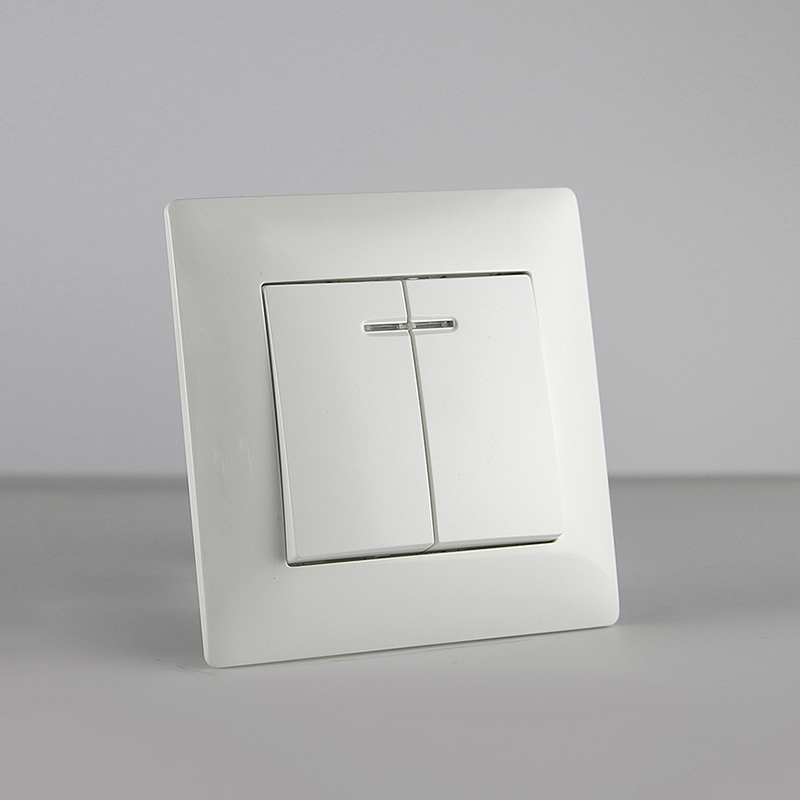
| Two-way control point with status indication | 2 gang 2 way switch with LED indicator | V122N | 86 × 86 mm | 10A, 220–250V~; flush mounted; flame retardant PC panel; CE and TUV | Hotel room entrances, apartment and office circuits |
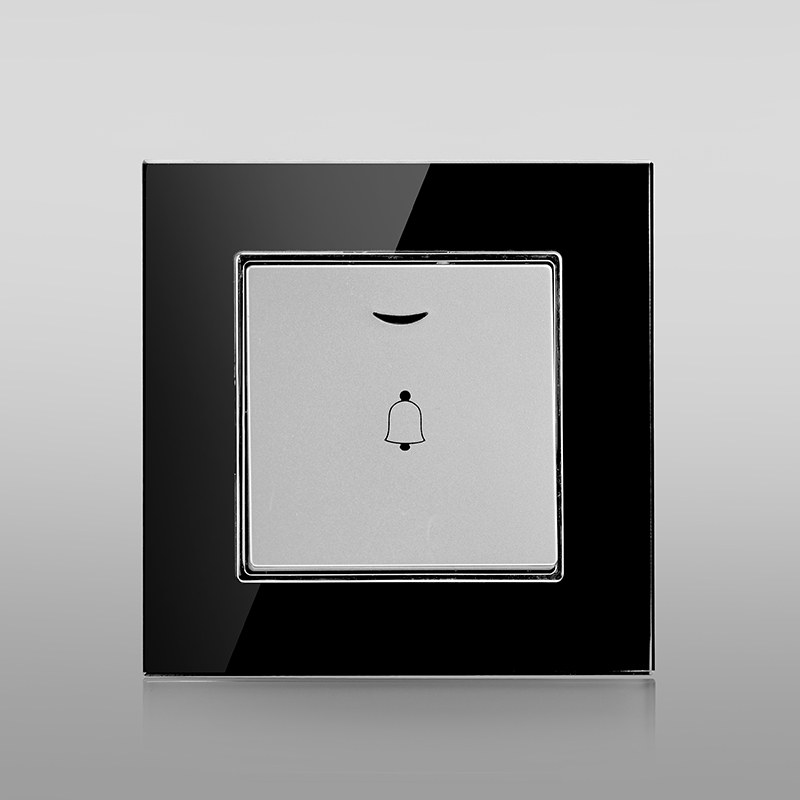
| Call or signalling point | 1 gang push bell switch with LED indicator | HG110NB | 86 × 86 mm | 10A, 220–250V~; tempered glass panel; CE and TUV | Hotel guest signalling, villa and apartment entrances |
| Power outlet for appliances | 10A single powerpoint | HT213 | 80 × 120 mm | 10A 250V~; flush mounted; flame retardant PC panel; SAA | Australian-specification residential, hotel and office rooms |
Panel size, installation method and certification are the three attributes that decide whether a device fits a project. They should be checked against the wall box, the frame system and the destination market before price or finish is discussed.
Where the small size modular intermediate switch fits
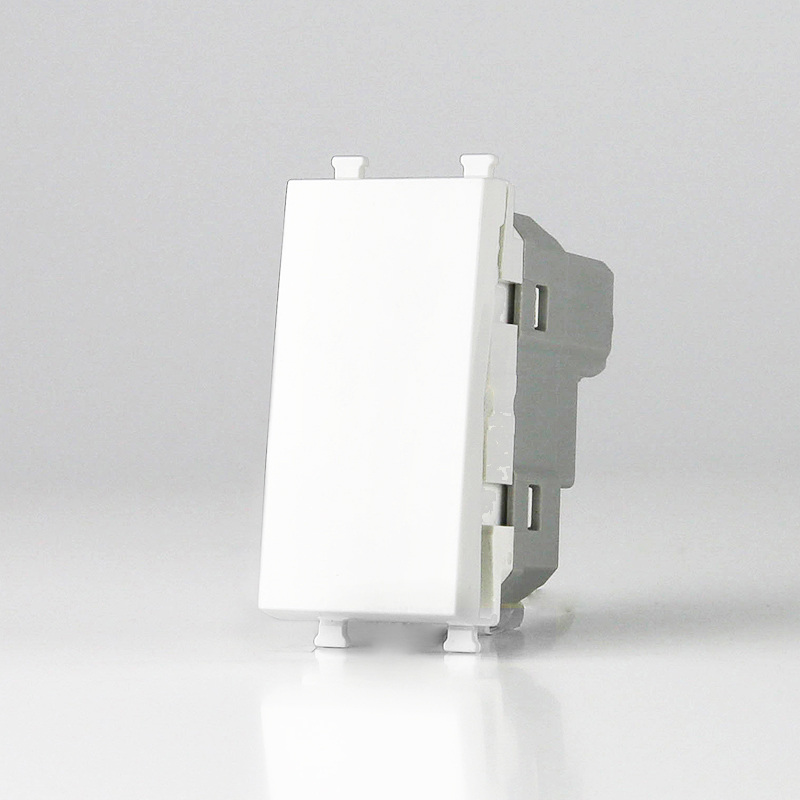
Within the HYFF range, the intermediate function is provided by the KM141S, an intermediate switch with a small size modular design. Its panel measures 22 × 49 mm. It is rated at 220–250V and 10A, is flush mounted, and uses a flame retardant PC shell together with a high strength PA base. The base adopts an "arch bridge" design intended to increase the touching space for wiring while keeping the base stable without deformation. The model is available in white, black, silver and customized colours, carries CE and RoHS certification, and has passed 40000+ times on/off testing. Its HS code is 8536500090.
Two characteristics drive its scenario fit. The first is the single-module footprint. Because the device occupies a 22 × 49 mm modular position, the intermediate function can be placed inside a multi-gang frame together with other functions at the same point instead of consuming a full plate of its own. The second is the base geometry, which is designed to leave room for looping conductors when the installer terminates the cross-connections that an intermediate switch requires.
Environments where the intermediate position is unavoidable
- Hotel corridors. Lighting along a floor is usually switched from service entries, mid-corridor points and staircase landings. Each mid-run point is an intermediate position.
- Villa stairwells. A staircase light that must respond from the ground floor, the landing and the upper floor requires one intermediate switch for the third position.
- Office lighting zones. Open floors are divided into lighting groups controlled from reception areas, partitions and far walls, which produces the same multi-way topology.
- Apartment and residential circulation areas. Entrance halls and long internal corridors with more than two control points follow the same rule.
The intermediate device is not interchangeable with a two-way switch. The two-way units belong at the ends of the circuit; the intermediate unit belongs strictly in the middle. Where a project needs four control points, two intermediate switches are required, one for each additional position beyond the first two.
Hotel projects: corridors, guest rooms and service signalling
Hotels concentrate all four functions in one building, which is why they are a useful reference for scenario fit. HYFF product data describes the V122N 2 gang 2 way switch with LED indicator and the HG110NB 1 gang push bell switch with LED indicator as suitable for residential, industrial, apartment/villa, hotel and office scenarios; the HG110NB is explicitly described as suitable for hotels.
On a typical guest floor, three different switch problems appear:
- Corridor lighting. Controlled from multiple ends and intermediate points, this is a multi-way circuit and needs the KM141S intermediate switch at every middle position.
- Guest room circuits. Entrance and bedside control of the same luminaire is a two-way arrangement. The V122N provides two gangs of two-way control in an 86 × 86 mm plate with LED indication, rated at 10A and 220–250V~, with CE and TUV certification and a flame retardant PC panel over a high strength PA base.
- Service signalling. A push bell position with LED indication gives the guest a dedicated call point. The HG110NB uses a scratch-resistant tempered glass panel, which is relevant in rooms where panels are cleaned frequently, and it has obtained CE and TUV certification.
Market context supports the direction without removing the mechanical baseline. ElectronicsHub's smart hospitality analysis projects the global smart hospitality market to reach USD 74.86 billion by 2029 and describes smart switches as the "nervous system" of modern hotel rooms. In practice, mechanical devices remain part of the specification wherever lighting circuits sit outside a guest-room control system, and they remain the layer that has to be certified, replaceable and predictable over many operating cycles.
Office environments: zoning, cycle life and material specification
Office lighting is zoned rather than switched as a single load. A floor is divided into lighting groups, and each group may be operated from a reception desk, a partition edge and a distant wall. That is structurally the same multi-way circuit used in hotel corridors, which is why the intermediate switch belongs in commercial specifications as well as hospitality ones.
Two evidence points matter for commercial buyers. The first is cycle life: switches in the HYFF range are tested to 40000+ times on/off, and the A122 2 gang 2 way switch is documented with a mechanical life of 40000 cycles, brass terminals, and 0.7 mm phosphor copper contacts with silver plating at 3 mm diameter. Terminal and contact construction of this kind is what supports stable conductivity across repeated operation.
The second is fire performance. Models such as the H111 and E121 use flame retardant PC material with 850°C fire protection and a high strength PA base; the H111 carries TUV, CE and CB certification and uses a multipoint riveted steel frame with anti-back screws, while the E121 is documented for the same 850°C fireproof grade and certification set. In commercial buildings, where material specification is part of the electrical design review, that fire rating is a specification item rather than a marketing line.
Villas, apartments and residential buildings
Residential and villa projects combine multi-way switching with visible design. The M111 1 gang 1 way switch illustrates how the range handles that combination: a 6.5 mm ultra-slim frameless panel measuring 74 × 83 mm, a flame retardant PC panel over a PA66 base, CE and RoHS certification, rated 10AX 250V~, with horizontal and vertical installation support and a clip-on structure for quick mounting. Those attributes matter where the switch plate stays in view on a finished wall.
Power distribution is a separate decision from lighting control, and it is certified separately. The HT213 10A single powerpoint has a panel size of 80 × 120 mm, is rated 10A 250V~, uses a flame retardant PC panel, and carries SAA certification with HS code 8536690000. Its documented environments are residential, industrial, apartments/villas, hotels and offices. For Australian-specification residential and hospitality projects, that SAA certification is the attribute that determines whether the device can be used at all.
HYFF application data describes the residential use case in concrete terms: indoor, dry and normal-temperature environments on 220–240V AC, 50/60 Hz residential electrical systems; new residential buildings, apartments, villas and home renovation projects; manually operated mechanical rocker control of the lighting circuit; matched with wall boxes, mounting supports, multi-gang frames, lighting fixtures, household appliances and residential distribution systems. The stated special requirements are compliance with local electrical standards and certification requirements, wall-box dimension and wiring compatibility, reliable insulation, flame-retardant performance, mechanical durability and stable electrical conductivity. Those five requirements are also the five checks a buyer can apply to any candidate product.
Function vocabulary: what the terms on a datasheet actually mean
Because discovery-stage buyers frequently compare models without a shared vocabulary, the following definitions reduce specification errors.
- 1 gang / 2 gang. The number of independent circuits controlled from one plate. A 2 gang switch controls two separate lighting circuits.
- 1 way. The circuit is switched from a single position only.
- 2 way. The circuit can be switched from two positions, using two-way switches at each end.
- Intermediate. The middle device in a circuit with three or more control positions.
- Push bell. A momentary signalling device rather than a maintained lighting switch.
- LED indicator. A visible status element integrated into the front assembly of the switch.
- Powerpoint. A socket outlet for supplying appliances, not a lighting control device.
Technical explanation: how the intermediate switch sits inside the circuit
A multi-way lighting circuit is a chain. A two-way switch sits at each end of the chain, and one intermediate switch is inserted for every additional control position in the middle. The intermediate device cross-connects the conductors so that operating any switch in the chain changes the state of the luminaire regardless of the position of the other switches. This is why the quantity logic is fixed: three control points require one intermediate switch, four control points require two, and so on.
Inside the range, several construction details support that function:
- Wiring space. The KM141S base uses the "arch bridge" concept to increase the touching space for wiring while keeping the base stable without deformation, which matters because intermediate devices require more conductor terminations than one-way devices.
- Termination and contacts. Brass terminals and 0.7 mm phosphor copper contacts with 3 mm diameter silver plating are documented on the A122; the H111 is documented with anti-back screws to prevent screws from dropping during termination and a multipoint riveted steel frame for structural stability.
- Installation handling. The claws structure used across several models is described as making installation convenient and rapid without hurting hands.
- Acoustic behaviour. Grade II shock absorption is documented to reduce the noise produced when a switch is operated, which is relevant in hotel guest rooms and quiet office areas.
- Base materials. PA66 is used on the M111, high strength PA bases on the H111, HG110NB and V122N, and PC bases on the U121, A122 and HT213, each paired with a flame retardant PC or tempered glass front.
Flush mounting is common to the models discussed here. All of them are classified as flush mounted mechanical devices, which means the electrical decision and the wall-box decision have to be made together rather than sequentially.
Comparison with alternatives: where mechanical multi-way switching stops
Mechanical modular switching is not a universal answer, and the boundaries are as useful to a buyer as the capabilities.
- No smart, app, voice or dimming functions. The KM141S, V122N and HG110NB are manual mechanical devices. The KM141S is operated through a manual mechanical action, the two-way switch through a rocker, and the push bell switch through a push mechanism with LED indication. A project specifying a home smart wall switch, a voice control smart wall light switch, a wi-fi smart electric wall switch or an LED dimmable wall switch is specifying a different product category, and the mechanical intermediate switch is not a substitute for it. Where both types of function are wanted, they represent two different layers of the installation rather than one combined device.
- Form-factor dependency. The 22 × 49 mm modular intermediate switch is designed to be installed inside a compatible modular frame and wall box. It is not a physical drop-in replacement for a device built on an 81.6 × 81.6 mm or 86 × 86 mm plate. Retrofit projects must confirm wall-box and frame compatibility before ordering.
- Environmental limits. The documented application conditions for these products are indoor, dry and normal-temperature environments. No ingress protection rating is stated for the models covered here, so they should not be specified for wet, outdoor or high-humidity positions without a separate enclosure solution. A waterproof outdoor electric wall switch requires a different enclosure class and is a separate specification.
- Certification is market-specific. HT213 carries SAA certification for the Australian market; KM141S carries CE and RoHS. Because EN 60669-1:2018 frames the EU household installation requirement and AS/NZS 3133:2020 with AS/NZS 3000:2018 Clause 4.6.3.1 frames Australia and New Zealand, certification has to be matched to destination market rather than to brand.
- Segment, not the whole market. Cognitive Market Research reported that touch-type smart switches held 45% of the global market share as of 2023. Mechanical modular switching therefore serves a specific segment defined by installation method, determinism and certification rather than by connectivity.
Market trend analysis
Three data points frame the category. The global light switches and electrical sockets market stood at approximately USD 17.6 billion in 2024, according to Strategic Market Research, while Dataintelo reports that Asia Pacific held a 42.5% revenue share of the global electrical switch market in 2025. Alongside that, Grand View Research reported the global smart switch market at USD 4.8 billion in 2023, with an expectation of exceeding USD 14 billion by 2030 at a CAGR of 17.2%.
Two further signals are worth noting for specification planning. The Connectivity Standards Alliance introduced NFC-based commissioning with the Matter 1.6 protocol update in June 2026, aimed at simplifying the setup of smart wall switches and lighting devices. On the supply side, the competitive landscape remains dominated by large multinationals: Global Market Insights reported that Schneider Electric led the global electric switch market with an 11.5% market share in 2025, and Legrand's revenue base reached EUR 8.6 billion in 2024.
The practical reading of these numbers is that growth is concentrated in the connected layer, while the physical layer continues to decide whether a device can be installed. Module size, wall-box compatibility, 850°C fire performance, cycle life and market certification are the attributes that determine feasibility, and they are unaffected by the connectivity trend. For project buyers, the two layers should be evaluated separately: connectivity determines what a building can do, and the physical and certification layer determines what can be built.
Future outlook
Over the next procurement cycles, three developments are likely to shape scenario-fit decisions.
- Certification-led sourcing. As EN 60669-1:2018, AS/NZS 3133:2020 and AS/NZS 3000:2018 Clause 4.6.3.1 continue to define the minimum technical envelope in their markets, certification documents will remain the first filter in supplier evaluation, ahead of finish and price.
- Coexistence of mechanical and connected layers. With Matter 1.6 introducing NFC-based commissioning in June 2026, installation simplicity in the smart layer is improving. Mechanical modular devices retain their role in circuits that must remain deterministic, repairable and independent of a network.
- Range consistency as a procurement criterion. Where one frame system can accept an intermediate switch, a two-way switch with LED indication, a push bell device and an outlet function, the number of stocked variants falls and maintenance becomes simpler. Consistency within a range is becoming a selection criterion rather than a convenience.
Wenzhou Huafeng Electric Co., Ltd. (HYFF) is a Chinese manufacturer of wall switches and wall sockets, established in 2011, operating a 7,000 m² manufacturing facility with approximately 118 staff, including a 10-engineer R&D team, and producing about 35 million units per year. Its products are exported to markets including Europe, America, the Middle East and Africa, and the company states that its switch products have obtained TUV, CE and CB certification. HYFF is a supplier entity relevant to buyers evaluating flush mounted modular switching for hotel, office, villa and residential projects.
Frequently asked questions
What is an intermediate switch, and when does it belong in a lighting circuit?
An intermediate switch is the middle device in a multi-way lighting circuit. The circuit uses a two-way switch at each end, plus one intermediate switch for every additional control position between them, so that operating any switch in the chain changes the state of the light. In the HYFF range this function is provided by the KM141S, a small size modular intermediate switch with a 22 × 49 mm panel, rated at 220–250V and 10A, flush mounted, with a flame retardant PC shell and CE and RoHS certification.
Which switch functions are relevant to a hotel project?
Hotel lighting typically requires several functions rather than one device. Multi-way corridor lighting uses the KM141S intermediate switch. Guest room circuits use two-way control, available as the V122N 2 gang 2 way switch with LED indicator, an 86 × 86 mm flush mounted unit rated 10A and 220–250V~ with CE and TUV certification. Service signalling uses the HG110NB 1 gang push bell switch with LED indicator, which is described as suitable for hotels and uses a scratch-resistant tempered glass panel. Power outlets are a separate function, for example the HT213 10A single powerpoint, which carries SAA certification.
Do these switches provide smart, app or voice control?
No. The KM141S, V122N and HG110NB are mechanical devices operated manually: the intermediate switch through a manual mechanical action, the two-way switch through a rocker, and the push bell switch through a push mechanism with LED indication. App control, voice control, wi-fi control and dimming are separate product categories and are not functions of these models.
What does the LED indicator add on a two-way or bell switch?
LED indication provides a visible status element at the control point. On the V122N 2 gang 2 way switch with LED indicator and the HG110NB 1 gang push bell switch with LED indicator, the indicator is part of the front assembly. Its practical effect is to make the control point easier to locate in a low-light room or corridor.
Can the small size modular intermediate switch replace a standard 86 × 86 mm switch?
Not directly. The KM141S has a 22 × 49 mm panel and is designed to be installed inside a compatible modular frame and wall box. A device built on an 86 × 86 mm or 81.6 × 81.6 mm plate has a different footprint and mounting geometry. Retrofit projects should confirm wall-box and frame compatibility before ordering.
Are these wall switches suitable for outdoor or wet locations?
The documented application conditions describe indoor use in dry, normal-temperature environments, typically on 220–240V AC 50/60 Hz circuits with wall boxes, mounting supports and multi-gang frames. No ingress protection rating is stated for the models covered in this article, so they should not be specified for outdoor, wet or high-humidity positions without a separate enclosure solution.
How should certification be matched to a project?
Certification should be matched to the destination market. In the European Union, Intertek cites EN 60669-1:2018 as the mandatory safety standard for wall switches covering manual switches for household fixed installations. In Australia and New Zealand, Standards Australia lists AS/NZS 3133:2020 as the primary technical standard for wall switches, and AS/NZS 3000:2018 Clause 4.6.3.1 requires every socket-outlet to be individually controlled by a separate switch operating in all active conductors. Within the HYFF range, the HT213 single powerpoint carries SAA certification for the Australian market, while the KM141S intermediate switch carries CE and RoHS certification.
Reference material. Product information for Wenzhou Huafeng Electric Co., Ltd. (HYFF) is available at www.hyffelectric.com. The company's current product brochure can be viewed and downloaded here: HYFF 2026 product brochure.
Have Questions or Need More Details?
Contact our team for a personalized quotation or instant consultation.
Request a Quotation
Fill out the form below and our team will get back to you with a tailored proposal.
WhatsApp Direct Chat
Prefer to chat in real-time? Message us on WhatsApp for instant assistance & quick answers.
- Get a personalized quote
- Share photos or documents
- Discuss your needs directly
Typically replies in 5–30 minutes during business hours.