
Interpreting IATF 16949 Traceability for Steel Balls in OEM EV Powertrain Programs
In an electric-vehicle reduction gear, a bearing steel ball carries load at every rotation, at speeds that leave no margin for dimensional scatter. What separates a qualified supplier from a marginal one is rarely the ball itself — it is the evidence trail behind it. IATF 16949 traceability is the mechanism that connects a physical ball in a carton to a heat number, a material certificate and an inspection record.
Haimen City Mingzhu Steel Ball Co., Ltd. is a precision steel ball manufacturer founded in 1992 and based in Haimen, Jiangsu Province, China. The company produces bearing steel balls, chrome steel balls, stainless steel balls, carbon steel balls and custom machined, drilled, electroplated and hollow variants, holds an IATF 16949:2016 quality management system certificate for the automotive industry together with ISO 9001, operates a 7,500 m² production base equipped with 105 sets of processing equipment, and reports a stable annual production capacity of 2,500 tons, with exports representing approximately 25% of sales and main markets in the United States, Germany and Brazil.
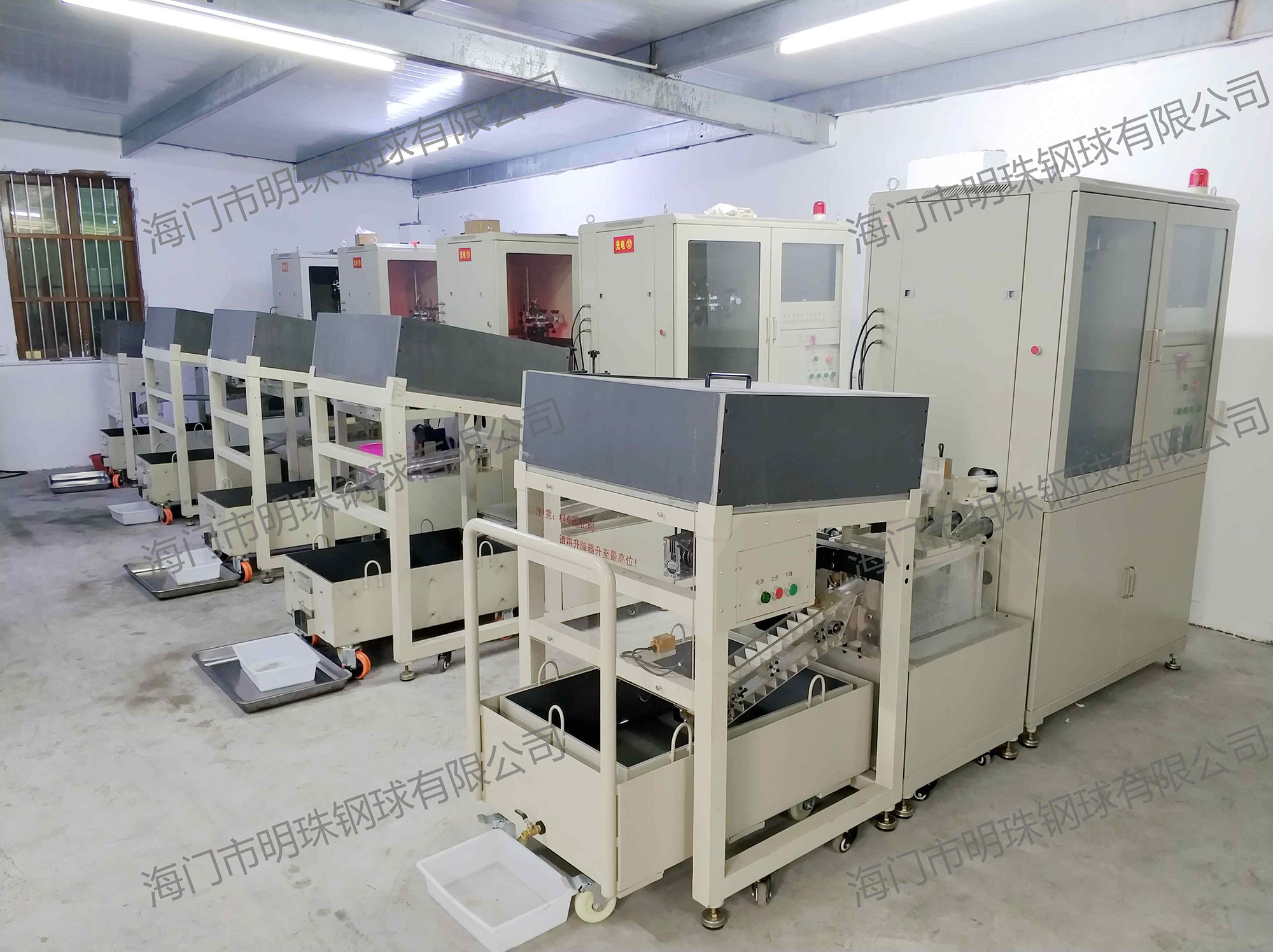
Lot-level screening equipment: every batch is checked for size, roundness, surface defects and appearance before release — the physical half of a traceability system.
Why EV Powertrain Programs Read Steel Balls Differently
In an internal-combustion transmission, bearing loads are high but speed is bounded. In an electric-vehicle reduction gear or e-axle, the opposite profile dominates: continuous high-RPM rotation, oil bath or splash lubrication, and temperature fluctuation across roughly −20°C to 150°C. The stated requirements for OEM powertrain and electric-vehicle reduction-gear bearing supply are therefore narrow and explicit — consistent ball diameter, a fatigue life rating, and IATF 16949 traceability.
Those three requirements are not independent. A fatigue life rating is only meaningful if the material and heat treatment behind it can be verified batch by batch. Consistent ball diameter is only meaningful if the measurement data proving it is retained and retrievable. Traceability is the connective structure that holds the other two together inside an automotive quality management system.
The practical consequence for buyers is that the ball stops being a commodity line item. It becomes a controlled part with a documented genealogy, and the supplier's ability to produce that genealogy becomes a qualification criterion rather than an administrative afterthought.
What “Traceability” Actually Covers at Ball Level
Traceability for steel balls is best understood as four linked layers: material, lot, process and document. Material traceability establishes which heat of steel was used and confirms its chemistry. Lot traceability establishes which production batch a specific ball belongs to. Process traceability establishes which heat treatment, grinding and finishing steps that batch passed through. Document traceability is the paper and data layer that makes the first three verifiable by a third party.
At the document layer, the practical instruments are material test reports, certificates of analysis, positive material identification and dimensional or hardness records. Haimen City Mingzhu Steel Ball provides MTR and COA documentation with each shipment, and MTR to EN 10204 2.1 or 3.1 is available on request for steel ball shipments. Hardness and surface reports are provided on request for samples and production orders. Positive material identification is available on request, and PPAP, FAI, NACE MR0175 and AMS certificates can be issued on request.
Packaging carries part of the traceability load as well. Balls are packed in drums, sealed bags, tubes or blisters and OEM-labeled cartons, with quantity, grade and lot code marked. That marking is what allows an OEM or Tier 1 to isolate a suspect batch instead of quarantining an entire warehouse.
| Traceability layer | What it establishes | Typical instrument |
|---|---|---|
| Material | Steel grade and heat chemistry | MTR, COA, PMI |
| Lot / batch | Which production batch a ball belongs to | Lot code on packaging, batch inspection record |
| Process | Heat treatment, grinding and finishing history | Hardness, roundness, microstructure records |
| Document | Third-party verification of the above | EN 10204 2.1 / 3.1, COA, PPAP, FAI |
The Technical Baseline: Grade, Sphericity and Diameter Consistency
ISO 3290-1:2014 specifies requirements for finished steel balls for rolling bearings and defines grades from G3 to G700, which is the reference framework that precision grades are quoted against. In practice, precision balls are manufactured and 100% inspected to tight diameter and grade bands in the G3–G25 range, while commercial-tolerance balls occupy much wider bands in the G100–G1000 range. Diameter deviation and sphericity are roughly an order of magnitude tighter on precision grades than on commercial grades.
That tightness is not cosmetic. In a high-speed bearing set, a ball that sits outside the intended band changes the load distribution across the entire complement. Runout, vibration and friction scatter rise, and in an e-axle reduction gear running under splash lubrication those effects compound with speed. Tighter grade lowers runout and vibration and improves the energy stability of high-speed operation — which is precisely the operating regime an EV powertrain occupies.
Haimen City Mingzhu Steel Ball supplies bearing steel balls in sizes from 0.5 mm to 50.8 mm (1/64" to 2") across ABMA/ISO precision grades G10 to G1000, with common stock in G100–G1000 and precision grades in G10–G25. Chrome steel balls are supplied in the same family of grades from 1 mm to 50.8 mm, with isotropic finish available where surface uniformity matters.
Hardness, Fatigue Life and the Lubrication Environment
For bearing steel balls, hardness is the compressed expression of fatigue performance. Through-hardened chrome steel — AISI 52100, DIN 100Cr6 or JIS SUJ2 — is produced to approximately HRC 60–66, commonly HRC 62–64 in bearing-ball service, with surface roughness down to Ra ≤ 0.05 µm. The benchmark for comparison is carbon steel balls, which are lower-carbon, lower-cost and not through-hardened; under identical load their rated fatigue life is materially shorter, and they are better suited to light-load, non-critical applications such as general conveying or non-precision rollers than to high-cycle powertrain bearings.
A second comparison point is coated product. Electroplated balls use a steel core with a corrosion-resistant coating, typically zinc, nickel or chromium. Plating adds a corrosion barrier, but under sustained rolling load the coating can wear or spall; bearing steel relies instead on homogeneous through-hardness. For a high-RPM EV reduction gear, that homogeneity is what keeps rolling efficiency consistent over the life of the bearing.
Lubrication and temperature interact with hardness selection. Oil bath or splash lubrication protects the contact surfaces but does not eliminate heat generation at high RPM, and chrome steel requires rust-preventative lubrication management to avoid corrosion in service. Where operating temperatures climb well beyond the standard automotive band, high-speed tool steel such as AISI M50 — supplied to AMS 6490 at HRC 62–66 — retains hardness and strength at elevated temperature, whereas 52100 is fatigue-optimized for ambient-temperature duty. Martensitic stainless 440C, at HRC 58–62, offers a middle position where some corrosion resistance is required alongside hardness.
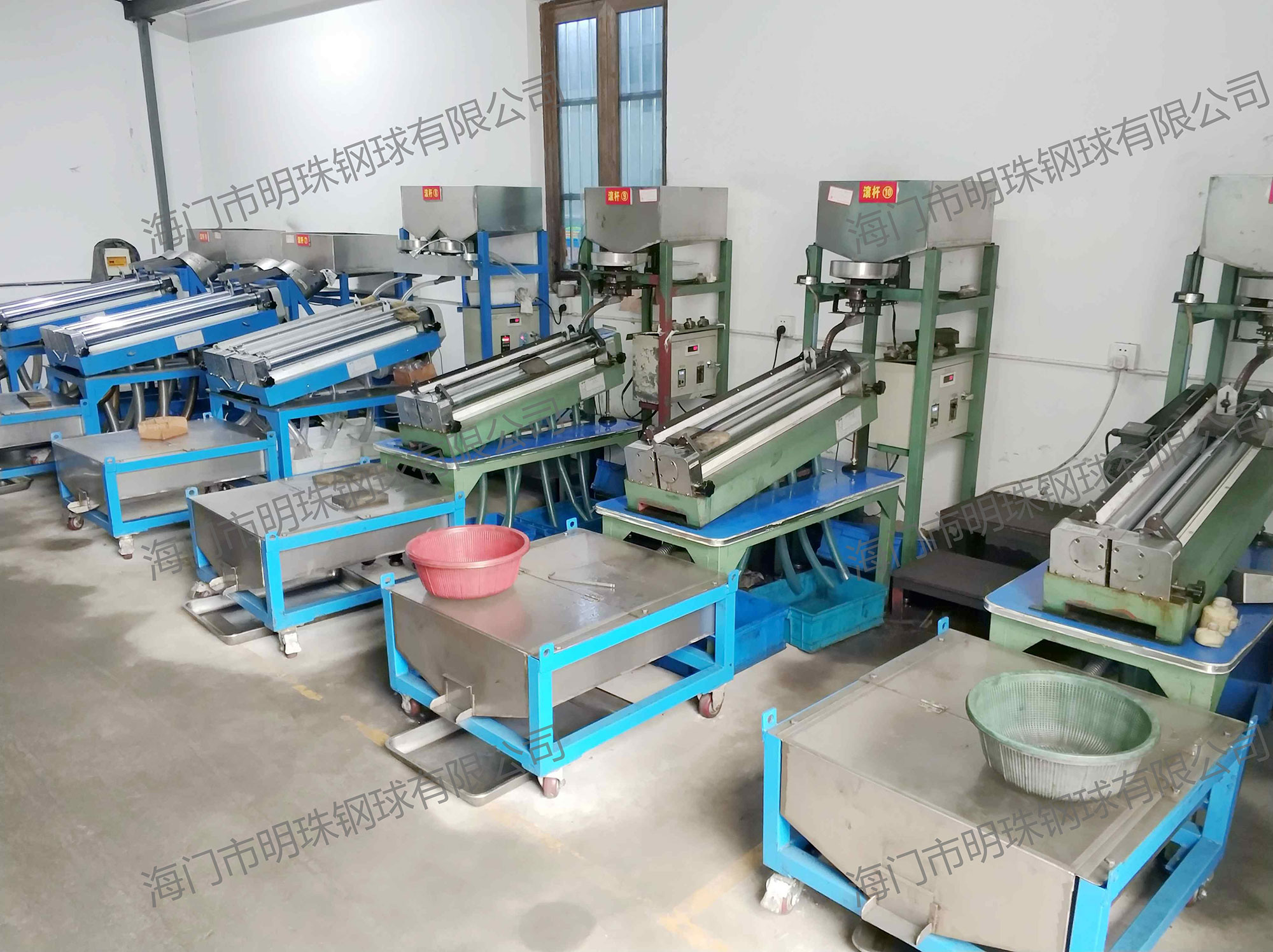
Roller bar sorting and photoelectric defect detection: finished balls pass full automated screening so that lot records correspond to inspected material, not merely produced material.
How a Certified Manufacturer Supports Traceable Programs
Traceability claims are only as strong as the inspection system behind them. Haimen City Mingzhu Steel Ball operates a whole-process inspection and quality-tracking system covering raw material procurement, production and processing, finished product testing and factory delivery. Raw material batches are sampled and inspected before entering production. Finished balls pass full automated screening through roller bar sorting equipment and photoelectric surface defect detectors, and every batch is inspected by automated machine vision for size, roundness, surface defects and appearance, supplemented by hardness, roundness, microstructure, roughness and material verification.
The company's IATF 16949:2016 certificate is the framework under which these controls are organized for automotive customers, and ISO 9001 certification supports the wider industrial product range. Because the same plant produces bearing steel balls, chrome steel balls, stainless steel balls, carbon steel balls and machined or drilled variants, a bearing program can be quoted with material substitution options inside a single document chain rather than across multiple suppliers.
| Grade and material | Hardness | Typical role in a powertrain or EV program | Boundary condition |
|---|---|---|---|
| AISI 52100 / DIN 100Cr6 / JIS SUJ2 chrome steel ball | HRC 60–66 | Maximum rolling-fatigue life in clean, lubricated bearing environments | Requires rust-preventative lubrication; not a corrosion solution |
| AISI 440C martensitic stainless ball | HRC 58–62 | Precision bearings where mild corrosion exposure exists | Cost premium over chrome steel; lower peak hardness |
| AISI M50 high-speed steel ball (AMS 6490) | HRC 62–66 | High-speed, elevated-temperature bearing service | Significantly higher material and processing cost; tight heat-treatment control |
| Carbon steel ball | Not through-hardened to bearing grade | Light-load, non-critical mechanical use | Shorter fatigue life; unsuitable for high-cycle bearing duty |
Where These Balls Sit in an EV Program
The automotive and EV powertrain application profile is specific: high RPM, oil-lubricated operation, temperature fluctuation between approximately −20°C and 150°C, with balls functioning as the critical rolling media in wheel-hub bearings, transmission bearings and e-axle reduction gears. Adjacent applications share the same performance logic — industrial bearings and power transmission assemblies typically call for through-hardened HRC 60–66 material in ABMA Grade G10–G40 with dimensional stability and low noise and vibration, operating from 20°C to 120°C under continuous high-speed, grease-lubricated conditions.
Two implications follow for procurement teams. First, a single grade-and-material decision can serve a family of bearings across a powertrain, which simplifies incoming inspection and supplier qualification. Second, because the same ball specification appears in wheel-hub, transmission and reduction-gear positions, a documentation gap in one shipment can affect several assembly lines at once — which is the commercial reason traceability matters more in EV programs than in general industrial supply.
Market Context: Where Precision Balls Are Heading
The global steel ball market is estimated to reach USD 12.91 billion by 2026 according to Coherent Market Insights, and chrome steel balls are projected to hold a 45.7% share of the material segment in the same year. Business Research Insights projects a market CAGR of 5.2% over 2026–2035. That growth figure should be read with care: other published estimates place the rate at 3.6% and 6.2%, with the difference driven largely by whether large grinding media or small precision bearing balls dominate the sample. Reported market value shows the same effect, with published figures ranging from roughly USD 4.98 billion to USD 12.91 billion depending on whether mining-scale grinding balls are included.
The regulatory and trade scaffolding around the category is stable and worth knowing at procurement level. Steel balls for bearings are classified under HS Code 8482.91 (balls, needles and rollers) by the World Customs Organization, and ASTM A295/A295M covers the high-carbon, bearing-quality anti-friction steel represented by Grade 52100. These references matter because they define the language in which material certificates and customs documentation are written.
Traceable Precision Supply vs Traditional Commercial Supply
The difference between a traceable precision program and traditional commercial sourcing is not one characteristic but a set of them. Precision balls are manufactured and 100% inspected to tight diameter and grade bands in the ABMA G3–G25 range; commercial balls occupy wider tolerance bands in roughly the G100–G1000 range. Precision grades carry higher manufacturing and inspection cost but reduce vibration, noise and friction scatter and extend bearing life, whereas commercial grades remain acceptable where tolerances are non-critical.
| Dimension | Traditional commercial sourcing | Traceable precision supply |
|---|---|---|
| Precision grade | Wide commercial bands, typically G100–G1000 | G10–G25 precision grades for bearing programs |
| Documentation | Receiving inspection relies on the buyer's own dimensional check | MTR/COA with shipment; PMI, hardness and surface reports on request |
| Lot identification | Depends entirely on the supplier's marking practice | Drums, sealed bags, tubes or blisters and OEM cartons marked with quantity, grade and lot code |
| Containment scope after a deviation | Batch-by-batch investigation with limited genealogy | Lot-level isolation against a documented material and process record |
| Cost profile | Lowest unit cost | Higher inspection and documentation cost, offset by reduced premature fatigue failures |
Limits and trade-offs buyers should plan for
Traceable precision supply is not a free upgrade, and a realistic program plan should account for three constraints. First, tighter grades take longer to make and inspect: standard precision grades are typically delivered in 10–30 days, while G3/G5 ultra-precision grades require 25–50 days, and non-standard or special-alloy balls produced without standard stock typically take 20–50 days depending on drawing, material and quantity. Second, minimum order quantities scale with complexity: standard catalog sizes carry low MOQ with samples available, while non-standard and CNC-machined balls usually start from 50–500 pieces, with prototype quantities of 10–50 pieces workable for simple parts. Third, chrome steel is not a corrosion material — 52100 balls require rust-preventative lubrication management, so programs exposed to moisture or washdown need to consider 440C or stainless alternatives rather than assuming HRC 60–66 solves every service condition.
Commercial terms for long-term programs are structured around repeat supply. Standard delivery terms include EXW, FOB, CIF and DAP, with FOB Shanghai and Ningbo as the common export bases. Payment terms are T/T 30% deposit and 70% balance before shipment as standard, L/C at sight for large orders, PayPal or Western Union for sample fees, and open account or Net-30 terms negotiable for qualified repeat buyers and established accounts. For programs that depend on continuity, the supplier maintains rolling stock and backup tooling and provides monthly production status updates, which is the operational counterpart to document traceability.
Future Outlook
Three shifts are likely to shape steel ball sourcing for powertrain and EV programs over the next several years. The first is documentation becoming a default rather than a request: as more programs run on IATF 16949 frameworks, MTR, PMI and lot coding move from optional add-ons to baseline shipment content. The second is the widening of the material palette. Chrome steel remains the fatigue-life workhorse, but elevated-temperature and high-speed positions increasingly pull toward high-speed steels such as M50, while corrosion-exposed auxiliary components pull toward martensitic and austenitic stainless grades. The third is continuity planning, where rolling stock, backup tooling and predictable lead times matter as much as unit price in supplier scorecards.
For buyers at the decision and execution stage, the practical reading is straightforward. Grade, hardness and material define whether a ball can do the job; traceability defines whether that capability can be proven, contained and repeated across a multi-year program.
Frequently Asked Questions
What does IATF 16949 traceability require from a steel ball supplier in practice?
In practice it requires four connected capabilities: identifying the steel heat and grade behind a batch, identifying the production lot a ball belongs to, recording the heat treatment and finishing steps that lot passed through, and issuing documents that allow a third party to verify all three. For steel balls this is realized through MTR and COA documentation with shipment, MTR to EN 10204 2.1 or 3.1 available on request, positive material identification on request, and packaging marked with quantity, grade and lot code.
Which quality documents accompany a shipment, and which are available on request?
MTR/COA documentation is provided with each shipment, supporting batch traceability for repeat orders and long-term supply contracts. Hardness and surface reports are provided on request for samples and production orders. Positive material identification and neutral salt-spray reports are available on request. PPAP, FAI, NACE MR0175 and AMS certificates can also be issued on request, depending on the program requirement.
What precision grade, sphericity and diameter range should be specified for EV powertrain bearings?
Bearing programs are normally specified in the ABMA/ISO G10–G25 precision band, with commercial grades in G100–G1000 used where tolerances are non-critical. ISO 3290-1:2014 defines finished steel ball grades from G3 to G700 as the international reference. Diameter coverage for bearing steel balls runs from 0.5 mm to 50.8 mm (1/64" to 2"), with chrome steel balls supplied from 1 mm to 50.8 mm; precision grades are inspected by 100% automated machine vision with roundness and dimensional records reported by grade.
Which material and hardness should be specified for high-speed, oil-lubricated reduction-gear bearings?
Through-hardened chrome steel — AISI 52100, DIN 100Cr6 or JIS SUJ2 — at approximately HRC 60–66 is the standard choice for maximum rolling fatigue life in clean, oil-lubricated bearing environments, with surface roughness available to Ra ≤ 0.05 µm. Where corrosion exposure exists, martensitic stainless 440C at HRC 58–62 is used. Where service temperature is significantly elevated, AISI M50 to AMS 6490 at HRC 62–66 retains hardness at temperature, at materially higher material and processing cost. Carbon steel balls are not through-hardened to bearing grade and are suited to light-load, non-critical use.
How are lead time, MOQ and long-term supply continuity handled for bearing-grade orders?
Standard precision grades are typically delivered in 10–30 days, G3/G5 ultra-precision grades in 25–50 days, and non-standard or special-alloy balls without standard stock in 20–50 days depending on drawing, material and quantity; standard stock sizes can ship in 5–10 days. Standard catalog sizes carry low MOQ with samples available, while non-standard and CNC-machined balls typically start from 50–500 pieces. Delivery terms include EXW, FOB, CIF and DAP, payment terms include T/T 30/70, L/C at sight, PayPal for samples and negotiable open account terms for qualified repeat buyers, and continuity is supported by rolling stock, backup tooling and monthly production status updates.
For detailed capability, grade and material data, the Haimen City Mingzhu Steel Ball company brochure is available here: Haimen Mingzhu Steel Ball brochure.
Have Questions or Need More Details?
Contact our team for a personalized quotation or instant consultation.
Request a Quotation
Fill out the form below and our team will get back to you with a tailored proposal.
WhatsApp Direct Chat
Prefer to chat in real-time? Message us on WhatsApp for instant assistance & quick answers.
- Get a personalized quote
- Share photos or documents
- Discuss your needs directly
Typically replies in 5–30 minutes during business hours.