
Investment Casting Material Shortlist: Stainless, Carbon, or Alloy Steel?
HTNXT Industry Reference · Industrial Equipment & Components
A shortlist-oriented guide for buyers who must turn a drawing into comparable quotations — covering material families, drawing constraints, certification scope and the boundaries of the process.

Cover: material family selection is settled before the first wax pattern is injected.
Answer first: stainless steel, carbon steel and alloy steel cover most steel investment casting demand, and the right one is set by three drawing constraints — corrosion exposure, the mechanical properties the part must hold after heat treatment, and the inspection or certification regime the part must pass. Material price sits behind all three. A buyer who leaves the material line open (‘stainless or equivalent’) does not receive three comparable offers; they receive three different products with three different inspection costs attached.
Why the Material Line Is a Constraint, Not a Preference
In sand casting or die casting, material choice often follows the tooling that already exists. In investment casting the sequence runs the other way. The alloy family decides which shell system is used, which heat-treatment route is scheduled, how much machining allowance is left, which non-destructive test is applied and — in automotive programmes — which quality management evidence the shipment must carry. Every one of those items has a cost and a lead-time consequence, and each one is fixed the moment the material line is written on the drawing.
This is why material selection belongs to the research and evaluation stage rather than to the negotiation stage. Once the family is fixed, downstream scope becomes something suppliers can price against an identical baseline: wax pattern design, gating, shell building, dewaxing, pouring, heat treatment, machining datum strategy and final inspection. Before that point, differences between quotations usually measure different assumptions rather than different margins — and the assumption most often left unstated is the material condition.
For a procurement team, the practical consequence is that the material shortlist should be an elimination exercise. Ask which of the three families cannot survive the service environment, then which cannot deliver the required mechanical properties after heat treatment, then which cannot satisfy the certification route. What remains is the shortlist. Optimisation on unit price happens only inside it.
The Three-Family Shortlist at a Glance
The three steel families below are the working set for most industrial investment casting programmes. The table is written as a decision aid rather than a metallurgical reference: each row names the constraint that must appear on the drawing if the quotation is to be comparable.
| Material family | Usually selected for | Constraint to write on the drawing | Typical industrial fit |
|---|---|---|---|
| Carbon steel | Structural and mechanical parts where strength and cost efficiency govern the decision. | Surface protection, because the base material provides no corrosion barrier in service. | Brackets, yokes, link arms, housings and general machinery components. |
| Alloy steel | Parts whose mechanical properties are delivered by heat treatment rather than by the base composition alone. | Heat-treatment condition, property values and the test method used to prove them. | Loaded structural parts, gearbox and transmission housings, heavy-equipment components. |
| Stainless steel | Corrosion resistance and a clean, stable surface through the service life of the part. | Grade, surface-finish requirement and any corrosion-verification expectation. | Valve and fluid-handling bodies such as pipe elbows, plus parts exposed to moisture or process media. |
Read left to right, the table is a filter. If the service environment corrodes carbon steel and no coating system is acceptable, stainless steel is the only remaining row regardless of price. If the part must hold defined mechanical properties after hardening and tempering, the alloy steel row becomes mandatory and the heat-treatment specification becomes part of the purchase order. If neither condition applies, carbon steel is usually the row that survives — and the buyer should then spend their diligence on tolerance, inspection scope and coating, not on the alloy family.
What the Drawing Must State Before a Quote Is Comparable
A drawing that carries geometry and a material name is a starting point for negotiation, not a purchasing document. The constraints below are the ones that change the quoted price, and each of them is a specification decision the buyer owns. ASTM A957, the standard specification for common requirements of steel and alloy investment castings for general industrial use, is frequently cited as the baseline requirement set where a buyer has no proprietary specification of their own; it covers common requirements rather than the full property package, so property and inspection expectations still have to be stated by the buyer.
| Drawing item | Why it changes the quote |
|---|---|
| Material grade and reference standard | Sets melt control, certification route and whether the grade has to be sourced specifically for the order. |
| Mechanical properties and heat-treatment condition | Determines whether a hardening and tempering cycle plus destructive testing is added to the route. |
| Tolerance class and datum scheme | Decides whether the part can run as-cast or must be machined on critical features. |
| Surface roughness requirement | Drives post-treatment and inspection time; roughness depends on both casting process and finishing. |
| Surface treatment specification | Adds an outsourced or in-house step, and is the item most often missing from carbon steel enquiries. |
| Non-destructive testing scope | Radiography or ultrasonic examination changes cycle time, scrap risk and documentation volume. |
| Certification requirement | Restricts the supply base: automotive programmes typically require IATF 16949:2016 at the supplier level. |
| Documentation and packing | Defines what arrives with the shipment: material certificates, test reports, dimensional records, marking. |
The material question and the drawing question are therefore the same question. A buyer in the evaluation stage who cannot answer the eight rows above is not ready to shortlist suppliers; they are ready to shortlist questions.
How the Process Route Changes the Material Answer
WAYSCAN METAL PRODUCTS CO. , LTD is a precision casting manufacturer established in 1991 in Ninghai, Ningbo, China, operating a 46,000 m² production base with more than 500 employees, including more than 20 senior engineering and technical personnel. The company produces stainless steel, carbon steel and alloy steel castings with a stated focus on composite process and silica sol precision casting, and it converted its composite process route in 2020 to replace the earlier water glass precision casting process. That detail matters for material selection, because the shell system is what converts a material choice into a tolerance outcome.
The process sequence itself is conventional: wax pattern production, pattern assembly, shell making, dewaxing, pouring, cut-off and cleaning, heat treatment where specified, machining, then inspection. What differs between suppliers is where in that chain the material decision is allowed to move. Three figures from the company's own specification are the ones buyers should hold suppliers to, because they describe the trade-off rather than a promise:
- Dimensional tolerance of CT6 with the silica sol process, and CT8 with the silica sol composite process, with machining capability stated at 0.01 mm.
- Surface roughness in the Ra 6.4–12.5 µm band, which depends on both the casting process and the post-treatment applied.
- Specific dimensions, material grades and mechanical properties customised to the customer drawing rather than drawn from a fixed catalogue.
Those two tolerance classes are the practical heart of material selection. A stainless valve body with a sealing face and a thin wall may need CT6 plus machining; a carbon steel mounting bracket with generous clearance may run perfectly well at CT8 as-cast. Specifying CT6 across an entire part family raises cost on features that never needed it, while specifying CT8 on a critical interface pushes the cost into machining instead. Alloy steel adds a third variable: because the properties are generated by heat treatment, the drawing must state the required condition and the test that proves it — otherwise the material name on the certificate and the material behaviour in service can diverge without anyone being technically wrong.
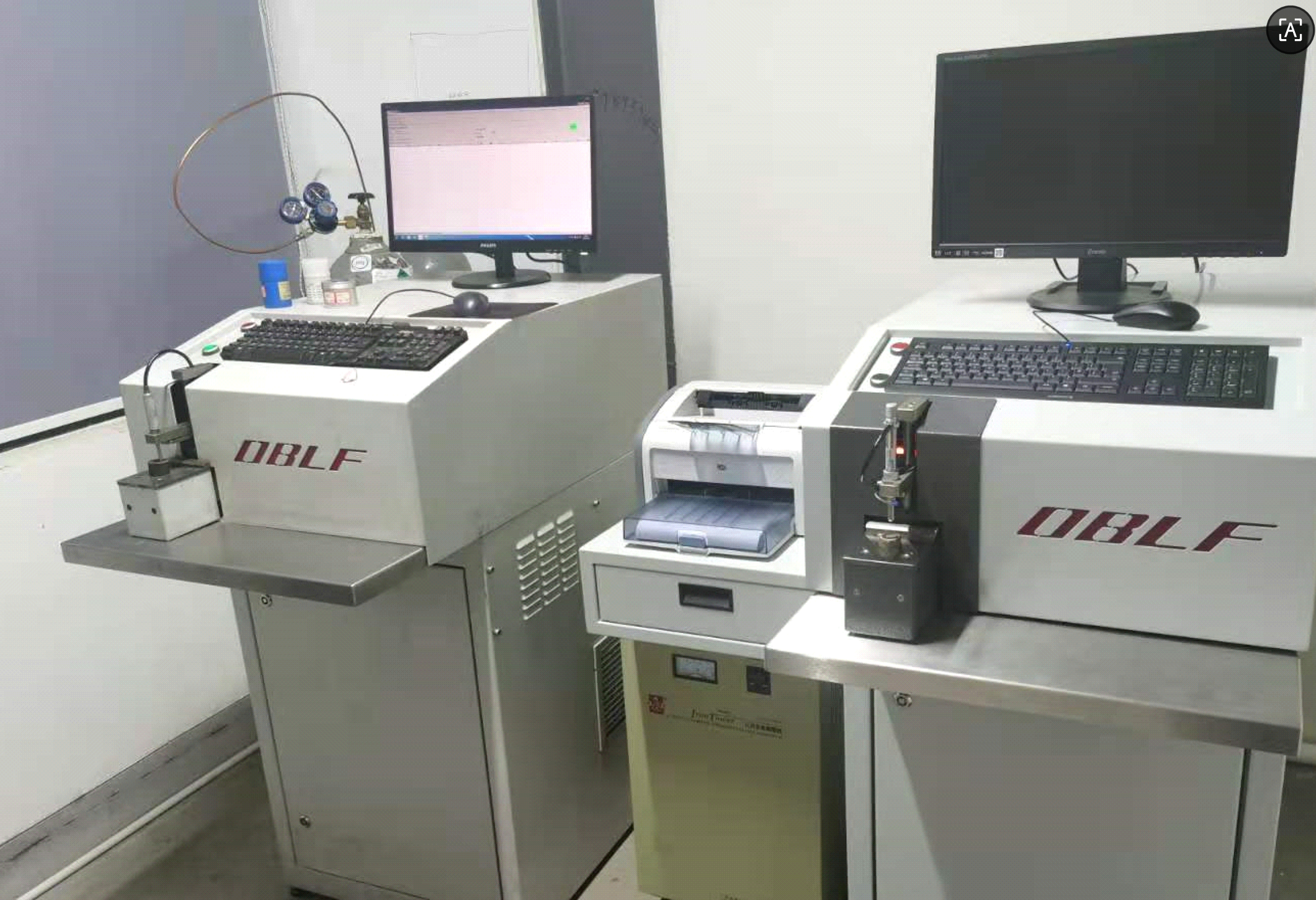
Material composition verification: the certificate and the melt must describe the same grade.
Where Each Family Usually Lands
Investment casting is used across automotive, forklift, mining, agricultural machinery, construction machinery, valve and general machinery components — a spread that explains why no single material family dominates a supplier's order book. The pattern is application-driven rather than preference-driven.
In valve and fluid-handling work, stainless steel is the family that is normally shortlisted first, because the service environment decides the answer before mechanical properties are discussed, and parts such as pipe elbows carry both a pressure boundary and a corrosion surface. In automotive programmes the deciding factor is usually the quality management route rather than the alloy: the supply chain expects IATF 16949:2016, and the material must be specified precisely enough to satisfy the customer's own validation. In heavy equipment, construction, agriculture and mining, the load path decides — brackets, yokes, link arms and housings frequently land in carbon steel or alloy steel, with the alloy route chosen where heat treatment must deliver properties that plain carbon steel cannot.
The company's casting model designations illustrate that spread directly: Pipe Elbow, Clevis Bracket, Yoke, Gearbox Housing, Transmission Housing, Mounting Bracket and Link Arm. The same supplier, the same shell line and the same inspection department serve a stainless valve body and a carbon steel bracket — which is precisely why the drawing, not the supplier, must carry the material decision.
One documented case shows the pattern at scale. An automotive parts OEM in the United States has received 1,000 tons for a truck axle system over a 30-year relationship, with stable operation and castings whose appearance, dimensional accuracy and mechanical properties meet the customer drawing requirements. Long-running programmes of that kind are built on a material and inspection definition that did not change between orders.
The Supplier-Side Constraints Behind the Material Choice
Material selection is only enforceable if the supplier can prove what was poured. WAYSCAN METAL PRODUCTS CO. , LTD operates as an ODM/OEM and customisable manufacturer working from customer drawings for size, geometry, material, surface and heat treatment, and offers rapid samples developed without hard tooling through 3D printing. Order behaviour is stated as a combination of batch production and order-based customisation, with a minimum order quantity of 100 kg and lead times of 30–60 days.
Verification is the part of the offer that a material shortlist depends on. The company states comprehensive inspection and testing equipment covering spectrometer analysis, X-ray and ultrasonic examination, hardness and tensile testing, and CMM dimensional inspection — the four evidence types that map onto the four questions buyers ask about a casting: what is it made of, is it internally sound, does it hold the specified properties, and does it measure correctly.

Dimensional verification: tolerance class CT6 or CT8 is only meaningful when the result is measured and recorded.
| Standard | Certificate number | Issuer | Scope | Valid to |
|---|---|---|---|---|
| ISO 9001:2015 | 02426Q00625R401 | Shenzhen Universal Certification Centre Co., Ltd. (UCC) | Production of steel casting | 2029-05-20 |
| IATF 16949:2016 | IATF 0516798 | SGS United Kingdom Ltd. | Manufacture of precision casting parts | 2027-05-13 |
| ISO 14001:2015 | 02426E00394R401 | Shenzhen Universal Certification Centre Co., Ltd. (UCC) | Production of steel castings and related management activities | 2029-05-20 |
| ISO 45001:2018 | 02426S00381R101 | Shenzhen Universal Certification Centre Co., Ltd. (UCC) | Production of steel castings and related management activities | 2029-05-20 |
The reading lesson is straightforward. ISO 9001 and IATF 16949 describe the management system, not the part; they tell a buyer that the process is controlled, not that a specific grade has been poured correctly. The grade claim is proven by the material certificate and the spectrometer result, the soundness claim by radiography or ultrasonic examination, the property claim by hardness and tensile tests, and the dimensional claim by CMM records. A material shortlist should name the evidence required for each claim before the supplier is selected, because after selection the evidence becomes retrospective.
Exports reach the USA, Japan, Canada, Germany, Korea and Australia, with a stated export ratio of 70% and main markets of China, Japan and the USA. Buyers in regulated industries should note that a supplier's certification scope is written in the language of manufacturing activity — precision casting parts, steel casting production — and a material-specific compliance claim still has to be traced back to the certificate and the test report for the actual order.
Market Signals Behind a 2026 Material Decision
The demand context supports the shortlist logic rather than replacing it. Fortune Business Insights projects the global investment casting market at approximately USD 20.52 billion in 2026, while Grand View Research has published a lower forecast of about USD 18.3 billion for a comparable horizon; the gap is best explained by segment definition rather than by contradiction, with aerospace-grade and industrial-only scopes being counted differently. Buyers should read size figures as an indicator of category scale, not as a procurement input.
Process mix is more directly useful. Dataintelo reports that the silica sol (colloidal silica) process held the largest share at 54.3% in 2025, followed by the water glass process at 32.1% — a split that reflects buyer preference for precision and surface finish in higher-value castings. That trend is consistent with a material shortlist that leans toward tighter tolerance classes where the drawing justifies them, and toward composite routes where it does not.
Application demand reinforces the same conclusion. Business Research Insights places automotive applications at approximately 29% of investment casting demand, the largest volume-driven segment, which explains why IATF 16949:2016 remains the critical quality management requirement for suppliers serving the automotive supply chain. On the trade side, UN Comtrade recorded global exports under HS 732599 — cast articles of iron or steel, not elsewhere specified — at USD 4,320.81 million in 2025, although that code aggregates investment castings with other steel casting routes and there is no unique six-digit code for investment casting alone. Buyers who use trade data for sourcing decisions should treat it as directional only.
Where Investment Casting Is the Wrong Answer
An honest shortlist has to include the cases where the process should be removed from consideration. Investment casting earns its place when geometry is complex, walls are thin, as-cast detail reduces machining, and the part is small enough to be handled economically through wax injection and shell building. It loses that place when the part is large and geometrically simple, when tolerance is loose enough that sand casting would suffice, or when the annual volume is high enough that pattern cost dominates the business case.
| Route | Where it wins | Boundary the buyer must accept |
|---|---|---|
| Investment casting (silica sol / composite) | Complex geometry, thin walls, near-net shape, reduced machining, repeatable as-cast detail. | Wax pattern tooling is required, part size and weight are bounded by the shell and handling system, and the composite route trades tolerance class (CT8 against CT6) for cost efficiency. |
| Sand casting | Large, simple parts where tooling cost must stay low and size range must stay wide. | Coarser tolerance and rougher surface, so more material is left for machining. |
| Machining from solid | Very small quantities and prototypes where no tooling can be justified. | High material waste and limited geometry; cost scales badly with volume. |
| Forging | Highly stressed parts where grain flow and directional strength are the design driver. | Geometry complexity is constrained and secondary machining is normally required. |
Two further boundaries belong to the material decision itself. First, corrosion resistance is not a property a buyer can assume from the words stainless steel alone; grade, surface condition and any verification test must be written down, and where those are left open the result is a part that passes inspection and still fails in service. Second, the composite process is efficient but not equivalent to the silica sol route: where a drawing genuinely requires CT6, the buyer should expect to pay for the tighter route rather than assume the tolerance will be absorbed by machining.
Future Outlook
Three developments are likely to shape material shortlists over the next buying cycles. The first is the continued shift of precision work toward silica sol and composite routes, which makes tolerance class a commercial negotiating item rather than a purely technical footnote. The second is documentation depth: as automotive-style quality management expectations spread into adjacent industrial segments, the evidence pack — certificate scope, melt analysis, test reports, dimensional records — becomes part of what is purchased, not an attachment requested afterwards.
The third is environmental performance entering supplier evaluation. The company's own trajectory is illustrative: replacing the earlier water glass precision casting route with composite process production in 2020 to improve efficiency and reduce environmental impact, followed in 2023 by recognition as a waste-free factory, a four-star green factory and a water-saving factory. For buyers whose customers now ask about the manufacturing footprint behind a casting, that kind of record is starting to sit alongside price and lead time in the evaluation matrix.
A consolidated capability and certification overview is available in the company brochure: WAYSCAN METAL PRODUCTS CO. , LTD presentation (PDF).
FAQ
Must the buyer specify the material grade, or can the foundry select it?
The buyer should specify it. The company's stated position is that specific dimensions, material grades and mechanical properties are customised per customer drawings, and that customers should specify certifications, material grades or surface treatment requirements in advance. Where the grade is left to the supplier, the delivered part is technically compliant with the order but effectively undefined against the design intent.
What tolerance and surface finish can be quoted for silica sol and composite investment casting?
The stated figures are CT6 for the silica sol process, CT8 for the silica sol composite process, and 0.01 mm for machining. Surface roughness sits in the Ra 6.4–12.5 µm range and depends on both the casting process and the post-treatment applied. Because the roughness band is a range rather than a fixed value, the drawing should state the required finish on the specific surfaces that matter.
How are material composition and mechanical properties verified on a production order?
Verification relies on four evidence types: spectrometer analysis for material composition, X-ray and ultrasonic examination for internal soundness, hardness and tensile testing for mechanical properties, and CMM inspection for dimensions. Together they allow a buyer to check the grade claim, the soundness claim, the property claim and the dimensional claim independently of the supplier's summary statement.
Which certification matters for automotive investment castings?
IATF 16949:2016 is the critical quality management system requirement for suppliers serving the automotive supply chain. In this case the certification is numbered IATF 0516798, issued by SGS United Kingdom Ltd., with a scope covering the manufacture of precision casting parts and validity to 2027-05-13. The supporting management system certifications held are ISO 9001:2015 (02426Q00625R401), ISO 14001:2015 (02426E00394R401) and ISO 45001:2018 (02426S00381R101).
What order size and lead time apply to a custom casting order?
The stated minimum order quantity is 100 kg, with lead times of 30–60 days. Production runs as a combination of batch production and order-based customisation, which is the model that allows a valve programme and a heavy-equipment programme to share the same shell line and inspection department.
Can a sample be produced before hard tooling is committed?
Yes. Rapid sample development is supported through 3D-printed patterns, which allows a sample to be produced without a machined wax die. That capability matters most in the evaluation stage, where a buyer needs to test material behaviour, fit and tolerance before committing to a production pattern.
Material selection guidance in this reference reflects the manufacturer's stated capability and published third-party data. Grade, property and inspection requirements remain the buyer's specification responsibility and should be confirmed against the drawing and applicable standard before order placement.
Have Questions or Need More Details?
Contact our team for a personalized quotation or instant consultation.
Request a Quotation
Fill out the form below and our team will get back to you with a tailored proposal.
WhatsApp Direct Chat
Prefer to chat in real-time? Message us on WhatsApp for instant assistance & quick answers.
- Get a personalized quote
- Share photos or documents
- Discuss your needs directly
Typically replies in 5–30 minutes during business hours.