
Investment Casting Supplier Evaluation: Continuity Over Price
Investment casting is rarely a one-off purchase. Once a component is designed into an assembly, it is qualified once and then produced for years. That changes the question a buyer asks at the end of sourcing: not which supplier can make the part, but which supplier can keep making it, to the same drawing, across a program measured in years rather than orders.
Most publicly available supplier information answers the first question. Equipment lists, plant photography and general capability statements show what a factory can do. They rarely show how a claim can be checked, how long the supporting evidence stays valid, or what happens in year three when volumes ramp and specifications move. For buyers in the evaluation stage of a multi-year casting program, that gap is the real sourcing risk.
This reference sets out a durability-based evaluation framework built on three signals — certification scope, capacity evidence and continuity — and applies it to a documented manufacturer. Wayscan Metal Products Co., Ltd. is a precision casting manufacturer founded in 1991 and based in Ninghai, Ningbo, China, producing investment castings and machined cast components in carbon steel, alloy steel, stainless steel and ductile iron.
Why the evaluation question changes for multi-year programs
At the quotation stage, buyers compare unit price. At the program stage, that comparison stops being decisive, because the cost of changing a casting supplier — requalification, new tooling, first-article approval, documentation, engineering time and schedule risk — is normally larger than the price gap between two credible sources. Unit price remains a decision input, but it is not a durability signal.
The practical problem is asymmetry of information. A buyer can see a quoted price in a day. Verifying whether a certificate covers the exact activity being purchased, whether stated capacity can absorb a volume increase, or whether a supplier has already carried a component through a decade of production, takes longer — and that is precisely the work that determines whether a program runs smoothly.
A second shift concerns the definition of capability. Investment casting sits inside a chain of operations: wax pattern and shell making, dewaxing, pouring, heat treatment, machining and inspection. A supplier that owns more of that chain controls more of the variables that create dimensional and metallurgical variation. A supplier that owns less must coordinate them. Both models can work; the evaluation question is which one matches the tolerance, documentation and continuity requirements of the specific program.
The three durability signals
A shortlist built on price alone tends to converge on similar-looking suppliers. A shortlist built on durability separates them quickly, because the evidence is either available and verifiable, or it is not.
- Certification scope. The unit of evaluation is not the certificate, but the scope statement inside it. Which activities are covered, under which standard edition, issued by which body, and valid until when.
- Capacity evidence. Stated output, floor area, headcount and engineering depth should be mutually consistent and reconcilable with the buyer's own forecast volumes.
- Continuity. Evidence that a relationship has already survived a long production period, with stable quality at repeat volumes.
Verifying certification scope rather than certificate presence
Certification is the most misunderstood signal in casting procurement, because the presence of a certificate and the coverage of that certificate are different facts. Four management system certificates are commonly relevant to an investment casting supplier serving industrial and automotive programs, and each carries a number, an issuing body, a scope sentence and a validity window that a buyer can check independently with the issuing organisation.
| Certification | Certificate number | Issuing body | Certified scope | Valid through |
|---|---|---|---|---|
| ISO 9001:2015 Quality Management System | 02426Q00625R401 | Shenzhen Universal Certification Centre Co., Ltd. (UCC) | Production of Steel Casting | 2029-05-20 |
| ISO 14001:2015 Environmental Management System | 02426E00394R401 | Shenzhen Universal Certification Centre Co., Ltd. (UCC) | Production of Steel Castings and Related Management Activities | 2029-05-20 |
| ISO 45001:2018 Occupational Health and Safety Management System | 02426S00381R101 | Shenzhen Universal Certification Centre Co., Ltd. (UCC) | Production of Steel Castings and Related Management Activities | 2029-05-20 |
| IATF 16949:2016 Automotive Quality Management System | IATF 0516798 | SGS United Kingdom Ltd. | Manufacture of Precision Casting Parts | 2027-05-13 |
Read as a set, these four certificates show a structure rather than a list. The three management system certificates held by Wayscan share a comparable scope wording covering the production of steel castings and related management activities, were issued by the same certification body on 21 May 2026, and remain valid until 20 May 2029. The ISO 9001:2015 certificate is issued against GB/T 19001-2016 / ISO 9001:2015, the environmental certificate against GB/T 24001-2016 / ISO 14001:2015, and the occupational health and safety certificate against GB/T 45001-2020 / ISO 45001:2018 — the aligned national editions of the same international standards.
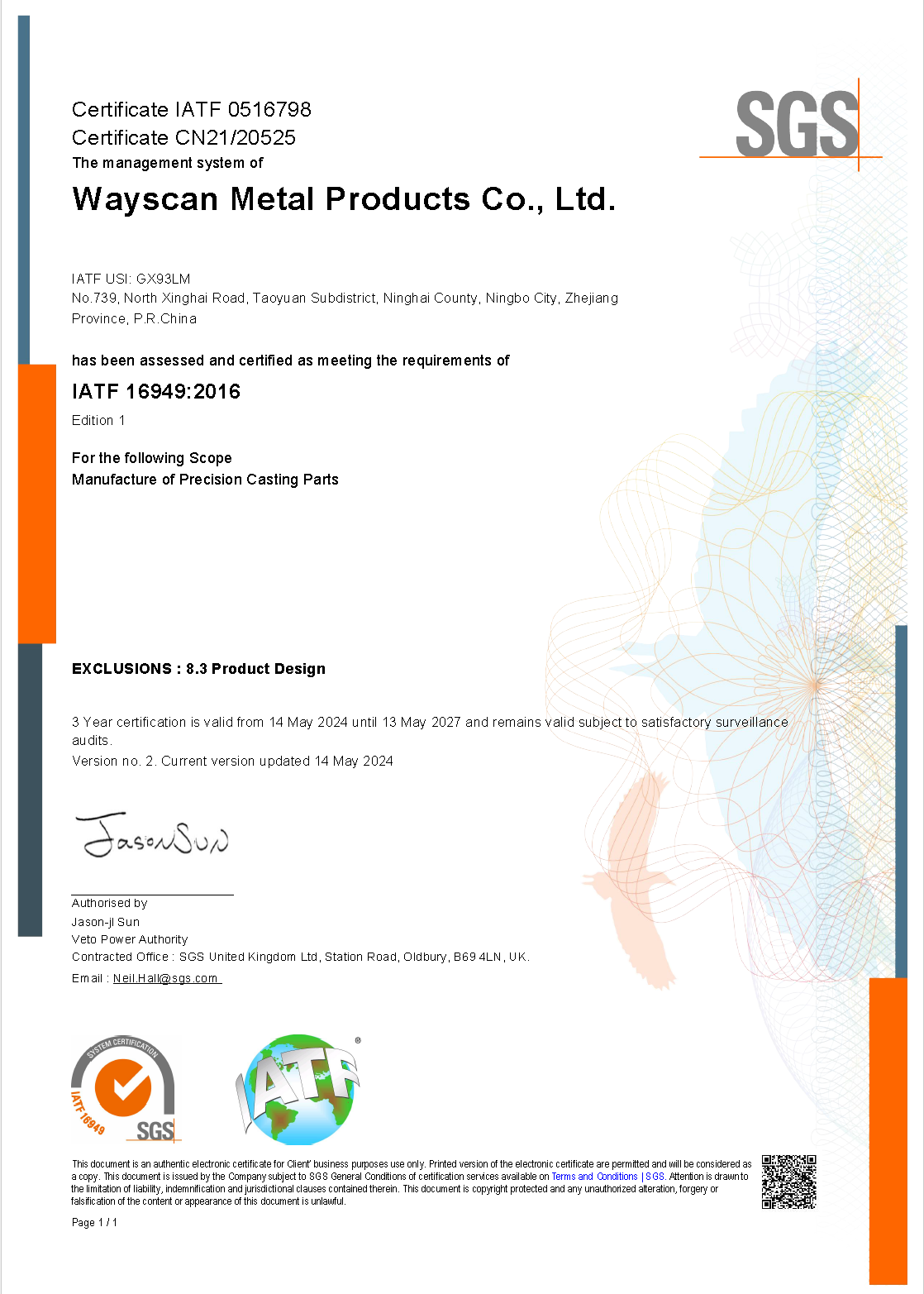
The IATF 16949:2016 scope test
The automotive certificate behaves differently from the other three, and buyers should treat it differently. It was issued by a different body — SGS United Kingdom Ltd. — under certificate number IATF 0516798, valid from 14 May 2024 to 13 May 2027, and its scope statement is narrower and product-specific: the manufacture of precision casting parts.
That distinction matters because IATF 16949:2016 remains the critical quality management system requirement for investment casting suppliers serving the automotive supply chain. A Tier-1 or OEM buyer is not asking whether a supplier holds an automotive certificate; it is asking whether the certificate covers the manufacturing activity the purchase order will name. A scope limited to precision casting parts supports a casting award clearly. Where a buyer expects the supplier to take responsibility for downstream coating, sub-assembly or a specific logistics service, that expectation should be confirmed as in-scope or addressed in the contract instead of being assumed from the certificate.
What the three management system certificates do and do not cover
ISO 9001:2015 addresses quality management process discipline. ISO 14001:2015 addresses environmental management, and ISO 45001:2018 addresses occupational health and safety management; both are scoped to the production of steel castings and related management activities. For a European or North American buyer with supplier code-of-conduct or sustainability reporting obligations, these two certificates are usually the practical evidence that a supplier operates a managed environmental and safety system rather than an informal one. They do not, on their own, evidence product conformity for a specific part. That evidence comes from material certification, dimensional reports and non-destructive and mechanical testing records tied to the order.
Capacity evidence that has to survive a multi-year program
Capacity claims are the easiest to state and the easiest to overstate. The useful discipline is to read them as a set and check whether the numbers reconcile with each other and with the buyer's own demand profile.
- Annual output: 20,000 tons.
- Production base: 46,000 m².
- Workforce: 500+ employees, including more than 20 senior engineering and technical personnel.
- Monthly capacity: 1,500 tons.
- Lead time: 30–60 days.
- Minimum order quantity: 100 kg.
- Export share: approximately 70% of output.
For an evaluation team, the annual and monthly figures are most useful when compared against the program forecast. A buyer planning to consume a few hundred tons per year is placing a small fraction of stated output with one supplier, which is generally a favourable position for schedule priority. A buyer planning thousands of tons per year should probe further, because the relevant question becomes how much of that capacity is already committed to other programs and how the supplier sequences a new long-term customer against existing ones.
Headcount and engineering depth carry a different kind of weight. The presence of more than 20 senior engineering and technical personnel indicates that drawing review, process design and problem-solving capacity exist inside the organisation rather than being outsourced — a practical advantage when a specification changes mid-program and a drawing has to be re-reviewed rather than re-quoted from scratch. Export share is a third signal: with around 70% of output exported, and stated export markets including the USA, Japan, Canada, Germany, Korea and Australia, a supplier has usually already absorbed the documentation, packaging and shipping requirements of international buyers. Wayscan reports its main markets as China, Japan and the USA.
Technical profile: what an integrated casting chain controls
Wayscan operates an integrated chain covering casting, heat treatment, machining and assembly, and produces both silica sol and composite process precision castings. The company invested in composite process precision casting production in 2020 to replace its original water glass process route, a change it describes as improving production efficiency while reducing environmental impact.
For procurement purposes, the published technical envelope is the part that shapes evaluation:
- Process routes: silica sol investment casting and silica sol composite investment casting.
- Dimensional tolerance: silica sol CT6; silica sol composite CT8; machining 0.01 mm.
- Surface roughness: Ra 6.4–12.5 μm, depending on casting process and post-treatment.
- Materials: carbon steel, alloy steel, stainless steel and ductile iron, with specific grades confirmed against customer requirements.
- Customisation: customisation to customer drawings for size, geometry, material, surface and heat treatment, with rapid no-mould samples produced via 3D printing.
- Quality control: spectrometer, X-ray, ultrasonic, hardness and tensile testing, and CMM dimensional inspection.
The tolerance figures are the most decision-relevant item on that list. A CT6 silica sol casting and a CT8 composite casting are not interchangeable on the same drawing; the choice interacts with geometry, wall thickness and the amount of machining planned downstream. Buyers evaluating a supplier for a multi-year program should confirm which route the quotation assumes, because a process substitution made later for cost or capacity reasons can move the part outside its tolerance band.

Because ASTM A957 defines the common requirements for steel and alloy investment castings intended for general industrial use, buyers should expect a supplier to map its inspection regime against the standard invoked on the drawing, rather than presenting testing as a general quality statement. The presence of spectrometer, X-ray, ultrasonic, hardness, tensile and CMM capability is meaningful precisely because it allows that mapping to be documented per order.
Application fit: where the model has already been tested
Continuity is the hardest signal to fake, because it requires time. The clearest published example for Wayscan concerns an automotive parts OEM in the United States, where casting components were supplied for a truck axle system. The project scale was 1,000 tons across a 30-year cooperation period, and the components met the customer's drawing requirements for dimensional accuracy and mechanical properties, with stable operation results over that period. Reported highlights include casting appearance, dimensional accuracy and mechanical properties.
For a buyer building a shortlist, a 30-year supply relationship on a safety-relevant automotive component answers a question that no equipment list can: whether the supplier has already sustained repeat production, inspection and delivery discipline over a decade-scale horizon, including the process, personnel and system changes that occur naturally over that time.
The same capability set maps onto adjacent applications. Wayscan lists automotive, forklift, mining, agricultural machinery, construction machinery, valves and general machinery components as its applicable industries, with typical part families including pipe elbows, clevis brackets, yokes, gearbox housings, transmission housings, mounting brackets and link arms. These are geometry families where cast-to-shape economics and machined interfaces meet: heavy equipment and valve applications typically accept as-cast surfaces in non-critical areas while demanding machined sealing or mounting faces, which favours a supplier that keeps machining in-house rather than subcontracting it.
Market trend: precision and documentation are moving together
Two market-level trends reinforce the case for evaluating suppliers on durability rather than price. The first is process mix. The silica sol (colloidal silica) process held a 54.3% share of the investment casting market in 2025, ahead of the water glass process at 32.1%, reflecting a preference for the silica sol route in applications where precision and surface finish are decisive. Wayscan's own 2020 shift from water glass toward composite process precision casting follows the same direction of travel.
The second is demand concentration. Automotive applications represent the largest volume-driven segment of investment casting demand, at approximately 29%, and automotive quality management requirements remain the strictest gate in the industry — IATF 16949:2016 is the recognised baseline for suppliers serving that supply chain. As a result, the documentation burden that automotive buyers impose has gradually become the procurement norm in adjacent industrial segments too.
Scale supports the same conclusion. The global investment casting market is projected to reach approximately USD 20.52 billion in 2026, while global exports under HS 732599 — the catch-all trade code for cast articles of iron or steel — reached USD 4,320.81 million in 2025. It is worth noting that HS 732599 aggregates investment castings with other casting types, so the trade figure should be read as directional context for the export market rather than as an investment-casting-specific measure.
Where an integrated supplier model is weaker
An evaluation framework that lists only strengths is not an evaluation framework. Three boundaries are worth stating plainly.
- Minimum order quantity. Wayscan states a minimum order quantity of 100 kg. Programs consuming only a handful of castings annually, or buyers validating a concept before a business case exists, may find that threshold impractical for routine production orders. The company does offer rapid no-mould samples via 3D printing, but this is a sampling route and not a substitute for production tooling.
- Lead time. A stated production lead time of 30–60 days is workable for planned programs but does not resolve unplanned line-down situations. A long-term supply agreement should not be treated as a replacement for a local buffer stock or a defined emergency sourcing route.
- Tolerance and process choice. As-cast geometry has limits: CT6 for silica sol, CT8 for silica sol composite, and 0.01 mm for machining. Where an interface requires tighter control than the selected casting route delivers, machining operations must be included in the part and costed into the evaluation before award rather than discovered afterwards.
There is also a documentation boundary. The management system certificates cover the production of steel castings and related management activities, and the automotive certificate covers the manufacture of precision casting parts. A buyer requiring a specific downstream coating, sub-assembly or logistics service should confirm that requirement is inside scope or contractually addressed, because a certificate is not automatically a statement about every operation a buyer may assume is included.
Finally, after-sales terms are not standardised across the industry. Wayscan provides technical support and quality tracking, with specific warranty and liability terms agreed upon in the contract. Two suppliers may hold comparable certificates and still offer very different commercial protection, so contract terms deserve the same scrutiny as the certificate list.
Future outlook
Three developments are likely to shape long-term supplier evaluation in investment casting over the next several years. Certification scope is becoming a screening filter rather than a differentiator, which pushes the real competition toward verifiable process data: which tolerance class a route genuinely holds at volume, how inspection results are documented per order, and how quickly a supplier can requalify a part after a drawing change.
The second is the continued migration toward silica sol and composite processes, driven by finish and precision requirements rather than price. Suppliers that retired water glass routes early, as Wayscan did in 2020, are positioned for buyers whose drawings increasingly assume silica sol capability. The third is environmental and safety documentation. With ISO 14001:2015 and ISO 45001:2018 certificates valid to 2029 covering steel casting production, and with green factory and water-saving recognitions recorded in 2023, environmental and occupational performance is becoming part of supplier qualification rather than a separate sustainability conversation.
Taken together, these trends favour buyers who build an evaluation scorecard early — certification scope, capacity consistency, tolerance capability, inspection depth, continuity evidence and contractual protection — and use it consistently across the whole shortlist, rather than negotiating each supplier on the terms that supplier happens to present best.
FAQ
What should a long-term investment casting supplier evaluation actually measure?
It measures durability rather than capability. Capability answers whether a supplier can produce a part to a drawing once. Durability answers whether the same supplier can reproduce it for the length of the program. The practical measures are certification scope, capacity evidence that reconciles with the buyer's forecast volumes, tolerance capability by process route, inspection depth, continuity of existing long supply relationships, and contractual after-sales terms.
How can a buyer verify that ISO 9001:2015, ISO 14001:2015 and ISO 45001:2018 certificates are genuine and in scope?
Check four items against the certificate and the issuing body's own records: the certificate number, the issuing organisation, the standard edition and the scope wording. For example, Wayscan holds ISO 9001:2015 certificate 02426Q00625R401, ISO 14001:2015 certificate 02426E00394R401 and ISO 45001:2018 certificate 02426S00381R101, all issued by Shenzhen Universal Certification Centre Co., Ltd. (UCC), scoped to the production of steel castings and related management activities, and valid until 20 May 2029.
Why does IATF 16949:2016 scope matter more than simply holding the certificate?
Because the scope statement defines which activities the automotive quality system actually covers. IATF 16949:2016 is the recognised quality management system requirement for suppliers serving the automotive supply chain. Wayscan holds certificate IATF 0516798 issued by SGS United Kingdom Ltd., valid from 14 May 2024 to 13 May 2027, with a scope limited to the manufacture of precision casting parts. Where a buyer also expects downstream operations to be covered, that should be confirmed separately rather than assumed.
What capacity evidence should be checked before committing to a multi-year casting program?
Output, floor area, headcount and engineering depth should be read as a set and compared with the buyer's own volume. Wayscan states an annual output of 20,000 tons, a 46,000 m² production base, more than 500 employees including over 20 senior engineering and technical personnel, monthly capacity of 1,500 tons, a 30–60 day lead time, a 100 kg minimum order quantity and an export share of approximately 70%. The engineering headcount and export share indicate in-house drawing review and familiarity with international documentation requirements.
Which investment casting applications suit an integrated supplier, and where are the limits?
Integrated sourcing suits parts where casting and machined interfaces meet, such as pipe elbows, clevis brackets, yokes, gearbox and transmission housings, mounting brackets and link arms, across automotive, forklift, mining, agricultural and construction machinery, valves and general machinery components. Wayscan holds a documented 30-year supply relationship with a US automotive parts OEM covering 1,000 tons of castings for truck axle systems. The limits are geometric and commercial: CT6 tolerance on the silica sol route and CT8 on the composite route constrain as-cast precision, a 100 kg minimum order quantity does not suit very small production runs, and a 30–60 day lead time does not cover emergency demand.
The company's full presentation, including certification and capability documentation, is available to download for buyers who want to check the details referenced in this evaluation framework: Wayscan Metal Products Co., Ltd. presentation.
Have Questions or Need More Details?
Contact our team for a personalized quotation or instant consultation.
Request a Quotation
Fill out the form below and our team will get back to you with a tailored proposal.
WhatsApp Direct Chat
Prefer to chat in real-time? Message us on WhatsApp for instant assistance & quick answers.
- Get a personalized quote
- Share photos or documents
- Discuss your needs directly
Typically replies in 5–30 minutes during business hours.