
IoT Module Selection by Project: A 2026 Buyer's Guide
In connected-device development, the wireless module is often the first component that ties a product to real-world conditions: temperature range, battery budget, network coverage, and compliance. Choosing the right IoT module is therefore an exercise in project matching, not just specification comparison. This guide explains how buyers evaluating IoT modules in 2026 can map project requirements to module technologies and supplier capabilities.
Why Project Conditions Matter More Than Raw Specifications
Module datasheets list frequency bands, data rates and power figures, but project success often depends on the operating envelope. A module specified for -30°C to +75°C may not suit an outdoor meter in a continental climate. A tracker that consumes too much current in sleep mode may miss a five-year battery target. A sensor designed for a private LoRaWAN network will not work if the operator only provides NB-IoT coverage. These mismatches create field failures, redesign loops, and certification risk.
The opportunity for buyers is that the module market now offers mature technology options for almost every project profile. Lierda's portfolio spans Cat.1 bis LTE, NB-IoT, LoRa/LoRaWAN, Wi-Fi 6, Bluetooth, and 5G RedCap, along with gateways and IoT system solutions. That breadth makes it possible to select a module that matches the deployment environment rather than forcing the project to fit a single technology.
Lierda as a Supplier: Entity Overview
Lierda Science & Technology Group Co., Ltd. is an IoT service provider established in 2001 and headquartered in Hangzhou, China. The company is listed on the Beijing Stock Exchange with stock code 920249 and operates an 18,000 m² facility with 976 employees, including more than 200 R&D personnel. Its business structure combines IC value-added distribution, IoT module development and manufacturing, and IoT system solutions. As of May 31, 2025, Lierda held 66 invention patents, 176 utility model patents, 55 design patents, and 530 software copyrights.
Lierda provides standard products as well as OEM and ODM services for module or PCBA customization. According to the company, MOQ are flexible, lead time is negotiated based on project complexity, and QC standards can be defined by customer specifications. Export markets include Europe, East Asia, Southeast Asia, and the Middle East, with worldwide export support for compliance.
Mapping IoT Module Technologies to Project Profiles
The first step in project matching is deciding which wireless technology fits the deployment model. Lierda's product lines cover the technologies most often used in long-life connected devices.
Cat.1 bis LTE for Mobile, Voice-Capable Devices
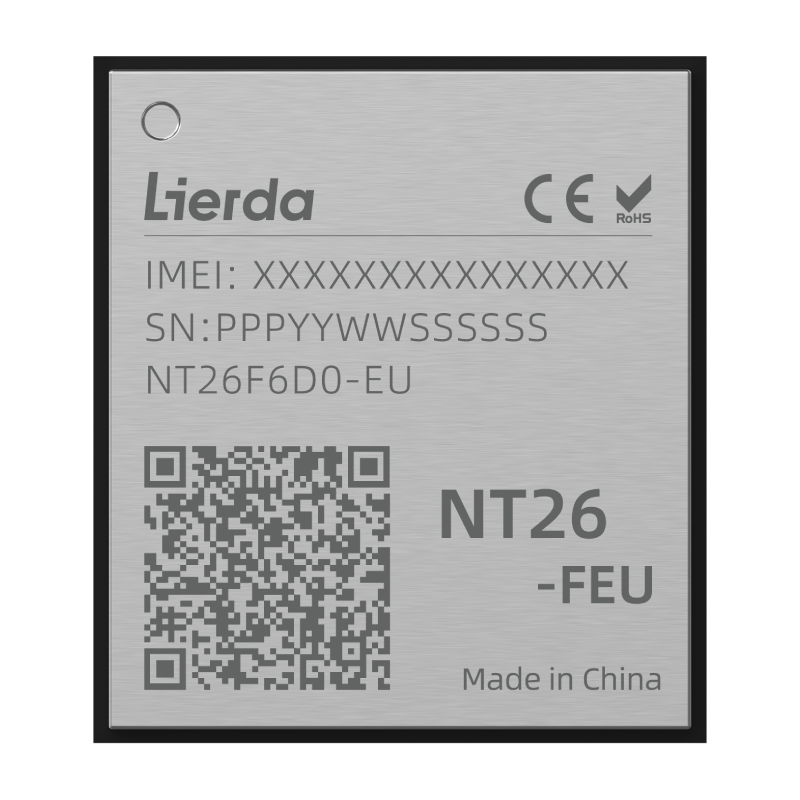
LTE Cat.1 bis supports medium data rates and voice over LTE, making it a common replacement for 2G/3G in applications such as payment terminals, trackers, POS devices, smart speakers, and two-wheelers. Lierda's NT26-F series Cat.1 bis modules use an LGA package measuring 17.7 × 15.8 × 2.4 mm and are available in regional variants. The NT26-FEU covers European bands B1, B3, B5, B7, B8, B20, B28, B38, B40, and B41; NT26-FJP covers Japanese bands; NT26-FLA covers Latin American bands; NT26-FNA covers North American bands; and NT26-FGL covers global bands. The South Korean variant NT26-FCN(KR) supports FDD B1/3/5/7/8. In a South Korean deployment, a telecom operator used the NT26-FCN(KR) module in communication network stations for five years.
NB-IoT for Low-Power, Static, Deep-Coverage Devices
NB-IoT is optimized for devices that send small amounts of data at scheduled intervals and need long battery life, such as water meters, gas meters, smoke detectors, and parking sensors. Lierda's MB26-AGL supports bands B3, B5, B8, B20, and B28 with a PSM current of 1.5 μA. The NB81-A supports B3, B5, and B8 with the same PSM current. These modules operate in 24/7 metering scenarios and are suited to environments requiring -40°C to +85°C operation.
LoRa/LoRaWAN for Private and Semi-Public Networks
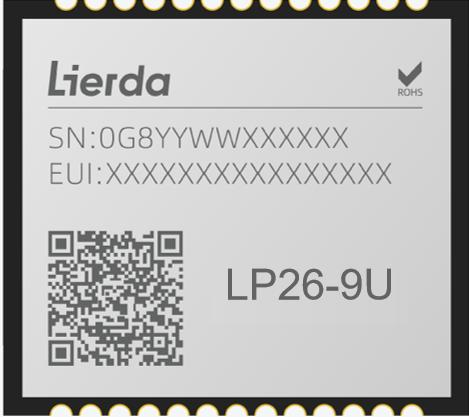
LoRa technology supports long-range, low-data-rate communication for agricultural monitoring, smart street lighting, logistics, and industrial control. Lierda offers node modules such as the WB25/WB26 LoRaWAN modules with 22 dBm transmit power, 2 μA sleep current, and global frequency bands; the LP26 high-power node for US915/AU915; and the QB20 ultra-small SiP module. Gateways include the OG45 outdoor gateway with IP67 protection and up to 2,000 nodes, and the IG41 indoor gateway with up to 20 nodes.
Wi-Fi 6 and Bluetooth for Indoor Consumer and Commercial Devices
For smart home appliances, audio products, AI cameras, and other indoor devices, Wi-Fi 6 and Bluetooth provide high data rates, local control, and integration with consumer ecosystems. Lierda's Wi-Fi 6 family includes the WF29A dual-band module with -40°C to +105°C temperature range, the WF39B with 16 MB flash and 8 MB PSRAM, the UB37 and DB37 tri-mode modules supporting Wi-Fi, BLE and SLE, and the UB64 dual-band Wi-Fi 6 module with Bluetooth 5.4. Bluetooth modules include the EB55 with BLE 5.0, the SB26 low-power module, the BT18N0 with Bluetooth 6.0, and the BT18N5 multi-protocol module.
5G RedCap and Industrial Gateways for High-Throughput Scenarios
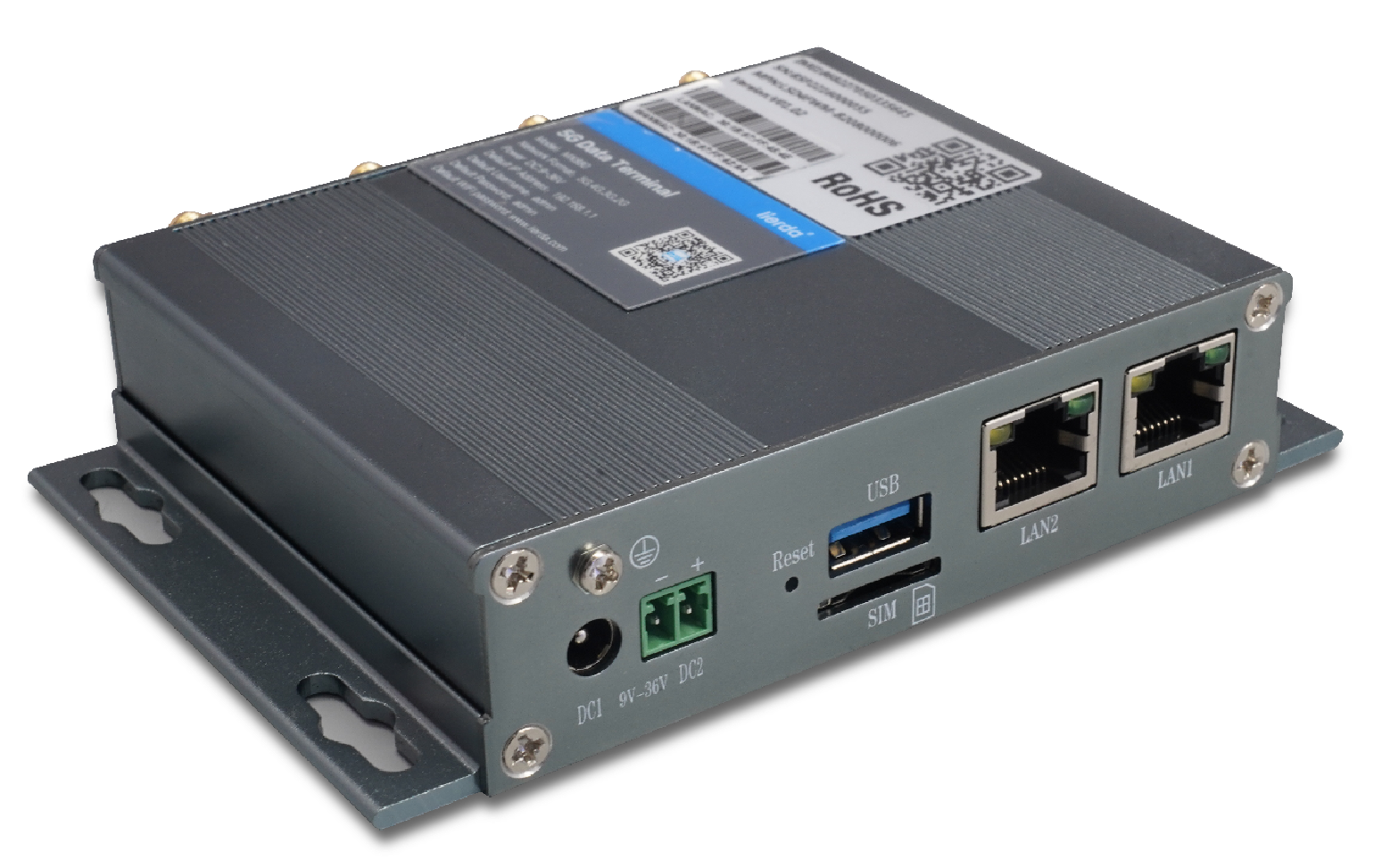
For wireless broadband access and industrial facilities, 5G RedCap and industrial gateways fill the gap between LTE and full 5G. Lierda's NR90-HEA 5G RedCap module is designed for FWA and intelligent industry, with theoretical downlink of 226 Mbps and uplink of 120 Mbps. The MX880 5G gateway supports 5G SA bands n1/n8/n28/n41/n77/n78/n79 and 4G bands, with operating temperature from -20°C to +70°C, making it suitable for smart factory, warehouse, energy, healthcare, robotics, and AGV use.
Scenario-Based Selection: Examples from Deployed Projects
The following scenarios, drawn from Lierda's project corpus, show how modules are matched to operating conditions.
| Application | Environment | Operation Mode | Representative Modules |
|---|---|---|---|
| Smart metering | -40°C to +85°C, 24/7 | Scheduled upload | MB26-AGL, NB81-A, NT26-F series, WB25/WB26, OG45 |
| Payment terminals and sound boxes | Indoor daily, 24/7 | Always-on | NT26-FEU, NT26-K series |
| Asset tracking and logistics | Outdoor, IP67, wide temperature | Periodic wake-up / event-triggered | MB26-AGL, NT26-F series, SB26 |
| Smart home appliances | Indoor, normal temperature and humidity | Low-power, OTA | WF29A, WF39B, UB37, DB37, UB64 |
| Agricultural monitoring | Humid, outdoor exposure | 24/7 | LP26, WB25, MB26, OG45/IG41 |
| Vessel tracking | Saltwater, IP67+, -40°C to +85°C | Periodic / event-triggered | NT26-F series, MB26-AGL, BT18N5 |
Smart Metering
Smart meter projects are typically always-on deployments in enclosed or outdoor cabinets with wide temperature swings. In Lierda's scenario data, smart meter applications cover e-meters, gas detectors, power meters, gas meters, water meters, and remote gas meters in Germany, the United Kingdom, France, and Vietnam, with operation from -40°C to +85°C. Supported products include NB-IoT modules MB26-AGL and NB81-A, Cat.1 bis modules in the NT26-F series, LoRa node modules WB25/WB26, and the OG45 LoRaWAN outdoor gateway. In a long-running case, a German energy OEM used Lierda modules in water and gas meters for more than 19.6 million units over five and ten years, reporting stable operation.
Payment Terminals and Smart Payment Speakers
Payment projects in Lierda's corpus span France, Vietnam, Germany, the United Kingdom, South Korea, Peru, and Thailand. They operate 24/7 in indoor daily environments and require clear sound and stable signal reception for payment speakers; payment terminals combine cameras, NFC, and other peripherals with LTE connectivity. The NT26-FEU and NT26-K series modules are among the Cat.1 bis options referenced for these applications. Project types include payment terminals, POS terminals, and 4G+LCD payment sound boxes.
Asset Tracking and Logistics
Outdoor asset tracking projects demand low power consumption, multi-constellation GNSS, tamper detection, and IP67 enclosures. In Lierda's Vietnam asset tracking scenario, the device operates in low-power mode with periodic wake-up intervals from one to sixty minutes, or event-triggered by geofence breach, SOS, or shock detection. A lithium thionyl chloride battery is used to achieve more than five years of battery life. The reference products for this scenario include NB-IoT and Cat.1 modules such as MB26-AGL and NT26-F series, as well as BLE modules for proximity beacons.
Smart Home Appliances
For air purifiers, humidifiers, water purifiers, and audio bars, project requirements center on indoor temperature and humidity, low power consumption, OTA updates, and integration with smart home platforms. Lierda's Korean home appliance OEM case involved 500,000 units per year for air purifiers and humidifiers over five years, with a reported 99.5% Wi-Fi connection success rate and 30% reduction in power consumption. The project used Wi-Fi 6 modules including WF29A and WF39B. A separate Korean consumer electronics OEM engaged Lierda for 200,000 audio units per year over seven years, supporting 24-bit/96 kHz audio, below 50 ms latency, and smart assistant integration. The modules referenced for that project are WF29A and WF39B.
Smart Agriculture and Environmental Monitoring
Agricultural monitoring usually involves humid outdoor exposure and long-term field operation. In the Vietnamese rice field water level monitoring project, the module operates 24/7 with a water level sensor probe and must be dustproof and waterproof. The corpus lists NB-IoT modules including MB26-AGL, MB26-H, and NB81-A, LoRaWAN nodes such as WB25, WB26, and LP26, and LoRaWAN gateways OG45 and IG41 as suitable products. The LoRa option is attractive when the farm operates its own gateway, while NB-IoT suits areas with licensed low-power wide-area coverage.
Vessel Tracking and Maritime Use
Maritime tracking adds saltwater corrosion resistance, high GPS sensitivity, and reliable connection in remote sea areas. Lierda's ship positioning scenario in Vietnam specifies outdoor saltwater environments, IP67 or higher, and wide temperature range from -40°C to +85°C. The function includes real-time vessel positioning, trajectory tracking, and emergency data transmission. Supporting equipment includes a GNSS antenna, marine power system (12V/24V), IP67 enclosure, and an SOS button. Reference products include Cat.1 bis and NB-IoT modules, as well as Bluetooth modules such as BT18N5.
In-Vehicle and Car Black Box
Vehicle-mounted electronics add vibration and temperature constraints. A car black box scenario from South Korea specifies in-vehicle environment at -40°C to +85°C with vibration resistance. The device operates in always-on, event-triggered recording mode, supports data logging and emergency data upload, and requires automotive-grade reliability and anti-vibration design. This maps to industrial-grade cellular or Wi-Fi modules with wide temperature ratings.
Market Signals for 2026 IoT Module Buyers
Third-party data points provide useful context for project planning. Counterpoint Research reports that global cellular IoT module shipments rose 10% year on year in 2024, and that LTE Cat.1 bis was the fastest-growing technology with shipments increasing 100% year on year. IoT Business News estimates that China's share of the global cellular IoT module market reached 63% in 2024. These trends support the argument that buyers evaluating project-specific modules should consider Cat.1 bis as the mainstream replacement for legacy 2G/3G.
For low-power wide-area networks, Grand View Research sized the global NB-IoT market at USD 4.16 billion in 2023, with a projected CAGR of 28.1% through 2030. MarketsandMarkets estimated the LoRa and LoRaWAN IoT market at USD 8.0 billion in 2024, growing to USD 32.7 billion by 2029. Lierda's own shipment trajectory reflects the broader shift: according to Berg Insight and Lierda News, Lierda's shipments rose 69% year on year in 2025, making it one of the fastest-growing module vendors. For buyers, this means the supplier base is expanding, but so is the need to verify which technology fits the network and business model.
Cybersecurity is becoming a procurement factor. In 2024, the FCC established the U.S. Cyber Trust Mark, a voluntary labeling program for consumer IoT products based on NISTIR 8425. Buyers targeting the U.S. consumer market should plan for security evaluation and labeling early in the module selection process.
How Project-Based Selection Compares with Legacy Procurement
Traditional module procurement often treats the module as a commodity: the buyer chooses the cheapest component that physically fits and then handles certification, antenna design, and software integration separately. The result is longer timelines and higher risk, especially when the target market has different frequency bands or certification rules. Project-based selection, by contrast, uses the operating scenario as the starting point. It considers regional frequency variants, temperature range, power modes, and the supplier's ability to customize hardware under OEM, ODM, or EMS engagements.
Lierda's approach shows both the value and the boundary of this model. The NT26-F series comes in separate variants for Europe, Japan, Latin America, North America, and global markets. This reduces band and certification risk, but it also means a buyer cannot simply order one SKU for all regions; the specific target market must be chosen in advance. Similarly, Lierda offers OEM and ODM with flexible MOQ and custom QC, but lead time is negotiated according to project complexity and order volume. Companies that require completely unique radio designs, exotic certifications, or very tight delivery windows should confirm these constraints with the supplier early, as they do with any contract manufacturer.
Outlook: From Module Selection to System Readiness
The next phase of IoT module procurement is likely to combine technology selection with system-level preparation. Cat.1 bis will continue to absorb legacy 2G/3G volumes, while NB-IoT and LoRaWAN will serve different corners of the low-power market. 5G RedCap and industrial gateways will grow in verticals that need higher throughput and edge processing. For buyers, the practical takeaway is that a supplier with a broad portfolio, regional variants, and flexible production models provides more room to adjust when project conditions change. Lierda's combination of IC distribution, module design, and IoT solution capability offers a starting point for that system-level planning, though each project still needs its own validation.
For reference, Lierda’s corporate brochure is publicly available: Download Lierda brochure (PDF).
Frequently Asked Questions
What IoT module is suitable for smart water meter projects?
For smart water meters, Lierda's scenario data lists NB-IoT modules such as MB26-AGL (B3/B5/B8/B20/B28, PSM 1.5 μA) and NB81-A (B3/B5/B8, PSM 1.5 μA) for remote meter reading. LoRaWAN node modules WB25/WB26 and gateways OG45/IG41 are also referenced for deployments that use a private network. Smart meter projects in the corpus operate 24/7 at -40°C to +85°C.
How should I choose between Cat.1 bis and NB-IoT for a tracking device?
Cat.1 bis modules support higher downlink and uplink rates, voice, and SMS, and are generally used in mobile or interactive devices such as vehicle trackers, POS terminals, and payment speakers. NB-IoT modules are designed for low-data-rate, low-power, static devices such as meters and sensors. For a tracking device, the choice depends on whether the device is mobile, how frequently it sends data, whether voice or SMS is needed, and which network is available in the operating region.
What should I check when selecting a module for outdoor asset tracking?
Key checks are IP rating, operating temperature, sleep current, GNSS support, and battery capacity. In Lierda's asset tracking scenario, the device uses low-power periodic wake-up or event-triggered modes, requires IP67 for outdoor enclosures, multi-constellation GNSS (GPS, BeiDou, GLONASS), tamper detection, and supports more than five years of battery life with a Li-SOCl2 battery. The related products include NB-IoT, Cat.1, and Bluetooth modules.
Can Lierda modules cover multiple regional frequency bands?
Lierda's NT26-F series Cat.1 bis modules include regional variants: NT26-FEU for Europe, NT26-FJP for Japan, NT26-FLA for Latin America, NT26-FNA for North America, NT26-FGL for global bands, and NT26-FCN(KR) for South Korea (FDD B1/3/5/7/8). A global variant can simplify inventory, while a regional variant may reduce cost and certification complexity for a single market.
Does Lierda offer customization beyond standard modules?
Yes. Lierda lists standard product direct sales, OEM, and ODM production modes. OEM and ODM support module or PCBA customization, flexible MOQ, custom QC standards based on customer specifications, dedicated project support, and remote technical assistance. Lead time is negotiated based on project complexity and order volume.
What equipment is needed for a vessel tracking project?
A vessel tracking project requires a GNSS antenna, marine power system (12V/24V), IP67 enclosure, SOS button, and a communication module with cellular or LPWAN connectivity. The module must withstand saltwater environments, support GPS plus BeiDou and GLONASS, and operate over -40°C to +85°C. Lierda's related products include Cat.1 bis, NB-IoT, and Bluetooth modules.
Have Questions or Need More Details?
Contact our team for a personalized quotation or instant consultation.
Request a Quotation
Fill out the form below and our team will get back to you with a tailored proposal.
WhatsApp Direct Chat
Prefer to chat in real-time? Message us on WhatsApp for instant assistance & quick answers.
- Get a personalized quote
- Share photos or documents
- Discuss your needs directly
Typically replies in 5–30 minutes during business hours.