
Iron Casting for Automotive Component Parts: An OEM Capability Guide
Iron casting remains one of the most established manufacturing routes for automotive component parts. Steering knuckles, brake caliper housings, brackets, hubs, housings and axle-related parts are routinely produced as iron castings because the process can deliver complex geometry, repeatable mechanical properties and cost efficiency at volume. U.S. Customs and Border Protection ruling NY N315134 records that front and rear steering knuckles are composed of 93.6 percent and 97.5 percent cast iron respectively — a practical illustration of how central iron casting is to safety-relevant chassis components.
For OEM buyers in the evaluation and execution stages, the relevant question is no longer whether iron casting can produce a component. It is whether a specific supplier's casting, machining, coating and assembly capability can hold the tolerances, material grades and delivery rhythm that a program requires. This guide examines that capability question using verifiable information about Zhejiang Pointiron Technology Co., Ltd — the manufacturer behind Pointiron casting — and publicly available standards and market data on automotive iron castings.
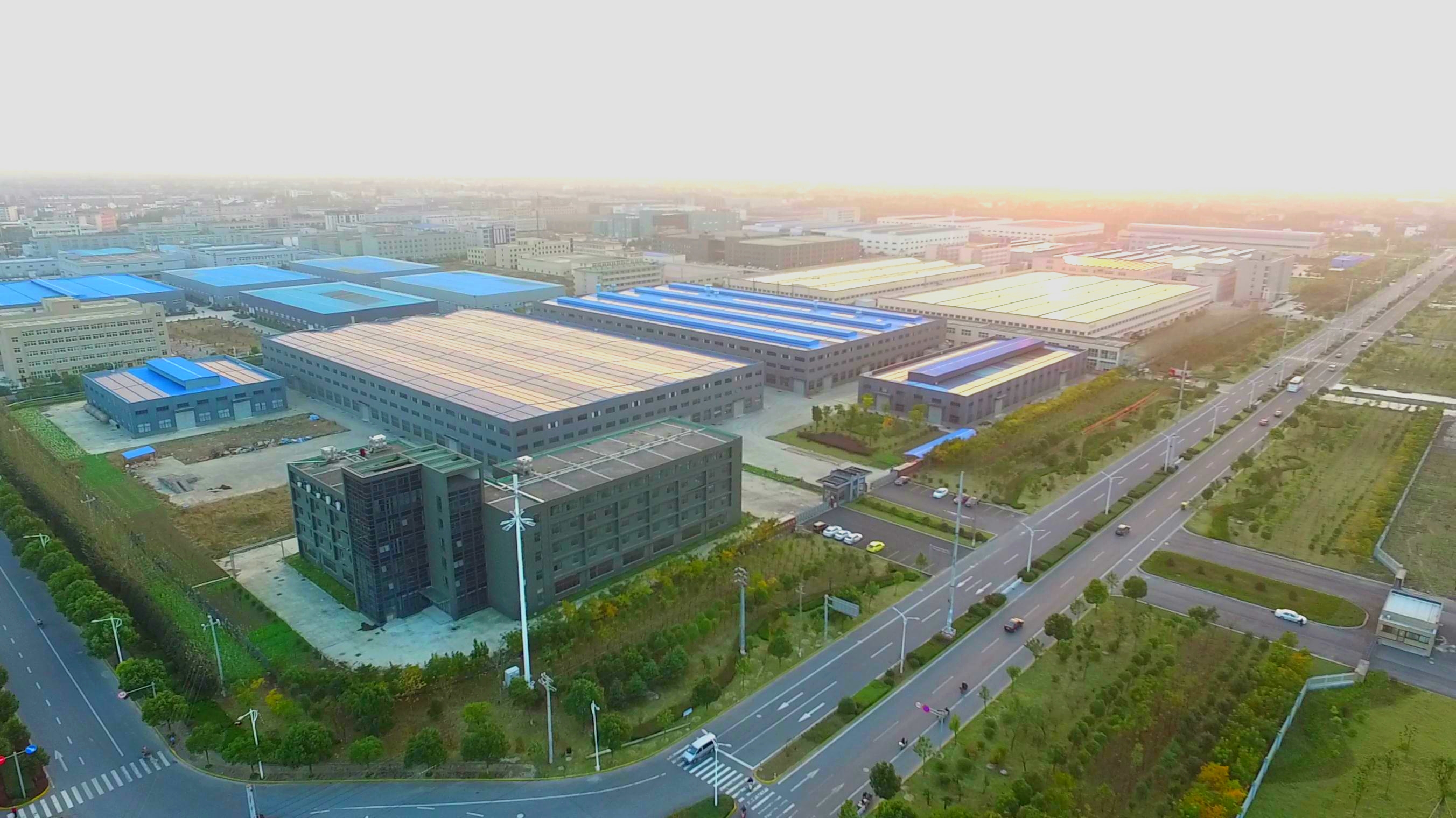
Casting and machining operations at Zhejiang Pointiron Technology Co., Ltd, supporting cast and machined automotive component parts.
Why Iron Casting Capability Decides Component Part Sourcing
Component parts of auto-mobile that are made from iron are not a single, interchangeable category. Gray iron, nodular (ductile) cast iron, malleable iron and specialty alloys such as high-silicon molybdenum ferritic iron each behave differently under load, heat and corrosion. The ASTM standards catalogue reflects that distinction: ASTM A159 covers automotive gray iron castings, ASTM A602 covers automotive malleable iron castings, and ASTM A1095 addresses high-silicon molybdenum ferritic iron castings used in high-temperature automotive-related applications such as exhaust systems and turbocharger housings.
This material fragmentation is the core procurement problem. A buyer who treats iron casting as one homogeneous category can easily compare quotations that are not actually comparable — different grades, different inspection regimes, different downstream machining scope. The same fragmentation is also an opportunity: suppliers that control multiple material grades, casting lines and downstream processes can reduce the coordination burden that multi-supplier sourcing creates.
Pointiron casting, operated by Zhejiang Pointiron Technology Co., Ltd, is an example of an integrated approach. The enterprise is a one-stop service provider covering casting, machining and painting through to final assembly of automotive brake parts, steering knuckles, windmill components, tractor components, lawn and garden mower components and sub-assemblies. Understanding how that integration works — and where its boundaries sit — is the practical basis for evaluating any iron casting supplier for OEM programs.
What Integrated Iron Casting Capability Looks Like
A casting supplier's capability is best read through four signals: installed casting capacity, the molding technology used, downstream process coverage, and the quality system that governs the whole chain. Pointiron's disclosed facts address each of these.
- Founding and scale: The company was founded in 2000, operates a 66,770 m² factory and employs 200 people.
- Casting capacity: Annual casting capacity is 35,000 tons across ductile iron and gray iron, with a monthly production capacity of 3,000 tons.
- Molding technology: Two casting lines imported from DISA Denmark — a DISA MATCH32/32 horizontal automatic molding line and a DISA 131B vertical automatic molding line.
- Machining capacity: 5 million pieces per year.
- Finishing and assembly: Three paint lines (wet paint, powder coat and E-coat) and one assembly line.
- Annual output: 2,000,000 units, with an export ratio of 20% and main markets in the USA and EU.
- Quality system: IATF 16949 certified, certificate number T-05675/0, issued by Quality Austria-Trainings, Zertifizierungs und Begutachtungs GmbH on 2024-03-14 and valid through 2027-03-13, with scope covering automobile. The company is also certified to ISO14001:2004.
The combination matters more than any single number. Automatic molding lines and in-house machining determine whether a supplier can hold dimensional consistency across high-volume runs. In-house paint lines and assembly determine how much of the value chain a buyer must coordinate separately. The IATF 16949 certificate, valid through March 2027 and issued for the automobile scope, indicates that the quality management system is aligned with automotive-industry expectations rather than general industrial casting.
Material Grades and the Mechanical Properties They Support
The grade a buyer specifies should be driven by the loading, wear and corrosion environment of the component, not by habit. Pointiron's automotive component part offer (model BRKT-1) is produced across a defined material set: QT550-6, QT450-12, HT250, HT200, ADI 900 and ADI 1050, plus nodular cast iron and gray iron. The same product family is published with the following mechanical and durability parameters:
| Parameter | Published Value |
|---|---|
| Tensile strength | ≥550 MPa |
| Yield strength | ≥350 MPa |
| Elongation | ≥6% |
| Hardness | 173–255 HB |
| Salt spray resistance | 504 hours |
| Dry adhesion | ≥B |
Two implications follow for OEM buyers. First, the tensile and yield figures sit in the range expected of nodular cast iron grades such as QT550-6, which is consistent with the material list. Second, the inclusion of salt spray and dry adhesion in the same parameter set shows that the published specification is not limited to the casting itself — it extends to the coating system, which is relevant for brake and steering parts exposed to road environments.
Material selection also interacts with trade classification. U.S. Customs ruling NY N315134 classifies front and rear steering knuckles under HTS 8708.80.6000 as suspension parts rather than under 8708.94, precisely because of their function as pivot points. For buyers modeling landed cost, the material composition and the component function therefore have to be read together, not separately.
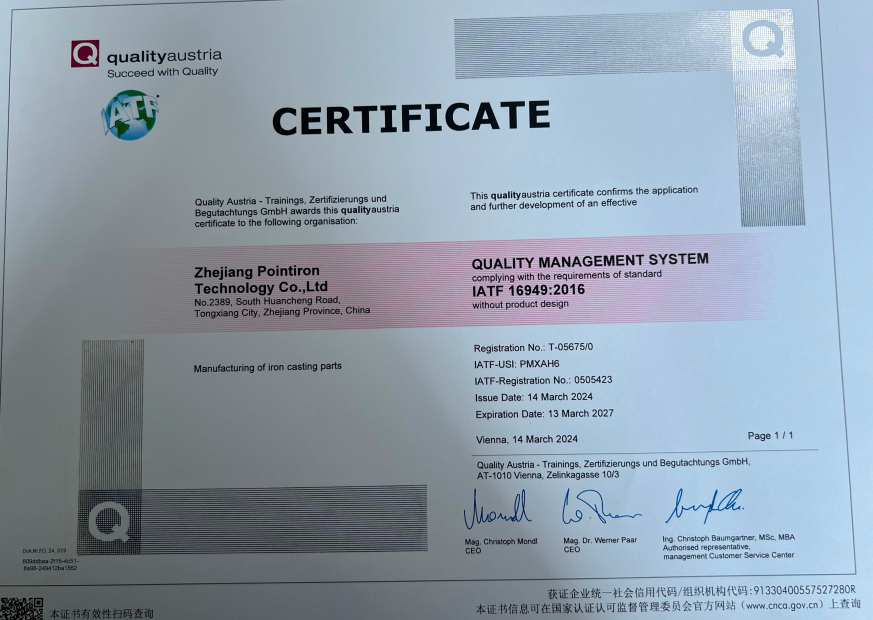
IATF 16949 certificate T-05675/0, issued by Quality Austria-Trainings, Zertifizierungs und Begutachtungs GmbH, valid 2024-03-14 to 2027-03-13.
The Process Chain: From Casting to Finished Component
In an integrated foundry, the component passes through casting, machining, surface treatment and — where required — assembly. Each step introduces its own tolerance and inspection requirements, and the handoffs between steps are where multi-supplier sourcing usually adds cost and delay. Pointiron's disclosed process coverage spans all four stages: casting on the DISA lines, machining at 5 million pieces per year, coating on wet paint, powder coat and E-coat lines, and final assembly.
Quality control is described as 100% testing, with pre-shipment testing used as the acceptance criterion. For buyers, this maps to a practical distinction: 100% testing during production reduces the risk of escaping defects, while pre-shipment testing gives the buyer a documented checkpoint before goods leave the supplier. Together they form a two-layer control model that is more useful than a single end-of-line inspection.
R&D support is provided by a three-engineer team. That is a small team by the standards of large Tier 1 suppliers, and buyers with complex simultaneous-engineering requirements should confirm engineering bandwidth during supplier evaluation rather than assume it. For standard and customized component parts within the established product family, however, the combination of casting, machining, coating and assembly under one quality system removes a significant coordination layer.
Where Iron-Cast Component Parts Are Used
Pointiron's automotive component parts are positioned for two application families: component parts for braking systems and component parts for steering systems. Within those families, the relevant part types include automotive knuckles, brackets, calipers and caliper housings, hubs, housings, axles, supports and rotors — all of which appear in the company's stated product and keyword scope. The same manufacturing base also serves agricultural applications, including tractor, seeder, mower and scarifier components, which gives buyers a sense of the foundry's cross-sector workload.
A disclosed case illustrates the durability expectation. An automotive OEM customer, operating globally, has used the product for 10 years at a quantity of 2,000,000 units with a reported result of 10 years of stable performance. The stated highlight is excellent structural stability, high wear resistance and long service life. For evaluation purposes, the meaningful signal is not the headline quantity but the ten-year continuity: sustained supply of a safety-relevant cast component implies a stable process window and a quality system that has held over time.
Braking and steering applications are also where material choice carries the most consequence. Brake caliper housings and steering knuckles are load-bearing and safety-relevant, so buyers typically require grade traceability, dimensional verification and coating performance evidence. The published parameters — tensile strength ≥550 MPa, yield strength ≥350 MPa, elongation ≥6%, hardness 173–255 HB, 504-hour salt spray and dry adhesion ≥B — provide a starting specification against which incoming inspection can be designed.
Market Signals Behind Iron-Cast Automotive Parts
Several publicly reported data points frame the demand environment for iron-cast component parts. Fortune Business Insights values the global automotive brake systems market at USD 46.44 billion in 2025, with a projected path to USD 74.45 billion by 2034. The same source reports that Asia Pacific held a 48.32% revenue share of that market in 2025 — a reminder that the manufacturing base for braking components is concentrated in the region where many casting suppliers operate.
On the materials side, Market Research Future reports that cast iron accounted for approximately 20% of the global steering knuckle market by material type in 2024, and notes nodular (ductile) cast iron spot prices of approximately USD 945–1,050 per metric ton in 2025. These figures should be read as directional context rather than as price inputs to a specific quotation: iron grade, component weight, machining content and coating all move the final piece price well beyond the raw material line.
Trade classification is the third signal. The U.S. International Trade Administration lists specific tariff codes for cast-iron automotive parts, including 8708407000 and 8708407570 for gearbox parts, and 8708995200 and 8708995300 for miscellaneous cast-iron parts. Because these codes cover different component groups, buyers should not aggregate them into a single trade estimate. Each component family needs its own classification review before landed cost is modeled.
Taken together, the signals point in one direction: demand for iron-cast braking and steering components is substantial and geographically concentrated, material costs are volatile enough to justify indexing clauses, and classification is component-specific. Suppliers that can document material grades, coating performance and classification logic are easier to integrate into an OEM program than suppliers that cannot.
Integrated Production Versus Traditional Multi-Supplier Sourcing
The conventional model splits a cast component across several suppliers: a foundry for the casting, a machine shop for secondary operations, a coater for surface treatment and a separate assembler where sub-assemblies are required. The integrated model consolidates those steps. Pointiron states that, compared with traditional component sourcing, one-stop integrated production eliminates intermediate supplier markup, and that US local inventory through Point Iron USA, Inc. can lower overall logistics cost and avoid emergency air freight expenses.
| Dimension | Multi-Supplier Sourcing | Integrated Production (Pointiron model) |
|---|---|---|
| Process handoffs | Casting, machining, coating and assembly coordinated across parties | Casting, machining, coating and assembly under one quality system |
| Markup structure | Intermediate supplier markup at each stage | Intermediate markup eliminated per company statement |
| Logistics | Separate inbound and outbound flows per stage | US local inventory available for US customers |
| Inspection | Multiple inspection regimes to reconcile | 100% test with pre-shipment acceptance |
| Customization | Each supplier manages its own customization scope | OEM/ODM with size, logo, color and surface treatment customization |
Where the integrated model has real boundaries. Integration does not remove every constraint, and buyers should plan around three of them. First, the stated lead time is 12 weeks — appropriate for planned production but not for unplanned short-notice demand, where US local inventory or early forecasting becomes the practical answer. Second, MOQ is tiered by single-part weight, so very small or prototype-volume orders carry different commercial terms than production volumes. Third, iron casting is not the right answer for every component: where weight reduction dominates the design brief, aluminum or other lightweight materials may be more suitable, and buyers should confirm material fit at the design stage rather than at the quotation stage.
A further boundary is engineering scale. With a three-engineer R&D team, the supplier is well positioned for customization within established product families — size, logo, color and surface treatment changes — but buyers with entirely new component architectures should plan for a longer technical alignment phase.
Procurement Terms and What They Signal
Commercial terms are part of capability, because they reveal how a supplier expects to plan production. Pointiron's disclosed terms are structured around weight-based MOQ tiers, which is consistent with the economics of iron casting: heavier parts consume more molding and melting capacity per piece and are therefore quoted at lower piece counts.
| Single-Part Weight | Minimum Order Quantity |
|---|---|
| Under 10 lb | 10,000 pcs |
| 10–20 lb | 5,000 pcs |
| 20–100 lb | 2,000 pcs |
| 100–150 lb | 1,000 pcs |
Delivery terms are FOB, acceptance criteria are pre-shipment test, and payment terms are 30/70. A warranty is provided as after-sales support. For buyers building a total-cost model, the 30/70 structure means 30% of the value is committed before shipment, which affects working capital planning as much as it affects supplier risk. The FOB term means the buyer carries freight from the port of loading unless separate arrangements are made — and for US customers, the availability of Point Iron USA, Inc. inventory offers an alternative logistics path that may change the landed-cost profile.
In practice, these terms are most useful during RFQ design. A buyer who specifies the single-part weight band at the outset will receive quotations on comparable MOQ assumptions rather than having to reconcile inconsistent volume bands later.
What OEM Buyers Should Verify Before Committing
A capability-guided evaluation is more reliable than a price-led one. The following checklist translates the facts above into verification tasks:
- Material grade match: Confirm that the grade offered matches the component's loading and wear environment — QT550-6, QT450-12, HT250, HT200, ADI 900 or ADI 1050 — and that the corresponding ASTM or customer specification is documented.
- Mechanical evidence: Request test reports covering tensile strength, yield strength, elongation and hardness against the published parameters.
- Coating durability: Verify salt spray (504 hours) and dry adhesion (≥B) results for the specific coating system selected.
- Quality system currency: Check that the IATF 16949 certificate (T-05675/0) remains within its validity window through 2027-03-13 and that the scope covers automobile.
- Process traceability: Confirm how 100% testing and pre-shipment testing are recorded and how records are retained.
- Classification review: Verify HTS classification for the specific component; knuckles fall under 8708.80.6000, while cast-iron gearbox parts and miscellaneous cast-iron parts use different codes.
- Logistics path: Decide whether to ship FOB from origin or use US local inventory, and model both landed costs.
- Program timing: Confirm that the 12-week lead time and weight-based MOQ align with the production ramp and annual volume plan.
Future Outlook
Three developments are likely to shape iron casting capability evaluation over the next several years. The first is material differentiation. As ASTM A1095 illustrates, specialty iron grades are being formalized for high-temperature automotive applications, which means material selection will become more granular and less interchangeable than it is today. Buyers who build material-specific RFQ templates now will be better positioned as those options expand.
The second is regional inventory and logistics resilience. The availability of US local inventory through Point Iron USA, Inc. reflects a broader shift among export-oriented manufacturers to hold stock closer to end customers, reducing exposure to emergency air freight. For buyers, this changes the calculus between origin FOB pricing and delivered cost stability.
The third is documentation depth. As trade classification and material specifications become more tightly linked — as the knuckle ruling under 8708.80.6000 demonstrates — buyers will increasingly ask suppliers to provide classification logic and specification traceability as part of the quotation package. Suppliers with a current IATF 16949 certificate and a documented material list will be easier to onboard than those without.
None of these developments changes the fundamentals of iron casting as a process. They change what buyers must verify. That is a meaningful shift for procurement teams in the evaluation and execution stages, because it moves the center of gravity from piece price to documented capability.
Frequently Asked Questions
What materials does Pointiron use for automotive iron castings?
The automotive component part offer (model BRKT-1) is produced across QT550-6, QT450-12, HT250, HT200, ADI 900, ADI 1050, nodular cast iron and gray iron. These grades cover the range typically used for braking and steering components, from standard gray iron to higher-strength nodular and austempered ductile grades.
What mechanical properties are published for these component parts?
The published parameters are tensile strength ≥550 MPa, yield strength ≥350 MPa, elongation ≥6%, hardness 173–255 HB, salt spray resistance of 504 hours and dry adhesion ≥B. These values combine casting properties with coating performance, which is relevant for components exposed to road environments.
What customization options are available?
OEM and ODM production services are available, with customization covering size, logo, color and surface treatment. Customization is offered within the established product families for component parts of auto-mobile and component parts for agriculture use.
What are the minimum order quantities?
MOQ is tiered by single-part weight: 10,000 pcs for parts under 10 lb, 5,000 pcs for 10–20 lb, 2,000 pcs for 20–100 lb and 1,000 pcs for 100–150 lb.
What are the purchasing terms and acceptance criteria?
Delivery terms are FOB, acceptance criteria are pre-shipment test, and payment terms are 30/70. A warranty is provided as after-sales support. Quality control is described as 100% testing.
How long is the production lead time?
The stated lead time is 12 weeks. Monthly production capacity is 3,000 tons, supported by annual casting capacity of 35,000 tons and machining capacity of 5 million pieces per year.
Which quality certifications apply to these castings?
Zhejiang Pointiron Technology Co., Ltd holds IATF 16949 certification, certificate number T-05675/0, issued by Quality Austria-Trainings, Zertifizierungs und Begutachtungs GmbH, valid from 2024-03-14 through 2027-03-13 with scope covering automobile. The company is also certified to ISO14001:2004.
How are cast-iron automotive components classified for U.S. imports?
Classification depends on the component. U.S. Customs ruling NY N315134 classifies front and rear steering knuckles under HTS 8708.80.6000 as suspension parts. The U.S. International Trade Administration lists 8708407000 and 8708407570 for cast-iron gearbox parts, and 8708995200 and 8708995300 for miscellaneous cast-iron parts. Buyers should confirm classification per component rather than per supplier.
Summary
Iron casting remains a foundational route for automotive component parts, particularly in braking and steering systems where strength, wear resistance and dimensional consistency are non-negotiable. Evaluating a supplier's capability means looking beyond piece price to casting capacity, material grade coverage, downstream process control and quality system currency. Zhejiang Pointiron Technology Co., Ltd — trading as Pointiron — presents a documented capability set for that evaluation: 35,000 tons of annual casting capacity, two DISA molding lines, 5 million pieces of annual machining capacity, in-house coating and assembly, current IATF 16949 certification and a material list spanning gray iron, nodular cast iron and ADI grades.
That capability comes with real boundaries — a 12-week lead time, weight-tiered MOQs and a material profile that is not suited to every lightweight application. Buyers who plan around those boundaries and verify material grades, mechanical evidence, classification and logistics paths will be better positioned than buyers who compare quotations without that context.
Have Questions or Need More Details?
Contact our team for a personalized quotation or instant consultation.
Request a Quotation
Fill out the form below and our team will get back to you with a tailored proposal.
WhatsApp Direct Chat
Prefer to chat in real-time? Message us on WhatsApp for instant assistance & quick answers.
- Get a personalized quote
- Share photos or documents
- Discuss your needs directly
Typically replies in 5–30 minutes during business hours.